What is Iranian Shiraz Poetry Divan 1390?
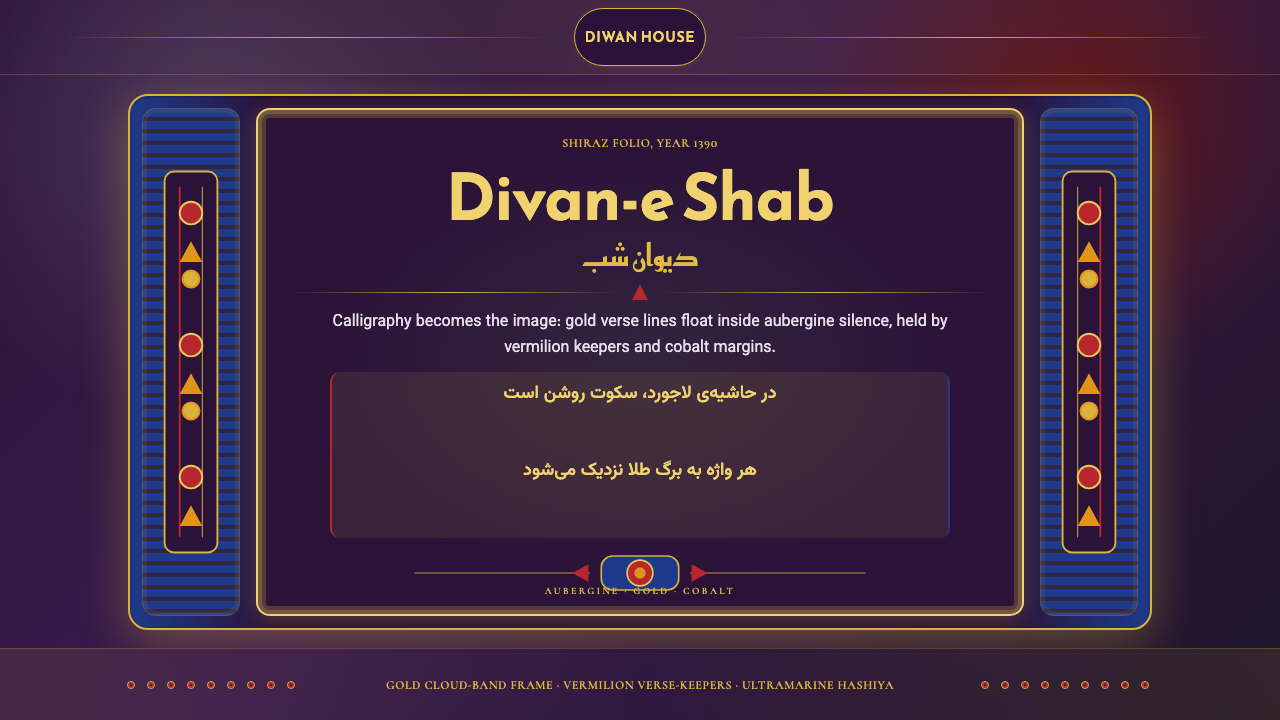
The Shiraz divan tradition transformed the Persian manuscript into a total art object — where calligraphy, illumination, and poetry fused so completely that the line between text and image ceased to exist.
Iranian Shiraz Poetry Divan 1390 in brief
The Iranian Shiraz Poetry Divan 1390 is a design system rooted in the illuminated manuscript culture of fourteenth-century Shiraz — a tradition in which court calligraphers and illuminators collaborated to produce books of ghazal poetry where every visual element, from the ground color to the margin ornament to the cadence of the script, was understood as part of a unified aesthetic whole.
At its heart, the style is an expression of lamplight intimacy. The canonical visual language consists of deep aubergine fields that absorb and concentrate light, gold-leaf ornamental bands that frame and divide the written columns, cobalt margin accents that cool and deepen the edges, and vermilion verse-markers that punctuate the rhythm of the text. Nothing is incidental. Every color, every ruled border, every cloud-band cartouche carries the accumulated judgment of generations of workshop masters.
The style translates this manuscript sensibility into a modern digital design language. It brings the same principle of total visual integration — where structure, type, ornament, and ground color work as one indivisible system — and the same commitment to richness over austerity. Applied well, it creates interfaces and compositions that feel simultaneously ancient and precise, intimate and authoritative.
Where does Iranian Shiraz Poetry Divan 1390 come from?
The tradition that gave rise to this design system emerged under two successive Shiraz dynasties: the Inju governors (roughly 1303 to 1357) and the Muzaffarids (1314 to 1393), who ruled Fars province from Shiraz during the turbulent aftermath of the Mongol invasions. Both courts were patrons of Persian literature and book arts, and both competed to attract the finest calligraphers, illuminators, and binders in the Iranian world. It was under these patrons that Shiraz developed its distinctive school of manuscript production — characterized by a palette of deep jewel tones, elaborate floral and geometric illumination, and a style of calligraphy that was moving from the older Naskh and Muhaqqaq scripts toward the fluid, oblique forms that would eventually crystallize as Nastaliq.
The peak of the tradition coincides with the life and posthumous fame of Hafez of Shiraz (c. 1315 to 1390), widely regarded as the greatest lyric poet in the Persian language. Hafez spent his entire life in Shiraz, serving at times in the Muzaffarid court, and his ghazals — intricate, multi-layered poems that combine erotic longing, mystical aspiration, and oblique political commentary — became the defining literary subject of the divan illumination tradition. A Hafez divan produced in Shiraz around 1390 was not simply a book; it was a devotional and aesthetic object, made to be handled slowly, read aloud, and looked at with sustained attention. The visual program of the manuscript — the color choices, the ornamental schemes, the proportion of margin to text column — was designed to honor and amplify the poems it contained.
Calligraphy was the pre-eminent art form in this tradition, and the script masters of the Shiraz school were celebrated figures who signed their work and were remembered by name across generations. Mir Ali Tabrizi, working slightly later in the period, is traditionally credited with perfecting Nastaliq — the script that would become the dominant vehicle for Persian poetry — though the groundwork for this development was laid in precisely the Shiraz workshops of the late fourteenth century. Junayd al-Sultani, an illuminator active in the Jalayirid court but trained in the broader Iranian manuscript tradition of this era, exemplifies the high standard of technical mastery that manuscript patrons demanded: every cloud-band border, every arabesque scroll, every hashiya margin decoration was executed with a precision and density that still registers as extraordinary to modern eyes.
The dissolution of the Muzaffarid dynasty under the conquests of Timur in 1393 disrupted Shiraz as a manuscript center, but it did not end the tradition. Many of the workshops and their masters relocated or were absorbed into new Timurid patronage networks. The visual vocabulary they carried with them — the deep jewel-toned grounds, the gold-leaf ornament, the cobalt margin accents, the rhythmic verse-keepers — persisted through the Timurid and Safavid periods and became foundational to the broader Persianate manuscript tradition that extended from Istanbul to Delhi. The 1390 date in the system's name evokes this precise moment of peak intensity, just before the political rupture, when the Shiraz workshops were producing some of the most technically accomplished and visually concentrated manuscript pages in the entire history of Islamic book arts.
What defines the Iranian Shiraz Poetry Divan 1390 look?
Ground and Atmosphere
The defining ground color is a deep aubergine — a dark, saturated purple-brown that absorbs light rather than reflecting it. This creates the quality the tradition aims for above all else: the sense of a page that glows inward, like a lamp seen through parchment. Against this ground, all other colors achieve an intensity that would be impossible on a white or cream field. The aubergine is never the only darkness in the system; it reads as warm against the colder cobalt accents at the margins, and as deep but welcoming against the incandescent gold.
Gold Ornament
Gold in this tradition is not a neutral highlight or a luxury signifier — it is the structural material of the page. Gold-leaf cloud bands divide the text columns from the illuminated borders. Gold arabesque scrolls fill the intercolumnar spaces. Gold cartouches frame the opening lines of poems. The effect is not opulence for its own sake but an almost architectural use of a luminous material to organize visual space. Gold creates the grid of the manuscript; the other colors inhabit the spaces the gold defines.
Cobalt Margin Accents
The margins of a Shiraz divan are rarely left as bare ground. They are animated by cobalt blue — a cool, intensely saturated blue that reads as a spatial deepening relative to the aubergine center. Cobalt appears in the hashiya border bands, in the geometric interlace patterns that frame the text blocks, and in the fine ruled lines that separate the calligraphic columns from the decorative margins. Its function is to create visual depth and to define the boundary between the written and the ornamented without interrupting the continuity of the page.
Vermilion Verse-Markers
The internal rhythm of a divan page is marked by vermilion — a warm, fire-like red used for the small ornamental dividers between verses, for the opening words of stanzas, and occasionally for the poet's name in the colophon. Vermilion does not compete with the gold or the cobalt; it punctuates them. Its role is fundamentally typographic: it teaches the eye where to pause and where to continue, giving the densely written column a breathing structure that pure calligraphy alone would not provide.
Calligraphic Presence
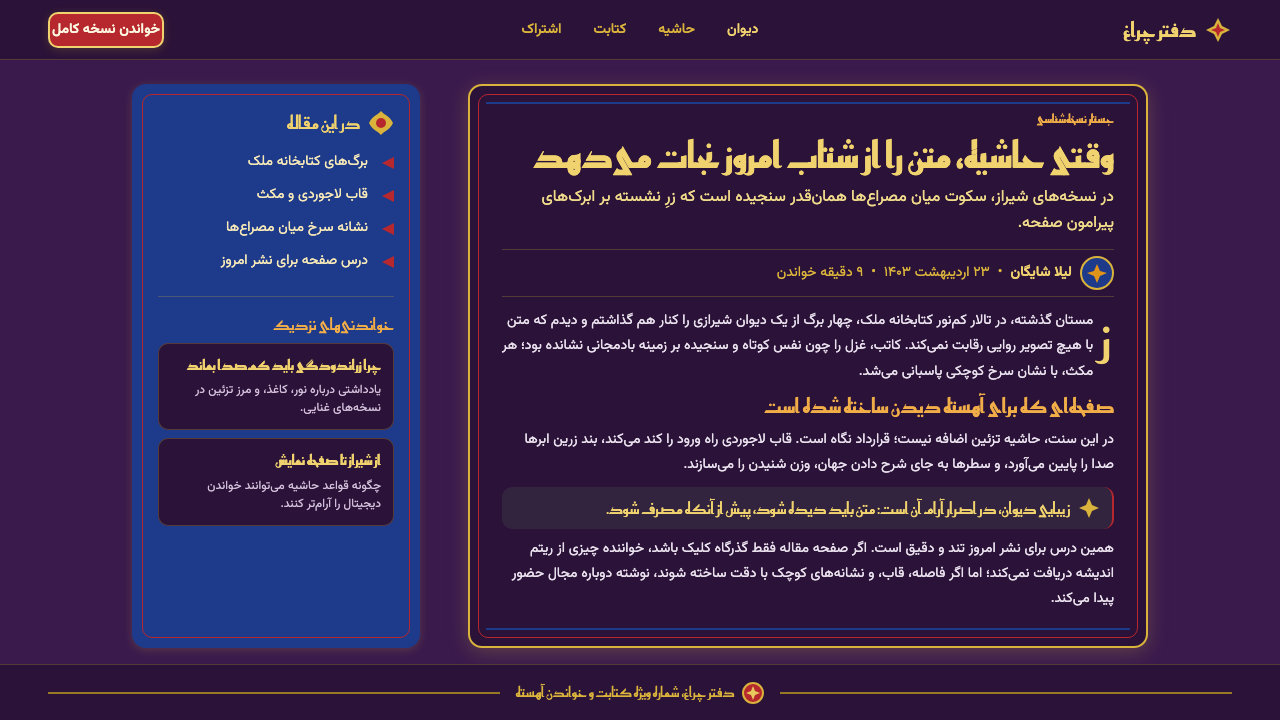
Script in a Shiraz divan is not a neutral carrier of text; it is a visual force in its own right. The proto-Nastaliq letterforms of the late fourteenth century have a characteristic quality: they are oblique, fluid, and rhythmically varied, with broad diagonal strokes descending from thin horizontals. The overall impression of a column of this script is of cascading movement — not the rigid verticality of Kufic nor the upright regularity of Naskh, but a controlled flow that reads simultaneously as decoration and as writing. This calligraphic presence means that type in a design system derived from this tradition should carry visual weight and directional energy, not simply convey information.
Geometric Interlace and Arabesque
The ornamental vocabulary of Shiraz manuscripts operates through two complementary modes: geometric interlace, in which star polygons and interlocking bands create infinitely extendable patterns at the borders and headers; and arabesque, in which sinuous plant-derived scrolls fill large grounds with organic, endlessly branching forms. Neither mode is random or purely decorative — both are expressions of a mathematical order that the Islamic arts understood as a reflection of divine pattern in the visible world. In a contemporary design system, this heritage suggests ornamental elements that are rule-governed, precise, and capable of filling space without becoming chaotic.
Luminous Density
Perhaps the most important single quality of the Shiraz manuscript aesthetic is its density — not as visual noise, but as concentrated presence. Every zone of the page is considered and resolved; there are no accidents, no breathing spaces left by default. Yet the result is not claustrophobic. The luminosity of the gold and the depth of the aubergine work together to create a visual richness that the eye reads as generous rather than overwhelming. This is the most difficult quality to carry into digital design: density must be deliberate and controlled, with each element earning its place through visual necessity rather than filling space for its own sake.

Who shaped Iranian Shiraz Poetry Divan 1390?
Hafez (c. 1315–1390) is the central literary figure of the divan tradition, and his ghazals provided the principal textual subject for the Shiraz school of manuscript illumination. His poetry operates simultaneously on multiple registers — as love lyric, as Sufi mystical allegory, and as oblique political commentary — and the manuscripts made to house his words were designed to honor this layered complexity through equally complex visual schemes. Hafez spent his life in Shiraz under Muzaffarid patronage and died there in 1390, the same year that marks the apogee of the tradition this design system evokes. His collected divan remains one of the most copied and illuminated texts in the history of Persian book arts, and his image as the defining lyric voice of the Persian tradition has given the entire Shiraz manuscript school its most durable cultural identity.
Mir Ali Tabrizi is traditionally credited in Persian art historical sources with the invention or perfection of Nastaliq — the suspended, diagonal, supremely fluid script that became the dominant vehicle for Persian poetry from the fifteenth century onward. Though his major activity is associated with Tabriz and with Jalayirid patronage rather than Shiraz directly, he represents the calligraphic ambition of the late fourteenth-century Iranian world that the Shiraz workshops were also part of. His work demonstrates the period's conviction that calligraphy was not a craft in the service of literature but an art form of equal standing with the poetry it rendered visible — a conviction that is foundational to the visual values of this design system.
Junayd al-Sultani was an illuminator and painter active under Jalayirid patronage in the late fourteenth century, and his surviving works are among the most technically accomplished examples of the Iranian manuscript tradition of the period. His name appears in colophons of manuscripts produced within decades of the 1390 date this system evokes, and his work exemplifies the standard of visual mastery that defined the Shiraz and broader Iranian court manuscript schools. Junayd's paintings demonstrate the period's characteristic integration of Chinese-influenced landscape elements — curved rocks, flowering trees, dynamic cloud forms — into an essentially Persianate visual framework, creating a visual cosmopolitanism that reflects the pan-Eurasian cultural exchange of the Mongol and post-Mongol period.
Saadi (c. 1210–1291) predates the period of peak manuscript illumination in Shiraz by a century, but his presence as the other great literary voice of the city is inseparable from the tradition. The Gulistan and Bustan — his prose-verse masterworks — were themselves subjects of Shiraz manuscript production, and his moral authority shaped the cultural context in which the later Hafez manuscripts were read and appreciated. The Shiraz tradition is unthinkable without Saadi's earlier establishment of the city as the literary capital of the Persian-speaking world. His work represents the literary depth and ethical seriousness that the visual richness of the divan manuscripts was understood to be in the service of.
Unlike the calligraphers, who sometimes signed their work, the illuminators and decorators of the Inju and Muzaffarid manuscript workshops are largely anonymous to history. Yet the visual achievements credited to these unnamed masters are as significant as anything produced by the named figures. The hashiya border systems, the cloud-band cartouches, the interlace geometric patterns, and the arabesque grounds that define the Shiraz manuscript aesthetic were developed and refined by workshop practitioners whose individual identities were subordinated to the workshop tradition itself. This anonymity is part of the tradition's visual philosophy: the ornament serves the text and the text serves the poem; the maker's personal identity is not the point. The design system honors this collective visual intelligence by treating the ornamental vocabulary as a shared resource rather than an individual signature.
How do you use Iranian Shiraz Poetry Divan 1390 today?
The Iranian Shiraz Poetry Divan 1390 style is a high-commitment aesthetic: it works best when applied comprehensively rather than as an accent layer over a neutral base. Its visual logic depends on the interaction of the deep aubergine ground, the gold structure, the cobalt margins, and the vermilion punctuation — remove any of these and the remaining elements lose their reference points and read as arbitrary richness rather than coordinated system. The style suits contexts where depth, cultural authority, and aesthetic seriousness are desired values, and where the audience is expected to slow down and look rather than scan and move on.
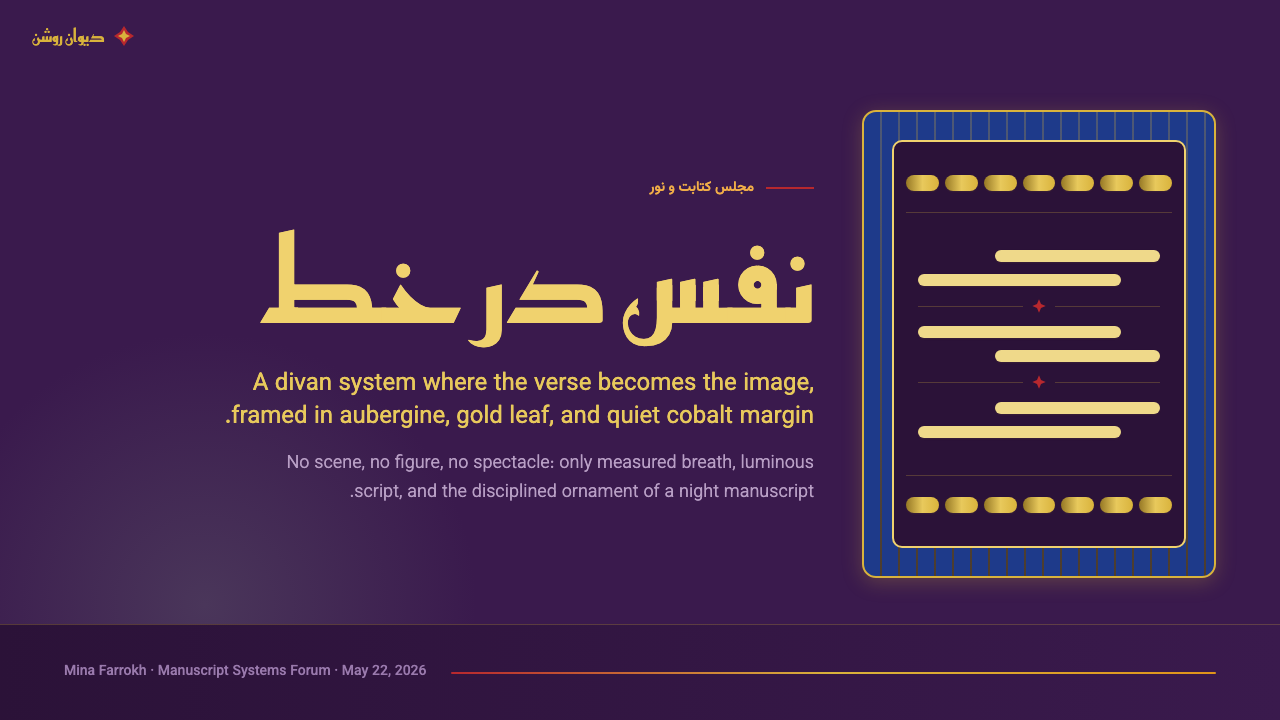
For presentation slides, this style creates some of the most distinctive and memorable cover pages available to contemporary designers. A cover should commit fully to the aubergine ground, use gold for the primary title, and treat any subtitle or date in a warm light tone that reads as illuminated against the dark field. Content slides work best when they resist the temptation to lighten the ground — a consistent deep background across all slides creates the immersive manuscript quality that is the style's main strength. Data visualizations gain remarkable presence on this ground: charts and graphs treated as geometric objects in cobalt, gold, and vermilion against aubergine read with a precision and authority that white-ground charts rarely achieve.
For web interfaces and digital applications, the style is particularly well-suited to contexts that carry cultural or literary weight: digital humanities platforms, poetry or literary archives, museum digital collections, high-end editorial publications, and premium content platforms where the visual language needs to signal that the content inside has been curated and honored rather than merely aggregated. Dashboard applications in this style benefit from using gold for primary navigation and status indicators, cobalt for data ranges and secondary information, and vermilion sparingly for alerts or emphasis. The deep ground should be consistent throughout; avoiding the temptation to lighten secondary screens maintains the immersive atmosphere.
For editorial and marketing contexts, the style supports long-form reading environments and premium brand identities in sectors where heritage and depth are valued — luxury goods, cultural institutions, academic publishers, and any context where the product or service has a genuine historical or cultural dimension. A marketing page in this style works through contrast and ceremony: section headers treated with gold ornamental framing, body text set in a warm light tone against the aubergine, and call-to-action elements in vermilion that catch the eye without breaking the tonal atmosphere. Photography, if used, should be treated with a warm duotone overlay that integrates it into the color system rather than allowing it to read as a foreign element.
The most common failure when applying this style is treating it as a dark theme with gold accents rather than as a total visual system with its own internal logic. The aubergine is not simply dark blue or dark grey with a purple cast — it is a specific chromatic warmth that must be maintained consistently. Similarly, the gold must read as genuinely luminous rather than as a metallic texture effect — gold that looks flat or grey undermines the entire manuscript-lamplight quality the system is built around. A second common mistake is over-using vermilion: in the original manuscripts, vermilion is sparse and rhythmic, used to mark genuine structural moments. Applied too liberally, it competes with the gold and disrupts the hierarchy that the system depends on.
This style demands patience and precision from the designer. Unlike styles that forgive approximation, the Shiraz manuscript aesthetic is unforgiving of carelessness: a wrong tone in the ground, a gold that is too pale, a cobalt that reads as navy rather than vivid ultramarine — each of these errors collapses the carefully constructed atmosphere. The payoff for getting it right, however, is a visual register that has no contemporary equivalent: ancient, intimate, authoritative, and unmistakably itself.
Iranian Shiraz Poetry Divan 1390 — FAQ
Is this style appropriate for modern digital products, or does it only work for heritage or cultural contexts?
The Shiraz manuscript aesthetic is genuinely versatile, though it does require a product where visual richness is an asset rather than a liability. It works very well for premium content platforms, knowledge products, long-form reading applications, and any digital product positioned around depth, curation, and cultural authority. It is less suited to transactional products — quick-purchase e-commerce, task-management tools, or utility dashboards — where the atmosphere of contemplative slowness that the style creates would work against the user's goal. The key question is whether the product asks the user to slow down and engage, or to accomplish a task quickly; the Shiraz aesthetic serves the first purpose beautifully and the second poorly.
How does the Shiraz manuscript style differ from other Islamic design traditions?
Islamic visual arts encompass an enormous range of regional and period traditions, and the Shiraz manuscript school is one specific node within that range. The Shiraz style is distinguished by its particular color palette — aubergine and gold rather than the turquoise and ivory of Iznik ceramics, or the red and black of Mamluk bindings, or the lapis and gold of Timurid Herat manuscripts — and by its specific integration of calligraphy, illumination, and poetry into a single visual program. It is also distinguished by the literary identity at its core: this is a tradition organized around Hafez's ghazals, not around architectural decoration, carpet weaving, or ceramic arts. The visual richness serves a literary purpose, and this literary character shapes everything about the system's visual values.
Can the style work in a lighter, less dark mode?
A light-mode inversion of this style is possible but requires fundamental reinterpretation rather than simple value reversal. The original manuscripts do have lighter-ground variants — some Shiraz pages use a warm cream or pale gold ground with darker calligraphy — but these are not simply bright versions of the dark ones; they have a different visual weight and a different relationship between figure and ground. In a contemporary digital inversion, the most successful approach is to treat a warm ivory or aged-parchment tone as the ground, maintain the deep aubergine as an accent or frame color rather than a field, and allow the gold to shift toward a deeper amber that reads as warm rather than luminous. The key risk is that lightening the ground tends to drain the style of its defining quality — the sense of light emerging from depth — and leave behind only surface decoration.
What makes a Shiraz-derived design feel authentic versus superficially imitative?
The difference between authentic application and superficial imitation comes down to structural versus decorative use of the visual vocabulary. Superficial imitation borrows the color palette and perhaps some arabesque ornament, but applies them to a layout whose underlying structure follows a different logic — a standard grid with gold accents, essentially. Authentic application means treating the ornamental elements as structural devices: the gold bands actually divide and organize the content space rather than decorating it; the cobalt margin elements define real visual zones rather than providing border decoration; the vermilion marks genuine moments of punctuation in the content hierarchy. The second distinguishing factor is the quality of the ground: authentic work commits to the deep aubergine as a full, consistent, absorbing field, not as a dark background panel contrasted against white sections.
How does the Shiraz manuscript tradition relate to contemporary Persian and Iranian design?
Contemporary Iranian graphic design is a rich and sophisticated field that draws on multiple historical layers — the manuscript tradition, the modernist wave of the mid-twentieth century, and the politically charged visual culture of the post-1979 period — and does not treat the fourteenth-century Shiraz aesthetic as a direct template. However, the manuscript tradition's emphasis on calligraphy as a primary design element, its comfort with visual density and ornamental richness, and its integration of text and image into unified compositional schemes all persist as underlying sensibilities in Iranian visual culture. Designers drawing on this tradition today tend to do so through selective quotation rather than wholesale adoption — using the visual vocabulary of illuminated borders or proto-Nastaliq letterforms as reference points within a contemporary compositional framework, rather than attempting full historical recreation.
Related design styles
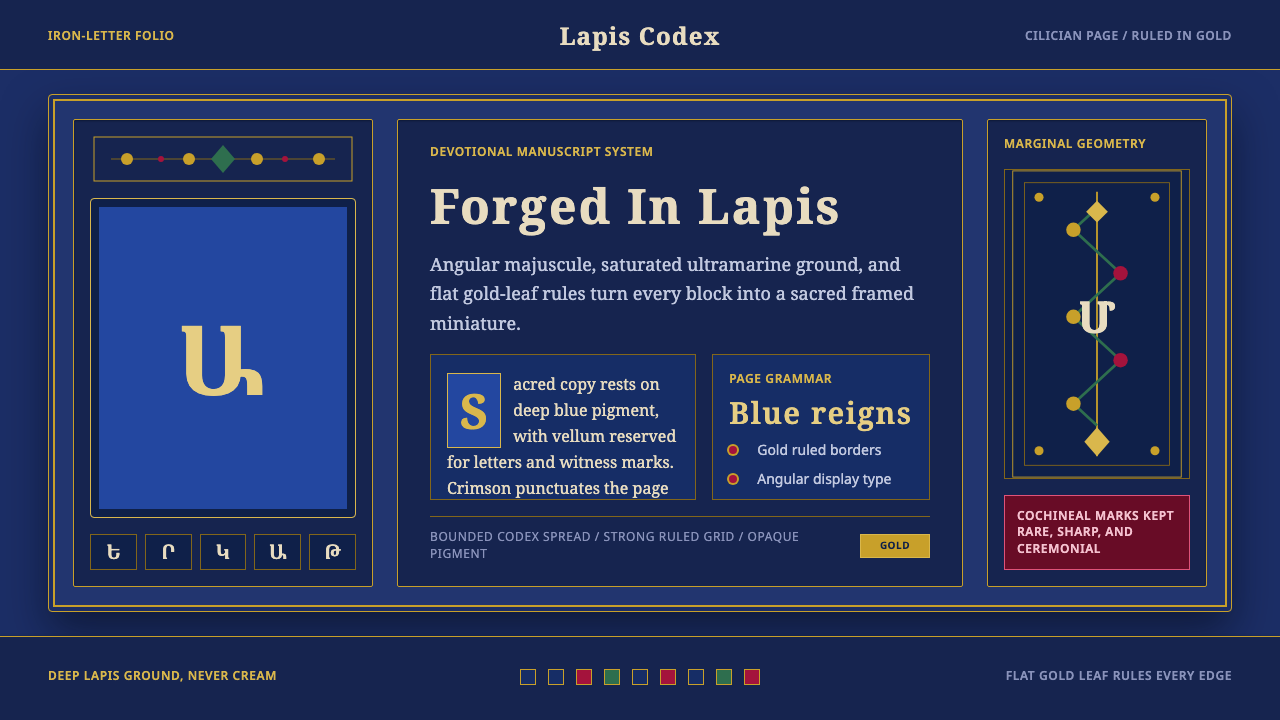 Armenian ErkatʿagirDevotional lapis reigns. Gold rules and angular serif glyphs frame a sacred g…
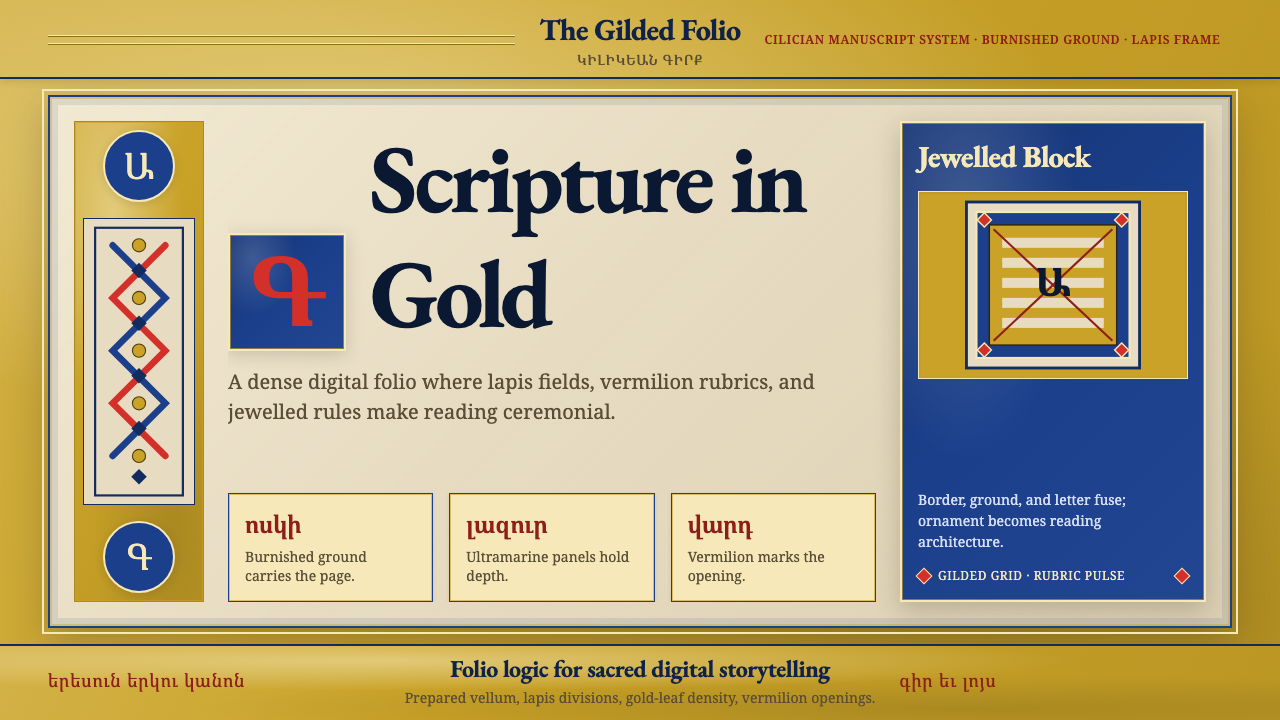 Armenian Illuminated ManuscriptGilded maximalism. Burnished gold, lapis frames, and vermilion initials build…
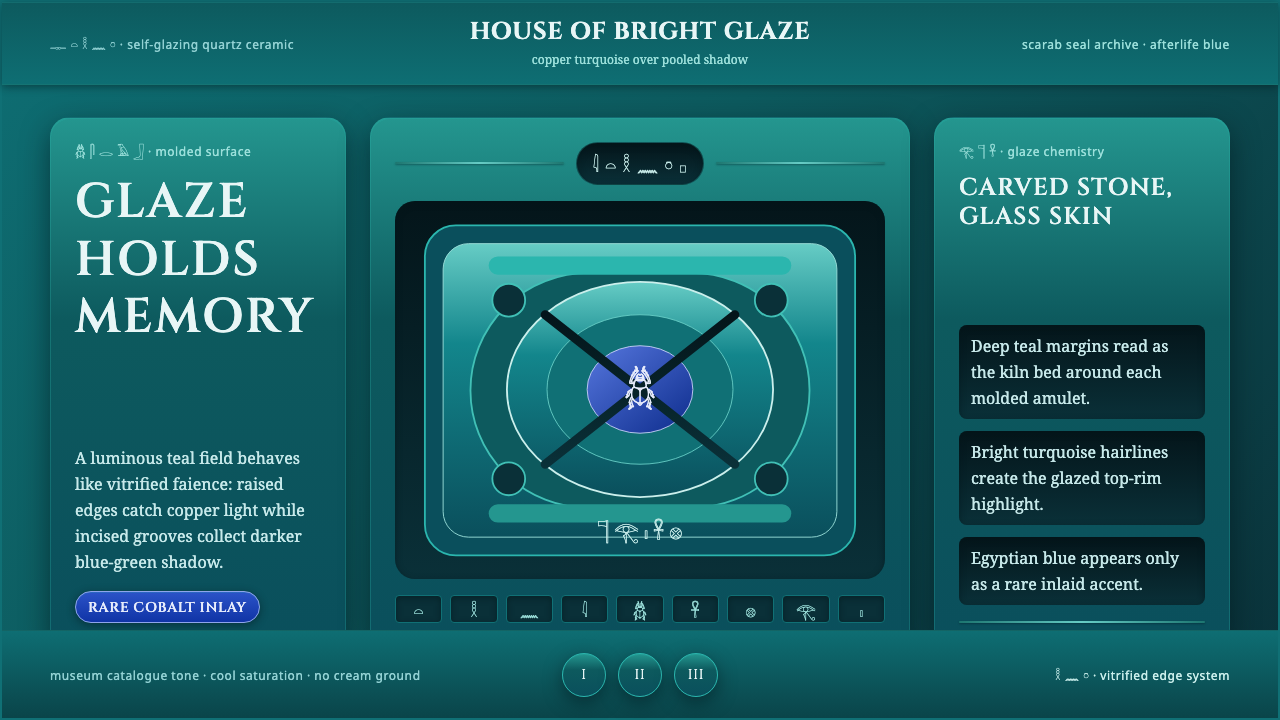 Egyptian FaienceGlaze carries the afterlife. Deep teal grooves, copper-turquoise rims, rare c…
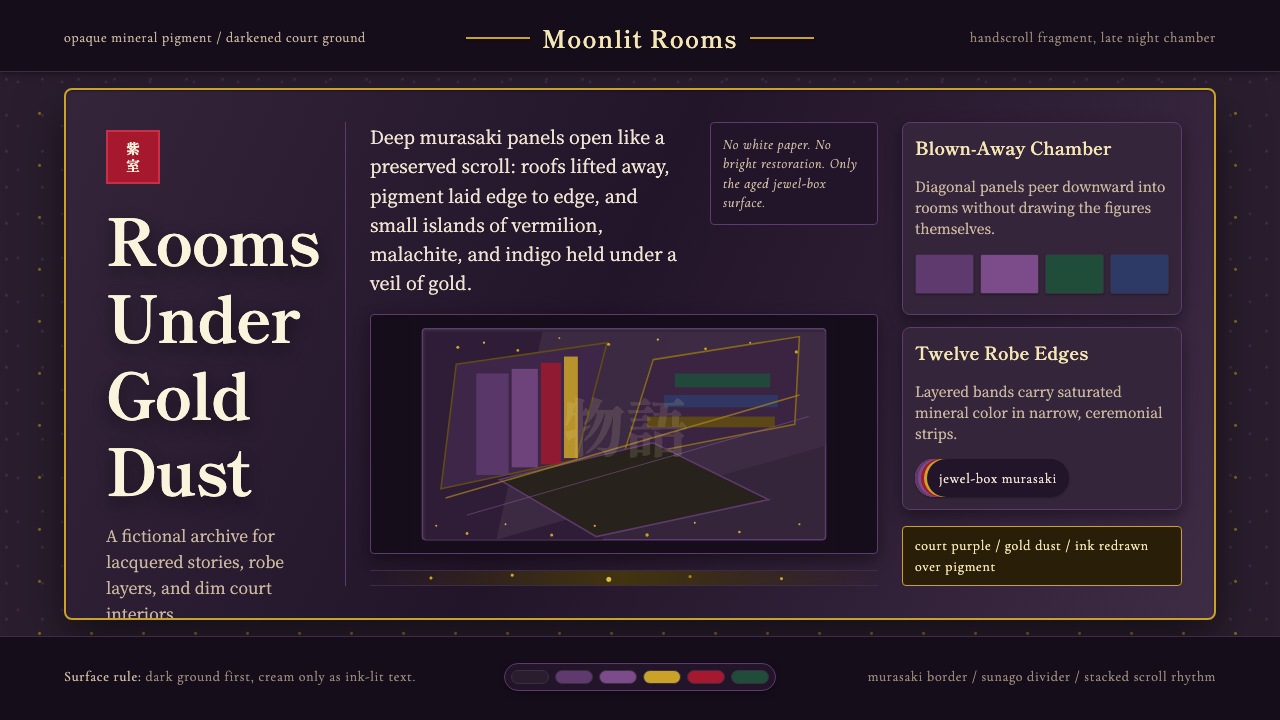 Heian Genji ScrollAged court opulence. Murasaki ground, gold dust, and stacked scroll panels.
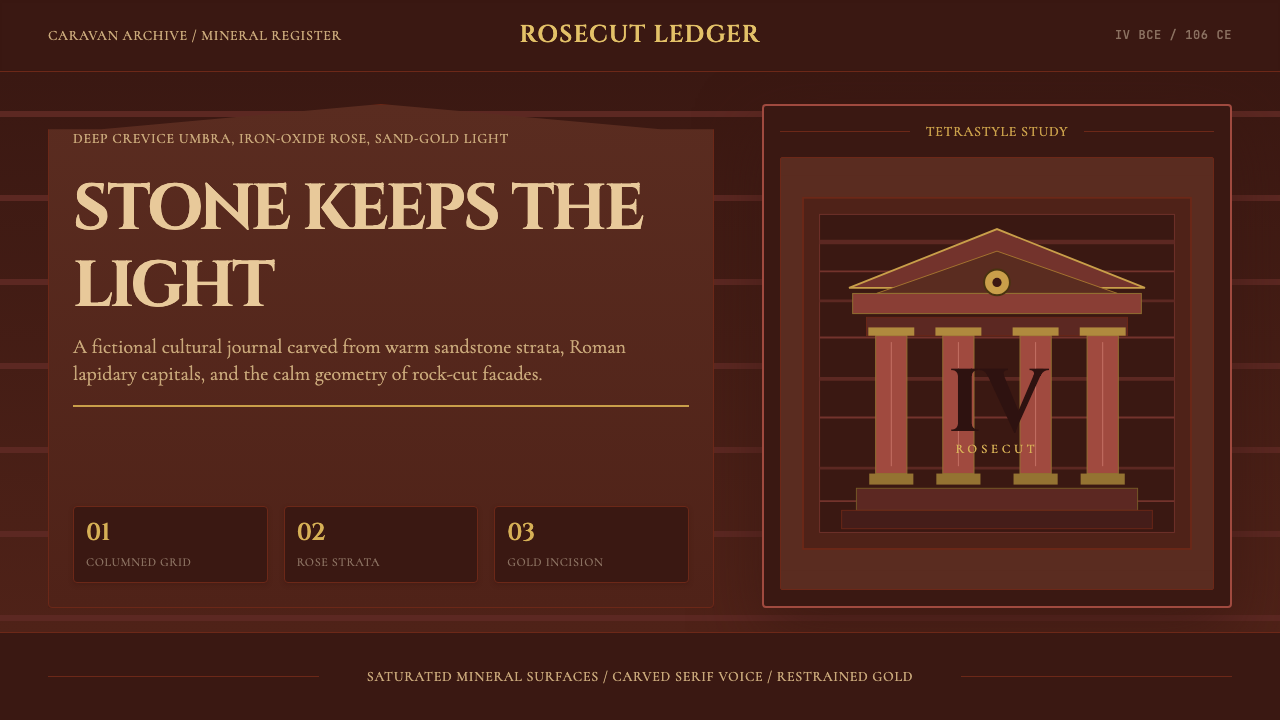 Jordanian Petra Rose NabataeanGeology feels monumental. Crevice umbra, rose strata, and Cinzel capitals car…
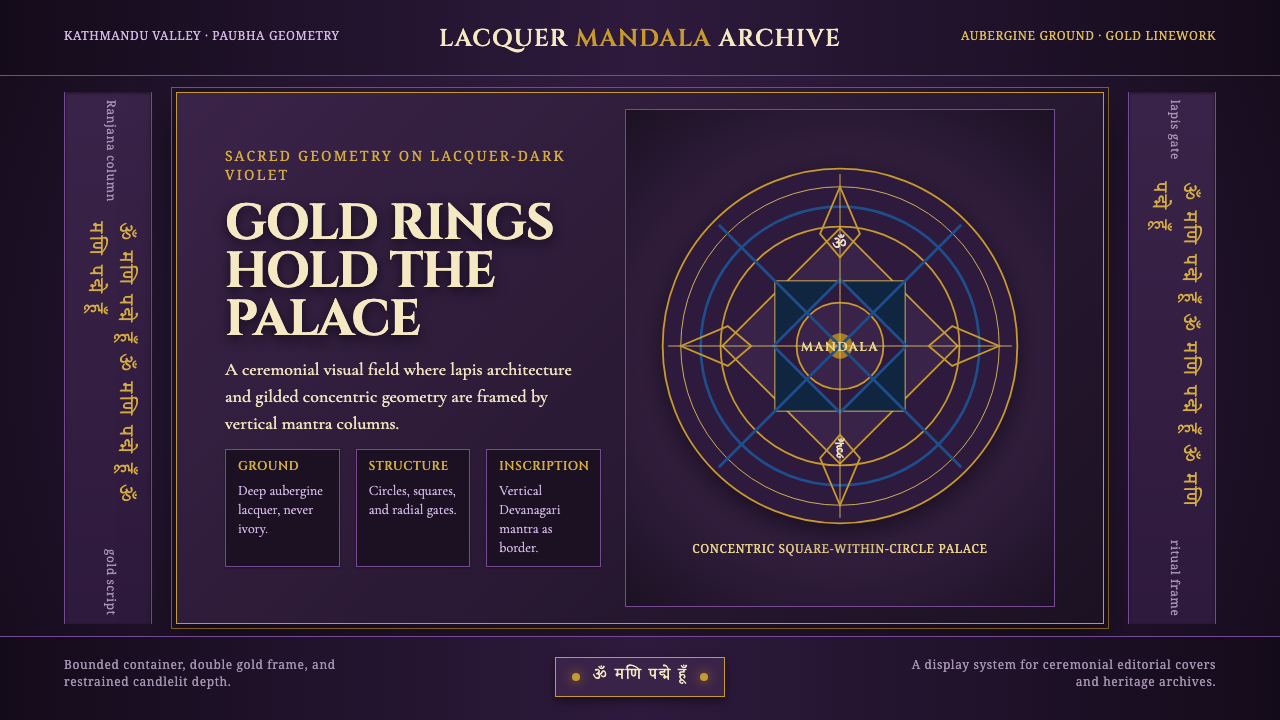 Newari Ranjana-Script MandalaCeremonial darkness. Gold mandala rings and lapis gates glow on aubergine lac…