What is Persian Miniature (Shahnameh era)?
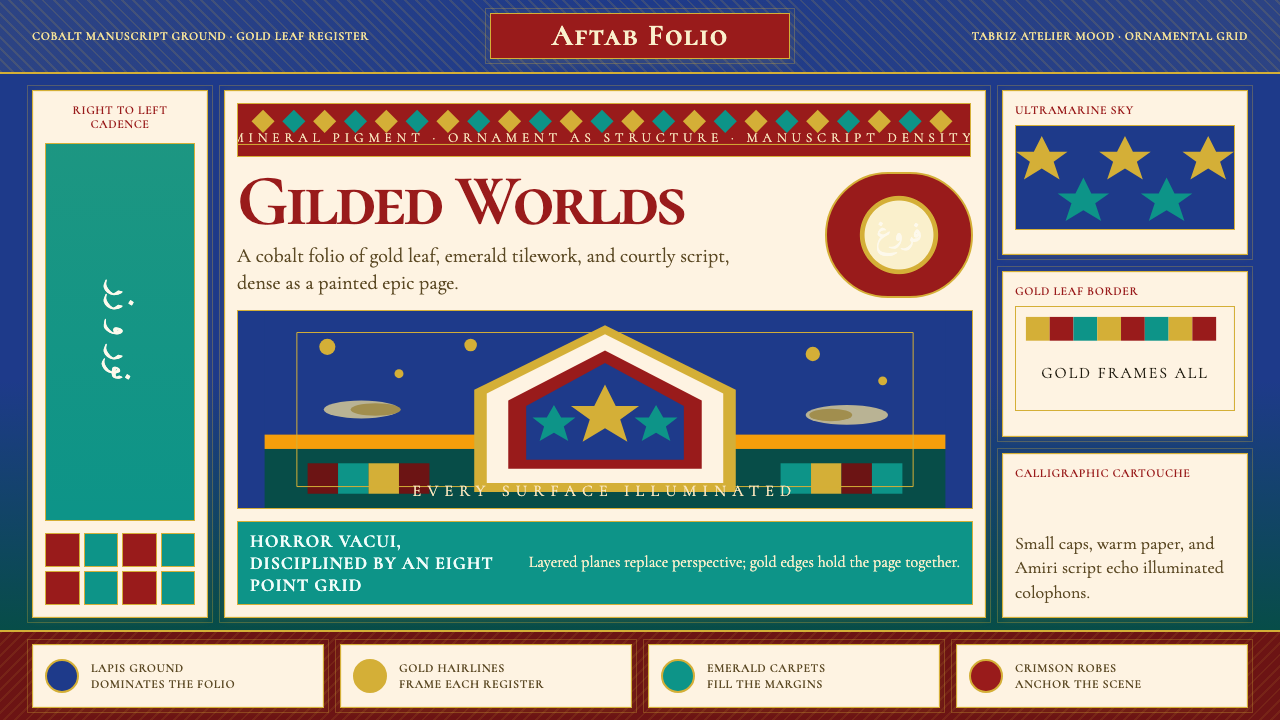
Persian miniature painting reached its most extravagant heights in the Shahnameh manuscripts of the Timurid and Safavid courts — a visual tradition where every inch of parchment blazes with ultramarine, gold leaf, emerald, and crimson, and where the boundary between calligraphy and image dissolved into one seamless illuminated whole.
Persian Miniature (Shahnameh era) in brief
Persian miniature painting of the Shahnameh era is a manuscript art tradition in which small-scale paintings — typically no larger than a folio page — were created to illustrate the great Persian epic poem, the Shahnameh (Book of Kings), composed by the poet Ferdowsi around 1010 CE. These miniatures were not decorative afterthoughts but integral to the manuscript as a total object: calligraphic text panels, gilded borders, and figural paintings were designed together, each element calibrated to the others in weight, color, and rhythm.
The visual language of these manuscripts is defined by extremes of density and luminosity. Grounds are typically a saturated cobalt or ultramarine blue, or a rich terracotta, against which figures in crimson, saffron, and emerald robes move across stylized landscapes — rock formations rendered as stacked bulbous forms, trees as symmetrical canopies, skies as bands of gilded cloud. Perspective is conceptual rather than geometric: figures are scaled according to narrative importance, and multiple moments in a story may appear simultaneously within a single frame.
Unlike European manuscript painting of the same period, Persian miniatures make no attempt to simulate three-dimensional space through shadow or atmospheric recession. Depth is implied through vertical stacking and overlapping — a figure higher on the page is understood to be farther away. The result is a flat, jewel-like surface intensity that has no equivalent in Western art history, and that translates with extraordinary power into digital screens, where the same luminosity and density of color can be achieved without loss.

Where does Persian Miniature (Shahnameh era) come from?
The roots of Persian miniature painting lie in the pre-Islamic illustrated manuscripts of Mesopotamia and in the book arts that flourished under the Abbasid Caliphate in Baghdad during the ninth and tenth centuries. When the Mongol Ilkhanid rulers who conquered Persia in the thirteenth century converted to Islam and began patronizing Persian court culture, they brought with them Chinese artistic influences — particularly the swirling cloud forms, dragon motifs, and landscape conventions of Song and Yuan dynasty painting — that merged with indigenous Persian and Arabic book traditions to produce something wholly new.
The Timurid dynasty (1370–1506), ruling from Herat in present-day Afghanistan and Samarkand in Central Asia, established the first great royal ateliers dedicated specifically to manuscript production. Sultan Husayn Bayqara's court at Herat in the late fifteenth century was the most celebrated of these: it was here that the painter Kamal ud-Din Bihzad, known in his own time as the Wonder of the Age, developed the compositional sophistication and psychological subtlety that would define the mature Persian miniature. Bihzad's figures display individual expression; his architectural settings show genuine observation of space; his use of color is precisely calibrated to narrative and emotional register.
When the Safavid dynasty under Shah Ismail unified Persia in 1501, many Timurid artists relocated to the new capital at Tabriz, carrying the Herat school's methods with them. The apex of the entire tradition arrived between 1525 and 1535 under Shah Tahmasp, when a royal commission produced the Shahnameh of Shah Tahmasp — sometimes called the Houghton Shahnameh after its later American owner. This manuscript contained 258 full-page paintings executed by the finest artists of the Safavid court, including Sultan Muhammad, Aqa Mirak, and the young Mir Sayyid Ali. It remains the most lavish illustrated manuscript ever produced and the defining masterwork of the tradition.
After Shah Tahmasp lost interest in painting in the 1540s, many Safavid artists dispersed — some to the Mughal court of Emperor Humayun in India, where they founded the Mughal miniature tradition, and others to the courts of the Uzbek khans in Central Asia. The style continued evolving through the late Safavid period centered on Isfahan, where the painter Reza Abbasi developed a more fluid, calligraphic line and began depicting subjects drawn from urban Safavid society rather than exclusively from epic literature. By the seventeenth century, the tradition had given rise to daughter traditions across Persia, Mughal India, and the Ottoman Empire, each inflecting the shared visual vocabulary with its own court culture.
What defines the Persian Miniature (Shahnameh era) look?
Color Palette
The palette is simultaneously maximal and precise. Ultramarine and cobalt grounds provide the dominant field — a deep, saturated blue of remarkable evenness derived from lapis lazuli mined in Afghanistan. Against this: crimson and vermilion robes, saffron and gold foliage, emerald grass and verdigris water, all rendered at full chromatic intensity without gradation. Colors do not blend into each other; each zone is bounded by a clear contour. The total effect is that of a mosaic or cloisonné enamel — jewel-like facets of pure color assembled into narrative.
Gold and Precious Materials
Gold leaf and gold paint were used not sparingly but lavishly — applied to clouds, architectural details, halos, decorative borders, and the illuminated headings (sarlowh) that marked the beginning of each chapter. Gold is not an accent in these manuscripts; it is a structural presence, contributing the same weight to a composition that ultramarine or crimson contributes. The borders that surround the pictorial field are typically gilded and patterned with geometric or floral arabesques, functioning as a transition zone between the text world and the image world.
Flatness and Conceptual Space
Persian miniatures reject cast shadow and atmospheric perspective entirely. Figures cast no shadows on the ground; distant mountains are as crisply detailed as foreground objects; the sky does not fade from deep to pale at the horizon. Instead, spatial depth is organized vertically: elements higher on the picture plane are understood as farther from the viewer. Rock formations are stacked in registration, like geological cross-sections seen from the side. This deliberate flatness is not a limitation — it is a formal choice that gives every element of the composition equal luminous presence.
Ornamental Borders and Frame Systems
Each miniature is embedded within a system of frames. The innermost frame is typically a narrow gold rule; outside it come bands of geometric tilework or arabesque; then the text columns; then the outer page margin with its own gilded ruling. This layered border system — derived from architectural tile programs visible in Timurid and Safavid mosques — creates a sense that the image is a window into a world protected by architectural ornament. In design applications, these nested border systems become a signature compositional device: content that is framed, layered, and ceremonially bounded.
Figural Conventions
Human figures in Shahnameh-era miniatures are rendered in a recognizable shared idiom: three-quarter face turned slightly to the side, almond-shaped eyes, high arching brows, small full mouth, and a characteristic downward tilt of the head that suggests both courtesy and melancholy. Heroes wear elaborate brocaded robes in high-chroma colors; warriors carry patterned shields and jeweled weapons; court scenes feature figures arranged in a fan or register at the upper edge of the composition. Individual physiognomy is secondary to type — what matters is the recognizable social role each figure performs.
Nastaliq Calligraphy Integration
The text in these manuscripts is written in Nastaliq — the most lyrical of the Persian-Arabic scripts, characterized by long sweeping horizontals, dramatic thick-to-thin transitions, and an overall flow that reads as organized movement. Nastaliq calligraphy columns are not merely containers for text but visual objects in their own right, designed to complement the rhythm and density of the paintings they surround. In the finest manuscripts, text and image interpenetrate: verses of the Shahnameh flow directly into the pictorial field, figures appear to emerge from or recede into the written word.
Narrative Simultaneity
A single miniature often depicts multiple sequential moments from an episode — a hero may appear twice within the same frame, once approaching a palace and once in conversation with its king. This is not an error or a limitation of compositional skill but a deliberate narrative convention inherited from earlier Buddhist and Byzantine manuscript traditions. Time is treated as a spatial dimension: the eye moves through the image and thereby moves through the story. This approach to simultaneous narrative has direct parallels in contemporary infographic and data storytelling design, where multiple moments of a process are rendered within a single contained frame.

Who shaped Persian Miniature (Shahnameh era)?
Bihzad (active c. 1470–1535) is the most celebrated painter in the Persian miniature tradition and the figure against whom all others are measured. Working first at the Timurid court in Herat under Sultan Husayn Bayqara's patronage, he developed a compositional approach of unprecedented complexity: his crowd scenes are differentiated by individual gesture and expression, his architectural settings display genuine observational intelligence, and his color choices reflect narrative psychology rather than convention alone. After the Safavid conquest of Herat in 1510, Shah Ismail brought Bihzad to Tabriz, where he became director of the royal library. His work influenced every major painter of the subsequent generation and established the technical and expressive standard that the Shah Tahmasp Shahnameh would attempt to equal.
Sultan Muhammad was the leading painter at the court of Shah Tahmasp and is credited with designing and painting some of the most ambitious compositions in the Houghton Shahnameh, including the celebrated Court of Gayumars — a scene of extraordinary teeming complexity in which hundreds of figures in animal-skin garments populate a rocky mountain landscape. His style is characterized by a controlled wildness: compositions that appear about to overflow their borders, color that vibrates at maximum intensity, and figures that crackle with kinetic energy. He was also a teacher; Mir Sayyid Ali, who later helped establish the Mughal school in India, trained under him.
Aqa Mirak was a close companion of Shah Tahmasp as well as one of the principal painters of the royal Shahnameh commission. Where Sultan Muhammad's style tends toward turbulence, Aqa Mirak's is distinguished by a composed, architectural dignity. His figures are arranged with a ceremonial clarity reminiscent of the tile programs in Safavid mosques; his color sense tends toward the cooler and more reserved end of the Persian palette. He is thought to have been responsible for some of the most structurally complex architectural scenes in the manuscript, where his understanding of Safavid building forms gave the painted settings an authority rooted in actual observation.
Mir Sayyid Ali, son of the Safavid painter Mir Musavvir, contributed to the Houghton Shahnameh before becoming one of the founding figures of the Mughal school in India. Emperor Humayun, in exile at the Safavid court in the 1540s, invited both Mir Sayyid Ali and Abd al-Samad to return with him to India, where they helped establish the imperial Mughal atelier. Mir Sayyid Ali's Mughal work shows the Safavid spatial precision applied to Indian subjects — court scenes, portraits, and naturalistic studies of animals and plants that would become the hallmarks of the mature Mughal style. He represents the most important vector of Persian miniature influence into South Asian artistic tradition.
Reza Abbasi (c. 1565–1635) represents the late flowering of the Persian miniature tradition under Shah Abbas I in Isfahan. He broke significantly from the epic manuscript conventions of the Tahmaspi period by directing his attention to single-figure studies of urban types — young men in fashionable dress, dervishes, calligraphers, lovers — rendered in a fluid calligraphic line of exceptional elegance. His work is less dense than the great Shahnameh manuscripts but more intimate; it marks the moment when the tradition turned from illustrating sacred epic to documenting contemporary social life. Reza Abbasi's linearity had a significant influence on subsequent generations of Persian and Indian painters.
How do you use Persian Miniature (Shahnameh era) today?
Applying Persian Shahnameh miniature aesthetics to digital design requires understanding its organizing principle: the page as a total illuminated object in which every element — ground color, border, typography, image — is co-designed to the same register of richness. This is the opposite of the Western modernist instinct to let breathing room define hierarchy. Here, density is the hierarchy. Successful applications lean into fullness rather than retreating from it, treating the entire surface as a field of considered ornament.
For presentation slides, this tradition offers one of the most distinctive and high-impact cover vocabularies available. A cover built in this idiom might use a deep cobalt or jewel-toned ground, set the title in a calligraphic or high-contrast serif typeface, and frame the entire composition with nested geometric or arabesque border bands. The gold-border treatment translates directly to a gilded or amber-toned rule around the slide edge, creating the manuscript folio feeling. Content slides should preserve the framing device — a subtle border rule or ornamental corner — while giving the interior more breathing room to accommodate legible data and text. Chapter dividers work especially well as near-full-bleed ornamental moments between more restrained content sections.
For web dashboards and pricing pages, the style is best applied selectively rather than at full saturation. A dashboard with a deep blue-ground hero section, gold-toned accent lines, and framed card components carries the manuscript spirit without overwhelming the functional interface. Pricing tiers can be differentiated using the manuscript palette — cobalt for the standard tier, deep crimson for the premium, saffron or gold for the enterprise — with nested border frames distinguishing each card. Navigation and body text should remain at high contrast against a lighter ground; the decorative density should be concentrated at structural moments like headers and feature highlights rather than distributed uniformly.
For editorial and marketing design — book covers, event posters, social cards, long-form article headers — the tradition is nearly ideal. The jewel-palette cover treatment, with a full-bleed ultramarine or emerald ground, gilded title type, and an ornamental border frame, signals cultural seriousness and visual luxury simultaneously. Marketing materials for cultural institutions, luxury brands, festivals, or book publishers benefit particularly from this treatment. The calligraphic type convention supports display sizes well: a headline in a high-contrast serif or a genuinely calligraphic face reads as both typographic and decorative at the scales where editorial design operates.
The most common mistake when attempting this aesthetic is mistaking complexity for the goal. In authentic Shahnameh miniatures, complexity is organized — every arabesque follows a geometric program, every color appears in precise proportion, every figure occupies a considered position. Designers who add decorative elements without a governing system produce visual noise rather than illuminated richness. A second common error is applying the dense color palette to backgrounds while keeping functional UI elements — buttons, labels, inputs — in the same chromatic register, which destroys legibility. The manuscript tradition always reserved the highest contrast for its text: calligraphic columns in deep ink against pale grounds, or gold on cobalt. That hierarchy must be maintained in digital applications for the aesthetic to function.

Persian Miniature (Shahnameh era) — FAQ
How does Persian Shahnameh miniature differ from other Islamic manuscript traditions?
The Shahnameh tradition is distinguished by its narrative figural painting — something that sets it apart from Arabic manuscript traditions, which were more often geometric or calligraphic, and from Ottoman illumination, which tended toward more restrained palette and border decoration. Persian Shahnameh miniatures are unusually dense in figural content, unusually bold in chromatic intensity, and unusually complex in compositional structure. They also carry a specifically Iranian literary identity: the Shahnameh was understood as the repository of Persian national and cultural memory after the Arab conquest, and the manuscripts that illustrated it bore that cultural weight. The tradition's willingness to depict the human figure in narrative action — despite the general Islamic ambivalence toward figural representation — reflects the particular court culture of Timurid and Safavid Persia.
Can this design style work in a digital product that needs to feel modern, not historical?
Yes, but the abstraction level matters significantly. A literal application — borders copied from manuscript scans, type imitating Nastaliq — will read as costume rather than design language. The more productive approach is to extract the underlying structural principles: the jewel-palette intensity, the layered framing device, the gold-accent treatment, the density-as-hierarchy logic. Applied at this level of abstraction, the tradition can inform a contemporary interface that feels culturally resonant and visually distinctive without feeling antiquarian. Brands in cultural, luxury, hospitality, and publishing sectors have successfully drawn on this vocabulary by using the palette and the compositional framing while employing modern typefaces and clean grid structures. The test is whether the historical influence is legible without being literal.
Why is there no shadow or three-dimensional shading in Persian miniatures?
The absence of shadow in Persian miniatures is not a technical limitation but a philosophical and formal commitment. Persian court painting inherited from Byzantine and earlier Near Eastern manuscript traditions a conception of pictorial space as symbolic rather than illusionistic: the goal was not to simulate how the eye perceives a scene but to present the scene's narrative and spiritual content in the most direct and luminous form possible. Shadow, by importing the logic of natural lighting, would have grounded the image in contingent physical reality — a specific time of day, a specific light source. The Persian miniature, by contrast, is timelessly lit: every element glows with its own internal illumination, which is why the tradition translates so naturally to the backlit environment of digital screens.
What is the Shahnameh, and why does it matter for understanding the visual tradition?
The Shahnameh (Book of Kings) is the Persian national epic, composed by the poet Abu'l-Qasim Ferdowsi and completed around 1010 CE. At roughly sixty thousand couplets, it is one of the longest poems in world literature. It narrates the mythological and historical history of Persia from the creation of the world through the Arab conquest of the seventh century, encompassing stories of primordial kings, dragon-slaying heroes like Rostam, tragic lovers, doomed warriors, and dynastic struggles. The Shahnameh was to Persian court culture what the Iliad was to the Greek world — both a literary monument and a cultural identity document. Understanding the narrative explains the iconographic choices in the miniatures: why certain figures wear certain colors, why architectural settings recur, why specific gestures carry specific emotional weight. Reading the images without the text misses the layer of meaning that gives the visual system its internal coherence.
How do I avoid making this style look cluttered rather than richly ornate?
The difference between richly ornate and cluttered lies in whether the decorative elements follow a governing geometric or hierarchical logic. In authentic Shahnameh manuscripts, nothing is placed arbitrarily: arabesques follow mathematical programs derived from the same geometry that underlies Islamic tilework; figure groupings follow compositional registers that echo architectural framing; colors appear in proportions calibrated to the visual weight of the narrative moment. In digital design, this translates to a discipline of systems rather than accumulation: define border frames before filling them, establish the color proportions before introducing ornament, and ensure that each decorative element occupies a structurally justified position. Density should increase toward the visual center or the hierarchically most important element, not be distributed uniformly across the entire surface. When in doubt, remove the most recently added decorative element — if the composition holds, it was not contributing structure.
Related design styles
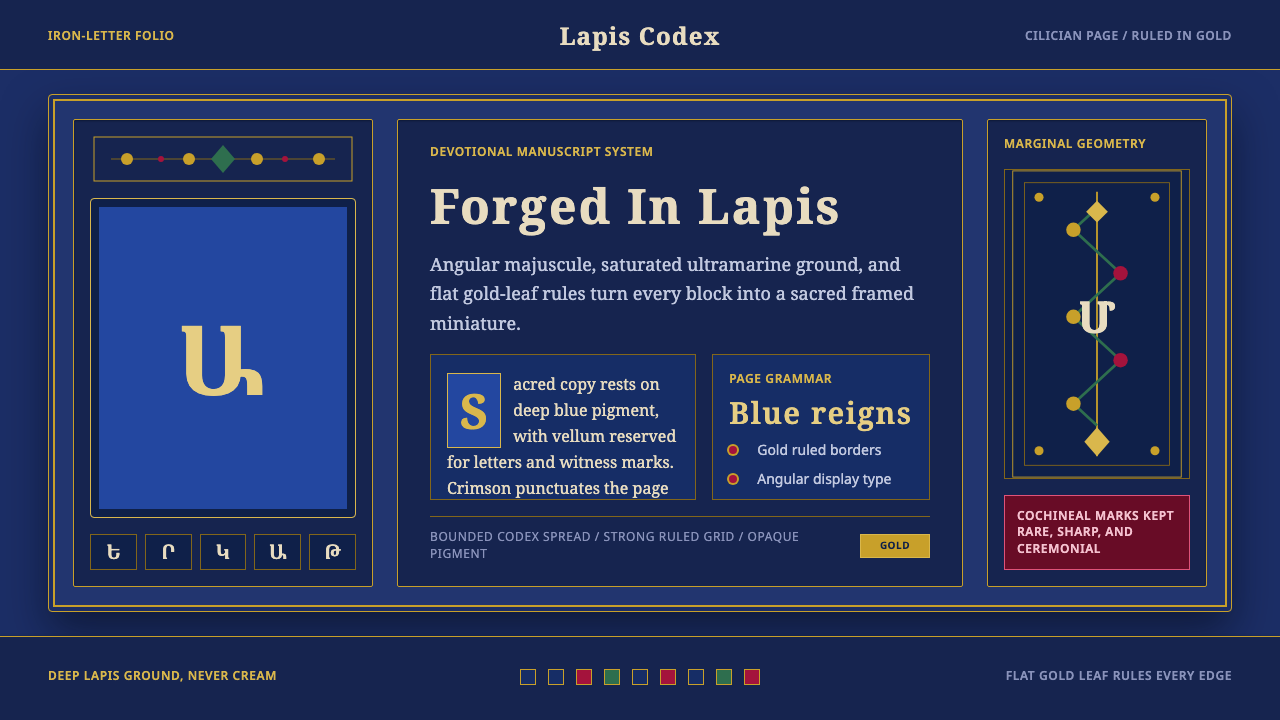 Armenian ErkatʿagirDevotional lapis reigns. Gold rules and angular serif glyphs frame a sacred g…
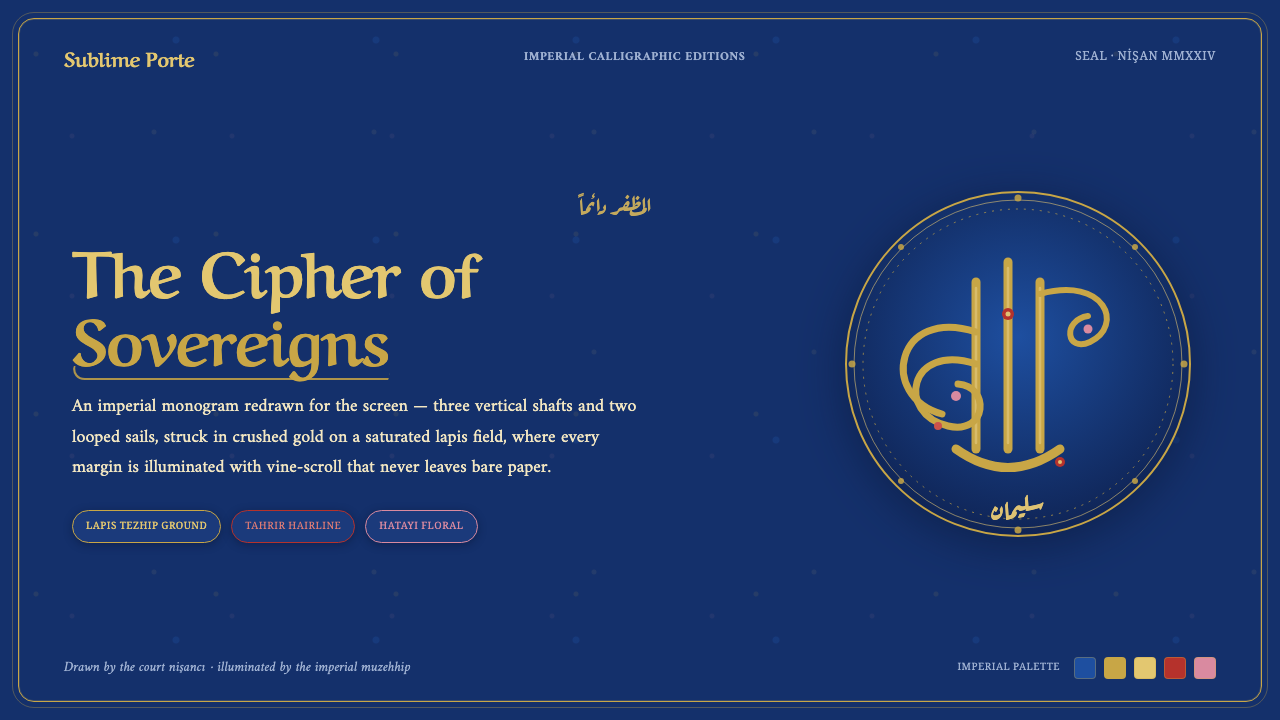 Ottoman Tughra SealEvery surface is a state seal. Gold tughra cipher on lapis, Aref Ruqaa script…
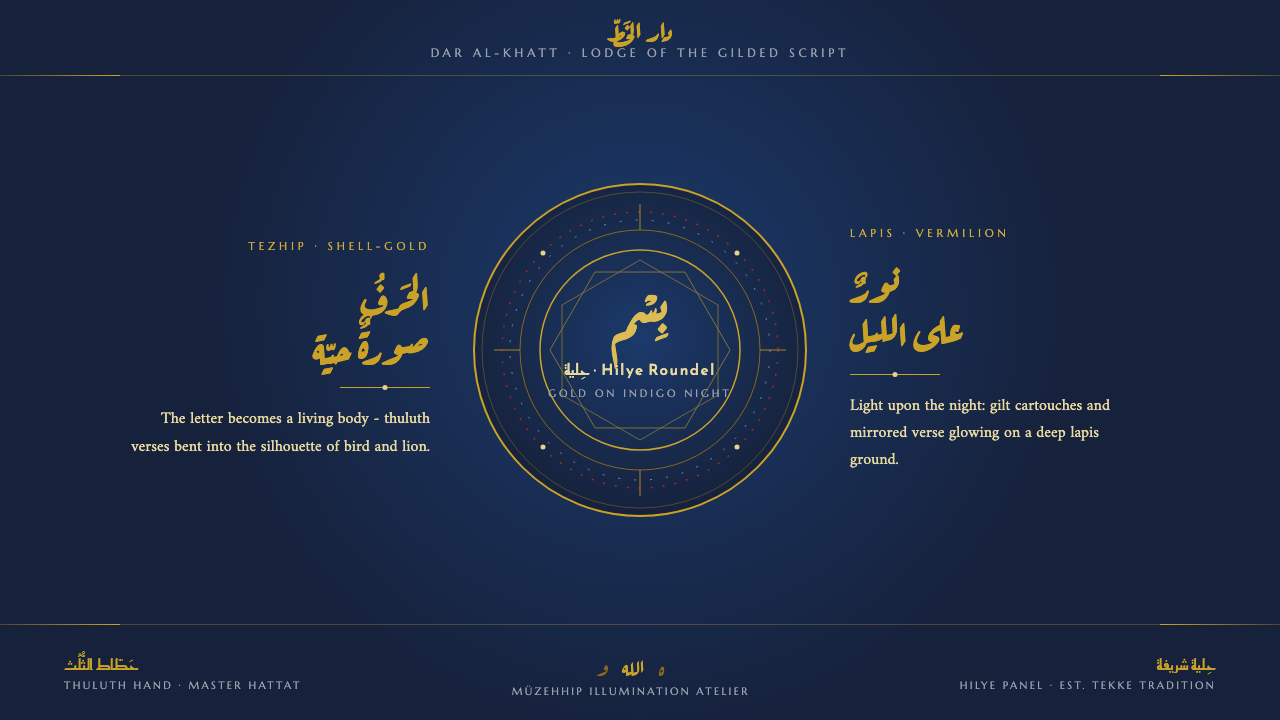 Sufi Zoomorphic CalligraphySacred script made flesh. Shell-gold thuluth on indigo-night grounds, framed…
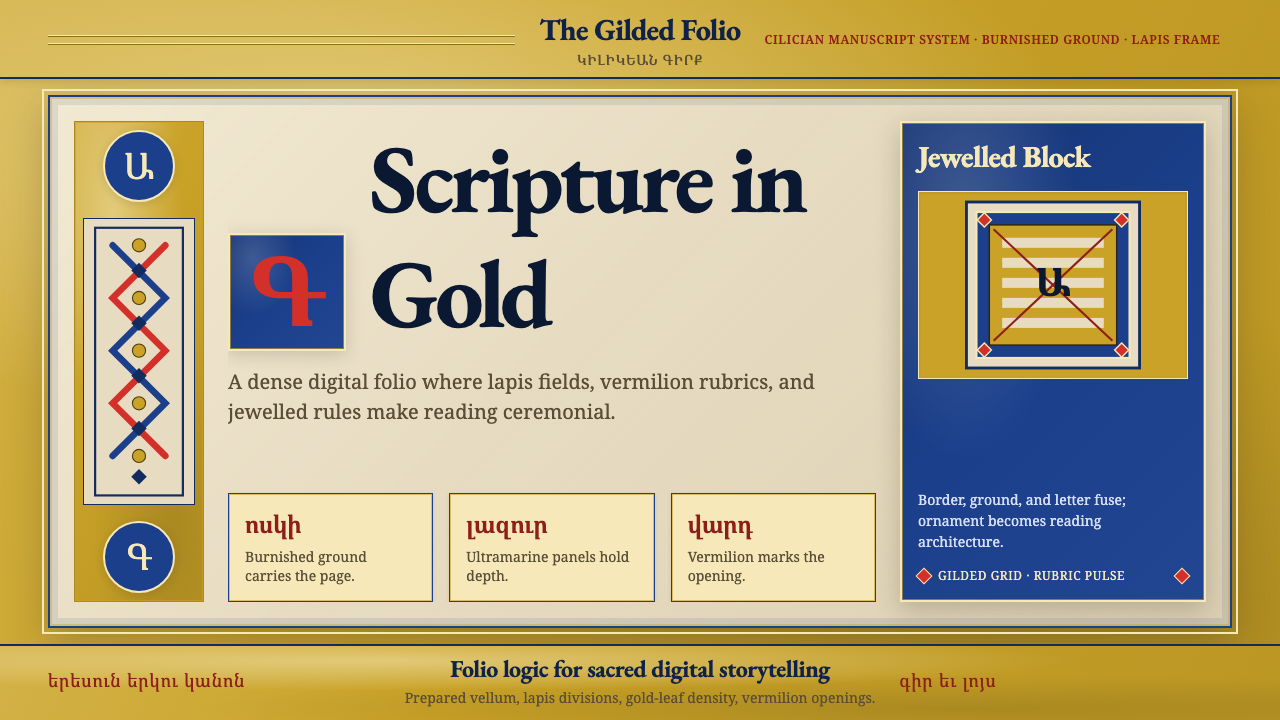 Armenian Illuminated ManuscriptGilded maximalism. Burnished gold, lapis frames, and vermilion initials build…
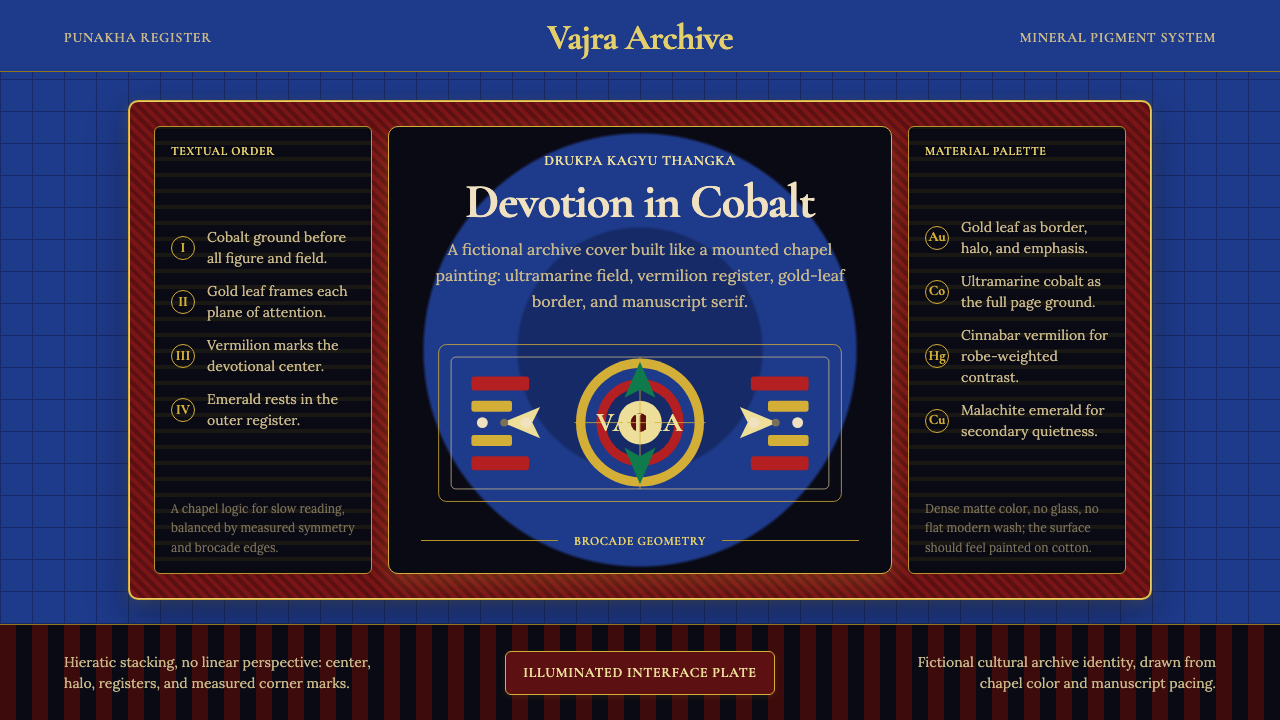 Bhutanese Drukpa Kagyu ThangkaDevotion made cobalt. Gold frames, Cormorant serif, and vermilion marks hold…
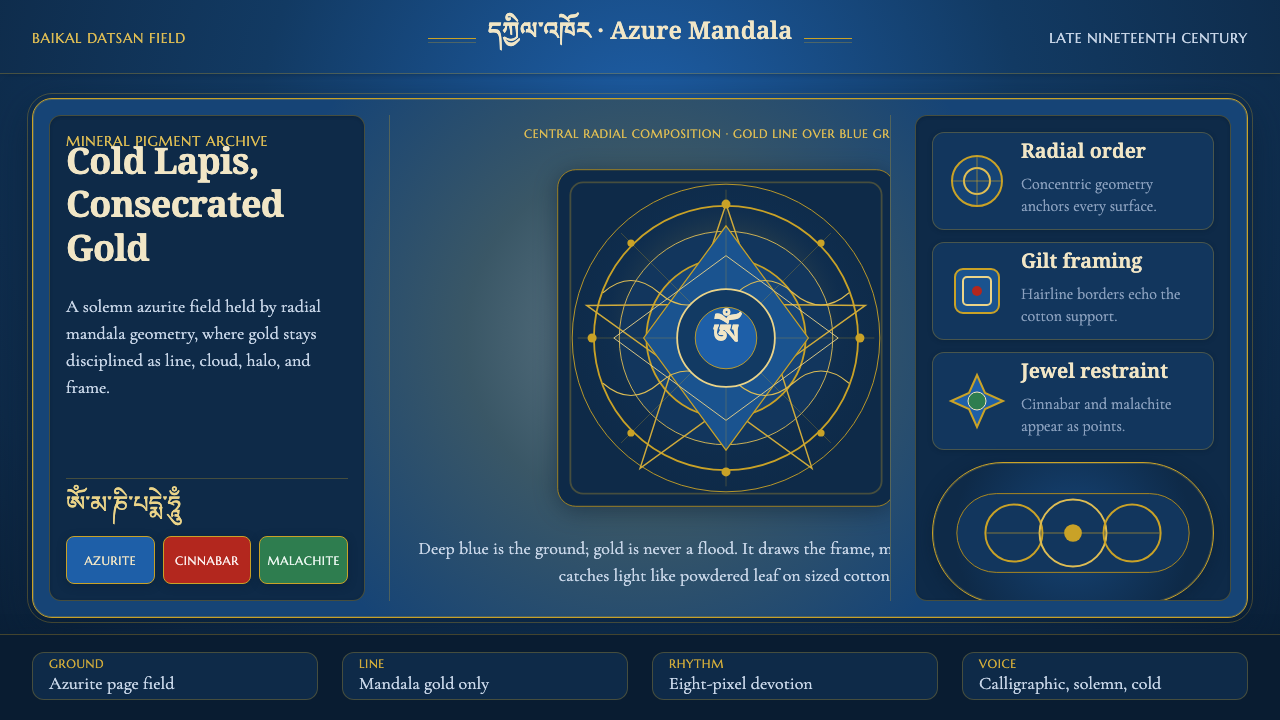 Buryat Buddhist Datsan ThangkaCold lapis holds silence. Gold mandala lines frame a solemn azurite field.