What is Bhutanese Drukpa Kagyu Thangka?
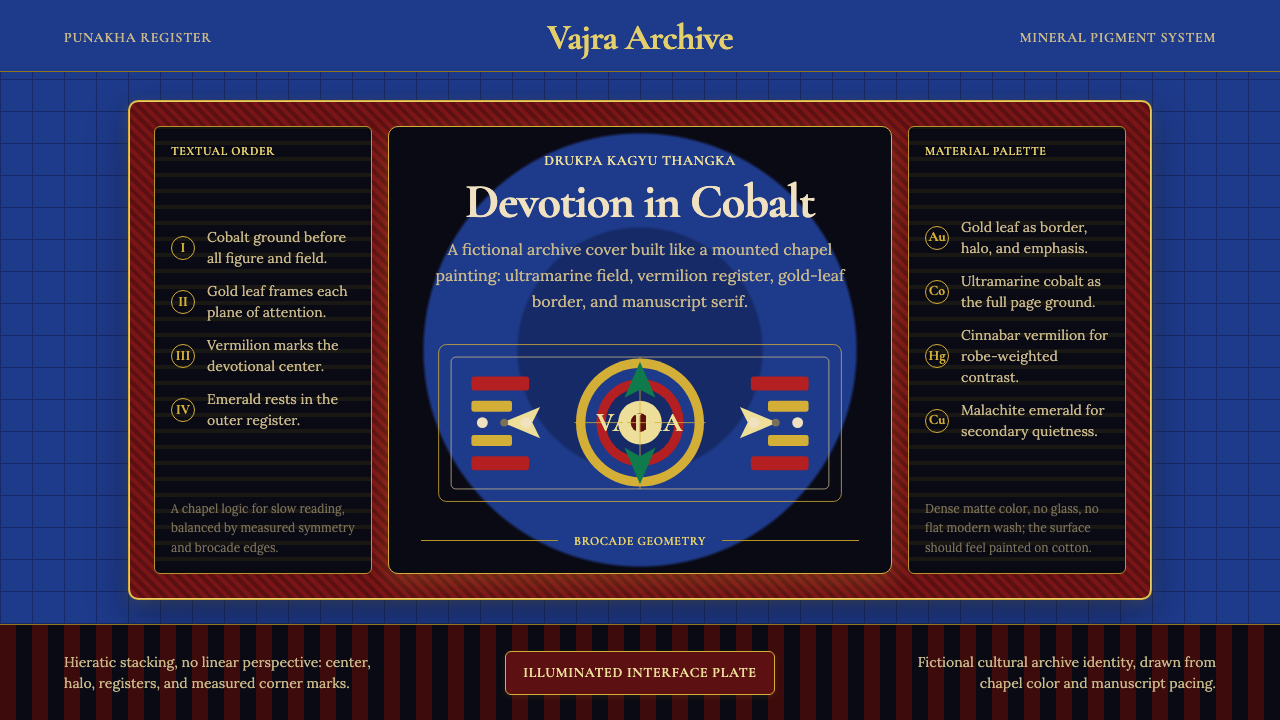
Bhutanese Drukpa Kagyu Thangka translates a thousand years of sacred chapel painting into a design language of mineral-deep cobalt grounds, brocade-patterned borders, and gold-leaf accents that treat every interactive element with the reverence of an illuminated manuscript.
Bhutanese Drukpa Kagyu Thangka in brief
Bhutanese Drukpa Kagyu Thangka is a design system rooted in the sacred scroll-painting tradition of Bhutan's dominant Buddhist lineage. Where Tibetan thangka painting from the Gelug school tends toward warmer ochre grounds, the Drukpa Kagyu tradition favored by Bhutanese monasteries is distinguished by its cooler, richer palette: deep ultramarine-cobalt backgrounds that evoke lapis lazuli pigment, figures rendered in vermilion and saffron against that mineral ground, and a pervasive ornamental vocabulary drawn from brocade textiles, cloud-scroll motifs, and the gold-leaf embellishment that covers architectural elements throughout Bhutan's dzongs.
The system's visual logic is inseparable from its devotional purpose. Thangka paintings are not decorative objects — they are meditation supports, teaching tools, and portable chapels. Every compositional choice follows a textual canon: the proportions of the deity figure, the arrangement of attendant figures, the symbolic color assigned to each direction of the mandala's compass, and the width of the ornamental border are all governed by iconometric treatises transmitted through the monastic lineage. The design system inherits this layered intentionality: nothing is placed arbitrarily. Structure serves meaning, and meaning is encoded in centuries-old conventions.
As a contemporary interface aesthetic, Bhutanese Drukpa Kagyu Thangka works through contrast and containment. The deep cobalt ground immediately establishes depth and gravity; warm gold accents on that darkness read as luminous rather than loud; and the brocade-pattern border system provides a structural frame that organizes content without imposing a Western grid rigidity. The overall register is rich, solemn, and ceremonial — appropriate for contexts where the product's authority and depth are as important as its usability.
Where does Bhutanese Drukpa Kagyu Thangka come from?
The Drukpa Kagyu lineage traces its founding to the twelfth century, when the Tibetan master Tsangpa Gyare Yeshe Dorje established the school after witnessing a vision of nine dragons rising from the earth — the name Druk, meaning 'dragon' or 'thunder dragon', became the lineage's symbol and eventually the name of Bhutan itself. The lineage's painting tradition drew on the broader Tibetan thangka canon but developed a distinctly cooler and more gold-saturated aesthetic as the school took root in the valleys of western and central Bhutan, where the high-altitude light, the mineral richness of locally sourced pigments, and the particular aesthetic preferences of Bhutanese patrons shaped the tradition over centuries.
The defining political and cultural event for Bhutanese religious art was the unification of Bhutan under Zhabdrung Ngawang Namgyal between 1616 and 1651. Zhabdrung — himself a Drukpa Kagyu master — constructed a series of dzongs, the fortress-monasteries that remain Bhutan's most distinctive architectural form, and established a unified national religious art program centered on the Zorig Chusum, the thirteen traditional arts and crafts. Thangka painting, known in Bhutanese as tshem, was codified as one of the thirteen crafts, and its iconometric rules, pigment recipes, and compositional conventions were standardized and transmitted through formal monastic training. The Punakha Dzong, completed in 1638 and still the winter seat of Bhutan's central monastic body, established the interior chapel aesthetic — deep cobalt walls, gold-leaf relief ornament, silk brocade altar skirts, and gilded bronze sculptures — that became the visual reference for the entire tradition.
The Zorig Chusum tradition was nearly broken during the late twentieth century as modernization brought imported visual culture and the economic pressure to train students in commercially viable skills rather than the years-long discipline of traditional painting. The founding of the Choki Traditional Art School in Thimphu in 1997 by Choki Dorji marked a deliberate effort to reverse this erosion. The school trains students in the full canonical curriculum: grinding and preparing mineral pigments from lapis, malachite, vermilion, and gold; constructing and sizing the cloth support; applying the precise iconometric grid that governs figure proportions; and completing the work with the gold-leaf outlining technique that gives Bhutanese thangka its characteristic luminosity.
Contemporary Bhutanese thangka painting exists in a dual register. Within the monastic tradition, it remains a living devotional practice — commissions for new monastery murals and portable thangkas continue, and the Choki school regularly provides painters for major restoration and new construction projects, including work at the Tashichho Dzong in Thimphu. Alongside this, the tradition has attracted international interest as both a fine-art commodity and an aesthetic reference point for design work that seeks to communicate depth, cultural rootedness, and the particular visual authority of a tradition that is simultaneously ancient and alive.
What defines the Bhutanese Drukpa Kagyu Thangka look?
Ground and Depth
The defining visual foundation of this system is a deep ultramarine-cobalt background that functions not as a neutral field but as an active depth. Unlike Western dark backgrounds that can read as empty or void, the Bhutanese chapel tradition treats the deep blue-black as the space of awakened mind — a saturated presence rather than an absence. Elements placed against it appear to float within rather than rest upon the surface. This creates a layered spatial quality that contemporary interface work can deploy to signal depth, gravitas, and interiority without resorting to simulated three-dimensionality.
Gold as Light
Gold in the thangka tradition is not an accent color but a fundamental structural material. Applied as a thin, burnished leaf over prepared grounds, it creates a surface that reflects ambient light with a warmth no paint pigment can replicate. In the design system, gold functions as the primary interactive and hierarchical signal: it marks the edges of figures, the titles of sections, the ornamental borders of frames, and the focal points of the composition. Against the deep cobalt ground, even a very thin gold line reads with extraordinary visual presence. The principle: gold should be applied sparingly enough that every instance retains its luminous authority rather than becoming background noise.
Brocade Structure
Traditional thangka paintings are mounted in silk brocade borders before being rolled for storage — a textile frame in rust-red, gold, and deep blue that both protects the painted panel and orients the viewer's attention. This brocade logic translates into the design system as a border and container vocabulary: decorative frames around cards and panels, patterned dividers between content sections, and ornamental rules that carry visual weight without interrupting reading flow. The brocade border signals containment and completion — content within the frame is finished and considered, rather than merely accumulated.
Warm Pigment Figures
Against the cool cobalt ground, the principal figures in Bhutanese thangka are rendered in warm, saturated pigments: vermilion red for wrathful protector deities, saffron and gold for peaceful bodhisattvas, deep green for certain emanations, and flesh tones built from layered warm washes. This systematic warm-cool contrast is the engine of the tradition's visual drama. In interface terms, it suggests placing warm-toned content elements — calls to action, featured items, primary navigation labels — against the cool deep background, creating a figure-ground distinction that is simultaneously aesthetic and functional.
Iconometric Order
The most discipline-specific characteristic of the thangka tradition is iconometry — the canon of proportional rules governing the placement and scaling of every figure in the composition. Before a monk-painter begins work, the canvas is divided into a precise grid from which the dimensions of the central figure, the positions of flanking attendants, the height of the throne, and the placement of landscape or architectural elements are all derived. The grid is not visible in the finished work, but its organizing logic pervades every spatial relationship. This principle translates into interface design as a commitment to proportional systems: establishing a base module and deriving all dimensions from it, so that even complex layouts maintain an underlying harmony that users perceive as order even when they cannot name its source.
Layered Ornament
Unlike minimalist traditions that treat all ornament as decoration to be removed, the Bhutanese thangka tradition treats ornament as a carrier of meaning. Cloud-scroll borders signal the celestial realm; flame aureoles around figures indicate the heat of spiritual transformation; lotus thrones mark awakened status; jewelry details on deity figures identify the specific iconographic program. Ornament in this system is not surface dressing — it is semantic content. Contemporary application of this principle requires selecting ornamental elements that carry coherent meaning rather than deploying decorative patterns purely for visual richness. Each pattern choice should be justifiable as a signal, not merely a texture.
Solemn Verticality
Thangka compositions are almost invariably vertical — the scroll format descends from the central deity figure through attendants, offerings, and landscape elements toward the patron dedication at the base. This vertical reading direction, from the sacred center outward and downward to the human world, gives the compositions their particular gravity. In interface design, this translates to an affinity for tall, vertical layouts with a strong central axis, generous top margins that establish hierarchy before content begins, and a downward reading flow reinforced by ornamental dividers and nested containers rather than horizontal banding.
Who shaped Bhutanese Drukpa Kagyu Thangka?
The Zhabdrung — literally 'at whose feet one submits' — was the Drukpa Kagyu hierarch who unified Bhutan in the first half of the seventeenth century and, in so doing, established the institutional framework within which Bhutanese religious art has been practiced ever since. His construction of the dzong network gave the thangka tradition its defining architectural patron contexts: the monastery fortress interiors, with their deep cobalt mural programs and gilded altar furniture, set the visual standard that all subsequent Bhutanese painting would aspire to. He is not only a historical figure but a symbol of the inseparability of religious, political, and aesthetic authority in the Bhutanese tradition.
The eighth-century Indian tantric master who is credited with establishing Buddhism in Tibet and Bhutan is the most frequently depicted figure in Bhutanese thangka painting. Known in Bhutan as Guru Rinpoche, his iconography — the curled mustache, the khatvanga trident staff, the eight forms representing different aspects of his activity — is a complete visual vocabulary that every Bhutanese thangka painter masters as a prerequisite to any other commission. His presence in the thangka tradition represents the continuity of the Indian tantric transmission into the Himalayan world, and his eight manifestations serve as a catalogue of the visual range the tradition can express, from the gentleness of Pema Jungnay to the fierce blue-black of Dorje Drolo.
The fifteenth-century Bhutanese tertön — 'treasure revealer', one who discovers concealed sacred texts and objects — whose rediscovered terma teachings became central to the Bhutanese Nyingma-Kagyu fusion tradition. Pema Lingpa is significant to the visual tradition because his revelations include iconometric texts specifying the precise proportional canons for deities particular to the Bhutanese lineage. His descendants, the Peling family, became hereditary custodians of a major temple complex and continued the patronage of thangka production across centuries. In Bhutanese visual culture, the terma tradition represents the possibility of innovation within strict canonical form — a concept relevant to design systems that seek to extend a tradition while respecting its governing principles.
The 'Divine Madman' of Bhutan — a fifteenth-century Drukpa Kagyu master whose unconventional behavior and earthy humor made him a beloved popular figure while his paintings and poems contributed to the distinctly Bhutanese inflection of the shared Tibetan thangka tradition. Drukpa Kunley is significant to the design tradition not as a painter but as a symbol of the irreverent vitality that runs beneath the formal canonical surface of Bhutanese religious art. The tradition is ceremonial and structured, but it is not stiff — the humor and humanity visible in the narrative painting programs of many Bhutanese monastery murals reflects a tradition that never lost touch with ordinary life even while depicting the extraordinary.
The contemporary Bhutanese master who founded the Choki Traditional Art School in Thimphu in 1997, providing institutional continuity for the Zorig Chusum crafts at a moment when modernization threatened to break the chain of transmission. Under Choki Dorji's direction, the school developed a curriculum that maintains traditional iconometric, pigment-preparation, and compositional training while producing graduates capable of undertaking both traditional commissions and contemporary design applications. His work represents the most explicit living bridge between the historical thangka tradition and its contemporary design applications, and the school has trained painters who have worked on restoration projects throughout Bhutan as well as institutional clients internationally.
How do you use Bhutanese Drukpa Kagyu Thangka today?
Bhutanese Drukpa Kagyu Thangka is not a style to apply lightly. Its visual authority depends on understanding what the system is doing — creating depth through color, signaling hierarchy through gold, containing content through ornamental frames, and building gravity through a solemn vertical reading direction. Applied without this understanding, it risks producing work that is merely dark and ornamented rather than genuinely authoritative. The style rewards investment in its logic and penalizes surface-level borrowing.
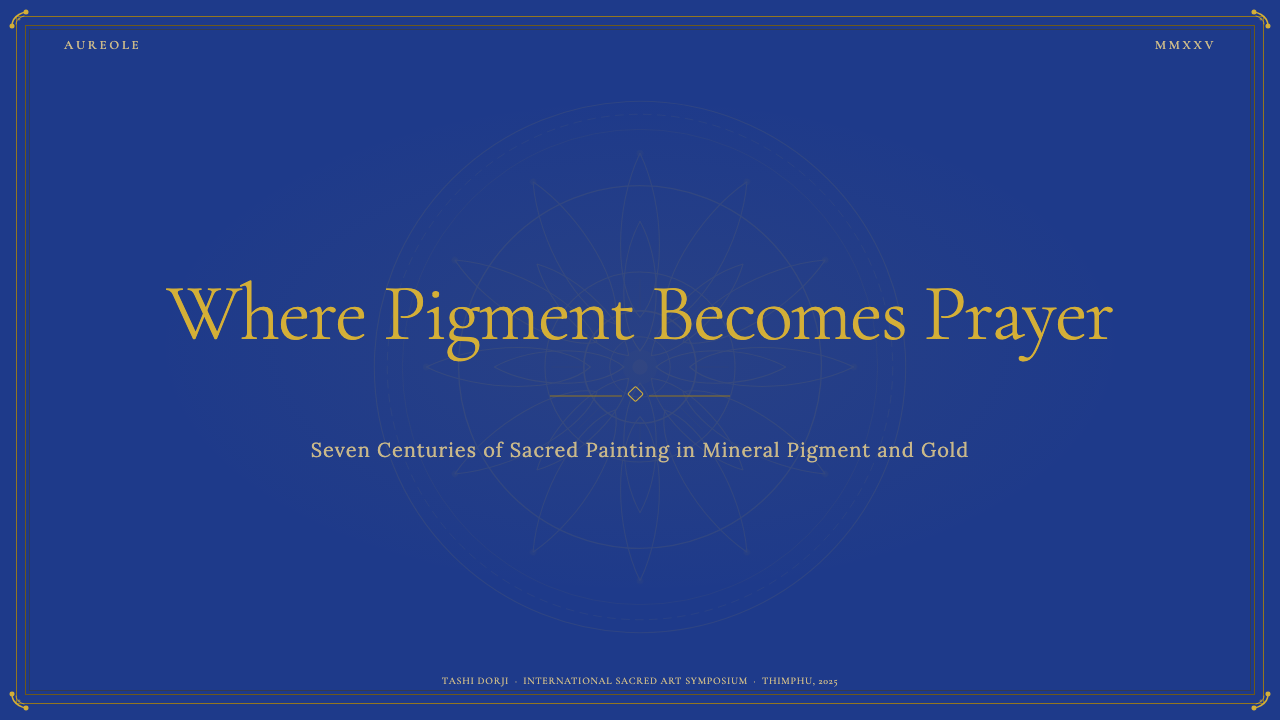
For presentation slides, the system excels on both cover and content pages. A cover benefits from the deep cobalt ground with the title rendered in gold-toned or warm light type, flanked by a border element derived from brocade geometry. Resist the temptation to center everything symmetrically — thangka compositions use a strong central axis but populate the field asymmetrically with figures, offerings, and landscape elements. Content slides should adopt the same ground color with section titles in warm light tones against the deep field; body text in a slightly cooler, more neutral light tone to distinguish it from headings; and thin gold-toned rules to mark section divisions. Data visualizations on this ground are striking: charts and diagrams in warm saffron and vermilion read as active signal against the cool depth.
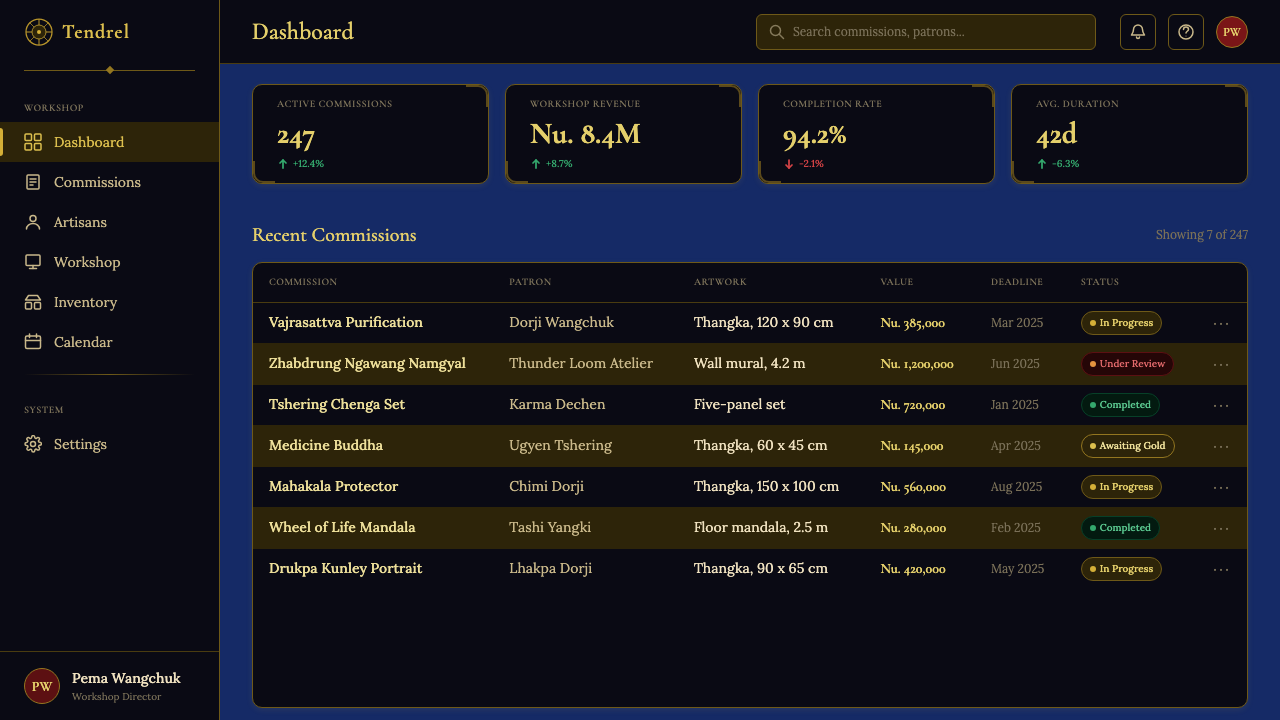
For web interfaces, this system is well-suited to premium, high-gravity contexts: luxury product pages, institutional cultural organizations, spiritual wellness platforms, and any product where authority and depth are primary values. The approach works best with a strong vertical layout, generous spacing between content blocks treated as ornamental breathing room, and card components that use layered border ornament rather than flat lines. Navigation should be minimal and type-led — the ornamental weight is carried by the content frames, not the chrome. Reserve gold accents for primary interactive elements and calls to action so that every gold element reads as a signal worth attending to.
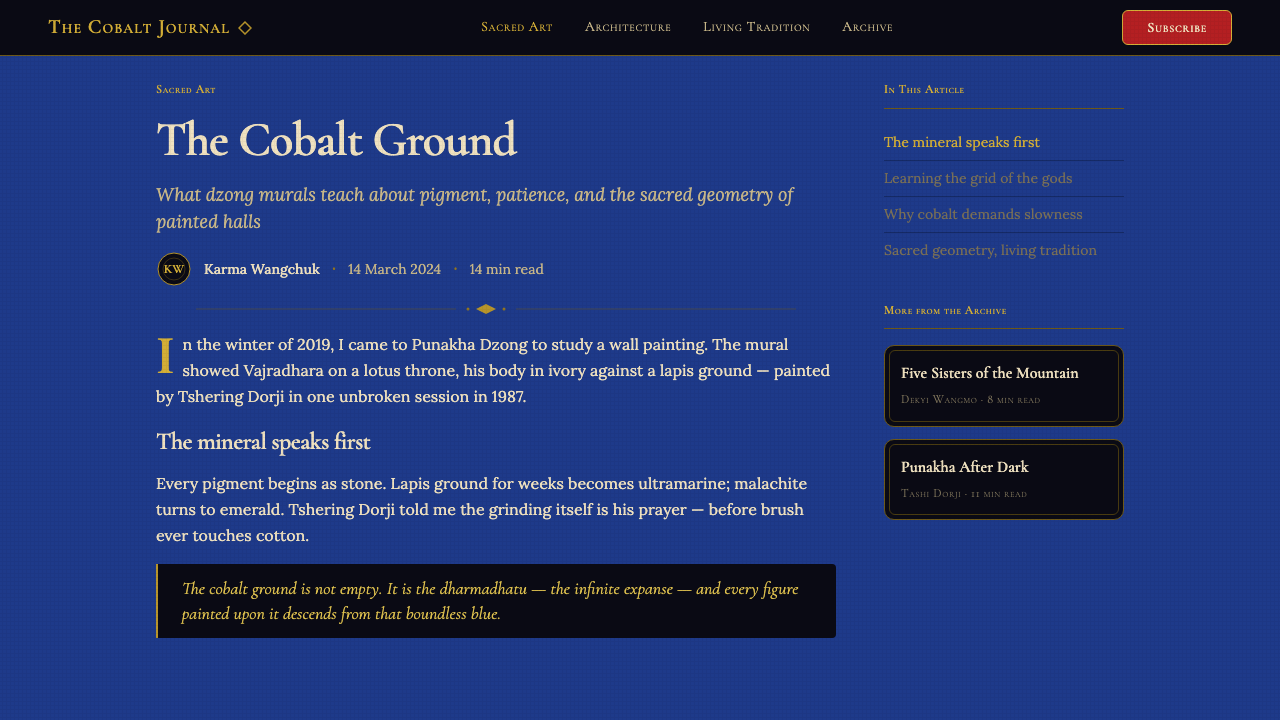
For editorial and marketing applications, the style produces richly atmospheric layouts. A feature article page using this system might set the introductory section against the deep cobalt ground in a full-width header block, then transition to a lighter ground for body text — mirroring the thangka convention of a richly colored central panel within a lighter mounting. Marketing pages benefit from alternating register: full-width hero blocks using the deep ground punctuated by lighter content sections, with the ornamental border vocabulary providing visual continuity across the contrast. The style handles typographic hierarchy well when warm light tones are used for headings and slightly cooler neutral tones for body copy.
The most common mistake when applying this system is misunderstanding the role of gold. Because the style is so strongly associated with gold ornament, designers sometimes deploy gold across an entire interface — navigation bars, all headings, all interactive elements, background patterns — until the entire surface reads as uniformly gilded. Authentic thangka work deploys gold economically: it appears at structural edges, focal points, and hierarchically primary elements, while the majority of the composition is held in the cool cobalt and the warm pigment tones of the figures. When gold appears everywhere, it disappears as a signal. Reserve it for what is most important.
Bhutanese Drukpa Kagyu Thangka — FAQ
How is Bhutanese Drukpa Kagyu Thangka different from Tibetan thangka style?
The two traditions share the same canonical foundation — the same iconometric texts, the same deity iconographies, the same compositional structures — but diverge in palette and decorative emphasis. Tibetan thangka from the dominant Gelug school tends to use warmer grounds, including ochre and rust-red priming colors, with a more restrained use of gold restricted to outlining and detail work. Bhutanese Drukpa Kagyu thangka characteristically uses a deeper, cooler cobalt blue as the primary ground, applies gold more liberally as both outlining and area fill on ornamental borders and architectural throne elements, and incorporates more prominent brocade textile references in the mounting and border design. The overall effect is more saturated, more jewel-like, and more ornamentally dense than central Tibetan work.
Is this style appropriate for non-spiritual or commercial products?
Yes, with careful attention to context. The visual language of this system — deep grounds, gold accents, ornamental containment, solemn hierarchy — communicates authority, depth, and premium quality that translates effectively to commercial contexts that share those values. High-end hospitality, cultural institutions, artisanal goods, financial services, and editorial brands have all used related visual registers successfully. The most important consideration is sincerity rather than appropriation: the style should be applied because its values align with the product's values, not as exotic decoration. Avoid deploying religious iconographic elements — deity figures, mantric symbols, ritual implements — in commercial contexts where they would be used purely as aesthetic motifs stripped of meaning.
How does the system handle light-background contexts if the deep cobalt ground isn't appropriate?
The system can be inverted, though it requires rethinking the hierarchy logic. On a light or near-white ground, the cobalt becomes an accent and structural color rather than a background, and gold must be used very sparingly since it reads poorly against light backgrounds at low contrast. The more successful light-ground interpretation draws on the mounting and brocade elements of the tradition: a warm cream or parchment ground with cobalt used for structural lines, headings, and primary interactive elements, gold reserved for micro-accents like icon fills or active state indicators, and ornamental border elements in a terracotta or warm ochre that references the rust-red brocade mounting without requiring the dark ground. This creates a lighter, more accessible register that retains the system's layered ornamental logic without the full depth of the chapel interior.
What is the role of the brocade border pattern and when should it be used sparingly?
In traditional thangka mounting, the brocade border serves three functions: it protects the painted panel during rolling and transport, it frames the viewer's attention on the sacred image, and it signals the painting's status as a finished and consecrated object rather than a work in progress. In interface design, the border pattern vocabulary carries the same containment and completion signals — a card with an ornamental border reads as a finished, considered item rather than an accumulation of information. Use borders at the macro level: framing major content sections, feature cards, or full-page containers. Avoid applying them to every individual list item, data row, or minor UI component — overuse dilutes the containment signal and turns the ornament into visual noise. The brocade border is most powerful when it is reserved for elements that genuinely merit the 'this is finished and worth attending to' signal.
How should the system handle motion and animation?
The thangka tradition is static — painted on cloth, mounted in brocade, displayed in firelit chapels where the flicker of butter lamps creates the only movement. Motion in a design system informed by this tradition should therefore feel like the slow, deliberate emergence of something revealed rather than the rapid transitions of interaction-focused interfaces. Entrances should be measured and purposeful: elements appearing as if unveiled, with a moderate fade or a slow upward rise from slightly below the reading line. Transitions between states — hover, active, selected — work best with subtle warmth shifts: a gold-toned highlight becoming slightly brighter, a border ornament illuminating along its path. Avoid rapid animation, bouncing, elastic easing, or playful motion that would undercut the system's solemn register. The model is the lighting of a lamp in a darkened chapel: gradual, warm, and attended.
Related design styles
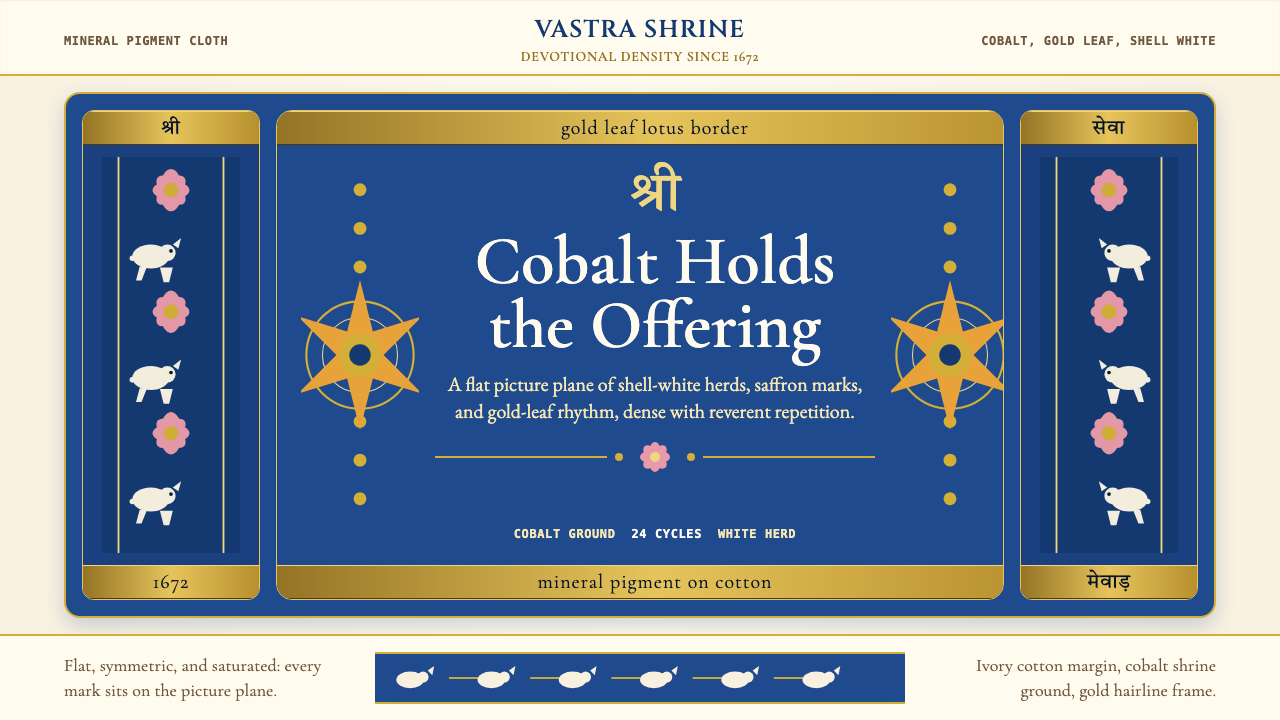 Rajasthani Pichwai (Nathdwara)Devotional density in cobalt. Gold borders, shell-white herds, lotus pink on…
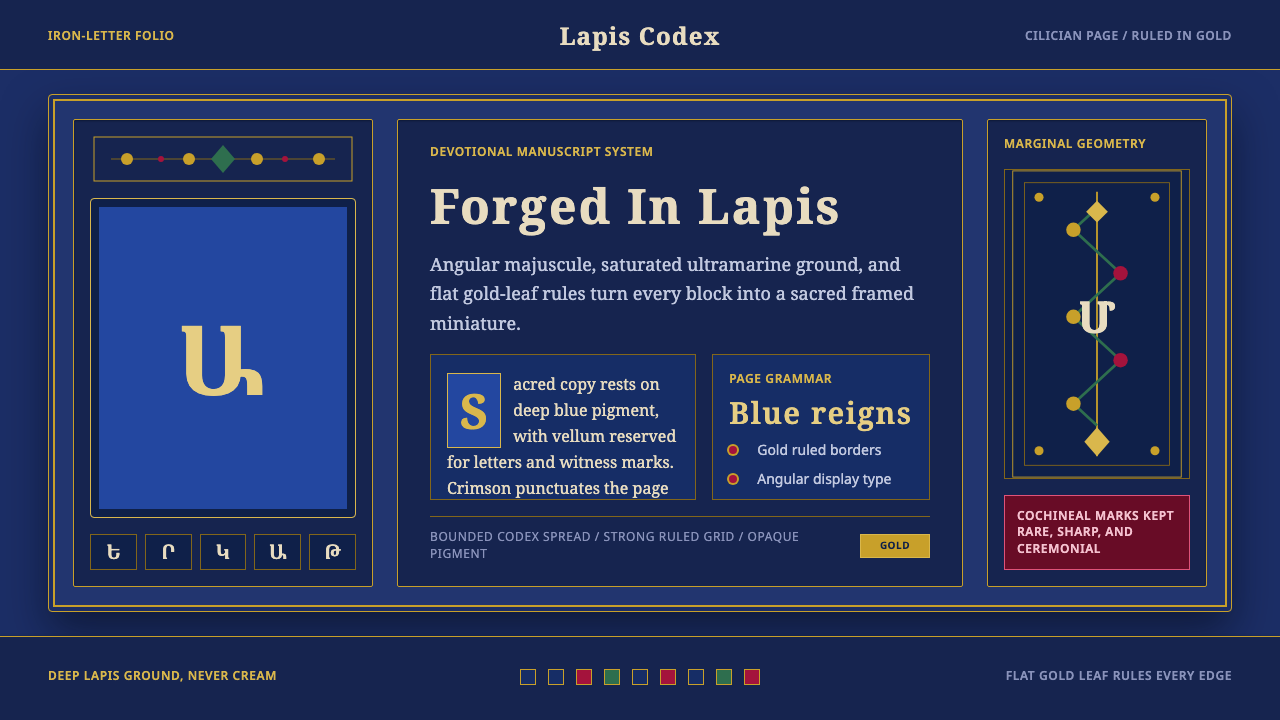 Armenian ErkatʿagirDevotional lapis reigns. Gold rules and angular serif glyphs frame a sacred g…
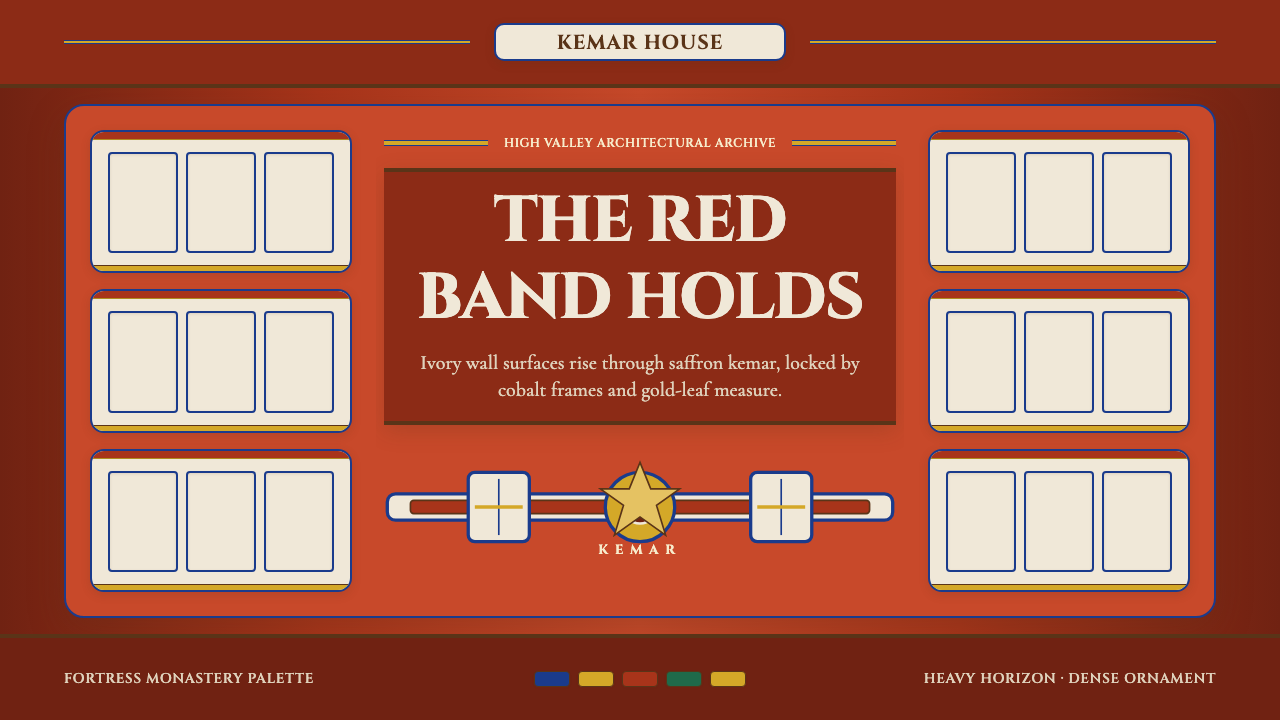 Bhutanese Dzong (Fortress Red)Monumental red holds the page. Cobalt frames and gold bands lock the fortress…
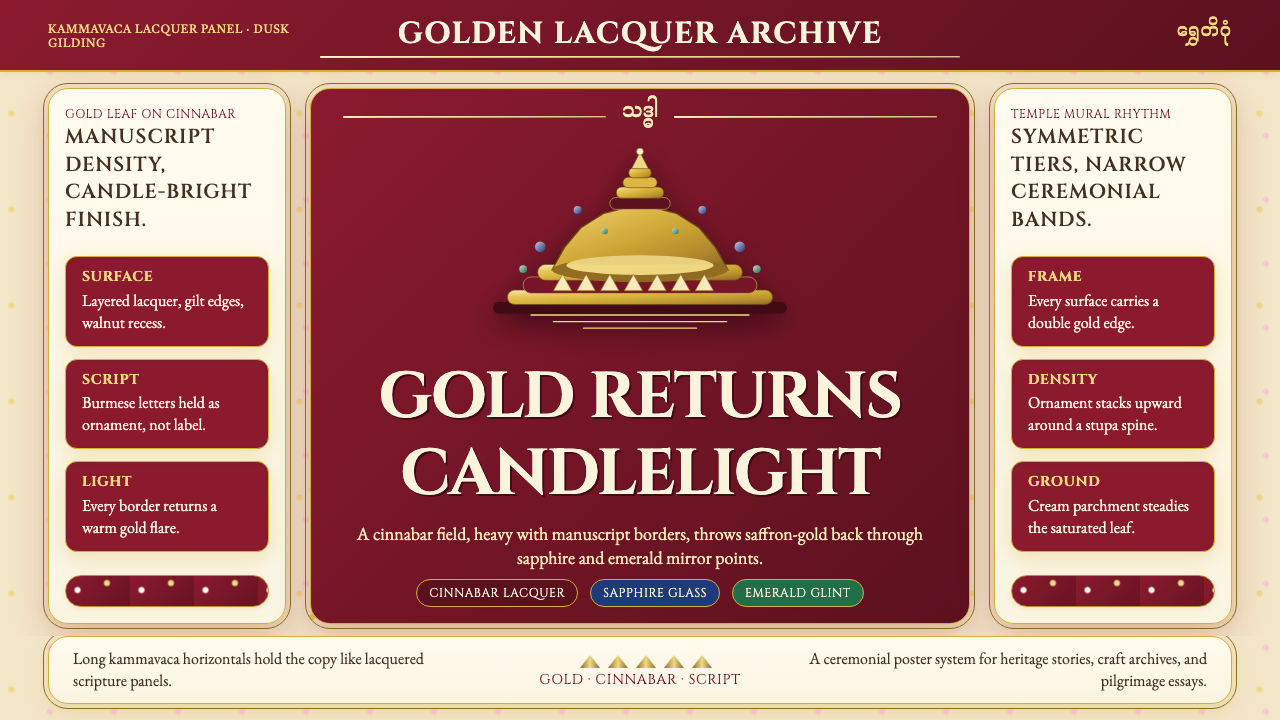 Burmese Shwedagon Gold-LacquerOpulence catches fire. Gold-leaf gradients on cinnabar panels frame a stupa s…
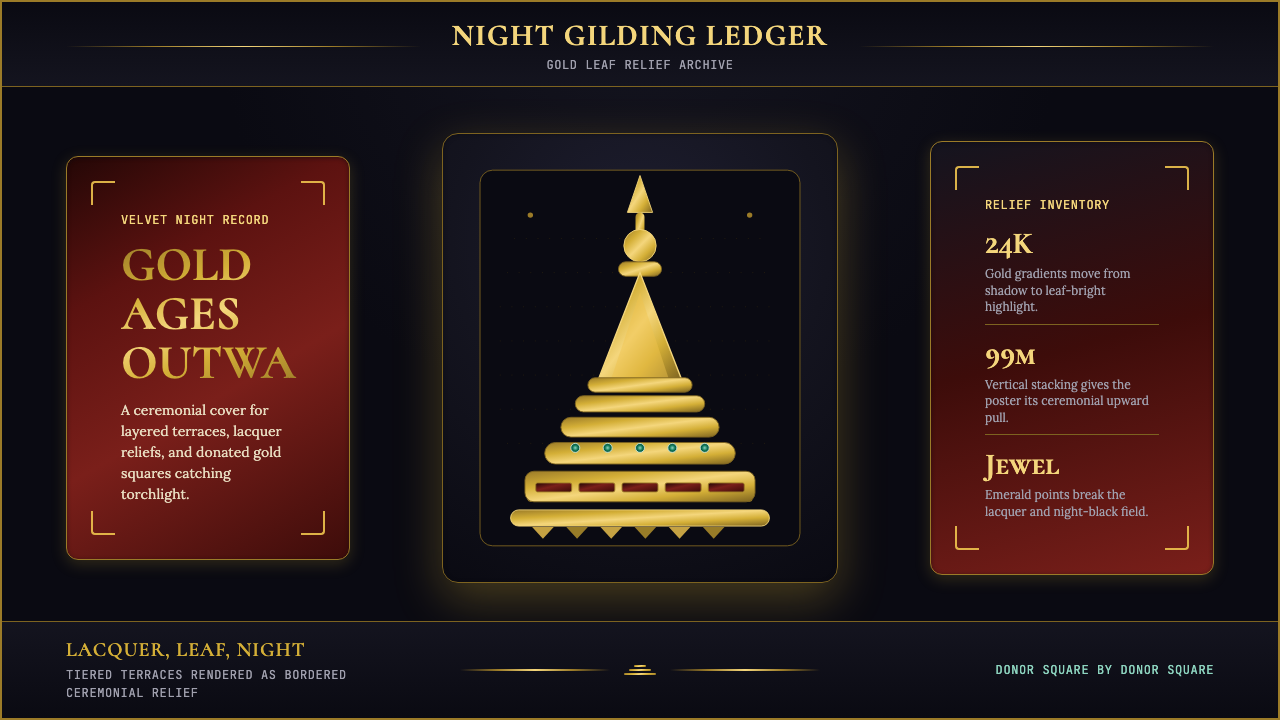 Burmese Shwedagon Stupa ReliefGold refuses restraint. Velvet black, teak-red lacquer, and tiered gradients…
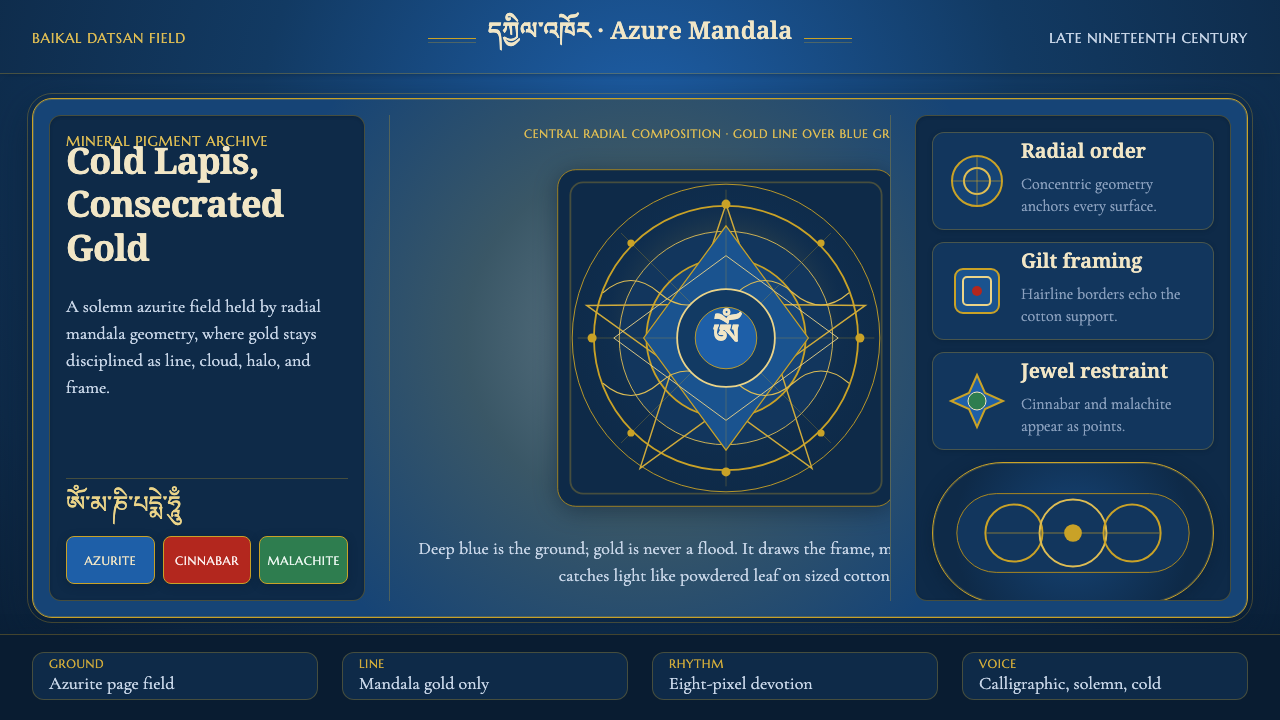 Buryat Buddhist Datsan ThangkaCold lapis holds silence. Gold mandala lines frame a solemn azurite field.