What is Nepali Paubha (Newari Scroll)?
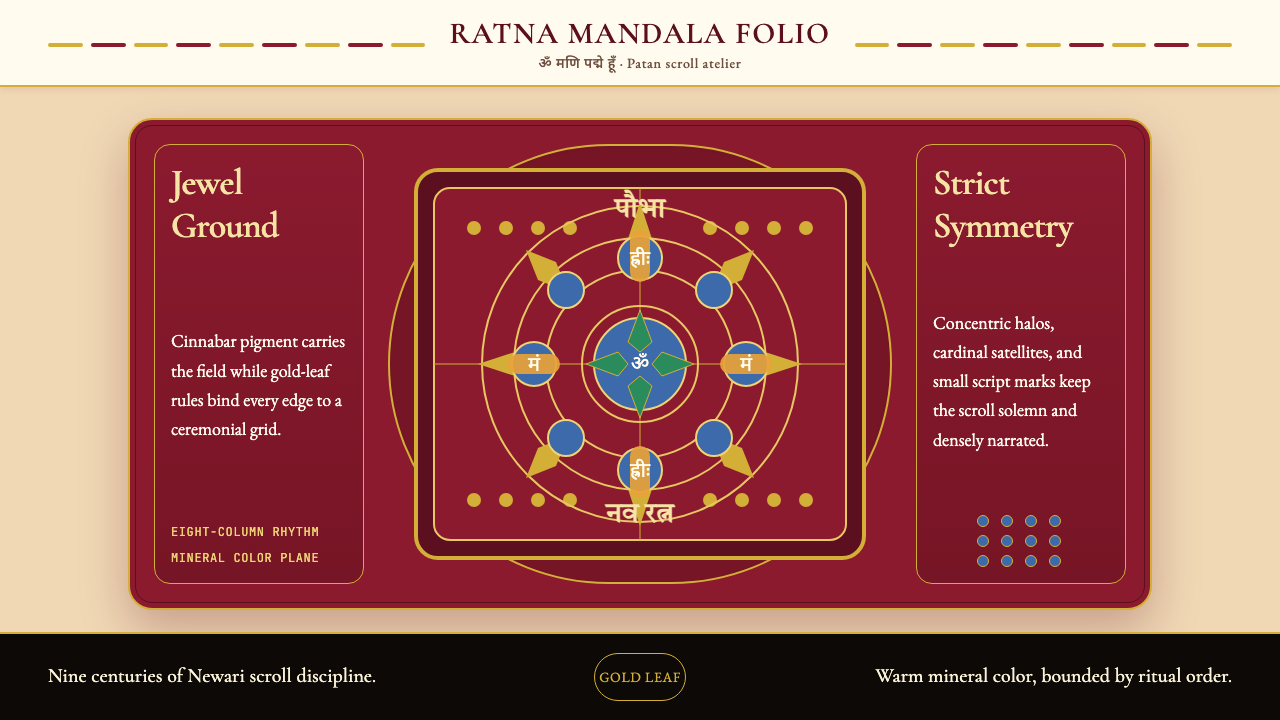
Paubha scroll painting is nine centuries of Newari devotion compressed into strict bilateral symmetry — cinnabar red ground, gold-leaf borders, and lapis halos radiating from a lotus-enthroned deity at the exact center.
Nepali Paubha (Newari Scroll) in brief
Paubha (also spelled Paubhā, from the Sanskrit pata meaning 'cloth painting') is the sacred scroll-painting tradition of the Newari people of Nepal's Kathmandu Valley. Older than Tibetan Thangka and visually distinct from it, Paubha is characterized by a warmer chromatic chord, denser micro-detail, and a strict bilateral symmetry organized around a central deity seated on a lotus throne. Every composition is simultaneously a devotional image and a meditative diagram — a physical mandala intended for ritual use, temple installation, and consecrated gifting.
The visual language of Paubha is immediately identifiable. A jewel-saturated red ground — traditionally prepared from cinnabar — fills the field. A band of hammered gold-leaf frames the outer edge. At the center, the principal deity sits in rigid frontal symmetry, surrounded by a prabhamandala (radiant halo) of concentric golden rings. From that center, lesser deities, attendants, and symbolic motifs radiate outward in the cardinal and ordinal directions, filling every available register with precisely rendered micro-figures. Mineral pigments — lapis lazuli blue, malachite green, orpiment yellow, vermilion red, and gold — are applied flat, without shading or atmospheric perspective. Color functions as symbol and identification, not as naturalistic description.
What distinguishes Paubha from neighboring traditions is its synthesis of Hindu and Buddhist iconography within a single visual system. A single scroll may depict Vajrayana Buddhist bodhisattvas alongside Hindu manifestations, reflecting the syncretic religious culture of the Malla-era Kathmandu Valley. The Chitrakar caste of Patan — hereditary painter-craftsmen who have held this practice for generations — follow strict iconometric canons (tala measurements) that prescribe the proportional relationships of every deity's body, hand gesture (mudra), attribute, and ornament. Deviation from these ratios is understood not as artistic license but as ritual error.

Where does Nepali Paubha (Newari Scroll) come from?
The roots of Paubha painting reach back to the Buddhist manuscript illuminations and palm-leaf painting traditions of the Pala and Sena dynasties of eastern India (roughly the eighth through twelfth centuries), whose stylized iconography and mineral-pigment techniques traveled north across the Himalayan foothills into the Kathmandu Valley alongside the spread of Vajrayana Buddhism. The earliest surviving Paubhas date to the eleventh century and already display the compositional grammar — centered deity, radiant halo, symmetrical registers — that would define the tradition for the next nine hundred years.
The golden age of Paubha production coincided with the Malla dynasty's rule over the Kathmandu Valley, spanning roughly 1200 to 1768. The Malla kings were lavish patrons of religious art: they commissioned monumental Paubhas for temple installations, sponsored the Chitrakar caste's workshops in Patan (also called Lalitpur), and documented iconographic standards in Sanskrit treatises. It was under Malla patronage that Paubha's formal vocabulary crystallized — the cinnabar red ground, the gold-leaf border band, the prabhamandala halo system, and the strict tala measurement canon all became codified conventions during this period.
The architect and sculptor Arniko (1245–1306) represents a pivotal figure in the outward transmission of Newari artistic tradition. Invited to the Yuan court of Kublai Khan at the age of seventeen, Arniko brought Newari building and painting techniques to China and Tibet, profoundly influencing the pagoda form and the aesthetic conventions of Tibetan Thangka painting. This historical exchange illustrates that Paubha was not a receiving tradition but an exporting one — Newari artistic knowledge flowed outward and shaped the visual cultures of a far larger Himalayan world.
When the Shah dynasty unified Nepal in 1768 under Prithvi Narayan Shah, the Malla court system that had sustained the Chitrakar workshops was dissolved. Paubha production did not cease, but its institutional base narrowed. The tradition survived through the caste system itself — the Chitrakar families of Patan maintained the practice across generations as a hereditary craft identity, even as royal patronage gave way to commissions from religious institutions and eventually from private collectors and cultural preservation organizations. In the late twentieth century, scholars including the Buddhist iconographer Lokesh Chandra documented and published Paubha iconographic systems, helping to anchor the tradition academically while contemporary Chitrakar masters such as Lok Chitrakar and Anant Karma Charya continued active production.
What defines the Nepali Paubha (Newari Scroll) look?
Chromatic Palette
Paubha's palette is derived entirely from mineral and metallic sources, giving it an exceptional warmth and density that organic dyes cannot replicate. Cinnabar (mercury sulfide) produces the characteristic deep warm red that saturates the ground. Lapis lazuli yields a rich, slightly violet blue used for halos, sky registers, and deity garments. Malachite supplies a dense, opaque green. Orpiment provides a warm yellow-gold for secondary figures and attributes. Gold leaf and gold powder appear throughout — on borders, halos, jewelry, and architectural elements — not as accent but as structural necessity. This mineral foundation means that the palette reads as heavy, precious, and immovable: there is nothing airy or pastel in authentic Paubha.
Strict Bilateral Symmetry
The compositional grammar of Paubha is built on a vertical axis of perfect bilateral symmetry. The principal deity occupies the exact center, flanked by mirror-image attendant figures, lotus scrolls, and subsidiary deities at every register. This symmetry is not merely aesthetic — it is cosmological, replicating the mandala's fundamental structure in which sacred center radiates outward in equal measure in all directions. Even when multiple deities populate a single composition, each cluster is balanced by its counterpart on the opposite side. The effect is one of absolute stillness and authority: nothing pulls the eye off center because the composition never permits an unbalanced weight.
Micro-Figural Density
Every available space in a Paubha is occupied. Between the main deity registers, small panels contain narrative scenes from the life of the depicted deity, surrounding fields are filled with row upon row of smaller bodhisattvas or Buddhas rendered at near-miniature scale, and architectural border motifs pack the frame bands with jewels, scrolling vines, and guardian figures. This horror vacui quality — an almost compulsive filling of negative space — serves theological purpose: each micro-figure is a complete devotional object in its own right, and the accumulation of presences amplifies the painting's ritual potency. A Paubha is not to be taken in at a single glance but meditated upon across its entire surface.
Flat Mineral Pigment Application
Paubha painters work in a strictly flat register: pigments are applied in pure, bounded areas with no gradation, blending, or atmospheric shading. A deity's skin tone is a single uniform hue; a garment is a single color bounded by a precise ink line. Depth and volume are communicated exclusively through iconographic convention — a figure's posture, gesture, and attribute placement — not through tonal modeling. This flatness is not a technical limitation but a deliberate system: it keeps every element at equal visual distance from the viewer, appropriate for an image understood as a presence rather than a representation. The gold outlines that delineate each form are drawn with exceptional fineness, requiring a stability of hand that traditional Chitrakar training cultivates over many years.
Iconometric Proportion Canon
Every figure in a Paubha is constructed according to tala measurement canons inherited from Sanskrit iconometric treatises. The tala — roughly the length from the hairline to the chin — serves as the base module from which all other proportions are derived: the height of the body, the width of the shoulders, the length of the limbs, and the size of each hand gesture all relate to the tala in prescribed ratios. These canons vary slightly by deity class and regional tradition, but the principle is constant: no figure may be drawn from observation or imagination. The painter's role is to transmit a received form correctly, not to invent. This constraint gives Paubha its characteristic look of figures that seem simultaneously ancient and precise — not because the painter has imposed a style, but because the canon has been faithfully applied.
Gold as Structural Element
In Paubha, gold is not decoration applied over a finished composition — it is a load-bearing structural element woven into the architecture of the image from the beginning. The outer border band is solid hammered gold leaf, establishing the painting's frame as a sacred threshold. The prabhamandala halo surrounding the central deity consists of multiple concentric rings in gold, each delineated with hair-fine lines. Gold powder mixed into the painting medium is used for the jewelry, crowns, and architectural canopies of all major figures. This pervasive use of gold gives the entire composition a luminous, unchanging quality — the painting seems to emit rather than reflect light — and signals to the viewer that the depicted world operates under different physical laws than the everyday.
Devotional Register Organization
Paubha compositions are organized into horizontal registers (layers) and radial zones that together create a legible cosmic map. The uppermost register typically depicts the transcendent realm: celestial Buddhas, bodhisattvas in their pure lands, or the cosmic deity at the apex of a hierarchical system. The middle register holds the principal deity's court — the main figure flanked by attendants, offering figures, and protective deities. The lower register frequently contains donor portraits, guardians, or scenes from the deity's mythological biography. This vertical stratification is not merely compositional but theological: movement from bottom to top traces a path from the mundane world upward through increasingly refined levels of reality toward enlightenment or liberation. The viewer's eye is guided on a structured spiritual ascent.

Who shaped Nepali Paubha (Newari Scroll)?
Born in Patan in 1245, Arniko led a team of Newari craftsmen to the Yuan court of Kublai Khan in 1260 at the invitation of the Tibetan lama Drogön Chögyal Phagpa. Over his forty-six years in China, he designed the iconic White Pagoda at Miaoying Temple in Beijing and served as superintendent of all craftsmen in China. His transmission of Newari building techniques and Buddhist iconographic conventions to China and Tibet makes him the most consequential historical figure in the outward diffusion of Paubha-adjacent visual culture, demonstrating that Newari artistic knowledge was of sufficient sophistication to reshape the visual identity of the Yuan empire.
One of the foremost contemporary masters of the Paubha tradition, Lok Chitrakar of Patan has devoted his practice to both the production of technically orthodox Paubhas and the documentation and transmission of Chitrakar craft knowledge to younger generations. Working within the hereditary conventions of his caste, he has been instrumental in demonstrating that Paubha can sustain rigorous technical standards in the present era while remaining a living ritual art rather than a purely archival curiosity. His work has been exhibited internationally and has brought critical attention to the tradition at a moment when urbanization and changing patronage patterns in the Kathmandu Valley have put pressure on hereditary craft systems.
A senior Chitrakar practitioner and teacher, Anant Karma Charya has played a central role in codifying and transmitting the tala measurement system and iconographic conventions of Paubha to students both within and outside the Chitrakar caste. His pedagogical work addresses a structural challenge facing the tradition: as the hereditary caste system's social authority has diminished, the transmission mechanism for the highly specialized technical and iconographic knowledge embedded in Paubha practice has had to adapt, moving from family workshop apprenticeship toward more formal instructional settings without sacrificing the depth of content those conventions carry.
An Indian Buddhist iconographer and scholar, Lokesh Chandra's encyclopedic publications on Tibetan and Himalayan Buddhist iconography — including his multivolume dictionary of Buddhist iconography — provided systematic scholarly documentation that has been indispensable for understanding the iconographic programs of Paubha and for distinguishing its conventions from related Thangka traditions. By anchoring the visual vocabulary of Himalayan sacred art in rigorous textual and comparative analysis, Chandra created a reference framework that contemporary Paubha practitioners, curators, and collectors use to authenticate and interpret the tradition's works.
The founder of modern Nepal, Prithvi Narayan Shah's 1768 conquest of the Kathmandu Valley and unification of Nepal under Shah dynasty rule effectively ended the Malla court system that had been Paubha's primary institutional patron for over five centuries. While this political rupture is often framed in terms of military and dynastic history, its consequences for Paubha were profound: the dissolution of Malla royal workshops forced the Chitrakar caste to reorganize around temple, monastery, and eventually private patronage networks. The transition shaped the economics and social organization of Paubha production for the two and a half centuries that followed, making the tradition more dispersed but also more resilient to any single patron's withdrawal.
How do you use Nepali Paubha (Newari Scroll) today?
Applying Paubha as a design reference requires understanding what the style actually does: it organizes complexity through symmetry, hierarchy, and density rather than simplification. It is not a minimalist system — it is a maximalist system with iron discipline. Borrowing its visual logic means choosing one or two of its structural principles — the bilateral symmetry, the radiant compositional grammar, the flat saturated palette — and deploying them with the same consistency that the Chitrakar masters applied to iconometric canons. Surface pastiche — applying a red background and gold borders without structural coherence — produces noise, not power.
For presentation slides, the Paubha visual vocabulary offers rich possibilities at both the cover and content level. A cover slide benefits from the tradition's compositional authority: a central figure, image, or title block sits on a deep cinnabar-red ground, flanked by symmetrically placed secondary elements — supporting points, brand marks, or decorative motifs — at equal visual weight on left and right. The gold-frame convention translates directly to a strong border band or ruled framing device that distinguishes the slide from the ambient screen. Content slides should respect the register system: use horizontal bands to organize information at different levels of hierarchy, with the most authoritative content occupying the visual center and supporting detail distributed symmetrically around it.
For web interfaces, Paubha-informed design is most effective on landing pages, feature showcases, and cultural institution websites where ceremonial weight and visual richness are appropriate. The approach: center the primary visual element on a deeply saturated ground, use a strong framing device — a bordered container, a rule-bounded panel — to create the sense of a sacred threshold, and populate secondary zones with symmetrically balanced content blocks. Dashboard and data contexts are harder: the tradition's density can become illegible at small scales and on tightly packed UI components. Where Paubha sensibility can survive in a dashboard is in the header, the state indicators, and the primary navigation — treating those areas as the high-register, high-formality zones while leaving the data fields comparatively minimal.
For editorial and marketing work, the Paubha chromatic palette — cinnabar red, lapis blue, malachite green, gold — operates as an immediately distinctive signature when used with restraint. A single full-spread image on a cinnabar ground with gold typography creates impact that no generic dark or light layout can match. The flat, no-gradient treatment means that the palette reads cleanly in print, on screen, and in environmental graphics without translation loss. Marketing materials for heritage brands, cultural organizations, luxury goods, and spiritual wellness contexts can draw on the tradition's associations of preciousness, permanence, and sacred authority — provided the execution maintains the palette's mineral richness rather than digitally warming or cooling it toward contemporary gradient conventions.
The most common mistake when referencing Paubha is confusing richness with busyness. Authentic Paubha is dense, but its density is organized: every element occupies a designated place in a hierarchical system, and nothing is random. Contemporary applications frequently import the surface visual qualities — saturated color, gold accents, symmetrical framing — while neglecting the compositional discipline that makes those qualities cohere. A Paubha-referencing design that is symmetrical in its overall frame but casually asymmetric in its internal elements, or that uses gold as scattered decoration rather than as a structural bordering and highlighting system, will read as confused rather than authoritative. Commit fully to the organizational logic or dial back the visual intensity to match the organizational rigor you can actually sustain.

Nepali Paubha (Newari Scroll) — FAQ
How does Paubha differ from Tibetan Thangka painting?
Paubha is older than Thangka and is its direct ancestor — Newari artistic conventions, carried north by craftsmen such as Arniko, significantly shaped early Thangka iconography and technique. Visually, Paubha tends toward warmer reds (cinnabar-dominant rather than the cooler iron-oxide reds of some Tibetan schools), denser compositional registers with less open ground showing, stricter bilateral symmetry, and a more pronounced Hindu-Buddhist syncretic content. Thangka, particularly in its Tibetan Gelug and Karma Gadri forms, developed its own regional conventions over centuries — including the distinctive pale blue-green grounds of the Menri style and the more atmospheric gold-ground compositions of older Kadampa works. Both traditions share the mineral pigment technique and the iconometric canon, but a practiced eye can distinguish them within moments by palette temperature, compositional density, and the relative emphasis on Hindu versus Buddhist iconography.
Is Paubha only appropriate for spiritual or cultural contexts, or can it be used more broadly?
The tradition carries strong sacred associations, and using it carelessly in commercial contexts risks appearing appropriative or disrespectful — particularly if specific deity imagery is repurposed as decoration without acknowledgment of its religious significance. However, the visual principles underlying Paubha — its compositional symmetry, its radiant organizational grammar, its mineral chromatic warmth, its gold-as-structure convention — are formal properties that can be applied to secular design contexts with care and deliberateness. The distinction is between borrowing the visual system as design language and reproducing sacred imagery as branding. Cultural institutions, heritage brands, luxury goods, and educational materials represent contexts where Paubha visual language can be applied thoughtfully; fast-moving consumer goods, social media graphics, and contexts demanding irony or informality are poor fits.
What makes the Paubha palette feel so distinctly different from other warm-toned historical styles?
The difference is mineral. Most historical warm-palette styles — Byzantine mosaic, Renaissance panel painting, Art Nouveau — use some combination of organic pigments, lead-based whites, and earth tones that produce warmth through richness and variety. Paubha's warmth comes from a more restricted and more intense mineral source: cinnabar red (mercury sulfide) has a distinctly warm, slightly orange-red character very different from iron-oxide earth reds; lapis lazuli blue has a depth and slight warmth that synthetic ultramarine lacks; orpiment yellow is more sulfurous and saturated than ochres or Naples yellows. Together, these minerals produce a palette that reads as hotter and more precious than historical Western warm palettes — closer to the interior of a fire or the surface of a gemstone than to an autumn landscape or a candlelit room. The pervasive gold further distinguishes it: used at this density, gold stops being a highlight and becomes the ambient light source of the entire composition.
Can the Paubha's strict symmetry be adapted for contemporary layouts without looking archaic?
Yes, provided the adaptation is principled rather than casual. The key insight is that Paubha's symmetry is radial and hierarchical, not merely mirrored: it always emanates from a powerful central element, with everything else organized in relation to that center. Contemporary layouts that adopt this organizing logic — a dominant central element with supporting content distributed symmetrically around it — inherit the style's compositional authority without requiring the full visual vocabulary of halo rings and micro-deity registers. The contemporary risk is treating symmetry as blandness: a Paubha-inflected layout should be symmetrical and intense, not symmetrical and neutral. The center must be strong enough to justify the symmetrical frame around it. A weak or undifferentiated central element surrounded by carefully balanced secondary content will read as corporate rather than ceremonial.
How should a designer handle the density characteristic of Paubha — does every design using this reference need to be visually dense?
Density is not a requirement — hierarchy is. Paubha's density emerges from a specific function: every available surface is used to accumulate devotional presence, because more figures means greater ritual potency. A design application does not share this theological imperative, and importing the density without the organizing logic produces clutter, not richness. What can be productively borrowed is the principle of compositional completeness: no element should be placed casually, every zone should have a defined purpose, and the overall composition should have a sense of considered resolution rather than unfinished space. A Paubha-referencing design can be relatively spare — few elements, generous ground — while still carrying the tradition's sense of compositional authority, provided those few elements are placed with the same intentionality that the Chitrakar master applies to a painting that will serve as a ritual object.
Related design styles
 Bhutanese Dzong (Fortress Red)Monumental red holds the page. Cobalt frames and gold bands lock the fortress…
 Lao Naga Temple StencilDevotional gilt, not chrome. Flat gold-leaf naga and flame stencils glow on o…
 Mughal Miniature (Akbar era)Opulence refuses emptiness. Saffron paper, ruby panels, cobalt lattice, gold…
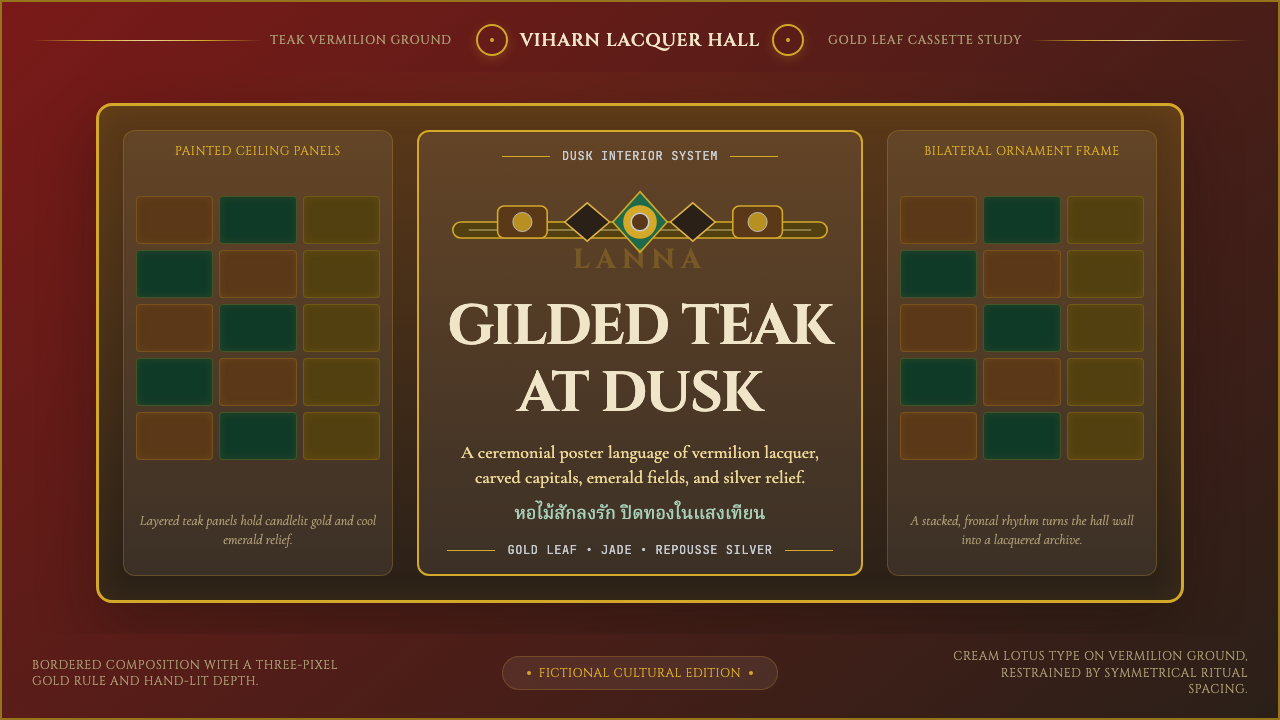 Thai Lanna Tai Yai TempleSacred lacquer glows. Vermilion ground, Cinzel capitals, gold cassette symmet…
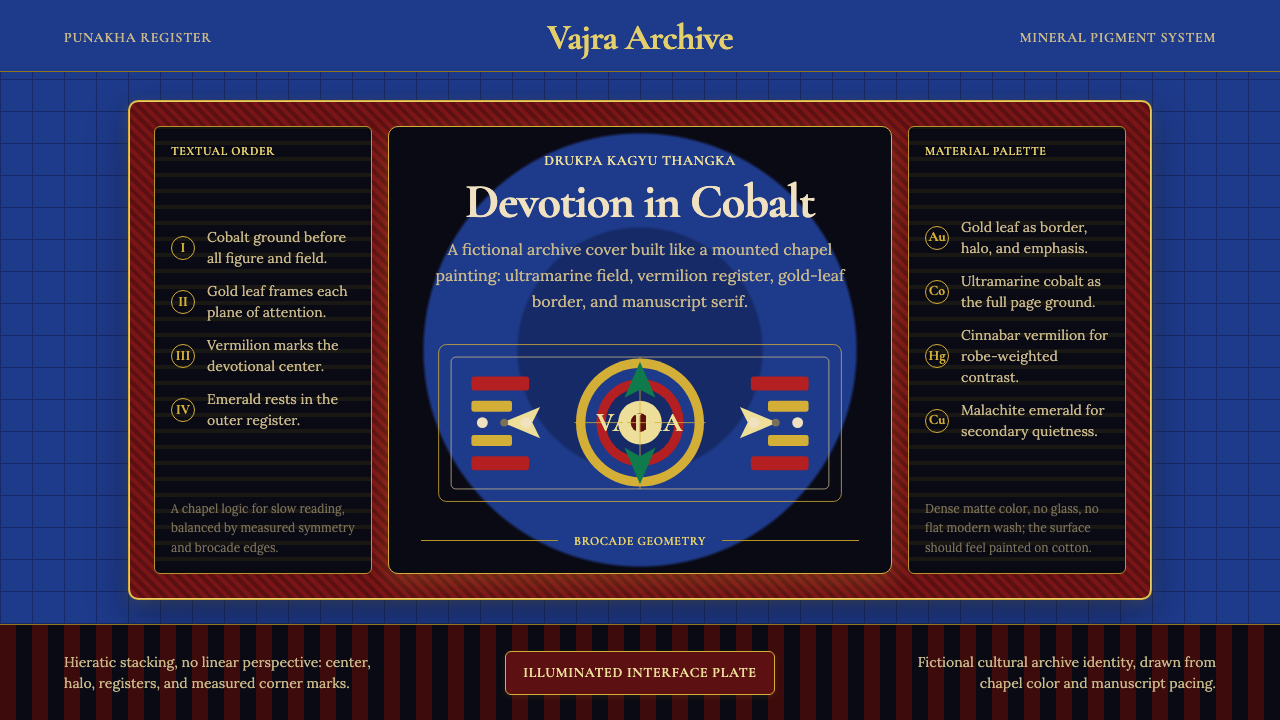 Bhutanese Drukpa Kagyu ThangkaDevotion made cobalt. Gold frames, Cormorant serif, and vermilion marks hold…
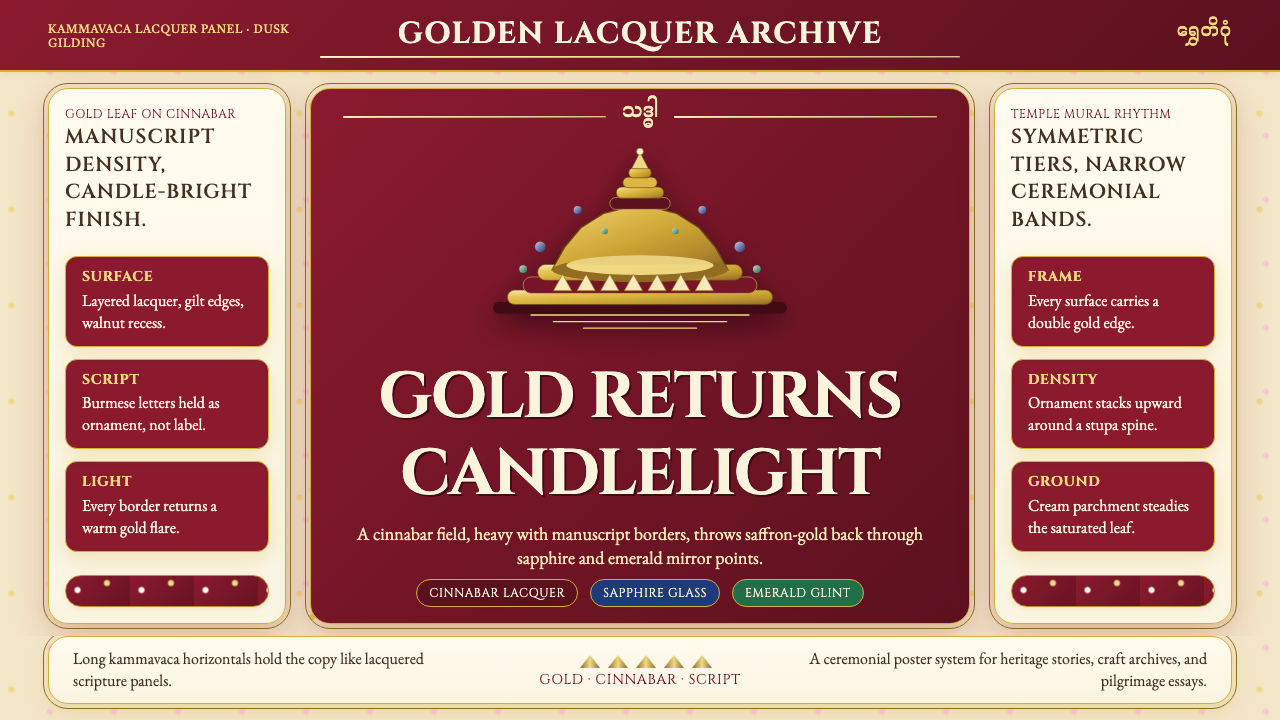 Burmese Shwedagon Gold-LacquerOpulence catches fire. Gold-leaf gradients on cinnabar panels frame a stupa s…