What is Burmese Shwedagon Gold-Lacquer?
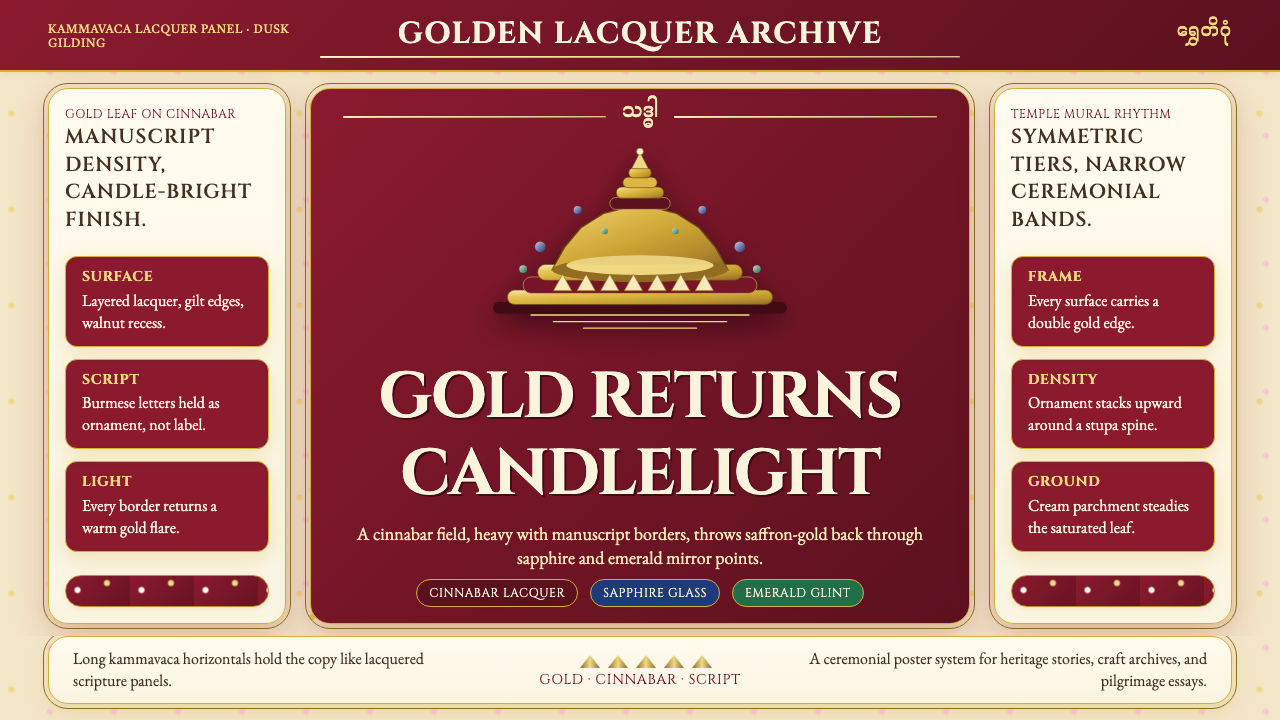
Twenty-seven tons of pilgrim-donated gold-leaf on a ninety-nine-meter stupa — Burmese Shwedagon gold-lacquer is the most saturated sacred-gold visual tradition in all of Southeast Asian Buddhism.
Burmese Shwedagon Gold-Lacquer in brief
Burmese Shwedagon gold-lacquer is a centuries-old visual culture that fuses devotional goldsmithing, lacquer painting, and monumental architecture into a single, instantly recognizable aesthetic. Its signature is gold-leaf applied over deep cinnabar-red lacquer grounds — a chromatic chord so intense that it seems almost to generate its own light in candlelit temple interiors. The style encompasses kammavaca manuscripts (votive texts written in gold on lacquered palm-leaf-shaped boards), gilded Buddha images on carved lotus thrones, glass-mosaic temple corridors, and the elaborately painted panels of the Mandalay marionette theater tradition.
Where many ornamental traditions use gold as accent, Shwedagon gold-lacquer uses it as the dominant field. Gold is not a highlight here — it is the atmosphere. The underlying cinnabar red acts as a warm shadow that deepens and enriches the gold rather than competing with it, while cobalt-blue and emerald-green appear as pointed accents among the gilded surfaces: the jeweled headdresses of Buddha images, the enamel inlay in lacquerware, the colored glass tiles of the zedi corridors. Mythological figures — the chinthe guardian lion, the hamsa golden goose, and the naga serpent — populate compositions with a controlled density that feels simultaneously symmetrical and alive.
The aesthetic is fundamentally one of sacred abundance rather than secular luxury. Every additional layer of gold-leaf applied by a pilgrim, every gilded finial added to a stupa spire, is an act of merit-making — dana, the Pali word for generosity — not decoration for its own sake. This devotional purpose gives the style its characteristic visual weight: it is thick, layered, and luminous in a way that rewards slow looking, because the surface itself records centuries of accumulated offering.

Where does Burmese Shwedagon Gold-Lacquer come from?
The roots of Burmese gold-lacquer aesthetics reach into the Bagan period (849–1297), when King Anawrahta unified the Irrawaddy plains under Theravada Buddhism and launched an extraordinary building program that produced more than three thousand temples and pagodas. Bagan's craftsmen developed sophisticated lacquer techniques — thayo, a paste made from ash and lacquer tree sap, was used to build up relief ornament on wooden surfaces before gilding — and established the compositional vocabulary of gold-on-red that would persist for a millennium. Temple murals from this period depict jataka tales and celestial beings in palette combinations of deep ochre, cinnabar, and white against dark grounds, with gold reserved for sacred figures and architectural elements.
The Shwedagon Pagoda itself predates the Bagan period. Local Mon chronicles attribute its founding to the lifetime of the historical Buddha, though archaeological evidence places the earliest substantial construction around the sixth to tenth centuries. What transformed the pagoda into the visual phenomenon it is today was the succession of royal donations — most decisively during the Konbaung dynasty (1752–1885). King Hsinbyushin, whose reign (1763–1776) overlapped with the conquest of Ayutthaya and a period of intense royal patronage, oversaw major reconstruction and additional gilding of the stupa. By the nineteenth century, the pagoda's layered gold surface had become both a devotional record and a political statement: the wealth of gold visible at Shwedagon was a measure of Burmese royal legitimacy and Buddhist piety simultaneously.
The Konbaung period also saw the flowering of Mandalay's marionette theater, yokthe pwe, which became a second major carrier of the gold-lacquer aesthetic. Puppet costumes and the painted wooden panels of the theater frame translated stupa ornament into performance: the same gold-on-red cinnabar palettes, the same mythological figures, the same layered gilding — now in motion. The lacquerware traditions of Bagan and Inle Lake, producing ceremonial bowls, betel-nut boxes, and manuscript chests, further diffused the aesthetic into domestic and diplomatic contexts. Lacquer objects were among the most prestigious gifts exchanged between Burmese courts and neighboring kingdoms.
Colonial disruption under British rule (1824–1948) interrupted royal patronage but did not extinguish the tradition. Craft families in Bagan and Mandalay maintained lacquer workshops through the colonial period and into independence. Contemporary masters such as U Maung Maung Ohn and U Soe Win have documented and continued the thayo lacquer-relief technique, adapting traditional forms for museum commissions and private collectors while preserving the material and chromatic logic of the original tradition. The Shwedagon Pagoda continues to receive gold-leaf donations from pilgrims around the world, ensuring that the living devotional practice — the actual accumulation of gold — remains active rather than merely historical.
What defines the Burmese Shwedagon Gold-Lacquer look?
Gold as Ground
Unlike most ornamental traditions that use gold for highlights, Shwedagon gold-lacquer treats gilded surfaces as the dominant visual field — the ground from which everything else reads. Gold is not applied sparingly or reserved for focal points; it floods entire surfaces, architectural planes, and figure bodies. The result is a visual richness that operates by interior luminosity: the surface appears to emit rather than merely reflect light.
Cinnabar Red as Shadow
Deep cinnabar red — the lacquer ground beneath the gold — functions less as a background color and more as a warm shadow that gives depth and warmth to the gilded surfaces above it. When gold-leaf is applied in layers of varying translucency, the red beneath bleeds through unevenly, creating subtle variation across what might otherwise be a uniform gold plane. This relationship between saturated warm red and gold produces the style's characteristic glow.
Jewel-Tone Accents
Sapphire blue and emerald green appear as sharp, jewel-like accents against the dominant gold-and-red ground. These colors are not used in broad fields but in concentrated doses — enamel inlay on lacquerware, colored glass tile on pagoda corridors, the painted gems of Buddha-image regalia. Their role is to sharpen and punctuate the warm richness of the gold ground, providing cool counterpoints that prevent visual saturation from becoming monotony.
Layered Relief and Texture
Shwedagon gold-lacquer is not a flat surface art. The thayo technique — applying lacquer paste in successive layers and shaping it before it hardens — builds up low-relief ornament that catches light at angles, creating a textural variation absent from two-dimensional gold printing. Borders, foliage, flame motifs, and figure contours are all slightly raised, so the composition has a tactile dimensionality that shifts as the viewing angle and light source change.
Mythological Density
Compositions in this tradition are densely populated with specific mythological figures drawn from Theravada cosmology and Burmese folk belief: the chinthe guardian lion flanks temple entrances, the hamsa golden goose symbolizes celestial aspiration, the naga serpent protects sacred water and thresholds, and the garuda eagle bridges earth and heaven. These figures are not decorative flourishes — each carries a fixed iconographic meaning — and their dense co-presence signals sacred space rather than mere ornament.
Candlelight Logic
The entire chromatic and textural system of Shwedagon gold-lacquer was calibrated for candlelight and oil-lamp interiors, not daylight. Under direct flame, gold-leaf throws back concentrated warmth, cinnabar red deepens toward burgundy, and the relief texture creates moving shadow patterns. This means that translating the style to digital or print contexts requires compensating for what flat, static, ambient light removes — the depth, movement, and heat that defined the original visual experience.
Axial and Vertical Symmetry
Temple architecture and manuscript compositions in the Shwedagon tradition favor strict bilateral symmetry around a central vertical axis — echoing the form of the stupa itself, which rises from a square base through diminishing circular tiers to a single pointed pinnacle. Buddha images are frontal, centered, and flanked by mirror-image attendants or guardian figures. This axial discipline gives compositions a stable, hieratic quality that reads as sacred authority rather than decorative arrangement.

Who shaped Burmese Shwedagon Gold-Lacquer?
The founder of the Pagan Empire and the ruler credited with establishing Theravada Buddhism as Myanmar's state religion, Anawrahta initiated the building program at Bagan that would produce the world's densest concentration of Buddhist monuments. His military campaign to obtain sacred Theravada scriptures from the Mon kingdom at Thaton in 1057 brought craftsmen, monks, and devotional art traditions northward, seeding the lacquer and goldsmith practices that would mature over the following centuries into the Shwedagon aesthetic.
The most significant royal patron in the Shwedagon Pagoda's recorded history, Hsinbyushin oversaw extensive reconstruction and gilding during the Konbaung dynasty's era of military expansion and cultural assertion. Under his reign the pagoda's upper tiers were rebuilt after earthquake damage and substantial quantities of gold-leaf were applied by royal commission. His patronage established the layered-gold idiom — successive donations accumulating over a sovereign spine — as the defining visual metaphor of Burmese royal Buddhism.
One of the foremost contemporary masters of Burmese thayo lacquer-relief technique, U Maung Maung Ohn has dedicated his career to documenting, teaching, and extending the classical methods of layered lacquer ornament. His workshops in Bagan have trained a new generation of craftspeople while producing work for museum collections internationally. His practice represents the living continuity of the tradition — the bridge between the Konbaung-era workshops and present-day material culture.
A Mandalay-based lacquer artist and educator whose work focuses on the gold-leaf kammavaca manuscript tradition, U Soe Win has worked to preserve the precise calligraphic and gilding conventions of ceremonial Pali texts at a time when the function of these objects — their use in ordination ceremonies — has diminished. His efforts include the creation of facsimile manuscripts for monastic communities and the documentation of regional variation in gold-on-lacquer letterform styles across Myanmar.
The living tradition of Shwedagon gold-lacquer extends beyond named masters to multi-generational craft families concentrated in Bagan's Myinkaba village, which has functioned as the center of Burmese lacquerware production for at least seven centuries. These families maintain the full sequence of the craft — from harvesting lacquer tree sap and preparing thayo paste, through layering, engraving, polishing, and gilding — and have adapted the tradition across functional forms from ceremonial bowls to contemporary art objects while preserving the fundamental chromatic and compositional logic of the ancestral style.
How do you use Burmese Shwedagon Gold-Lacquer today?
Burmese Shwedagon gold-lacquer is one of the most visually distinctive styles available for contemporary design work — and one of the most demanding to apply well. Because the style's power comes from chromatic saturation, textural layering, and a specific relationship between warm gold and deep red, it resists simplification more than most historical references. Applying it correctly means understanding what the original system was doing and finding equivalent decisions in the medium you are working in, rather than borrowing surface features.
For presentation slides, the style excels on cover pages where a strong first impression is required. A Shwedagon-derived cover works best when a deep cinnabar or burgundy-red ground occupies most of the frame, with gold-toned text and decorative elements floating above it. Texture can be suggested by layering translucent warm-toned shapes rather than flat uniform fills. Content slides should use the warm-red and gold palette more sparingly — a rich accent bar, a gilded section marker, or a cinnabar-tinted background band — with body text in deep near-black or ivory for legibility. Data slides benefit from the jewel-tone accent palette: use sapphire or emerald for secondary data series, gold for the primary line or bar, against a cream or deep-red ground.
For web interfaces, the style is best suited to contexts where richness and prestige are explicit values: luxury brand landing pages, cultural institution sites, high-end hospitality or spa experiences, and heritage product showcases. Dashboard contexts work only if the data volume is low and the audience expects a contemplative pace. The approach: use a deep warm-red or near-black navigation bar with gold typography, an off-white or cream content background for readability, and reserve the full gold-on-red treatment for hero sections, call-to-action buttons, or feature-highlight cards. Pricing tiers can use gold accents to distinguish premium from standard offerings.
For editorial and marketing work, Shwedagon gold-lacquer provides strong poster and cover energy. A magazine spread using this palette might feature a cinnabar-red full-bleed background on the verso, a large gold-toned headline in a high-contrast display face, and a product or portrait photograph treated with warm color grading that echoes the lacquer palette. Marketing emails and social cards work well with a simpler version of the system: gold type on deep red, or deep red type on cream with a gold-line border, maintaining the warmth of the original without requiring the full density of the temple interior.
The most common mistake when applying this style is treating it as simply a gold-and-red color scheme, without attending to the specific character of those colors or their relationship. Gold that reads as bright yellow rather than deep warm gilt, or red that reads as cherry rather than cinnabar-brown, will produce a result that feels festive rather than devotionally rich. Similarly, using the style's visual density as license for compositional clutter undermines it: the original temple interior is dense but not chaotic — every element has a fixed iconographic position, and the overall composition is governed by the axial symmetry of the stupa form. When adapting the style, maintain that underlying structural discipline even as surface richness is applied.

Burmese Shwedagon Gold-Lacquer — FAQ
Is Shwedagon gold-lacquer the same as general Southeast Asian gold aesthetics?
No — while gold is pervasive across Buddhist Southeast Asia, the Burmese Shwedagon aesthetic has a specific character that distinguishes it from Thai, Khmer, or Javanese gold traditions. The Burmese system is defined by the gold-on-cinnabar-red lacquer ground as its fundamental chord, combined with the thayo relief technique and the specific iconographic vocabulary of Theravada cosmology as filtered through Burmese court art. Thai gold traditions, for instance, tend toward gold on black lacquer with intricate cut-glass inlay; Khmer gold is more architecturally integrated and less reliant on the warm-red counterpoint. Shwedagon gold-lacquer is the most saturated and warm of the regional traditions.
Can this style work in a light-background digital context?
Yes, but it requires careful translation. The original style is optimized for dark warm grounds where gold reads as luminous against depth. On a light or white background, gold tones can lose their punch and read as pale yellow or khaki. The solution is to use gold at full saturation only in bordered or contained elements — a dark-framed card, a banner with a cinnabar-red band, an icon or decorative rule — rather than attempting to float gold type on white. Cream or warm off-white backgrounds work better than pure white, as they maintain some of the warmth that the original lacquer ground provides.
How do you adapt the textural richness of lacquer-relief to flat digital media?
The thayo relief technique creates depth through physical variation in surface height — something flat digital media cannot replicate directly. The most effective translation strategies are: using layered translucent shapes in warm gold and amber tones to suggest variation within a gold field; applying a subtle warm-to-deep gradient within gold elements (moving from bright gold at the light source toward deep amber at the shadow edge); and using fine line ornament — geometric borders, flame-motif rules, or foliage edge treatments — to supply the intricate detail that relief carving provides in the original. The goal is visual complexity that rewards close inspection, not photorealistic surface simulation.
What kinds of brands or products should avoid this style?
Any brand for which lightness, minimalism, clinical precision, or Scandinavian restraint are core values will conflict with Shwedagon gold-lacquer's fundamental character — the style is constitutionally opposed to emptiness and reduction. Products in the healthcare, financial compliance, or enterprise software categories may find the richness reads as excessive or unserious. Brands targeting adolescent or youth audiences should also exercise caution: the style's visual weight and iconographic specificity tends to read as mature, archaic, or foreign rather than accessible and contemporary. The style is strongest when the cultural or spiritual richness it carries is itself part of the brand's value proposition.
How does this style differ from general opulent or maximalist aesthetics?
Shwedagon gold-lacquer is opulent, but its richness is structured by devotional logic rather than by luxury signaling. Every element in the traditional vocabulary — the chinthe lion, the hamsa goose, the naga serpent, the layered gold tiers of the stupa — carries a fixed iconographic meaning derived from Theravada cosmology. The density is not accumulation for its own sake; it is a visual record of merit-making, a materialized account of generations of offering. Contemporary maximalism, by contrast, tends to use richness as a mood rather than as a semantic system. Designs that apply this style well will preserve some of that underlying semantic discipline — using decorative elements that carry consistent meaning rather than simply filling space with gold motifs.
Related design styles
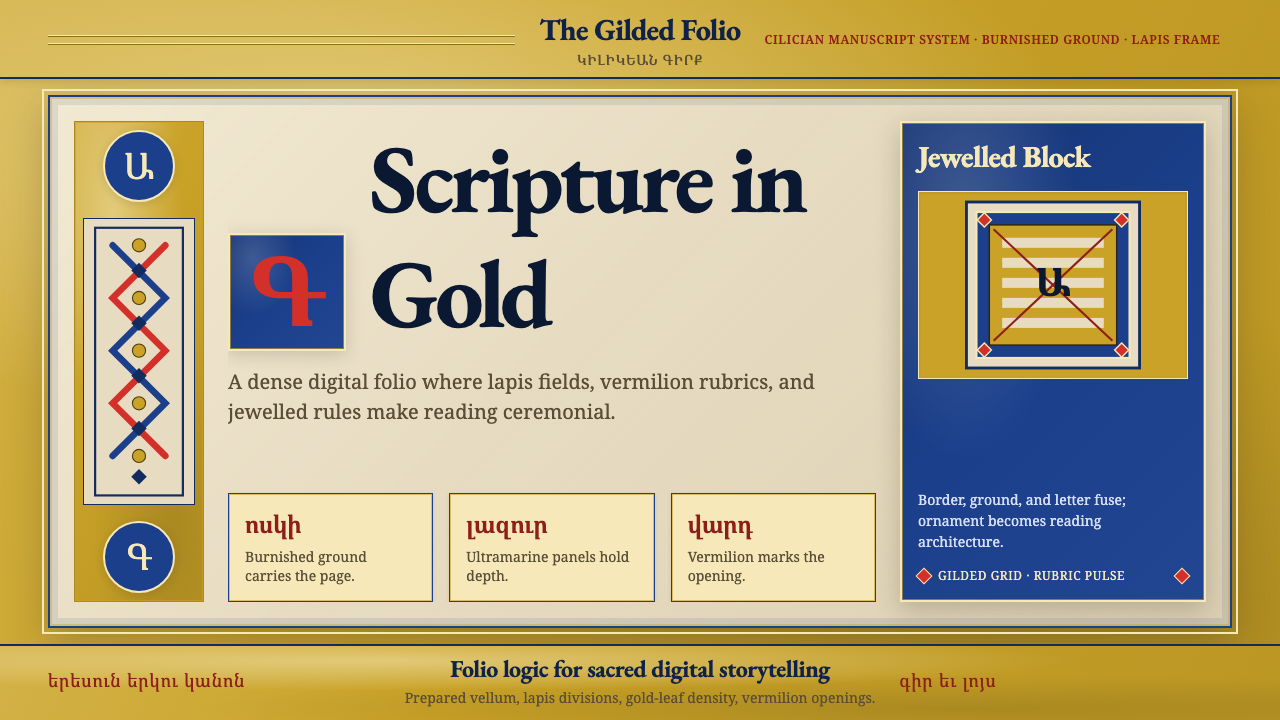 Armenian Illuminated ManuscriptGilded maximalism. Burnished gold, lapis frames, and vermilion initials build…
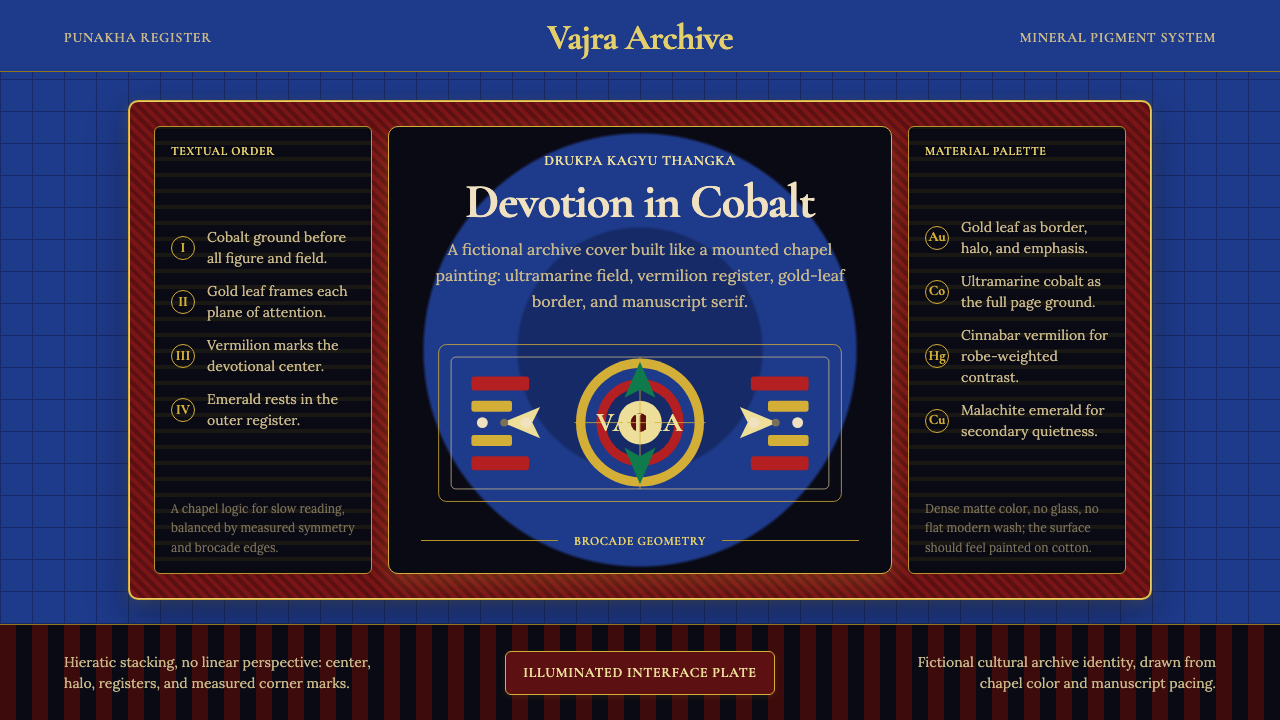 Bhutanese Drukpa Kagyu ThangkaDevotion made cobalt. Gold frames, Cormorant serif, and vermilion marks hold…
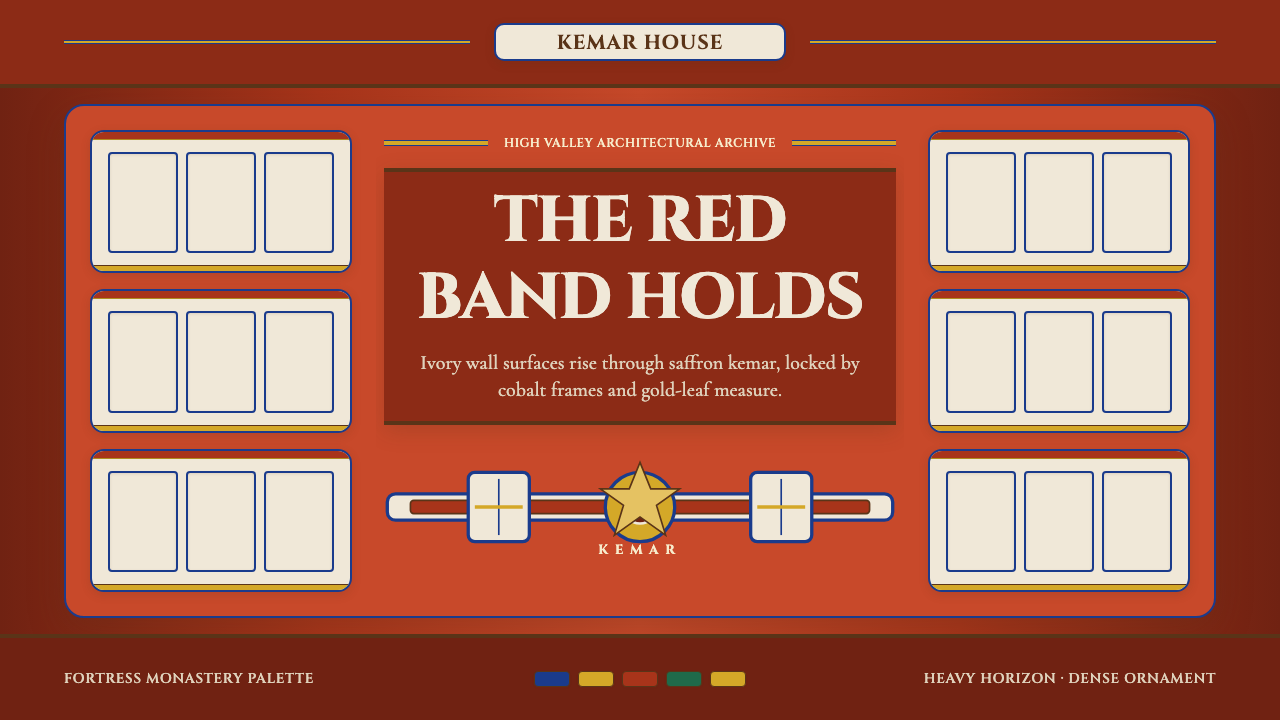 Bhutanese Dzong (Fortress Red)Monumental red holds the page. Cobalt frames and gold bands lock the fortress…
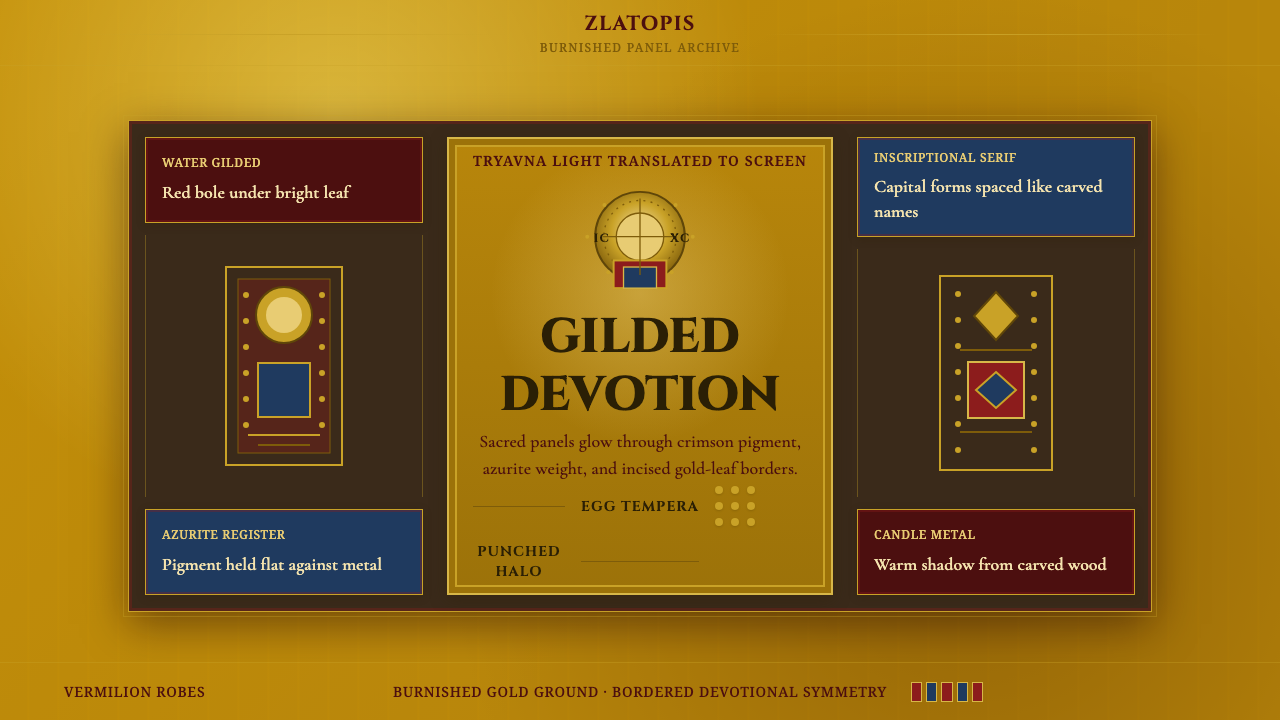 Bulgarian Orthodox IconSacred metal holds still. Burnished gold, crimson panels, and punched halos f…
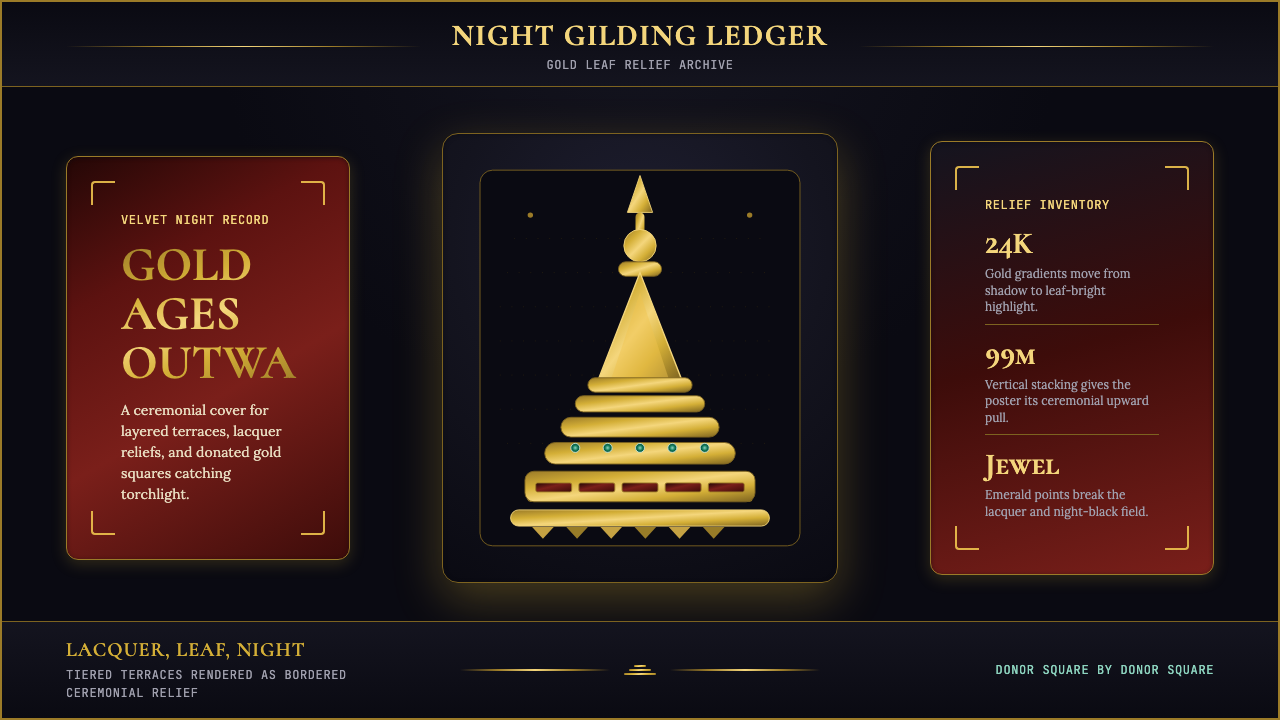 Burmese Shwedagon Stupa ReliefGold refuses restraint. Velvet black, teak-red lacquer, and tiered gradients…
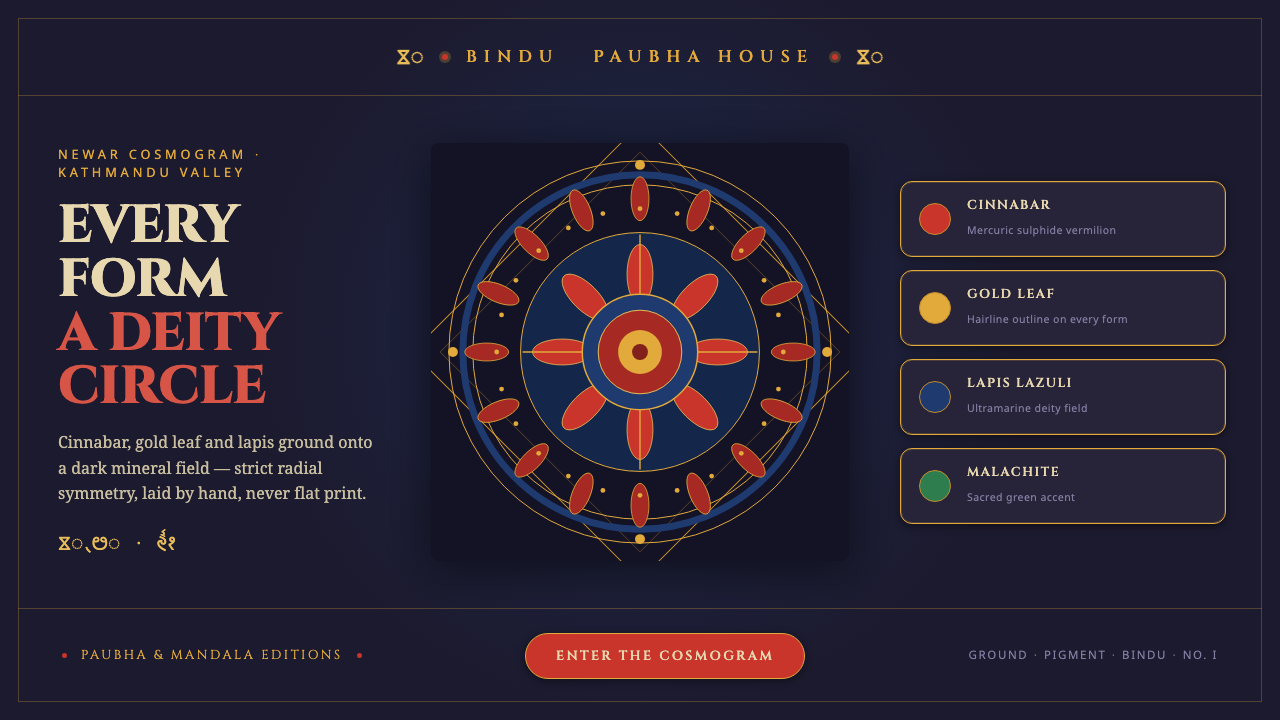 Kathmandu Tantric MandalaSacred geometry as interface. Cinnabar, gold and lapis rings radiate from one…