What is Mughal Miniature (Akbar era)?
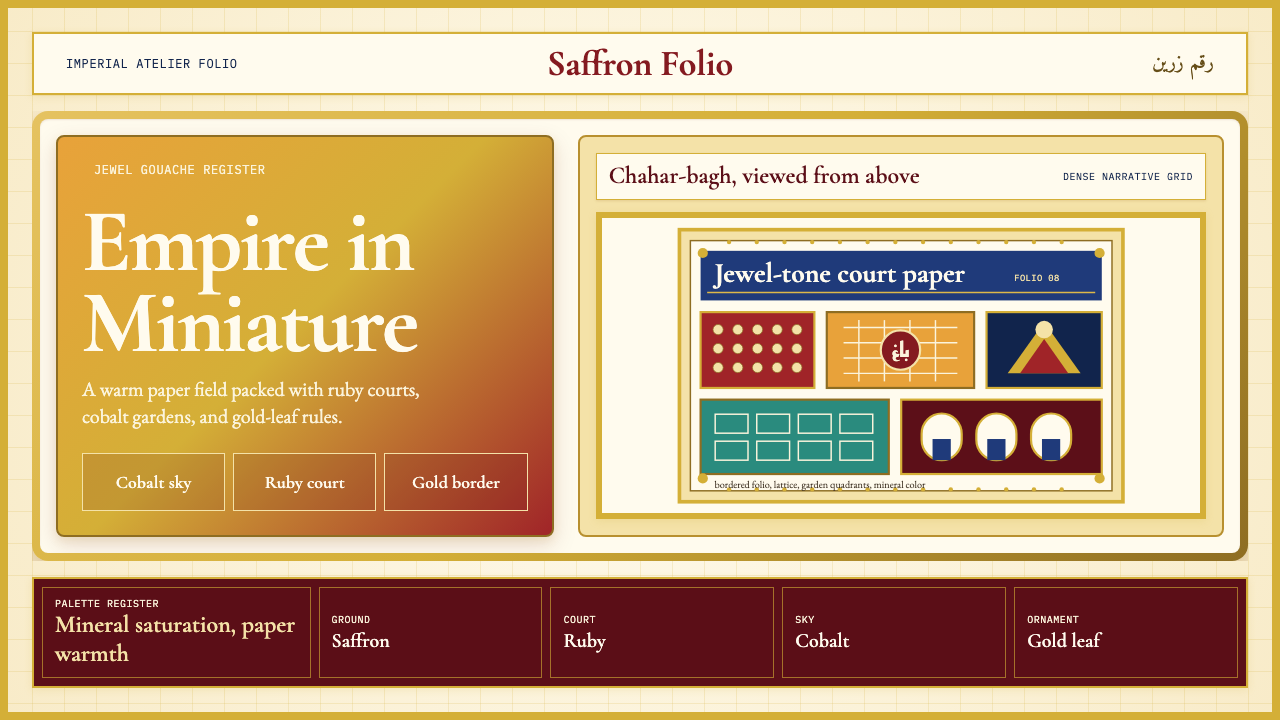
Akbar's imperial atelier fused Persian opulence with Rajput precision, filling every folio with jewel-tone gouache, micro-figures, and gold-leaf borders that refuse to leave a single inch of parchment unoccupied.
Mughal Miniature (Akbar era) in brief
Mughal miniature painting is the Indo-Persian pictorial synthesis that South Asia produced at the height of Mughal imperial power. The style is defined by jewel-tone gouache on warm cream or tinted paper — saffron-orange grounds, ruby-crimson tent panels, cobalt-blue skies, and gold-leaf ornament applied with a brush of a single hair. Every composition is dense with narrative incident: elevated Persian viewpoints pack three to one hundred micro-figures into a single folio, each face a recognizable portrait rendered with startling psychological specificity.
The visual grammar of the Akbar-era atelier (active roughly from the mid-sixteenth century through the early seventeenth) sits at the intersection of Safavid Persian manuscript tradition, Timurid book art, and indigenous Hindu and Jain pictorial conventions. The result is neither purely Persian nor purely Indian — it is a third thing, recognizable by its simultaneous use of Persian spatial recession, Rajput color intensity, and naturalistic portraiture that anticipates European conventions by decades.
What distinguishes Mughal miniature from other courtly painting traditions is its documentary ambition. These were not devotional objects or decorative luxury goods alone; they were visual records of imperial authority — histories, chronicles, and fables translated into images that the emperor himself supervised, annotated, and used as evidence of divine mandate. The paintings are dense precisely because they are meant to be read as well as seen.

Where does Mughal Miniature (Akbar era) come from?
The Mughal imperial painting workshop was formally established by the Emperor Akbar (r. 1556–1605) shortly after he consolidated power following his father Humayun's death. Humayun had spent fifteen years in exile at the Safavid court in Tabriz, and he returned to Delhi in 1555 accompanied by two Persian master painters — Mir Sayyid Ali and Abd al-Samad — who had already begun training Humayun's household painters in the Safavid manner. When Akbar inherited the throne, he expanded this seed workshop dramatically, eventually employing over one hundred painters working simultaneously on projects of unprecedented scale.
The most ambitious early project was the Hamzanama, an illustrated retelling of the adventures of Hamza, uncle of the Prophet Muhammad. Akbar commissioned the work shortly after his accession; it eventually comprised fourteen hundred large-format folios painted over nearly fifteen years, with Mir Sayyid Ali and Abd al-Samad directing teams of Hindu and Muslim painters working side by side. The collaboration was not merely logistical — it was deliberate policy. Akbar's court was a project of imperial synthesis, and the atelier's mixed workforce reflected the emperor's insistence that Hindu painters, many trained in the Rajput tradition, work alongside the Persian masters. The result was a gradual transformation of the style itself: Rajput color intensity and interest in naturalistic animal painting began infiltrating the Safavid-derived spatial conventions.
By the 1580s, when the Akbarnama (the official chronicle of Akbar's reign, illustrated by the painter Basawan among others) was being produced, the workshop had developed a distinctively Mughal visual language. Basawan, a Hindu painter from the Agra atelier, pushed the tradition furthest toward naturalistic portraiture and compositional drama. His figures display genuine emotional specificity — grief, surprise, authority, tenderness — rendered through subtle gradations of posture, gesture, and facial expression that had no precedent in the Persian manuscript tradition. The court moved between Agra, Fatehpur Sikri, Lahore, and Delhi, and each location brought new patronage networks, new building projects, and new visual influences that were absorbed into the workshop's evolving grammar.
The tradition Akbar established continued under his successors Jahangir (r. 1605–1627) and Shah Jahan (r. 1628–1658), each adding new emphases — Jahangir's atelier is famous for botanical and zoological accuracy under painters like Ustad Mansur, while Shah Jahan's produced the architectural and ceremonial grandeur of the Padshahnama. Aurangzeb's austere reign (1658–1707) sharply curtailed court painting, and many workshop painters dispersed to provincial Rajput and Pahari courts, where they seeded regional schools that continued producing miniature painting through the eighteenth and nineteenth centuries. The Akbar-era workshop thus stands as the founding moment — the period when the full vocabulary of Mughal painting was invented and when the synthesis of Persian, Indian, and increasingly European visual influences was at its most creatively volatile.
What defines the Mughal Miniature (Akbar era) look?
Jewel-Tone Palette
The Mughal atelier used mineral pigments ground from lapis lazuli, malachite, cinnabar, and orpiment, producing colors of extraordinary saturation and depth — cobalt blue, ruby red, saffron orange, emerald green, and warm ivory. These hues were not mixed to suggest atmosphere or light; they were applied in flat, saturated zones that read as symbolic registers of space: a crimson Mughal tent interior signals imperial enclosure, a cobalt sky signals open Persian heaven, a saffron ground signals the warm presence of earth and court. Gold leaf, beaten to near transparency, was used for borders, architectural details, and halos, adding a luminous metallic register absent from any purely painted palette.
Elevated Viewpoint and Spatial Density
Mughal compositions employ the elevated Persian viewpoint — a steep, almost isometric perspective that compresses receding space into stacked horizontal bands rather than a single-point cone. This allows the painter to show multiple simultaneous events at different spatial depths without the figures overlapping illegibly. A battle folio might show hand-to-hand combat in the foreground, cavalry maneuver in the middle register, and distant fortifications in the uppermost band — all readable at once. The result is an extreme spatial density that has no Western equivalent: there are no empty passages, no atmospheric distances, no breathing room between narrative elements.
Micro-Figure Portraiture
Perhaps the most technically remarkable feature of Mughal miniature is the psychological specificity achieved at miniature scale. Individual figures in a crowded battle or court scene — sometimes no larger than a thumbnail — are rendered with distinct facial features, recognizable physiognomies, and individualized expressions. The Akbar-era painters, particularly Basawan, developed a vocabulary of posture and gesture that could convey emotional states — reverence, grief, insolence, eagerness — in a figure occupying mere millimeters of the composition. This was partly a function of the fine squirrel-hair brushes used, but primarily a disciplinary achievement: painters spent years learning to control their hand at microscopic scale.
Gold-Leaf Borders and Architectural Framing
Every Mughal folio is bounded by a gold-leaf border of considerable width — a luminous frame that separates the painted field from the surrounding calligraphic text and signals the sacred or imperial status of the image. Within the composition, architectural elements — Mughal pointed arches, jaali lattice screens, pavilion columns, and garden walls — function as internal framing devices that subdivide the picture plane into distinct narrative zones. The combination of external gold border and internal architectural subdivision gives Mughal miniatures their characteristic quality of a picture within a picture within a frame: each zone is complete in itself yet legible as part of a larger whole.
Nastaliq Calligraphy and Text Integration
Mughal miniatures were inseparable from their manuscript context: the painted folios were always conceived in relation to the surrounding Nastaliq Persian script — the flowing, oblique calligraphic style that dominated Mughal literary culture. Inscriptions within the painted field, identifying figures or providing dialogue, are rendered in the same Nastaliq hand. The relationship between text and image was hierarchically clear but visually symbiotic: calligraphy provided the narrative spine; illustration provided the visual body. In the most elaborate manuscripts, cartouche titles in gold Nastaliq were embedded directly into the top margins of the painted field, functioning simultaneously as caption and ornamental panel.
Narrative Simultaneity
Unlike Western painting of the same period, which typically committed a single composition to a single moment in time, Mughal miniature frequently depicted multiple sequential events within a single folio — a convention inherited from Persian and Indian manuscript traditions. A hunting scene might show the quarry fleeing, the moment of the kill, and the triumphant return in separate spatial registers of the same image. This simultaneity is not a compositional confusion but a deliberate narrative strategy: the painting is a synoptic record of an event, not a frozen instant. The viewer is expected to move through the image in time as well as space.
Hybrid Flora, Fauna, and Architectural Vocabulary
Mughal miniature developed a recognizable repertoire of motifs drawn from multiple traditions simultaneously. Garden settings feature the chaharbagh — the four-part Persian-Islamic paradise garden — populated with Indian lotus, cypress, and banana trees. Animals are rendered with naturalistic specificity: the elephants, lions, and exotic birds of the Mughal court were documented with the same precision as the human portrait subjects. Architectural elements are specifically Mughal — the bulbous onion dome, the pierced jaali screen, the chattri pavilion — but they share space with Persian muqarnas vaulting and Rajput corbelling. This layered visual vocabulary is one of the most reliable markers of authentic Mughal-period work.

Who shaped Mughal Miniature (Akbar era)?
Emperor Akbar (r. 1556–1605) was not merely the patron of the imperial atelier — he was its intellectual architect. Though illiterate by some accounts, Akbar was deeply engaged with the visual content of the manuscripts produced in his name, regularly reviewing work in progress and directing narrative choices. He established the system of dual attribution — Persian masters directing, Indian painters executing — that made the stylistic synthesis possible, and he personally inspected finished folios with a connoisseur's eye. His insistence on psychological realism in portraiture was a departure from Safavid convention and drove the atelier toward the naturalistic innovations that define the Akbar-era style.
Basawan was arguably the most innovative painter of the Akbar-era workshop — a Hindu artist from the Agra atelier who pushed Mughal portraiture furthest toward psychological depth and compositional drama. His figures are recognizable across the large illustrated manuscripts by their distinctive emotional specificity: a grieving courtier's hunched shoulders, a soldier's startled backward glance, an emperor's easy authority. Basawan also experimented with European compositional devices — aerial perspective, cast shadow, foreshortening — introduced via prints and paintings reaching the Mughal court from Jesuit missionaries and Portuguese traders, integrating them into an otherwise Persian-derived spatial framework. His collaboration with other workshop painters on single folios — a common Mughal practice — often produced the period's most complex pictorial achievements.
Mir Sayyid Ali was one of the two Persian masters Humayun brought from Tabriz to Delhi in 1555, and he served as the primary director of the Hamzanama project — the sprawling illustrated epic that effectively established the Mughal workshop's operating procedures and visual baseline. Trained in the refined Safavid manner at the court of Shah Tahmasp, he brought with him the technical standards of Persian manuscript painting at its peak: the preparation of the paper ground, the layering of mineral pigments, the use of gold leaf, and the compositional conventions of Persian narrative illustration. His influence on the early atelier was foundational, even as the Hindu painters he trained gradually transformed the style away from its Safavid origins.
Abd al-Samad — called 'Shirin Qalam' (Sweet Pen) by Akbar — was the second of the Persian masters who accompanied Humayun from Tabriz, and he eventually rose to become superintendent of the imperial mint in addition to his role as a master painter. His administrative authority within the imperial household gave the painting workshop institutional stability and court access that a purely artistic appointment might not have secured. As a painter, Abd al-Samad excelled in the depiction of architectural space and decorative surface — the glittering tilework, the geometric garden layouts, and the muqarnas vaulting that define Mughal palatial settings appear in his folios with documentary precision.
Ustad Mansur was the pre-eminent natural history painter of the Mughal atelier, active primarily under Emperor Jahangir (r. 1605–1627) but trained in the tradition Akbar established. Jahangir awarded him the honorific title 'Nadir al-Asr' (Wonder of the Age) for his botanical and zoological studies, which depicted exotic animals — the Siberian crane, the dodo, the turkey — brought to the Mughal court as diplomatic gifts with a precision that rivals European scientific illustration of the period. Mansur's work demonstrates the continuity of the Akbar-era empirical impulse into the succeeding generation: the same documentary ambition that drove Akbar's chronicle illustrations drove Jahangir's natural history program.
How do you use Mughal Miniature (Akbar era) today?
Mughal miniature is among the most visually distinctive historical styles available to contemporary designers, precisely because its visual logic is so foreign to Western modernist defaults — dense rather than spare, ornamental rather than structural, hierarchical rather than democratic. Applying it effectively requires understanding what the system is doing at the level of meaning: saffron-orange grounds signal warmth and terrestrial richness, cobalt registers signal the infinite and the imperial, gold borders signal the sacred and the exceptional. Using these colors decoratively, without that semantic load, produces kitsch rather than design.
For presentation slides, Mughal miniature works best on cover and section-divider pages rather than data-heavy content slides. A cover page in this idiom typically features a rich colored ground — deep saffron, warm terracotta, or jewel cobalt — with a central architectural or floral motif rendered in contrasting color and gold, framed by a layered border system. Slide titles should be set in a typeface with calligraphic warmth, weighted toward the ornate; sans-serif minimalism fights the style's premises at every point. Data slides, where they must occur, work best with the palette reduced to two jewel tones against cream, with decorative borders confined to section headers so the data itself can breathe.
For web interfaces, the style is best suited to editorial contexts, cultural institutions, luxury e-commerce, and heritage brands rather than software dashboards or analytical tools. A Mughal-influenced web layout might use a warm parchment ground rather than a stark white, reserve cobalt or crimson for primary action elements, use dense floral or geometric border patterns as section dividers rather than simple rules, and treat photography as if it were a folio — framed, elevated, never bleeding to the edge. Navigation should feel like a manuscript colophon: slightly ceremonial, weighted, deliberate. Avoid light-weight or condensed typefaces that undercut the style's inherent gravitas.
For editorial and marketing work, the Mughal miniature vocabulary supports rich storytelling contexts: cultural travel brands, luxury textile or jewelry campaigns, museum publications, and platforms positioning themselves in relation to heritage craft. A Mughal-influenced editorial spread might use a full saffron or deep crimson background for feature openers, dense ornamental borders as section markers, and gold-ink equivalents for headline type. The visual model is the illuminated manuscript page: every element of the spread is considered part of a unified decorative field rather than functional components arranged on a neutral grid.
The most common mistake when applying this style is surface exoticism — borrowing the color palette and the ornamental motifs without understanding the underlying principles of density, hierarchy, and narrative simultaneity. A layout that uses jewel tones and floral borders but retains the sparse, white-ground minimalism of contemporary design is not Mughal — it is Mughal wallpaper over a modernist skeleton. Authentic application requires committing to density: more color, more layering, more visual incident per unit of space than Western modernist design instincts will naturally allow. The second common mistake is treating gold as a generic luxury signal rather than as a structural element: in the original tradition, gold borders and gold inscriptions mark the sacred and the hierarchically supreme, not merely the expensive.

Mughal Miniature (Akbar era) — FAQ
Is Mughal miniature the same as Persian miniature painting?
They share deep roots but are distinct traditions. Mughal miniature descended directly from Safavid Persian painting — specifically the Tabriz school under Shah Tahmasp — via the two masters Humayun brought to Delhi in 1555. But within a single generation, Mughal painting diverged substantially. The Safavid tradition maintained a relatively consistent idealized figure type and a flattened, patterned landscape; Mughal painting introduced individualized portraiture, increased spatial depth, naturalistic animal and botanical study, and direct engagement with European pictorial conventions arriving through Jesuit and Portuguese contact. By the Akbar era, Mughal miniature was already its own tradition — related to but clearly distinguishable from any contemporary Safavid work.
Can this style work in digital design without looking like a costume or theme?
Yes, but it requires extracting structural principles rather than copying surface motifs. The Mughal visual system offers genuinely transferable ideas: the use of saturated color as semantic register (not just decoration), the layered border as a framing system for content hierarchy, the dense compositional approach that treats every zone of the layout as meaningful rather than leaving empty space as a default. Applied at the level of principle rather than pastiche, these ideas produce design that feels rich and authoritative without feeling costumed. The failure mode is using lotus borders and saffron backgrounds while retaining the underlying structure of a contemporary minimal layout — that produces theme-park Mughal. The success mode is genuinely rethinking the compositional logic from the ground up within the style's premises.
How should gold be used in a design inspired by Mughal miniature?
In the original manuscripts, gold performs two functions: it marks borders (the liminal zone between the image and the surrounding text world) and it marks the hierarchically supreme within the image (halos, throne canopies, divine light, imperial regalia). It is never used as a background fill or as a diffuse glow; it is always a precise, bounded element. In digital or print application, this translates to: use gold for borders and framing elements, for the highest level of typographic hierarchy, and for selective emphasis on elements of genuine hierarchical importance. Avoid using gold as a general-purpose luxury texture, as ambient metallic sheen, or as a gradient element — all of those applications drain the color of its semantic specificity and reduce it to period decoration.
What typefaces pair well with this aesthetic in contemporary work?
The original manuscripts paired Nastaliq Persian calligraphy with the painted images — a script with distinctive oblique flow, compact descenders, and calligraphic warmth that has no exact Latin equivalent. In contemporary Latin-alphabet design, the closest analogues are high-contrast, bracketed-serif display typefaces with calligraphic origins — typefaces where the pen angle is evident in the stroke modulation and where the letterforms have genuine historical depth rather than geometric reductionism. Transitional and old-style serifs work better than modern high-contrast serifs, which tend to feel cold. For Chinese text, brushstroke-influenced Songti or calligraphic styles complement the aesthetic better than purely geometric or neo-grotesque designs. The key principle: the typeface should feel as if it was made by a skilled human hand, even if it was not.
Is Mughal miniature appropriate for brands or products not connected to South Asian culture?
The appropriateness depends on how the style is engaged with rather than whether a cultural connection exists. A brand using Mughal visual vocabulary superficially — lotus borders on a generic product, jewel tones as exotic color, miniature motifs as novelty — risks aestheticizing a living cultural tradition as costume. A brand that engages with the style through genuine research, uses it to communicate values authentically aligned with what the style represents (density, hierarchy, imperial richness, documentary ambition), and does so with acknowledgment of its origins is on more defensible ground. The distinction is between borrowing surface and engaging with meaning. Practically: committing to understanding the system deeply enough to apply it with structural fidelity — not just chromatic imitation — is both the ethical and the aesthetic prerequisite.
Related design styles
 Bhutanese Dzong (Fortress Red)Monumental red holds the page. Cobalt frames and gold bands lock the fortress…
 Lao Naga Temple StencilDevotional gilt, not chrome. Flat gold-leaf naga and flame stencils glow on o…
 Nepali Paubha (Newari Scroll)Sacred density. Cinnabar ground, gold-leaf frame, lapis rings in strict symme…
 Thai Lanna Tai Yai TempleSacred lacquer glows. Vermilion ground, Cinzel capitals, gold cassette symmet…
 Bhutanese Drukpa Kagyu ThangkaDevotion made cobalt. Gold frames, Cormorant serif, and vermilion marks hold…
 Burmese Shwedagon Gold-LacquerOpulence catches fire. Gold-leaf gradients on cinnabar panels frame a stupa s…