What is Burmese Shwedagon Stupa Relief?
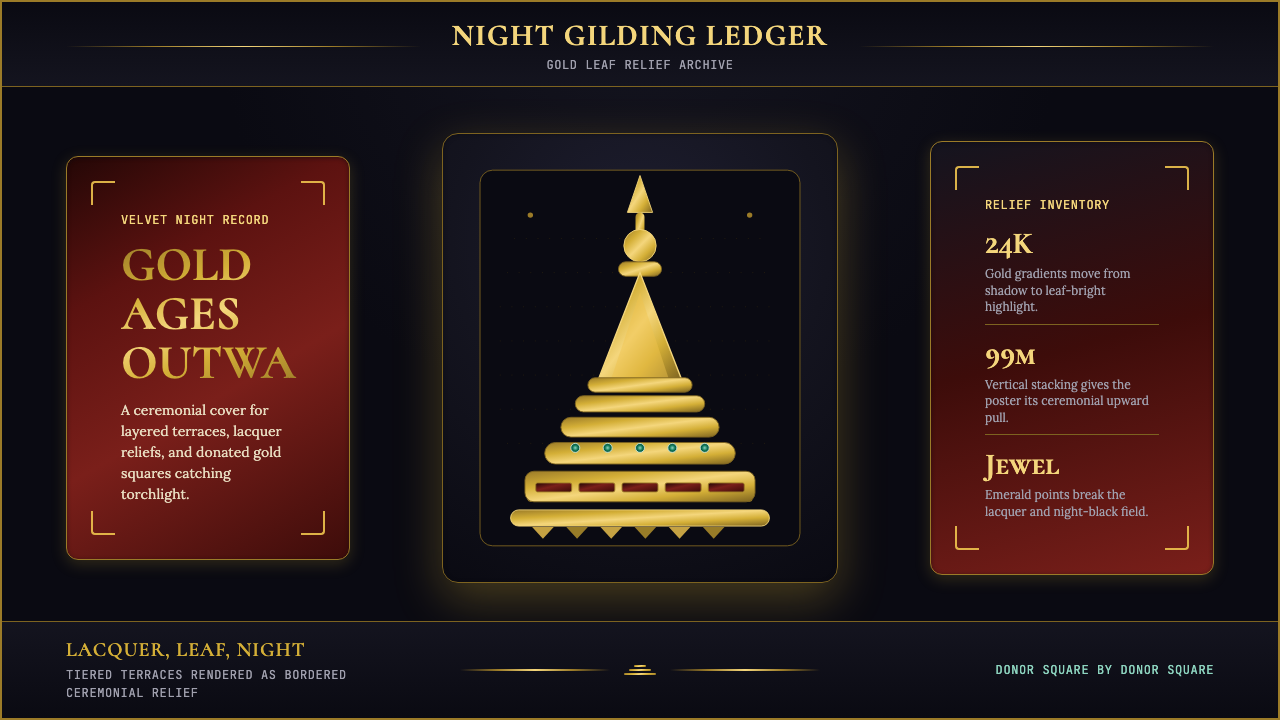
The Shwedagon Pagoda blazes against the tropical night in a visual language where consecrated gold, teak-red lacquer, and jewel-toned accents collapse centuries of devotion into a single overwhelming composition.
Burmese Shwedagon Stupa Relief in brief
Burmese Shwedagon Stupa Relief is a design language drawn directly from the night experience of Yangon's Shwedagon Pagoda — a monument whose surface is clad in individual gold-leaf squares donated by pilgrims across many centuries, set against the absolute darkness of a tropical sky. The visual system translates this encounter into a contemporary design idiom: deep black grounds, brilliant gold-gradient ornament, velvet-dark lacquer panels, and gem-green accents that suggest the pagoda's emerald and sapphire settings.
The language is one of sacred density. Where modernist traditions strip ornament away, this system layers it with purpose: each tier of gilded ornament references the stupa's ascending terraces, each border pattern echoes the chinthe-lion guardian figures and lotus motifs carved into the pagoda's stone base. Density is not clutter — it is devotional accumulation, and the visual logic treats each added element as an offering rather than decoration.
The result is a dark, luminous, ceremonially weighted aesthetic that stands in deliberate contrast to Western minimalism. Backgrounds are near-black or deep velvet; gold reads as warm, dimensional, and consecrated rather than showy; typography is formal and unhurried. The system is suited to any context where richness, reverence, and cultural specificity need to be communicated without apology.
Where does Burmese Shwedagon Stupa Relief come from?
The Shwedagon Pagoda has the deepest continuous sacred history of any Buddhist monument in Southeast Asia. According to tradition, it was originally raised in the sixth century BCE — contemporaneous with the historical Buddha — to enshrine eight of the Buddha's hairs gifted to two merchant brothers from the Mon kingdom. While this founding date lies in the realm of devotional history, excavated inscriptions and architectural evidence confirm continuous development since at least the eleventh century CE, making the pagoda a living architectural document spanning more than a thousand years of Burmese and Mon Buddhist practice.
The monument's current visual identity is largely the product of the fifteenth through eighteenth centuries. Queen Shin Sawbu, who ruled Pegu in the mid-fifteenth century, is credited with establishing the tradition of weighing herself in gold and donating that weight in gold leaf to plate the stupa — a practice that initiated the cycles of re-plating that continue to this day. King Hsinbyushin of the Konbaung dynasty completed major reconstructions after a devastating earthquake in 1769, and it is largely his era's patronage that fixed the present proportions: a bell-shaped lower section rising through multiple terraces to a fluted spire and, at the very top, a jewel-tipped umbrella finial set with diamonds, rubies, sapphires, and emeralds.
The visual ecology of the Shwedagon is inseparable from Burmese lacquerware tradition, one of the country's oldest and most technically demanding crafts. Lacquer — derived from the thitsi tree — is applied in many layers over wicker, bamboo, or wood forms, polished between coats, and finally carved or painted with mythological figures, floral scrollwork, and ceremonial scenes. The deep red-brown of cured lacquer and the black of lacquered grounds are the pagoda's secondary palette, appearing in the decorative pavilions, offering tables, and shrine furniture that surround the main stupa. This craft lineage gives the design system its distinctive material registers: gold is never isolated but always set against the rich darkness of lacquered grounds.
Modern photographic documentation of the Shwedagon — particularly the nocturnal photography that became widespread from the late twentieth century onward — crystallized a specific visual interpretation of the monument: the stupa as a luminous object suspended in near-perfect darkness, its gold surface breaking the night with graduated warmth. This photographic register, rather than the daylight experience of the pagoda, is the direct visual ancestor of the Shwedagon Stupa Relief design language. Conservators and artisans including U Win Maung and Win Pe have documented the ongoing restoration practices, ensuring that the methods of gold-leaf application and lacquerwork that define the monument's material identity are preserved and transmitted.
What defines the Burmese Shwedagon Stupa Relief look?
Gold as Sacred Material
Gold in this system is not a flat tint but a material presence — warm, graduated, and multidirectional in its luminosity. It behaves as if lit from within, with deeper amber tones at edges and edges giving way to near-white brilliance at the most elevated surfaces. This graduated warmth directly references the visual behavior of actual gold leaf on curved architectural forms, where the angle of light produces constantly shifting tonal variation. Gold is reserved for the most structurally significant elements — headings, primary calls to action, structural borders — and never used as background fill for large areas, which would read as excess rather than consecration.
Deep Black and Lacquer Grounds
The primary background is a near-absolute black that reads as dense and material rather than digital void — evoking the polished lacquer grounds of Burmese decorative furniture and shrine objects. Against this ground, every gold element acquires heightened luminosity through contrast. Subsidiary surfaces use deep teak-brown and lacquer-red as grounding tones, giving large areas of the composition a sense of layered material depth rather than flat darkness. These lacquer-ground tones prevent the overall palette from collapsing into simple high-contrast black-and-gold, instead producing a composition with genuine tonal range.
Jewel Accents
Emerald green and sapphire blue appear as controlled accent tones drawn from the literal gemstone settings at the pagoda's apex — the diamond-studded umbrella finial that terminates the spire is encrusted with rubies, sapphires, and emeralds. In the design system, these gem tones function as tertiary accents: high-saturation, small-area touches that create moments of brilliance within the predominantly gold-and-black composition. They are used for notification indicators, status elements, or decorative detail points — never as structural color for large layout elements.
Tiered and Layered Ornament
Burmese stupa architecture is defined by ascent through multiple terraces — each tier slightly narrower than the one below, creating a rhythm of horizontal bands that draws the eye upward toward the spire. The design system translates this architectural logic into visual layering: borders nest within borders, panels are framed by decorative strips, and hierarchical information is organized in stacked tiers rather than flat columns. This layered approach is not gratuitous complexity but a deliberate structural metaphor — each ring of ornament marks a threshold, a step in an upward progression.
Ceremonial Typography
Type choices lean toward the formal and unhurried — high-contrast serif letterforms that carry a sense of weight, occasion, and deliberateness. Titles are set with generous letter-spacing and occupy central positions in compositions, echoing the inscriptional quality of stone-carved dedicatory texts found throughout the pagoda complex. Body text is treated as secondary information, given quieter weight and less visual prominence, ensuring that the ornamental and structural hierarchy of the composition is never undermined by typographic competition.
Luminosity Through Contrast
The system's primary expressive mechanism is extreme value contrast between near-black grounds and near-white or bright-gold figures. This approach produces a sense of internal luminosity — elements appear to glow rather than simply to be colored. The effect is deliberately evocative of the candle-and-floodlight illumination of the actual pagoda at night, where points of intense brightness appear against absolute darkness. Intermediate grey tones are used sparingly, mainly for secondary informational elements, to preserve the drama of the primary contrast.
Guardian and Protective Motifs
Shwedagon's sculptural program includes chinthe — mythical lion-dragon guardian figures that flank every stairway entrance — alongside naga serpent railings, lotus-bud pinnacles, and floral petal scrollwork. These motifs enter the design system as structural border elements: corners and edges are marked by zoomorphic or botanical forms that signal protection, threshold, and sanctity. Rather than importing these motifs literally, the system uses their structural logic — bilateral symmetry, rhythmic repetition, hierarchical placement at entry points — to organize the visual field.
Who shaped Burmese Shwedagon Stupa Relief?
Queen Shin Sawbu ruled the Mon kingdom of Pegu in the mid-fifteenth century and is credited with initiating the tradition of weighing oneself in gold and donating that weight in gold leaf to plate the Shwedagon's stupa. This act established the devotional logic of the monument as a site of continuous material accumulation — a practice that has continued for more than five hundred years and accounts for the pagoda's current extraordinary surface density. Shin Sawbu is also credited with laying out the surrounding terrace complex and establishing protocols for the management of donations, making her as significant to the monument's organizational identity as to its material one.
Hsinbyushin, fourth king of the Konbaung dynasty, oversaw major reconstruction of the Shwedagon after a severe earthquake in 1769. His patronage funded the raising of the main stupa to close to its current height and the installation of the ornamental umbrella at the apex with its extraordinary gemstone settings. The Konbaung dynasty's investment in the pagoda — conducted against a background of military expansion and dynastic legitimation — is why the monument's current visual language reflects eighteenth-century Burmese royal aesthetics as much as it does older Mon Buddhist traditions.
U Win Maung is among the most significant figures in the documentation and conservation of Burmese Buddhist material culture in the twentieth century. His work on the architectural and decorative records of the Shwedagon and related monuments provided systematic photographic and measured documentation of the pagoda's ornamental program at a level of detail that had not previously existed. This documentation established the visual archive from which contemporary designers working in the Shwedagon idiom draw — the catalogued inventory of guardian figures, lotus capitals, naga railings, and tiered cornice profiles that defines the monument's ornamental vocabulary.
Win Pe worked within the tradition of Burmese lacquerware conservation and was involved in the documentation of the craft techniques used in the production of the devotional objects, furniture, and architectural elements that populate the Shwedagon's surrounding terraces. His contribution to preserving the technical knowledge of thitsi-based lacquer application — the layering, polishing, and carving methods that produce the deep red-black surfaces characteristic of the tradition — helped ensure that the material language of Burmese sacred craft remained available to subsequent generations of artisans and, by extension, to designers working in this visual idiom.
How do you use Burmese Shwedagon Stupa Relief today?
The Shwedagon Stupa Relief language is among the most specific of all dark ceremonial aesthetics in terms of what it communicates: consecration, accumulated devotion, and culturally rooted grandeur. Applying it well requires understanding this specificity — it is not a generic dark-luxury mode but a system with a coherent material and spiritual ancestry. Used with that understanding, it is remarkably effective for high-stakes presentation contexts, premium digital products, and editorial work that needs to convey depth without distance.
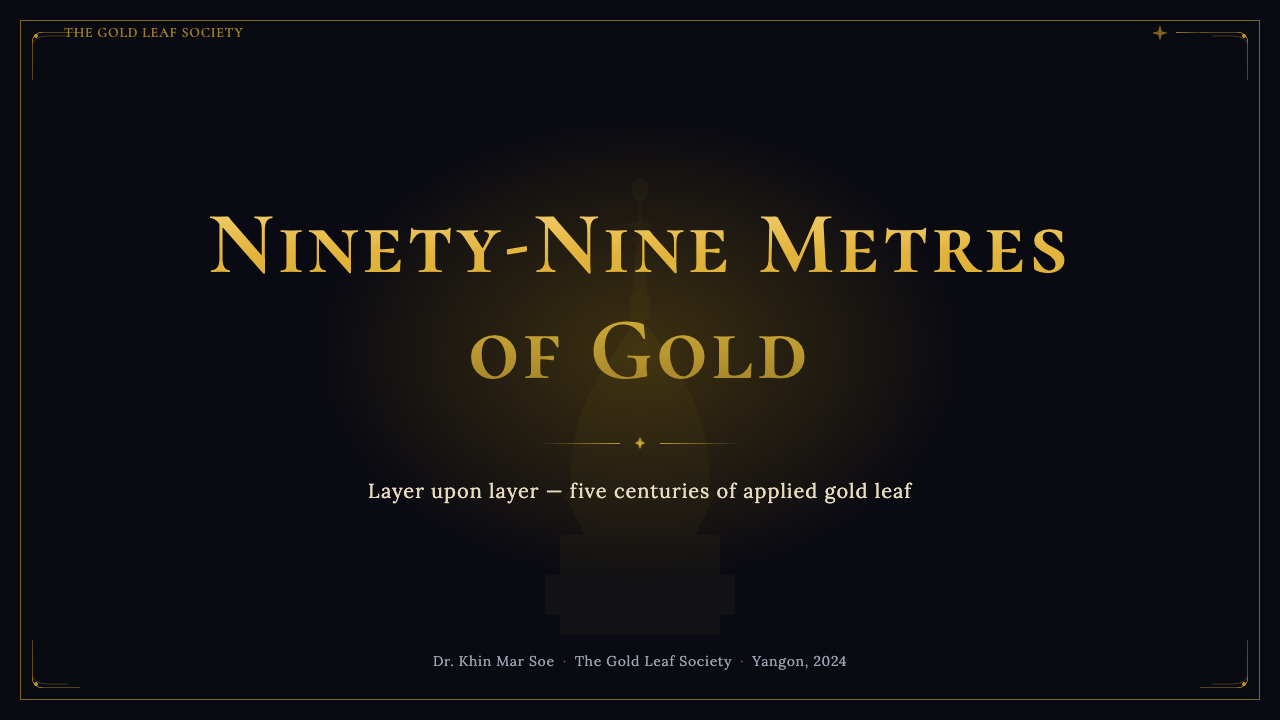
For presentation slides, the system is particularly powerful on cover pages and section dividers. A cover works best with a near-black ground, a central compositional element in layered gold gradient, and title text in high-contrast formal type — no busy backgrounds, no competing secondary imagery. Section dividers can introduce the lacquer-red accent as a banding element, creating a visual rhythm that echoes the pagoda's ascending terraces. Content slides should strip back to a simpler register: the ground remains dark, gold is reserved for headings and critical callouts, and body information is given in a neutral cream or soft warm white. Data visualization in this system works well when charts are treated as contained panels with gold-bordered frames, bars and segments picked out in the primary gold and gem-accent palette.
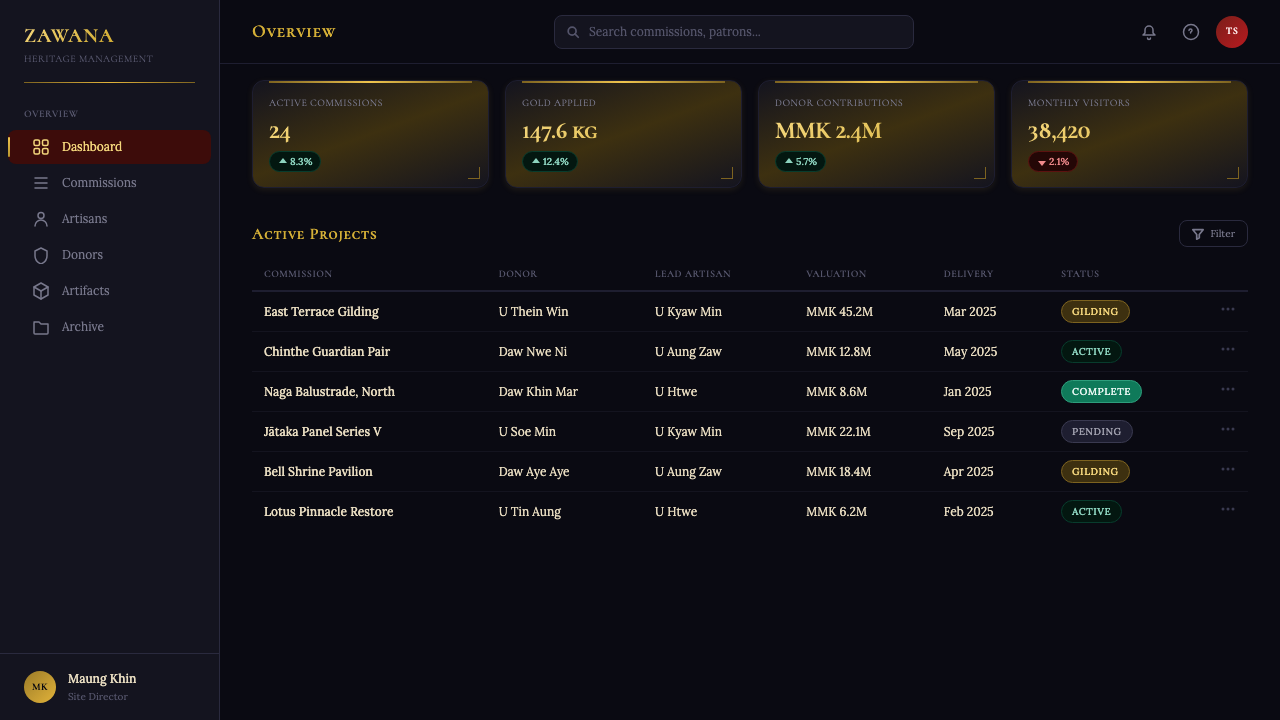
For web interfaces, this language is well suited to premium product pages, cultural or museum contexts, luxury e-commerce, and entertainment platforms. The dark ground and gold hierarchy naturally organize a pricing page by tier — the highest tier takes the most gold; middle tiers use lacquer-red as their accent; base tiers step back to cream-and-warm-white on dark. Navigation should be restrained: wordmarks in gold, links in warm neutral, with active states highlighted by a thin gold underline rather than background fills. Cards should use a layered border treatment — a thin outer border in near-black, an inner inset of the lacquer-panel tone — that recalls the decorative frames of Burmese shrine furniture without directly copying them.
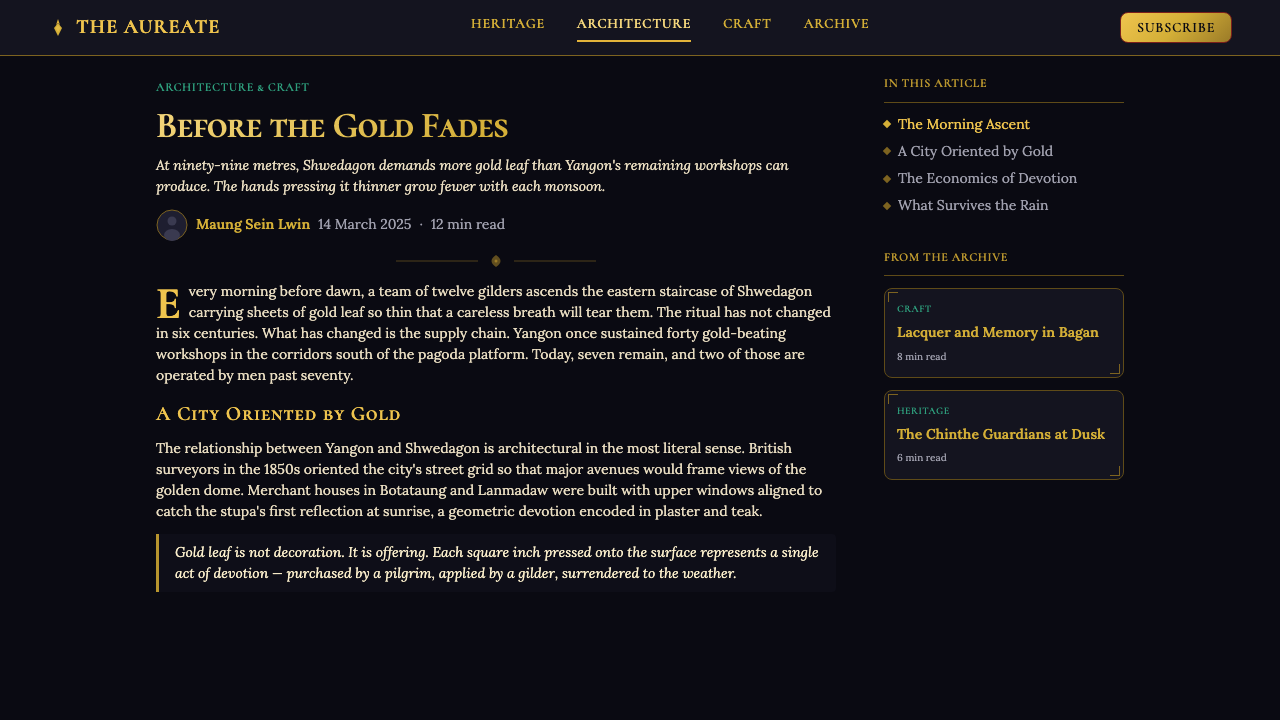
For editorial and marketing work, the style supports rich long-form reading environments and high-presence campaign imagery. An article layout in this language uses a dark masthead with the publication mark in gold, a slightly lightened content well for body text readability, and pull quotes or chapter headings in the full gold treatment. Marketing pages benefit from alternating full-width panels: a gold-on-near-black feature block, followed by a lacquer-warm-dark narrative section, followed by a gem-accent testimonial or feature point. The rhythm of these alternating sections creates the sense of ascending tiers — always moving the reader upward toward the core message.
The most common mistake when working with this system is treating gold as a background color rather than a figure color. Gold placed as a solid fill beneath dark text inverts the fundamental contrast logic of the Shwedagon aesthetic — it washes out the luminous-against-dark effect that the system depends on. The second common error is mixing the system's ceremonial density with contemporary minimalist negative space conventions: the Shwedagon idiom requires compositional fullness — borders, layered frames, and ornamental weight — and looks under-realized when applied with a sparse hand. If the composition feels empty, add structure; do not add arbitrary color.
Burmese Shwedagon Stupa Relief — FAQ
How is Burmese Shwedagon Stupa Relief different from other gold-on-dark luxury aesthetics?
Generic luxury gold-on-dark — as found in financial services, prestige automotive, or high fashion — typically uses gold as a flat metallic tone applied to a single compositional level. Shwedagon Stupa Relief layers gold across multiple tiers, uses graduated warmth rather than flat color, sets gold against lacquer grounds rather than pure black, and introduces jewel-tone accents drawn from an explicit architectural source. The result reads as devotionally specific rather than generically premium — it communicates a particular cultural and spiritual inheritance, not just market positioning.
Can this aesthetic work for digital products aimed at non-Burmese audiences?
Yes, but the approach matters. Applied with fluency and genuine understanding of the source material — its architectural origins, its craft traditions, its devotional logic — the Shwedagon idiom translates into a powerful visual language for global premium contexts, because it communicates qualities (consecration, accumulated value, luminosity against darkness) that are widely legible. Applied superficially — simply using dark backgrounds and yellow-gold accents — it collapses into generic dark luxury and loses its distinctiveness. The system rewards investment in understanding rather than surface borrowing.
How do the jewel accents — emerald green and sapphire blue — get used without competing with the gold?
The key is surface area and placement hierarchy. Gold covers the structurally significant elements — headings, primary borders, key calls to action. Jewel tones appear only in tertiary positions: small status indicators, corner decorative details, the occasional notification dot. They are never set directly adjacent to gold at equal scale — that would create harmonic competition rather than complement. When in doubt, restrict jewel accents to elements that are informationally secondary and physically small, so that their high saturation reads as a bright point rather than a competing focal element.
Is the decorative density of this system a problem for information-heavy interfaces?
It requires management rather than avoidance. The solution is to distinguish clearly between two registers: the ceremonial frame and the informational content. Chrome elements — navigation, borders, section headers, footers — can carry the full ornamental density of the system. The content well itself should be treated more simply: dark but undecorated ground, clear typographic hierarchy, adequate spacing between information blocks. This separation means the overall composition reads as rich and structured, while individual content items remain legible and scannable. Think of it as the relationship between the pagoda's elaborately decorated terrace perimeter and the clear navigational paths laid out between the shrines.
Does this aesthetic work for light-background or daytime-register interfaces?
With significant care, but it is not the natural register of this system. The Shwedagon idiom derives its power from the night experience of the pagoda — luminosity against absolute darkness. On a light ground, gold loses its luminous contrast, becomes closer to khaki or ochre, and the jewel accents lose their brilliance entirely. A light variant can work if the gold is reserved for the darkest elements in the composition — dark headings, strong borders on cream grounds — but it is a fundamentally different visual proposition. If a light interface is required, it may be worth considering whether a different style entirely is better suited to the context, or whether a restricted dark panel can be used as a component within an otherwise light layout.
Related design styles
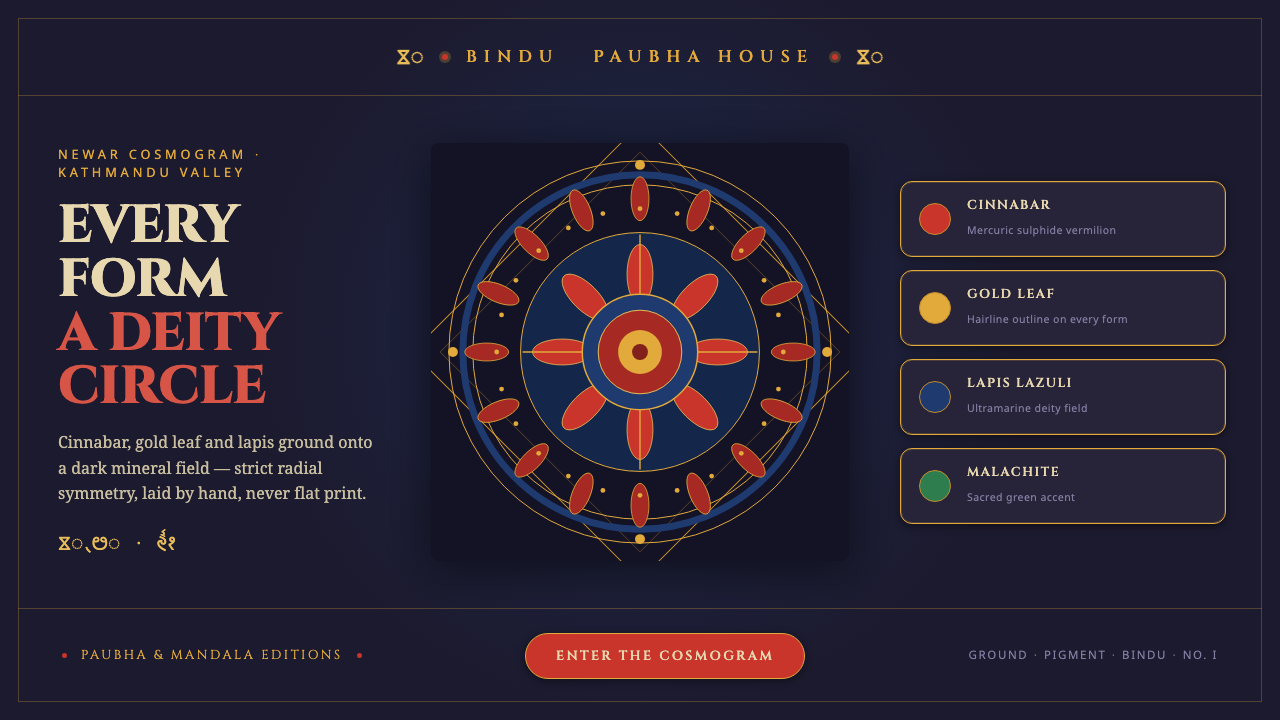 Kathmandu Tantric MandalaSacred geometry as interface. Cinnabar, gold and lapis rings radiate from one…
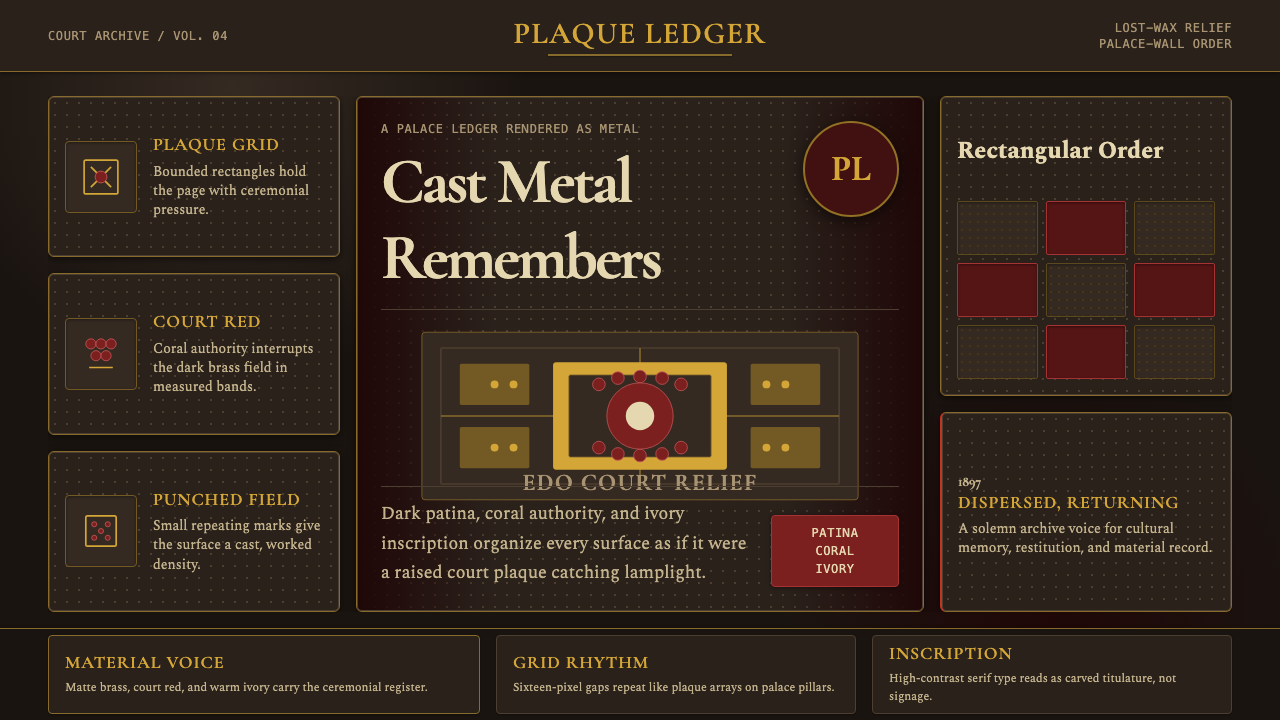 Benin Bronze Oba CourtCourt gravity in cast metal. Patinated brass grid, coral red panels, ivory se…
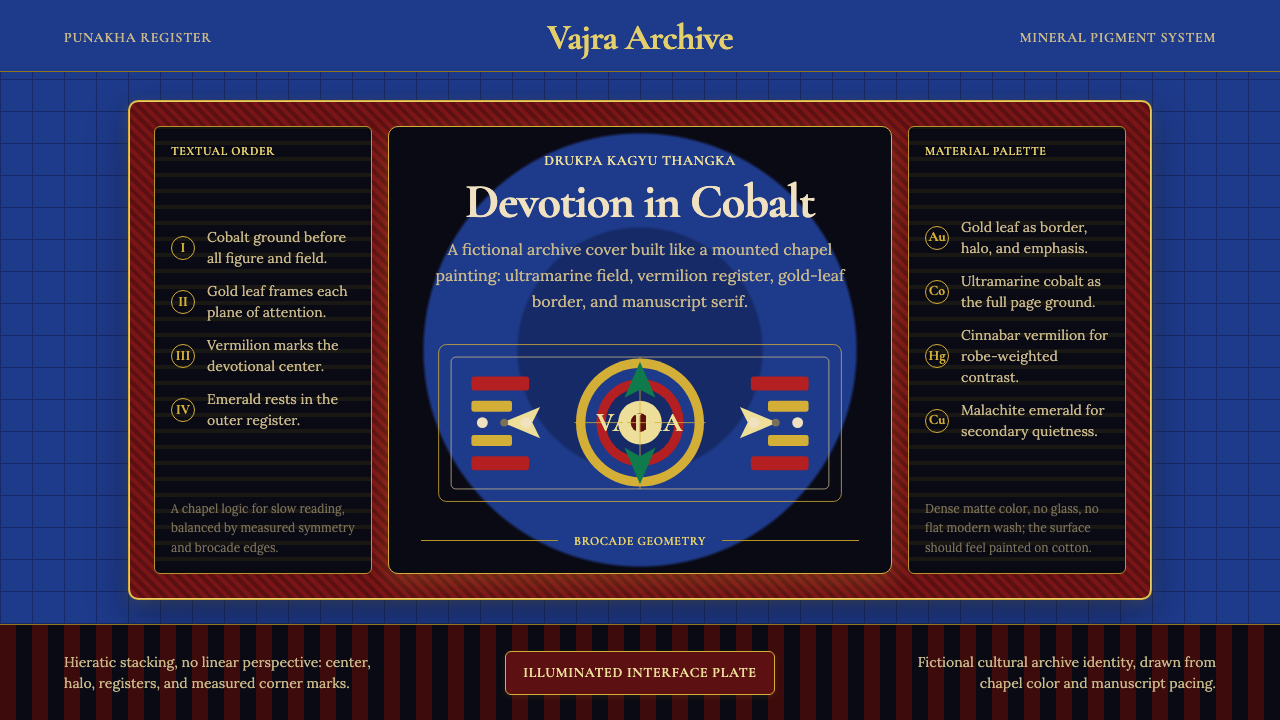 Bhutanese Drukpa Kagyu ThangkaDevotion made cobalt. Gold frames, Cormorant serif, and vermilion marks hold…
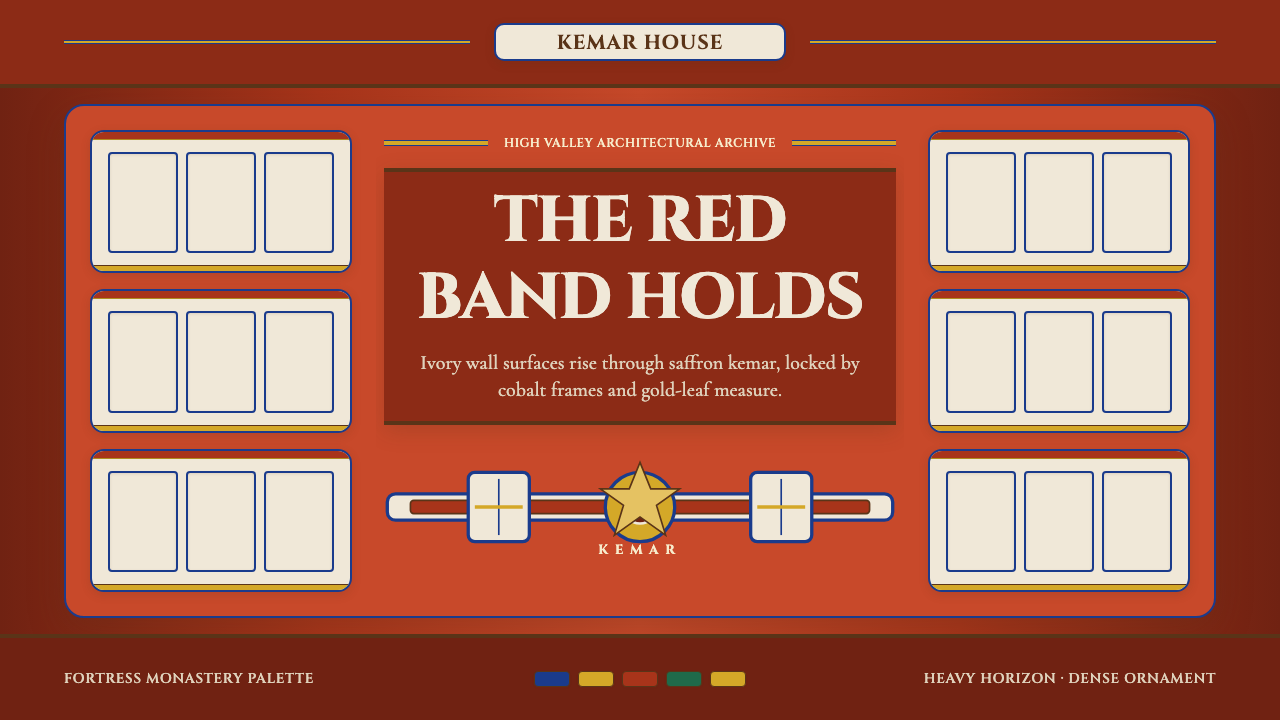 Bhutanese Dzong (Fortress Red)Monumental red holds the page. Cobalt frames and gold bands lock the fortress…
 Bird of Paradise MonographTheatrical plate-book darkness. Flame plumes blaze from a bordered forest-bla…
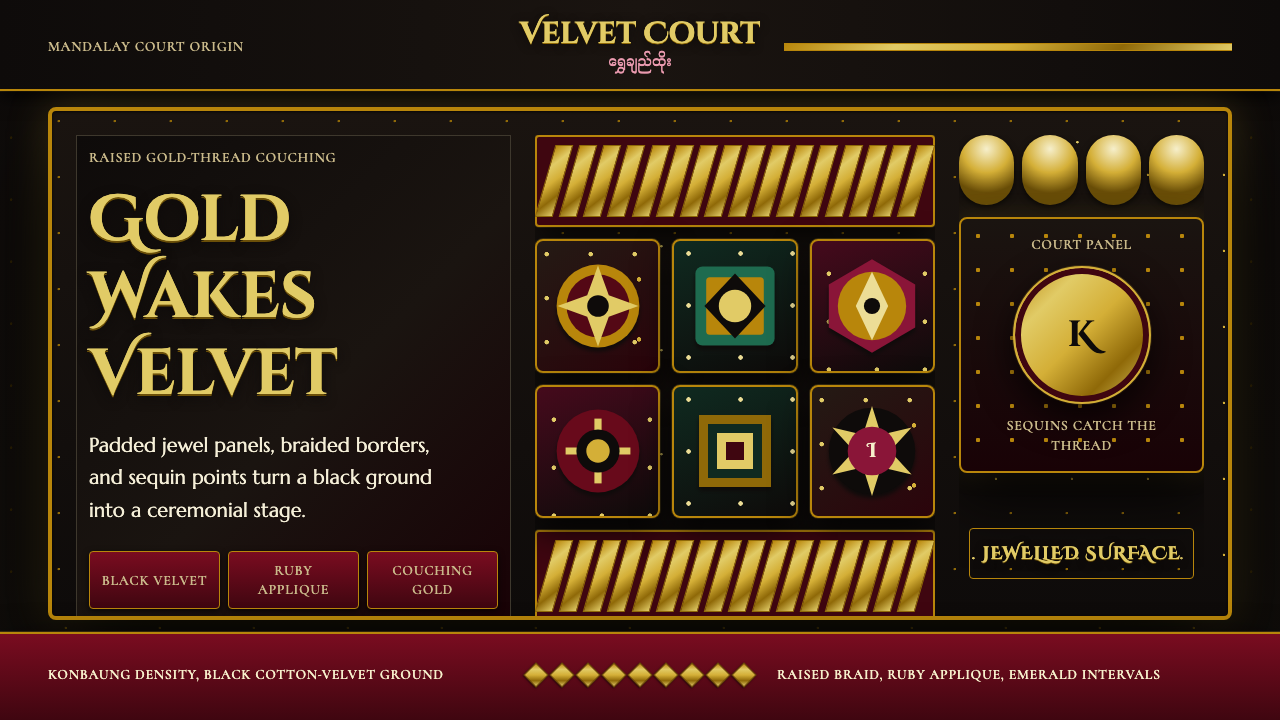 Burmese Kalaga TapestryVelvet becomes theater. Black ground, gold-thread borders, ruby and emerald p…