What is Greek Vase Attic (500 BC)?
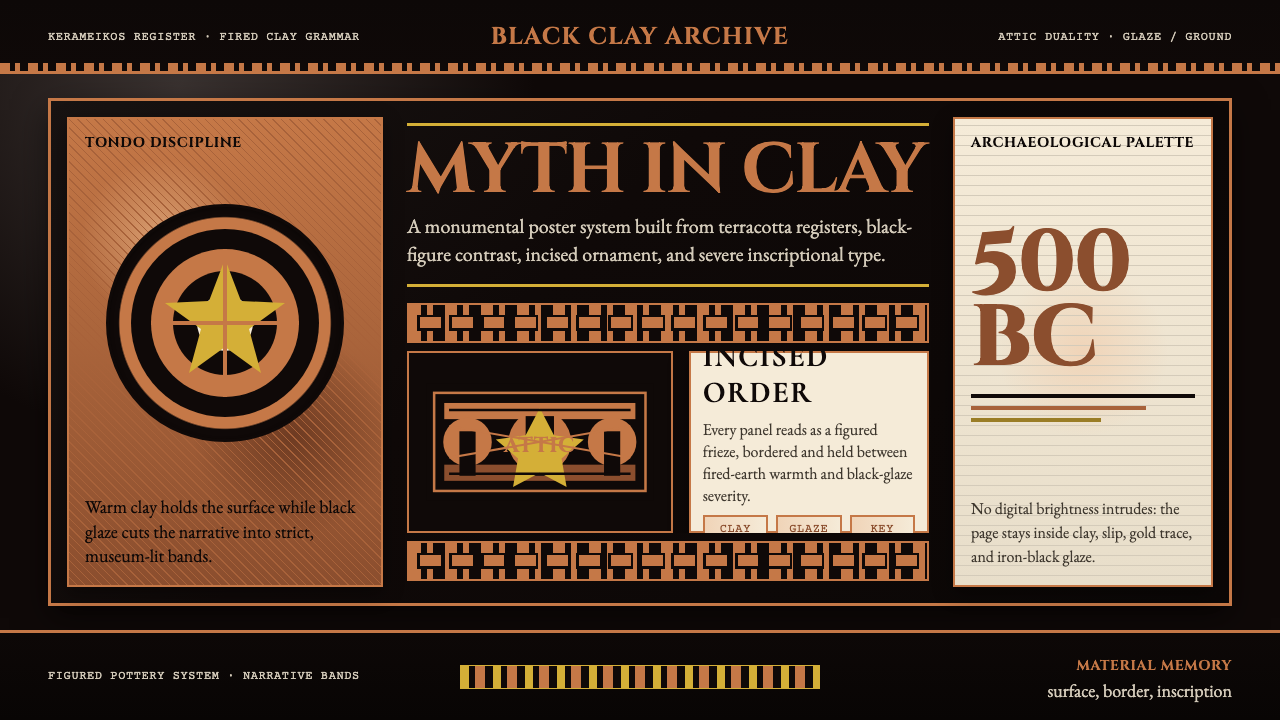
Black glaze, terracotta ground, and incised silhouette — the visual language of Attic vase painting turns two fired pigments into one of antiquity's most enduring narrative systems.
Greek Vase Attic (500 BC) in brief
Greek Vase Attic (500 BC) is a design aesthetic drawn from the peak era of Athenian ceramic painting, a tradition that flourished in the Kerameikos pottery district of Athens between approximately 620 and 320 BCE, reaching its expressive height around 500 BCE. The visual system is defined by a radical binary: jet-black glaze set against a warm, orange-toned clay body — or, in the later red-figure technique, the inverse. Everything that exists in the composition is either fired black or left as terracotta; no intermediate colors intrude.
The aesthetic is simultaneously austere and narrative-rich. Figured friezes wrap cylindrical surfaces with processions of gods, athletes, warriors, and mythological scenes, each silhouette incised or reserved with extraordinary line precision. Meander borders — the endlessly repeating Greek-key pattern — frame compositions at top and bottom, functioning as a structural device that organizes pictorial space the way a page margin organizes text. The ornamental vocabulary extends to palmettes, lotus chains, and egg-and-dart molding at vessel rims.
What makes this visual language distinctive as a design system is its discipline: a maximum of two dominant tones, severe geometric framing, and figures that communicate through pose and silhouette rather than shading or illusionistic depth. It is an aesthetic of contour, of the telling edge — closer in spirit to a woodblock print or a shadow-puppet tradition than to anything that requires tonal gradation.

Where does Greek Vase Attic (500 BC) come from?
Attic vase painting emerged from an older Greek geometric tradition in which vessels were decorated entirely with abstract meander, zigzag, and lattice patterns, with the human figure absent or rendered as a pure silhouette schematic. By the seventh century BCE, contact with Egyptian and Near Eastern art introduced more figurative, narrative tendencies — the so-called Orientalizing period — and Athenian potters began populating their vessels with mythological scenes drawn from Homeric epic, Hesiodic theogony, and the cycles of Heracles and Theseus.
The black-figure technique, developed by Corinthian potters and rapidly adopted and perfected in Athens from around 620 BCE, worked as follows: a potter shaped the vessel on a wheel, and a painter applied a slip of refined clay — which fired to an iron-rich black — to the areas that would become the dark figures. Details such as musculature, drapery folds, and inscriptions were incised through the slip with a pointed instrument before firing, revealing the warm terracotta beneath. A single firing at controlled temperatures produced the canonical two-tone result.
Around 530 BCE, an anonymous Athenian potter known to scholars as the Andokides Painter — one of the key figures listed in the source materials — pioneered a reversal of the technique. In red-figure painting, the background was flooded with the black slip, leaving the figures in the natural terracotta color. Details were now painted on with a fine brush using diluted slip, allowing far greater fluidity of line and the depiction of foreshortening and interior anatomical detail. The transition from black-figure to red-figure occurred rapidly; by 480 BCE red-figure had essentially superseded the older method for narrative work, though black-figure continued in use for certain vessel types, particularly the Panathenaic amphora awarded as prize vessels at the Athenian games.
The peak era — roughly 530 to 400 BCE — produced the canonical masters. Exekias, active in the mid-sixth century BCE, is considered the supreme black-figure painter: his Achilles and Ajax Playing Dice and the Cup with Dionysus in a Ship demonstrate a compositional gravity, spatial economy, and psychological intensity that later traditions struggled to surpass. Euphronios, working at the turn of the fifth century, brought the red-figure technique to its expressive limit in works that depicted muscular anatomy with a precision that contemporaries recognized as revolutionary. The Brygos Painter produced work of lyric energy — revelers, symposia scenes, and mythological combats rendered with a fluid spontaneity that feels almost calligraphic. Together, these painters established a visual vocabulary that the Grand Tour collectors of the eighteenth century would rediscover, and that Josiah Wedgwood would translate into neoclassical ceramics for a new European market.
What defines the Greek Vase Attic (500 BC) look?
Binary Palette
The entire visual system operates on a strict two-tone foundation: fired black glaze against the warm, iron-rich orange of the natural clay body. No intermediate hues are introduced; the discipline of the kiln enforces it. In black-figure work, figures are dark on a light ground; in red-figure, the ground floods black and figures emerge in terracotta warmth. This radical chromatic economy means that every compositional decision — positive/negative, figure/ground, foreground/background — is expressed through the same binary opposition.
Incised Line and Contour
In black-figure painting, internal detail — musculature, drapery, hair, armor — is incised through the applied black slip with a sharp instrument, revealing the warm clay beneath as a fine line. The result is a quality unique to the technique: the drawn line is simultaneously a cut, a revelation, and an edge. In red-figure, detail is instead painted on with a thin brush, allowing freer, more spontaneous linework. Both approaches privilege the contour above all else; form is defined by edge, not by tonal modeling or shading.
Meander Border and Geometric Framing
The Greek-key meander — an endlessly turning right-angle spiral — appears at the top and bottom registers of virtually every figured vessel as a structural frame. It separates the narrative frieze from the vessel's functional zones (neck, foot, handle attachment) and provides a visual rhythm that the figured scenes play against. Additional geometric registers — tongue patterns at the vessel's shoulder, egg-and-dart at the rim, lotus-and-palmette chains at the handles — complete a layered ornamental architecture that is entirely non-representational and entirely structural.
Silhouette and Pose
Because there is no shading, no cast shadow, and no atmospheric perspective, figures must communicate entirely through silhouette and gesture. Attic painters developed a grammar of canonical poses — the archer in three-quarter profile, the fallen warrior in the arc of death, the symposiast reclining on a kline — that audiences could read instantly. This vocabulary of legible postures is analogous to an iconographic system: each pose carries semantic weight independent of facial expression or tonal nuance. It is design-through-convention, where clarity of communication is achieved not through novelty but through shared visual code.
Narrative Frieze Organization
Figured scenes are arranged in horizontal registers that wrap continuously around the vessel, a compositional strategy inherited from ancient Near Eastern cylinder seals and Egyptian tomb painting. The frieze format implies procession, sequence, and simultaneity: events that unfold in time are compressed into a band that the viewer reads by rotating the object. This is not illustration in the modern sense but a spatial notation of narrative — a way of encoding story in continuous horizontal space. The ground line beneath figures is abstract, not perspectival; figures stand on the same plane regardless of their depicted distance from one another.
Material Warmth and Surface Memory
The terracotta ground is not a neutral background — it is itself the material of the vessel, and its warmth is inseparable from the object's identity as fired earth. The contrast between the lustrous, almost metallic black glaze and the matte, grainy clay body is a material contrast as much as a chromatic one. Attic vase painting is never purely visual; it carries the memory of specific earth, specific kilns, and specific fire. In design application, this quality translates to a preference for surfaces that feel tactile and grounded rather than digitally clean and immaterial.
Archaeological Restraint
The entire aesthetic operates under a principle of severe restraint. Color is limited to what the kiln allows. Decoration appears only in designated registers and never bleeds into functional zones. Figure scale is consistent within a register rather than hierarchical in the medieval sense. Nothing is added for optical richness or emotional warmth that is not already inherent in the technique itself. This restraint is not poverty of means — it is disciplined amplification: within extreme constraint, every incised line and every preserved contour carries disproportionate expressive weight.

Who shaped Greek Vase Attic (500 BC)?
Active in Athens during the mid-sixth century BCE, Exekias is considered the supreme master of the black-figure technique. He worked both as a potter and a painter — an unusual dual role — and signed several of his vessels in both capacities. His Achilles and Ajax Playing Dice amphora captures two heroes at rest in a moment of concentrated stillness, their spears vertical, their eyes fixed on a game board between them, the weight of the Trojan War suspended in the pause. His Cup with Dionysus in a Ship — the god reclining in a vessel surrounded by dolphins, a vine laden with grapes growing from the mast — achieves a circular compositional perfection that exploits the kylix form as no painter before him had done. Exekias demonstrated that the black-figure technique, far from being a limitation, was a medium of profound gravity and psychological depth.
Euphronios worked at the turn of the fifth century BCE and is the defining figure of the early red-figure technique. His Calyx-Krater depicting the Death of Sarpedon — in which Hypnos and Thanatos (Sleep and Death) carry the fallen Lycian king while Hermes watches — is among the most celebrated surviving examples of ancient Greek painting. The anatomical detail of the dying Sarpedon's body, with its rendered musculature and the careful foreshortening of limbs, represented a technical advance so striking that contemporaries inscribed their admiration on vessels. Euphronios was also a successful potter-entrepreneur; his name appears on vessels as both painter and dedicant, suggesting a workshop of considerable scale and commercial ambition.
Known to scholars by the name of the potter Andokides, on whose vessels he painted, the Andokides Painter is credited with pioneering — or among the earliest practitioners of — the red-figure technique around 530 BCE. Several surviving vessels attributed to him are bilingual: one side painted in the older black-figure style, the other in red-figure, as though the painter were demonstrating the transition itself. This bilingual quality makes his work uniquely important for understanding the technical and conceptual shift from one tradition to the other. He represents a threshold figure, standing between two visual systems, working in both simultaneously, and establishing that the new technique was not a rejection of the old but a structural inversion of the same binary logic.
The Brygos Painter, named after the potter Brygos who signed many of the cups on which he worked, was active in the early fifth century BCE and is celebrated for the lyric energy and emotional spontaneity of his line. Where Euphronios pursued anatomical authority, the Brygos Painter pursued movement and mood — his revelers tumble and sway with an almost calligraphic freedom, his maenads are fierce, his Iliadic scenes carry an urgency that contemporaneous black-figure work rarely achieved. He represents the strand of Attic vase painting that valued expressive gesture over systematic correctness, and his influence on subsequent painters of the severe style is visible in the way later artists balanced anatomical rigor with emotional legibility.
How do you use Greek Vase Attic (500 BC) today?
Greek Vase Attic translates into contemporary design work as a system of extreme chromatic discipline and ornamental precision. Applying it well requires understanding its core logic: two dominant tones in high contrast, geometric framing as structural necessity rather than decoration, and figures or content elements that communicate through silhouette and edge rather than tonal gradation. It is a style for work that wants to feel archaeological, authoritative, and narratively rich without relying on color complexity.
For presentation slides, the style offers strong possibilities at both the cover and content levels. A cover slide benefits from the full-bleed terracotta-and-black treatment: warm orange ground with a large black silhouette shape or frieze-like illustration anchoring the composition, title text rendered in a weight and style that evokes monumental inscription. Content slides work well with a strict two-column structure where a narrow ornamental border — meander-inspired, purely geometric — frames the slide edge, and text sits within a clean field. Data visualization takes on a figured-frieze quality: charts and graphs rendered in the palette's two tones, with accent marks or category indicators drawn from the meander and palmette vocabulary.
For web interfaces and dashboards, the style suits contexts where gravity and historical weight are desired qualities — a luxury goods platform, a museum or archival product, an academic publisher, or any brand that wants to invoke permanence rather than novelty. The approach: use the dark ground as the primary surface, reserve the warm orange-terracotta as the key accent color for interactive states, active selections, and calls to action. Navigation elements and structural dividers should use meander-like geometric borders in reduced scale. Avoid drop shadows entirely; use flat bordered components instead. Pricing pages work well with the black-ground variant, where tier cards are distinguished by the presence or absence of terracotta accent, not by gradients or glow effects.
For editorial and marketing work, the style's poster-like quality is its greatest asset. A full-spread editorial layout built on the black-and-terracotta binary, with text set in a classically proportioned typeface at high contrast against the ground, projects a confidence that few contemporary styles can match. Marketing materials — event posters, exhibition announcements, brand identity systems for heritage or luxury clients — benefit from the frieze convention: a narrow horizontal band of geometric or figured ornament across the bottom or top of the composition functions as a visual anchor that reads immediately as classical without being nostalgic. Pull-quotes and callout text work well set within a meander border box.
A common mistake when applying this style is treating the terracotta warmth as an invitation to introduce additional earth tones — ochre, sienna, umber — in the interest of visual richness. Attic painting permits no such expansion; its power comes precisely from the refusal of a third tone. A second common error is over-populating the ornamental registers: the meander border works because it is contained, repetitive, and unvarying — the moment it is enlarged, embellished, or combined with other ornamental motifs at the same scale, the structural function collapses into decorative noise. Use the geometric framing elements at small scale and consistent weight, and resist the temptation to make them a design statement in themselves.

Greek Vase Attic (500 BC) — FAQ
What is the difference between black-figure and red-figure, and does it matter for design application?
Black-figure places dark figures on a light terracotta ground; red-figure inverts this, flooding the ground with black and leaving figures in the warm clay color. For design application, the distinction translates directly to two valid layout orientations: a light-ground variant feels warmer, more documentary, and slightly more approachable; a dark-ground variant carries more visual weight, feels more monumental, and reads as more contemporary. Both are historically authentic. Choose based on the emotional register of the product: dark-ground for authority and gravitas, light-ground for warmth and accessibility. Avoid mixing the two orientations on the same surface, as Attic painters only did so in the transitional bilingual vessels of the Andokides period.
How should the meander border be used without looking like a costume or pastiche?
The meander border works as a structural element only when it is small, consistent, and placed at a functional boundary — the edge of a slide, the top of a card, the divider between a header and body zone. It fails when it is enlarged to become a feature, when it is rendered with excessive weight relative to the content it frames, or when multiple ornamental registers are stacked. The historical vessels succeed because the meander is proportionally tiny relative to the figured scene it borders. In contemporary application, treat it as a hairline structural mark rather than a decorative statement. A single thin meander rule at the base of a text column is more effective than a wide ornamental band dominating the composition.
Can this style work for digital products aimed at younger or casual audiences?
It can, but requires careful modulation of its inherent severity. The terracotta warmth is the most accessible quality in the palette — leading with it, using the black sparingly as structural accent rather than dominant ground, and keeping the geometric ornamentation at hairline weight will soften the overall register significantly. The style also has a latent quality that resonates with contemporary aesthetics: its flat silhouette figures and high-contrast ground anticipate by two and a half millennia the visual logic of sticker packs, icon libraries, and motion graphics built from flat shapes. A youth-facing application that reinterprets the figured-frieze convention through contemporary iconography — using silhouette illustration in the terracotta-on-black palette — can feel fresh and referential simultaneously without reading as archival or academic.
Is there a risk that this style reads as exclusively Western or Eurocentric?
The question is worth holding. Attic vase painting is a specific artifact of ancient Mediterranean culture, and its most direct lineage runs through European Grand Tour collecting, Wedgwood neoclassicism, and nineteenth-century academic art history — all explicitly Eurocentric contexts. In design application, the risk of parochialism is mitigated by treating the style's formal properties — binary palette discipline, framing-as-structure, silhouette communication — as universal design principles that happen to be expressed through a specific historical vocabulary, rather than as markers of cultural ownership. The meander pattern, for instance, appears independently in ancient Chinese bronzes, pre-Columbian pottery, and Celtic metalwork; the black-on-terracotta binary resonates with Japanese lacquerware and West African resist-dyeing traditions. Frame the reference as formal and historical rather than claiming cultural centrality.
How does this style relate to Neoclassicism and Art Deco, which also draw on ancient Greek sources?
All three traditions share a common source — ancient Greek visual culture — but they interpret it very differently. Neoclassicism (late eighteenth and early nineteenth century) filtered ancient Greece through Roman copies and Renaissance humanism, producing a style that emphasized sculptural roundness, full color, and the heroic figure. Art Deco (1920s–1940s) abstracted Greek ornamental motifs — meanders, palmettes, chevrons — into high-contrast geometric patterns, but combined them with jazz-age dynamism, metallic materials, and the full modern color spectrum. The Attic Vase source is more archaeologically strict than either: it is committed to the binary palette, the fired-material constraint, and the figured-frieze format as they actually existed in the fifth century BCE, not as filtered through later European aesthetic preferences. The result is rawer, more severe, and less domesticated than either Neoclassicism or Art Deco — closer to the artifact itself than to the interpretive traditions that followed.
Related design styles
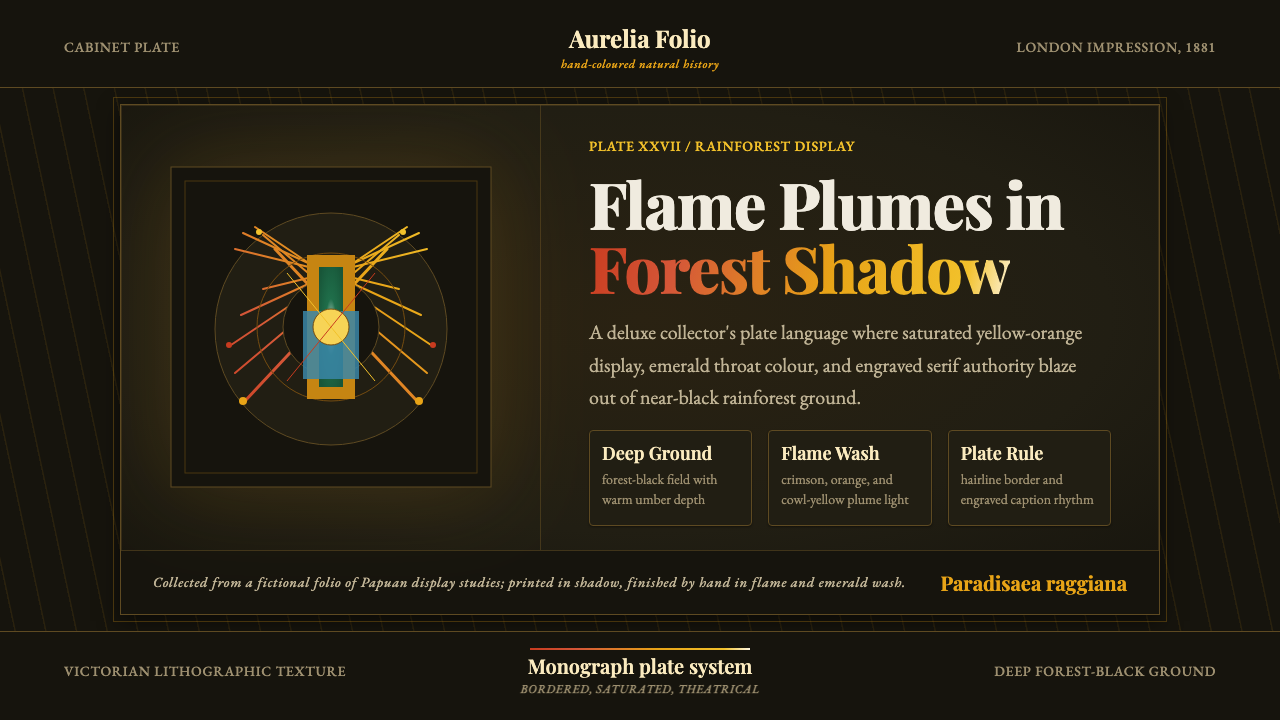 Bird of Paradise MonographTheatrical plate-book darkness. Flame plumes blaze from a bordered forest-bla…
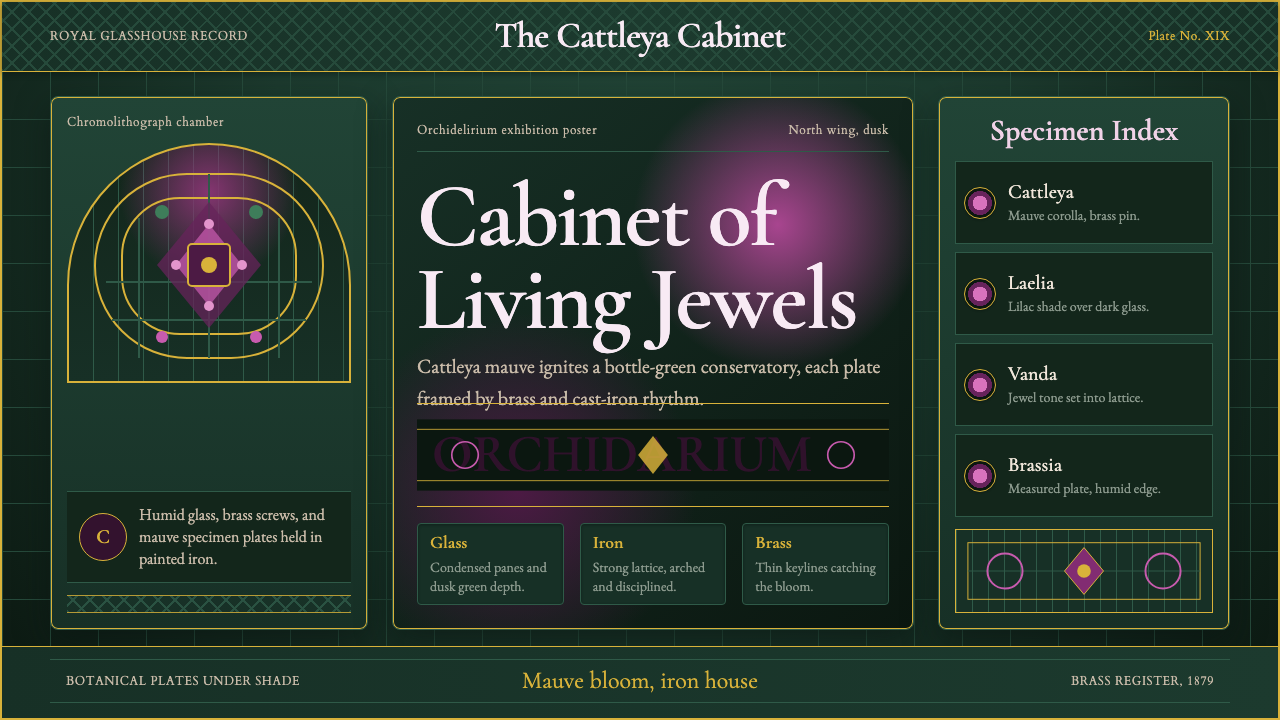 Orchid ConservatoryLush Victorian darkness. Cattleya mauve and brass sit inside bottle-green iro…
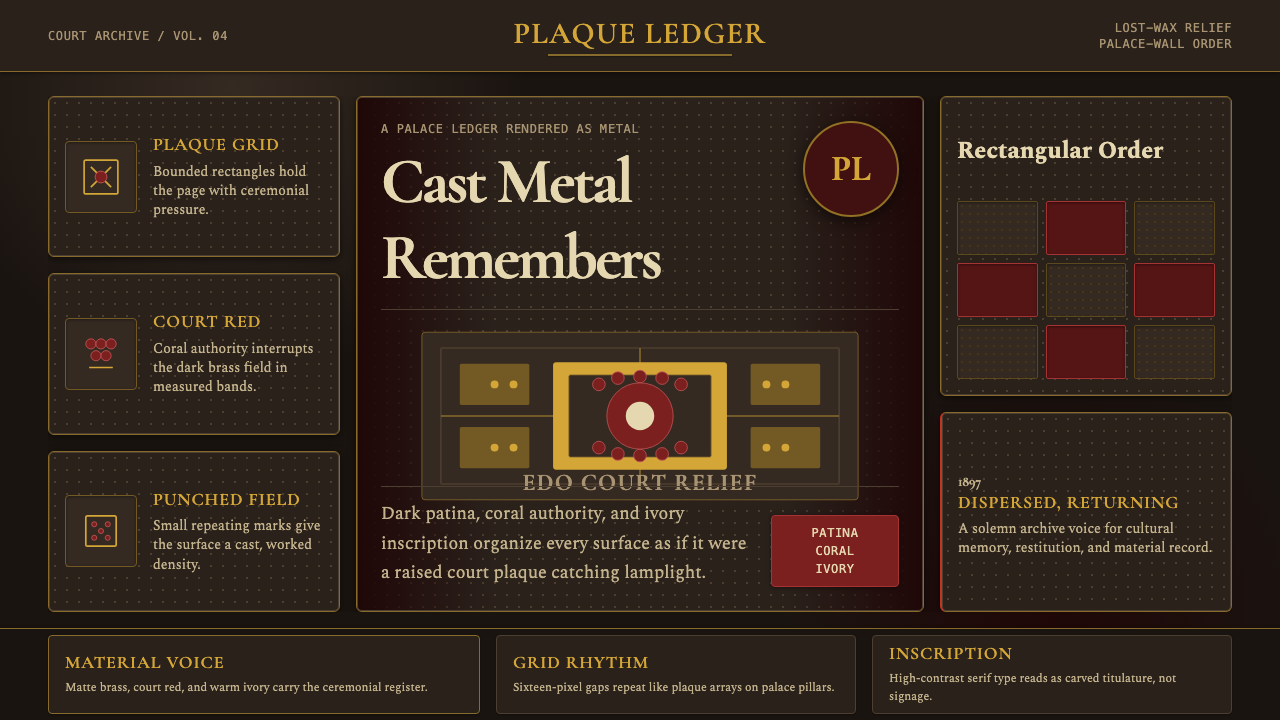 Benin Bronze Oba CourtCourt gravity in cast metal. Patinated brass grid, coral red panels, ivory se…
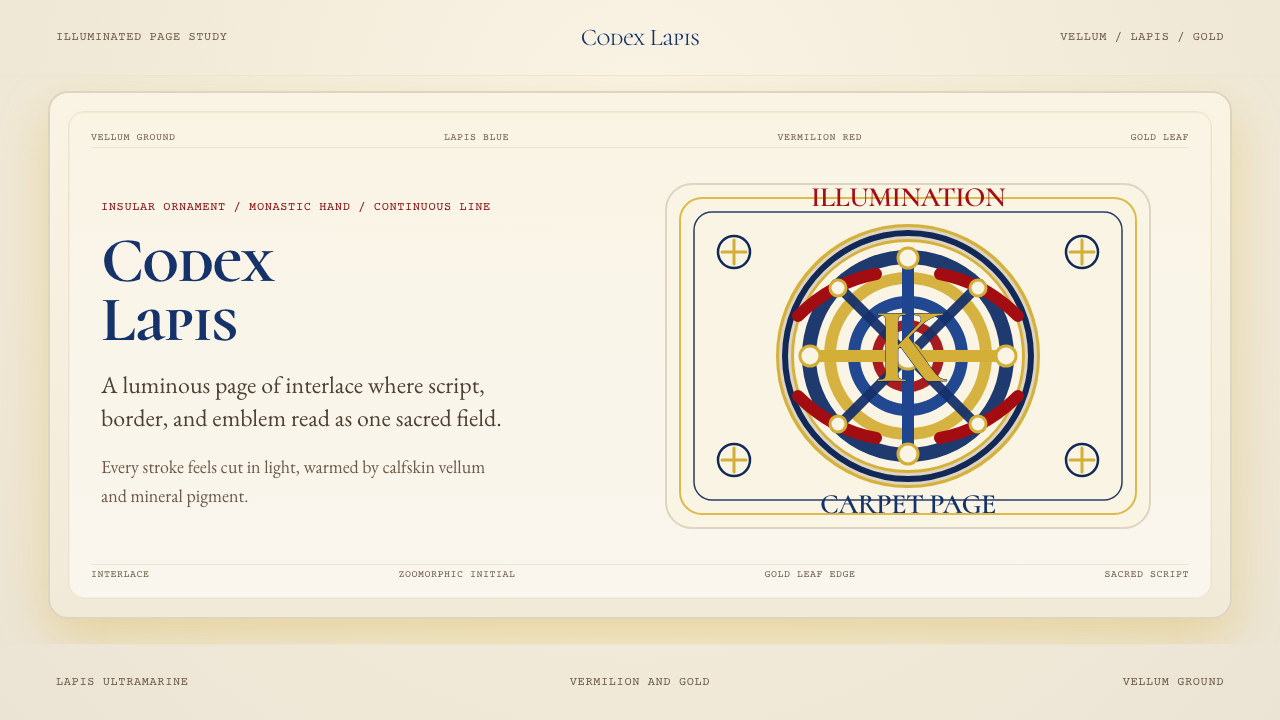 Book of Kells Celtic (800)Sacred and precise. Vellum cream, lapis, vermilion, and gold knotwork.
 Burmese Shwedagon Stupa ReliefGold refuses restraint. Velvet black, teak-red lacquer, and tiered gradients…
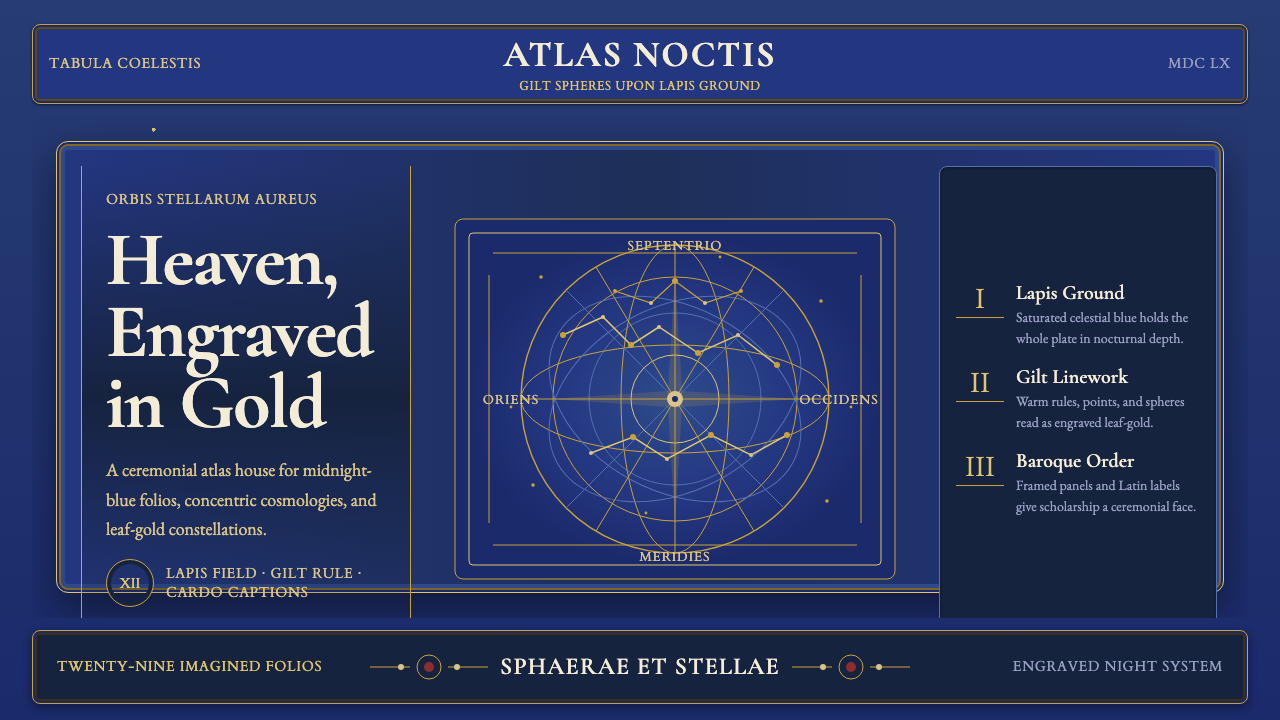 Cellarius Celestial AtlasCelestial luxury on lapis. Gilt serif type, star fields, and concentric chart…