What is Book of Kells Celtic (800)?
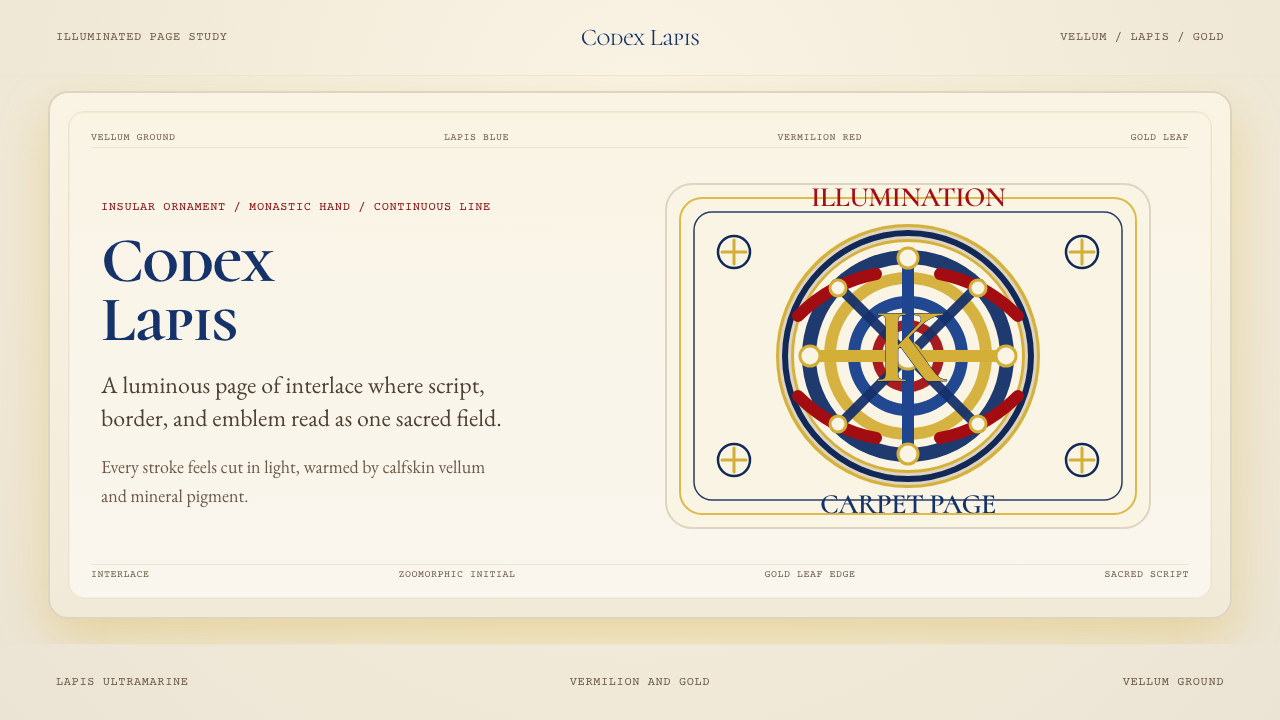
The Book of Kells turns sacred manuscript into a design system — interlace knotwork, jewel pigments, and warm vellum cream woven into every border, initial, and accent.
Book of Kells Celtic (800) in brief
The Book of Kells Celtic (800) design system draws its entire visual vocabulary from one of the most extraordinary manuscripts ever produced — a gospel book created by Columban monk-artists around 800 CE, now held at Trinity College Dublin. Its palette is derived from four historically specific pigments: the deep sky-blue of lapis lazuli, the burning orange-red of vermilion, the sulfurous warm yellow of orpiment, and the radiant surface of hammered gold leaf — all applied over the warm ivory of calfskin vellum. Every color decision in this system refers back to those mineral and animal origins.
What distinguishes the Insular illumination tradition from other ornamental systems is the centrality of interlace — continuous knotwork lines that loop, braid, and return without terminus. This is not pattern in the decorative sense; it is structured complexity, where every line can be traced to its origin and followed to its end. The zoomorphic elements — birds, fish, and serpent-forms whose bodies dissolve into the knotwork — add figural energy without ever breaking into representational illustration. The visual system is simultaneously abstract and alive.
Applied to digital surfaces, this tradition becomes a framework for treating ornament as architecture. Borders are not decoration added after the fact; they are structural containers that define sacred space within the composition. The vellum ground is not a neutral white but a warm, slightly aged cream that carries the memory of the physical manuscript. Every accent is a jewel — used with the restraint appropriate to something precious, placed where the eye should linger, never scattered indiscriminately.

Where does Book of Kells Celtic (800) come from?
The manuscript now known as the Book of Kells was produced by a community of monks associated with the monastery founded by Saint Columba — Colum Cille — on the island of Iona off the western coast of Scotland, sometime around 800 CE. The exact place and date of production remain the subject of scholarly debate; the most widely accepted position holds that work began on Iona and may have continued at the monastery of Kells in County Meath, Ireland, after a Viking raid on Iona in 806 CE forced the community to relocate. The manuscript's 340 surviving folios are vellum — calfskin, prepared and stretched — and the scale of the labor required to produce them is almost incomprehensible. Estimates suggest the hides of over 185 calves were needed for the vellum alone.
The illumination techniques employed by the Columban monk-artists represent the fullest flowering of the Insular art tradition — a style that emerged from the encounter between early Christian manuscript practice imported from the Mediterranean and the pre-existing abstract decorative traditions of Iron Age Celtic metalwork. The spiral forms, trumpet curves, and interlace patterns found in La Tène metalwork from centuries earlier reappear in the pages of the Book of Kells, now rendered in ink and mineral pigment rather than hammered bronze. The four principal pigments — lapis lazuli imported from Afghanistan, vermilion ground from mercury sulfide, orpiment derived from arsenic trisulfide, and gold applied as beaten leaf — represent a material investment of extraordinary scope for a monastic scriptorium of the period.
The manuscript was acquired by Trinity College Dublin in 1661, presented by Henry Jones, then Bishop of Meath, who had obtained it from the Commonwealth commissioners during the turbulent years of the Cromwellian settlement of Ireland. It has been on continuous exhibition at Trinity College since the nineteenth century and is now among the most visited cultural artifacts in the world. The act of rebinding the manuscript in the 1950s unfortunately resulted in some cropping of the illuminations, but the overwhelming majority of the work survives in extraordinary condition. The manuscript's formal recognition as a cultural monument of world significance has made it the defining object of Insular illumination in the global imagination.
The Celtic Revival of the nineteenth century brought renewed popular attention to the manuscript's aesthetic vocabulary. Artists, typographers, and decorators of the Arts and Crafts movement drew on Insular knotwork and zoomorphic interlace as a counter to industrial mechanization — reclaiming hand-wrought complexity as a form of resistance. In the twentieth and twenty-first centuries, the Book of Kells has been invoked across graphic design, tattoo culture, architectural ornament, and digital illustration, demonstrating the extraordinary adaptability of a visual language first fully developed in the scriptoria of the early medieval North Atlantic world.
What defines the Book of Kells Celtic (800) look?
Color
The palette is anchored by four jewel-like hues derived from historically specific mineral and organic sources: a deep sky-blue recalling lapis lazuli, a burning orange-red corresponding to vermilion, a warm sulfurous yellow echoing orpiment, and a luminous gold suggesting beaten leaf. These are deployed against a ground of warm vellum cream — never neutral white — that softens the entire composition and grounds it in the physical memory of parchment. Color is used with the restraint of something costly: each hue occupies its designated role and does not bleed into surrounding space. The effect is simultaneously rich and disciplined.
Interlace and Knotwork
The defining structural element is continuous interlace — braided, looping lines that never terminate, encoding the idea of eternity in pattern form. In this design system, interlace appears at the borders of compositional areas, framing content rather than filling it. The knot lines have consistent width and follow strict over-under rules; the visual discipline of the system resides in this rule-governed complexity. A well-executed knotwork border is immediately legible as intentional structure, not random decoration.
Zoomorphic and Figurative Elements
Birds, fish, serpents, and hybrid creatures appear throughout the Insular tradition with their bodies dissolving into or emerging from knotwork. These forms are never representational in the naturalistic sense — they are abstract lifeforms rendered in profile or overhead, simplified to their most recognizable silhouette, and subordinated to the overall pattern logic. In contemporary application, zoomorphic accents function as focal-point decorations: placed at corners, initials, or key visual intersections to reward close inspection without disrupting the compositional whole.
Carpet Page and Compositional Density
The carpet page — a full-folio illumination in which the entire surface is covered with dense interlace, zoomorphic forms, and geometric subdivisions — represents the tradition's most extreme compositional statement: sacred fullness, the abhorrence of empty ground. In contemporary use, this principle translates to a preference for richly bordered and internally structured layouts over sparse minimalism. The vellum ground is never treated as waste space; every margin is either actively occupied or defined by the structural geometry of the border.
Typography and Letterform
The Insular tradition produced a distinctive script — the half-uncial and insular minuscule — characterized by rounded, compact letter bodies with distinctive wedge-shaped serifs and an organic quality unlike the rigid geometry of later humanist letterforms. Applied as a design principle rather than a literal typeface recommendation, this means favoring rounded, slightly organic letterforms over rigidly geometric ones, treating initial capitals as visual focal points that can bear ornamental weight, and understanding that type and image are not separate systems but can be woven together in the same compositional field.
Sacred Geometry and Symmetry
Unlike the deliberate asymmetry of Bauhaus or Swiss modernism, the Book of Kells tradition is rooted in bilateral and radial symmetry — the cross, the mandorla, the circular chi-rho monogram. This reflects the manuscript's theological program: symmetry here is not classical authority but divine order. In a contemporary digital layout, this means compositions may be formally centered and axially mirrored, with the visual tension generated by the density and intricacy of the ornament rather than by asymmetric placement of elements.
Gold and Luminosity
Gold in the manuscript tradition functions as light materialized — not a decorative color but the physical presence of divine radiance on the page. In this design system, gold-toned accents carry that same hierarchical weight: they mark what is most important, most permanent, most worthy of sustained attention. Gold should never be used as background fill or scattered as general emphasis; it is reserved for singular moments — a key figure, a primary call to action, a border accent — where its luminous quality creates genuine visual priority.

Who shaped Book of Kells Celtic (800)?
The sixth-century Irish abbot who founded the monastery on Iona around 563 CE is the spiritual patron of the manuscript tradition that produced the Book of Kells. Though Columba died more than two centuries before the manuscript was completed, his community of monk-artists — the Columban familia — carried his mission across the North Atlantic world. The manuscript was long believed, in pious tradition, to be Columba's own work, and this attribution shaped its veneration as a sacred relic as much as an artistic achievement. The manuscript's status as a cult object around his memory is inseparable from the visual intensity with which it was made.
The Book of Kells was produced not by a single illuminator but by a scriptorium team — scholars have identified at least four distinct hands in the manuscript's illuminations. These anonymous monk-artists were simultaneously theologians, craftsmen, and visual thinkers of remarkable sophistication. They developed the interlace grammar, the zoomorphic vocabulary, and the carpet-page compositional system to a degree of elaboration never surpassed in the Western manuscript tradition. Their anonymity is itself a form of statement: the work was not individual expression but communal devotion, each scribe and painter subordinating their identity to the larger sacred purpose.
The seventeenth-century Bishop of Meath whose presentation of the manuscript to Trinity College Dublin in 1661 established the institutional home that has protected and exhibited it for more than three and a half centuries. Jones obtained the manuscript during the Cromwellian settlement of Ireland, a period of profound political and religious disruption. His act of donation — whatever its complex political motivations — ensured the manuscript's survival at an institution with the resources to conserve, study, and exhibit it. The Book of Kells entered the consciousness of global design culture largely because Trinity's stewardship made it continuously accessible to scholars, artists, and eventually the general public.
The nineteenth-century Celtic Revival — part of the broader Arts and Crafts reaction against industrial uniformity — was responsible for bringing the Book of Kells visual vocabulary into mainstream Western design consciousness. Artists associated with the movement, along with typographers who adapted Insular letterforms for print, transformed manuscript interlace and zoomorphic ornament from archival curiosity into living design language. Their interpretations ranged from scholarly facsimile to free adaptation, but collectively they established the visual conventions — warm grounds, knotwork borders, jewel-toned accents — that contemporary designers recognize as the Celtic illuminated style.
The visual grammar of the Book of Kells did not emerge from manuscript culture alone. Its spiral forms, trumpet curves, and abstract interlace descend directly from the La Tène metalworking tradition of Iron Age Celtic Europe — a design language first developed in hammered bronze, enamel inlay, and gold filigree. The Insular scribes who adapted this vocabulary for vellum and pigment were translating an already ancient and sophisticated abstract decorative system into a new medium. Understanding this lineage clarifies the distinction between Celtic ornament as a coherent structural tradition and its frequent superficial misappropriation as generic tribal pattern.
How do you use Book of Kells Celtic (800) today?
The Book of Kells Celtic (800) system works best in contexts where richness, cultural depth, and a sense of the sacred or monumental are desired values — and where the audience will reward visual complexity rather than retreating from it. Applying it correctly requires understanding that the style's ornament is not decoration layered on top of a layout, but the structural logic of the layout itself. Every border is a container, every accent is a jewel, and the warm cream ground is not blank space but inhabited surface.
For presentation slides, this system offers particularly strong cover and section-divider opportunities. A cover built on this vocabulary uses a formal centered or symmetrically axial composition: the title rendered in large, weighty letterforms within a knotwork-bordered field, with a jewel-toned accent — deep blue, vermilion, or gold — marking the most important typographic element. Section dividers benefit from a simplified carpet-page approach: a narrow horizontal band of interlace marking the transition, with the vellum cream as the dominant ground. Content slides should be restrained relative to the cover — the ornamental density of the system belongs at moments of ceremonial weight, not at every data bullet.
For web interfaces, this vocabulary is most effective on heritage and cultural institution sites, luxury and craft-goods e-commerce, editorial platforms with strong identity, and any context where the brand promise involves depth, authenticity, or the handmade. Dashboard applications are not natural territory for this system, but where data must be presented within a branded environment, a light application works: vellum-toned backgrounds, jewel-colored status indicators, and knotwork-derived dividers that give the data table a sense of structural intention. Pricing and comparison pages benefit from the tradition's comfort with dense, richly bordered layout — each tier presented as a self-contained illuminated field.
For editorial and marketing work, the style supports both full-throttle richness and restrained application. A long-form article or editorial spread benefits from knotwork drop-caps or initial letters that announce chapter or section breaks with visual ceremony, body text on a warm cream ground that reduces eye fatigue in long reading sessions, and gold or vermilion pull-quote accents that reward the reader who pauses to scan. Marketing pages work well when the hero section uses the full visual vocabulary — dense border, jewel tones, gold accent — while subsequent sections pull back to simpler vellum-and-one-color treatments, creating a rhythm between ceremonial and functional.
A common mistake when applying this system is treating Celtic knotwork as surface texture rather than structural border logic. Tiling an interlace pattern as a background fill — the way a fabric print might be tiled — destroys the system's architectural meaning and produces visual noise rather than sacred order. Similarly, deploying the full jewel palette simultaneously at high saturation overwhelms the warm ground and eliminates the hierarchy that makes each accent legible. Authentic application uses deep blue as the dominant hue, vermilion as the primary accent, orpiment-yellow for the warmest emphasis, and gold only for singular moments of maximum importance. The vellum ground should do the quiet work of holding everything together.

Book of Kells Celtic (800) — FAQ
Is this style appropriate for secular and commercial contexts, or only for heritage and cultural institutions?
The style has a long history of secular and commercial application — the Celtic Revival of the nineteenth century was explicitly a craft and commercial movement, and Insular ornament has appeared on everything from whiskey labels to luxury packaging to architectural ironwork. What matters is whether the context can sustain the style's visual weight and whether the brand values align with what the style communicates: depth, craft, age, and a certain reverence for the handmade. Consumer brands that carry heritage narratives, cultural institutions, academic publishers, premium hospitality, and artisan goods producers are natural homes. Fast-moving consumer goods, technology startups positioning on speed and disruption, and clinical healthcare contexts are not.
How do you apply knotwork borders in a digital medium without them becoming visually overwhelming?
The key is treating interlace as frame, not fill. The manuscript tradition used carpet pages — full-surface knotwork — only for the most ceremonially significant moments: the opening pages of gospel books, the chi-rho monogram. For everything else, knotwork appeared at borders and corners while the central field remained relatively open. Applied digitally, this means a knotwork border of moderate visual weight surrounding a calm interior with generous leading and white-space allocation. The border does the ornamental work so the interior does not have to. If the interior is also dense with pattern, the hierarchy collapses and the composition becomes fatiguing to read.
Can this style work effectively with a dark background?
The manuscript tradition is fundamentally a light-ground system — vellum is warm cream, not black — and inverting it requires care. A dark inversion is possible and can be effective for night-mode interfaces or premium contexts where the dark ground reads as richness rather than severity. On dark grounds, the gold accent becomes dramatically more luminous and should be used even more sparingly than on cream. The deep lapis blue tends to recede and may need to be lightened slightly to maintain its role. Vermilion holds better in dark contexts. The overall effect should feel like viewing illuminated manuscript by candlelight — warm, contained, glowing — rather than like a generic dark-mode interface with pattern applied.
How is this style different from generic Celtic or Viking ornament?
The Book of Kells tradition is a specific, historically rooted design vocabulary with clear structural rules. Generic Celtic ornament — as it appears in popular culture — is often a mixture of La Tène knotwork, Norse Viking interlace, and modern invention, applied without attention to the compositional hierarchy or color discipline of the original sources. The distinguishing markers of the authentic Insular tradition are: the four historically specific pigments on a warm vellum ground; the formal architectural relationship between border, ground, and content; the subordination of zoomorphic elements to overall pattern logic; and the use of bilateral symmetry reflecting theological rather than decorative intent. A design that gets the knotwork motif right but uses a random color palette on a stark white ground, or tiles it as background fill, is borrowing the surface without engaging the system.
How should imagery and photography be used within this design system?
The Insular tradition contains no photography and almost no naturalistic representation — all figural content is stylized, symbolic, and subordinate to the ornamental field. Contemporary application of this system works best when photography is either absent or treated with significant formal intervention: cropped to a strong silhouette, framed within an ornamental border that absorbs it into the compositional logic, desaturated and toned to the system's jewel palette, or reproduced in a duotone using two of the tradition's four canonical colors. A naturalistic photograph placed directly on a vellum ground without formal mediation will read as a collision of two different compositional logics rather than a coherent design statement. The system's strongest contemporary expression tends toward illustration, iconography, and typographic composition rather than photographic realism.
Related design styles
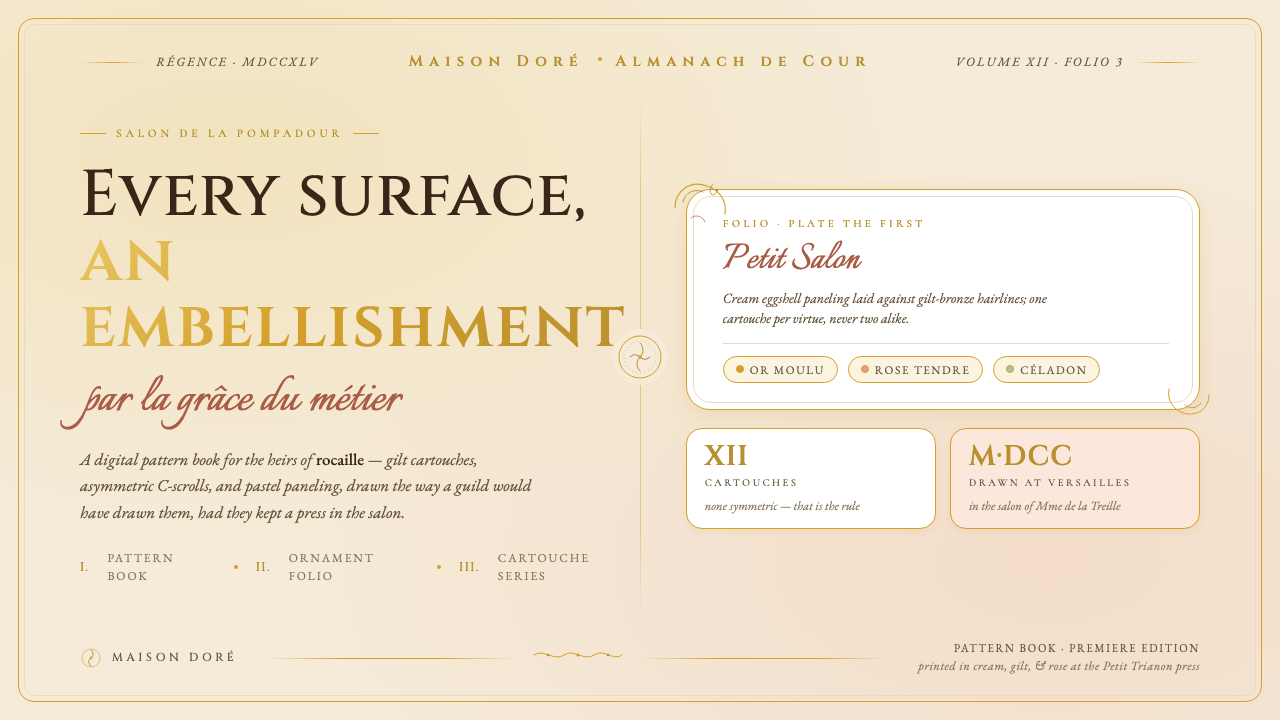 Versailles Rococo OrnamentEvery surface earns an embellishment. Cream paneling, ormolu gilt hairlines,…
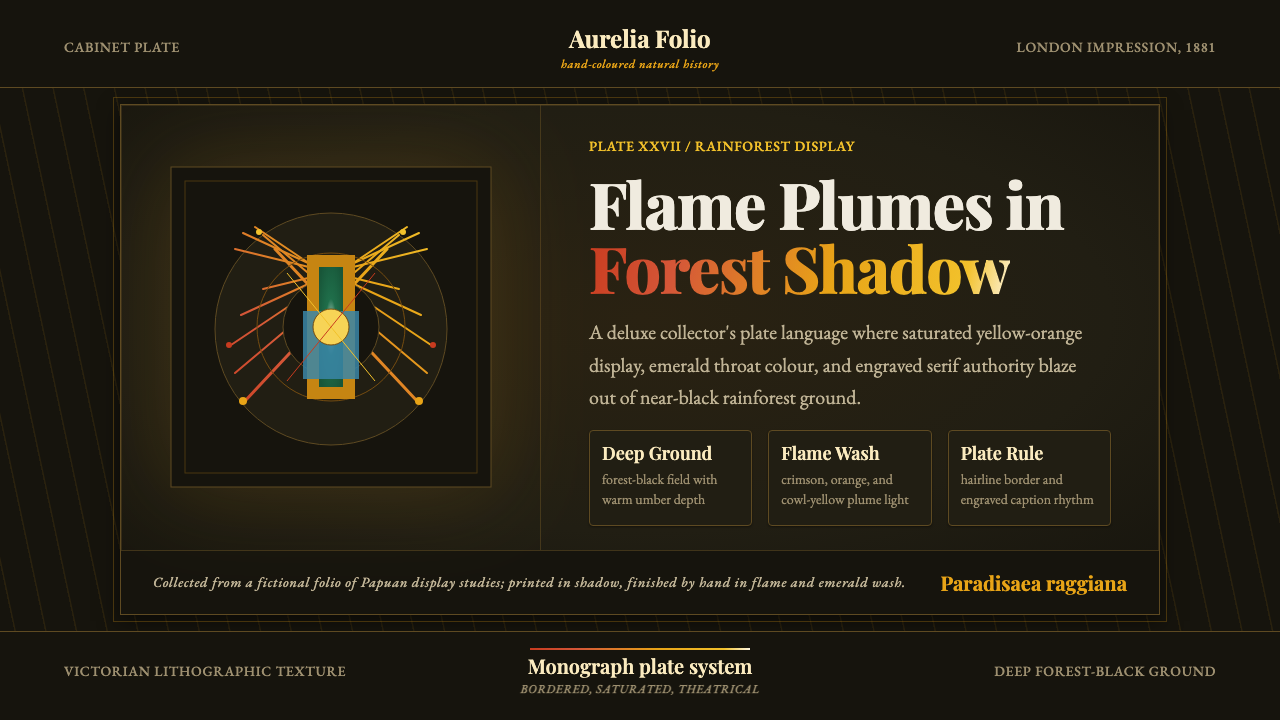 Bird of Paradise MonographTheatrical plate-book darkness. Flame plumes blaze from a bordered forest-bla…
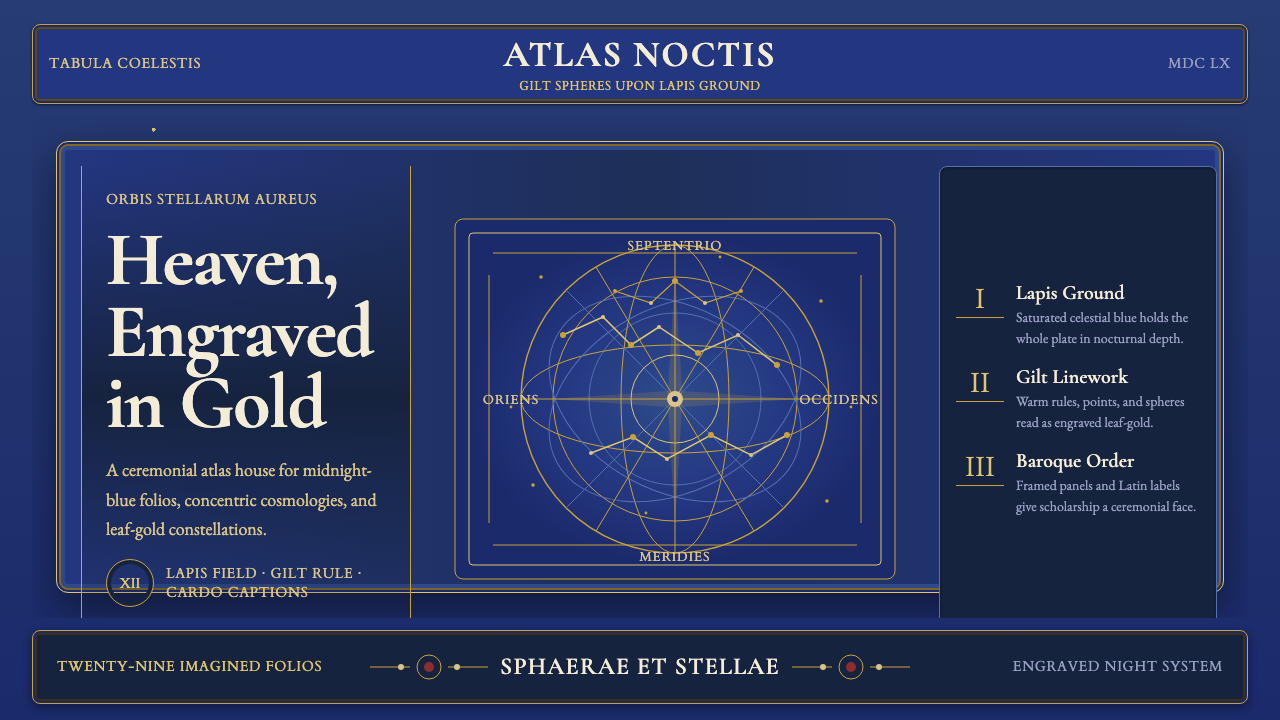 Cellarius Celestial AtlasCelestial luxury on lapis. Gilt serif type, star fields, and concentric chart…
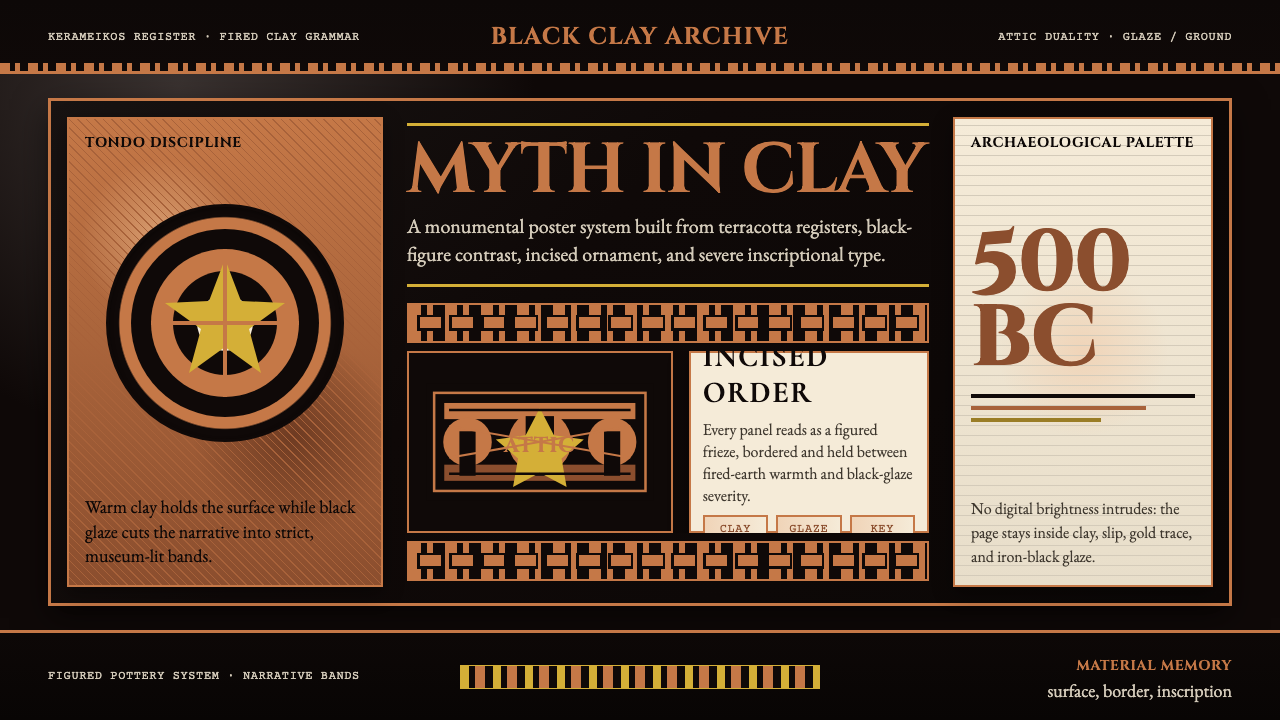 Greek Vase Attic (500 BC)Archaeological severity. Jet-black glaze, terracotta bands, and meander borde…
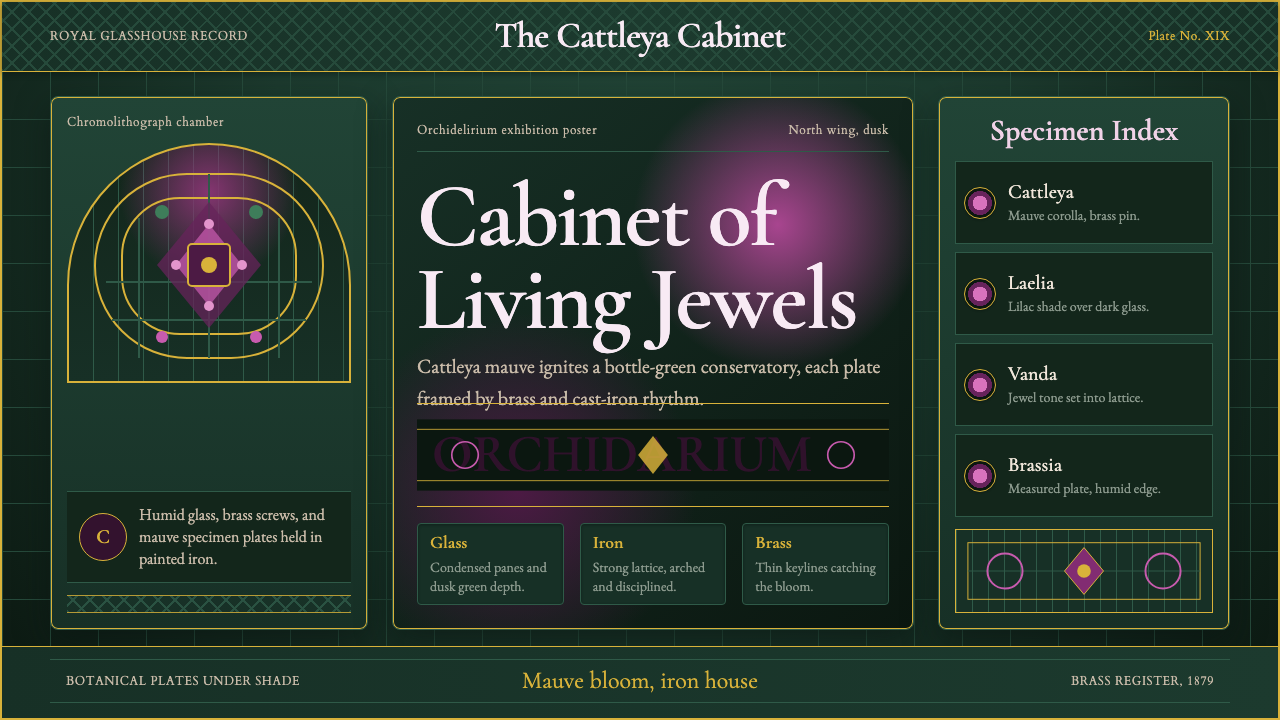 Orchid ConservatoryLush Victorian darkness. Cattleya mauve and brass sit inside bottle-green iro…
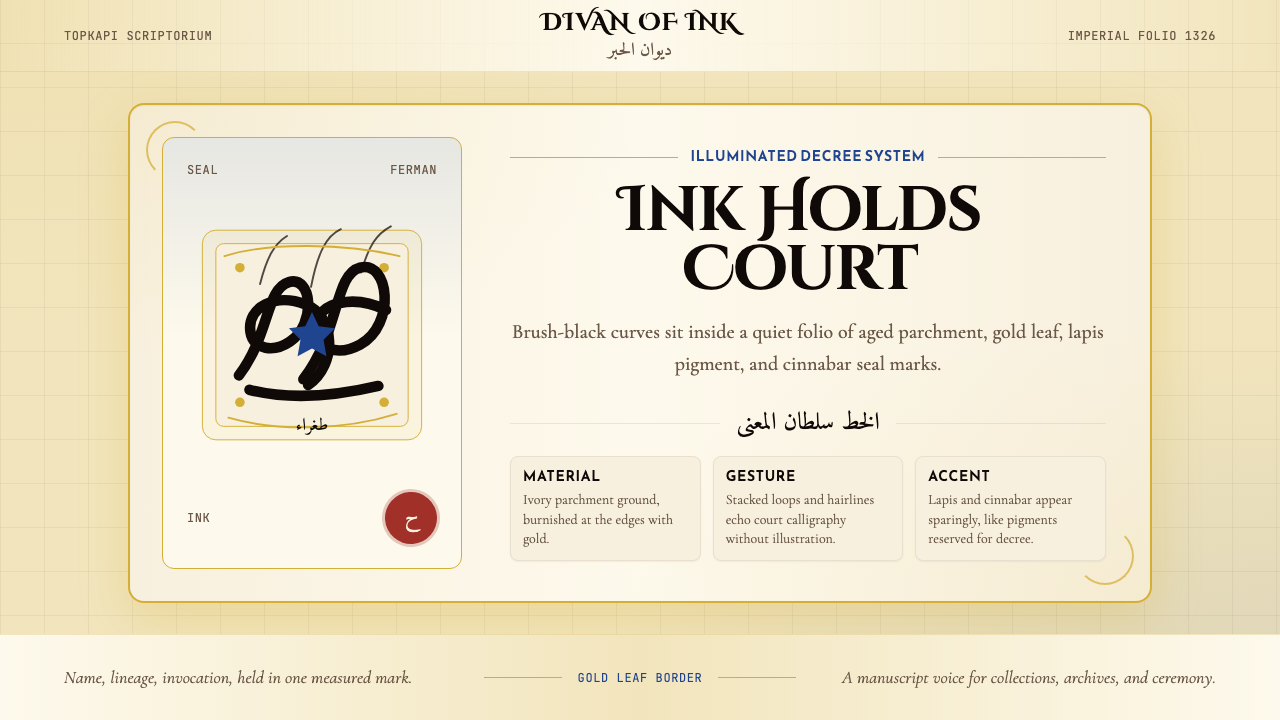 Ottoman Tughra CalligraphyImperial ink holds court. Gold borders, lapis panels, and Cinzel tughra-like…