What is Ottoman Tughra Calligraphy?
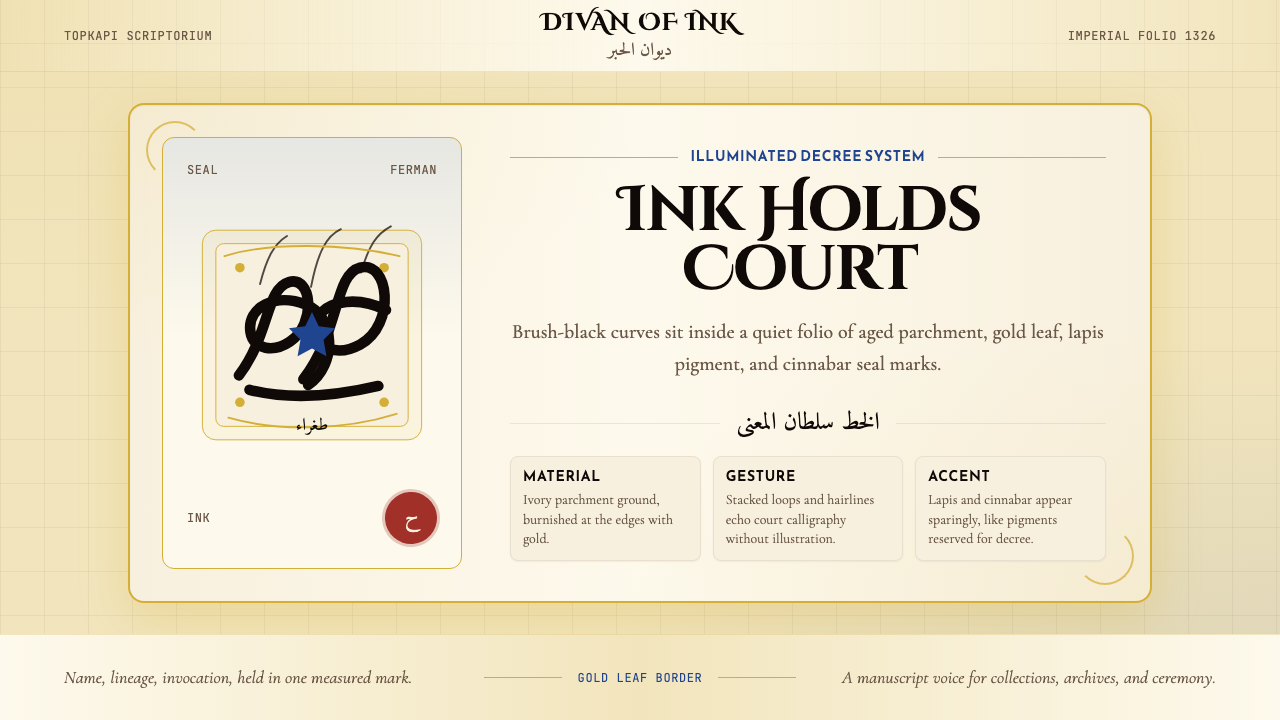
Six centuries of imperial ink distilled into a single flourish — the Ottoman tughra is calligraphy as sovereign authority, where every stroke carries the weight of a dynasty.
Ottoman Tughra Calligraphy in brief
Ottoman Tughra Calligraphy is a design system rooted in the imperial monogram-sigils that identified and authenticated every decree, charter, and official document of the Ottoman sultans from the fourteenth century to the early twentieth. The tughra itself is a single elaborate compositional unit encoding the sultan's name, his father's name, and the invocatory phrase 'ever victorious,' rendered by specialist court calligraphers — the nişancı and their apprentices — in an interlocking grammar of loops, extended verticals, and radiating strokes that can take years to master.
As a visual system, Ottoman Tughra Calligraphy channels the aesthetic of the imperial scriptorium (kitabhane) of Topkapı Palace in Istanbul: deep ink on aged ivory parchment, gold-leaf illumination borders framing the page, lapis-lazuli blue accent ornaments drawn from the manuscript tradition, and the crimson of the seal. The palette is deliberately restricted to the material substances of the court atelier — ink, parchment, gold, ground lapis, cinnabar — and every element of the system performs a role already established by six centuries of court practice.
What distinguishes this aesthetic from generic 'Islamic calligraphy' is its specifically imperial character. The tughra form is not decorative script but administrative authority made visual — a royal signature so elaborated and conventionalized that forgery was structurally near-impossible. Adapted as a contemporary design language, it produces interfaces and layouts that feel simultaneously archaic and monumental: documents rather than screens, proclamations rather than pages.

Where does Ottoman Tughra Calligraphy come from?
The tughra tradition is conventionally traced to Orhan I, the second ruler of the Ottoman dynasty, whose administrative documents from around 1326 bear the earliest known examples of the form. At this stage the tughra was relatively simple — a stylized rendering of the ruler's name with a few distinctive flourishes — but the structural grammar was already present: the central name-block (sere), the looping extensions to the left (tuğ), and the sweeping rightward arc (hançer). Over the following two centuries, as the Ottoman state expanded from a minor Anatolian principality into a continental empire, the tughra grew proportionally in complexity and ceremonial weight.
The peak of tughra refinement arrived under Sultan Süleyman I, known in the West as Süleyman the Magnificent, who reigned from 1520 to 1566. His court at Topkapı was the cultural apex of the Ottoman world, employing hundreds of master craftsmen across dozens of ateliers. The calligraphic arts — hat sanatı — were organized under a formal hierarchy, with the nişancı (chancellor) holding ultimate responsibility for the royal cipher and teams of trained calligraphers producing the thousands of documents the imperial administration required annually. It was during Süleyman's reign that the tughra achieved its canonical proportions: the three tall vertical staffs (tuğ), the double oval of the serifed lower loops (beyze), and the long horizontal extension to the right that gave the form its characteristic profile.
The broader tradition of Ottoman court calligraphy drew on and synthesized several distinct Islamic script lineages. The Naskh and Thuluth scripts, refined over centuries in Abbasid and Mamluk ateliers, provided the structural foundation; Diwani — a specifically Ottoman development of the sixteenth century — offered a more cursive, interlocking style suited to the administrative documents and imperial edicts (ferman) that required both speed and visual authority. The great masters who defined these traditions — Hafız Osman in the seventeenth century, Mustafa Râkım Efendi in the late eighteenth and early nineteenth, and Sami Efendi into the early twentieth — each refined not only letterforms but the entire philosophy of spatial arrangement, ink density, and the relationship between positive stroke and ground.
The Ottoman calligraphic tradition ended with the Turkish Republic's script reform of 1928, which replaced the Arabic-script Ottoman Turkish with a Latin-alphabet Turkish. By that point the tughra had already become primarily a historical and decorative form — the last Sultan, Mehmed VI, had been deposed in 1922. But the tradition had already produced an enormous body of work housed in the Topkapı Palace archives, the Turkish and Islamic Arts Museum, and collections worldwide, and the visual vocabulary it established — the interplay of dense ink strokes against pale grounds, the gold-leaf ornamental borders, the structural dignity of the elongated vertical — proved deeply influential on subsequent generations of designers who drew on Ottoman material culture.
What defines the Ottoman Tughra Calligraphy look?
Palette
The color system is anchored in manuscript materials rather than abstract theory. Jet-black ink — the primary mark-making substance — reads as absolute authority against the warm tone of aged parchment or ivory ground. Gold leaf provides the sole luminous accent, used for border illumination and ornamental fills rather than as a general highlight. Lapis-lazuli blue, derived from ground mineral pigment, appears in geometric ornament panels and decorative medallions; it is a rare, costly accent rather than a field color. Cinnabar red functions as the seal and authentication mark. Together these four accents against the parchment ground constitute the entire palette — each color earned by its material origin, not chosen for aesthetic preference.
Calligraphic Line
The defining visual element is the broad, pressure-modulated calligraphic stroke. Thick vertical downstrokes contrast against fine hairline horizontals and diagonal connectors; each transition between thick and thin is an expression of the reed-pen's angle and the calligrapher's wrist pressure, not a mechanical interpolation. In the tughra itself, three tall vertical staffs (tuğ) tower above the body of the composition, creating dramatic negative space between their shafts. The sweeping horizontal tail (hançer) extends far to the right, balancing the vertical emphasis with horizontal counterweight. This asymmetric tension — massive verticals against a long horizontal — is the compositional engine of the entire style.
Illumination and Border
Ottoman manuscripts are distinguished by the elaborate border illumination that frames the text — intricate geometric and floral interlace patterns executed in gold leaf, lapis blue, and cinnabar on a black or deep-ground field. These borders are not decorative afterthoughts but structural components: they demarcate the sacred or official zone of the text from the surrounding page, and their visual density signals the importance of the document. In a design system context, this translates to ruled borders of controlled weight and ornamental corner pieces that anchor the composition without competing with the primary textual content.
Script Hierarchy
Ottoman documents use a rigorous typographic hierarchy built on script selection rather than point-size variation. The tughra occupies an entirely separate register — an image-object rather than readable text, positioned at the top of the document as sovereign signature. Below it, principal text appears in large Thuluth or Diwani script; secondary text shifts to Naskh for readability at smaller scale; marginal notes and administrative annotations occupy yet another register. This multi-layer hierarchy — from monogram-image down through three or four script sizes — translates directly into modern design as a system of sharply differentiated type scales, where the largest heading element is structural and symbolic rather than simply the most important text.
Geometric Ornament
Beyond the calligraphic elements, Ottoman manuscript decoration employs a precise vocabulary of geometric interlace — star polygons, interlocking hexagons, eight-pointed rosettes, and continuous knot patterns derived from the broader tradition of Islamic geometric art. These ornamental forms obey strict mathematical rules of symmetry and repetition; they are constructed rather than drawn freehand. In a contemporary adaptation, these patterns function as textural fills, divider ornaments, and background elements that add visual richness without introducing representational imagery or photographic content.
Spatial Gravity
Ottoman court documents are not balanced compositions in the Western academic sense. The tughra dominates the upper portion of the document with overwhelming visual weight; the text content below is deliberately subordinated — it exists to be authorized by the signature above it, not to compete with it. This creates a strong top-weighted vertical gravity. The practical consequence for contemporary layouts is a deliberate asymmetry of vertical emphasis: the most visually powerful element anchors the top, and the content area below gains authority by proximity and subordination rather than by its own visual mass.
Material Texture
Unlike Bauhaus flatness or Swiss grid sterility, Ottoman Tughra Calligraphy embraces material presence. Aged parchment has a warm, slightly uneven ground; gold leaf catches light unevenly; ink settles into the surface with varying absorption. In digital adaptation, this means the style permits and even encourages subtle textural grounds — a warm off-white with slight variation rather than a pure flat white, a gold-tinted surface that reads as reflective rather than as a flat fill color. The materiality is historical evidence: it communicates that what the viewer is seeing is a document of consequence, one that has survived.

Who shaped Ottoman Tughra Calligraphy?
Hafız Osman (1642–1698) is considered the supreme codifier of Ottoman calligraphic style. He was the student of Dervish Ali and ultimately reformed the proportional system of the Naskh and Thuluth scripts, establishing the canonical letterform ratios that all subsequent Ottoman calligraphers took as their standard. His copies of the Quran and his single-sheet compositions (hilye-i şerif — descriptions of the Prophet) were so revered that they were reproduced and distributed across the empire. Dozens of later masters traced their lineage through him, and his proportional rules continued to govern Ottoman calligraphic education until the script reform of 1928.
Mustafa Râkım Efendi (1757–1826) is credited with the final and definitive refinement of the tughra form itself. Working in the late eighteenth and early nineteenth centuries, he brought both the Jeli Thuluth monumental script and the tughra to what subsequent tradition regarded as their perfected state. His tughra compositions for Sultans Selim III and Mahmud II are still considered the canonical examples of the form. He also trained a generation of calligraphers who carried his refined system through the nineteenth century, and his influence on the visual grammar of official Ottoman documents was unmatched in his era.
Sami Efendi (1838–1912) was one of the last great masters of the classical Ottoman calligraphic tradition and the teacher of many calligraphers who would carry the tradition into the early Republic period. He excelled in the Ta'liq and Diwani scripts as well as Thuluth, producing both official documents and single-composition artworks. His calligraphic panels became prized collectibles, and his teaching lineage — through students such as Necmeddin Okyay — represents the final transmission of the unbroken classical Ottoman tradition before the script reform ended the living practice of the art.
Sultan Süleyman I (reigned 1520–1566), called the Magnificent in Western historiography and the Lawgiver (Kanunî) in Ottoman tradition, was not himself a tughra calligrapher but the patron under whose reign the form reached its canonical perfection. His court at Topkapı was the most sophisticated cultural center in the Mediterranean world: the Imperial Council produced thousands of firmans annually, each bearing a tughra drawn to the highest standard by the imperial chancellery's specialist calligraphers. Süleyman was also personally accomplished in goldsmithing, which may explain the particular emphasis his court placed on the integration of gold-leaf illumination with calligraphic text. The proportions and compositional balance established in his-era tughras became the model that Mustafa Râkım later codified.
The nişancı was not a single historical individual but the title of the senior official responsible for drawing and authenticating the royal tughra on all imperial documents. The position ranked among the highest offices of the Ottoman bureaucracy. A nişancı served for years as an apprentice before being authorized to draw the sultan's tughra; the slightest deviation from the canonical proportions could invalidate a document. The role combined the functions of royal secretary, chief calligrapher, and legal authenticator. Understanding the nişancı as a role — rather than an individual artist — clarifies the tughra's nature: it was a reproducible standard, not a personal expression, and its authority derived from institutional regularity rather than individual genius.
How do you use Ottoman Tughra Calligraphy today?
Ottoman Tughra Calligraphy is among the most distinctive historical styles available to contemporary designers — its visual grammar is so singular that even a partial application reads as a clear reference to the tradition. But it is not a general-purpose aesthetic. Its authority comes from restraint, material specificity, and structural hierarchy; misapplied, it degrades into decorative exoticism. The first requirement for using it well is understanding what the system is communicating: weight, legitimacy, permanence.
For presentation slides, the style excels when the content itself carries institutional gravity — financial reports, legal or compliance presentations, heritage brand narratives, historical or archival material. A cover slide benefits from the tughra-derived composition: a large central calligraphic motif or ornamental medallion positioned in the upper third, the title set in display type that evokes ceremonial script proportions (tall, narrow, with controlled stroke contrast), against an ivory or aged-parchment ground. Content slides should treat the gold-ruled border as the organizing frame and use the parchment ground consistently. Data slides gain authority when charts and graphs are treated as structured documents rather than infographic elements — dark ink bars on a pale ground, with gold accent lines marking thresholds or key values.
For web interfaces, the style is most appropriate for luxury e-commerce, heritage institutions, cultural archives, and fintech products positioning around stability and trust. Dashboard applications benefit from the document-like quality: define clear structural borders around information panels, use an off-white or warm ground for the primary field, reserve the gold accent for the single most important interactive element or current-state indicator. Pricing pages built in this style communicate premium positioning through material richness rather than through feature lists — the visual weight of the layout itself signals that the product does not compete on price. Navigation should be typographically authoritative with generous spacing; geometric ornament can serve as section dividers.
For editorial and marketing work, the style is well-suited to brand identity systems for heritage luxury goods, cultural institutions, and architectural firms. A brand identity built in this language uses the tughra's logic of compositional concentration — all the complexity resolved into a single dense motif rather than distributed across the layout. Marketing pages work best when the contrast between the dense ornamental header and the restrained, spacious content area below is exploited deliberately: the header earns attention through visual density; the content area earns trust through clarity and breathing room. Social cards and email headers in this style should treat the entire composition as a bordered document rather than a full-bleed image — the border is integral, not optional.
The most common mistake when applying Ottoman Tughra Calligraphy is overloading every element with ornamentation. In historical practice, the gold border and geometric ornament are present precisely because the calligraphic text itself is spare — one or two lines of large script on an otherwise empty ground. Contemporary misapplications tend to layer ornamental borders on top of already-dense content, producing visual noise rather than authority. The second common error is treating the palette as license to use gold as a general highlight color, spreading it across buttons, icons, and text links until it loses all signaling power. In the historical system, gold appears only in the border and the illuminated ornament — the text and body of the document remain in pure black ink. Maintain that discipline: gold is the frame, not the content.

Ottoman Tughra Calligraphy — FAQ
What exactly is a tughra, and how does it differ from other Islamic calligraphy?
A tughra is the specific calligraphic monogram used as the royal cipher of Ottoman sultans — a fixed compositional form encoding the sultan's name, his father's name, and the phrase 'ever victorious,' rendered in a distinctive interlocking structure of loops, verticals, and a long horizontal extension. It is not simply 'decorative Arabic calligraphy' but a functional legal and administrative document element whose precise proportions were codified and enforced. Other Islamic calligraphic traditions — Quranic Naskh, Persian Nastaliq, North African Maghrebi script — are text-based writing systems; the tughra is an image-object that happens to encode readable text within a non-readable overall form. Its closest parallel in Western tradition would be a royal seal or a dynastic coat of arms, not a typeface.
Can this style work for digital products aimed at younger or casual audiences?
With significant adaptation, yes — but the adaptation required is substantial enough that the result may no longer read as Ottoman Tughra Calligraphy in any meaningful sense. The style's core visual properties — monumental weight, material richness, top-weighted vertical gravity, restricted palette — communicate institutional authority and permanence. These properties directly conflict with the lightness, playfulness, and accessibility that casual digital products require. A more honest approach would be to use the aesthetic as a controlled citation — a single tughra-derived motif as a logotype or hero element in an otherwise contemporary layout — rather than attempting to apply the full system to an audience for whom its reference culture is unfamiliar. The risk of cultural misappropriation also deserves acknowledgment: Ottoman calligraphy is a living aesthetic tradition still practiced in Turkey, the Arab world, and Muslim communities worldwide; using it as pure decoration without reference to its context can read as disrespectful.
How do I avoid the layout looking like a stereotyped 'Middle Eastern' cliché?
The difference between informed citation and cliché lies in specificity. Clichéd 'Middle Eastern' design typically mixes elements from several unrelated traditions — Moorish arch shapes, generic Arabic-style type, North African geometric tile patterns, crescent-and-star motifs — without grounding in any specific practice. Ottoman Tughra Calligraphy is a precisely defined historical tradition with documented masters, a specific institutional context, and a codified visual grammar. Using it correctly means engaging with that specificity: the exact compositional logic of the tughra form, the particular palette of the Ottoman manuscript atelier, the hierarchical structure of court documents. Avoid mixing in elements from other Islamic or Middle Eastern traditions as though they were interchangeable; each tradition has its own integrity. When in doubt, reducing the application to a single well-executed citation element is more respectful and more visually powerful than a comprehensive pastiche.
Is this style appropriate for dark-mode interfaces?
A dark inversion — placing light calligraphic strokes and gold ornament against a deep ground — has historical precedent: some Ottoman lacquerwork, bookbinding, and architectural tile programs placed gold and light-colored ornament on dark grounds. However, the primary manuscript tradition was light-ground, and inverting it changes the character of the aesthetic significantly. On a dark ground, the gold ornament becomes the dominant element rather than a structural accent, and the calligraphic strokes lose some of the weight and authority that their darkness-against-light produces. A dark variant works best when the ground is a very deep ink tone — closer to black — and the calligraphic strokes are rendered in a warm near-white rather than pure white, maintaining the warm material character of the original. Avoid dark grounds with cool-gray tonality; they produce a generic dark-luxury feel rather than the specific material warmth of the Ottoman atelier.
How does Ottoman Tughra Calligraphy relate to contemporary Arabic or Turkish typography?
The relationship is historical and aesthetic rather than functional. Contemporary Arabic typography — optimized for digital rendering, user interface applications, and print at varied scales — is a technically modern discipline that shares the script system of classical Ottoman calligraphy but not its tools, constraints, or institutional context. Modern Arabic type design has its own masters and its own tensions (between readability and cultural expression, between regional script traditions, between desktop and mobile rendering). Ottoman calligraphy, conversely, was produced for large-format documents and manuscripts at a scale that allowed detail invisible in digital type. Turkey's 1928 script reform severed the practical continuity between Ottoman calligraphic practice and contemporary Turkish typography entirely; modern Turkish is written in the Latin alphabet, and Ottoman calligraphy is now a fine art and heritage practice rather than a functional communication medium. Designers using this aesthetic for Latin-script or Turkish-language interfaces are making a cross-script historical reference, not applying a native typographic tradition.
Related design styles
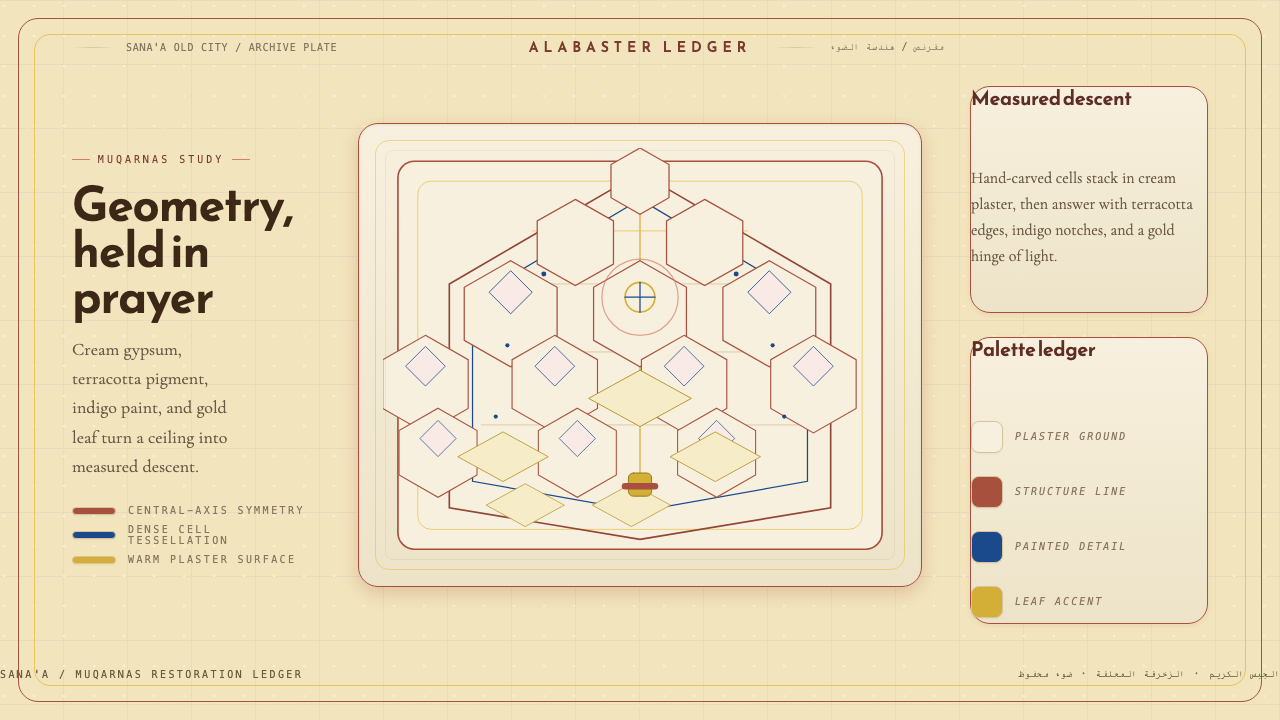 Yemeni Mukarras VaultSolemn geometry, warmed by plaster. Cream gypsum, terracotta, and indigo buil…
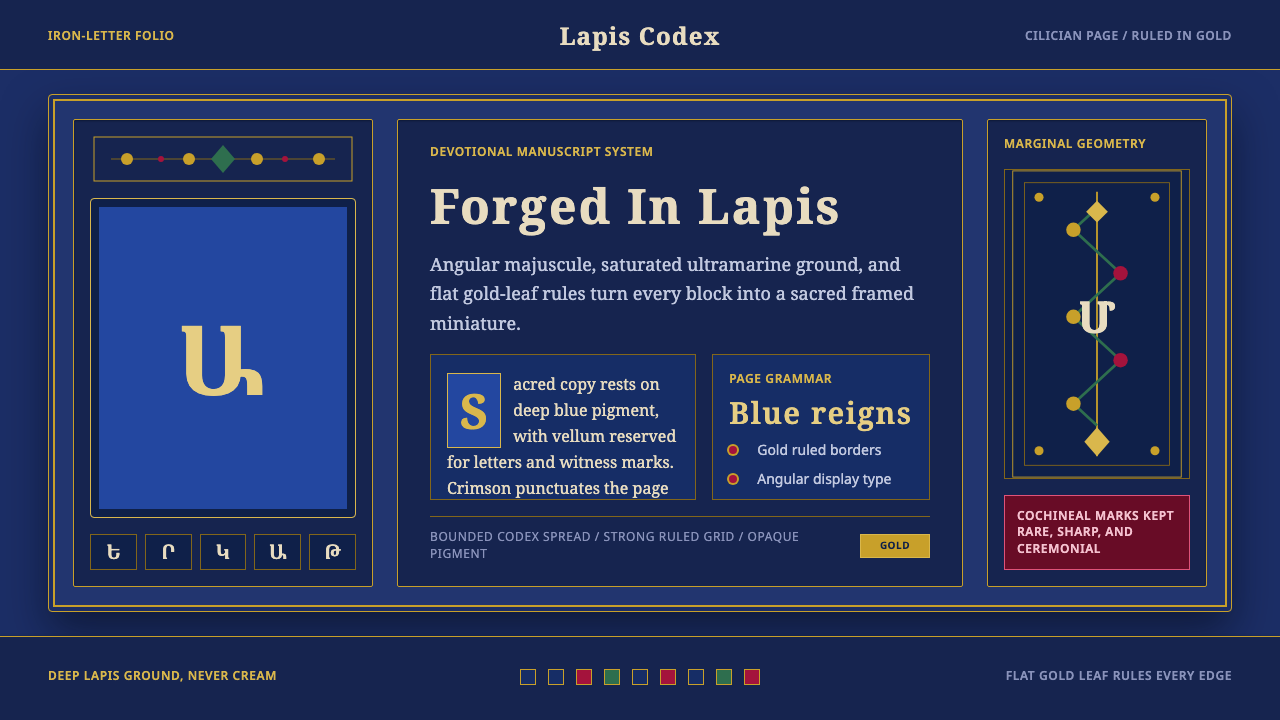 Armenian ErkatʿagirDevotional lapis reigns. Gold rules and angular serif glyphs frame a sacred g…
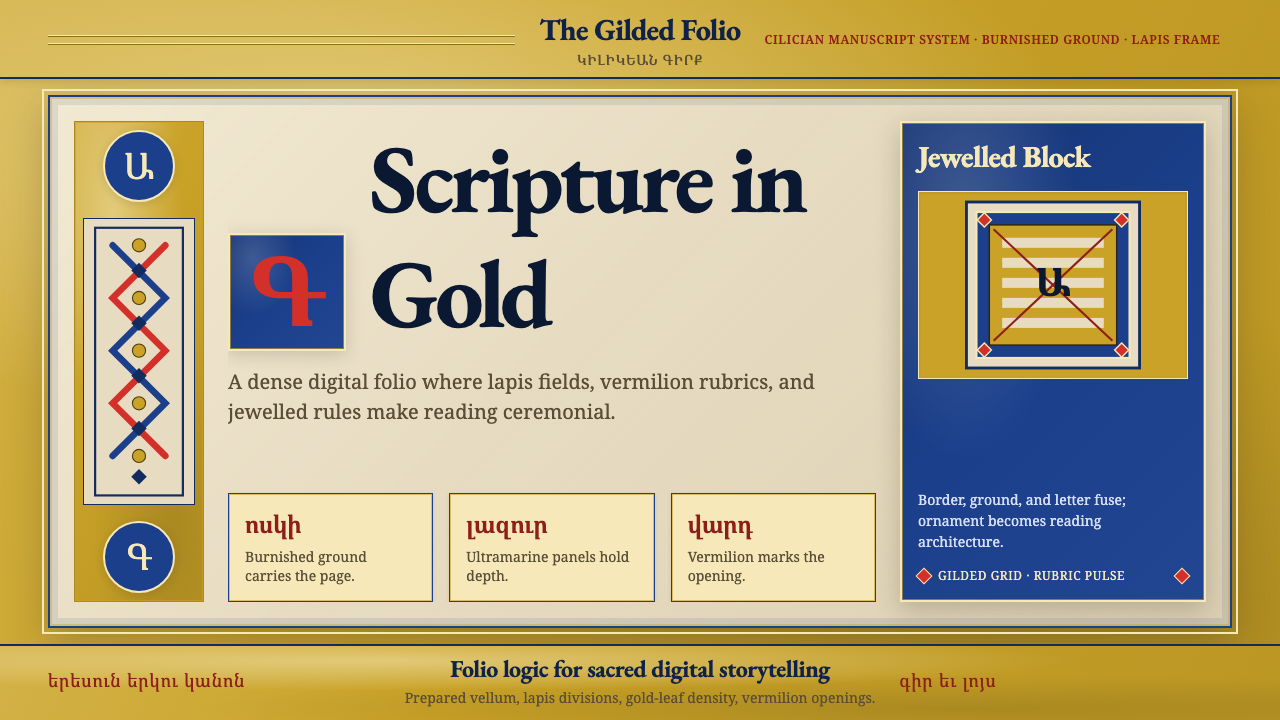 Armenian Illuminated ManuscriptGilded maximalism. Burnished gold, lapis frames, and vermilion initials build…
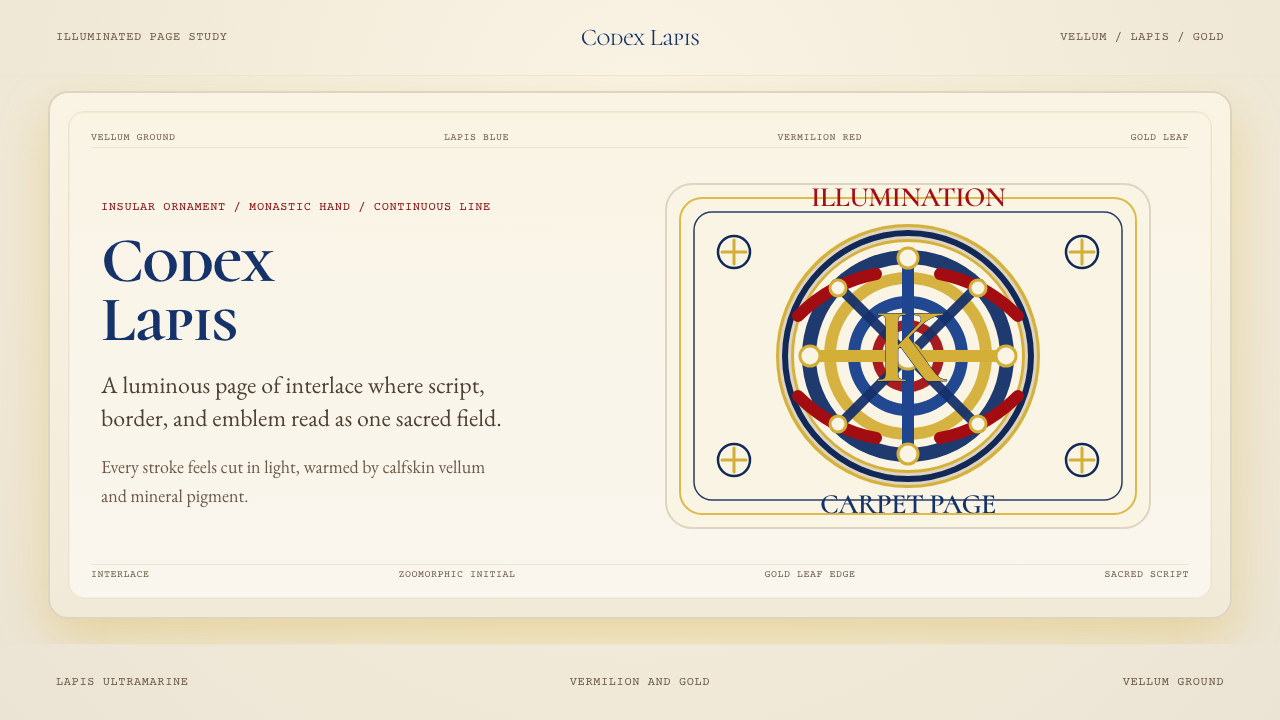 Book of Kells Celtic (800)Sacred and precise. Vellum cream, lapis, vermilion, and gold knotwork.
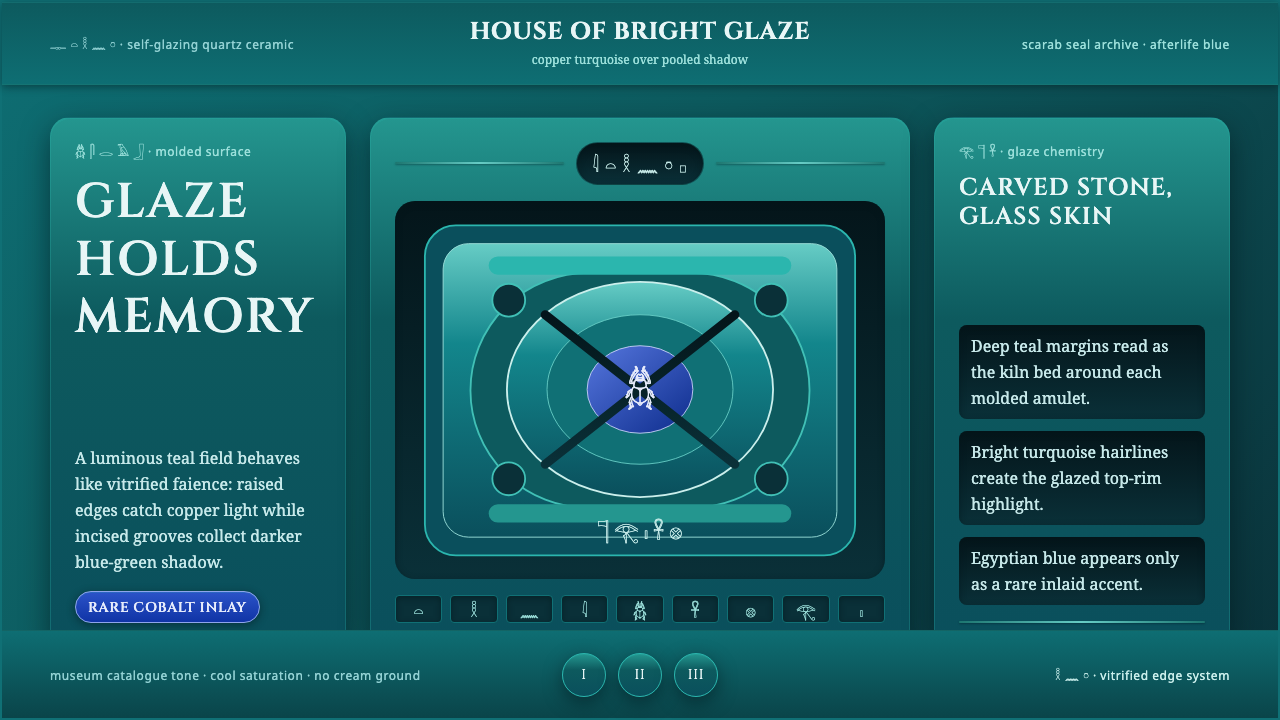 Egyptian FaienceGlaze carries the afterlife. Deep teal grooves, copper-turquoise rims, rare c…
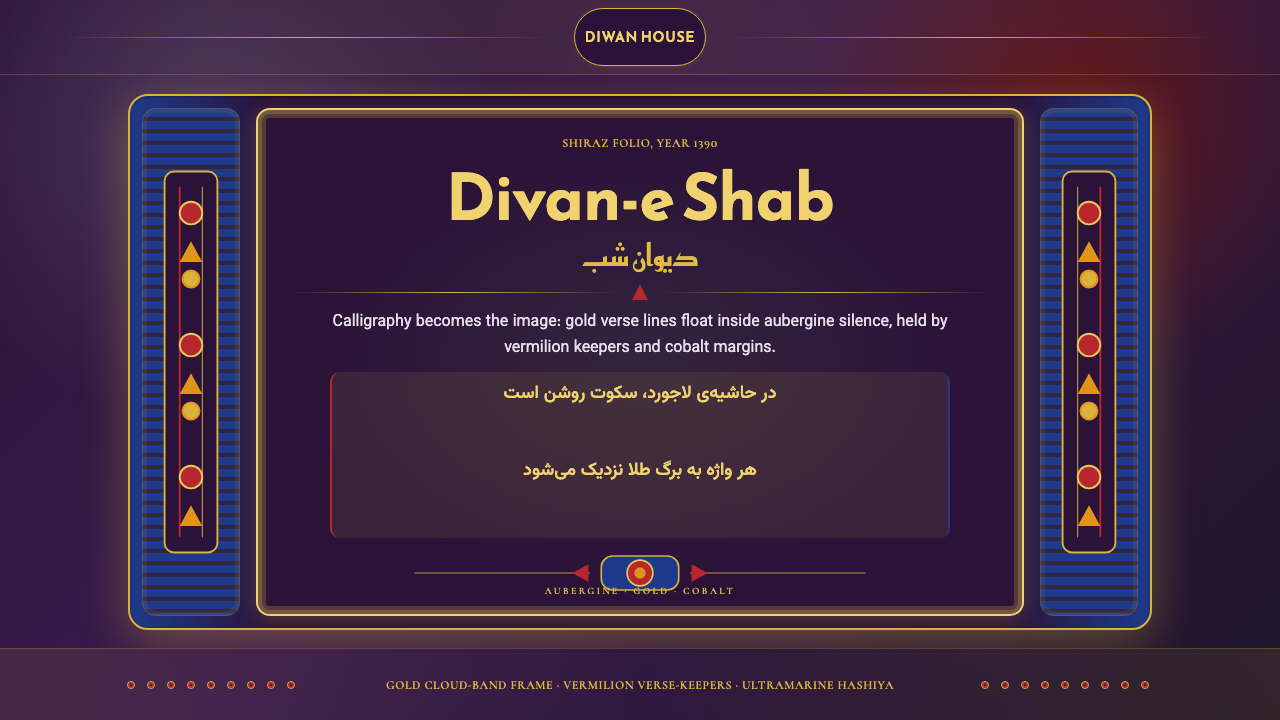 Iranian Shiraz Poetry Divan 1390Midnight manuscript glow. Aubergine fields, gold Kufi type, cobalt margins.