What is Armenian Illuminated Manuscript (Toros Roslin)?
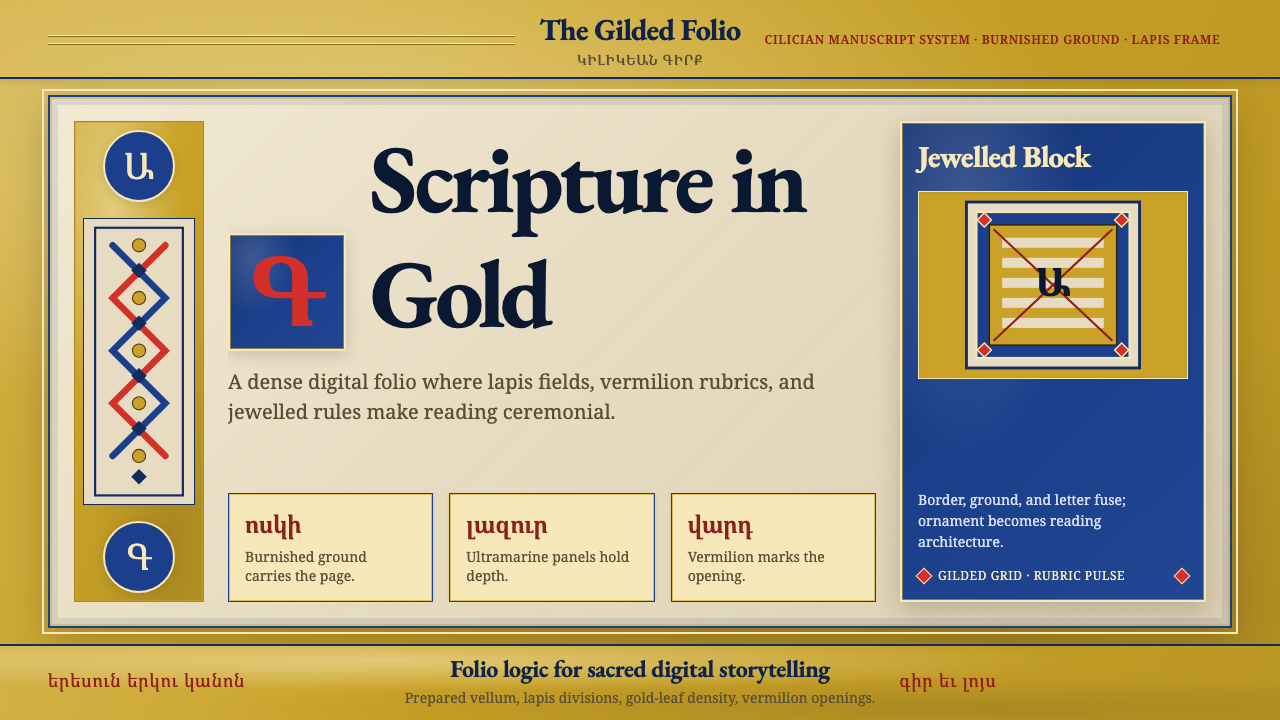
In 1262, a master illuminator painted gold, lapis, and vermilion onto vellum in a Cilician scriptorium — and left behind one of the most jewel-dense pages in manuscript history.
Armenian Illuminated Manuscript (Toros Roslin) in brief
Armenian Illuminated Manuscript reconstructs the visual world of Toros Roslin, the thirteenth-century master illuminator who completed a gospel book in 1262 at the Cilician scriptorium of Hromkla, painting gold leaf, lapis-lazuli blue, and vermilion onto prepared vellum.
The system is defined by luminous, gilded grounds paired with deep ultramarine fields and vermilion accents — a maximalist density of color and ornament rarely found outside sacred manuscript traditions. Nothing in this language is sparse; every surface invites close, sustained looking, in the manner of a page meant to be studied rather than glanced at.
Serif type echoes the calligraphic hand of the originals, while distinctly Armenian visual inventions — ornithomorphic bird-letter initials, khachkar-style interlace, and jewelled marginal frames — fuse with a Byzantine sense of grandeur to produce a style that is unmistakably its own, neither purely Western nor purely Eastern in its lineage.

See the Armenian Illuminated Manuscript (Toros Roslin) design system
Where does Armenian Illuminated Manuscript (Toros Roslin) come from?
Cilician Armenia — an Armenian kingdom established in the eastern Mediterranean, distinct from the Armenian highlands further east — became, over the twelfth and thirteenth centuries, a center of manuscript production that absorbed influences from its Byzantine, Crusader, and broader Mediterranean neighbors while developing a visual identity distinctly its own. The scriptorium at Hromkla, a fortress and seat of the Armenian Catholicos, was among the most productive centers of this tradition.
Toros Roslin worked at Hromkla in the mid-thirteenth century, active roughly from the 1250s through the 1260s, and is considered the preeminent master of the Cilician school of illumination. His completed gospel book of 1262 stands as a peak achievement of the tradition: miniatures painted in gold leaf, lapis-lazuli blue, and vermilion, with pigment analysis in later centuries confirming the use of these specific, costly mineral-based colors rather than cheaper substitutes.
Roslin's work fused Byzantine grandeur — inherited through centuries of contact between Armenian Christianity and the Byzantine Empire — with distinctly Armenian inventiveness. Among his most original contributions were ornithomorphic initials, letterforms built from the bodies of stylized birds, a device with few direct parallels in Byzantine or Western European illumination. He also incorporated khachkar-style interlace, the intricate knotwork ornament associated with Armenian cross-stones, translating a sculptural tradition into two-dimensional manuscript decoration, and framed his miniatures and canon tables with jewelled marginal borders that read as inlaid gemstones rendered in paint.
This combination of imported grandeur and local invention gave Cilician illumination — and Roslin's work specifically — a distinct identity within the broader family of Eastern Christian manuscript art: dense, maximalist, and unmistakably Armenian even while conversing fluently with its Byzantine and Mediterranean neighbors.
What defines the Armenian Illuminated Manuscript (Toros Roslin) look?
Color
The palette centers on three costly mineral pigments: burnished gold leaf, deep lapis-lazuli ultramarine, and vermilion red. These colors are used at full saturation and density rather than diluted or muted, reflecting both their material costliness and the sacred importance of the manuscripts they adorn.
Gilding
Burnished gold leaf provides the system's most luminous surface treatment, applied to backgrounds, halos, and ornamental frames. Gold in this tradition is not a flat color but a reflective material surface — it catches and returns light, giving the page an active, luminous quality that flat paint cannot replicate.
Ornithomorphic Initials
Letterforms built from the stylized bodies of birds are among the tradition's most original inventions, particularly associated with Toros Roslin. These initials fuse calligraphy with figurative illustration, treating the letter itself as a living, ornamental creature rather than an abstract mark.
Khachkar Interlace
Intricate knotwork ornament, derived from the carved interlace patterns of Armenian khachkar cross-stones, appears throughout the manuscript's borders and framing devices. This translates a sculptural, three-dimensional tradition into flat, two-dimensional decoration without losing its intricacy.
Jewelled Marginal Frames
Miniatures and canon tables are bordered with frames rendered to resemble inlaid gemstones — painted approximations of jewelled metalwork rather than plain ruled borders. These frames add a further layer of density and preciousness to an already maximalist page.
Byzantine-Armenian Fusion
The overall grandeur of composition and figure style draws on centuries of contact with Byzantine art, while the specific ornamental vocabulary — bird initials, khachkar interlace — remains distinctly Armenian. This fusion, rather than either influence alone, defines the Cilician school's identity.
Density Over Restraint
Every surface in this tradition tends toward maximalism rather than restraint — ornament fills margins, initials, and frames alike, leaving little bare vellum visible. This density is a deliberate expression of devotion and craft investment, not an absence of editing.

See the Armenian Illuminated Manuscript (Toros Roslin) design system
Who shaped Armenian Illuminated Manuscript (Toros Roslin)?
The preeminent master of Cilician Armenian illumination, Roslin completed his defining gospel book in 1262 at the Hromkla scriptorium. His fusion of Byzantine grandeur with original inventions like ornithomorphic bird initials established the visual vocabulary this design system reconstructs, and pigment analysis of his surviving work confirms the use of genuine gold leaf, lapis-lazuli, and vermilion.
The broader community of scribes and artists working at Hromkla and other Cilician centers developed the school's shared vocabulary of khachkar-style interlace and jewelled marginal framing, building an institutional tradition of manuscript production around which Roslin's individual mastery emerged.
How do you use Armenian Illuminated Manuscript (Toros Roslin) today?
This system rewards density and craft investment — it is one of the most ornamentally rich styles in the library, and applying it well means embracing that maximalism rather than tempering it toward contemporary minimalism.
For presentation slides, the style suits heritage, cultural, and luxury content especially well. Cover slides benefit from a gilded ground with a jewelled-frame border treatment, while content slides can use ornate initial-letter treatments for section headers, echoing the manuscript's own illuminated capitals rather than plain typographic headings.
For web interfaces, the palette works well for cultural institutions, museum digital collections, or luxury brands seeking a maximalist, heritage-rich identity. Deep ultramarine and gilded gold should anchor key surfaces; vermilion suits accent details and calls to action; ornamental border treatments can frame key content blocks the way jewelled frames border a miniature.
For editorial and marketing work, the style is a strong fit for long-form cultural storytelling, art history features, or heritage-brand campaigns. Feature layouts can use the interlace and jewelled-frame motifs as structural devices around pull quotes or key imagery, while keeping the overall composition dense rather than airy.
A common mistake when applying this system is thinning out the ornament to make the layout feel cleaner or more modern — this directly contradicts the maximalist logic of the source tradition. Equally common is substituting flat, matte gold for the burnished, reflective quality genuine gilding carries; the system depends on that luminous, light-catching gold surface rather than a dull metallic fill.

See the Armenian Illuminated Manuscript (Toros Roslin) design system
Armenian Illuminated Manuscript (Toros Roslin) — FAQ
Why is this style so much denser than other historical illumination traditions?
Cilician Armenian illumination, and Toros Roslin's work in particular, treated every available surface — margins, initials, canon-table frames — as an opportunity for ornament, reflecting both the sacred importance of gospel manuscripts and the era's willingness to invest enormous craft labor into devotional objects. The density is not excess; it is the tradition's fundamental visual grammar.
What makes the ornithomorphic bird initials distinctly Armenian rather than Byzantine?
While Byzantine manuscript art influenced the overall grandeur of Cilician illumination, letterforms built from stylized bird bodies have few direct parallels in Byzantine manuscript traditions and are considered one of Toros Roslin's most original contributions — a specifically Armenian visual invention layered onto an imported sense of scale and solemnity.
How do we know the pigments used were genuinely gold, lapis, and vermilion rather than cheaper substitutes?
Scientific pigment analysis conducted on surviving Cilician manuscripts, including work attributed to Toros Roslin, has confirmed the presence of genuine gold leaf, lapis-lazuli-derived ultramarine, and vermilion — costly materials whose use signals both the wealth of the patrons commissioning these gospel books and the sacred seriousness with which they were produced.
Does this style work for secular or contemporary commercial content?
It can work well for luxury, heritage, or cultural-institution branding that wants to signal preciousness, craft, and historical depth, but its dense, devotional maximalism sits less naturally with casual, everyday, or budget-oriented consumer content, which usually benefits from lighter, less ornamented visual languages.
Related design styles
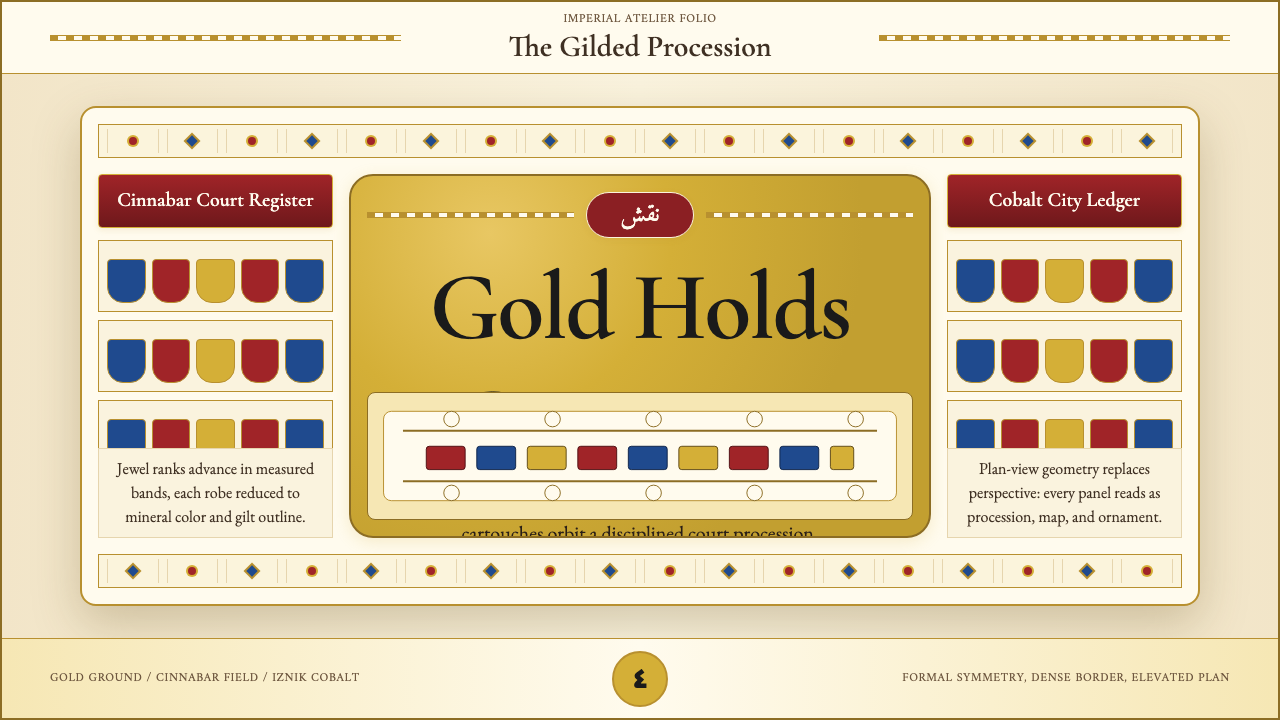 Ottoman Court Miniature (Topkapı)Ceremony made dense. Gold ground, cinnabar cartouches, cobalt procession geom…
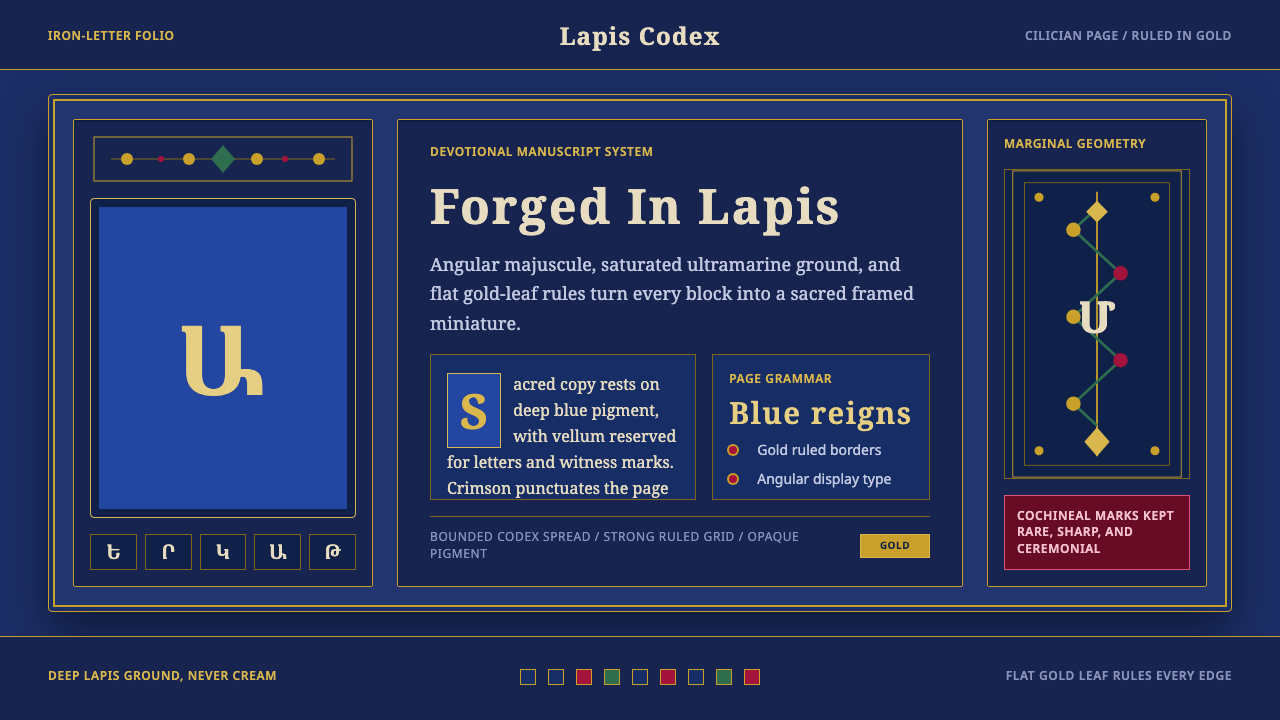 Armenian ErkatʿagirDevotional lapis reigns. Gold rules and angular serif glyphs frame a sacred g…
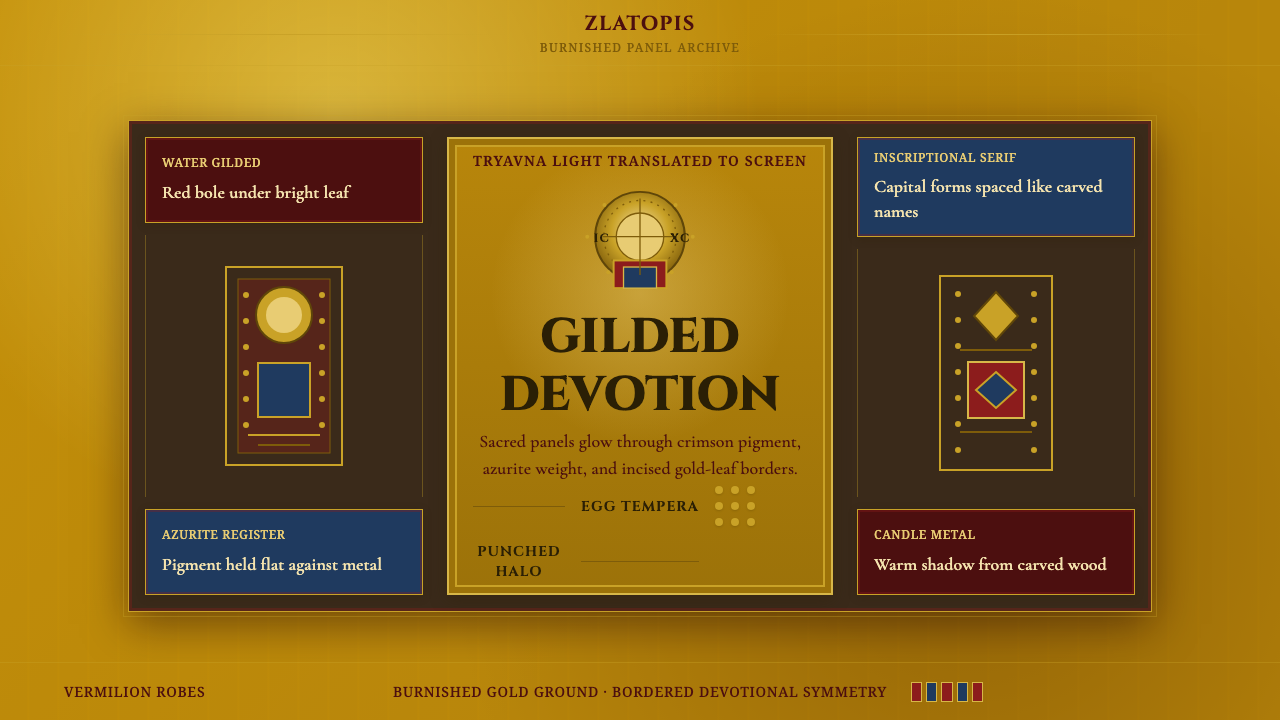 Bulgarian Orthodox IconSacred metal holds still. Burnished gold, crimson panels, and punched halos f…
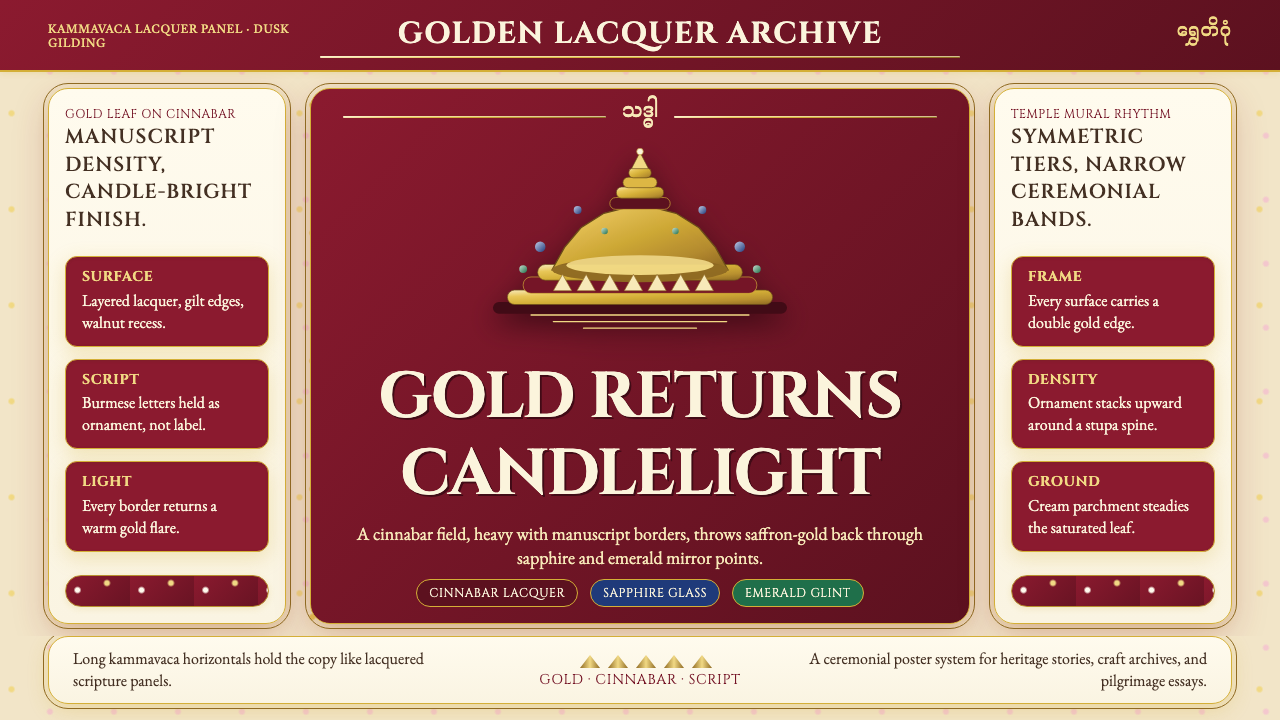 Burmese Shwedagon Gold-LacquerOpulence catches fire. Gold-leaf gradients on cinnabar panels frame a stupa s…
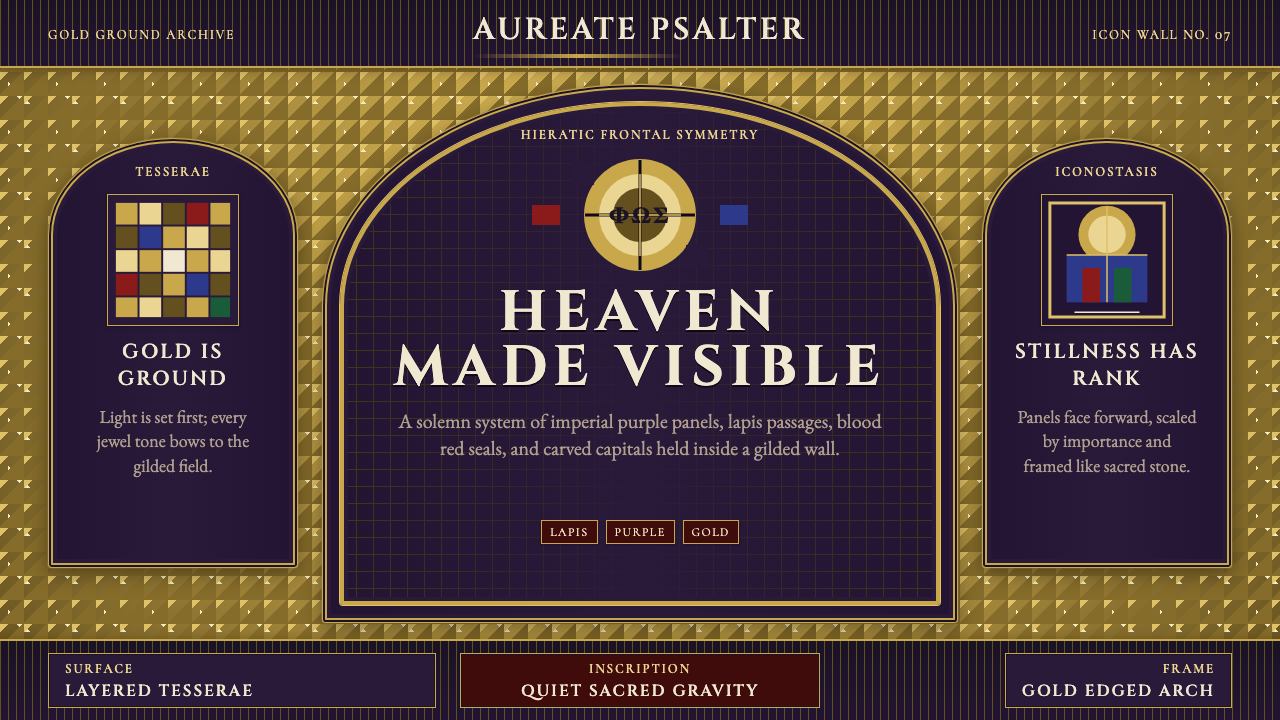 Byzantine Mosaic / IconSacred weight, tiled in light. Gold tesserae ground, Cinzel capitals, arch-fr…
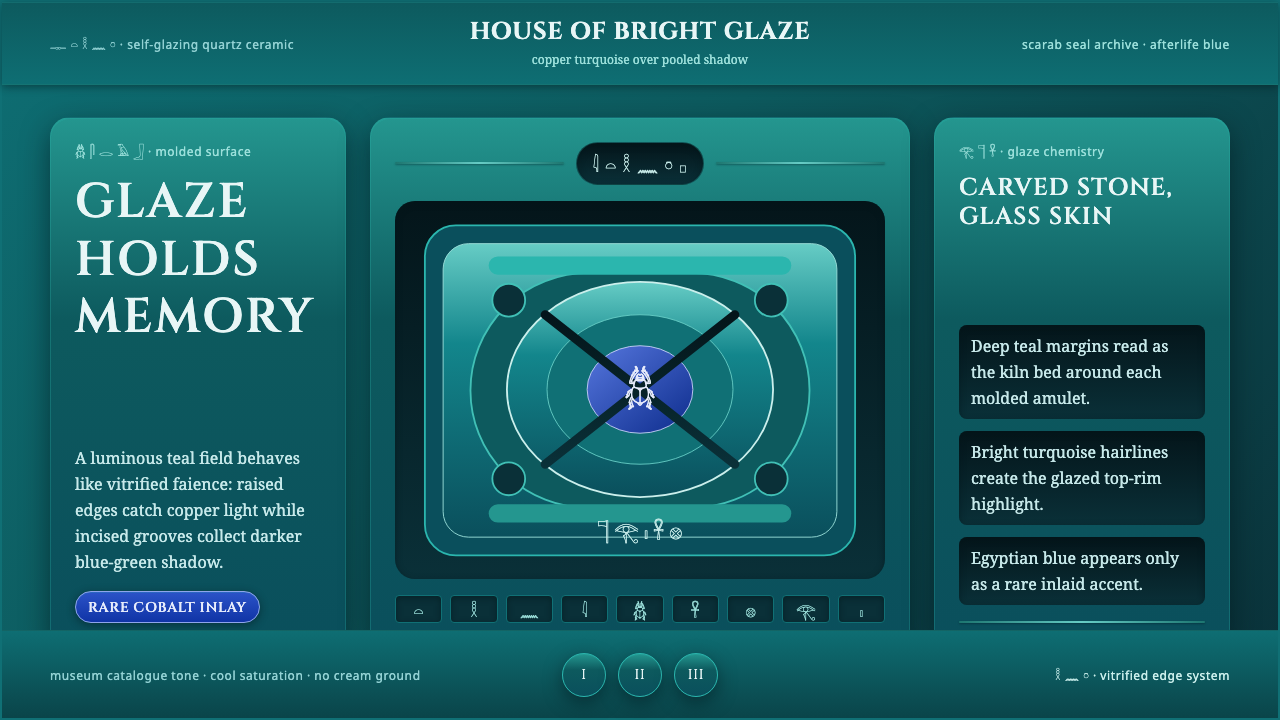 Egyptian FaienceGlaze carries the afterlife. Deep teal grooves, copper-turquoise rims, rare c…