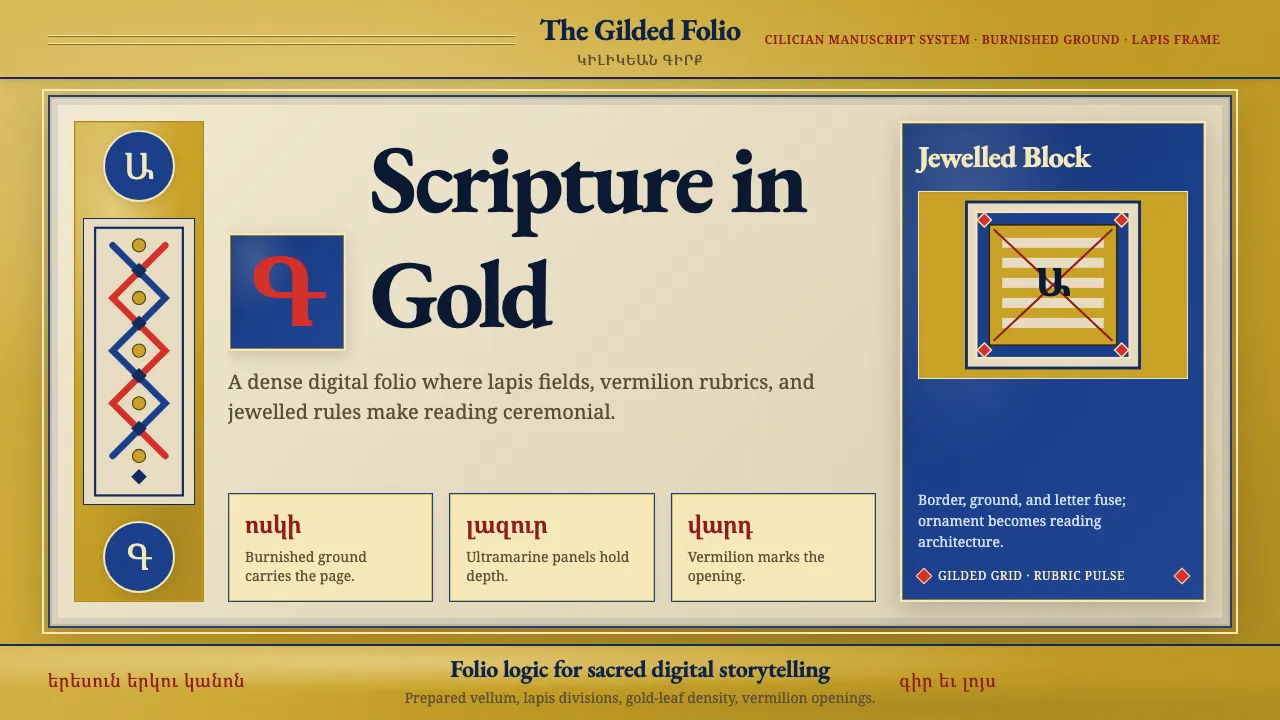
About Armenian Illuminated Manuscript (Toros Roslin)
In 1262, the master illuminator Toros Roslin completed a gospel book in the Cilician scriptorium of Hromkla, painting in gold leaf, lapis-lazuli blue, and vermilion on prepared vellum. His miniatures fuse Byzantine grandeur with a distinctly Armenian inventiveness — ornithomorphic bird-letter initials, khachkar-style interlace, and jewelled marginal frames.
This design system distills that scriptorium maximalism into digital form: luminous gilded grounds, deep ultramarine fields, vermilion accents, and serif type that echoes the calligraphic hand of the originals.
Learn more about the Armenian Illuminated Manuscript (Toros Roslin) style
- Origin
- Cilician Armenia (Hromkla scriptorium), Eastern Mediterranean
- Era
- 13th century (peak: the 1262 gospels of Toros Roslin, Hromkla scriptorium)
- Key figures
- Toros Roslin
- Movements
- Armenian manuscript illumination · Cilician school · Byzantine-influenced Eastern Christian art
Armenian Illuminated Manuscript (Toros Roslin) design spec
Colors
Typography
The other 11 sections — buttons, cards, spacing, motion, techniques and more — open once you unlock. Download the DESIGN.md or send it to your AI in one click. Unlock once, yours forever.
Sign up nowStyles similar to Armenian Illuminated Manuscript (Toros Roslin)
Also inspired by art & artists, with a close feel.
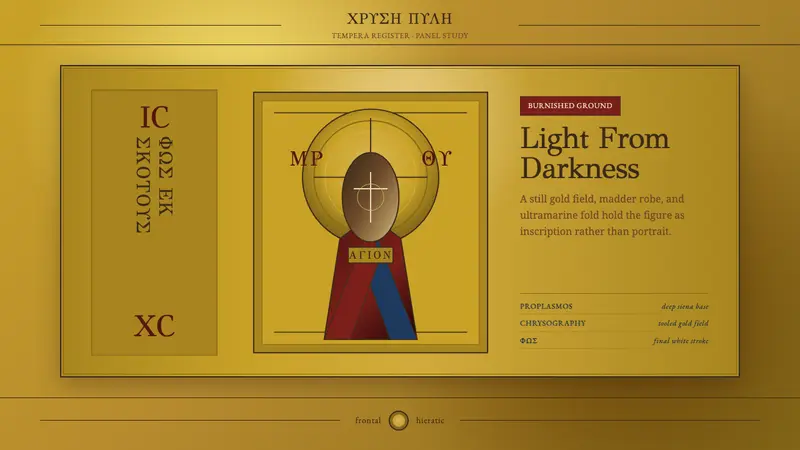 Mount Athos IconStillness becomes light. GFS Greek inscriptions frame madder, ultramarine, and gold.
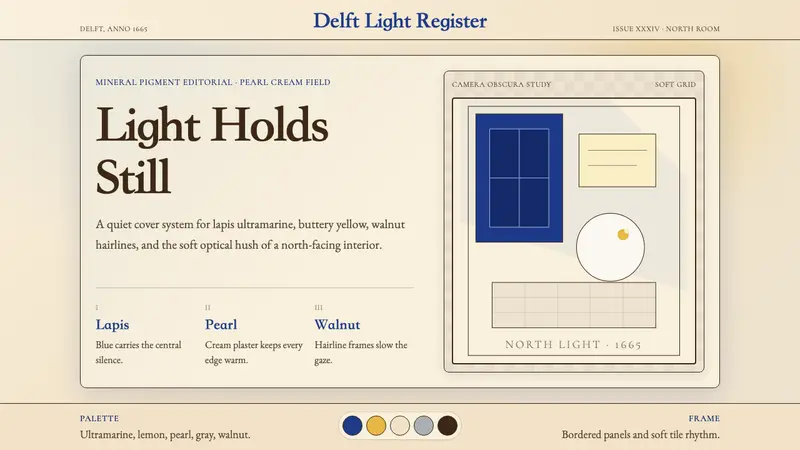 Vermeer Dutch Golden AgeStillness glows. Lapis ultramarine, pearl cream, and walnut frames hold north light.
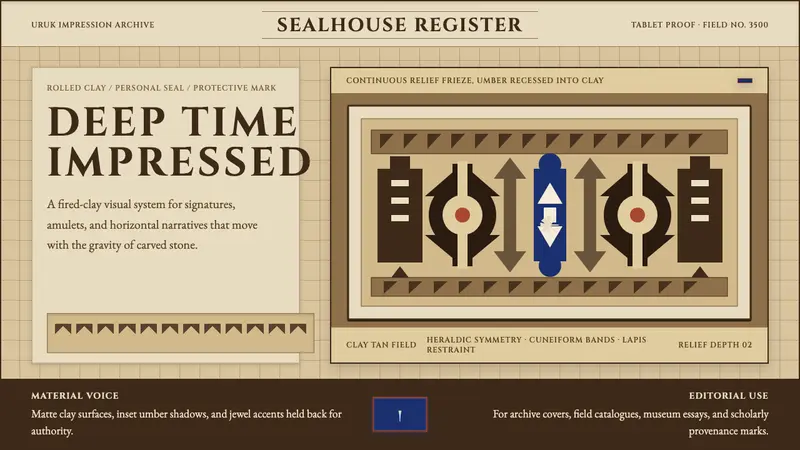 Sumerian Cylinder SealAncient weight, pressed in clay. Cinzel caps and cuneiform wedges cut umber into tan.
 Leonardo — Mona Lisa (1503)Form emerges without edges. Ochre light dissolves into umber shadow and blue-green haze.