What is Ottoman Court Miniature (Topkapı)?
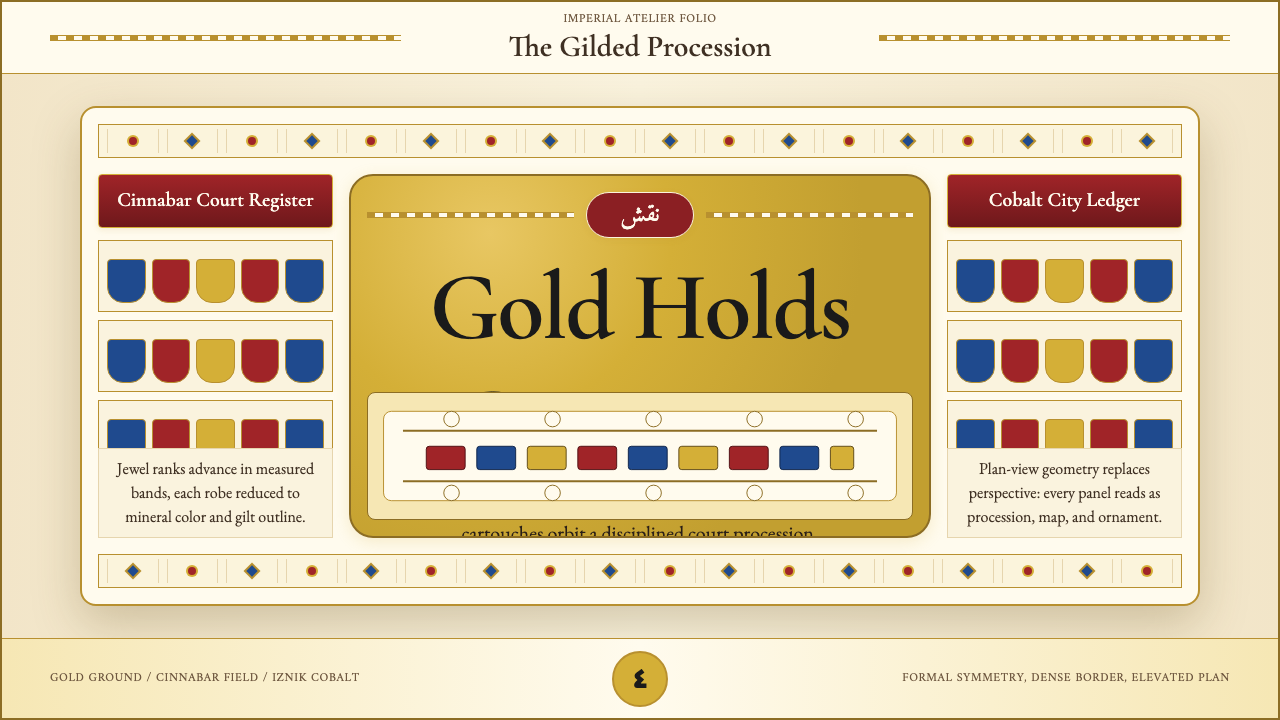
Ottoman Court Miniature is where ceremony becomes density — gilded heavens, cinnabar-red cartouches, and processions of jewel-toned kaftans arranged with the precision of a cartographer's eye.
Ottoman Court Miniature (Topkapı) in brief
Ottoman Court Miniature is the peak achievement of Islamic book art produced under the patronage of the Ottoman sultans, made primarily in the nakkaşhane — the royal painting atelier inside Topkapı Palace in Istanbul — between roughly 1500 and 1750. Unlike its Persian Safavid and Mughal Indian cousins, which often prioritize lyrical landscape, emotional portraiture, and sensuous floral elaboration, the Ottoman court style is architectural in temperament: dense, ceremonial, and topographically precise.
The visual grammar is distinctive and immediately recognizable. Deep gold grounds stand in for sky and atmosphere, eliminating spatial recession in favor of sacred presence. Saturated cinnabar reds and cobalt blues are deployed in interlocking geometric register bands, tulip-and-rose border patterns, and the formal kaftans worn by courtiers and sultans alike. Human figures are schematic — posed, ranked, and arrayed rather than psychologically individualized — because the subject is ceremony and institution, not private feeling.
This is an art of the state record and the commemorative book. Its patron was the imperial chancery; its audience was the sultan and his court. Every image is simultaneously an act of documentation and a declaration of power, executed with the concentrated skill of craftsmen who trained for years inside the palace walls.

Where does Ottoman Court Miniature (Topkapı) come from?
The Ottoman nakkaşhane traces its institutional origins to the mid-fifteenth century, when Mehmed II — the conqueror of Constantinople in 1453 — organized a court atelier on a Timurid-Persian model, importing artists and patterns from Tabriz and Herat. The style that would become distinctively Ottoman, however, crystallized during the long reign of Süleyman the Magnificent (1520–1566), when the empire reached its greatest territorial extent and the palace arts reached a corresponding ambition. Under Süleyman, the nakkaşhane employed hundreds of craftsmen across dozens of disciplines — illuminators, binders, calligraphers, painters — working in an organized hierarchy under a chief artist, the sernakkaş.
The defining visual documents of the classical Ottoman period are the şehnameler (books of the sultan's deeds) and the sürnameler (festival books recording imperial circumcision ceremonies and court celebrations). The Sürname-i Hümayun of 1582, commissioned by Murad III to record fifty-two days of circumcision festivities for his son, is perhaps the most spectacular surviving example: its hundreds of pages document guild processions, acrobatic performances, and naval displays along the Hippodrome with a panoramic, scrolling visual logic that has no parallel in Western book art of the same period. The work is attributed largely to Nakkaş Osman, the most important painter of the late sixteenth-century Ottoman court.
The style evolved through several distinct phases. The sixteenth century established the formal canon under Nakkaş Osman: gold-ground compositions, schematic facial typology, architectural cross-section views of palace interiors, and the characteristic tiered-horizon cityscape. The seventeenth century saw a gradual relaxation of the severe geometric order, with figures acquiring slightly more individual treatment. The reign of Ahmed III (1703–1730) brought the so-called Tulip Period, during which Ottoman court culture absorbed Baroque and Rococo influences from European diplomatic exchange, and the painter Levni produced a series of single-figure portraits and festival images that remain the most stylistically adventurous works in the tradition.
The tradition declined after 1750 as the Tanzimat reform era brought Western academic painting into the Ottoman court, and the imperial patronage system that had sustained the nakkaşhane gradually gave way to European-trained studio painters. What remained was collected: the Topkapı Palace Museum now holds the world's most important concentration of Ottoman illustrated manuscripts, and it is from this archive that contemporary understanding of the style is almost entirely drawn.
What defines the Ottoman Court Miniature (Topkapı) look?
Gold Ground
The most immediately distinctive feature of Ottoman court miniature is the pervasive use of burnished gold as a ground for sky, background, and atmospheric space. Where Persian and Mughal miniatures often use blue or gradated washes to suggest recession and luminosity, Ottoman court painting substitutes gold — a choice that collapses natural depth in favor of iconic presence. The gold is not decorative in a subsidiary sense; it is the primary visual fact of the image, establishing a register of sacred formality before any figure or building is introduced.
Saturated Cinnabar and Cobalt
The Ottoman palette beyond gold is built on two anchoring hues: a deeply saturated, warm cinnabar red and a rich cobalt blue. These appear in cartouche panels framing inscriptions, in the decorative register bands separating pictorial zones, in the kaftans worn by courtiers, and in tiled architectural surfaces. The two colors are rarely softened or mixed; they function as structural declarations rather than descriptive tones. Against the gold ground, the cinnabar reads as both warm and commanding; the cobalt reads as cooling and spatially recessive, creating a rhythmic visual alternation across the page.
Topographical Precision
One of the most unusual qualities of the Ottoman court style is its commitment to topographical accuracy. Matrakçı Nasuh's city-view paintings, produced in the 1530s and 1540s, represent Istanbul, Tabriz, Baghdad, and other cities with a cartographic specificity that predates the Western bird's-eye-view tradition. Buildings are shown in architectural elevation or cross-section, their structural and spatial relationships preserved. Festival book scenes record actual buildings in the actual positions they occupied in Istanbul. This documentary impulse distinguishes Ottoman court miniature from the more fantastical or generalized landscape conventions of Persian painting.
Formal Court Composition
The canonical Ottoman court scene places the sultan on a throne at the upper center of the composition, attended by ranked rows of standing or kneeling courtiers. This hierarchical arrangement is strictly symmetrical about a vertical axis: figures are organized by proximity to the sultan, with senior officials and viziers closest. The sultan is often distinguished by scale — slightly enlarged — and by the richness of his kaftan, turban jewel, and surrounding setting. The composition does not attempt illusionistic depth; it reads as an organizational diagram as much as a pictorial scene, encoding protocol and precedence in its very structure.
Arabesque and Tulip-Rose Border Bands
Pictorial scenes in Ottoman manuscripts are invariably enclosed within a system of framing elements: narrow outer border lines, wider bands of arabesque interlace or floral scrollwork, and inner cartouche panels bearing calligraphic inscriptions in Arabic or Ottoman Turkish. The floral repertoire centers on the tulip, hyacinth, carnation, and rose — the canonical Ottoman garden flowers — rendered in a stylized, non-shading mode that converts botanical form into geometric pattern. These border systems are not incidental ornament; they carry the same visual weight as the central image and encode the manuscript's cultural identity as clearly as its subject matter.
Schematic Figuration
Ottoman court figures are not portraits in the Western individualist sense. Faces tend toward a shared typology: a rounded oval, slightly down-turned almond eyes, a small curved mouth, a defined but undramatic nose. Individual identity is communicated through rank markers — the height and form of the turban, the pattern of the kaftan, the position in the composition — rather than through psychological rendering of the face. This schematic approach is consistent with Islamic visual tradition's wariness of naturalistic human representation, but it also serves the compositional logic of the festival book format, where dozens or hundreds of figures must be organized into legible processions across a horizontally unfolding scene.
Flat Planes and Absence of Shadow
Ottoman court miniature employs pure, unmodulated areas of color with no cast shadows, shading, or tonal gradation to suggest volume or light source. Architectural surfaces, garments, and landscape elements are all rendered as interlocking flat planes distinguished by hue and pattern rather than by light and shadow. This is not a technical limitation but a deliberate aesthetic choice rooted in Islamic artistic philosophy: the image is a surface record, not a window into illusionistic space. The result is an image of concentrated graphic power — dense, legible at a distance, and formally unified in a way that deep spatial recession would compromise.

Who shaped Ottoman Court Miniature (Topkapı)?
Nakkaş Osman served as the leading painter of the Ottoman nakkaşhane under sultans Murad III and Mehmed III in the latter half of the sixteenth century, and is the figure most responsible for the codification of the classical Ottoman court miniature style. His work on the Hünername (1584–1588), a biographical history of the Ottoman sultans, established the compositional conventions — the gold-ground throne scene, the ranked courtier procession, the architectural cross-section — that would define the tradition for the next century. His portraits of the sultans, produced in a series of album paintings, are the most authoritative images of the Ottoman dynasty from this period.
Matrakçı Nasuh was a polymath in the service of Süleyman the Magnificent — mathematician, historian, soldier, and artist — who created the Beyân-ı Menâzil-i Sefer-i Irâkeyn (c. 1537), a remarkable illustrated travel chronicle recording Süleyman's eastern campaigns. His city-view illustrations of Istanbul, Tabriz, Baghdad, and other cities represent some of the earliest and most detailed topographical paintings in the Islamic world, anticipating the bird's-eye-view cartographic tradition by decades. His visual approach — aerial perspective without vanishing point, buildings shown simultaneously in elevation and plan — is one of the most distinctive contributions to the Ottoman court visual repertoire.
Levni was the court painter under Ahmed III during the Tulip Period (early eighteenth century), and his work represents the most significant departure from classical Ottoman conventions within the tradition. His single-figure images of court women, musicians, and dancers — produced as album paintings — show a new interest in the individual figure as subject, with more fluid contour lines, greater attention to the fall of drapery, and a lighter, more playful palette than the severe classicism of Nakkaş Osman. His contributions to the Sürname-i Vehbi (1720) bring a theatrical vivacity to the festival-book format that distinguishes it from its sixteenth-century predecessors.
Mehmed Siyahkalem — whose name translates as 'black pen' — is associated with a body of brush-and-ink drawings in a pre-classical, fifteenth-century Ottoman or Turkic manner that remains partly enigmatic in attribution and date. His images of shamans, demons, wrestlers, and nomadic figures represent a strikingly different register from the formalized gold-ground court style — rawer, more kinetically drawn, influenced by Central Asian steppe visual traditions rather than Persian court refinement. Whether Siyahkalem was a single artist or an attribution name for a stylistic group remains debated, but the works associated with him are among the most powerful and unusual objects in the Topkapı collections.
How do you use Ottoman Court Miniature (Topkapı) today?
Ottoman Court Miniature is not among the immediately obvious historical styles for contemporary design work, but it rewards careful application. Its core visual logic — flat saturated planes, bold geometric framing, gold or deep-neutral grounds, and hierarchical figure arrangement — translates into a design vocabulary suited to contexts demanding ceremony, authority, and visual richness without photographic realism. The challenge is handling the density: Ottoman miniature is a maximalist style within a rule-governed system, and successful contemporary application requires understanding which rules generate the visual richness, not merely adding more decoration.
For presentation slides, the Ottoman miniature sensibility works best on cover and section-divider pages rather than dense content pages. A cover page built on this aesthetic uses a rich, deep ground — a warm golden tone or a deep jewel-toned field — with the title set in high-contrast lettering framed by a decorative border band adapted from the arabesque or floral register motif. Section dividers can use a horizontal band of repeated geometric-floral pattern in cinnabar or cobalt as a visual reset marker. Content slides should be restrained by comparison: the ornamental richness belongs at the structural moments, not scattered through every data table. A subtle gold accent in chart titles or slide headers can carry the aesthetic thread without overwhelming readability.
For web interfaces and dashboards, the Ottoman aesthetic suggests an approach built on deep, rich backgrounds — not the flat whites of minimalist UI, but warm parchment tones or deep indigo or emerald grounds — with content organized in clearly bordered card panels that echo the manuscript's framing cartouches. Navigation elements and tier labels can take on a banner-like horizontal register quality. Color is used as a rank signal: one dominant jewel tone identifies primary actions, a second anchors structural containers, and typography is kept clean and high-contrast against the enriched ground. Pricing pages benefit from a distinct tier structure where the premium tier carries the full gold-and-cinnabar treatment, establishing hierarchy through visual richness rather than just size or weight.
For editorial design and marketing materials, the style supports a mode of high-ceremony visual communication well suited to luxury branding, cultural institution identity, event posters, and heritage product launches. An Ottoman-inflected editorial layout uses a deep-ground page with text set in high-contrast light type, bordered by a narrow geometric or floral band at the margins. Feature spreads can use a central image field framed by arabesque-derived ornamental borders that treat the photograph or illustration as a miniature-painting subject within a manuscript page. For digital marketing, the formal symmetry of the court scene — a centered, hierarchically organized composition — works well for announcement graphics and hero sections where the product or subject occupies the sultan's visual position at center.
The most common mistake when applying this aesthetic is treating the gold as a literal fill color and the floral patterns as freely repositionable clip-art. Ottoman court miniature achieves its density through a rigorously organized layered system: ground, register band, central field, inner frame, subject, inscription panel. Each layer has a defined function. Applying decorative elements without this structural logic produces pastiche — visually busy but incoherent. Similarly, the palette should not be extended into soft pastels or desaturated neutrals; the style's authority comes precisely from the commitment to full saturation against a richly toned ground. Diluting the palette produces something that reads as vaguely 'ornamental' rather than distinctively Ottoman.

Ottoman Court Miniature (Topkapı) — FAQ
How is Ottoman court miniature different from Persian miniature painting?
They share a common ancestry — both derive from the Timurid-era Herat school — but evolved in distinct directions. Persian miniature painting, especially in its Safavid manifestation, tends toward lyrical landscape, elaborate floral background patterns, and emotionally expressive figurative scenes drawn from literary sources like the Shahnameh or the works of Rumi and Hafez. Ottoman court miniature is more documentary in purpose: its subjects are historical events, imperial ceremonies, and topographical records rather than poetic narratives. The Ottoman palette tends toward heavier gold grounds and more saturated, unmodulated color fields; the Persian palette allows greater gradation and atmospheric color. Ottoman figures are more schematic and rank-coded; Persian figures are more individually characterized.
Can this style work in a digital interface without looking costume-like or pastiche?
Yes, but restraint and structural integrity are essential. The risk of pastiche comes from applying decorative surface elements — arabesque borders, floral motifs, gold fills — without the underlying organizational logic of the original system. A successful digital application abstracts the principles rather than copying the ornament: a deep warm ground instead of white, a high-contrast bordered card structure instead of plain containers, jewel-toned accent colors used at high saturation but restricted to specific functional roles, and a typographic hierarchy that is formal and clear. The goal is to evoke the aesthetic register — ceremony, richness, authority — not to reproduce a digitized manuscript page.
What makes the tulip such a central motif in this tradition?
The tulip has a layered significance in Ottoman culture that makes its visual ubiquity in the decorative arts legible as more than botanical preference. The tulip was among the first plants systematically cultivated in Ottoman palace gardens from the fifteenth century onward, and its cultivation became an imperial passion — by the early eighteenth century the Tulip Period under Ahmed III saw thousands of varieties bred and displayed in elaborate palace garden festivals. In Arabic script, the letters that spell 'tulip' (lâle) and the letters that spell 'God' (Allah) are the same, giving the flower a spiritual resonance beyond its horticultural prestige. In the visual arts, its clean, pointed-petal form translates readily into the geometric-floral pattern vocabulary that Ottoman decorators used across textiles, tiles, metalwork, and manuscript borders.
Is there a dark or night-mode variant that preserves the visual spirit of this style?
The Ottoman style actually adapts more gracefully to deep or dark backgrounds than many historical styles, because the original gold-ground convention already operates outside a light-from-above logic. A dark adaptation built on very deep indigo, near-black, or dark emerald grounds can preserve the jewel-toned accent palette — cinnabar, cobalt, gold — without sacrificing the style's visual density. The key is maintaining high contrast between the ground and the accent colors, and keeping the framing and border elements present. What does not survive the dark inversion is the warm parchment-ground character of the illuminated manuscript page; the dark variant reads as more formal and nocturnal than the luminous gold of the original, which is a valid aesthetic register but a different one.
How should typography be chosen to complement this aesthetic?
Original Ottoman manuscripts use Arabic-script calligraphy — primarily Naskh and Nesta'liq forms — for their inscriptions and cartouches, and these have no direct Latin equivalent. For contemporary work in Latin script, the most compatible approach is a typeface with formal, classical proportions and visible stroke contrast, similar to what the calligraphic cartouche provides in the original: a sense of craft, weight, and ceremony in the letterform. High-contrast serif designs in a traditional or transitional style complement the aesthetic better than geometric sans-serifs, which read as too modern and structurally at odds with the handmade-manuscript origin. For East Asian languages, brush-influenced or carved-character styles with visible weight variation offer the closest equivalent to the calligraphic authority of the Nesta'liq inscription panel.
Related design styles
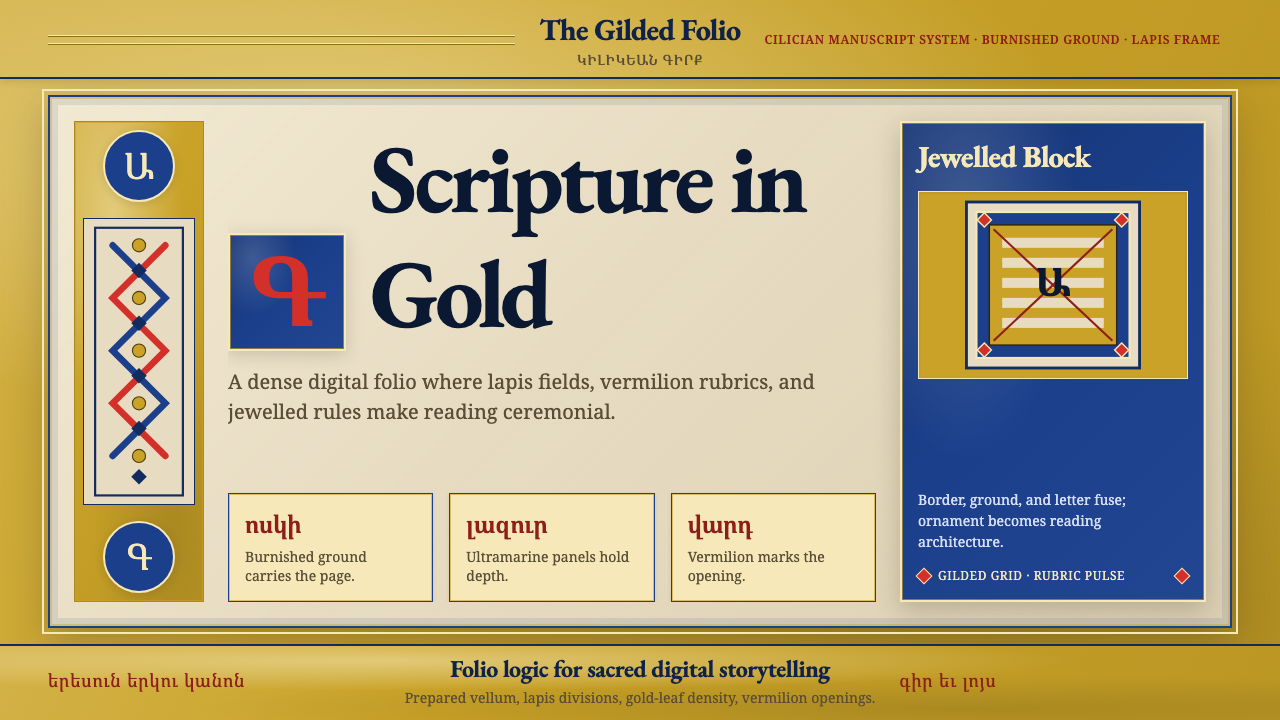 Armenian Illuminated ManuscriptGilded maximalism. Burnished gold, lapis frames, and vermilion initials build…
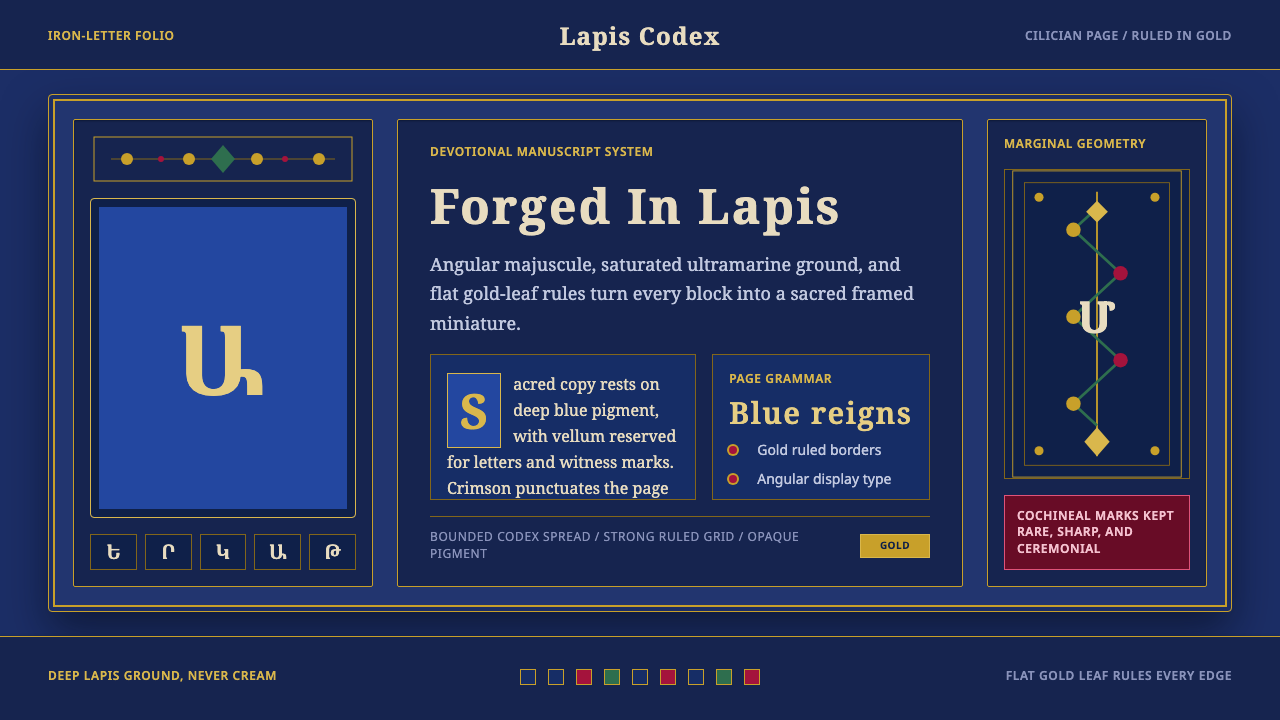 Armenian ErkatʿagirDevotional lapis reigns. Gold rules and angular serif glyphs frame a sacred g…
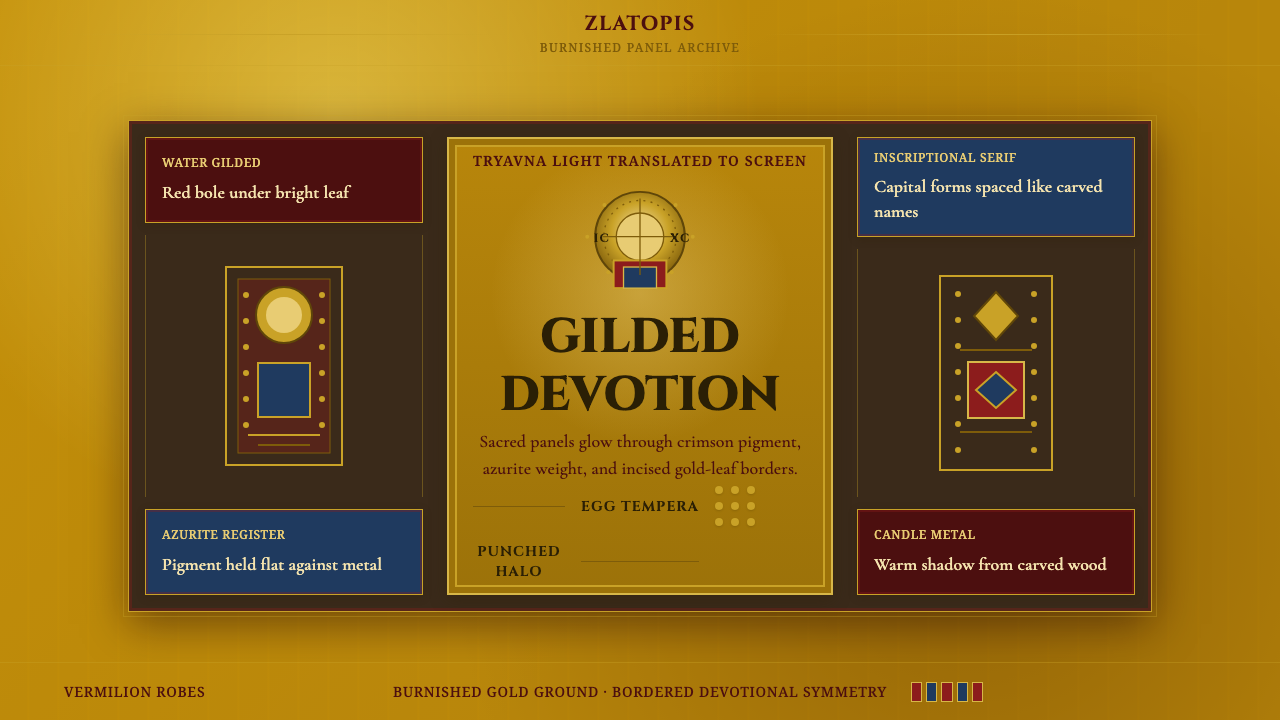 Bulgarian Orthodox IconSacred metal holds still. Burnished gold, crimson panels, and punched halos f…
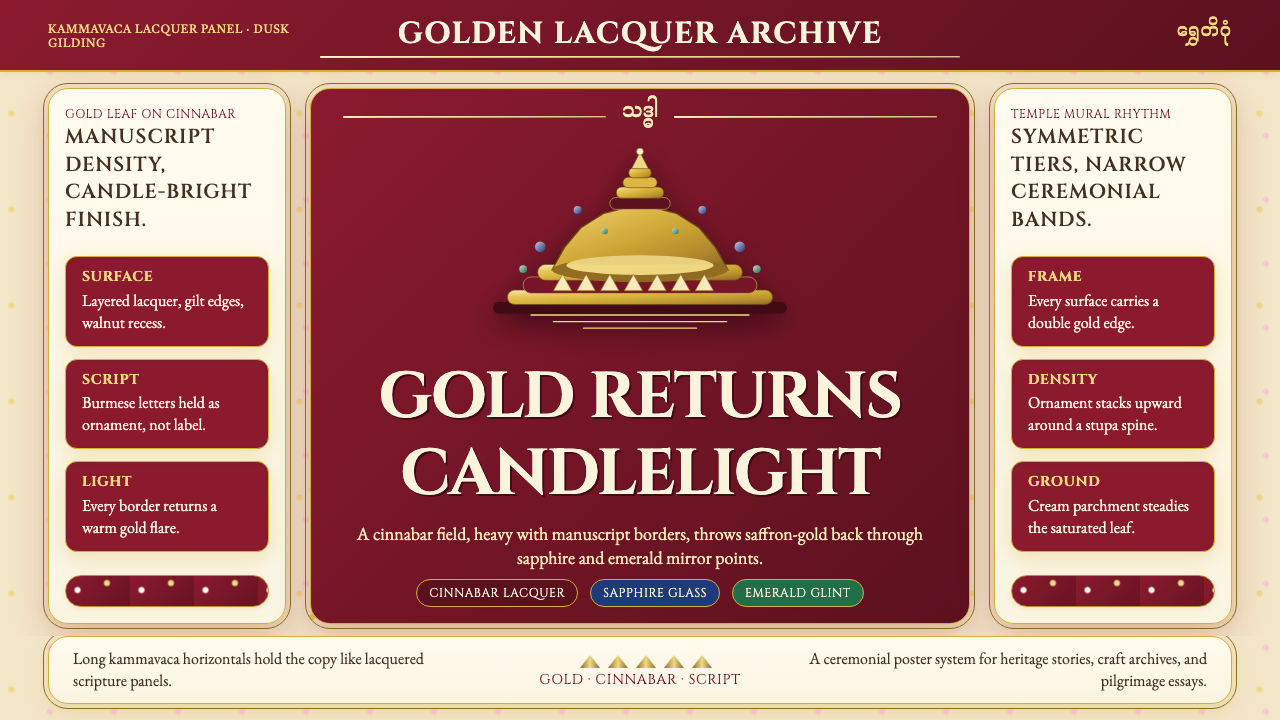 Burmese Shwedagon Gold-LacquerOpulence catches fire. Gold-leaf gradients on cinnabar panels frame a stupa s…
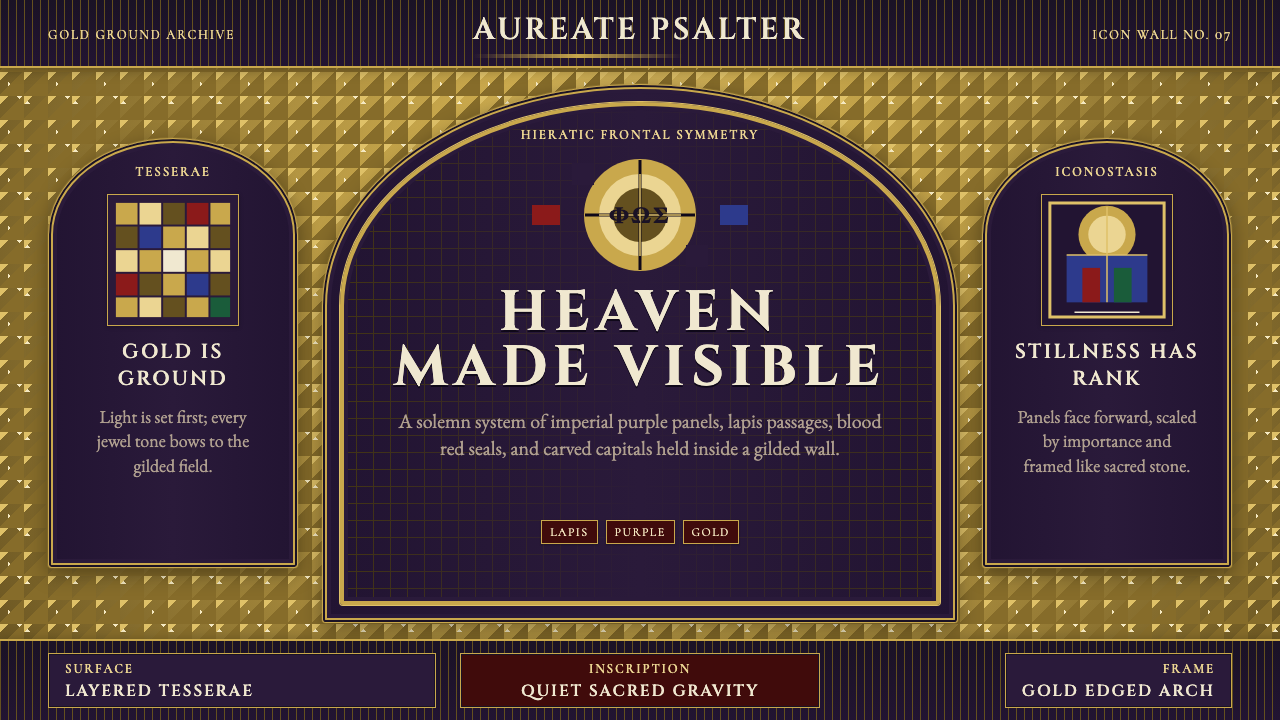 Byzantine Mosaic / IconSacred weight, tiled in light. Gold tesserae ground, Cinzel capitals, arch-fr…
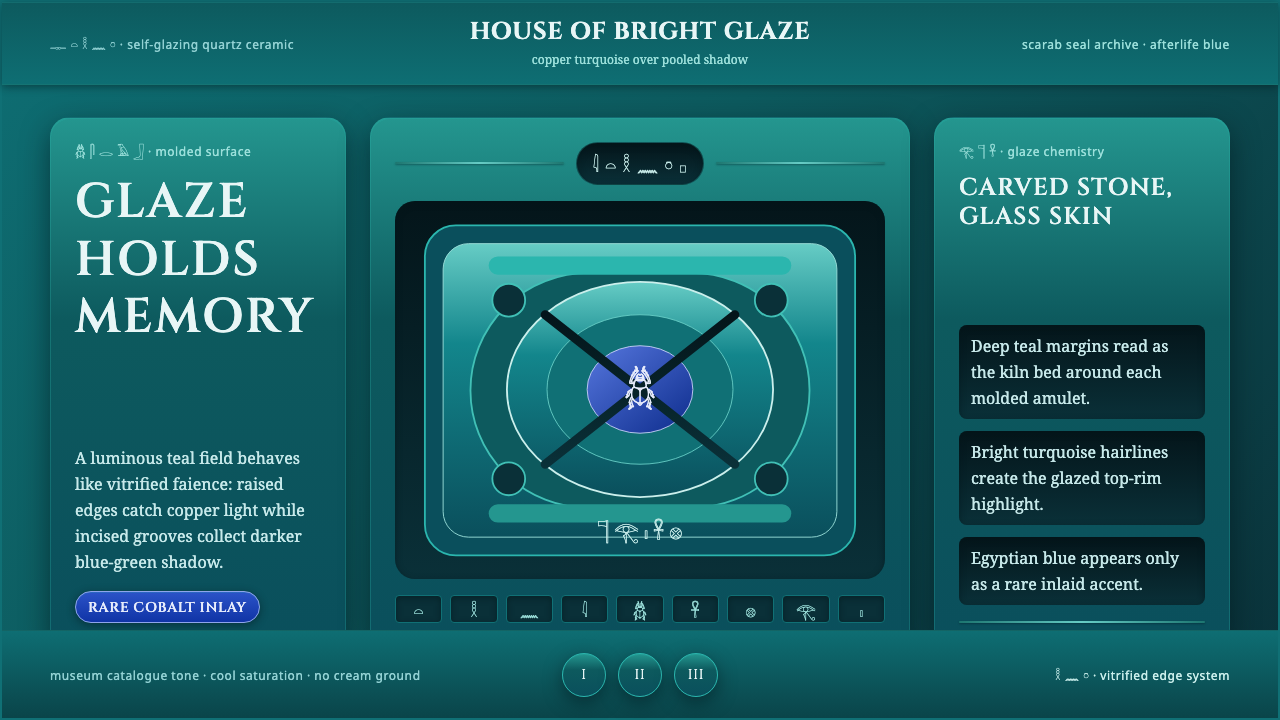 Egyptian FaienceGlaze carries the afterlife. Deep teal grooves, copper-turquoise rims, rare c…