What is Byzantine Mosaic / Icon?
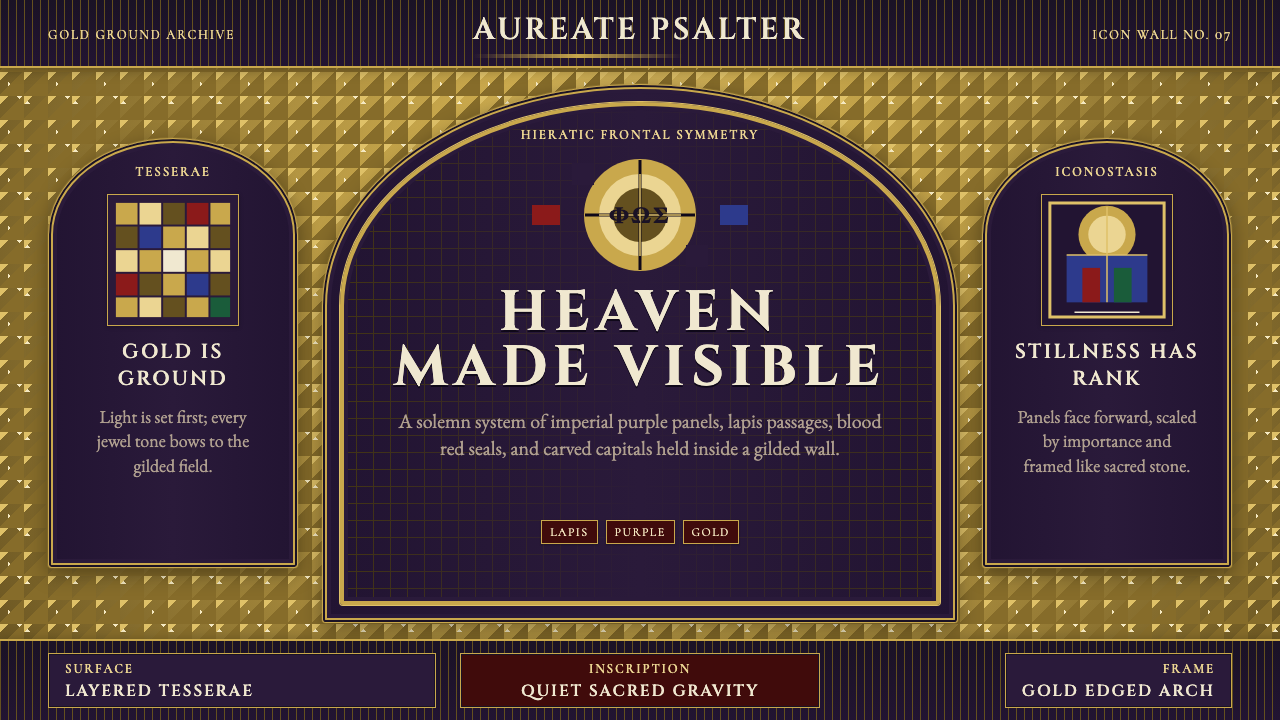
For over a thousand years, Byzantine artisans transformed flat gold tesserae and jewel-toned pigments into a visual theology — an art of sacred hierarchy, frontal stillness, and divine light that remains one of the most recognizable and emotionally potent design languages in human history.
Byzantine Mosaic / Icon in brief
Byzantine Mosaic is a visual system born from sacred purpose. Over the course of more than a millennium — from the founding of Constantinople in 330 CE to the fall of the empire in 1453, and continuing through the Orthodox icon tradition to the present day — mosaicists and icon painters developed a consistent formal language: gold as divine ground, frontal figures in jewel-toned robes, strict symmetry framed by arches, and inscriptional letterforms carved rather than drawn. Every element of this system carries theological meaning, and that fusion of form and meaning gives the style its extraordinary gravity.
The defining visual move is the use of gold not as decoration but as the page itself. In Byzantine mosaic, the gold ground is understood as the infinite, uncreated light of God — the backdrop against which earthly figures and divine presences are rendered. Figures stand frontally, with large eyes that meet the viewer's gaze directly, rigid postures that signal eternity over motion, and robes in lapis blue, blood red, imperial purple, and emerald green. There are no casual poses, no atmospheric perspective, no shadows that suggest a worldly light source. The image is icon, not window.
This is also a hierarchical system. The size and placement of figures communicates their spiritual rank: Christ Pantocrator dominates the central dome or apse; the Theotokos (Mother of God) occupies the conch apse; emperors and empresses appear below, distinguished by gold and purple regalia. Architectural framing — the arch, the mandorla, the nimbus — demarcates sacred from secular space. Everything is ordered, nothing is accidental, and the viewer is positioned not as an observer of a scene but as a supplicant before a presence.

Where does Byzantine Mosaic / Icon come from?
The origins of Byzantine visual culture lie in the convergence of Roman imperial art, early Christian iconography, and Eastern Mediterranean craft traditions. When the Emperor Constantine moved his capital from Rome to the newly founded Constantinople in 330 CE, he brought with him the ambition to build a Christian empire as visually magnificent as its pagan predecessor. Roman mosaic technique — long used for floors, baths, and villa decorations — was elevated to the walls and vaults of churches, where gold tesserae replaced the naturalistic stone and glass of Roman work and became the medium of the divine.
The sixth century, under Emperor Justinian I (reigned 527–565 CE), marks the great flowering of Byzantine mosaic. San Vitale in Ravenna, completed around 547 CE, contains the most celebrated surviving mosaic cycles from this era: the famous panels of Justinian and his court, and of Empress Theodora and her retinue, in which the figures stand in stiff frontal procession, wearing imperial regalia against a gold ground, their haloed heads suggesting divine sanction for earthly power. The mosaics at Hagia Sophia in Constantinople, though repeatedly altered, and those at the Monastery of Saint Catherine on Mount Sinai represent the breadth of Justinianic ambition. The master mosaicists of Ravenna — whose names are largely lost — created the definitive vocabulary of the Byzantine visual system in these decades.
The eighth and ninth centuries brought the Iconoclast Controversy (726–843 CE), a theological and political crisis over whether figural images of the divine were legitimate or constituted idolatry. During Iconoclasm, figural mosaics were destroyed or plastered over; geometric and floral patterns replaced them. The Triumph of Orthodoxy in 843 CE restored the use of images and intensified the theological articulation of their purpose. Henceforth, Byzantine images were understood not merely as illustrations but as windows onto heavenly reality — a doctrine that made precise formal conventions a matter of spiritual necessity, not artistic preference.
After the fall of Constantinople in 1453, the Byzantine visual tradition migrated. It was carried east and north through the Orthodox church: the monastic community of Mount Athos in Greece became a living repository of icon-painting technique; Kyivan Rus' (present-day Ukraine and Russia) absorbed the tradition and developed its own school, whose most celebrated practitioner was the monk Andrei Rublev (c. 1360–c. 1430), whose Trinity icon — three angels gathered around a table — is considered the supreme achievement of Russian icon painting. The Italo-Byzantine style, visible in the work of Duccio and early Cimabue in thirteenth-century Italy, transmitted the Byzantine visual grammar directly into the roots of Western Renaissance painting. The tradition persisted, transformed, and was never fully extinguished.
What defines the Byzantine Mosaic / Icon look?
Gold Ground
The defining feature of Byzantine Mosaic is the gold ground — tesserae of glass with gold leaf embedded at the back, set at slight angles so that they catch and scatter light differently depending on the viewer's position. The gold is not a background color; it is understood as the divine light itself, the infinite and uncreated luminosity against which sacred figures are presented. In digital and print applications, this principle translates to a deep, warm luminous ground — whether literal gold or a richly saturated amber-gold — that functions as the dominant field, with all other elements sitting within it rather than on top of a neutral surface.
Frontal Hieratic Figures
Byzantine figures are hieratic — arranged and posed according to their spiritual rank rather than naturalistic observation. They stand or sit frontally, facing the viewer with large, almond-shaped eyes that command rather than suggest. Three-quarter poses and profile views are reserved for attendant figures or for Judas in narrative scenes. The body is dematerialized: robes fall in stylized folds that indicate spiritual gravity, not physical weight. Size communicates hierarchy — the most sacred figure is the largest, regardless of spatial logic. This use of scale and frontality as meaning-carriers, rather than as representational tools, is the style's most powerful transferable principle.
Jewel-Tone Palette
Against the gold ground, Byzantine color is saturated and symbolic: lapis lazuli blue for the Virgin's mantle and the heavenly realm, deep crimson for Christ's inner robe and sacrificial significance, imperial purple for royal and divine authority, and emerald green for life and renewal. These are not atmospheric colors — they carry fixed theological associations. White is used for resurrection light and angelic presence; black and deep umber anchor shadows without naturalism. The palette is simultaneously sumptuous and restrained: the colors are very few, each used purposefully, and the gold ground unifies them by setting each jewel-tone in the same luminous field.
Arch Framing and Symmetry
Byzantine compositions are organized around the arch, the apse, and the central axis. The apse half-dome, the triumphal arch, the mandorla surrounding Christ in majesty — these architectural frames are not decorative borders but structural theological statements, marking the boundary between the earthly and the divine. Symmetry in Byzantine work is a statement of cosmic order: the Pantocrator enthroned, flanked by symmetric archangels, represents the ordered heaven against the turbulence of the world below. In contemporary design applications, arch-framed panels, bilateral symmetry, and centralized compositions carry this sense of deliberate authority.
Inscriptional Typography
Byzantine inscriptions are carved into the image, set in Roman capital letters that feel cut from stone rather than written on a surface. They identify figures — IC XC for Jesus Christ, MP OY for Mother of God — and mark boundaries between the sacred figures and the viewer. The letterforms are monumental, widely spaced, and carry the visual weight of permanent declaration rather than conversational notation. In design applications, this principle calls for Roman or classical capital letterforms set with wide tracking, at a scale that reads as authoritative inscription rather than label, with no lowercase informality.
Flat Depth and Inverse Perspective
Byzantine images deliberately invert or flatten the spatial conventions that Western art later codified. Objects closer to the divine center sometimes appear larger, not smaller. Architectural settings are shown from multiple viewpoints simultaneously. Figures cast no shadows, and the ground beneath them is gold — there is no floor, no horizon, no atmosphere. This is not failure of technique; it is a spatial theology: naturalistic depth would imply that the viewer occupies a fixed physical standpoint, but the sacred image is meant to transcend particular viewpoints and address the soul directly. In design terms, this translates to layered flatness — overlapping forms with consistent value rather than atmospheric recession.
Nimbus, Mandorla, and Sacred Geometry
The nimbus (circular halo) and the mandorla (the almond-shaped aureole of glory surrounding full figures) are the Byzantine system's primary geometric containers for sacred presence. They are not decorative additions but theological markers: the nimbus identifies a sanctified individual; the mandorla encloses Christ in his divine totality. These forms — perfect circle, vesica piscis — carry their own geometric dignity and impose a radial, centralized order on the composition. In contemporary applications, circular framing, vesica proportions, and radial symmetry evoke this quality of contained, centered authority.

Who shaped Byzantine Mosaic / Icon?
Justinian I (reigned 527–565 CE) was the greatest patron of Byzantine monumental art. His building program — which included the reconstruction of Hagia Sophia in Constantinople after the Nika riots, the completion of San Vitale in Ravenna, and the construction or restoration of churches across the empire — produced the canonical examples of Byzantine mosaic that defined the style for all subsequent centuries. The Ravenna panels depicting Justinian and Theodora in procession are among the most studied images in art history, demonstrating the fusion of imperial and sacred iconography: the emperor wears the purple and gold of imperial rank, carries the eucharistic paten, and is surrounded by clergy and soldiers — secular power and divine authority rendered as a single inseparable unity.
Andrei Rublev (c. 1360–c. 1430) is the most celebrated icon painter in the Russian Orthodox tradition. His Trinity icon — three angels seated around a table, painted in a palette of lapis blue, warm gold, and pale rose — represents the Byzantine visual tradition at its most refined: the gold ground, the frontal angelic presences, the circular movement implied by the three figures' inclined postures, and the inscriptional simplicity all achieve a contemplative stillness that transcends decoration. Rublev was canonized as a saint by the Russian Orthodox Church in 1988. His work is the clearest proof that the Byzantine visual system, transplanted through the Orthodox tradition, produced its own genius centuries after the empire's fall.
The mosaicists who produced the sixth-century cycles in Ravenna — at San Vitale, Sant'Apollinare Nuovo, and Sant'Apollinare in Classe — are largely anonymous, their names unrecorded, their identities absorbed into the collective theological project they served. What survives is their technical achievement: tesserae set at calculated angles to scatter light, gold grounds of extraordinary consistency, and figure cycles that resolved the fundamental challenge of Byzantine art — representing the infinite in finite materials. Their work is the primary evidence for how Byzantine visual conventions were established, and it remains the most complete surviving body of early Byzantine monumental mosaic.
Duccio (c. 1255–c. 1319) was the leading Sienese painter of his generation and the central figure through whom Byzantine visual conventions entered the early Italian Renaissance. His Maestà altarpiece (1308–1311), painted for Siena Cathedral, fuses the gold ground, frontal hieratic postures, and jewel-tone palette of the Byzantine tradition with a new tenderness and spatial awareness that would eventually become the Renaissance. Duccio represents the Italo-Byzantine moment: the point at which Byzantine formal authority and a new Western humanism were still held in productive tension, before the naturalism of Giotto decisively broke from the iconic flatness of the Eastern tradition.
How do you use Byzantine Mosaic / Icon today?
Byzantine Mosaic is among the most dramatic and emotionally potent historical styles available to contemporary designers, but it requires genuine commitment rather than surface borrowing. The style's authority depends on the coherence of its entire system: the gold ground as the primary field, the jewel-tone palette deployed sparingly against it, the hierarchical scale of elements, the arch-framed symmetry, and the inscriptional weight of the typography. Applying only the gold color without the frontal stillness and the structural hierarchy produces pastiche, not presence.
For presentation slides, Byzantine Mosaic works with exceptional power on cover slides and chapter dividers. A cover built in this style uses a deep gold or richly saturated amber ground as the full-bleed background, with the title set in wide-tracked Roman capitals — large, centered, and treated as inscription rather than headline. Supporting text should be minimal and set at a smaller scale, placed symmetrically below the title. Figurative or architectural imagery, if used, should be flat, frontal, and placed within an arch-framed or circular medallion panel. Content slides benefit from adopting the hierarchical scale principle: primary headings at the scale of a declaration, secondary text significantly smaller, no decorative dividers — the gold ground itself provides the unifying field.
For web interfaces, this style suits contexts where authority, reverence, and depth are desired — luxury goods, cultural institutions, premium editorial platforms, or any brand positioning itself as historically grounded or deeply considered. Dashboard applications in this style should use a warm, deep ground color as the primary surface, with interactive elements — buttons, cards, selected states — distinguished by jewel-tone accents rather than flat utility colors. Navigation should be centered and symmetrical, with the brand mark treated as a sacred seal rather than a wordmark. Pricing pages take on the quality of a tiered sacred hierarchy: each tier named with a single authoritative word, differentiated by scale and ornamental detail rather than color alone.
For editorial and marketing work, Byzantine Mosaic brings a quality of timelessness and gravitas that is rare in contemporary design. A magazine spread or long-form article in this style uses the gold or deep amber ground for full-bleed section headers, with the body text set against a much lighter or near-white field for readability. Pull quotes are treated as inscriptions — centered, wide-tracked, set at a scale that commands the page. Marketing materials, particularly for heritage brands, cultural events, or luxury launches, work well with arch-framed hero images, tessellated or mosaic-inspired background textures in the secondary design elements, and a typographic system that reads as carved rather than printed.
The most common mistake when applying Byzantine Mosaic is treating the gold as background decoration rather than as the primary field. In authentic Byzantine work, the gold is the subject — every other element exists within it. A layout that uses gold as a border, an accent stripe, or a hover state has inverted the logic of the system. The second common error is mixing the deep saturated jewel tones with lighter or more neutral colors in ways that dissolve the palette's intentional richness. A Byzantine-derived palette should feel like stained glass, not like a pastel gradient. Third: the style depends on stillness and symmetry — introducing casual asymmetry, playful scale variation, or informal typographic choices collapses the sense of hieratic authority that makes the style distinctive.

Byzantine Mosaic / Icon — FAQ
Is Byzantine Mosaic the same as Byzantine Icon painting?
They are closely related but distinct media with the same underlying visual theology. Mosaic is an architectural medium — tesserae of glass, stone, and gold leaf set into wet plaster on walls, vaults, and apses. Icon painting is a portable medium — egg-tempera pigments applied to prepared wooden panels. Both systems use the gold ground, the frontal hieratic figure, the jewel-tone palette, and the inscriptional text, but mosaic is monumental and fixed, while icons are intimate and portable. For design purposes, the combined tradition is treated as a single visual system because the formal principles are shared: it is the architecture of meaning, not the physical medium, that defines the style.
Can this style work on a light or white background, or does it require the gold ground?
The gold ground is the defining architectural element of the Byzantine system — removing it fundamentally changes the style's character. That said, there are legitimate reduced applications. A light-mode interface can use a warm ivory or parchment ground instead of deep gold, with gold reserved for structural accents, borders, and selected states. The jewel-tone palette and the frontal, arch-framed compositional logic can function against pale grounds and still read as Byzantine-derived. What the style cannot survive is a cold white or neutral grey background — these grounds dissolve the warmth and sacred gravity that the system depends on. If a light background is required, lean warm: the ground should feel like aged vellum or sunlit marble, not a digital default.
How do I use Byzantine Mosaic without making it feel costume-like or theatrical?
The risk of theatricality comes from decorative excess — using Byzantine motifs as surface ornament without committing to the underlying structural logic. Authentic Byzantine work achieves solemnity through restraint within richness: the palette is saturated but few colors are used; the gold is pervasive but not varied; the compositions are symmetrical but not busy. To avoid costume-effect, commit fully to one or two Byzantine principles — the gold ground and inscriptional typography, for instance — and apply them with discipline across an otherwise restrained design system. The moment you start adding mosaiced borders, arch-shaped decorative elements, and jewel-tone gradients simultaneously, the design tips into pastiche. One deep principle, rigorously applied, reads as authority; many surface motifs applied loosely read as imitation.
What contexts are a poor fit for Byzantine Mosaic?
Byzantine Mosaic is poorly suited to any context requiring approachability, playfulness, speed, or informality. The style is inherently slow — it asks the viewer to stop, look, and be in the presence of something weighted and deliberate. Startup products, social apps, children's platforms, fast-food brands, sports applications, and any context built around energy and momentum will find the style's gravity oppressive rather than powerful. Similarly, functional utility applications — forms, task managers, workflow tools — need the kind of typographic and spatial informality that Byzantine visual logic specifically refuses. The style performs best when the product itself is positioned as rare, considered, and deserving of the viewer's full attention: luxury, cultural heritage, ceremonial, or archival contexts.
How does Byzantine Mosaic relate to Art Nouveau or other ornamental styles?
They are superficially related — both use richly saturated color, intricate surface patterning, and architectural framing — but structurally opposite. Art Nouveau is organic, sinuous, and naturalistic in its references, drawing on plant forms, flowing hair, and the curved line as a value in itself. Byzantine Mosaic is frontal, geometric, and theological in its references, drawing on the flat gold ground, the symmetrical arch, and the hieratic figure. Art Nouveau decoration is applied to surfaces; Byzantine visual logic is the surface. The two styles are occasionally confused because both feel opulent and deliberate, but Art Nouveau is sensuous and earthly where Byzantine is sacred and transcendent. Mixing elements of both — organic curves with gold grounds, flowing naturalistic figures in hieratic poses — produces visual incoherence rather than synthesis.
Related design styles
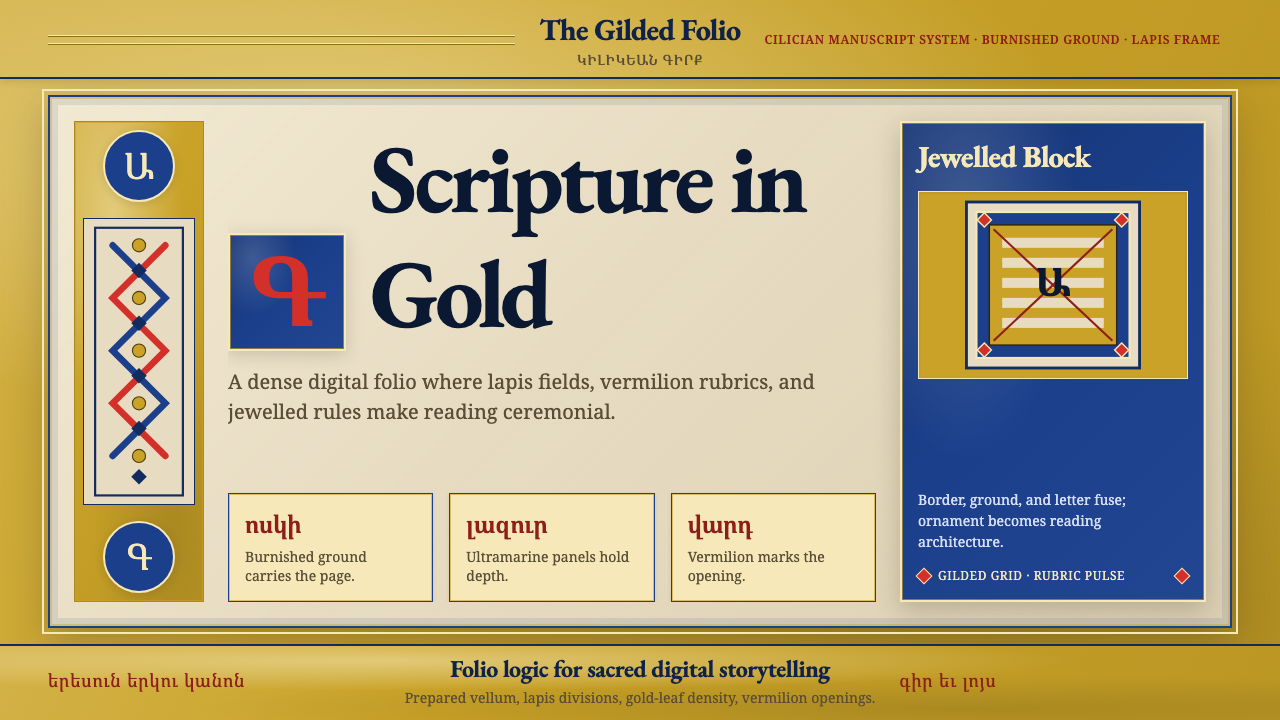 Armenian Illuminated ManuscriptGilded maximalism. Burnished gold, lapis frames, and vermilion initials build…
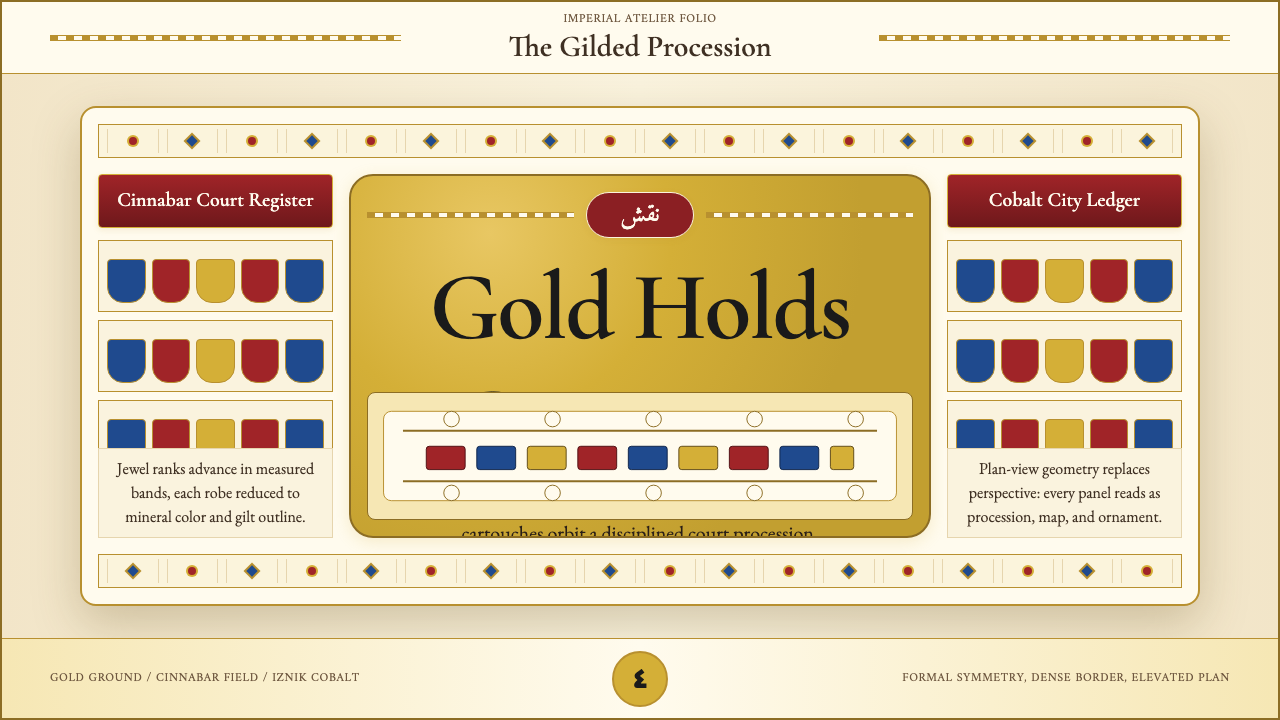 Ottoman Court Miniature (Topkapı)Ceremony made dense. Gold ground, cinnabar cartouches, cobalt procession geom…
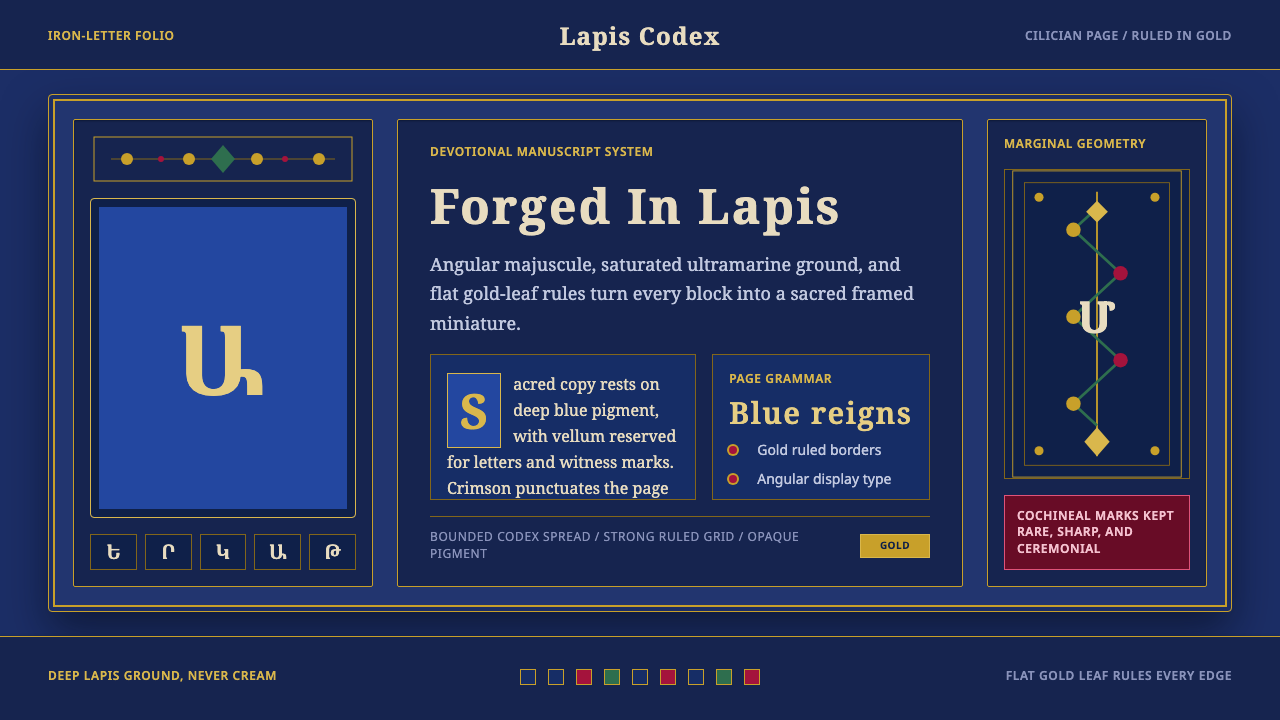 Armenian ErkatʿagirDevotional lapis reigns. Gold rules and angular serif glyphs frame a sacred g…
 Bulgarian Orthodox IconSacred metal holds still. Burnished gold, crimson panels, and punched halos f…
 Burmese Shwedagon Gold-LacquerOpulence catches fire. Gold-leaf gradients on cinnabar panels frame a stupa s…
 Egyptian FaienceGlaze carries the afterlife. Deep teal grooves, copper-turquoise rims, rare c…