What is Jordanian Petra Rose Nabataean?
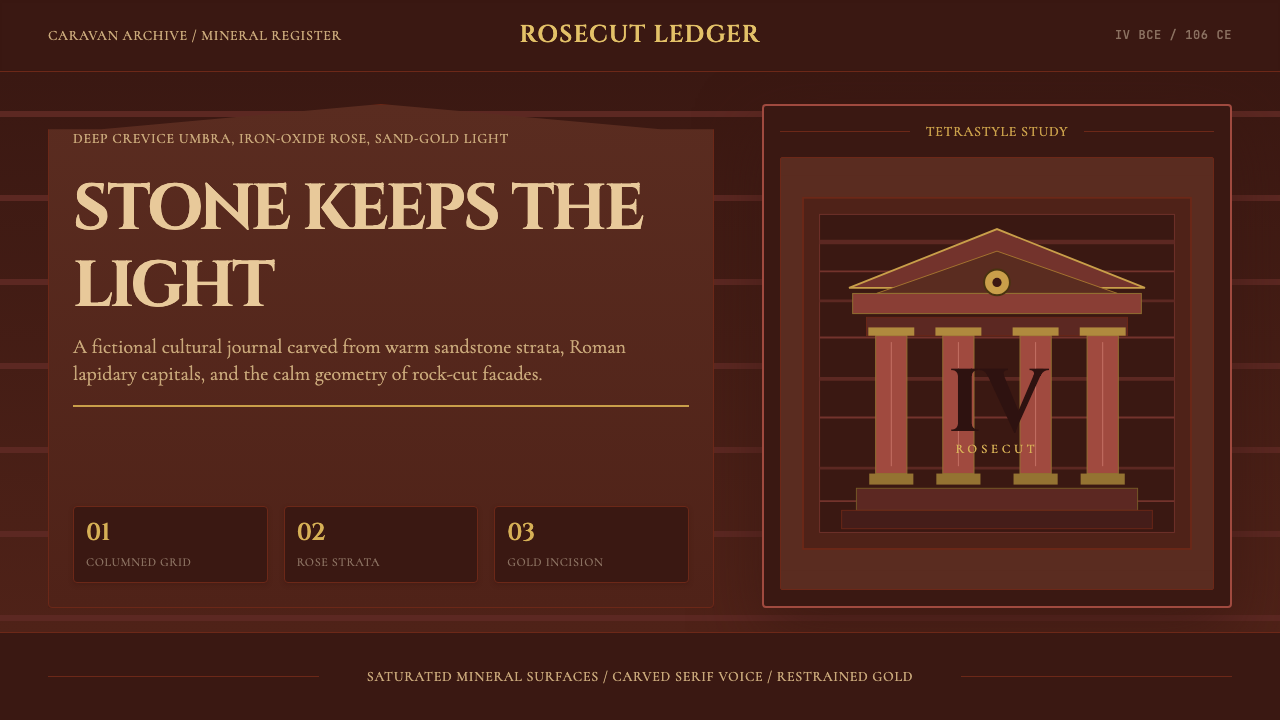
Carved into rose sandstone canyons two thousand years ago, the Nabataean city of Petra left behind a visual language as permanent as the rock itself — mineral warmth, monumental weight, and an architecture that treats geology as ornament.
Jordanian Petra Rose Nabataean in brief
Jordanian Petra Rose Nabataean is a design language rooted in the ancient city of Petra, the Nabataean caravan capital that was literally carved out of the rose-red sandstone cliffs of Wadi Musa in southern Jordan. Where most historical styles borrow from manufactured artifacts — pottery, textiles, printed works — this one draws its entire visual vocabulary from geology: the layered strata of iron-oxide reds, warm ochres, cream bands, and deep crevice shadows that make Petra's cliffs unlike any other landscape on earth.
The aesthetic is monumental and deeply warm at the same time. The darkness is never cold; it carries the amber undertones of sandstone shadow rather than the neutral grey of modern dark themes. The accent colors read as naturally occurring — the particular red of iron-rich rock, the pale gold of desert sand caught in afternoon light — rather than designed or chosen. There is an immediacy to this palette that comes from its geological truth: these colors existed before any human eye chose them.
Typographically, the style echoes the fusion of cultures that defined Petra at its height. Nabataean script — an elegant, flowing Semitic hand — blended over centuries with Greek and Roman lapidary tradition, producing inscriptions that feel simultaneously ancient and cosmopolitan. In contemporary application, this translates to a preference for serif letterforms with classical proportion, suggesting carved stone rather than printed ink, and for display treatments that carry the unhurried gravity of a dedicatory inscription on a temple facade.
Where does Jordanian Petra Rose Nabataean come from?
The Nabataean people were originally a nomadic Arab tribe who, by the fourth century BCE, had established control over the caravan routes linking the Arabian Peninsula, the Levant, Egypt, and the Mediterranean world. Their genius was logistical: they taxed and protected the flow of frankincense, myrrh, spices, and silk rather than producing these goods themselves. The wealth that accumulated from this trade was poured into Petra, a city in a canyon system so defensible and so rich in fresh water from cistern-harvested rainfall that it seemed designed by the landscape itself.
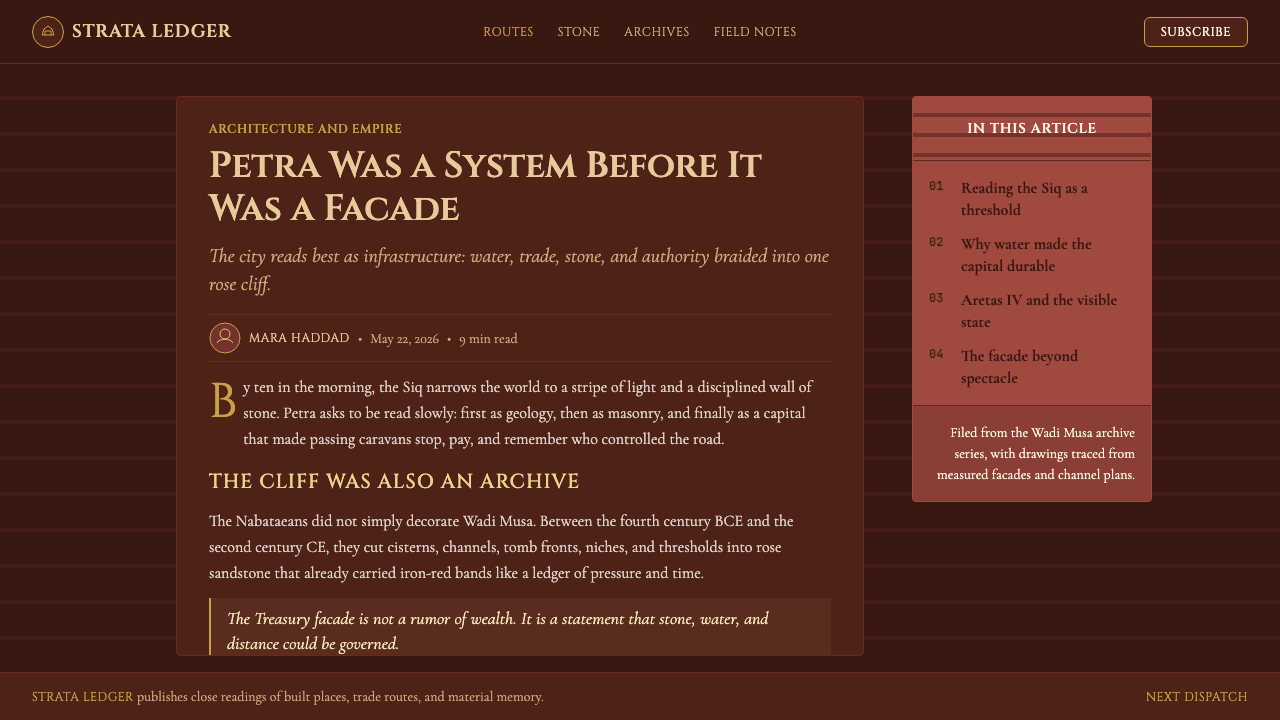
Al-Khazneh — the Treasury — is the most famous of Petra's rock-cut monuments, carved directly into the rose cliff face around the first century BCE during the reign of King Aretas III. Its facade combines a Hellenistic vocabulary (Corinthian columns, pediments, classical proportions) with distinctly Nabataean details: urns on the roofline that may have held ashes or grain, and a central circular tholos that departs from strict Greek symmetry. The building is not constructed; it is excavated. Every detail that would normally be built up from separate stones was instead carved away from the continuous living rock. This reversal — removal rather than accumulation — gives Petra's architecture its peculiar weight. The surfaces glow with the natural color variation of the sandstone, banding from deep purple-red at the base through warm rose to pale cream at the top.
Petra reached its political and cultural peak under King Aretas IV, who ruled from 9 BCE to 40 CE. During this period, the city's population may have approached thirty thousand, a remarkable density for an ancient desert settlement. Aretas IV minted some of the finest Nabataean coins, bearing his own portrait alongside that of his queen, and patronized a building program that extended rock-cut monuments throughout the canyon system. The Nabataean script, which Aretas's court used alongside Greek for official inscriptions, would later serve as the direct ancestor of the Arabic script — making Petra not only the visual but the calligraphic ancestor of an enormous portion of the world's written communication.
The city fell to Rome in 106 CE when the Emperor Trajan annexed the Nabataean kingdom as the province of Arabia Petraea. Roman rule added colonnaded streets and a theater, but the essential character of Petra — its intimate relationship between architecture and geology, its palette drawn entirely from the living rock — remained. The city declined gradually after the third century CE as sea routes undercut the overland caravan trade, and by the medieval period it was known only to local Bedouin communities. The Swiss explorer Johann Ludwig Burckhardt rediscovered it for a European audience in 1812 by disguising himself as a pilgrim and gaining entry to the Siq, the narrow canyon that is the city's only accessible approach. UNESCO designated Petra a World Heritage Site in 1985, and it was voted one of the New Seven Wonders of the World in 2007.
What defines the Jordanian Petra Rose Nabataean look?
Color and Palette
The palette is drawn directly from geological strata rather than from any manufactured or chosen source. Deep crevice umbra — the darkest value — serves as the ground, evoking the shadow at the foot of canyon walls that never receives direct sun. Against this, iron-oxide reds and warm rose midtones carry the color of the cliff face itself, ranging from saturated terracotta to cooler dusky pinks depending on the angle of light. Sand-gold and pale ochre serve as the highest accents, catching light the way exposed quartz and pale limestone catch afternoon sun in the canyon. The palette is entirely warm — there is no cool grey, no blue, no green anywhere in the system. Even the darkest values contain amber and brown rather than neutral black.
Texture and Surface
The most distinctive quality of this style is its mineral surface. Surfaces suggest stone — not smooth stone but layered sandstone with its characteristic grain, subtle color banding, and the slightly rough quality of a material that was formed rather than manufactured. In digital application, this translates to backgrounds that carry a quiet natural variation rather than flat uniform fill, as if the color itself has been worn and deposited over time. This is not noise for its own sake; it is the difference between a wall that reads as geological presence and one that reads as a flat design choice. Gradients, where they appear, move through the warm spectrum — from deep shadow to warm rose to pale sand — and always reference the vertical layering of actual cliff strata.
Monumental Scale and Weight
Nabataean architecture operates at two scales simultaneously: the intimate human scale of carved inscription and the overwhelming geological scale of the cliff face itself. This dual register — human mark against inhuman vastness — defines the style's approach to hierarchy. Large elements are very large; type used for display purposes carries genuine mass and architectural weight. Negative space is not minimal in the contemporary sense but generous in the ancient sense: the same generous emptiness that surrounds a carved inscription on a tomb facade, letting each element assert its presence against the silence around it. There is no clutter, not because of modernist discipline but because stone is expensive and carved marks are permanent.
Classical-Eastern Typographic Fusion
Petra was a crossroads city, and its inscriptions bear the traces of that cosmopolitan identity. Nabataean merchants used their own flowing script for religious and commercial purposes while adopting Greek for official state communication and Roman conventions for monumental display. The resulting epigraphic sensibility blends formal lapidary weight — letters intended to be read from a distance, carved to last millennia — with a calligraphic fluency that speaks of mercantile culture and the continuous writing demands of a trading empire. In contemporary application, this suggests typefaces that balance classical proportion with organic warmth: serifs rooted in carved-stone tradition, with enough softness to recall the brush-written origins of Nabataean script.
Depth Through Layering
Petra's visual complexity comes not from added ornament but from natural layering — the way geological strata reveal themselves on a cliff face, each band of color and texture the record of a different epoch of deposition. The design language mirrors this through compositional layering: elements recede into shadow rather than floating on flat planes, foreground content sits against middle-ground texture, and the overall sense of depth is geological rather than spatial. This is depth that feels excavated rather than constructed, as if the design was always there in the rock and the designer simply removed the surrounding material to reveal it.
Restraint and Permanence
Nabataean artisans carved because stone is permanent and every mark carries cost. This necessity translated into an aesthetic of economy: nothing is carved that does not need to be. In the design system, this principle manifests as a reluctance toward decoration for its own sake — patterns, borders, and embellishments appear only when they carry meaning derived from the architectural tradition, such as the stepped merlons of a Nabataean roofline or the scroll capitals of a colonnade. Everything else is the warm silence of sandstone waiting. The result is a style that reads as both ancient and restrained, its authority drawn from what it withholds as much as from what it shows.
Warm Darkness
This is a dark style, but its darkness is categorically different from the cool, neutral dark backgrounds common in contemporary design systems. The deep crevice shadow of the Siq — the narrow canyon entrance to Petra — carries warmth because the sandstone walls absorb and re-radiate heat. In the design language, the darkest values maintain this mineral warmth: they read as deep amber-black or deep wine-red rather than charcoal grey or cool near-black. This distinction is critical for getting the style right. A layout using cool dark backgrounds with this style's accent colors will feel like a mismatch — modern tech aesthetic with historical ornament grafted on. The warmth of the darkness is not optional; it is the foundation on which everything else rests.

Who shaped Jordanian Petra Rose Nabataean?
Aretas IV ruled the Nabataean kingdom from 9 BCE to 40 CE and presided over Petra at its absolute zenith. Under his patronage, the rock-cut program expanded to include the Monastery (Ad Deir) and numerous smaller tomb facades throughout the canyon system, and Nabataean coinage reached its highest artistic achievement. His long reign — nearly five decades — gave the city time to consolidate its aesthetic vocabulary into a mature and consistent language. The funerary and civic architecture commissioned under Aretas IV defines what we now recognize as the Nabataean visual idiom: Hellenistic forms inhabited by a distinctly Eastern sensibility.
The Swiss explorer who rediscovered Petra for the Western world in 1812 was not an archaeologist but a trained linguist who had studied Arabic and Islamic customs in order to travel undetected through the Middle East. His account of the rediscovery — describing the narrow Siq opening onto an immense rose-colored facade — established the romantic template through which Petra would be imagined for the next two centuries. The visual language of Petra entered European consciousness as much through his written description as through any image, and the qualities he emphasized — the mineral color, the scale, the shock of encountering civilization embedded in raw geology — are precisely the qualities that define the design aesthetic today.
American archaeologist Philip Hammond led excavations at Petra from the 1960s onward and was responsible for uncovering the Temple of the Winged Lions, one of the city's major religious structures. Hammond's work established much of what is currently understood about Nabataean civic and religious life, including the sophistication of the city's water management system — the elaborate network of channels, cisterns, and pipes that made a metropolis possible in an arid canyon environment. This hydraulic infrastructure is itself a kind of design achievement, and it reinforces the Nabataean identity as a civilization that imposed elegant systematic solutions on hostile physical conditions.
British scholar Iain Browning produced in 1982 what remains one of the most comprehensive architectural surveys of Petra. His detailed analysis of the rock-cut facades — their proportional systems, the sequence of their construction, the way Hellenistic ornamental conventions were adapted and transformed by Nabataean builders — provided the scholarly basis for understanding Petra as a coherent aesthetic system rather than a collection of individual monuments. His documentation of the color variation in the sandstone, and his attention to the way light moves through the canyon at different times of day, established a framework for thinking about the geological palette that now underpins this design language.
The individuals who physically carved Petra's facades are unknown by name, but the body of their collective work constitutes the design tradition itself. What archaeology has established is that Nabataean stone carvers developed a distinctive approach to rock-cut architecture that differed meaningfully from Egyptian, Greek, and Roman precedents: they used the natural banding and color variation of the sandstone as an active compositional element rather than treating it as a substrate to be plastered over or painted. They worked with the geology rather than against it. This fundamental attitude — using what is already present, making the given material the language — is the deepest principle of the aesthetic and the one most worth understanding before applying it.
How do you use Jordanian Petra Rose Nabataean today?
Jordanian Petra Rose Nabataean is a style that rewards depth of understanding before application. Its surface qualities — the warm dark ground, the rose and ochre accents, the sense of mineral weight — are immediately legible and can be applied as a visual theme. But the style achieves its real power when the logic behind those choices is also honored: warmth in the darkness, restraint in the ornament, geological layering in the depth, and a typographic voice that carries the gravity of carved stone. Applied as a superficial palette over a contemporary layout structure, it will look evocative but thin. Applied with an understanding of what Nabataean visual culture was actually doing, it becomes something rare: a dark style that is warm rather than cold, historical rather than retro, monumental rather than heavy.
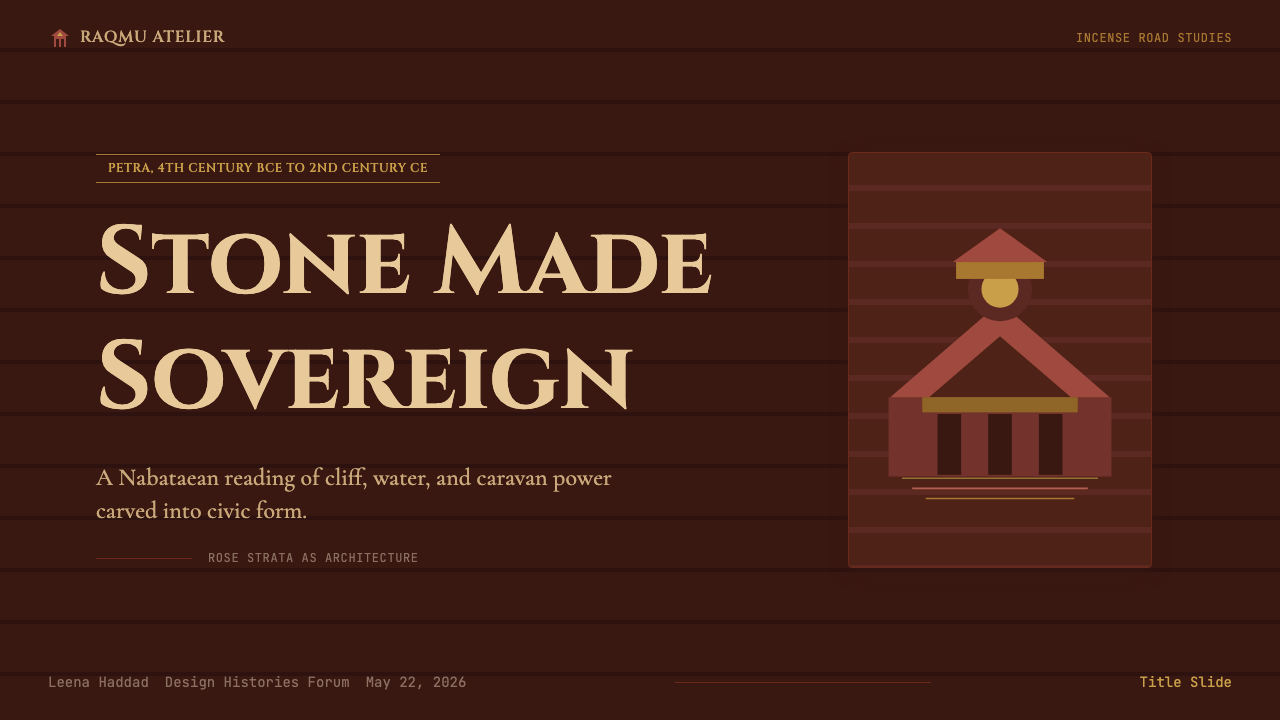
For presentation slides, this style is particularly powerful for opening and closing moments. A title slide benefits from the full geological weight: deep crevice shadow as the ground, a single large letterform or symbol in rose or gold against it, and almost nothing else. The scale contrast between an immense dark field and a small warm mark is where the style lives. Content slides should be treated with more restraint: warm off-black or deep rose as the background, body text in a high-contrast pale value, section headers in a slightly warmer or larger treatment that recalls lapidary inscription. Data visualizations should use the warm spectrum — the rose-to-gold range — for positive or primary values, with the deep shadow values for neutral or zero states. Avoid cold blues or clean whites, which will feel imported rather than native to the system.
For web interfaces, this style is well-suited to cultural institutions, heritage brands, travel and hospitality platforms, and luxury products where depth, permanence, and warmth are valued. The approach requires a genuine dark background — warm near-black or deep umbra — as the primary surface, with content areas in warmer, slightly lighter midtones rather than white or cool grey. Card components should carry the sense of relief: subtle shadow treatments that suggest a slightly raised surface, not floating but emerging from the ground. Interactive elements benefit from the gold or pale sand accent, which reads as naturally luminous against the dark surface, the way a lit torch reads against a canyon wall at dusk.
For editorial and marketing work, the style's poster-like qualities are its greatest strength. Full-bleed backgrounds in the deep crevice tone, with large display type in rose or sand-gold, produce a visual register that is simultaneously ancient and contemporary. The key restraint: use no more than two accent colors in a single composition. The rose and the gold together can work, but a third value — even a subtle one — tends to break the geological coherence and tip the palette toward the decorative. Section breaks should be spare: a thin warm line, a shift in background value, or simply generous negative space, rather than ornamental dividers. The style's authority comes from understatement, not accumulation.
The most common mistake when applying this style is conflating warmth with richness and adding more — more texture, more ornament, more accent colors, more complexity — in an attempt to feel more historical or more opulent. Petra itself teaches the opposite lesson: the most powerful of its monuments are the simplest. Al-Khazneh is two columns and a broken pediment and the vast rose cliff it is carved from. The restraint is the power. In digital application, the temptation to fill dark backgrounds with decorative pattern or to use multiple warm tones simultaneously is the equivalent of cluttering a sandstone facade with unnecessary carving. Trust the ground. Trust the geological palette. The warmth of well-chosen darkness is more eloquent than any added ornament.
Jordanian Petra Rose Nabataean — FAQ
Is this style appropriate for digital products, or is it only suited to heritage and cultural contexts?
The style is absolutely applicable to digital products, but the fit depends on what values the product wants to communicate. Products that benefit most are those seeking to convey depth, permanence, authority, and a sense that what is being offered has been carefully considered over time — premium subscription services, high-end hospitality booking platforms, cultural institutions, collectors' markets, and editorial products in the arts or history spaces. It is less suited to products that need to communicate speed, lightness, playfulness, or technical modernity. The geological warmth and monumental weight can be assets or liabilities depending on whether they align with the product's intended emotional register.
How do you distinguish an authentic application of this style from a generic 'ancient desert' theme?
The distinction lies in specificity and restraint. A generic ancient desert aesthetic typically reaches for obvious signals: sand textures, camel silhouettes, hieroglyph-adjacent ornament, oversaturated terracotta against pure black. Authentic Nabataean-derived work is far more specific and far more restrained. The warmth of the darkness is its most distinctive quality — the background carries amber and brown rather than neutral black. The layering is geological rather than decorative: depth comes from color banding through a warm spectrum, not from pattern overlay. Typographically, it favors classical lapidary proportion over ornate historical display faces. And crucially, it does not reach for desert iconography — the power of Petra's original architecture comes from its refusal to depict the landscape and its insistence on being the landscape instead.
Can this style work for light-background interfaces, or does it require a dark ground?
The style can work on a light ground, but it requires a specific kind of lightness — not clean white or cool off-white, but the pale warm sand or cream of bleached limestone. On a pale sandstone ground, the rose and deep umbra tones become the structuring accents rather than the background, and the overall effect shifts from cavernous to cliff-face: sun-exposed, mineral, warm. This light variant suits contexts where the dark version would feel too heavy — editorial content pages, documentation, or any interface where extended reading is required. The key rule remains the same: no cool neutrals anywhere in the system. A cool grey separator, a neutral white modal background, or a blue-tinted shadow will immediately break the geological coherence and make the palette feel inconsistent.
How does this style relate to other ancient Mediterranean and Middle Eastern aesthetics such as Egyptian or Byzantine?
All three aesthetics share deep historical roots in the ancient world, but their visual logic is fundamentally different. Egyptian design is hieratic and flat, governed by a symbolism of profile view and frontal presentation that treats the picture plane as a register of eternal timeless fact. Byzantine aesthetics are abstract and transcendent, using gold ground and frontal figuration to signal sacred reality above physical experience. Nabataean Petra sits between these two and resolves them differently: it is neither flat nor transcendent but geological and experiential — the visual system is about being inside something vast, carved from the earth, rather than either reading a symbolic program or ascending toward the divine. In contemporary design terms, Petra is warmer and more spatial than Egyptian, less austere and more mineral than Byzantine.
What is the single most important thing to get right when applying this style?
The warmth of the dark values. Everything else in the system — the rose accents, the sand gold highlights, the lapidary typography, the geological depth — depends on having the right darkness as its foundation. If the background reads as neutral grey-black or cool charcoal, the entire geological logic collapses: the accent colors become arbitrary rather than natural, the layering looks decorative rather than structural, and the style reads as a historical theme applied over a contemporary base rather than as a coherent visual world in its own right. Spend the most time getting the deep umbra tone right — warm, amber-inflected, carrying the quality of deep canyon shadow in afternoon light — and the rest of the system will fall into place around it.
Related design styles
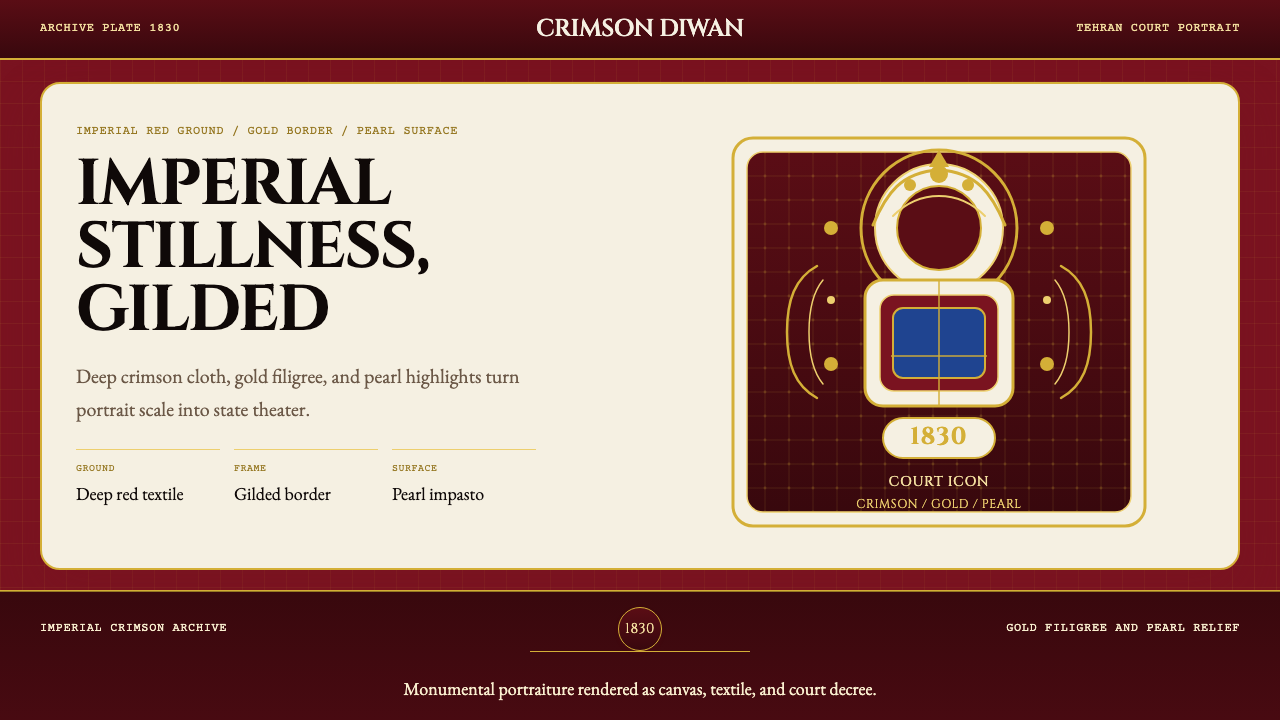 Persian Qajar Portrait (1830)Imperial stillness, gilded. Deep crimson, gold filigree, and pearl accents st…
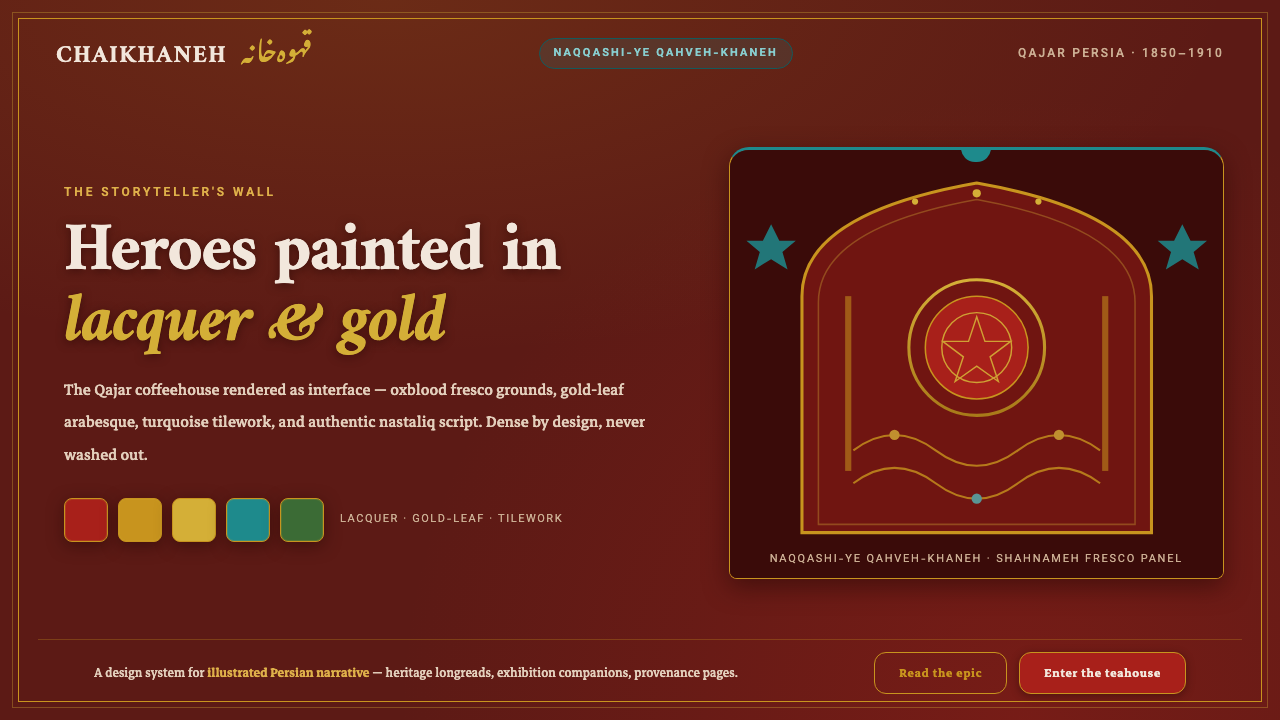 Persian Teahouse ChaikhanehQajar coffeehouse maximalism. Lacquer-red heroes, gold-leaf arabesque on deep…
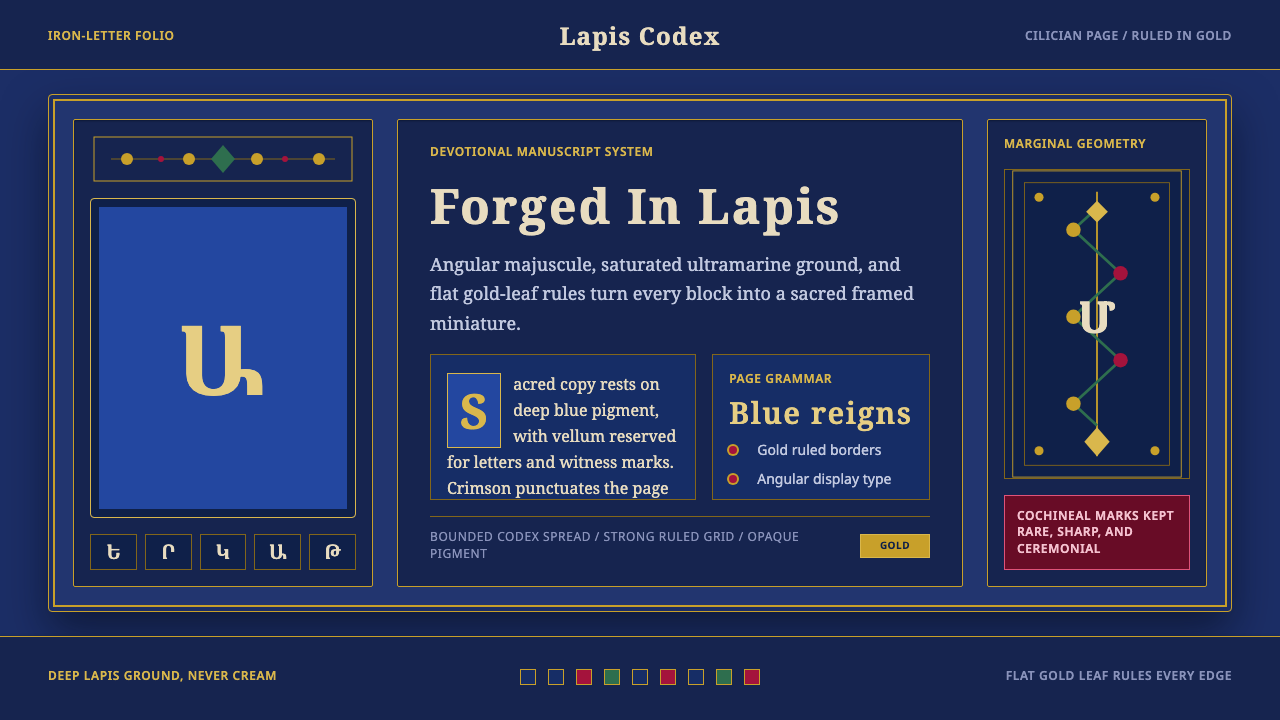 Armenian ErkatʿagirDevotional lapis reigns. Gold rules and angular serif glyphs frame a sacred g…
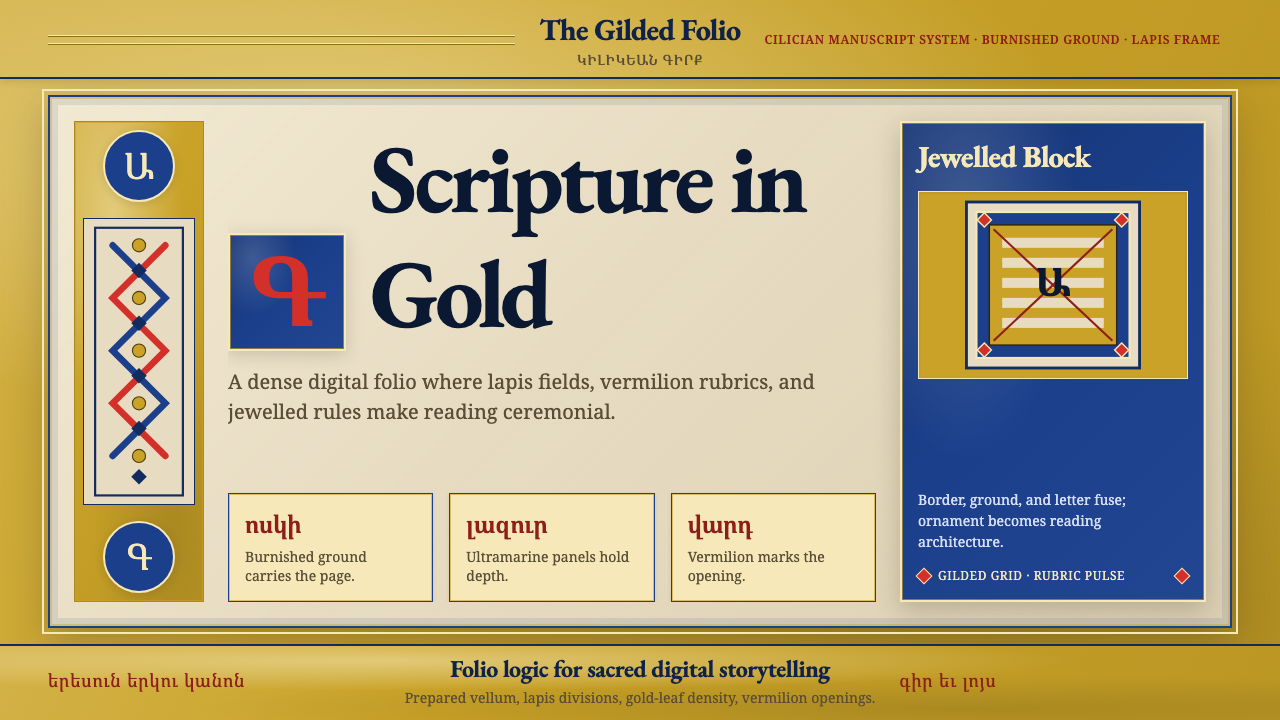 Armenian Illuminated ManuscriptGilded maximalism. Burnished gold, lapis frames, and vermilion initials build…
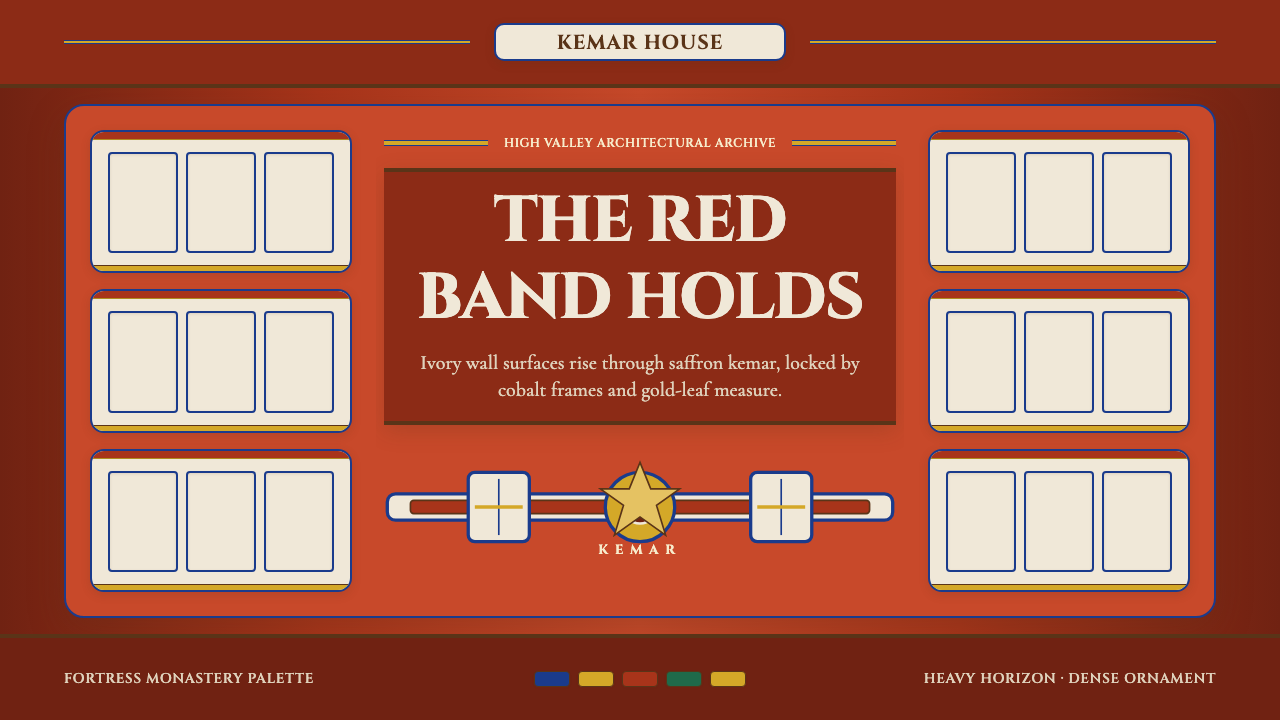 Bhutanese Dzong (Fortress Red)Monumental red holds the page. Cobalt frames and gold bands lock the fortress…
 Egyptian FaienceGlaze carries the afterlife. Deep teal grooves, copper-turquoise rims, rare c…