What is Ethiopian Lalibela Rock-Hewn Church (c.1200)?
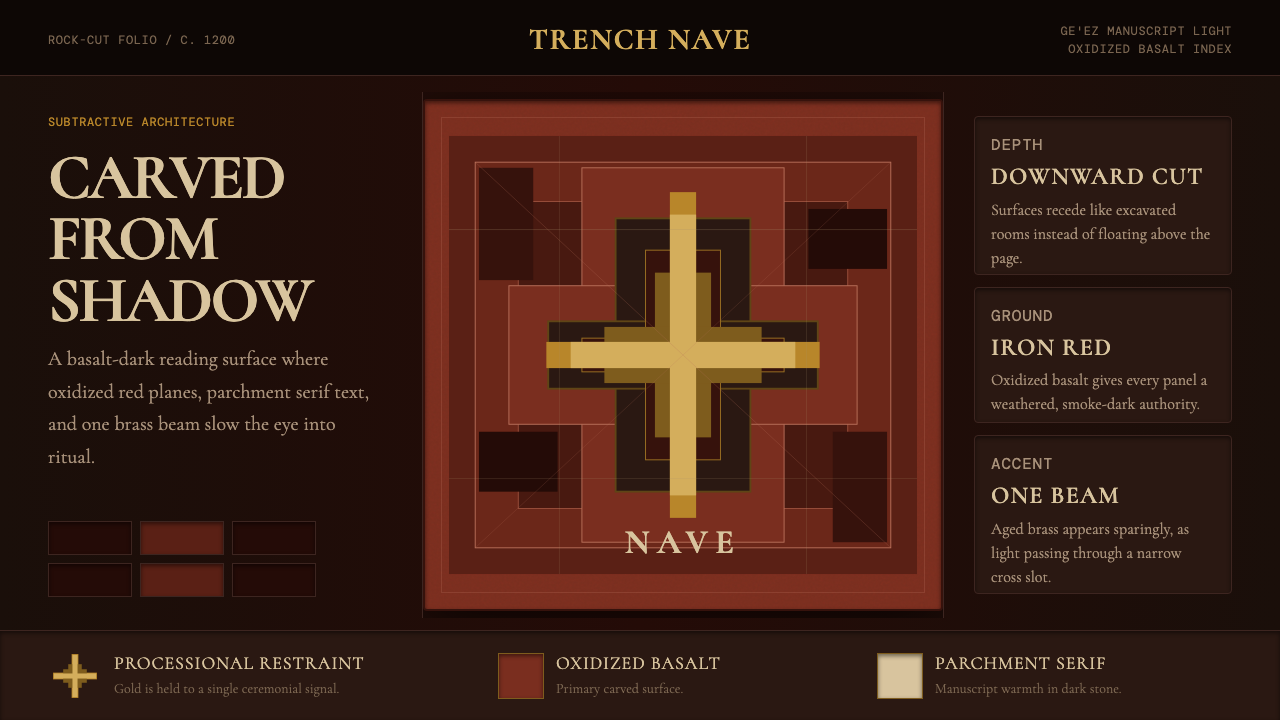
Carved downward into living rock rather than built upward from the ground, the churches of Lalibela embody a design language rooted in sacred darkness, volcanic weight, and the slow accumulation of devotion.
Ethiopian Lalibela Rock-Hewn Church (c.1200) in brief
The Ethiopian Lalibela Rock-Hewn Church style refers to the visual and spatial language derived from the eleven monolithic churches carved from volcanic basalt at Lalibela, in the highlands of Amhara, Ethiopia, during the reign of King Gebre Mesqel Lalibela around the turn of the thirteenth century. Unlike any other architectural tradition in the world, these churches were not assembled from cut stone — they were subtracted from a single living mass. Walls, columns, windows, and roofs are all continuous with the bedrock from which they were removed.
As a design aesthetic, the style draws on the specific qualities that centuries of weathering, candlelight, and liturgical use have imprinted on these spaces: deep trench shadows that frame monoliths on all four sides, iron-oxide red and oxidized ochre surfaces marked by the memory of chisels and the slow staining of rain, cross-shaped apertures that carve geometry into walls, and the aged warmth of brass processional crosses and illuminated Ge'ez manuscripts. The overall register is one of sacred gravity — a vocabulary that communicates permanence, depth, and the weight of centuries.
This is not a style of abundance or surface richness. It is a style of excavation — of arriving at form by removal, of treating darkness as a presence rather than an absence, of allowing materials to age into their own beauty rather than presenting them as new. In digital and print contexts, that translates to restrained palettes of deep umber, oxidized red, and parchment bone against shadow grounds, with gold used as sparingly as a single shaft of light through a carved nave window.
See the Ethiopian Lalibela Rock-Hewn Church (c.1200) design system
Where does Ethiopian Lalibela Rock-Hewn Church (c.1200) come from?
The city of Lalibela — known as Roha during the medieval period — sits at high altitude in the Lasta highlands of what is now Ethiopia's Amhara region. It takes its modern name from King Gebre Mesqel Lalibela, who ruled the Zagwe dynasty from approximately 1181 to 1221. According to Ethiopian Orthodox tradition, the king was inspired by a vision in which angels instructed him to build a new Jerusalem in the highlands after Muslim conquest had cut off Ethiopian Christian pilgrims from the original holy city. Whether or not the churches were all begun under his direct reign — scholarly debate continues — the complex is universally associated with his name and his ambition.
The Zagwe dynasty ruled from a region without significant timber resources, making conventional stone-and-mortar construction difficult. The builders instead exploited the local volcanic geology: the basalt rock of the Lasta highlands, though extremely hard, weathers into a form that can be worked with iron chisels over long periods. The subtractive method — excavating downward and inward from the plateau surface — meant that each church took shape as its material was removed, carving interior spaces, exterior facades, and even drainage channels from a single continuous mass. Structural columns and arched roofs emerged from what remained, not from what was added.
The eleven churches divide into two main groupings and one isolated example. The northern cluster — including the largest, Bete Medhane Alem, and the most photographed, Bete Giyorgis — is separated from the southeastern cluster by a water channel. Bete Giyorgis, dedicated to Saint George, stands alone in a deep rectangular pit and is considered the finest example of the complex's mature style: a perfect cube of basalt, its roof carved with three recessed crosses within crosses, its walls unornamented except for incised geometric panels. The interior is dim and intimate, lit by the cross-shaped windows that give the exterior its most recognizable profile.
Ethiopian Orthodox Christianity had been the state religion since the fourth century, when King Ezana of Aksum adopted it. By Lalibela's time, the faith had developed a distinct visual and liturgical culture centered on the Ge'ez language, elaborate processional ritual, and a tradition of illuminated manuscripts whose pages combined parchment-toned grounds, iron-gall inks, and mineral-derived pigments in deep ochre, crimson, and aged gold. The churches at Lalibela absorbed and concentrated this visual tradition into stone, becoming sanctuaries whose aesthetic was inseparable from their spiritual function. Franciscan priest Francisco Álvares, who visited Ethiopia in the 1520s, wrote the first detailed European description of the churches — and admitted that no written account could fully convey what he had seen.
What defines the Ethiopian Lalibela Rock-Hewn Church (c.1200) look?
Shadow as Structure
The defining visual feature of the Lalibela style is the deep trench that surrounds each monolithic church on all sides, separating the carved building from the surrounding rock face and filling the entire surround with shadow. This is not incidental darkness — it is the primary structural gesture of the aesthetic. In design applications, this translates to a compositional logic that uses deep, high-contrast shadow zones as active framing elements rather than backgrounds. Content floats within shadow, anchored by it, given weight by the darkness that surrounds it.
Oxidized, Volcanic Palette
The color range is drawn directly from the materials and weathering of the site: deep iron-oxide red from basalt surfaces stained by centuries of rain and mineral seepage, umber and smoke-tinged near-black for deep shadow zones, warm parchment bone for surfaces catching light, and aged gold used with utmost restraint for decorative and liturgical accents. This is not a palette of vivid saturated color — it is the palette of slow oxidation, of surfaces that have aged into their final state. Nothing looks new; everything carries the patina of duration.
Cross Geometry
The cross is not merely a religious symbol in this context — it is the primary geometric module from which the architecture is organized. Cross-shaped windows pierce thick walls at every church, casting cross-shaped shafts of light into dark interiors. The roof of Bete Giyorgis is carved with nested crosses, each inscribed within the one above. In design applications, the cross and its nested, recursive variants serve as the organizing geometric motif: framing devices, division markers, and focal points that carry both structural and symbolic weight.
Subtractive Form
Lalibela architecture is defined by what was removed, not what was added. The columns, arches, and decorative panels are not separate elements assembled together — they are what remained after everything surrounding them was chiselled away. This subtractive logic carries a distinct visual quality: edges appear to emerge from mass rather than being composed from components; recessed surfaces and carved reliefs carry the sense of depth discovered rather than depth constructed. In design, this principle argues for interfaces and layouts where content appears revealed rather than assembled.
Manuscript Warmth
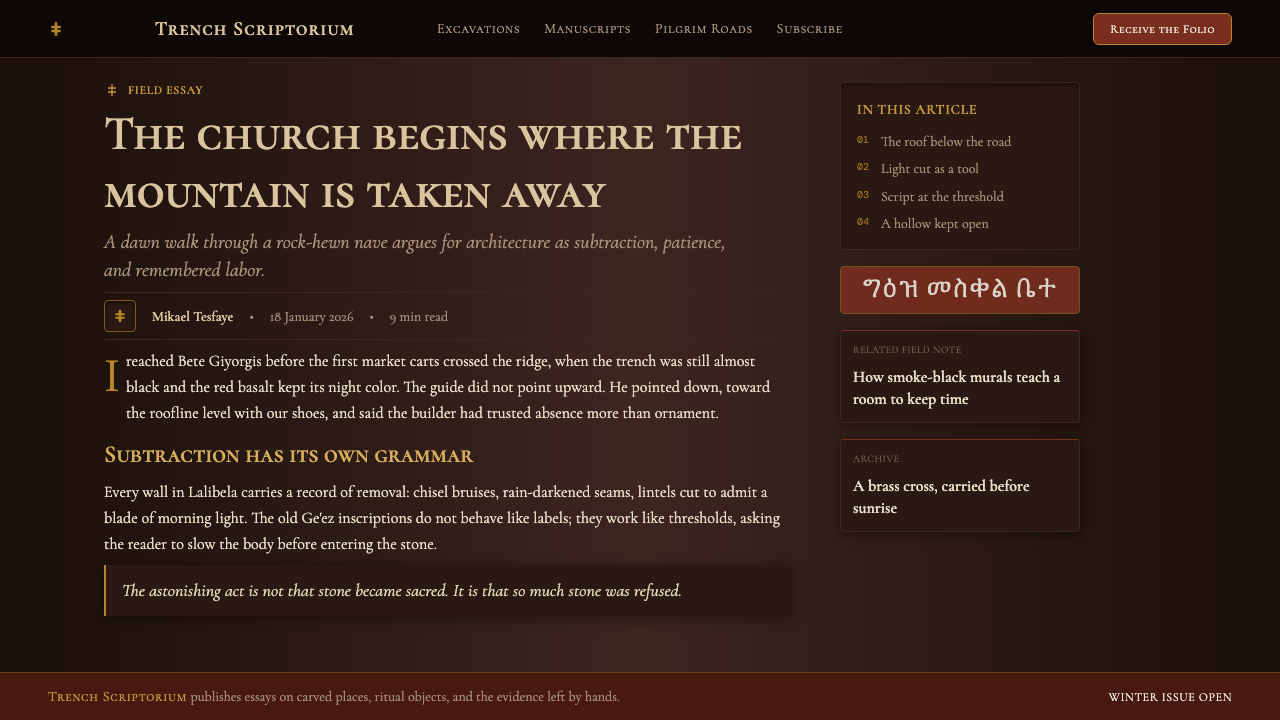
The Ethiopian Orthodox tradition produced illuminated manuscripts in the Ge'ez liturgical language whose visual qualities provide the style's typographic and warm-accent register. These pages are characterized by generous, rounded letterforms with a strong vertical axis, parchment grounds warmed by aged animal skin, pigments in muted crimson and earthy ochre applied with visible brushwork, and gold leaf used for halos, borders, and emphasized passages. In contemporary applications, this tradition suggests a typographic register of generous, humanist letterforms with visible weight and warmth, and a use of warm-toned accent colors derived from aged pigments rather than bright modern hues.
Monolithic Weight
Perhaps the most distinctive quality of the Lalibela aesthetic is a sense of mass and solidity that transcends ordinary architectural weight. These structures are not walls enclosing space — they are the rock itself, shaped. Every surface carries the implied mass of the mountain from which it was taken. In design terms, this translates to compositions that feel grounded and heavy rather than airy and floating: generous margins that anchor content rather than open it up, deep shadow tones that pull downward rather than recede, and a general preference for settled visual weight over dynamic tension.
Sacred Restraint
The churches at Lalibela are architecturally austere compared to contemporary European ecclesiastical building. There is almost no surface decoration on the exteriors beyond geometric incised panels and the carved crosses. Interior walls are bare rock. The drama comes entirely from proportion, light, and shadow — not from applied ornament. This restraint is not poverty of means; it is a deliberate theological and aesthetic choice. In design applications, this principle demands that every decorative element justify its presence and that the primary aesthetic experience comes from composition, contrast, and material quality rather than from surface embellishment.

See the Ethiopian Lalibela Rock-Hewn Church (c.1200) design system
Who shaped Ethiopian Lalibela Rock-Hewn Church (c.1200)?
The Zagwe dynasty king under whose reign the rock-hewn church complex was carved, Gebre Mesqel Lalibela ruled from approximately 1181 to 1221. Ethiopian Orthodox tradition venerates him as a saint, attributing the construction directly to divine instruction conveyed in visions. His ambition to create a New Jerusalem in the Ethiopian highlands — a pilgrimage destination that would substitute for the earthly Jerusalem now closed to Ethiopian Christians — shaped not only the scale and religious significance of the complex but its spatial logic: the churches, their connecting tunnels, and their surrounding trenches are understood as a topographic map of Jerusalem itself, with the water channel dividing the complex representing the River Jordan.
The sixth-century Ethiopian composer and saint who is credited with developing the Ge'ez liturgical chant system — known as zema — that continues to be used in Ethiopian Orthodox worship at Lalibela and elsewhere. Yared's system organized sacred music into three modal scales corresponding to different seasons and liturgical contexts, and he is said to have composed using a notation system of his own invention. His influence extends to the visual culture of Ethiopian Christianity because the manuscript tradition that produced the illuminated texts held at Lalibela grew up in close relation to the liturgical music tradition he founded: both are organized by seasonal cycle, both use the Ge'ez language, and both shape the sensory experience of worship at the rock-hewn churches.
The Portuguese Franciscan priest who accompanied an embassy to Ethiopia from 1520 to 1526 and wrote the first detailed European account of the Lalibela churches in his work Verdadeira Informação das Terras do Preste João das Índias, published in 1540. Álvares described the churches with evident wonder and acknowledged that he had deliberately understated their size and elaborateness because he feared being disbelieved. His account introduced Lalibela to European scholarly and cultural attention for the first time, framing these structures as worthy of comparison with the great monuments of antiquity. His description remains one of the foundational primary sources for understanding how the churches appeared and functioned in the early sixteenth century.
The wife of King Lalibela, who according to Ethiopian Orthodox tradition played an active role in the construction of the church complex and is specifically credited with overseeing the completion of Bete Giyorgis — the church dedicated to Saint George that stands as the finest and most complete example of the complex. Her participation places the architectural project within a tradition of royal female patronage in Ethiopian Christianity that extends through the medieval period. Several of the churches in the southeastern cluster are associated with her name in liturgical tradition, and her feast day continues to be observed in the Ethiopian Orthodox calendar.
How do you use Ethiopian Lalibela Rock-Hewn Church (c.1200) today?
The Lalibela style is one of the most distinctive and least commonly applied historical aesthetics in contemporary design — which makes it both an opportunity and a responsibility. Its visual vocabulary communicates depth, permanence, and sacred solemnity with unusual directness. The challenge is applying it in ways that honor its origins and coherence rather than flattening it into generic dark-mode roughness.
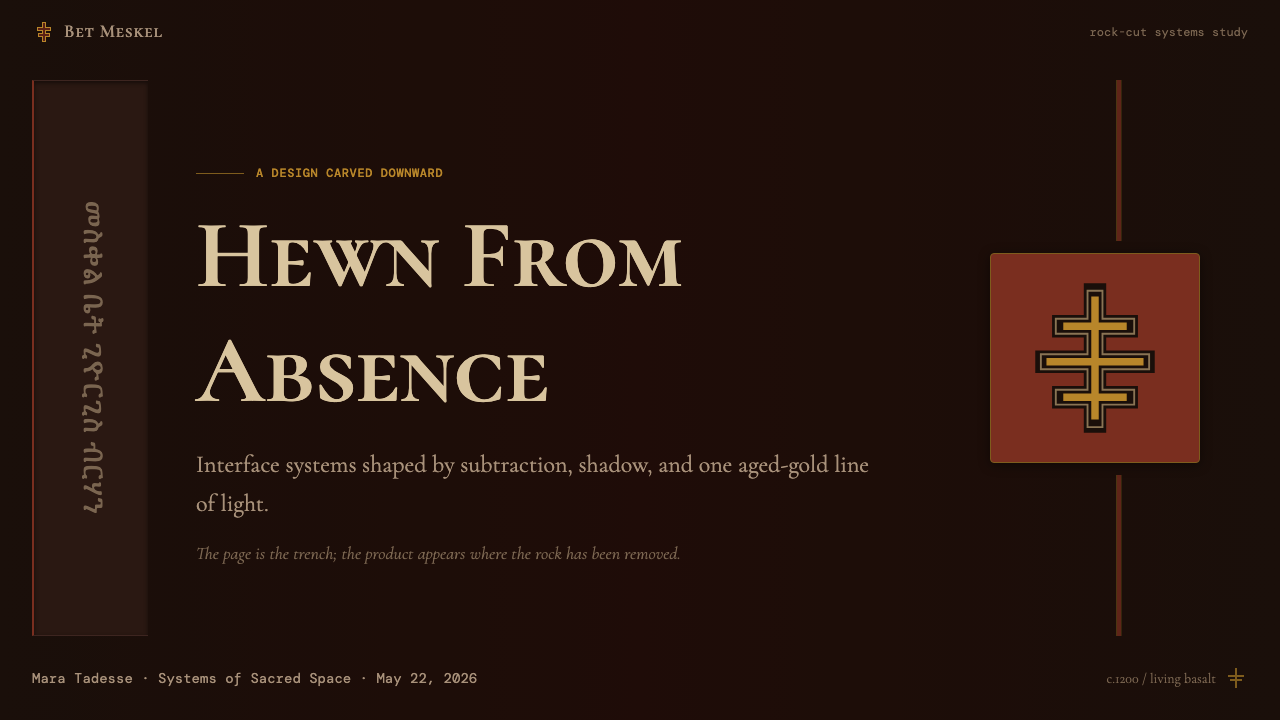
For presentation slides, this aesthetic works most powerfully in contexts that require gravitas: cultural institution decks, heritage brand pitches, documentary or archival projects, and any presentation that needs to communicate age and authority rather than speed and novelty. Cover slides benefit from the monolithic compositional logic: a single large form — a cross, a column of text, a stark geometric figure — set against deep shadow. Content slides should carry the same restraint: minimal text at a generous scale, warm parchment-toned grounds for lighter sections, and gold or warm ochre used only for single accent elements per slide. Avoid applying every characteristic at once; the style reads strongest when one or two qualities dominate each composition.
For web interfaces, the Lalibela aesthetic is well-suited to contexts that benefit from a sense of institutional depth: museums, archives, cultural foundations, premium editorial platforms, and heritage-facing products. In practice this means: a background that reads as dark volcanic stone or deep shadow rather than flat black; text in warm bone or parchment tones rather than pure white; a restrained use of warm metallic or aged-gold accents for interactive highlights, headings, and borders; and card components with visible depth achieved through inner shadow and subtle tonal variation rather than flat surfaces. Navigation should feel architectural — quietly monumental, not playful.
For editorial and marketing work, the style's most effective register is measured ceremony. Long-form editorial pieces can use the aesthetic to build a sense of reading as a ritual: slow pacing, wide margins as meditative space, section breaks marked by a simple incised cross or horizontal rule rather than decorative illustration. Marketing applications should resist the temptation to lighten the palette in an attempt to make it more approachable — the power of this style comes from its commitment to depth and restraint, and a half-committed version loses both the drama and the credibility.
A common mistake when applying this aesthetic is mistaking darkness for the message. Simply setting content against a black background and adding some orange-tinted effects does not produce the Lalibela register — what distinguishes it is the quality of the tones (volcanic, oxidized, aged rather than simply dark), the deliberate use of light as a structural element (revealing, not decorating), and the complete avoidance of surface novelty. The style has no tolerance for trendy textures, glow effects, or ambient blurs — those belong to a different visual world entirely.
See the Ethiopian Lalibela Rock-Hewn Church (c.1200) design system
Ethiopian Lalibela Rock-Hewn Church (c.1200) — FAQ
How is this style different from other dark, textured design aesthetics?
Most contemporary dark and textured aesthetics — brutalist web design, industrial dark mode, grungy editorial — derive their visual character from urban or industrial sources: concrete, oxidized metal, weathered signage. The Lalibela style is geological and liturgical in origin. Its darkness comes from the interior of carved rock, not from a post-industrial surface. Its warm accents come from aged brass and illuminated manuscripts, not from neon or backlit displays. The result is a different emotional register: monumental and ceremonial rather than rebellious or edgy. The textures feel ancient rather than decayed.
Does this style work for products targeting modern, technology-forward audiences?
It can, but with significant constraints. The Lalibela aesthetic communicates deliberation, depth, and permanence — qualities that position a product as serious and enduring rather than fast and iterative. For a technology product that wants to signal that it is built to last, that it takes its work with genuine gravity, and that its craft has been considered rather than rushed, this visual language is coherent and powerful. It is not well-suited to products where speed, approachability, or collaborative lightness are primary values. The style works best when a technology product has a subject matter that is itself weighty — historical archives, cultural preservation tools, long-form research platforms.
How should gold be used within this aesthetic?
Gold in the Lalibela context is liturgical and architectural — it appears in the processional crosses carried through the rock-hewn naves, in the gold leaf of illuminated manuscript borders, in the aged brass of chalices and other ritual objects. Its role is not decorative emphasis in the contemporary sense but sacred designation: gold marks what is holy, what is central, what commands attention in an otherwise dim and earthy space. In design applications, this means gold should appear rarely and with clear intent — as a single heading accent, a key border, an active state indicator. Using it for hover effects, gradients, or general visual interest dissolves its meaning entirely.
Can this style be applied to a light-background layout?
The Lalibela style depends fundamentally on the quality of its shadow — the deep trenches surrounding the monolithic churches are what give the carved forms their sense of weight and isolation. A light-background inversion is possible but requires careful thought. The key is retaining the warm, aged quality of the palette: a parchment or warm pale ground rather than pure white, iron-oxide red and aged ochre rather than vivid modern tones, and deliberate use of deep shadow zones within the layout even when the overall ground is light. The risk in a light inversion is that the style's most distinctive quality — monumental depth — becomes difficult to communicate without the darkness that creates it.
What makes this style appropriate for heritage and cultural institution work?
Cultural institutions and heritage projects face a consistent challenge: communicating the significance of historical material to contemporary audiences without either trivializing it or making it feel inaccessible. The Lalibela aesthetic solves this by embedding age into its structure rather than applying it as a surface effect. The worn quality of the palette, the weight of the shadow zones, the restraint of the decorative language — these are not stylistic choices layered over neutral content, they are the visual argument that what is being presented has weight and endurance. For institutions working with African history, Ethiopian Christianity, early medieval material culture, or the broader heritage of the Global South, this style has the additional quality of drawing on a visual tradition that is genuinely connected to the subject matter rather than imported from European modernism.
Related design styles
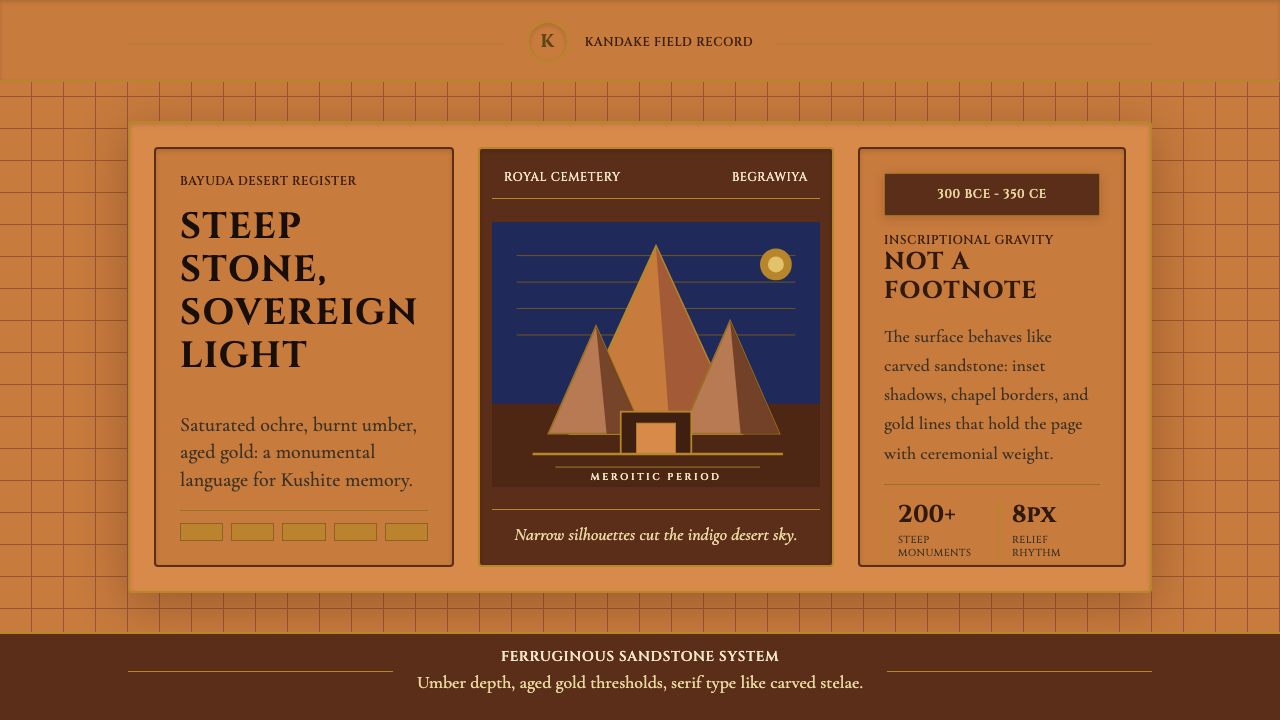 Sudanese Nubian Meroë PyramidMonumental, not muted. Ochre sandstone, umber depth, gold borders, and Cinzel…
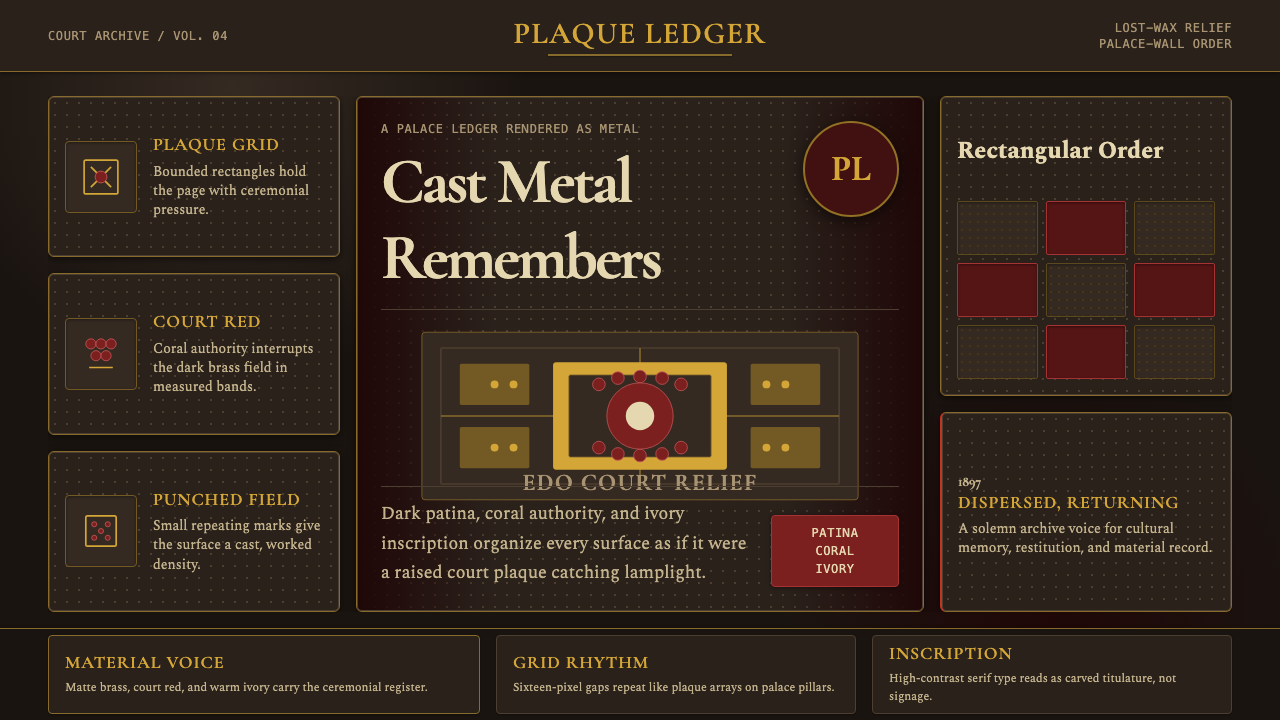 Benin Bronze Oba CourtCourt gravity in cast metal. Patinated brass grid, coral red panels, ivory se…
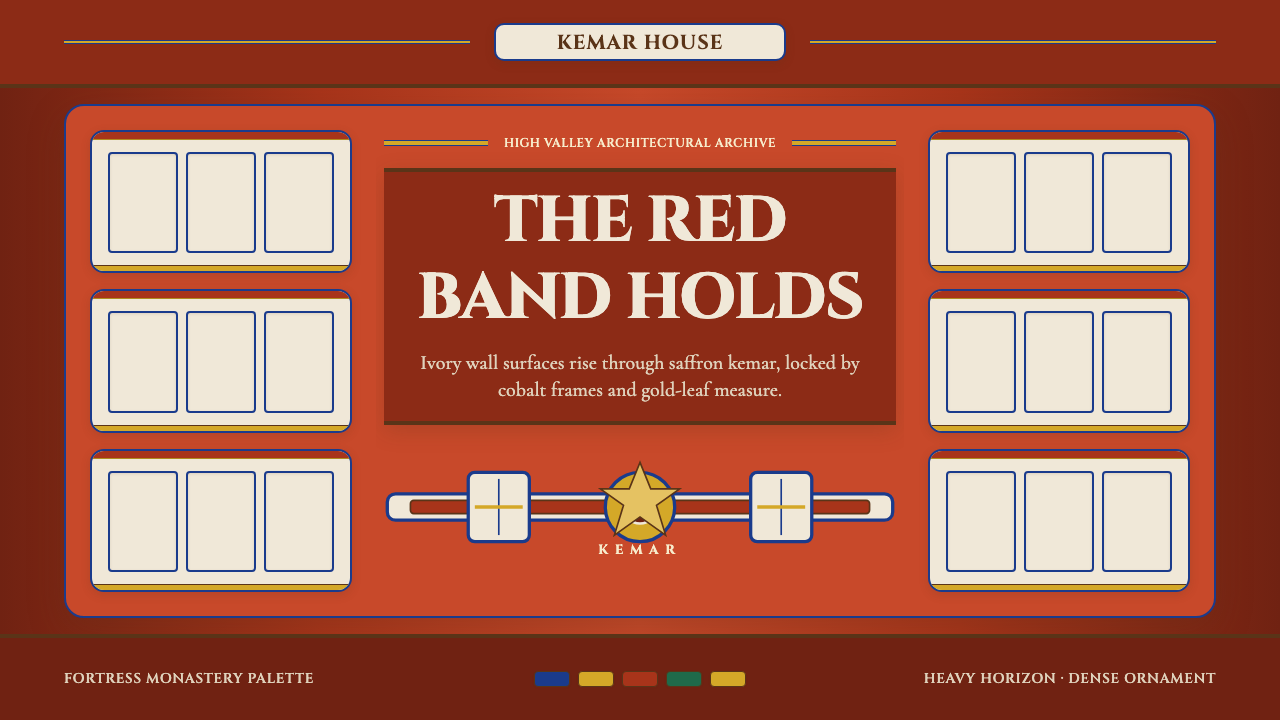 Bhutanese Dzong (Fortress Red)Monumental red holds the page. Cobalt frames and gold bands lock the fortress…
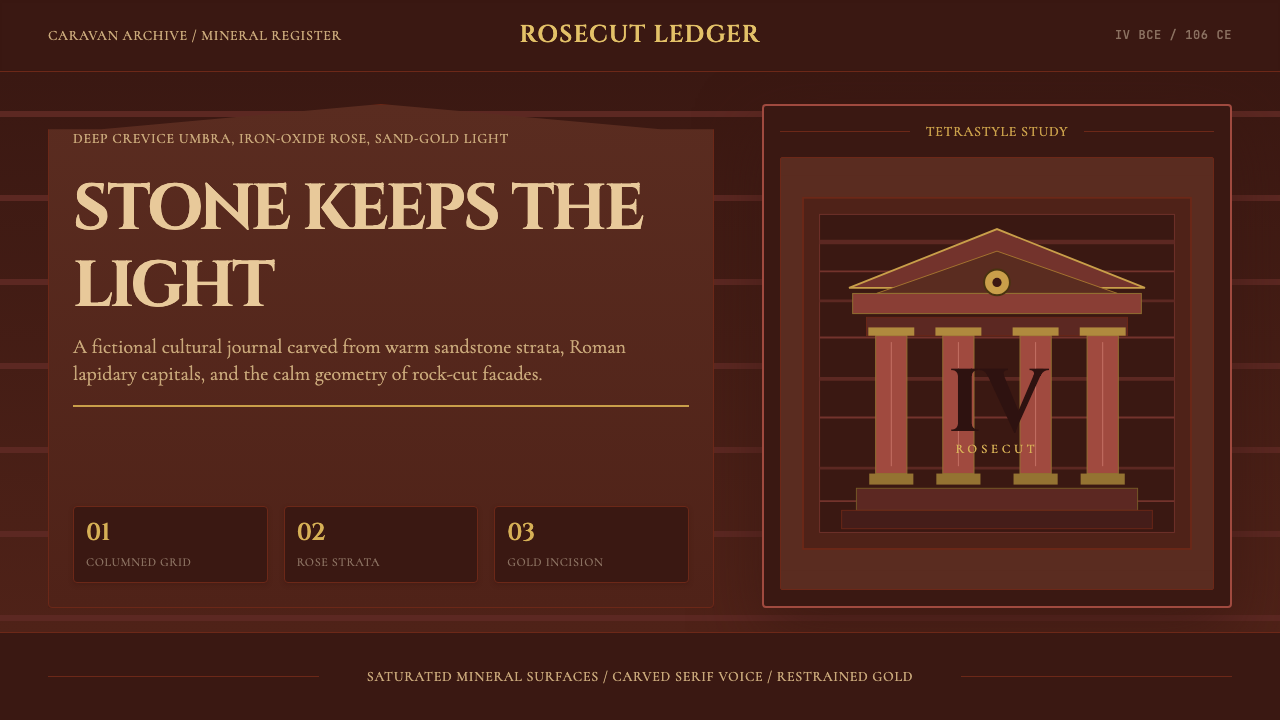 Jordanian Petra Rose NabataeanGeology feels monumental. Crevice umbra, rose strata, and Cinzel capitals car…
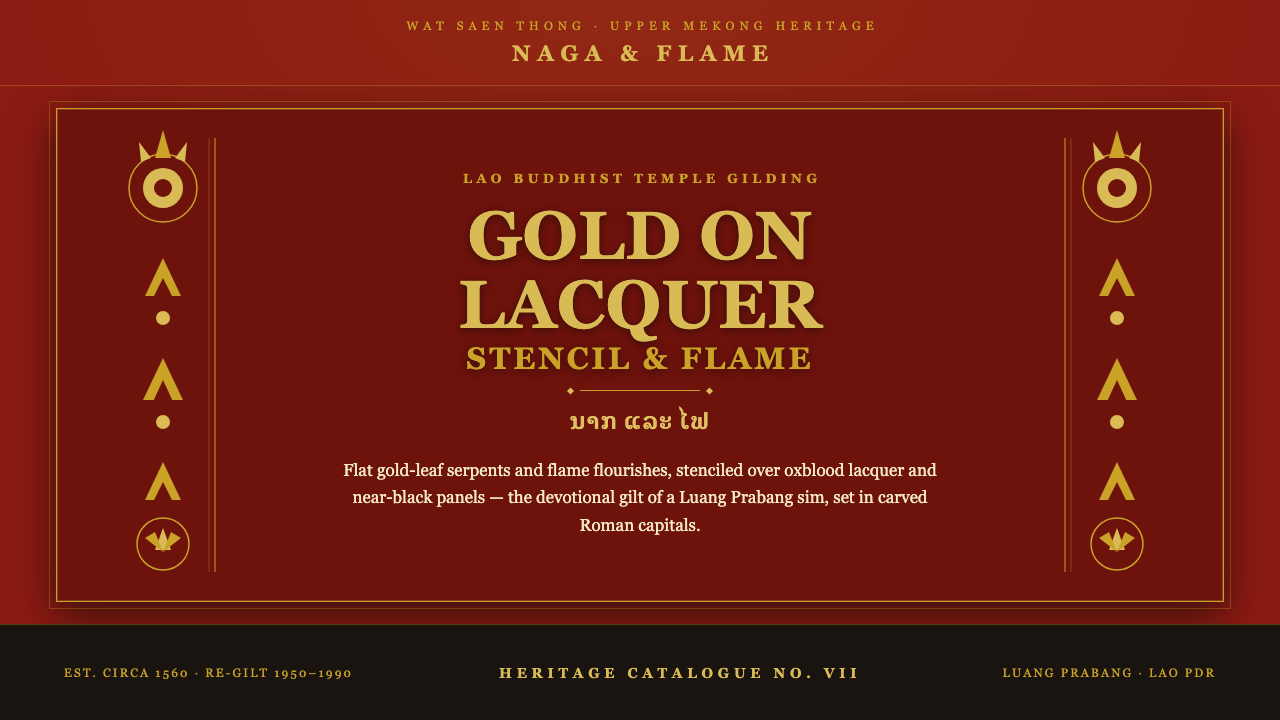 Lao Naga Temple StencilDevotional gilt, not chrome. Flat gold-leaf naga and flame stencils glow on o…
 Mughal Miniature (Akbar era)Opulence refuses emptiness. Saffron paper, ruby panels, cobalt lattice, gold…