What is Rossetti — Pre-Raphaelite Stunner?
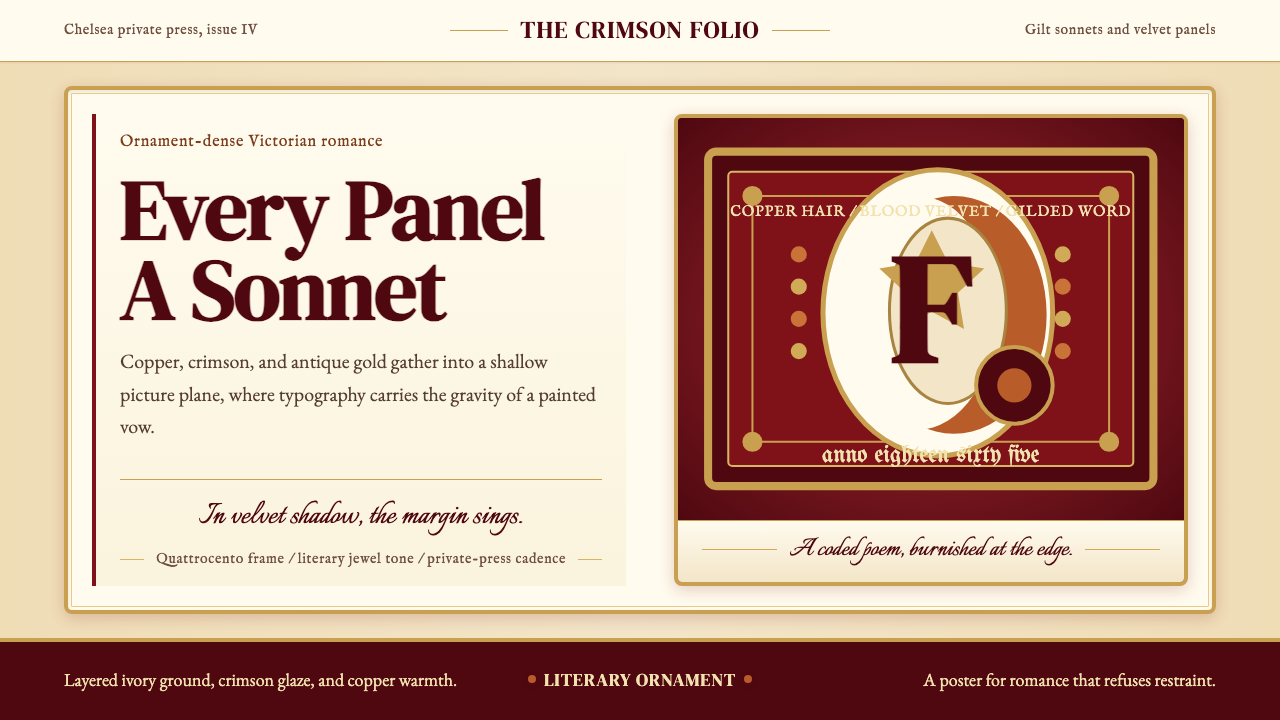
Rossetti's Pre-Raphaelite style dresses every surface in jewel-deep colour, cascading copper-red hair, and the density of an illuminated medieval manuscript.
Rossetti — Pre-Raphaelite Stunner in brief
Rossetti — Pre-Raphaelite Stunner is the visual language distilled from Dante Gabriel Rossetti's mature portrait phase of the 1860s and 1870s: a world of blood-crimson velvet, ancient-gold ornament, and half-length female figures whose copper-red hair fills the frame like a second subject. Every surface carries symbolic freight — pomegranates, lilies, convolvulus blossoms, and the occasional Latin inscription woven into the painted border. The mood is saturated, literary, and deliberately anti-academic.
The palette is not simply rich; it is intentionally coded. Deep jewel tones — crimson, copper, antique gold, and deep olive — serve as emotional registers rather than neutral description. The composition follows a shallow picture plane derived from Italian Quattrocento painting: figures sit close to the surface, drapery presses against a dense decorative background, and depth is achieved through layered ornament rather than perspectival recession. Three-quarter and profile views dominate, the sitter's gaze directed slightly away from the viewer — an intimate withholding that charges the image with longing.
The style is ornament-rich and unapologetically literary. Rossetti was a poet as well as a painter, and his visual work and verse were designed to be read together. Titles are quotations; frames bear inscribed sonnets; flowers and objects carry the weight of Dante, Keats, and Arthurian legend. Applying this aesthetic today means embracing that density — layered texture, symbolic detail, and a romantic heaviness that places beauty above efficiency.

Where does Rossetti — Pre-Raphaelite Stunner come from?
The Pre-Raphaelite Brotherhood was founded in London in 1848 by seven young artists and writers — among them Dante Gabriel Rossetti, William Holman Hunt, and John Everett Millais — who shared a conviction that English painting had grown hollow since Raphael. They looked past the Renaissance High Style to the earlier Italian and Flemish masters: the vivid colour, flat picture planes, and minute botanical observation of painters working before 1500. Their name was a manifesto — a deliberate rejection of the academic tradition that stretched from Raphael through the Royal Academy.
Rossetti's relationship to the Brotherhood was always eccentric. He was its most charismatic member but also its most literary, most medieval, and most private. While his early work shared the Brotherhood's bright outdoor colour and moral earnestness, by the late 1850s he had moved decisively toward something different: the large-scale half-length portrait of a beautiful woman — the 'stunner,' as he and his circle called such figures — set against backgrounds of dense decorative patterning. These were not portraits in the conventional sense; they were icons. The subjects — first Elizabeth Siddal, his model and later wife, then Jane Morris, wife of his friend and collaborator William Morris — became vessels for an imagined world of medieval romance and Dantesque longing.
The Chelsea house at Cheyne Walk, where Rossetti lived from 1862 after Siddal's death, became the physical environment for this mature style. He filled it with blue-and-white Chinese porcelain, Jacobean furniture, antique textiles, and live animals — peacocks, wombats, a zebu. The rooms were the paintings' atmosphere made habitable, and the aesthetic they generated fed directly into the broader Aesthetic Movement of the 1870s and 1880s, which held that the cultivation of beauty was a sufficient end in itself. Walter Pater, Oscar Wilde, and Aubrey Beardsley all owed intellectual debts to Rossetti's formulation of art as intense, private, beauty-saturated experience.
The historical context of the 1860s sharpens the style's meaning. Victorian academic painting was dominated by narrative moralising — large canvases depicting improving historical or religious scenes, colour kept subordinate to draughtsmanship. Rossetti's 'stunners' were a refusal of all this: small in format, private in subject, insistently non-narrative, and saturated in colour so deep it bordered on excess. The style was also entangled with the Arts and Crafts Movement through Rossetti's friendship with William Morris; the same principles that governed the painted surface — handcraft over industrial production, symbolic ornament over mere decoration, depth of material over cheapness — also governed Morris's wallpapers, textiles, and the founding of the firm Morris, Marshall, Faulkner and Co. in 1861.
What defines the Rossetti — Pre-Raphaelite Stunner look?
Colour
The palette runs deep and warm: blood-crimson, copper-red, antique gold, deep olive, and midnight blue. These are jewel tones, not pastels — they carry the density of oil glaze built up in layers, the richness of dyed velvet, and the glow of medieval stained glass. No colour is used decoratively alone; each carries symbolic meaning. Crimson signals passion and sacrifice; gold signifies the sacred or ideal; olive and copper belong to the earthly and mortal. The palette is never cool, never neutral, and never flat — warmth and depth are non-negotiable.
Ornament and Surface Density
Every plane is loaded. Backgrounds are woven or embroidered patterns — honeysuckle, pomegranate, diaper-work, leaf-scroll — that press forward against the figure rather than receding. Drapery is rendered stitch by stitch, fabric fold by fold, with the loving exactitude of medieval tapestry. This is not background noise; it is structured abundance. The ornament is never random: each motif is chosen for symbolic resonance, creating a second layer of meaning beneath the primary image.
Shallow Picture Plane
Space is compressed. Figures occupy the foreground in a shallow box of depth, consistent with Rossetti's study of Quattrocento masters who placed their subjects against gilded or patterned grounds with minimal recession. There is no atmospheric perspective, no open landscape window, no deep spatial drama. This compression focuses the viewer's attention entirely on the surface — on texture, colour, and symbolic object — rather than on narrative space. The figure and her attributes fill the frame as a jewel fills its setting.
The Stunner Pose
The characteristic figure is shown from the waist or chest upward, turned at a three-quarter angle or in pure profile. The gaze is averted — directed slightly past the viewer, or cast downward — creating a sense of interior absorption that is simultaneously accessible and withheld. The neck is long, the lips full, the hair abundant and typically loose or half-bound. Hands often hold a symbolic object — a flower, a mirror, a stringed instrument — or are caught in a gesture of offering or reverie. This pose is iconic rather than naturalistic; it is a convention as codified as a Byzantine saint's stance.
Symbolic Botany
Flowers and plants are never incidental. Rossetti inherited a Victorian and medieval tradition of floriography — the language of flowers — in which each species carried a fixed meaning: pomegranate for fertility and underworld descent, lily for purity, rose for love, convolvulus for persistence and entanglement. These appear in bouquets the sitter holds, in the woven background, in embroidered borders, and occasionally inscribed as text within the composition itself. A viewer conversant with the system reads the painting as a poem on two simultaneous registers.
Literary Integration
Rossetti's works are inseparable from text. Picture frames bear inscribed lines of his own sonnets, sometimes in the artist's own handwriting. Titles quote Dante, Keats, the Bible, or Rossetti's own verse cycle The House of Life. This is not illustrative art — it does not depict a scene from a text — but art that aspires to the condition of a poem: dense, allusive, calling for rereading. Any design working in this idiom carries that literary weight through titles, captions, ornamental text elements, and the names of typefaces that echo medieval manuscript culture.
Material Richness
Texture is everywhere and always legible. Velvet absorbs light differently from silk; embroidery catches it differently from woven brocade. Rossetti rendered these distinctions with the patience of a goldsmith, and the visual system inherits that insistence. In contemporary design, this translates to a preference for paper stocks with tactile weight, layered visual textures that suggest depth, and typographic ornaments that recall hand-drawn or hand-pressed production. The underlying message is always that care — material, intellectual, emotional — has been lavished on the object.

Who shaped Rossetti — Pre-Raphaelite Stunner?
Rossetti was the dominant creative force of the Brotherhood's mature phase and the inventor of the 'stunner' portrait type. Poet, painter, and collector simultaneously, he was unusual among Victorian artists in his systematic integration of image and text — his sonnets and his paintings were designed to be read together, each illuminating the other. His models — above all Elizabeth Siddal and Jane Morris — became the faces of an entire aesthetic movement, and his Chelsea household at Tudor House on Cheyne Walk served as a magnetic centre for the Aesthetic Movement throughout the 1860s and 1870s.
Siddal was Rossetti's primary model, muse, and eventually wife, and her particular physical appearance — auburn hair, pale skin, heavy-lidded eyes — became the template for the Pre-Raphaelite female ideal. She was also a gifted artist and poet in her own right, though her work remained largely unrecognised during her lifetime. Her death from a laudanum overdose in 1862 deepened Rossetti's existing medievalism into something more elegiac; the sonnets he buried with her and later exhumed became the nucleus of The House of Life.
Jane Morris, née Burden, became Rossetti's second great muse after Siddal's death and is the model for many of his most iconic later works, including Proserpine and La Pia de' Tolomei. Her dark features — heavy brows, a wide jaw, deep-set eyes — represented a different pole of the Pre-Raphaelite beauty ideal from Siddal's pallor. Her marriage to William Morris placed Rossetti at the centre of a complex web of artistic, personal, and commercial relationships that shaped both the Aesthetic Movement and the Arts and Crafts Movement.
Burne-Jones was the movement's second great painter and a crucial link between Pre-Raphaelitism and the Aesthetic Movement. Trained under Rossetti's influence, he developed a more elongated, otherworldly figure style and a preference for Arthurian and classical mythology over Rossetti's Dantesque themes. His collaborations with William Morris — on stained glass, tapestry, and book illustration — helped translate Pre-Raphaelite visual principles into the applied arts and gave the movement a durable decorative legacy extending well into the early twentieth century.
Morris was a central figure in Rossetti's circle, though his own contribution was less painterly than organizational and commercial. His founding of Morris, Marshall, Faulkner and Co. in 1861 — with Rossetti and Burne-Jones among the partners — turned Pre-Raphaelite aesthetic principles into marketable goods: wallpapers, textiles, furniture, and stained glass. His insistence that beautiful design should be available to the everyday domestic environment, and his conviction that the machine age had impoverished craftsmanship, gave the movement a political edge that Rossetti's purely aesthetic programme lacked.
How do you use Rossetti — Pre-Raphaelite Stunner today?
The Rossetti Pre-Raphaelite style is one of the most distinctive historical aesthetics available to contemporary designers, but it demands an honest commitment to density. It cannot be applied as a surface wash of crimson and gold over a clean modern layout — the result will feel like a costume rather than a conviction. To work in this idiom is to accept that ornament is meaning, that colour is symbol, and that every element on the surface should carry its own weight in the larger composition.
For presentation slides, the style suits covers and chapter dividers above all. A cover page works best as an icon-like composition: a deep jewel-toned background, a single central figure or motif rendered in high detail, and a title set in a typeface with calligraphic or serif weight that evokes manuscript lettering. Section dividers benefit from a single symbolic botanical element — a pomegranate branch, a lily stem — placed against a richly textured ground. Content slides should pull back from the full ornamental density; a narrower palette of two jewel tones with generous margins allows the data or argument to breathe while the aesthetic frame remains consistent. Data charts take on an almost tapestry-like quality when bars and segments are coloured in deep crimson, antique gold, and olive against a cream or ivory field.
For web interfaces, the style works best on landing pages, editorial features, and brand stories rather than transactional or functional dashboards. A hero section might pair a full-bleed background of deep crimson or antique-velvet texture with a headline in a generously spaced, classically weighted typeface. Pricing or feature sections should adopt a lighter register — ivory grounds, copper-toned accents — to avoid visual fatigue. Navigation benefits from gold or copper typographic weight rather than icon-heavy patterns. For product imagery, the style demands photographic treatment that echoes the shallow picture plane: subjects close to the surface, backgrounds that are textured rather than plain, props or florals chosen for symbolic resonance.
For editorial and marketing design, Pre-Raphaelite principles support deeply layered layouts: pull-quotes set in calligraphic display type against tonal backgrounds, botanical ornaments used as section markers rather than generic decorative dividers, and body text set in a warm-toned serif typeface with generous line-height. Marketing campaigns in this style communicate luxury, handcraft, and cultural depth — they are well suited to heritage brands, fashion houses, perfume and beauty lines, literary publishers, and cultural institutions. The symbolism of the botanical motifs can be adapted: a brand centred on fertility and growth might lean into pomegranate and vine imagery; one centred on purity might favour lily and white convolvulus.
The most common mistake when applying this aesthetic is confusing richness with clutter. Pre-Raphaelite ornament is dense but never random — each element is chosen for symbolic fitness, and there is always a clear compositional hierarchy beneath the decorative surface. Designers who fill a layout with generic floral textures, mix multiple unrelated historical typeface styles, or apply the jewel palette at full saturation across every element will produce something that reads as period-costume excess rather than principled richness. The discipline of the original style lies in its specificity: each motif earns its place by carrying meaning, and the colour palette, however deep, is always internally coherent.

Rossetti — Pre-Raphaelite Stunner — FAQ
How is Pre-Raphaelite different from Art Nouveau, which also features organic ornament and rich colour?
The two share ornamental density and a rejection of academic convention, but their logics are opposite in one key respect. Pre-Raphaelite ornament is symbolic and literary — each motif carries a specific meaning drawn from a shared cultural vocabulary of flowers, scripture, and classical myth. Art Nouveau ornament is formally generative — the arabesque line and the stylised plant form are ends in themselves, celebrated for their visual rhythm rather than their referential content. Pre-Raphaelite colour is jewel-deep and mineral; Art Nouveau colour is often greened, muted, and iridescent. And where Pre-Raphaelite composition is icon-like and compressed, Art Nouveau composition tends toward flowing, sinuous movement across a larger field.
Can this style work in a digital-first context — screens, apps, UI components — or is it fundamentally print and physical?
It can work digitally, but it requires selective translation rather than direct transfer. The jewel palette translates well to screens — deep saturated tones are naturally suited to backlit displays. The symbolic botanical ornament works as illustrated headers, section dividers, or loading states. What does not translate is the tactile quality of physical richness: velvet depth, oil-glaze luminosity, and the weight of embossed paper. Digital applications of this style tend to succeed when they embrace the palette and the compositional compression while acknowledging that screen-based texture is always somewhat flat. The style works for brand identity systems, editorial web design, and prestige e-commerce — and struggles for utility-first products where decoration competes with function.
Is the style inherently feminine, or can it be applied to contexts with a different gender register?
The 'stunner' portrait tradition is explicitly organized around the representation of idealised femininity, and that history is inseparable from the visual system. However, the underlying principles — symbolic ornament, jewel-toned palette, literary density — are not inherently gendered. Medieval manuscript culture, from which the style partly descends, was as much a masculine institution as a feminine one. In contemporary use, the aesthetic can be redirected toward gender-neutral or masculine registers by emphasizing the armorial and heraldic aspects of the medieval inheritance — shield shapes, motto banners, dark ground with gold inscription — while moderating the flowing hair and specific floral symbolism of the stunner portrait type. The palette alone is not gendered; its coding depends entirely on context.
How much text can this style comfortably carry — is it suited to information-dense layouts?
Pre-Raphaelite visual culture was itself extraordinarily text-dense — poems inscribed on frames, titles that were quotations, symbolic objects requiring glossaries to fully decode. The style is therefore not hostile to text; it is hostile to text that has no considered relationship to its visual surround. Long-form editorial layouts work well in this idiom because the decorative frame is understood as a structural device — the text column is the centre of the composition, the ornament its border. What does not work is dense functional text — terms and conditions, data tables, navigation labels — placed directly against elaborately textured backgrounds. The rule is: the more the text is meant to be read carefully and at length, the more this style can support it; the more it is meant to be scanned quickly, the more it will resist.
What is the single most important rule for applying this style without it becoming pastiche?
Every element must earn its place through meaning, not through decorative impulse. Rossetti's original paintings are dense but never arbitrary — the pomegranate is there because Persephone ate it; the lily is there because it signals the sacred and the mortal simultaneously; the copper hair fills the frame because it is the painting's second subject, not because it is pretty. When contemporary designers import the surface vocabulary — the jewel tones, the botanical motifs, the textured grounds — without importing the logic of symbolic selection, the result is decoration with no argument behind it: beautiful, perhaps, but hollow. The discipline is to ask of every element: what does this mean? Why is this specific flower, this specific shade, this specific typeface choice here rather than another? When that question has a real answer, the style is working. When it does not, the design is costume.
Related design styles
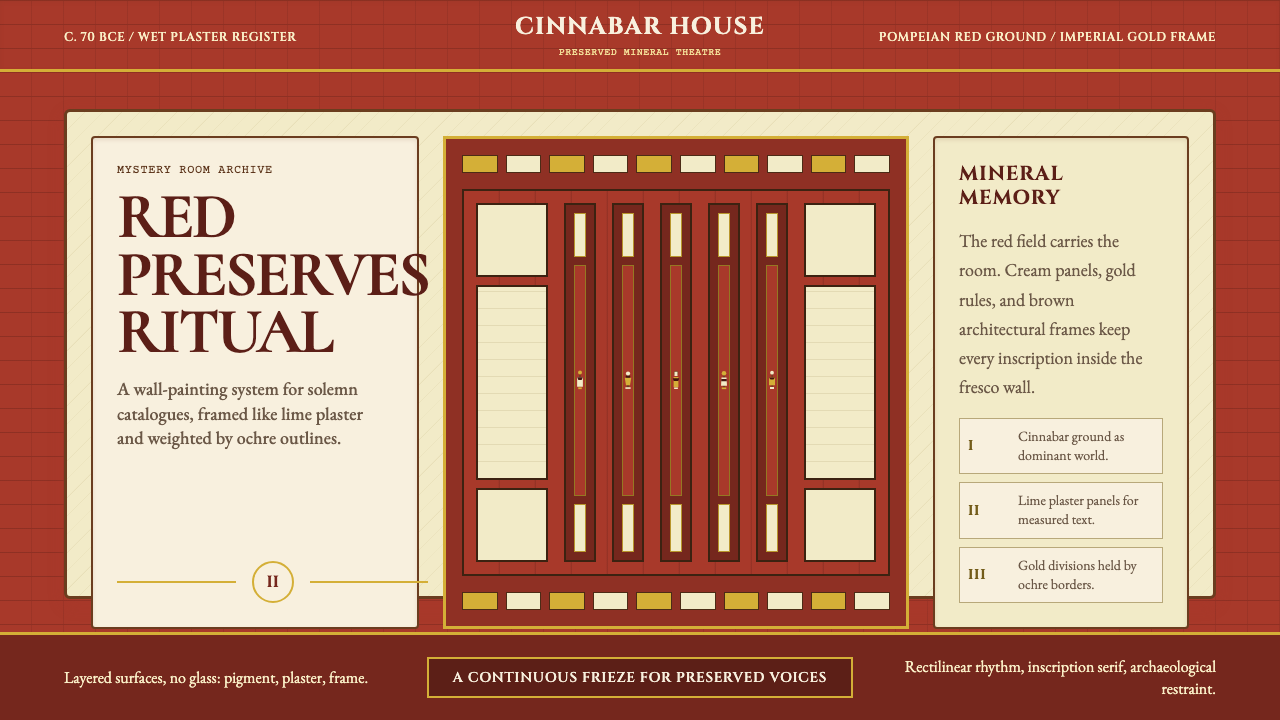 Pompeii Fresco Villa of MysteriesThe wall is the world. Pompeian red, cream plaster panels, and gold frames ho…
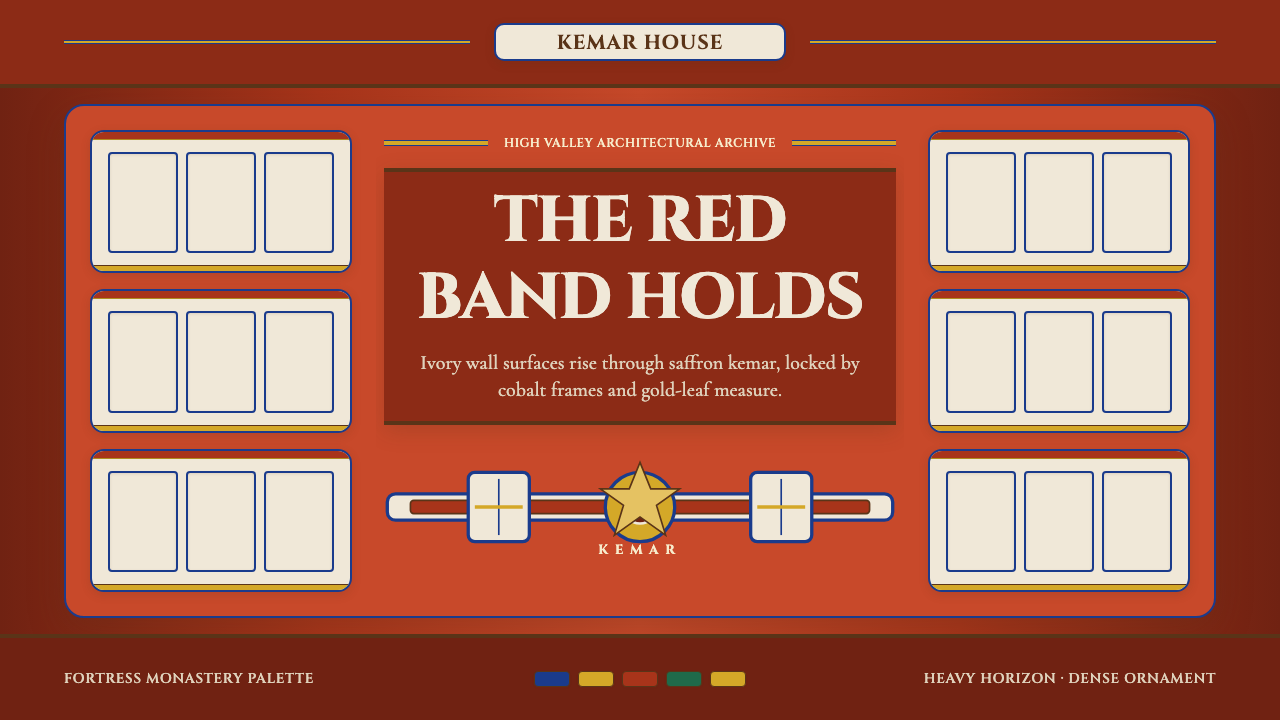 Bhutanese Dzong (Fortress Red)Monumental red holds the page. Cobalt frames and gold bands lock the fortress…
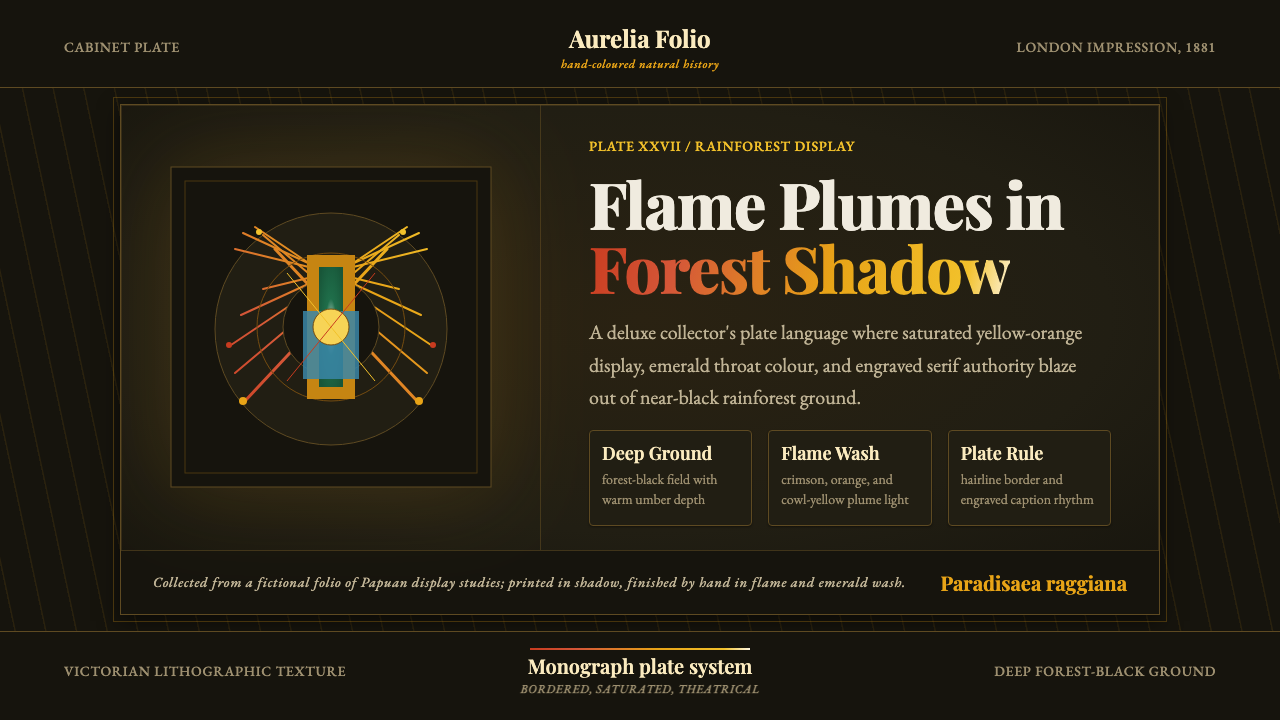 Bird of Paradise MonographTheatrical plate-book darkness. Flame plumes blaze from a bordered forest-bla…
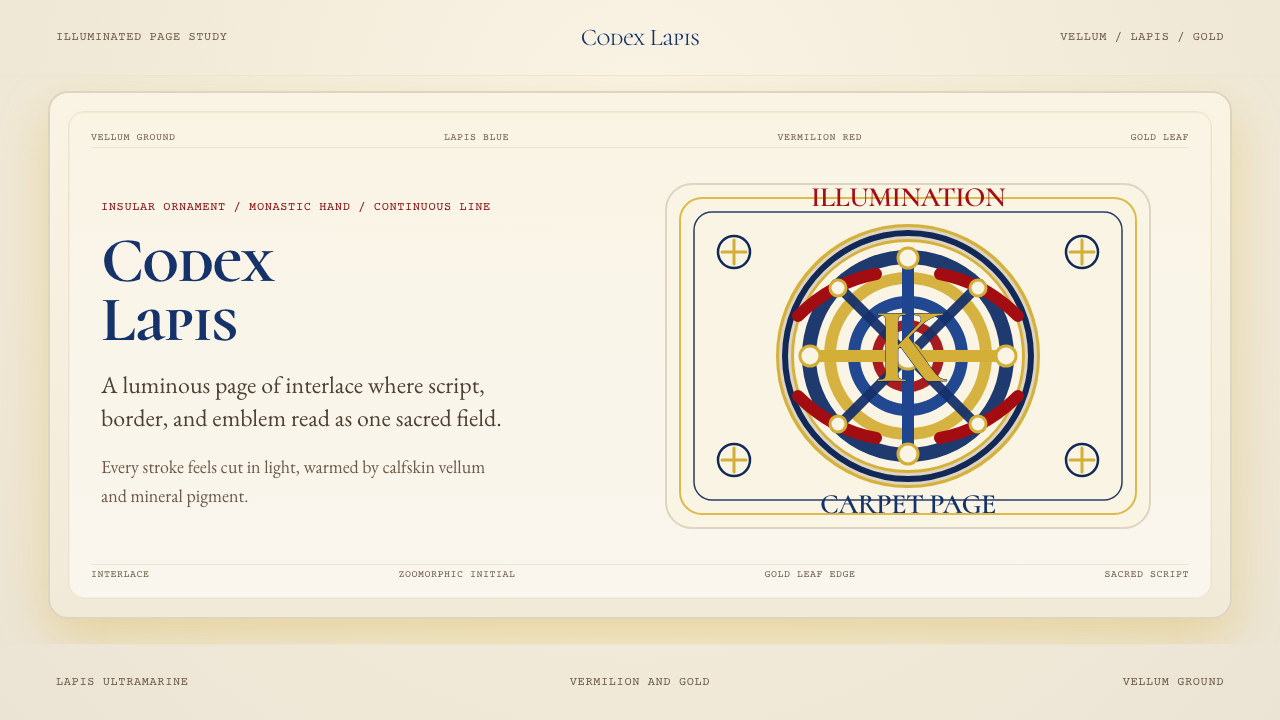 Book of Kells Celtic (800)Sacred and precise. Vellum cream, lapis, vermilion, and gold knotwork.
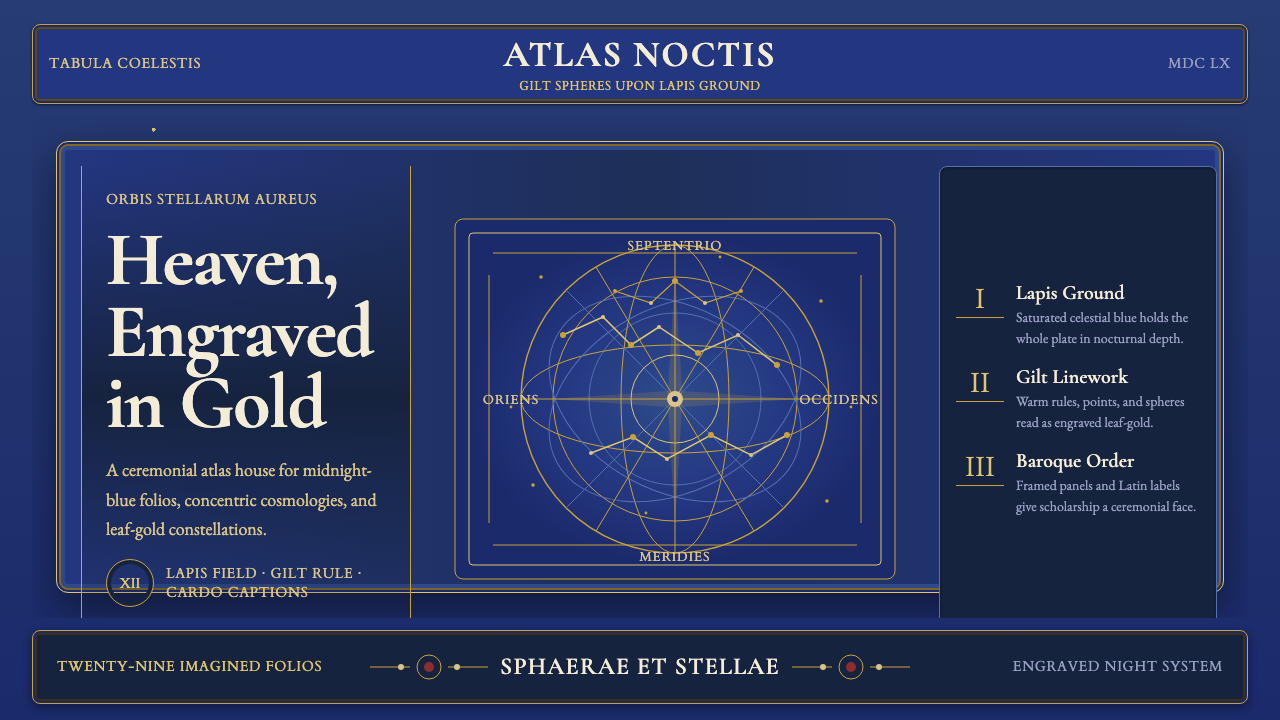 Cellarius Celestial AtlasCelestial luxury on lapis. Gilt serif type, star fields, and concentric chart…
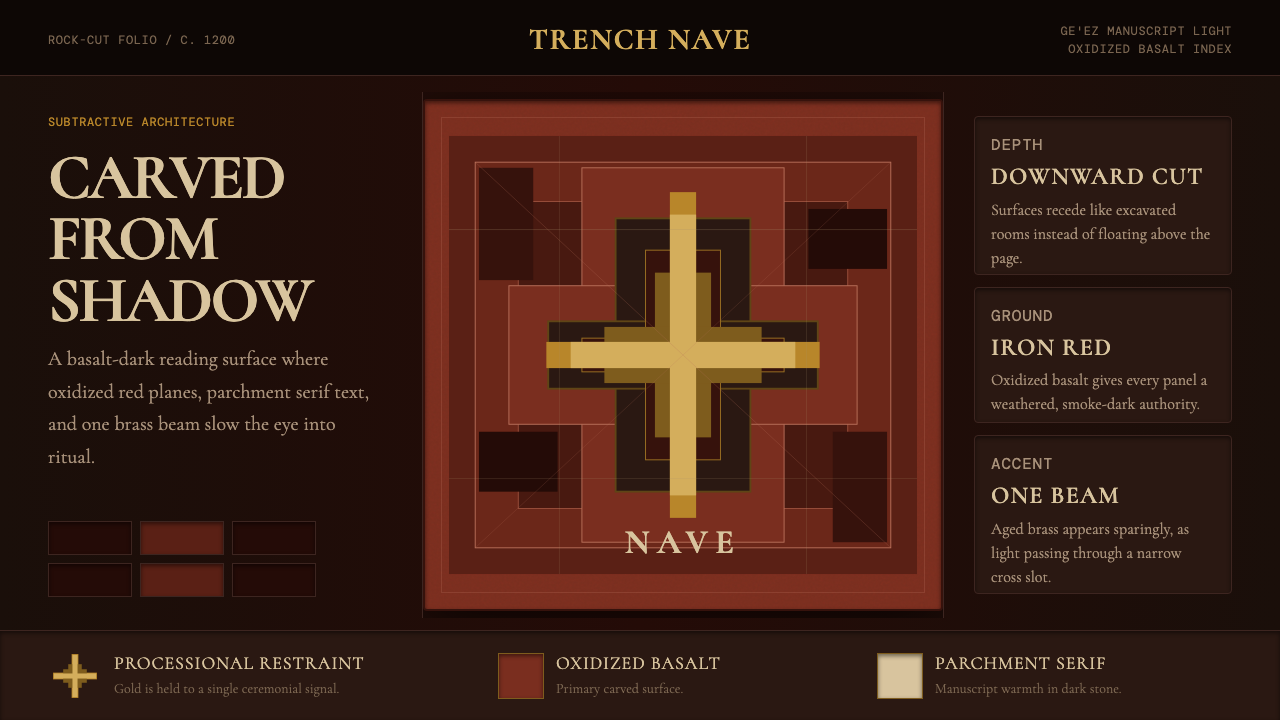 Ethiopian Lalibela Rock-Hewn Church (c.1200)Sacred weight in shadow. Oxidized basalt, parchment serif, and one aged-gold…