What is Pompeii Fresco Villa of Mysteries?
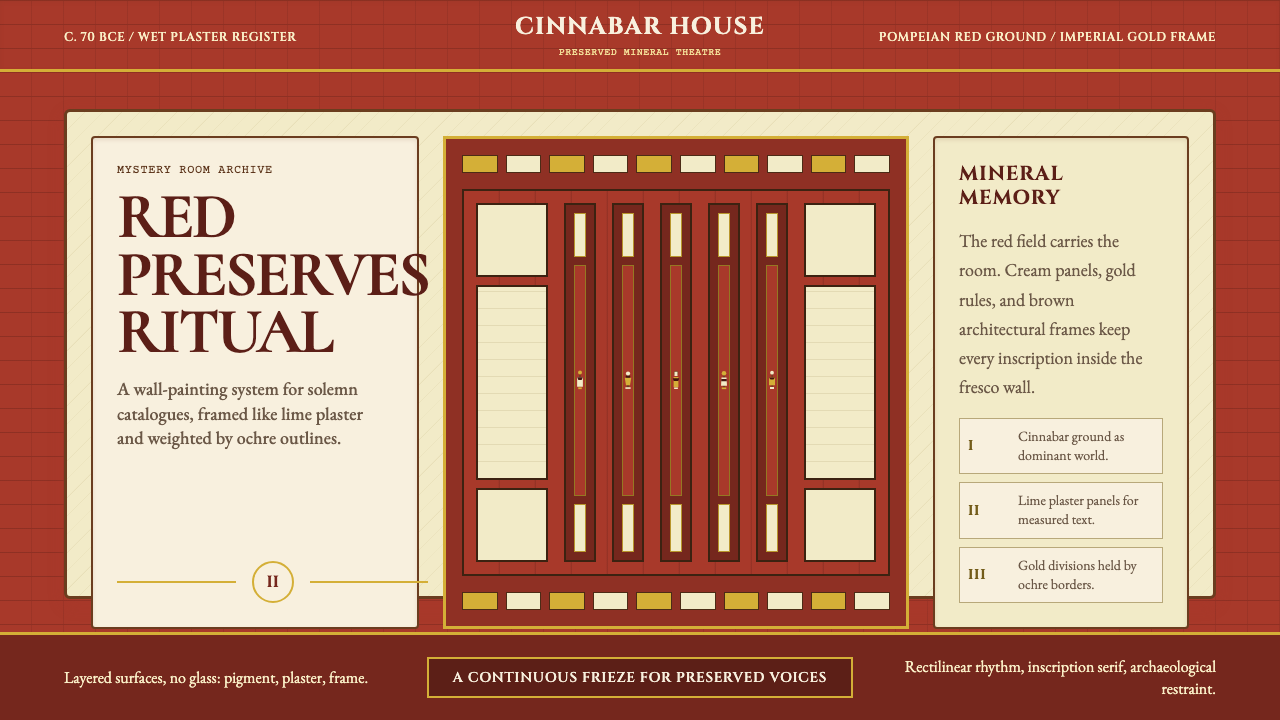
Two thousand years of volcanic ash could not dim the saturated cinnabar red of the Villa of the Mysteries — the most complete narrative wall-painting to survive from the ancient world.
Pompeii Fresco Villa of Mysteries in brief
The Pompeii Fresco Villa of Mysteries design language is drawn directly from the most celebrated room in Roman painting: the triclinium frieze of the Villa of the Mysteries outside Pompeii, where twenty-nine life-size figures enact an unidentified Dionysiac ritual against a ground of intense cinnabar red. The style takes that monumental wall as its organizing principle — treating every surface as a plaster field divided into structural panels, every color as a mineral substance with material memory, and every line as the deliberate mark of a painter working fresco, where each stroke is permanent from the moment it touches wet lime.
The visual system rests on three primary materials translated into design: Pompeian red as the dominant page ground, cream lime-plaster as the field for content, and imperial gold as the accent that frames and elevates. Against these grounds, figures and text are rendered in the ochre-brown outlines characteristic of late Republican Roman wall-painting — a line quality that is simultaneously architectural and figurative, borrowed from the Second Pompeian Style tradition in which painted columns, pediments, and receding architectural vistas gave flat walls the illusion of depth without abandoning their identity as walls.
What distinguishes this style from generic classicism is its material specificity. The cinnabar used in ancient frescoes was among the most expensive pigments of the Roman world, produced from mercury ore mined in Spain, and its intensity was understood as a mark of patronal ambition. The cream of lime plaster carries the warmth of calcium carbonate aged over centuries, not the bright white of modern paint. The gold of gilded stucco ornament is warm and slightly matte — refined metal applied by hand — not the sharp metallic of digital gradients. Every color in the system carries the memory of a substance and a process.

Where does Pompeii Fresco Villa of Mysteries come from?
The Villa of the Mysteries was a large suburban estate on the western edge of Pompeii, roughly half a kilometer outside the Herculaneum Gate. Its most important room — the room from which the villa takes its modern name — was decorated sometime around 70 BCE in the mature Second Pompeian Style. The frieze runs continuously around three walls of the room, presenting what appears to be an initiation sequence into the mystery cult of Dionysus, the god of wine, ecstasy, and transformation. The figures include a terrified young woman, a winged female figure wielding a whip, a reclining Dionysus, a satyr gazing into a bowl, and a kneeling bride being prepared for ritual. Their identities and the precise meaning of the sequence remain debated by classical scholars, which is itself part of what makes the room compelling: it presents a narrative that was intentionally opaque to the uninitiated.
The eruption of Vesuvius in 79 CE buried the villa under meters of volcanic pumice and ash, preserving it — along with most of Pompeii — until systematic excavation began in 1748. The Villa of the Mysteries was not fully excavated until 1909–1910, under the direction of Vittorio Spinazzola and subsequently Amedeo Maiuri, who served as Superintendent of Antiquities for Campania from 1924 to 1961 and whose extensive publications brought the villa and its fresco to international scholarly attention. The paradox of preservation-by-catastrophe — that the very disaster which destroyed Pompeii is what allowed us to see it — has been a theme in scholarship ever since, and it resonates in the design principle of treating color as a material that endures rather than a surface that refreshes.
The cinnabar red that dominates the frieze belongs to a specific Roman decorative tradition known as the red room or Pompeian red interior, in which a deep saturated ground served as both architectural frame and chromatic atmosphere. Roman pigment technology distinguished between several reds — minium (lead oxide), rubrica (iron oxide), and cinnabar (mercury sulfide) — and cinnabar, the most vivid and most expensive, was typically reserved for the most important rooms and the most ambitious patrons. Its use throughout the Villa of the Mysteries frieze signals the scale of the commission and the status of whoever owned the villa, still unknown.
Post-excavation, the frieze became one of the most reproduced images in the history of classical archaeology. Elaine K. Gazda's scholarship on Roman copies and originals helped situate the Villa frieze within broader debates about the relationship between Greek prototypes and Roman adaptations, and about what constitutes originality in a culture that valued skilled replication as a form of cultural transmission. The color system itself — red ground, cream panel, gold frame — spread far beyond Campania through the excavation publications and subsequent influence on neoclassical interior design in the eighteenth and nineteenth centuries, entering the visual vocabulary of European decorative arts well before it became available as a digital design reference.
What defines the Pompeii Fresco Villa of Mysteries look?
Pompeian Red Ground
The dominant color of the system is a deep, saturated red derived from cinnabar — mercury sulfide ground to pigment and applied in Roman fresco. It is not a warm orange-red or a cool crimson: it sits in the middle range, intense without being harsh, carrying a slight mineral weight that distinguishes it from purely synthetic reds. In the design system, this red functions as the architectural ground — the wall itself — and content floats above it in cream panels. Using it as a background rather than an accent is essential to the style's authority.
Cream Lime-Plaster Panel
Roman fresco technique applied colored pigment to wet lime plaster, and the cream-white of aged plaster — warmer than pure white, cooler than ivory — appears throughout the Villa frieze as the field for figures and architectural detail. In the design system, cream panels are the content zones: text, imagery, and data live here. The off-white is not neutral; it carries the visual temperature of a material that has been fired, applied, and dried. Setting type against cream rather than pure white reduces contrast just enough to give the layout a physical warmth.
Imperial Gold Ornament
Gold in Roman decorative arts — applied as gilded stucco, gold leaf, or yellow ochre in fresco — served as the organizing edge: the frame, the border, the threshold between zones. In the design system, gold functions as both structural separator and hierarchical signal. It appears as thin banding around panels, as ornamental details on architectural motifs, and as the accent color for emphasis. The quality of gold in this system is warm and slightly matte, evoking metal applied by hand rather than a mechanical metallic finish.
Ochre-Brown Figural Outline
The figures in the Villa frieze are defined by a warm ochre-brown contour — iron-oxide pigment at lower saturation than the red ground — that gives them their weight and legibility against both red and cream fields. This outline quality is the system's primary figurative tool. In contemporary design application, it translates to illustration styles and icon treatments that use a warm brown stroke rather than black, keeping graphic elements embedded in the fresco palette rather than floating as modern digital objects.
Architectural Panel Structure
The Second Pompeian Style organized wall surfaces into zones separated by painted architectural elements: columns, pilasters, cornices, and entablatures rendered in trompe-l'oeil. The design system inherits this structural logic as a layout principle: every composition is understood as a wall divided into load-bearing zones. Horizontal bands at the top and bottom of the surface anchor the content field, just as a cornice and plinth anchor a Roman wall. This gives layouts a verticality and groundedness that purely grid-based systems sometimes lack.
Monumental Serif Typography
Roman lettering — the carved capital inscriptions of monuments, milestones, and dedications — is the typographic reference for this system. The letters are proportioned according to classical optical correction, with strokes that taper to fine serifs evoking the chisel's action on stone. In the design system, this translates to display typography with pronounced stroke contrast, classic proportions, and the weightiness of an inscription rather than the neutrality of a text face. The serifs are not decorative additions; they are the formal residue of the tool and material that originally made the letters.
Material Grain and Texture
Fresco is not a smooth medium. The grain of the plaster support, the crystalline structure of mineral pigments, and the slight variations in application created by working in a time-limited wet state all contribute to a surface that is both uniform in color and subtly alive in texture. The design system treats this quality as a principle: flat color fields carry a suggestion of material grain rather than the absolute smoothness of digital fills. This is achieved through treatment rather than heavy texture overlay — the goal is the memory of a substance, not the simulation of a photograph.

Who shaped Pompeii Fresco Villa of Mysteries?
The artist or workshop responsible for the Villa of the Mysteries frieze is unknown — Roman fresco painters rarely signed their work, and the distinction between the master who designed the composition and the assistants who executed it is impossible to reconstruct at this distance. What is clear is that the frieze was painted by someone with command of the full Second Pompeian Style vocabulary: controlled foreshortening, psychologically differentiated figures, and a sophisticated understanding of how saturated red interacts with cream and gold at large scale. The anonymity is itself historically significant: it reflects Roman attitudes toward craft, in which the patron's ambition rather than the painter's identity was the legible statement.
Spinazzola directed the excavations at Pompeii from 1910 to 1923, introducing the practice of stratigraphic excavation and in-situ preservation that allowed the Villa of the Mysteries — and much of the Via dell'Abbondanza — to be documented more carefully than earlier nineteenth-century digs. His methodological innovations meant that the contextual relationships between architectural elements, fresco surfaces, and portable objects were preserved and recorded rather than dismantled. The quality of the Villa of the Mysteries as a preserved environment, rather than merely a source of extracted objects, owes substantially to his directorship.
Maiuri served as Superintendent of Antiquities for Campania from 1924 to 1961, making him the dominant figure in Pompeii scholarship for nearly four decades. His monograph on the Villa of the Mysteries, published in 1931, established the interpretive framework — initiation into the Dionysiac mysteries — that continues to shape popular understanding of the frieze. Maiuri also oversaw the physical consolidation of the villa as a site open to visitors, transforming it from an archaeological dig into a cultural monument. His interpretation of the frieze as a ritual sequence rather than a mythological narrative gave the design system its thematic coherence: a continuous story unfolding around a room, experienced by moving through space.
Gazda, a scholar of Roman art at the University of Michigan, edited the influential volume 'The Villa of the Mysteries in Pompeii: Ancient Ritual, Modern Muse' (2000), which gathered interdisciplinary perspectives on the frieze from classical archaeologists, art historians, and scholars of religion. Her broader work on Roman copying practices and the question of originality in Roman art is directly relevant to the design system: she argued that Roman visual culture valued skilled replication and creative adaptation as legitimate artistic operations, not as lesser alternatives to invention. This framing is useful for understanding how a design system inspired by ancient work can be both historically grounded and genuinely contemporary.
Briullov, the Russian Romantic painter, visited Pompeii in 1827 and was so affected by the excavated city that he produced 'The Last Day of Pompeii' (1833), a monumental canvas that brought the eruption and the ruins to a mass European audience before photography made the site universally accessible. The painting, which toured major European cities and was purchased by the Russian Imperial family, established Pompeii as a romantic and tragic site of cultural imagination. Briullov's engagement with the color of Pompeii — especially its reds — influenced how the site was understood aesthetically by subsequent generations, and his work is part of the chain of reception that eventually made Pompeian red a recognizable design reference.
How do you use Pompeii Fresco Villa of Mysteries today?
The Pompeii Fresco Villa of Mysteries style is not a neutral framework — it carries the weight of ritual, monumentality, and material history. Applying it correctly requires understanding what makes it different from other classically derived styles: it is warm where neoclassicism tends to be cool, material where art deco tends to be abstracted, and narrative where other ancient-inspired systems tend to be ornamental. The decision to use it should begin with the question of whether the content has the gravity the style demands.
For presentation slides, the style works most powerfully when the red ground is used as an actual background rather than an accent. A cover slide with the cinnabar red occupying the full surface, a cream panel centered or offset for the title, and a thin gold rule framing the panel creates an immediate sense of authority. Content slides work best when they treat the cream field as the primary content zone, with the red visible only as a border or band — this prevents the dominant color from competing with text legibility. Data slides benefit from the panel system: charts and graphs seated within cream-bordered zones on a red ground take on the quality of framed artifacts rather than floating digital objects.
For web interfaces and dashboards, the style is well suited to contexts where gravitas and distinction are valued over approachability — premium product pages, cultural institution websites, editorial platforms, and high-end portfolio presentations. The approach is to use the red ground for hero sections and structural dividers, cream for content areas and cards, and gold as the interactive accent. Navigation should lean on the monumental serif for wordmarks and primary labels, with generous spacing that echoes the breathing room of the frieze's architectural zones. Avoid using the full Pompeian red on interactive elements like buttons at small scale — at that size the color reads as warning rather than heritage.
For editorial and marketing work, the style supports long-form and high-impact applications equally well. A feature article layout can use a red-ground header section with a cream body field below, with gold rules marking section breaks — the architecture of the wall translating directly into page structure. Marketing pages work well with alternating full-width sections in red and cream, creating a rhythm that echoes the alternating figure-ground of the frieze itself. Pull quotes and callouts gain authority when set in the monumental serif against the red ground with gold framing, creating moments that read as inscriptions rather than design elements.
The most common mistake when working with this style is applying it as a color scheme alone — taking the red, cream, and gold without the structural logic that makes them cohere. A red background with modern sans-serif type and card-based layout does not produce a Pompeian result; it produces an anachronism that looks neither historical nor contemporary. The style requires committing to the panel architecture, the serif typography, and the material weight of each color. A second common mistake is adding too much gold: in the actual fresco, gold functions as a thin organizing line, not a fill color. Used as a fill, it quickly overwhelms the red-cream balance and tips the palette from monumental to merely opulent.

Pompeii Fresco Villa of Mysteries — FAQ
How does this style differ from generic neoclassicism or the Grand Tour aesthetic?
Neoclassicism, particularly in its eighteenth-century European form, tended toward the cool, pale, and restrained — white marble as the dominant reference, with classical motifs applied as surface decoration to essentially modern structures. The Villa of the Mysteries style begins instead from warm, saturated color as the architectural ground, and treats classical elements not as applied ornament but as load-bearing structure. The difference is between a building with classical columns applied to a modern facade and a room whose walls are themselves the art. The fresco tradition is also specifically Roman and specifically Campanian — not Athenian, not Renaissance, not generic antiquity.
Can this style work on a light or white background, or does it require the red ground?
The style can be adapted to light-ground applications, but it requires careful reconfiguration. Without the red as dominant ground, the cream becomes the primary surface and the red shifts to the role of accent — more similar to a classical interior detail palette than to the Villa frieze itself. This is a legitimate variation, particularly for contexts where the full red would be too intense for long-form reading (editorial body text, technical documentation). The risk is that a light-ground version without the red's presence can drift toward generic warm classicism. To maintain the system's identity in a light-ground variant, the gold and ochre-brown elements must carry more structural weight, and the typography must lean more explicitly on monumental forms.
How should imagery and photography be integrated into this style?
Photography in this system works best when it is treated with the same material logic as the fresco pigments — which means avoiding the clean, high-resolution, color-accurate aesthetic of contemporary stock photography. Images benefit from treatments that warm the color temperature, add a slight grain or texture consistent with the material palette, and reduce the dynamic range toward the tonal relationships of mineral pigment on plaster. Figurative imagery — portraiture, architectural photography, still life — integrates more naturally than landscape or abstract photography. When photography is used alongside the red and cream palette, it typically occupies a cream panel zone rather than the red ground, to prevent visual competition. Illustration that follows the ochre-brown outline convention is often more successful than photography for primary visual elements.
Is this style appropriate for digital products with accessibility requirements?
The core palette presents specific accessibility considerations. Pompeian red as a background color requires careful attention to the contrast ratio of any text placed against it — cream or near-white type on the saturated red will typically meet contrast requirements, but mid-tone colors introduced for hierarchy on the red ground may not. The cream-on-red combination that the style depends on for its primary content zones is generally accessible for display text at larger sizes; body text at reading sizes benefits from being placed on the cream panel with dark type rather than reversed out of the red. Gold as an interactive element requires supplementary signaling (shape, underline, or position) since it cannot carry sufficient contrast on its own for small interactive text. None of these constraints are obstacles to using the style — they are simply the conditions under which its material logic should be applied.
What kinds of content or products are a poor fit for this style?
The Villa of the Mysteries style struggles in contexts that call for lightness, playfulness, or immediate approachability. Children's products, casual consumer applications, food and beverage brands where freshness is the primary value, and technology products positioning themselves as minimal or future-oriented will all find the style's weight working against them. The style also requires a certain scale to read correctly: at very small sizes — mobile app icons, small-format social content, compact UI components — the panel architecture collapses and the color system reads as heavy rather than monumental. It is equally misaligned with brands whose identity rests on speed, efficiency, or frictionlessness. The appropriate use cases are products and communications where depth, authority, cultural weight, and a sense of duration are assets rather than liabilities.
Related design styles
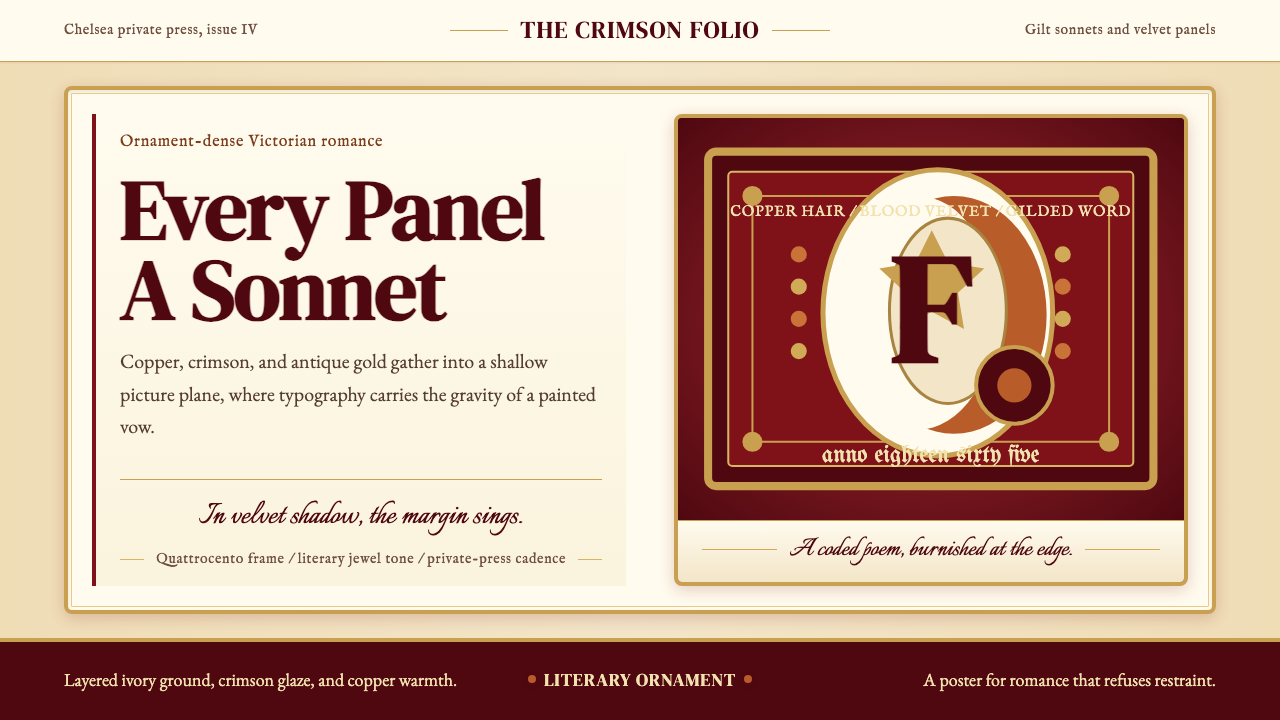 Rossetti — Pre-Raphaelite StunnerRomance refuses restraint. Crimson velvet, copper serif, and gilt frame turn…
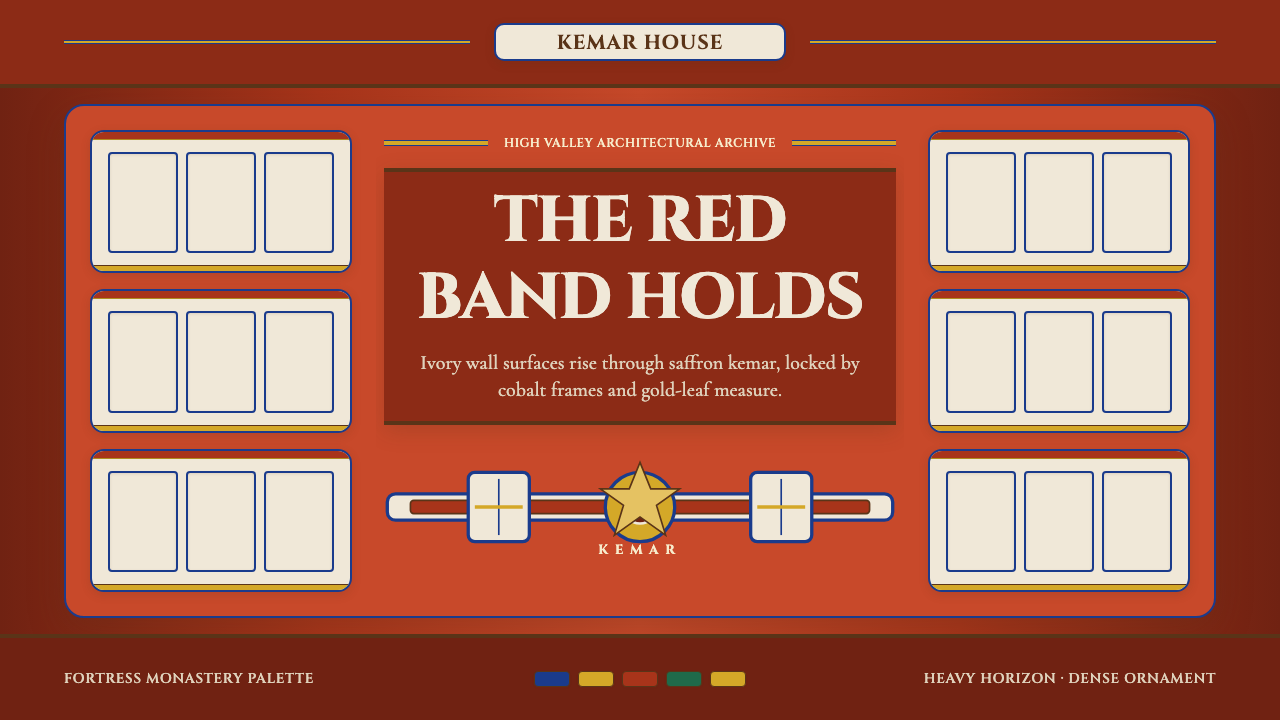 Bhutanese Dzong (Fortress Red)Monumental red holds the page. Cobalt frames and gold bands lock the fortress…
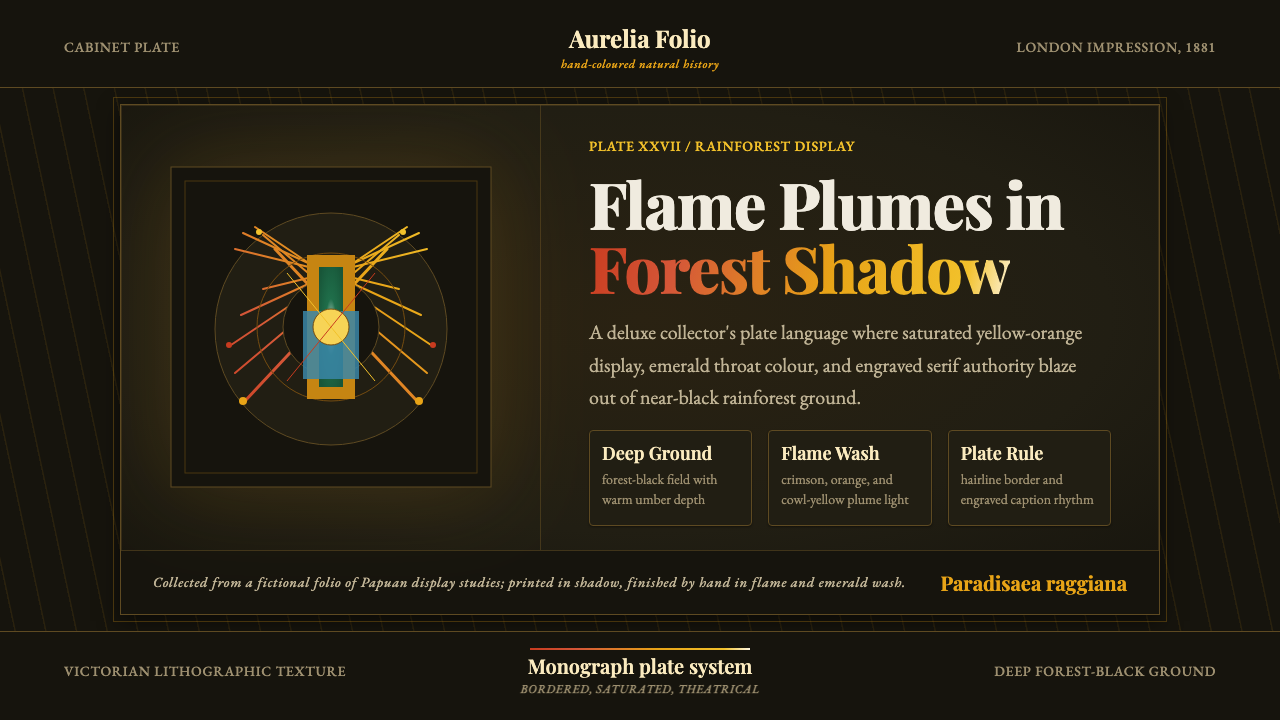 Bird of Paradise MonographTheatrical plate-book darkness. Flame plumes blaze from a bordered forest-bla…
 Book of Kells Celtic (800)Sacred and precise. Vellum cream, lapis, vermilion, and gold knotwork.
 Cellarius Celestial AtlasCelestial luxury on lapis. Gilt serif type, star fields, and concentric chart…
 Ethiopian Lalibela Rock-Hewn Church (c.1200)Sacred weight in shadow. Oxidized basalt, parchment serif, and one aged-gold…