What is Bhutanese Dzong (Fortress Red)?
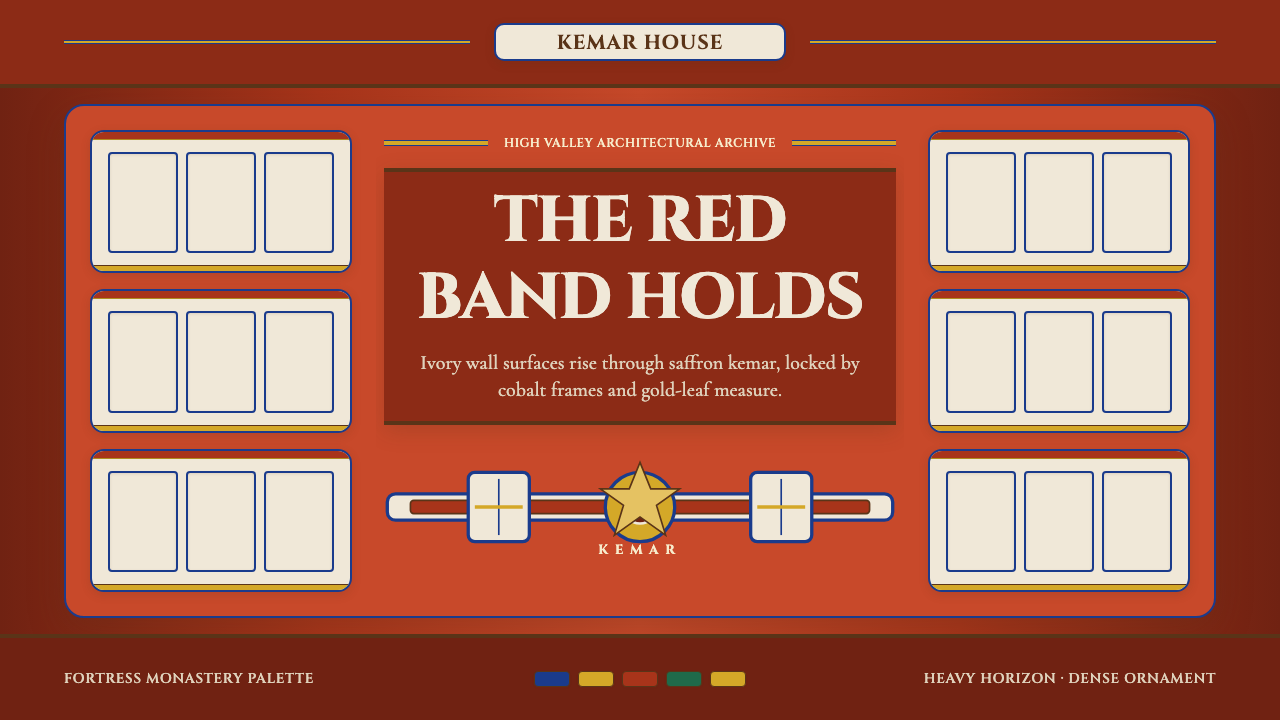
Saffron-red fortress walls rise from Himalayan valley floors — the Bhutanese dzong tradition translates monumental devotion into a design system built on saturated warmth, cobalt accents, and the heavy horizontality of mountain-fortress architecture.
Bhutanese Dzong (Fortress Red) in brief
Bhutanese Dzong (Fortress Red) is a design system rooted in the visual language of the dzong — the fortress-monastery complexes that have dominated Bhutan's valley confluences since the seventeenth century. The style takes as its foundation the kemar band: the deep saffron-red ceremonial stripe that encircles every dzong at the level of its upper floors, marking the sacred threshold between secular and monastic space. In this design system, that band becomes the page itself — a field of concentrated, red-orange warmth from which ivory whitewash surfaces and cobalt-blue window-frame accents emerge as highlights and structural breaks.
The aesthetic is one of calculated density and deliberate opulence. Where many historical styles pursue restraint as a virtue, the dzong tradition insists on the opposite: every wall is painted, every cornice is gilded, every beam end is carved. The design system translates this principle into rich layering — multiple horizontal registers, ornamental borders treated as structural elements, and a palette in which no color is allowed to be merely neutral. The result reads as ceremonial rather than decorative: gravity, not whimsy.
Visually, the style operates through strong horizontal banding. The architecture it references is organized by massive wall planes punctuated by projecting window bays, sloping walls that taper inward from base to parapet, and layered rooflines of gilded copper. This structural logic carries directly into layout: the composition divides into distinct horizontal zones — a dominant warm-red ground register, crisp white card surfaces sitting within it, cobalt window-frame elements framing content areas, and a band of gilded detail as a crowning accent. The overall effect is monumental even at modest scale.
Where does Bhutanese Dzong (Fortress Red) come from?
The dzong as an architectural typology was codified in Bhutan in the 1630s by Zhabdrung Ngawang Namgyal, a Tibetan Buddhist lama of the Drukpa Kagyu lineage who fled Tibet and unified the Himalayan valleys that would become Bhutan under a single religious-political authority. The dzong served simultaneously as fortress, administrative center, and monastery — a three-part function that demanded an architecture both imposing and sacred. Punakha Dzong, founded in 1637 at the confluence of the Pho Chhu and Mo Chhu rivers, remains the most celebrated example, its whitewashed walls rising directly from the riverbank with the saffron-red kemar band marking the upper monastic quarters.
The visual system of the dzong did not emerge from purely aesthetic deliberation. It was governed by a codified building manual known as the Bhutanese building canon, which prescribed not only structural dimensions but the hierarchical deployment of color, material, and ornament. The white of the lower walls was limewash over rammed earth — both structurally practical and symbolically pure. The deep red of the kemar band derived from a mixture of red ochre pigment and animal adhesive, applied annually in ceremonial renewal. Cobalt and gold appeared at the window cornices, carved from timber and painted by specialist artisans who belonged to hereditary craft guilds. The result was not decoration applied to architecture but color and ornament embedded in the building's structural and spiritual logic.
Bhutan's relative isolation from colonial-era disruption meant that the dzong tradition continued largely unbroken through the nineteenth and twentieth centuries. Unlike many Asian architectural traditions that experienced catastrophic rupture during colonial occupation, Bhutanese dzongs were maintained, rebuilt after earthquake and fire, and continue to function as active administrative and religious centers. Punakha Dzong, for instance, was damaged by floods and fire repeatedly and rebuilt each time to the original proportions. Trongsa Dzong — from which the ancestors of the current royal family governed before the establishment of the Wangchuck monarchy in 1907 — remains the most strategically positioned dzong, controlling the narrow ridge between eastern and western Bhutan, and still serves as a working administrative complex.
Western scholarly attention to the Bhutanese dzong arrived primarily through scholars such as Michael Aris, whose archival and field research in the 1970s and 1980s documented the tradition's historical depth and architectural coherence. The art historian and curator Christian Schicklgruber brought museum-level attention to Bhutanese material culture through major exhibitions at the Museum of Ethnology in Vienna and the Museum Rietberg in Zurich. Zowo Penjor, the master craftsman credited with overseeing the construction of major dzong rebuilds in the twentieth century, represents the living continuity of the hereditary artisan tradition that produced the original buildings. Together, these figures helped establish the dzong as a subject of serious cross-cultural design scholarship rather than merely a picturesque subject for travel photography.
What defines the Bhutanese Dzong (Fortress Red) look?
Color System
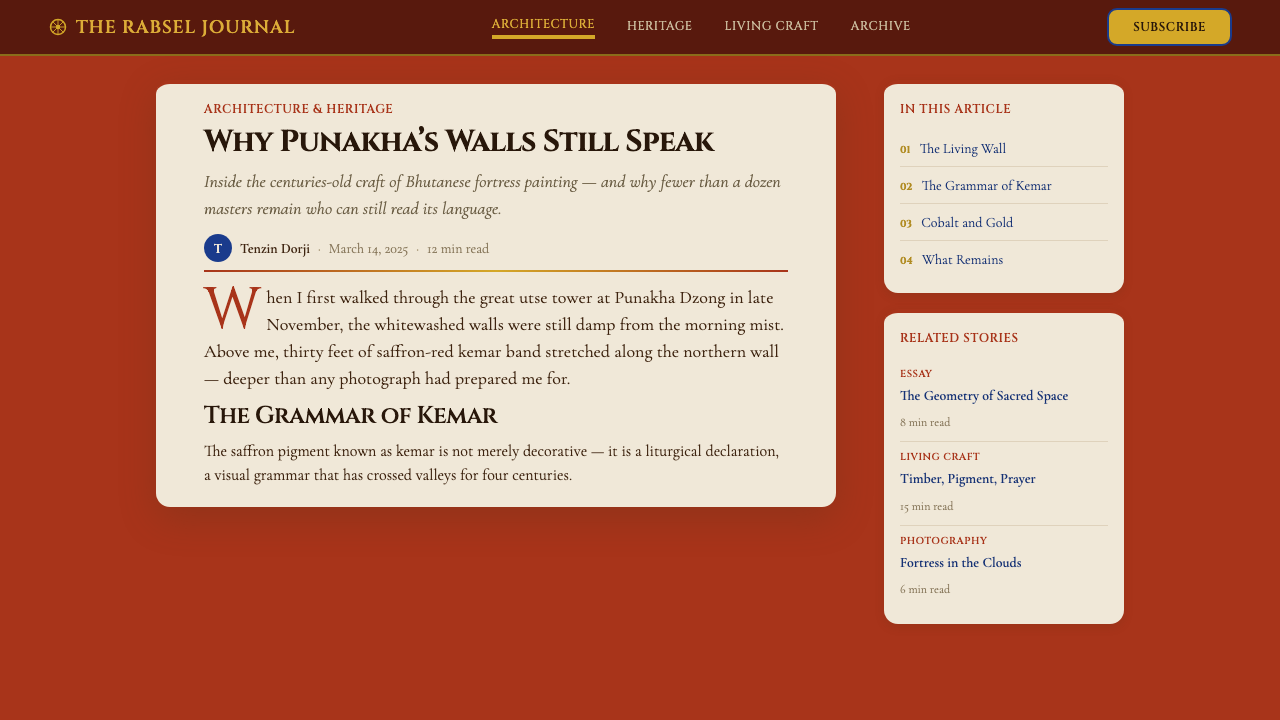
The palette centers on deep saffron-red as the dominant ground — not a bright vermilion or muted terracotta but the specific warm-orange-red of iron-oxide pigment applied to sun-baked walls. Against this, ivory whitewash surfaces emerge as clean, luminous fields — the color of limewash over rammed earth rather than pure white. Cobalt blue, used for window cornices and painted details, is the sharpest accent, cool and mineral in quality. Gold or burnished yellow-ochre appears as a crowning detail, never as a dominant field. The system is triadic but hierarchical: red grounds everything, white provides surface, cobalt punctuates, gold crowns.
Horizontal Banding
The most defining structural device in the style is the bold horizontal band — the architectural kemar stripe translated into a layout register. Compositions divide into distinct horizontal zones rather than a single undifferentiated field: a strong red or warm-ground base layer, an intermediate zone of white card surfaces, and a narrower upper accent band in cobalt or gold. This banding creates reading direction from bottom to top and gives even a simple page a sense of architectural sectional logic, as if the viewer were looking at an elevation drawing of a dzong wall.
Ornamental Framing
The dzong tradition treats framing as a sacred act: every window, every doorway, every panel is enclosed within a multi-layered border of painted and carved ornament. The design system inherits this sensibility — content areas sit within visible, substantial frames that are not mere outlines but layered systems of color and pattern. A card or image container is bordered by a combination of thin bright lines and a broader colored band, evoking the multi-layered painted cornices of the architecture. The frame does not call attention to itself at the expense of content; it situates the content in a context of deliberate ceremony.
Weight and Mass
Dzong architecture is characterized by the massive taper of its walls — structures that visibly grow thicker at the base than at the parapet, communicating weight, permanence, and inward gravitational pull. The design system translates this into visual heaviness: elements sit low and anchor firmly rather than floating. Typography tends toward generous weight at display sizes; spacing within components is contained rather than airy. The overall composition resists the urge toward lightness and levity — it insists on groundedness.
Timber Cornice Typography
The carved and painted timber capitals of dzong window cornices suggest a typographic sensibility that is monumental, crisp, and ornamented without being frivolous. The style's type choices favor letterforms with visible stroke weight contrast and a suggestion of carved precision — characters that feel drawn with deliberateness rather than efficiency. Display type carries sufficient weight to read as architectural inscription; supporting text is set with generous leading to allow each line its own register, echoing the horizontal layers of the building itself.
Gilded Detail as Hierarchy Marker
In dzong architecture, gold or gilded copper is reserved for the highest elements — roof finials, the crowning band above the kemar, and sacred object containers. It is never used lavishly across broad surfaces but appears as a concentrated accent that signals the pinnacle of a hierarchy. The design system observes the same discipline: gold-toned or burnished warm-yellow elements appear only at the top of a visual hierarchy — a headline, a badge, a key data point — and their restraint makes them feel genuinely precious rather than merely decorative.
Sacred Geometry and Symmetry
Unlike modernist traditions that favor asymmetric tension, dzong architecture is organized around bilateral symmetry — gateways centered on axes, courtyards flanked by mirrored wings, window patterns repeated at regular intervals across vast wall faces. The design system uses symmetry as a tool for conveying authority and ceremony: cover compositions are centrally anchored, content containers are evenly distributed, and decorative border patterns repeat at consistent intervals. Symmetry here is not stiffness — it is the visual language of institutional gravitas.

Who shaped Bhutanese Dzong (Fortress Red)?
The Tibetan lama who fled his homeland and unified Bhutan's fractious valleys in the 1630s is the single figure most responsible for the dzong as a standardized architectural and visual form. His founding of Punakha Dzong in 1637 and the subsequent establishment of dzongs at strategic valley confluences across the country fixed the typology's proportions, color system, and functional organization. The visual system that this design style inherits — the kemar band, the whitewashed mass, the cobalt and gold cornices — was established not by an aesthetic preference but by Zhabdrung's codified building canon, which linked architectural form to religious and political authority.
The master craftsman credited with directing the major dzong reconstruction projects of the twentieth century represents the continuity of Bhutan's hereditary artisan tradition. In a context where architectural knowledge was transmitted through apprenticeship and guild lineage rather than written manuals, Zowo Penjor's role was to embody the accumulated craft knowledge of the dzong-building tradition. His work on major rebuilds — undertaken after earthquake, fire, and flood damage — demonstrates the tradition's capacity for self-renewal without stylistic drift: each rebuilt structure returned to the established proportions, palette, and ornamental vocabulary, not as archaeological reconstruction but as living practice.
The British scholar of Tibetan and Himalayan studies, and the husband of Nobel Peace Prize laureate Aung San Suu Kyi, conducted foundational archival and field research on Bhutan's architectural and cultural heritage in the 1970s and 1980s. His work, including studies of the historical texts that governed dzong construction, helped establish the tradition as a subject of rigorous cross-cultural scholarship. By situating the dzong within a broader Himalayan political and religious history rather than treating it as a picturesque curiosity, Aris provided the scholarly grounding that allowed the style to be understood in structural rather than merely exotic terms.
The Austrian curator and ethnographer brought Bhutanese material culture — including the visual system of the dzongs — to major museum audiences through landmark exhibitions at the Museum of Ethnology in Vienna and the Museum Rietberg in Zurich. His catalogues documented the color canon, the craft hierarchy, and the sacred meaning of the ornamental system with a precision that transformed the dzong's visual vocabulary from ethnographic data into a designerly resource. By framing the dzong's aesthetic as a coherent, internally logical system rather than a collection of exotic decorative motifs, Schicklgruber's work made the tradition accessible for contemporary design interpretation.
Rather than a single individual, the Drukpa Kagyu monastic tradition — the Tibetan Buddhist lineage that Zhabdrung brought to Bhutan and that remains the state religion — collectively shaped the visual and spatial logic of the dzong as an ongoing institutional practice. The tradition's emphasis on elaborate ritual, hierarchical sacred space, and the use of material splendor as a vehicle for devotional attention directly generated the visual system that this design style inherits. The tradition continues to commission, maintain, and ceremonially renew the dzong's painted surfaces, ensuring that the aesthetic remains a living religious practice rather than a historical artifact.
How do you use Bhutanese Dzong (Fortress Red) today?
Bhutanese Dzong (Fortress Red) is a high-ceremony style best suited to contexts that need to project authority, cultural richness, and deliberate grandeur. Unlike styles that derive their power from restraint, this system gains authority through accumulation — layered registers, bold color contrast, and visible structural ornamentation all working together to produce a sense of institutional weight. The key discipline when applying it is not restraint across the board but restraint within each layer: every element should be chosen deliberately, but no layer should be absent.
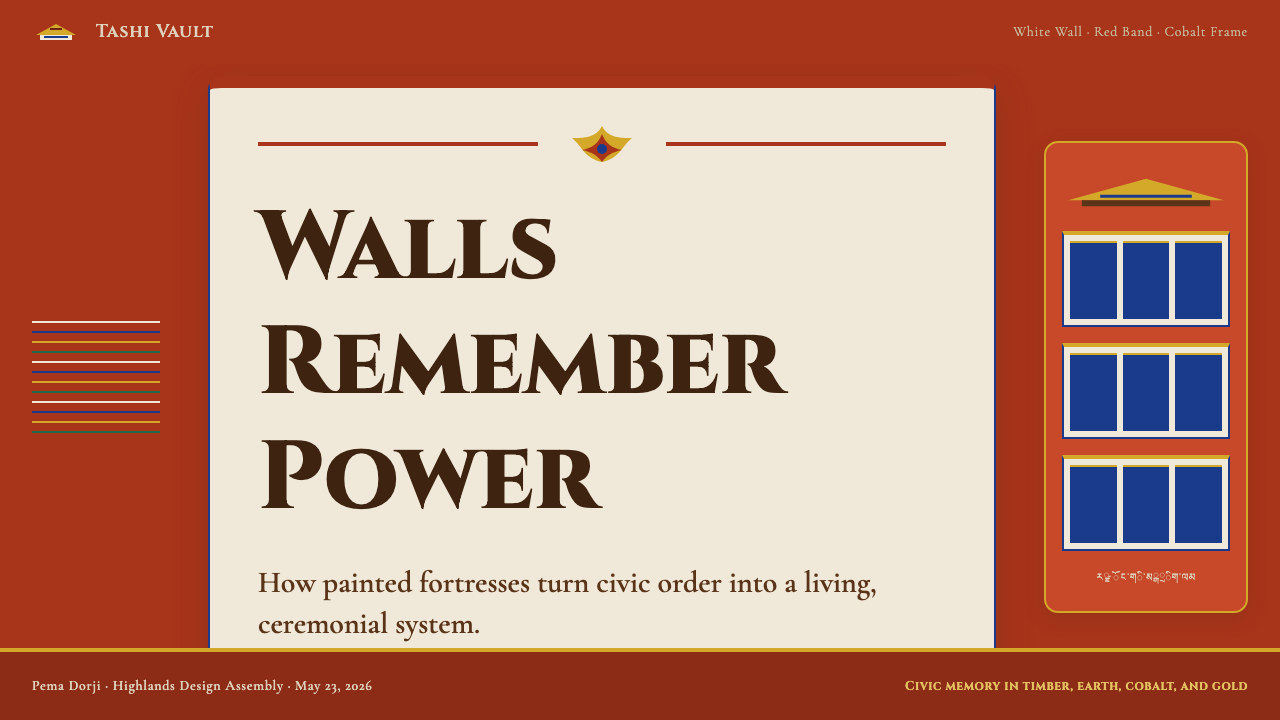
For presentation slides, the style excels on cover and transition pages where establishing a dominant visual impression matters more than dense information delivery. A cover built on this system uses the dominant warm-red field as the full-bleed background, with a white or ivory title panel sitting within it as if set into a window bay — bordered by a thin cobalt rule and a narrow gold accent band above. The title itself should be set in a letterform with genuine weight and presence, not a delicate face. Content slides are more restrained: a white or near-white ground, organized into clear horizontal bands by subtle but visible rules, with the red appearing only as a header bar or section marker. Data slides benefit from the color hierarchy — red for the primary data series, cobalt for secondary, gold for a highlighted key figure.
For web interfaces, this style translates powerfully to branded portal pages, cultural institution websites, and heritage tourism platforms where visual richness is expected and appropriate. The approach requires a robust grid: the horizontal banding logic should inform section breaks at the macro level, with each section of the page corresponding to a distinct register. Navigation bars and header areas can carry the deep red; content areas use the white or ivory ground; footer or summary sections can reintroduce the red or a deeper, warmer tone. Interactive states — hover, selected, active — are a natural place to deploy the cobalt accent, which reads as precise and decisive against the warm ground.
For editorial and marketing work, the style supports high-impact launch materials, cultural event programs, and institutional annual reports where ceremony and gravitas are explicitly desired values. A magazine spread or event program can treat the page as a dzong wall elevation: the dominant warm-red field occupies the outer columns or the lower horizontal band, with a central white panel carrying body text. Pull quotes or section headers work well in a cobalt or gold accent color, set large enough to read as architectural inscription rather than typographic emphasis. Avoid using the full ornamental weight of the style on documents primarily intended for prolonged reading — dense body text on warm red reduces legibility and fatigue readers.
A common mistake when applying this style is treating the saffron-red as a background for body text across extended reading areas. The red ground is designed for impression and ceremony, not for sustained reading — it is the fortress wall, not the interior room. White or ivory surfaces within the composition are where extended content belongs; the red should command periphery, frame, and register breaks. A second common error is introducing additional colors outside the defined palette — neutrals, cool grays, or earth tones that feel harmonious in isolation but dilute the deliberate intensity of the red-cobalt-gold triadic system. The palette's authority depends on its compression; every addition weakens the overall effect.
Bhutanese Dzong (Fortress Red) — FAQ
Is this style appropriate only for Bhutanese or Buddhist cultural content?
No — the dzong's visual system is culturally specific in its origins but transferable as a design language in the same way that Bauhaus geometry or Japanese wabi-sabi restraint can be applied across contexts. The style's strengths — saturated warmth, monumental horizontality, bold color triads, layered framing — are formal qualities that work wherever ceremonial authority and visual richness are desired values. That said, using it in contexts that require cultural sensitivity about Bhutanese Buddhism demands awareness: the visual elements carry meaning in their original context, and applications that trivialize or misrepresent that context can read as appropriative rather than inspired.
How does this style differ from other Himalayan or Tibetan-influenced aesthetics?
The Bhutanese dzong tradition is visually distinct from Tibetan monastic architecture and Nepali or Indian Himalayan styles in several specific ways. Bhutanese dzongs use a particularly saturated, warm-biased red for the kemar band — deeper and more orange-tinged than the brick-reds common in Tibetan monastery complexes — combined with whitewashed earthen walls of exceptional brightness. The cobalt-and-gold window cornice combination is characteristic of Bhutanese dzong craftsmanship specifically. Tibetan aesthetics often feature more extensive use of gold on large surfaces and a broader range of muted earth tones; Nepali architecture draws more heavily on carved wood screens and brick; Indian Himalayan traditions vary enormously by region. The dzong style is unusually codified and legible as a system.
Can this style work in a minimal or digital-product context, or is it always maximalist?
The style is not inherently maximalist — it is architectural in its logic, which means it organizes elements systematically rather than accumulating them arbitrarily. A minimal application of the dzong system is entirely possible: limit the palette strictly to the three-color triad, use the horizontal banding structure without the ornamental border layers, and apply the gilded accent only to a single headline or key action element. The result will be spare compared to the original architecture but will retain the style's defining formal qualities — the warm-red ground, the cobalt precision, the sense of deliberate hierarchy. The mistake is conflating 'rich' with 'cluttered': the actual dzong buildings, for all their ornamentation, are organized with extreme structural clarity.
How should the cobalt accent be used without making designs feel garish?
The cobalt accent reads as garish when it competes with the red ground across large areas simultaneously. In the original architecture, cobalt appears at precise, architecturally bounded locations — window cornices, painted panel borders — not spread across walls. The same discipline applies in design: cobalt belongs at structural punctuation points, not as a background field or a repeating texture. It works best as a rule line, a border accent, an interactive state marker, or a small typographic element. Keep the total area of cobalt to a small fraction of the total composition and it will feel incisive and cool against the warmth of the red, rather than jarring.
Does the style suit dark-mode or dark-background interfaces?
The canonical dzong palette is built on warmth and strong contrast between the saturated red ground and the bright whitewash surfaces — a fundamentally light-on-dark and dark-on-light interaction rather than a dark-mode aesthetic. A deep-mode inversion is possible but requires reorienting the hierarchy: the red can shift to a deeper, more muted burgundy or burnt sienna to serve as a mid-tone, with the whitewash element becoming a light accent rather than the dominant surface. The cobalt and gold continue to work well against dark grounds. The risk is that the visual warmth and ceremonial opulence of the style depend heavily on the saturated red reading as luminous rather than somber; in purely dark contexts without careful calibration, the palette can feel heavy rather than grand.
Related design styles
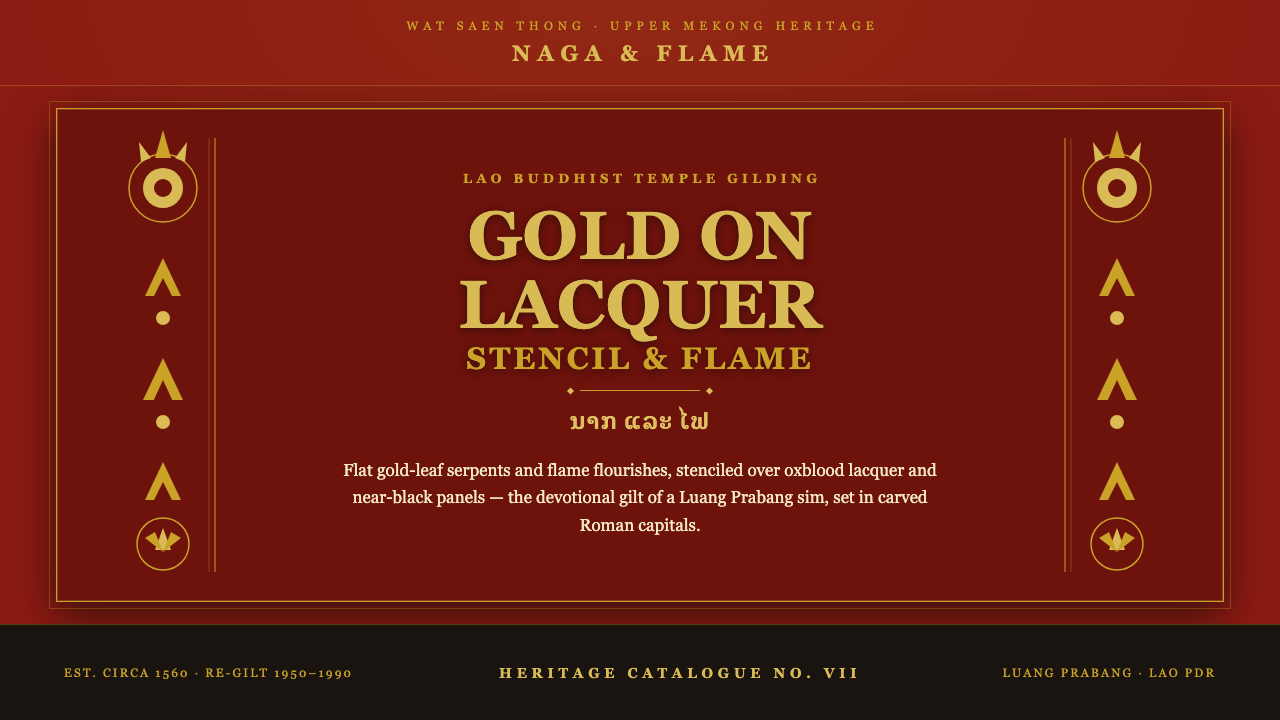 Lao Naga Temple StencilDevotional gilt, not chrome. Flat gold-leaf naga and flame stencils glow on o…
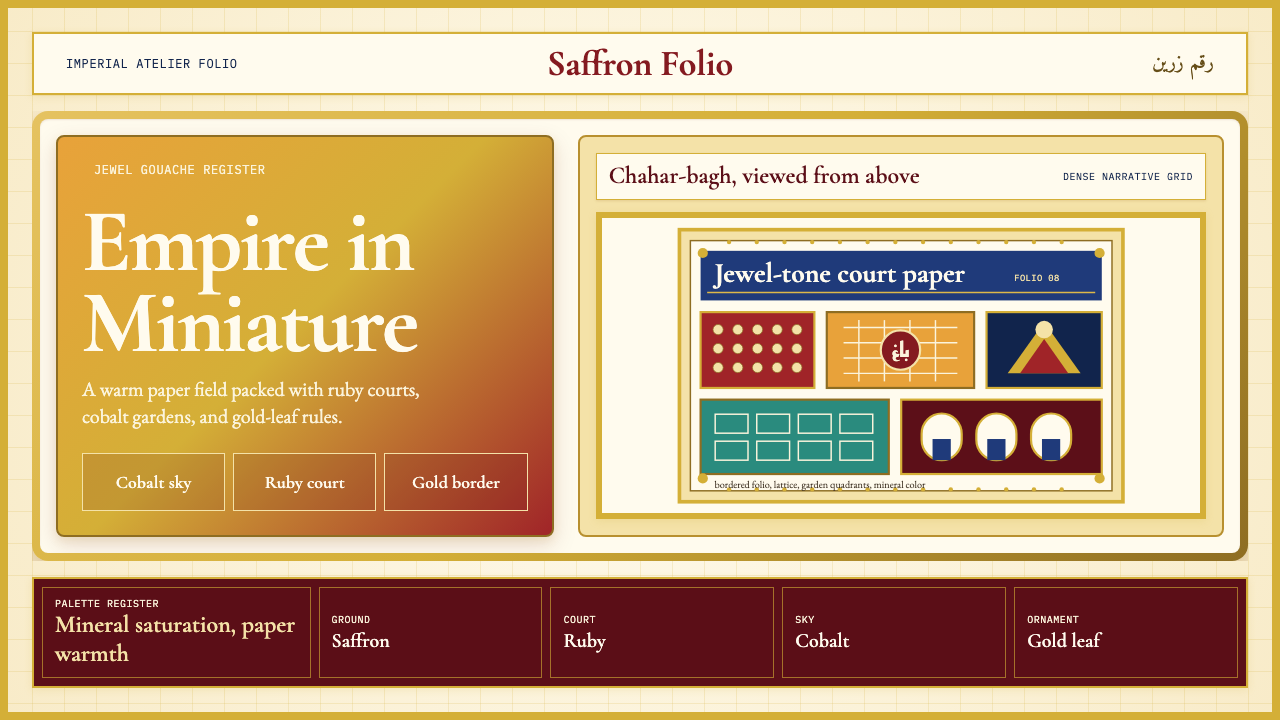 Mughal Miniature (Akbar era)Opulence refuses emptiness. Saffron paper, ruby panels, cobalt lattice, gold…
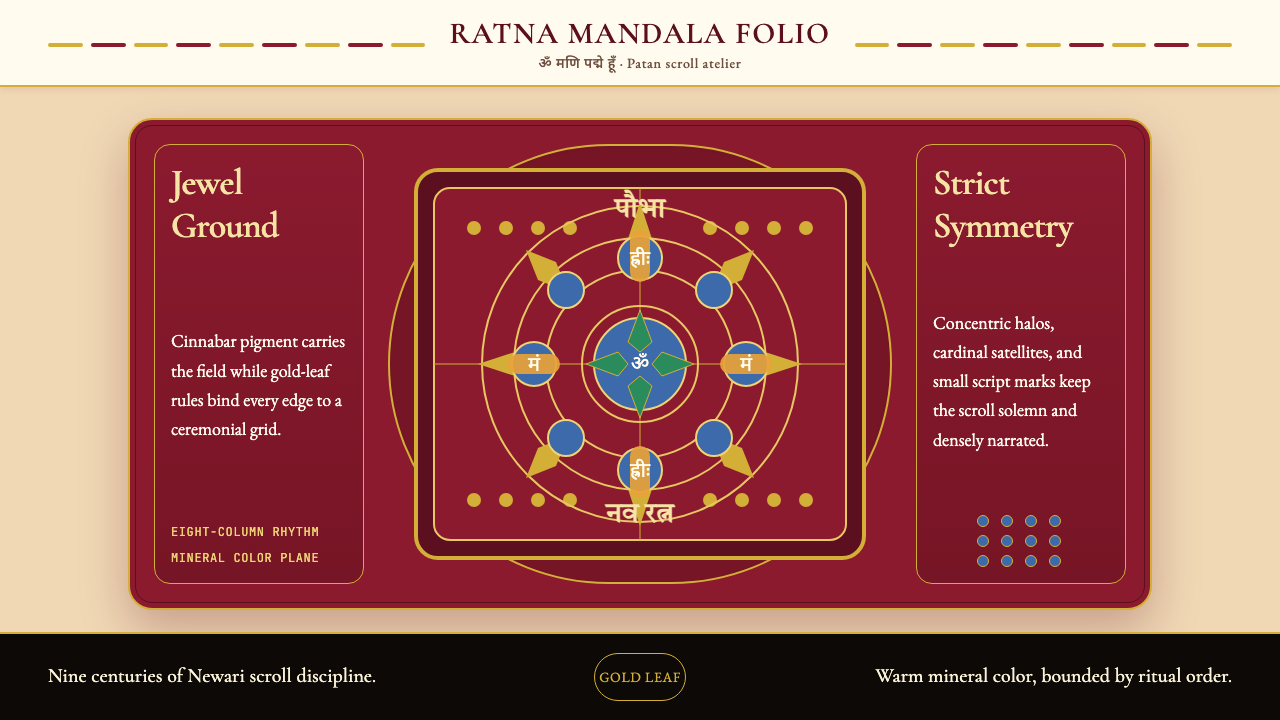 Nepali Paubha (Newari Scroll)Sacred density. Cinnabar ground, gold-leaf frame, lapis rings in strict symme…
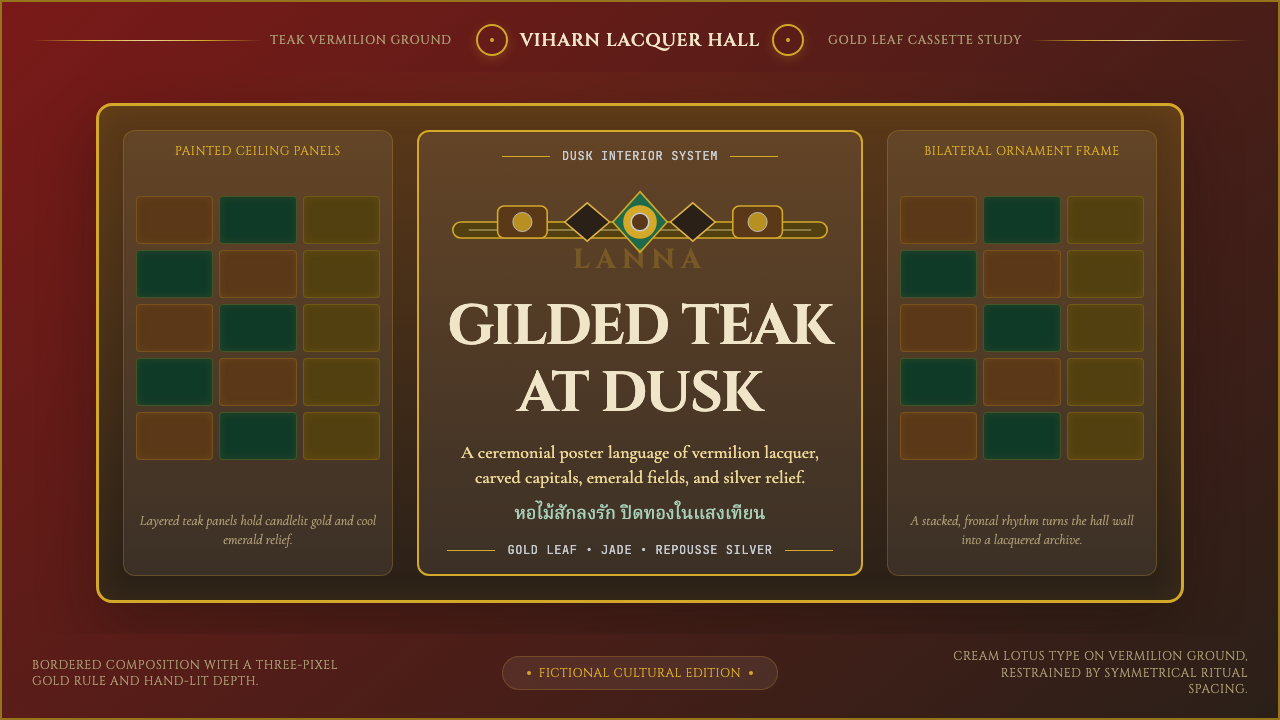 Thai Lanna Tai Yai TempleSacred lacquer glows. Vermilion ground, Cinzel capitals, gold cassette symmet…
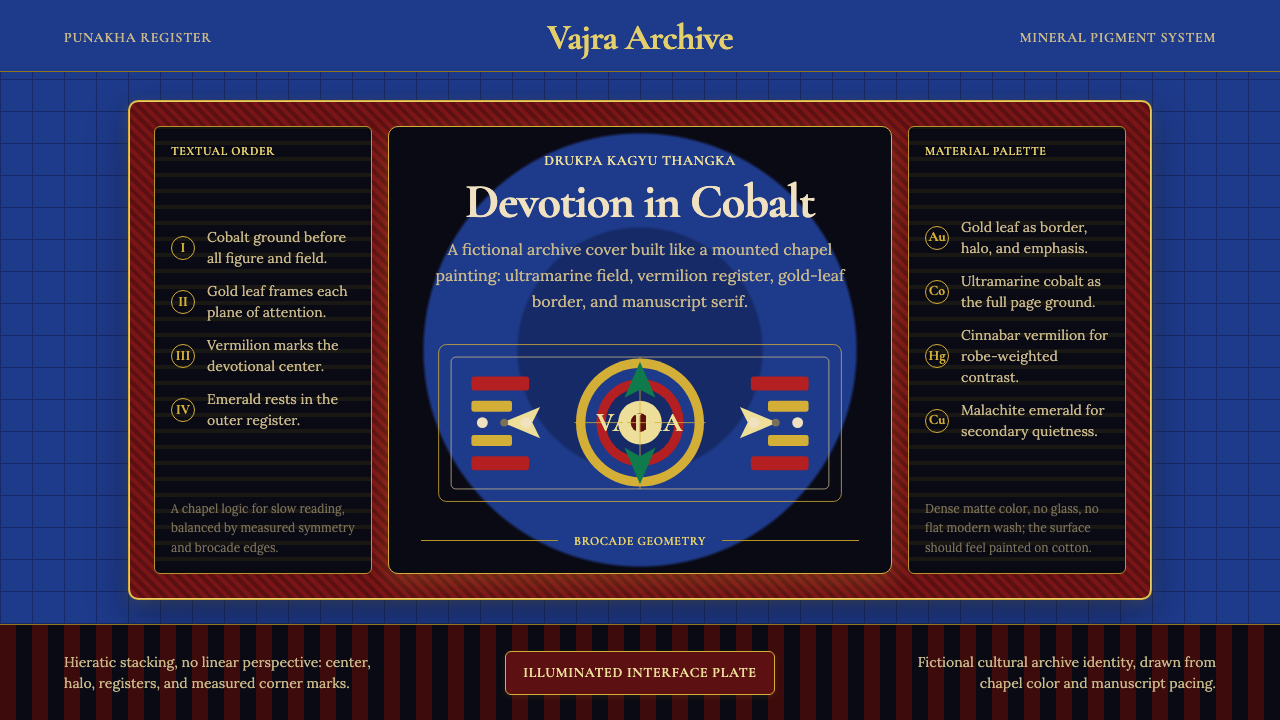 Bhutanese Drukpa Kagyu ThangkaDevotion made cobalt. Gold frames, Cormorant serif, and vermilion marks hold…
 Burmese Shwedagon Gold-LacquerOpulence catches fire. Gold-leaf gradients on cinnabar panels frame a stupa s…