What is Persian Qajar Portrait (1830)?
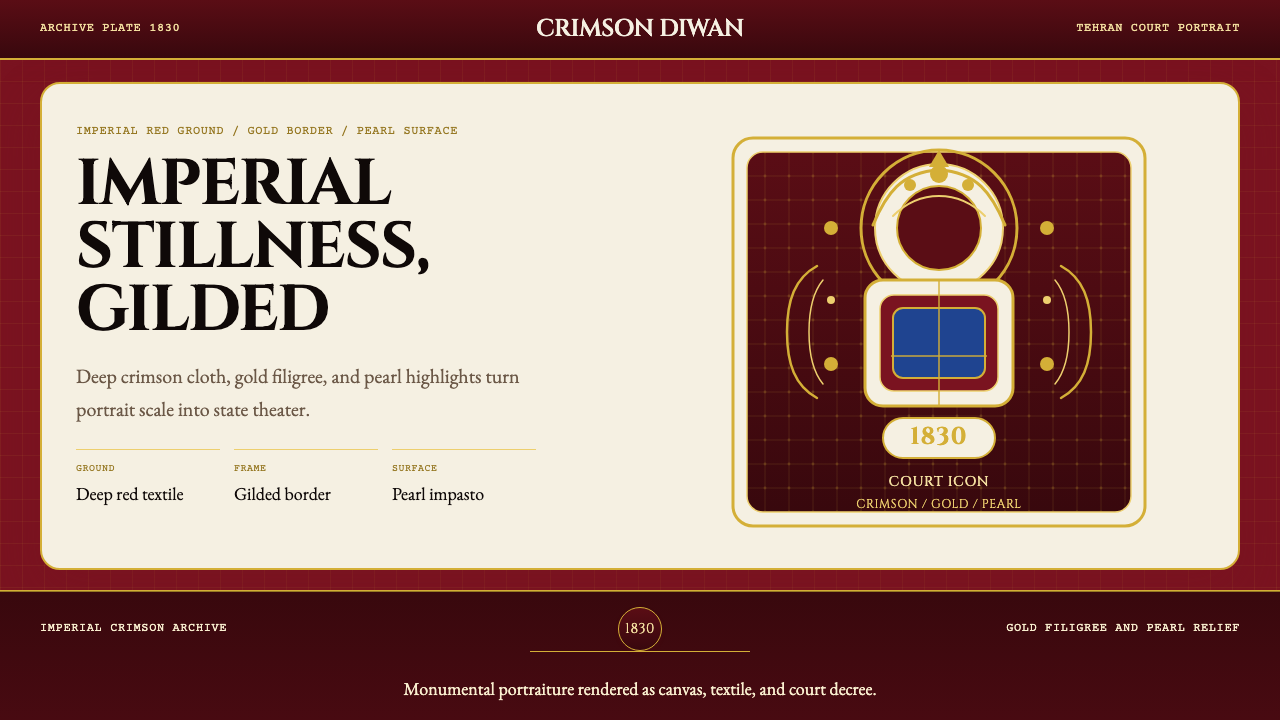
Qajar court painters fused Persian miniature flatness with European oil technique to forge monumental royal icons of jeweled regalia, deep crimson grounds, and gilded ornament — a throne-room grandeur now translated into digital design.
Persian Qajar Portrait (1830) in brief
Persian Qajar Portrait (1830) is a design aesthetic derived from the regal court portraiture produced during the Qajar dynasty — the imperial house that ruled Iran from 1789 to 1925. At its creative peak under Fath-Ali Shah in the early nineteenth century, Qajar painting produced life-size canvases of jewel-encrusted monarchs posed in static, frontal grandeur against deep-crimson textile backdrops edged in gold filigree. The result was less a likeness than an icon: a two-dimensional assertion of divine royal power delivered through density of ornament, richness of surface, and the precision of calligraphic line.
What makes the Qajar portrait style visually distinctive is its deliberate hybridity. Persian miniature painting contributed flatness of form, an absence of naturalistic recession, and the additive logic of pattern-on-pattern — where ground, figure, and border compete for equal visual attention rather than receding in perspectival hierarchy. European academic portraiture, which Qajar painters encountered through diplomatic exchange and imported prints, contributed the monumental scale, the three-quarter or frontal pose, and the ambition of capturing textural specificity in fabric and jewel. The Qajar synthesis keeps both impulses and resolves the tension not by choosing one tradition but by layering them: a figure painted with the flat symbolic authority of an illuminated manuscript, dressed in robes rendered with the material attention of a Venetian master.
As a contemporary design system, Persian Qajar Portrait (1830) channels this visual inheritance into a palette of imperial crimson, warm gold, and soft cream — ground tones that read as both opulent and legible. Decorative borders modeled on carpet-weave geometry frame content panels. Typography draws on the weight and verticality of Naskh calligraphic tradition without reproducing specific letterforms. The total effect is of warmth and ceremony: an aesthetic that signals heritage, craftsmanship, and a refusal of the disposable — appropriate wherever a product or brand wishes to communicate depth of culture and deliberateness of intent.

Where does Persian Qajar Portrait (1830) come from?
The Qajar dynasty came to power in Iran in 1789 under Agha Mohammad Khan and established Tehran as its capital. From the outset, the court used visual art as a deliberate instrument of statecraft: portraits of the ruling Shah were distributed to foreign courts, mounted in formal reception halls, and reproduced on lacquerware, enamels, and tile panels installed in public buildings. This institutional demand for royal imagery drove the rapid development of a distinctive Qajar pictorial language. The portrait was not a private commission but a political declaration, and its visual conventions were chosen to communicate authority at a glance to both domestic subjects and foreign observers.
The early nineteenth century brought a decisive shift. Under Fath-Ali Shah (r. 1797–1834), the Qajar court was in sustained diplomatic contact with Napoleonic France, Tsarist Russia, and the British East India Company. Foreign envoys arrived bearing European oil paintings and engraved portraits as gifts; Qajar painters examined these images carefully. The result was not wholesale adoption of European technique but selective absorption. Artists retained the Persian tradition's frontal pose, its additive approach to surface decoration, and its indifference to cast shadow and atmospheric perspective. From European practice they borrowed large-format canvas support, the ambition of capturing material specificity, and a heightened attention to the face as a zone of psychological presence — though in Qajar work the face remains idealized and typological rather than individualized.
The workshop of Mihr Ali — the most celebrated Qajar court painter of the period — produced a series of monumental standing portraits of Fath-Ali Shah that set the canonical standard. In these works the Shah stands at full length against a deep-crimson ground, his robes weighted with pearls, rubies, and emeralds rendered almost relief-like through impasto application; gold filigree borders frame the composition with the dense geometry of a Persian carpet border. The treatment of the figure is iconic rather than naturalistic: proportions are elongated, the long black beard is rendered as a cascade of idealized parallel lines, and the jeweled aigrette in the royal crown becomes the picture's brightest focal point. These canvases circulated internationally — examples entered the collections of the British royal family and European museums — and established Qajar portraiture as a recognized style.
After Fath-Ali Shah, court patronage continued under Mohammad Shah and Naser al-Din Shah. Abu'l Hasan Khan Ghaffari, known by the honorific Sani al-Mulk, introduced a further European influence by studying in Rome in the 1840s and bringing back academic figure-drawing conventions. By the late nineteenth century, Qajar portraiture was absorbing photography — Naser al-Din Shah was himself an avid photographer — and the painted portrait began incorporating photorealistic detail in faces while retaining the flat, pattern-saturated backgrounds of the earlier tradition. The style's period of greatest visual coherence and cultural reach, however, remains the era of Fath-Ali Shah, circa 1797 to 1834, which is why 1830 serves as the design system's reference year: it captures the style at peak synthesis, before photographic influence complicated the aesthetic.
What defines the Persian Qajar Portrait (1830) look?
Color Ground
The dominant ground is a deep, saturated crimson — not a harsh red but a warm, wine-like depth that reads as both ceremonial and enveloping. Against this ground, cream and ivory panels provide contrast zones for content without competing with the primary field. Gold functions as the connective tissue: borders, dividers, and ornamental accents are rendered in warm gilded tones that unify the palette and elevate the overall register toward the opulent.
Ornamental Borders
Borders in the Qajar visual vocabulary are never passive margins; they are active pattern fields derived from carpet-weave and tilework geometry. Interlocking palmettes, repeating medallions, and arabesques form dense perimeter bands that simultaneously contain the central composition and assert their own visual weight. The border is not decoration applied to the edge — it is a second layer of meaning that announces the frame as sacred or royal threshold.
Figure Flatness and Frontality
Following Persian miniature convention, the Qajar portrait figure is rendered without atmospheric shadow or volumetric modeling. The body is a silhouette into which surface pattern is inlaid rather than a three-dimensional form illuminated from a single light source. Frontality — the figure facing squarely toward the viewer — concentrates authority and removes any suggestion of casual informality. This flatness, paradoxically, increases the image's iconic power by eliminating the transient and preserving the essential.
Jeweled Surface Density
Qajar portraits are distinguished by an almost obsessive attention to material accumulation. Pearl strands, ruby-set epaulettes, emerald armlets, and diamond aigrettes are rendered with the concentrated detail of a jeweler's inventory. Each gem becomes a focal node in a larger ornamental field. This principle of dense, additive surface — where richness is measured by how much considered detail can be sustained without becoming noise — translates in contemporary digital design to layered visual texture and meticulous typographic spacing.
Calligraphic Line Quality
Persian calligraphy — particularly the Naskh and Nastaliq scripts — informed the Qajar painter's approach to line: controlled, deliberate, and varied in weight from hair-thin to bold stroke within a single mark. This calligraphic sensibility appears in the rendering of the Shah's beard, the drawn edges of robes, and the lettered inscriptions that often appear within the border compositions. In a design system context, it translates to typography that carries visible stroke contrast and a vertical emphasis that reads as both authoritative and refined.
Symmetry and Hierarchical Centering
Unlike the Bauhaus tradition of dynamic asymmetry, Qajar composition is anchored by bilateral symmetry, especially in the framing architecture of borders and panels. The central figure occupies a vertical axis that the surrounding ornamental field mirrors on either side, reinforcing the sense of formal ceremony. Hierarchical centering — placing the most important element at the composition's visual heart — extends this logic to layout: the most authoritative content occupies the center, while supporting information is disposed symmetrically around it.
Warm Candlelight Luminosity
Qajar court paintings were produced for and displayed in candlelit and oil-lamp-lit interiors — reception halls, throne rooms, and private audience chambers. The palette reflects this ambient warmth: colors are saturated but tend toward the red-orange end of the spectrum rather than the cool blue-white. Even the gold is warm rather than cool, and the shadow areas in the crimson grounds retain a deep, glowing darkness rather than turning black. This luminosity quality should inform the temperature of every color decision in the design system: cool whites and pure blues feel like category errors.

Who shaped Persian Qajar Portrait (1830)?
Fath-Ali Shah (r. 1797–1834) was the second Qajar ruler and the monarch whose sustained patronage defined Qajar court portraiture as a genre. His personal iconography — the impossibly long black beard, the jewel-saturated regalia, the still frontal pose — was so consistently reproduced across paintings, lacquerware, rock reliefs, and enamels that it became a visual brand for the dynasty itself. He actively encouraged diplomatic gift exchange involving portraits, using imagery as an extension of foreign policy. The dozens of surviving monumental portraits of Fath-Ali Shah, now distributed across museums from Tehran to St. Petersburg to London, represent the fullest surviving record of the Qajar court aesthetic at its peak.
Mihr Ali was the most accomplished court painter working during Fath-Ali Shah's reign and the artist most responsible for establishing the canonical format of the Qajar royal portrait. His surviving full-length standing portraits of the Shah — several exceeding two meters in height — demonstrate a mastery of the hybrid technique that defines the style: Persian handling of surface pattern and frontal pose combined with European attention to material specificity in the rendering of fabric, fur, and jewel. Mihr Ali's work set the standard that later Qajar painters measured themselves against, and his treatment of the gold-bordered crimson ground became the compositional template for royal imagery throughout the dynasty.
Mirza Baba served as chief court painter during the transitional period bridging the late eighteenth and early nineteenth centuries, working under both Agha Mohammad Khan and Fath-Ali Shah. He is credited with significant early work in adapting European portrait conventions to the Qajar idiom and produced one of the earliest known large-format Qajar portraits. Mirza Baba's role was foundational in establishing the administrative and institutional framework of Qajar court arts patronage — organizing workshop production, managing commissions, and setting quality standards — creating the infrastructure that allowed later painters like Mihr Ali to achieve their canonical works.
Sani al-Mulk — 'the Peer of the Kingdom' — worked in the later Qajar period under Naser al-Din Shah and represents the style's most significant engagement with academic European training. After studying in Rome in the 1840s, he returned to Iran with a deepened understanding of anatomical drawing and compositional structure, which he applied to both portrait painting and the emerging Iranian illustrated press. He founded the satirical illustrated newspaper Mulla Nasreddin and created illustrated manuscripts that demonstrate the full evolution of Qajar visual culture toward the hybrid late style. His work shows how the Qajar aesthetic could absorb new influences without abandoning its essential iconographic commitments.
Beyond individual named masters, the Qajar court operated as a collective workshop system in which teams of painters collaborated on large-format canvases — one specialist handling the face, another the robes and jewels, a third the architectural or textile background. This collaborative model, inherited from the earlier Safavid workshop tradition, explains both the stylistic consistency across large numbers of surviving works and the occasional unevenness of quality between different zones of a single painting. Understanding the workshop nature of Qajar production is important for appreciating how the style operated as a system rather than as individual artistic expression: it was a designed visual language with quality standards, repeatable conventions, and distributed authorship.
How do you use Persian Qajar Portrait (1830) today?
Persian Qajar Portrait (1830) is not a minimalist style, and applying it well requires embracing its central premise: richness achieved through control, not through chaos. The visual system's logic is one of layered ceremony — each element should feel placed with deliberate intent, as if positioned by a court official who understood that every object in a throne room carries symbolic weight. This discipline distinguishes authentic Qajar-derived work from mere ornamentation: the borders and gold accents must structure and contain the composition, not merely embellish it.
For presentation slides, the style excels on covers and title sequences where first impressions carry the full weight of the presentation's character. A cover slide benefits from the deep-crimson ground with a centered content panel framed by a thin gold ornamental border — the title rendered in a high-contrast serif typeface at a weight that reads as inscriptional. Content slides work best when they discipline the decorative impulse: retain the warm palette and the bordered panel structure but reduce ornamental complexity to a single framing element. Data slides in this style perform well when charts and graphs are treated as jeweled objects — giving them generous white space within cream panels, coloring key data series in the gold accent tone, and presenting labels in a refined serif rather than a neutral sans-serif.
For web interfaces, the Qajar aesthetic is most powerful on landing pages, cultural institution sites, luxury e-commerce, and brand heritage pages where the goal is to communicate depth, exclusivity, and considered craft. The approach requires commitment: a near-black or deep-crimson primary background, cream content cards with fine gold border treatments, and typography that leans toward the vertical and serifed. Dashboard and tool interfaces are more challenging — the style's decorative density can conflict with the rapid scanning demands of data-heavy screens. When adapting for dashboards, reduce the border complexity to a single thin rule, reserve the deep crimson for section headers only, and ensure that data tables and charts sit in clean cream panels with clear typographic hierarchy.
For editorial and marketing work, the Qajar style carries strong associations with heritage, luxury, cultural authority, and the handcrafted. It suits long-form editorial layouts for cultural publications, museum communications, high-end hospitality branding, and anniversary or retrospective campaigns. A Qajar-derived editorial layout uses generous margins, a restrained typeface at multiple weights for headline hierarchy, and places pull quotes or key statistics inside bordered panels that echo the portrait's medallion-within-ground structure. Marketing pages work well when they alternate between crimson-ground hero sections and cream-ground content sections — the tonal alternation provides rhythm without requiring additional decorative elements. A single consistent gold accent used for calls to action and structural dividers maintains visual cohesion across long page lengths.
The most common mistake when applying Persian Qajar Portrait (1830) is confusing density with clutter. Historic Qajar paintings are dense because every element is controlled and intentional — the density is the product of accumulation with purpose. Applying the style without that discipline produces visual noise rather than ceremonial richness. Practically, this means avoiding simultaneously active borders, active backgrounds, active typography, and active imagery — never layer all four decorative registers at once. Choose two or three elements to carry the ornamental weight and let the others breathe. Similarly, the gold accent will dominate if used too liberally: limit it to borders, dividers, and one or two typographic highlights per composition, and let the crimson ground do the heavy work of establishing atmosphere.

Persian Qajar Portrait (1830) — FAQ
How does Persian Qajar Portrait relate to Islamic geometric art more broadly?
The relationship is one of inheritance rather than identity. Qajar court portraiture draws on the broader Iranian and Islamic decorative tradition — including arabesque, interlace, geometric tilework, and carpet pattern — for its border and background elements. But the portrait genre itself introduced a representational figurative focus that is distinct from the aniconic tendency in much Islamic religious art. The Qajar style is specifically court art produced for a secular monarchical context, and its figural representation was justified by the Shah's divine mandate rather than any departure from Islamic principle. In design system terms, this means the geometric and arabesqued border elements can be deployed independently of the figurative dimension — they carry the cultural resonance of Persian decorative tradition without requiring the full portrait iconography.
Can this style work for digital products that are not luxury or heritage brands?
Yes, but the application requires deliberate recontextualization. The Qajar aesthetic carries strong associations with ceremony, cultural authority, and material richness, which means it will read as category-appropriate for cultural institutions, heritage tourism, fine dining, academic publishing, and high-end hospitality. For digital products in fast-moving consumer, productivity, or technology categories, the associations may work against the brand — the style signals deliberateness and tradition in contexts where speed and modernity are the desired message. The most successful recontextualizations strip the style to its structural essentials — the warm palette, the bordered panel, the high-contrast serif typography — while significantly reducing the ornamental density. This produces a product that reads as refined and considered without signaling antiquity.
What is the biggest difference between Qajar portrait style and Mughal miniature painting?
Both are court portrait traditions with deep Persian roots, and they share a great deal: the importance of jeweled regalia, the preference for additive surface pattern, the hierarchical frontal pose. The key differences are scale, technique, and European influence. Mughal miniature painting is small in format — produced in bound albums for intimate viewing — while Qajar portraits are monumental, designed for large public halls. Mughal technique refined the layered opaque watercolor method to an extraordinary degree of finish, with a luminous, gem-like surface. Qajar work adopted oil on canvas from European practice, which allowed larger scale and impasto texture but sacrificed some of the Mughal tradition's refined delicacy. Mughal portraiture also engaged more directly with European naturalism in facial depiction, particularly under Emperor Jahangir, while Qajar portraits maintained a more typological and idealized approach to the face throughout.
Is there a dark-mode version of this style, and how should it be approached?
The historic Qajar palette is naturally deep rather than dark — the crimson grounds are saturated and warm, not cold or neutral. A dark-mode interpretation is therefore less about inverting to black and more about deepening the existing palette. A workable dark variant uses a very deep burgundy or near-black with warm undertones as the primary ground, retains gold borders and accents at their full warmth, and uses a deep cream or aged-parchment tone rather than pure white for content panels. The key discipline: avoid introducing any cool neutrals or cool grays — these break the ambient warmth that is central to the Qajar sensibility. Pure black backgrounds require careful handling, as they will make the gold accents appear harsh and the composition will lose the enveloping warmth that distinguishes authentic Qajar-derived work from generic dark luxury aesthetics.
How do I avoid the style reading as costume or pastiche rather than as a genuine design system?
The line between authentic style application and pastiche lies in whether the visual choices serve the content's communication or merely decorate it. Pastiche occurs when the ornamental elements are applied as a surface layer over a layout that would work identically without them — when the borders could be removed without affecting information hierarchy or user navigation. Authentic Qajar-derived design integrates the decorative structure with the informational structure: borders define content zones, the crimson ground establishes the primary register of importance, the gold accent marks the hierarchy of calls to action. If you can strip the decoration and still have a functional layout, the style is not integrated — it is costume. The second discipline is restraint: authentic historic Qajar work is dense, but every element earns its place. Modern applications should be even more selective, using the decorative vocabulary sparingly enough that each ornamental element reads as considered rather than reflexive.
Related design styles
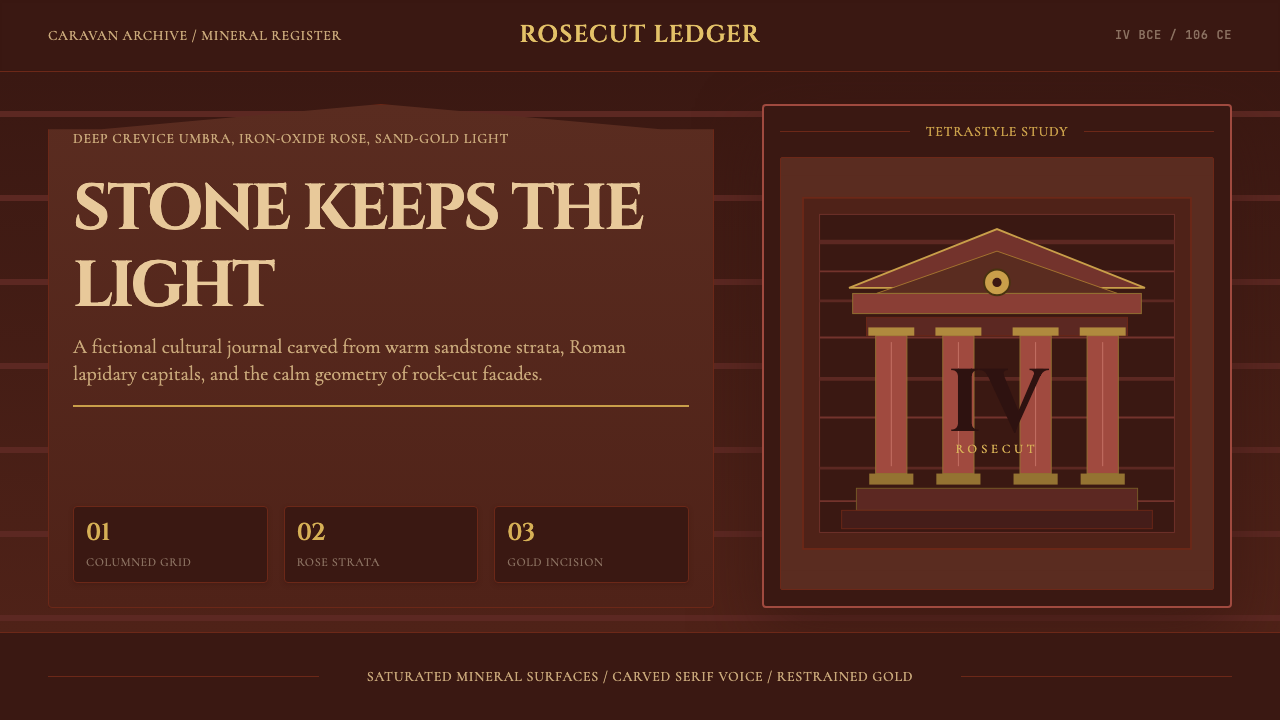 Jordanian Petra Rose NabataeanGeology feels monumental. Crevice umbra, rose strata, and Cinzel capitals car…
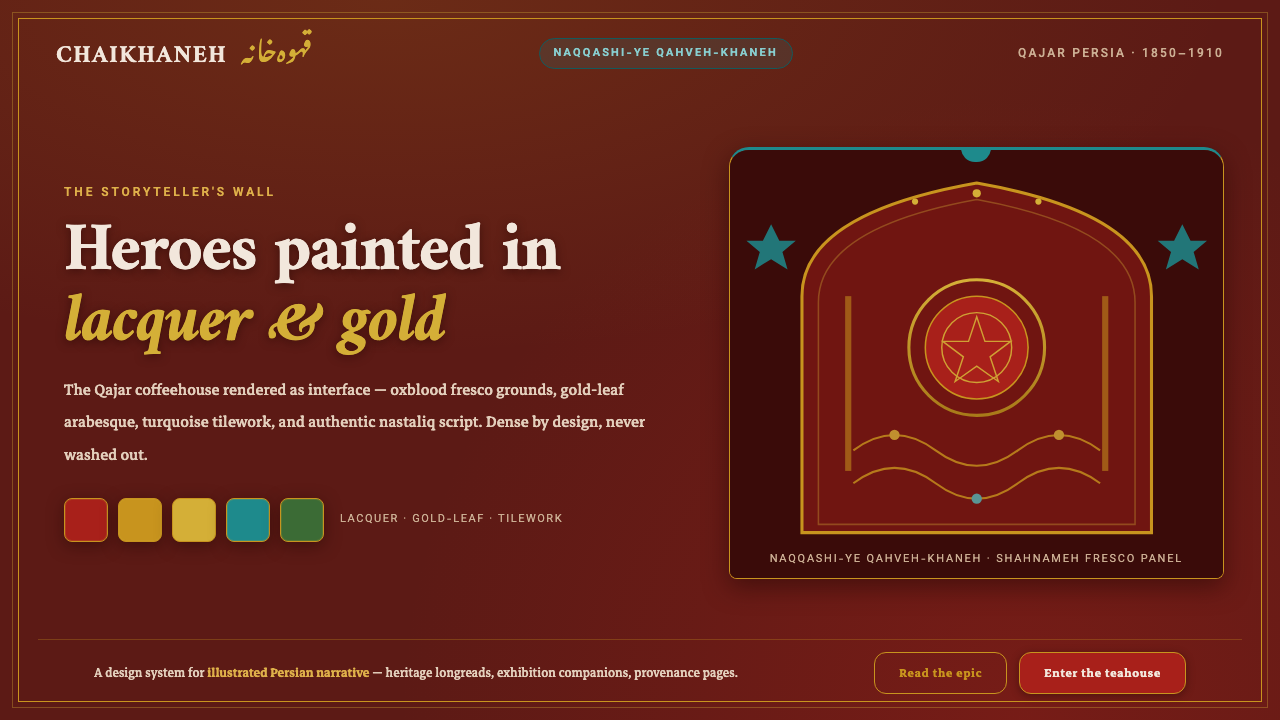 Persian Teahouse ChaikhanehQajar coffeehouse maximalism. Lacquer-red heroes, gold-leaf arabesque on deep…
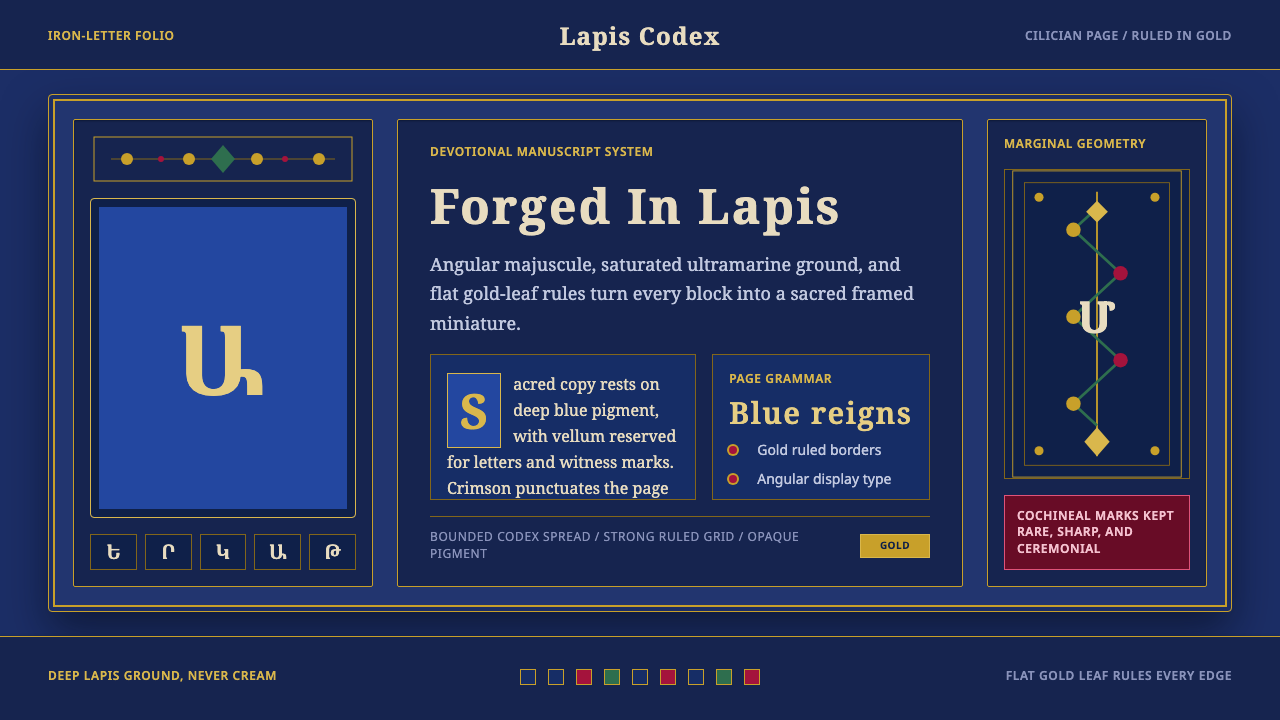 Armenian ErkatʿagirDevotional lapis reigns. Gold rules and angular serif glyphs frame a sacred g…
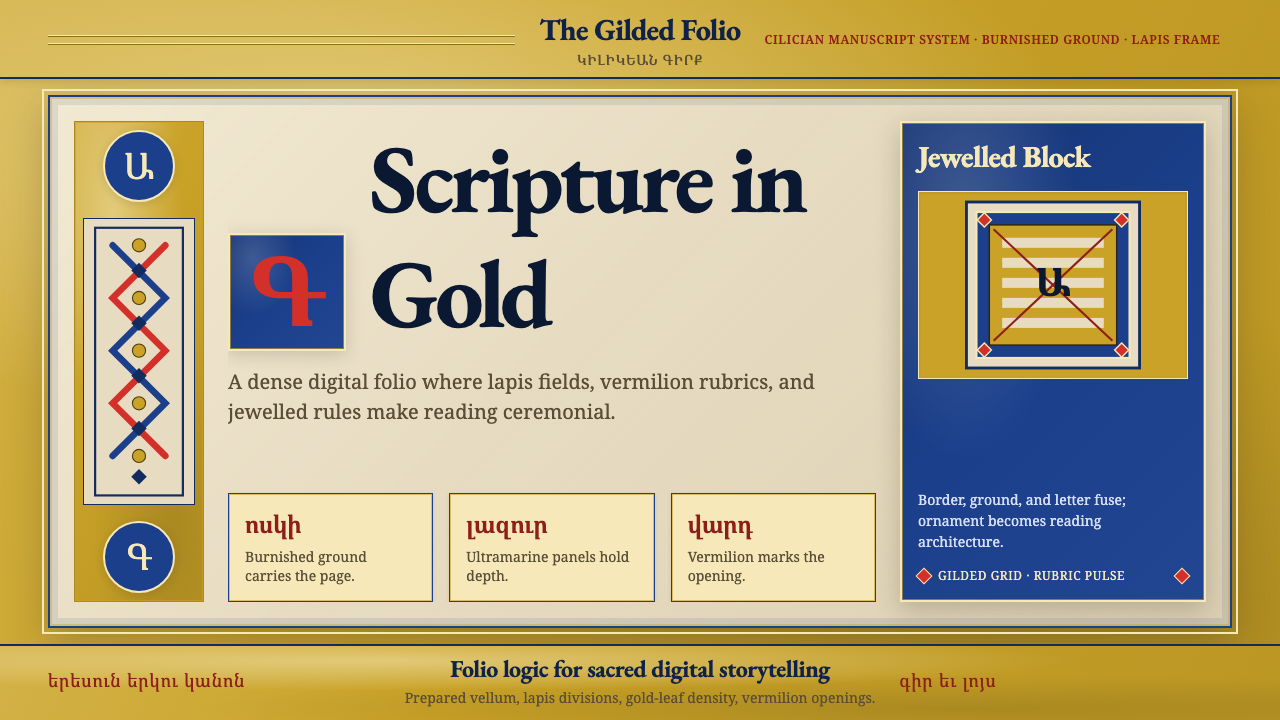 Armenian Illuminated ManuscriptGilded maximalism. Burnished gold, lapis frames, and vermilion initials build…
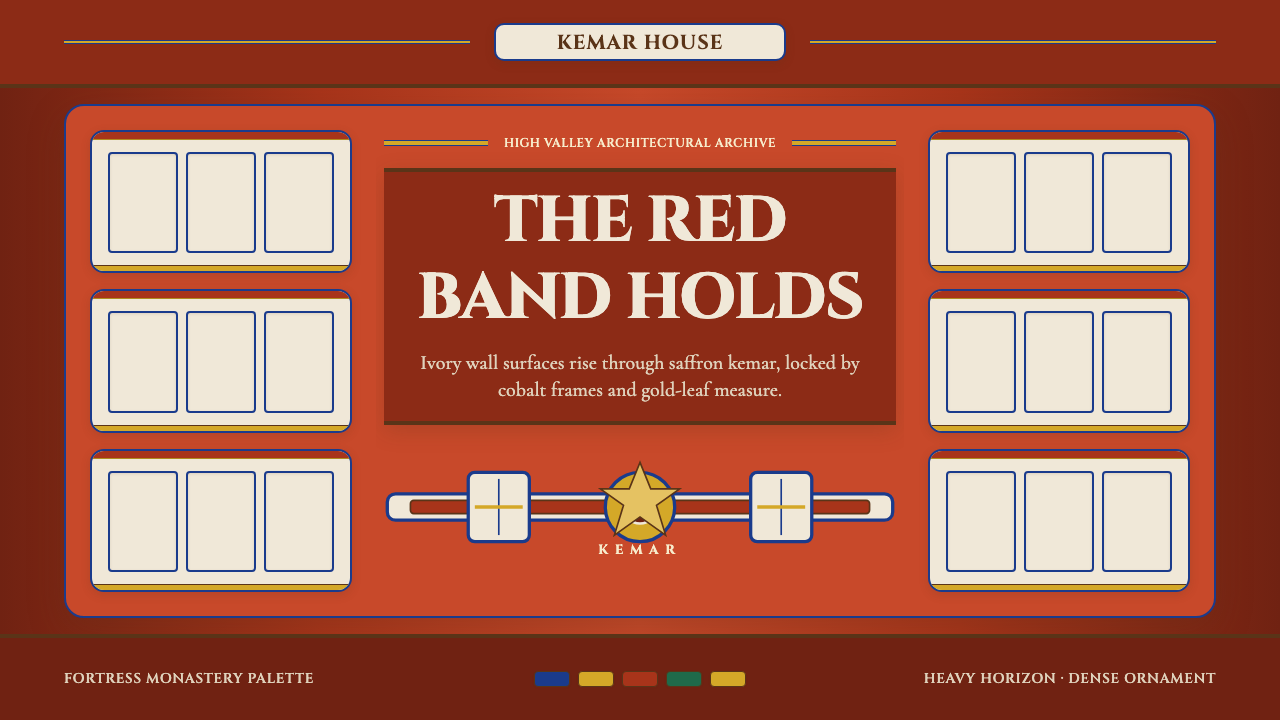 Bhutanese Dzong (Fortress Red)Monumental red holds the page. Cobalt frames and gold bands lock the fortress…
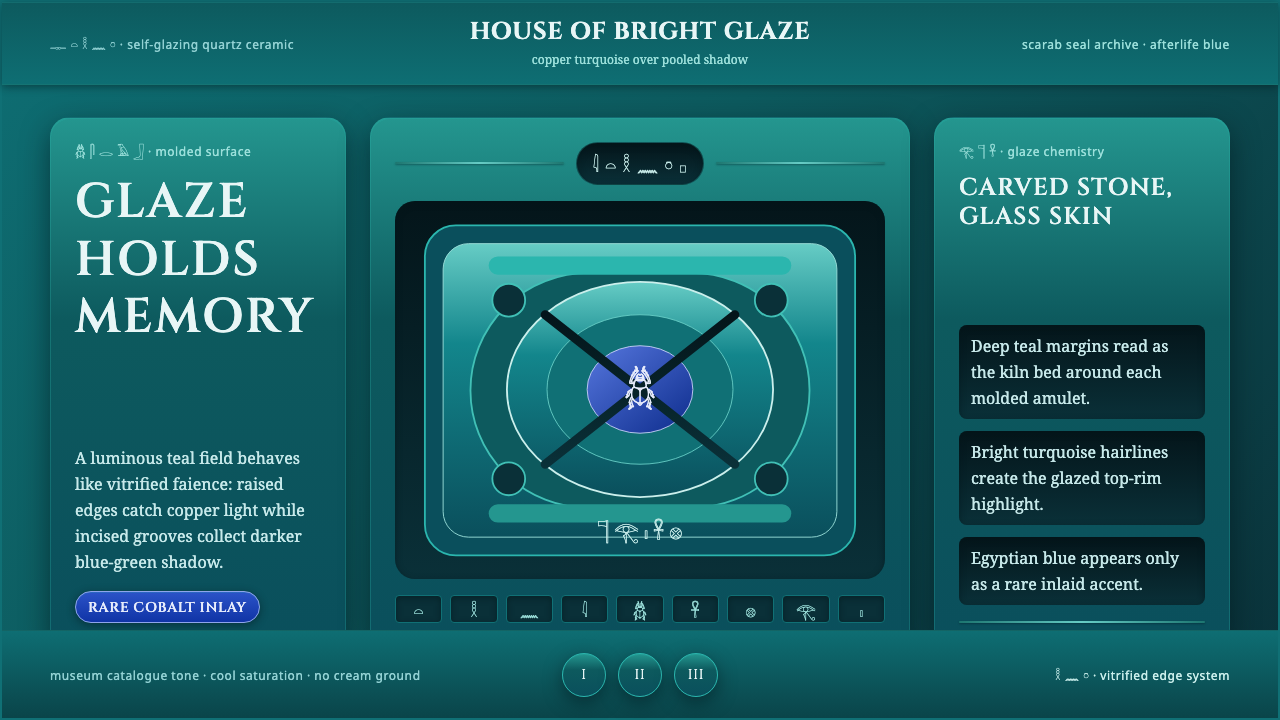 Egyptian FaienceGlaze carries the afterlife. Deep teal grooves, copper-turquoise rims, rare c…