What is Yemeni Mukarras Vault?
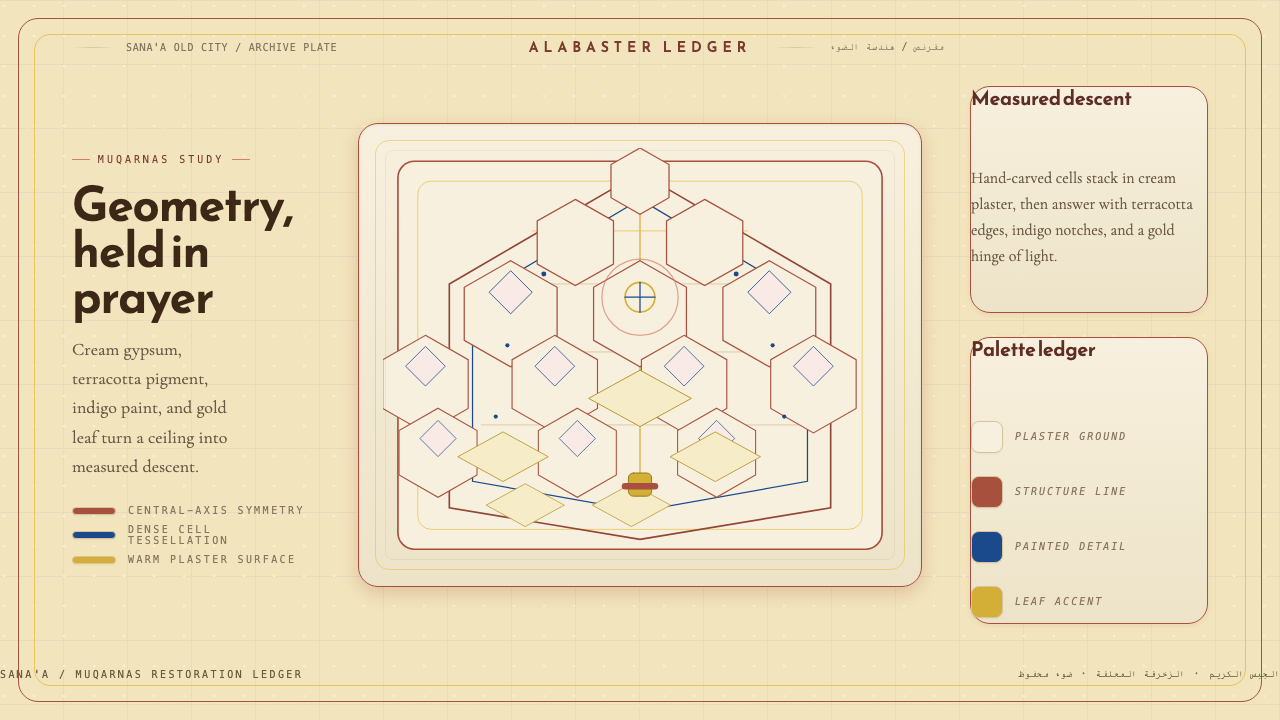
Yemen's muqarnas ceilings are computational geometry in plaster — honeycomb vaults of hand-carved gypsum cells that transform flat surfaces into cascading sacred geometry.
Yemeni Mukarras Vault in brief
The Yemeni Mukarras Vault design system draws its visual logic from muqarnas — the three-dimensional stalactite-like ornamental vaulting that defines the ceilings of mosques, palaces, and merchant houses across the Islamic world. Yemen's Old City of Sana'a preserves the tradition's most delicate regional variant: interlocking gypsum cells, each a small geometric prism, assembled into honeycomb canopies of extraordinary density and precision. The palette is warm and mineral — cream plaster, terracotta drawn from the fired mud-brick walls beneath, indigo echoing the hand-painted cell borders, and rare moments of gold leaf where emphasis demands it.
Unlike purely abstract geometric systems, muqarnas vaulting is structurally generative: each cell is both ornament and load-bearing component, and the overall pattern emerges from the repetition and rotation of a small set of interlocking prism types. This computational logic — complex wholes assembled from simple, repeated units — is central to the design language. Surfaces feel richly worked yet rigorously ordered. There is no empty space that is not also a geometric decision.
Translated into interface and graphic design, the system prioritizes warmth over clinical whiteness, hierarchical layering over flat minimalism, and geometric intricacy at focal points over uniform surface treatment. It is a system for work that wants to feel simultaneously ancient and precise — scholarly, craft-made, and deeply considered.

Where does Yemeni Mukarras Vault come from?
The term muqarnas — sometimes transliterated as moqarnas, mukarnas, or stalactite vaulting — refers to a system of corbelled, tiered niches that first appears in Islamic architecture during the tenth and eleventh centuries, likely developed simultaneously in Persia and North Africa. The essential innovation was structural and ornamental at once: by projecting small prismatic cells outward and downward in successive tiers, craftsmen could effect the visual transition from a square or polygonal plan to a circular dome without any single dramatic structural gesture. The vault appeared to dissolve into a shower of geometric fragments, suspending heaven between earth and sky.
Yemen's engagement with muqarnas deepened over centuries as the tradition traveled along Indian Ocean trade routes connecting the Arabian Peninsula, East Africa, and the Indian subcontinent. The Sana'a Old City — a UNESCO World Heritage Site continuously inhabited for more than two and a half thousand years — concentrates the most archaeologically layered examples. The distinctive Yemeni variant favors gypsum over stone, allowing for greater surface detail and the distinctive painted finish. Cream, terracotta, and indigo are not simply aesthetic choices: cream gypsum was the material itself; terracotta derived from the iron-rich local clay used in fired brick; indigo was a prized trade commodity carried along the same routes as frankincense and coffee.
The Tahirid dynasty (1454–1517) and the later Zaydi Imams who ruled much of highland Yemen until the twentieth century were important patrons of the muqarnas tradition, commissioning the elaborate ceilings that survive in Sana'a's great mosques, the suqs, and the distinctive multi-story tower houses called mafraj. Master builders known as Mutarrizid specialists — the term denotes expertise in the interlocking geometry — transmitted the craft through apprenticeship lineages that persisted well into the modern period. The knowledge was oral and tactile: cell proportions, rotation sequences, and interlocking joint types were learned by hand before they were ever drawn on paper.
European scholarly attention arrived relatively late. The British architectural anthropologist Trevor Marchand spent extended periods in Sana'a in the 1990s and 2000s documenting the transmission of muqarnas knowledge among living master builders, producing the most detailed ethnographic account of how the craft is actually learned and practiced. His work revealed that the builders do not work from geometric drawings in the modern sense: they operate from a mental vocabulary of cell types and assembly rules, constructing the vaults through sequential physical reasoning rather than pre-planned elevation drawings. This procedural, generative understanding of ornament — closer to algorithmic thinking than to artistic improvisation — distinguishes Yemeni muqarnas craft from purely decorative traditions. The Yemeni Heritage Foundation and international conservation bodies continue active restoration work, complicated by ongoing conflict, to preserve what remains of Sana'a's extraordinary built fabric.
What defines the Yemeni Mukarras Vault look?
Warm Mineral Palette
The color system is built from materials rather than from abstract color theory. Cream gypsum anchors the ground — warmer and softer than clinical white, carrying the tactile memory of hand-worked plaster. Terracotta, drawn from the fired mud-brick construction beneath every muqarnas vault, functions as the primary accent: earthy, grounded, and warm rather than bold or aggressive. Indigo provides depth and contrast, echoing the hand-painted borders that define each gypsum cell. Gold appears sparingly, at moments of structural emphasis or compositional arrival, recalling the gilded highlights on carved surfaces. The palette reads as excavated rather than designed — as if the colors were always latent in the earth beneath the building.
Interlocking Geometric Cells
The structural motif of the system is the small geometric cell — a prism, a faceted niche, a honeycomb compartment — that derives meaning from its relationship to neighboring cells rather than from any intrinsic form. Patterns are generated by the rotation and repetition of a small set of cell types, creating overall compositions of far greater complexity than any single element would suggest. In interface applications, this logic translates into grid systems built from modular, interlocking components: cards that share edges without gaps, data tiles that tessellate, and border treatments that feel continuous rather than arbitrarily stopped.
Layered Depth and Relief
Muqarnas vaulting achieves its visual drama through accumulated depth — surfaces that project forward in tiers, casting shadow on the recessed cells behind them. This is not flat decoration applied to a surface but decoration that is the surface, shaped in three dimensions so that light itself becomes a design material. In two-dimensional design work, this translates into deliberate use of layering: foreground elements that cast clear, hard shadows on the fields behind them; borders and frames treated as having thickness rather than being pure line; and compositional arrangements that imply a physical stacking of planes rather than elements floating on a single flat field.
Sacred Geometry as Structure
Islamic geometric ornament is not incidental to muqarnas — it is the method. The patterns are generated from a vocabulary of regular polygons (hexagons, octagons, twelve-pointed stars, and their subdivisions) governed by strict proportional relationships that repeat at different scales simultaneously, a property now recognized as a form of self-similar or quasi-crystalline tiling. In design application, this principle supports multi-scale coherence: motifs and proportions that work at the scale of an overall page layout also work at the scale of a single icon or border detail, because they derive from the same underlying geometric logic rather than being separately designed at each scale.
Craft Surface Quality
Yemeni gypsum plaster, when properly worked, has a surface quality distinct from both rough stone and machine-polished marble — a matte warmth that absorbs and diffuses light rather than reflecting it. Paints applied to this ground have a slightly chalky, absorbed quality rather than the high-gloss brightness of modern synthetic pigments. Translating this into digital design means avoiding saturated, high-gloss surfaces in favor of slightly desaturated tones that feel applied rather than lit from within. Gradients, when used at all, should suggest the uneven absorption of pigment into plaster, not the smooth mathematical interpolation of screen-space color.
Hierarchical Ornamentation
In traditional muqarnas architecture, ornament is not uniformly distributed — it is densest at the apex of a vault and at transition zones between structural elements, and it recedes into simpler patterns and eventually plain plaster at the base. This hierarchy of ornamental intensity mirrors the hierarchy of structural and ceremonial importance. In design systems derived from this logic, decorative complexity should be concentrated at moments of arrival, emphasis, or transition — a cover, a chapter opening, a data highlight — while supporting elements and body content remain relatively restrained. The ornament earns its complexity by contrast with what surrounds it.
Indigo as Structural Accent
In the Sana'a muqarnas tradition, indigo is applied specifically to the borders that define the edges of each gypsum cell — it is a line-drawing color, a color of demarcation and articulation rather than of mass or field. This precise role distinguishes indigo in the Yemeni Mukarras system from how deep blue is used in many other design traditions. Here it should function as an outlining and articulating agent: table rules, section dividers, border accents, icon strokes. Used as a large field color, indigo loses its structural function and risks overwhelming the warmer, more grounded tones that anchor the overall palette.

Who shaped Yemeni Mukarras Vault?
The Mutarrizid specialists — a craft designation rather than a single individual — were the hereditary master builders who sustained the muqarnas tradition in Yemen over many centuries. The title denoted expertise in the interlocking geometry of prismatic cell assembly: knowing which cell types could be combined, in which rotational sequences, to produce stable and visually coherent vaults of a given scale and plan. Their knowledge was transmitted orally and through physical practice within family and guild lineages, without dependence on geometric drawings. This tacit, procedural knowledge — closer in character to a programmer's library of reusable modules than to an architect's static drawing — allowed extraordinarily complex vaults to be built and rebuilt across generations by craftsmen who might be illiterate but who possessed a sophisticated geometric intelligence instantiated in their hands and eyes.
The Tahirid dynasty, which controlled much of highland and coastal Yemen between 1454 and 1517, were among the most significant institutional patrons of the muqarnas tradition in its mature Yemeni form. Their court at Rada and their patronage in Sana'a and Zabid funded the commissions — mosques, madrasas, and merchant palaces — that produced some of the most elaborate surviving muqarnas ceilings. The Tahirids occupied a culturally complex position: nominally Sunni rulers in a region with strong Zaydi Shia traditions, they patronized architecture that synthesized Yemeni local craft with Persian and Egyptian formal influences carried along the Indian Ocean trade network. The ceilings they commissioned represent a moment of maximum synthesis, when the tradition had absorbed enough external influence to reach a new level of geometric complexity without losing its distinctively Yemeni material character.
The British architectural anthropologist Trevor Marchand spent extended research periods in Sana'a in the 1990s and 2000s, embedding himself among working muqarnas craftsmen to document how the tradition was actually transmitted. His resulting publications — particularly his study of the cognitive and embodied dimensions of muqarnas craft knowledge — represent the most rigorous ethnographic account of the tradition in any language. Marchand demonstrated that the master builders do not work from pre-drawn geometric elevations: they operate from a mental vocabulary of cell types and assembly procedures, constructing the vault through sequential physical decision-making that is fundamentally different from the design-then-build workflow of modern architecture. His work revealed that what looks like ornamental complexity from outside is experienced by the craftsmen as a kind of spatial grammar — generative rules rather than fixed images — a finding that has since influenced both Islamic art history and cognitive anthropology.
The Yemeni Heritage Foundation has been the principal institutional custodian of Sana'a's architectural heritage through successive periods of political upheaval, working alongside UNESCO, the Aga Khan Trust for Culture, and international conservation bodies to document, stabilize, and restore damaged muqarnas ceilings and the tower houses that contain them. Their work gained urgent additional dimension after the destruction wrought by the civil conflict beginning in 2015, which caused damage to multiple historic structures in the old city. The Foundation's documentation projects — creating precise measured drawings and photogrammetric records of muqarnas vaults — have preserved knowledge that might otherwise be lost as the craftsmen who understand the construction methods age, and as physical structures are damaged beyond the capacity of conventional restoration.
Beyond any named individual, the Yemeni muqarnas tradition was sustained by the anonymous collective of master masons, plaster workers, and painters whose successive generations inhabited and constantly renewed the built fabric of Sana'a for over a millennium. The tower houses — some rising eight or nine stories, with muqarnas-decorated mafraj reception rooms at their summits — were not static monuments but living buildings continuously repaired, extended, and embellished by craftsmen who understood themselves as participants in an ongoing project rather than as individual artists. This collective, accretive mode of creation produced an environment of extraordinary density and coherence that no single designer could have planned: a city that is itself a kind of distributed geometric intelligence, each building in dialogue with its neighbors through shared proportional and ornamental systems.
How do you use Yemeni Mukarras Vault today?
The Yemeni Mukarras Vault system is among the most distinctive and culturally specific of the available design languages — which means it carries great potential for memorability and differentiation, but also requires careful matching to context. It works best in applications where warmth, craft, depth, and a sense of accumulated cultural authority are desirable. It is poorly suited to contexts demanding clinical cleanliness, aggressive modernity, or deliberate blankness. Understanding this fit is the prerequisite for everything else.
For presentation slides, the system rewards a layered approach rather than the flat, white-field minimalism that has dominated slide design for a decade. A cover slide built in this language might use a warm cream or plaster-toned ground, with a geometric border treatment derived from muqarnas cell patterns framing the central content area. Title typography should have weight and presence without feeling decorative — the architecture of the type carries meaning here, not flourishes. Content slides work well with a consistent left-side structural border in terracotta or indigo, treating the column as a frame that echoes the cell-border logic of the vaulting. Data slides can use the layered depth logic: highlighted figures or key statistics are visually elevated above surrounding content through shadow and border treatment, as if they occupy a higher tier in the vault.
For web interfaces, this design language is strongest in contexts with scholarly, cultural, archival, or premium artisan associations. A dashboard built with this vocabulary should use the cream ground as its dominant surface, with terracotta used for active state indicators, primary actions, and tier badges. Indigo functions best as a structural color — table dividers, section headings, icon outlines — rather than as a filled button or large surface. Pricing pages can leverage the hierarchical ornamentation principle: the featured or recommended tier receives a richer border treatment or a gold accent, while lower tiers are framed more simply. Navigation and typographic hierarchy should be established through weight and scale rather than color variety, keeping the palette concentrated and controlled.
For editorial and marketing work, the muqarnas logic of concentrated ornament at moments of arrival translates directly into layout practice. Opening spreads and chapter pages can carry the full ornamental weight — geometric border treatments, layered frames, terracotta and indigo accents — while body text pages recede to clean cream fields with minimal decoration. Pull quotes and call-outs benefit from a bordered, cell-like treatment that visually elevates them from the surrounding text field. Marketing pages in this language should resist the impulse to decorate uniformly: one full-width section with the complete ornamental vocabulary, surrounded by calmer, plainer sections, creates stronger impact than ornament spread at equal intensity across the entire page.
The most common mistake when applying this design language is treating it as a texture or surface pattern rather than a structural system. Muqarnas ornamentation is not applied to architecture — it is the architecture. Designers who import a geometric border pattern from this vocabulary but leave the underlying layout logic unchanged will produce something that looks like ornamental wallpaper rather than structured design. The system must be adopted at the level of the grid and the hierarchy, not only at the level of visual embellishment. A second common error is using all four palette colors simultaneously at high intensity — cream ground, terracotta, indigo, and gold all competing for attention. Authentic Yemeni muqarnas work uses one material as the dominant ground and reserves the others for specific structural functions; restraint in color application is what allows the geometric complexity to read clearly rather than becoming visual noise.

Yemeni Mukarras Vault — FAQ
Is this design language appropriate for non-Islamic or secular contexts?
Yes, with thoughtfulness. Muqarnas vaulting originated in a specifically Islamic architectural context, but its visual logic — geometric cell patterns, warm mineral palette, hierarchical ornamentation — is not inherently religious any more than Gothic pointed arches are inherently Christian in contemporary use. The design language functions as a historical craft tradition that has been abstracted into a formal system. What matters is that the use is neither trivializing nor falsely claiming cultural identity: a luxury hospitality brand, a cultural institution, an editorial publication, or a design studio drawing on this vocabulary for its craft associations and visual richness is using it appropriately. A fast-casual food chain or a cryptocurrency exchange using the same vocabulary is likely creating a mismatch between the language and its implied values.
How does the Yemeni Mukarras Vault system differ from other Islamic geometric design styles?
Islamic geometric design is a broad family with significant regional variation. The Yemeni variant is distinguished by three specific characteristics: its material basis in gypsum plaster rather than stone, tile, or wood (giving it a warmer, more matte surface quality); its particular color triad of cream, terracotta, and indigo rather than the blue-and-white or polychrome tilework associated with Persian or Moroccan traditions; and its emphasis on three-dimensional vaulted form rather than flat surface pattern. Moroccan zellige tilework and Persian Arabesque are primarily flat-surface traditions; Ottoman Iznik ceramic design privileges vivid polychrome and floral motifs. The Yemeni muqarnas tradition is specifically about depth, projection, and the geometry of three-dimensional spatial transitions — which is what gives the design language its distinctive layered, relief-like quality.
Can this system work in a digital dark-mode context?
A dark inversion of the Yemeni Mukarras Vault system is possible but significantly changes its character. The system's warmth and material depth depend heavily on the cream plaster ground: removing it in favor of a dark background shifts the palette from warm and mineral to cool and more austere. If a dark variant is needed, a very deep, warm-toned brown — the color of aged Yemeni mud brick in dim interior light — works better as a ground than standard near-black, as it preserves the material association. Terracotta remains effective as an accent on a dark warm ground; indigo, however, tends to disappear against very dark backgrounds and should be lightened to a medium blue tone if structural use is needed. Gold becomes more prominent on dark grounds, which can work well at small scale for highlight purposes but will feel overwrought at large areas.
What kind of typography pairs best with this design language?
The Yemeni Mukarras Vault system is architecturally dense and materially warm — which creates specific demands on typography. Very thin or delicate typefaces will be visually overwhelmed by the surrounding ornamental complexity; very geometric, machine-like sans-serifs may clash with the hand-worked surface quality. The system works best with typefaces that have a certain weight and calligraphic heritage without being overtly decorative: humanist serif types with visible stroke contrast, or humanist sans-serifs with subtle optical correction rather than purely mechanical geometry. For Arabic script where applicable, traditional Naskh or Thuluth proportions are natural companions to the ornamental vocabulary. Type scale should be generous — the ornamental frame requires that content within it has sufficient presence to hold its own against the surrounding pattern without being dwarfed.
Is the gold accent essential, or can it be omitted without losing the system's character?
Gold is not essential to the system's fundamental character — it is a moment of emphasis rather than a structural element. The three primary materials of Yemeni muqarnas work are gypsum (cream), fired clay (terracotta), and pigment (indigo); gold leaf was applied sparingly to gilded highlights on completed surfaces. In design application, gold should be treated the same way: optional, used for moments of genuine emphasis or distinction such as a premium tier marker, a featured quote, or a structural accent at a compositional arrival point. Omitting it entirely produces a more austere and perhaps more contemporary reading of the vocabulary, while using it heavily risks tipping the system toward pastiche or visual extravagance. If gold is used, it should appear in no more than one or two locations per composition.
Related design styles
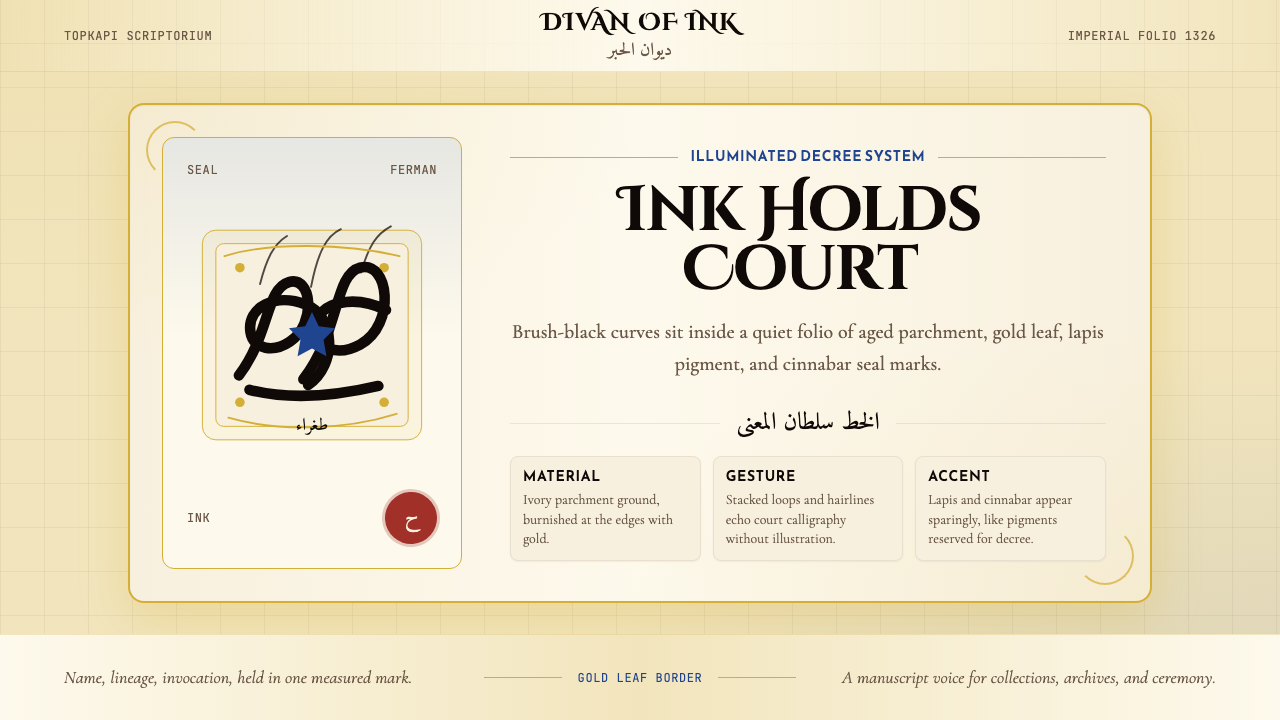 Ottoman Tughra CalligraphyImperial ink holds court. Gold borders, lapis panels, and Cinzel tughra-like…
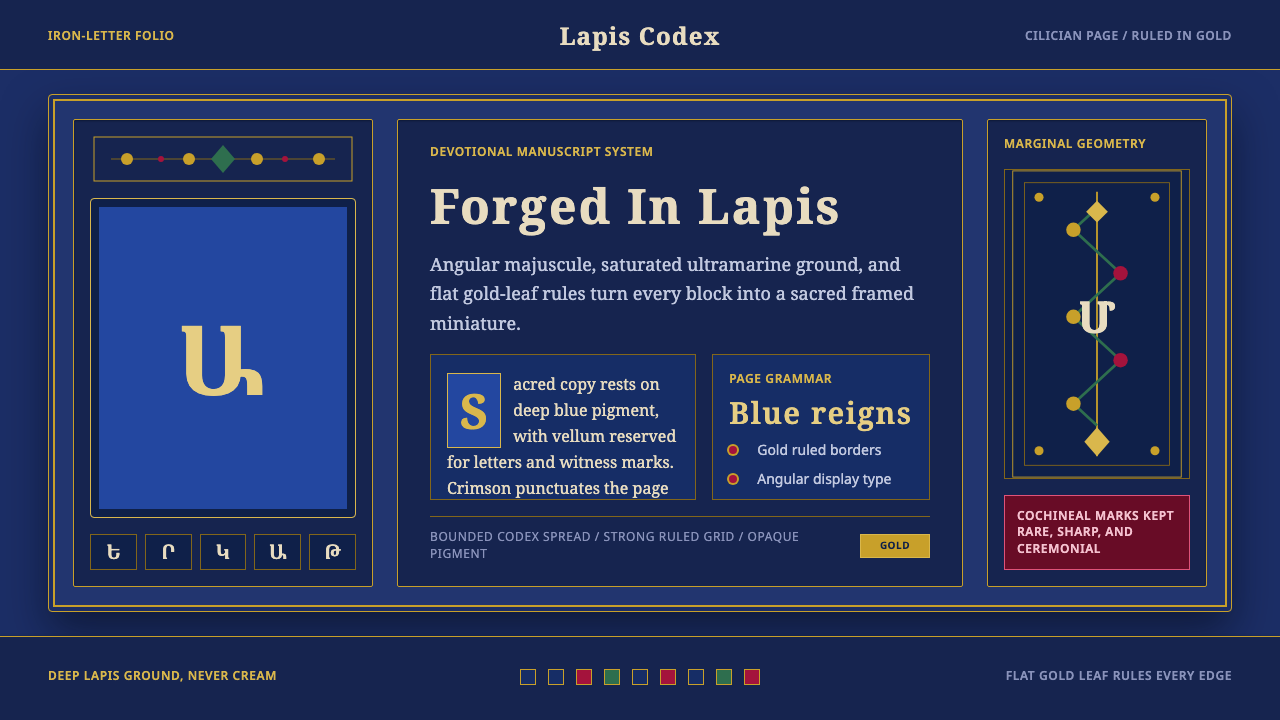 Armenian ErkatʿagirDevotional lapis reigns. Gold rules and angular serif glyphs frame a sacred g…
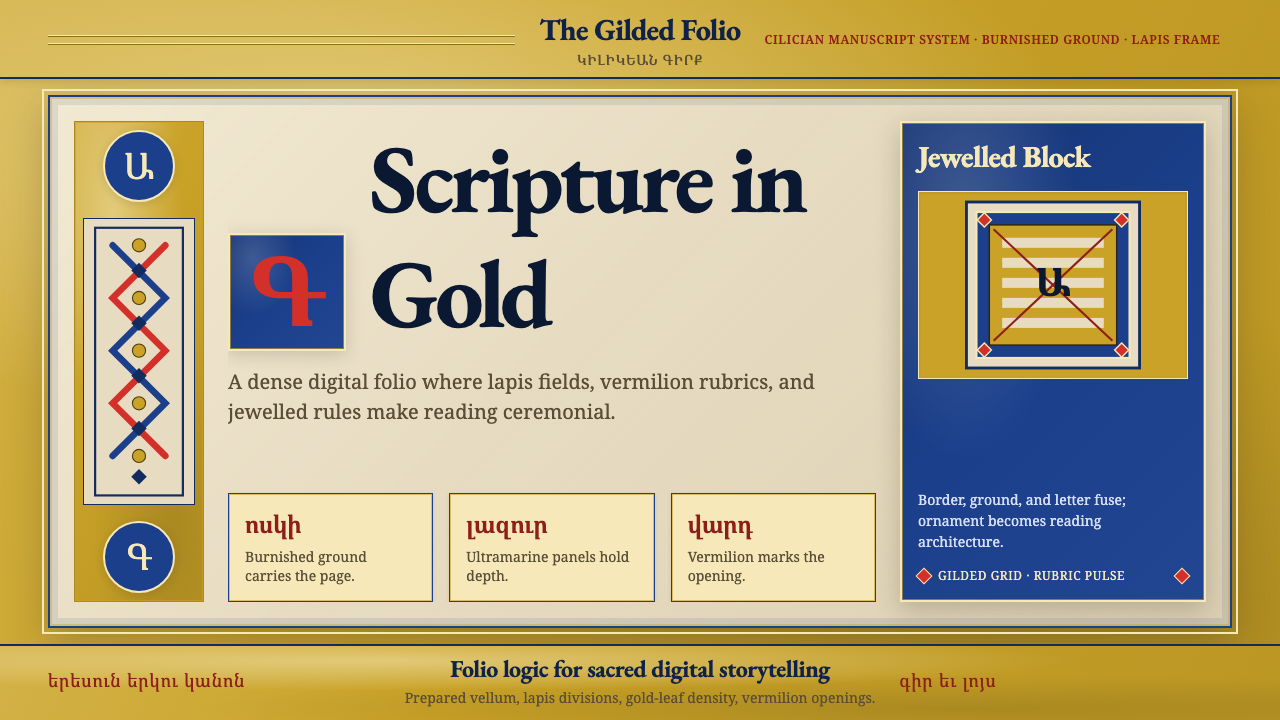 Armenian Illuminated ManuscriptGilded maximalism. Burnished gold, lapis frames, and vermilion initials build…
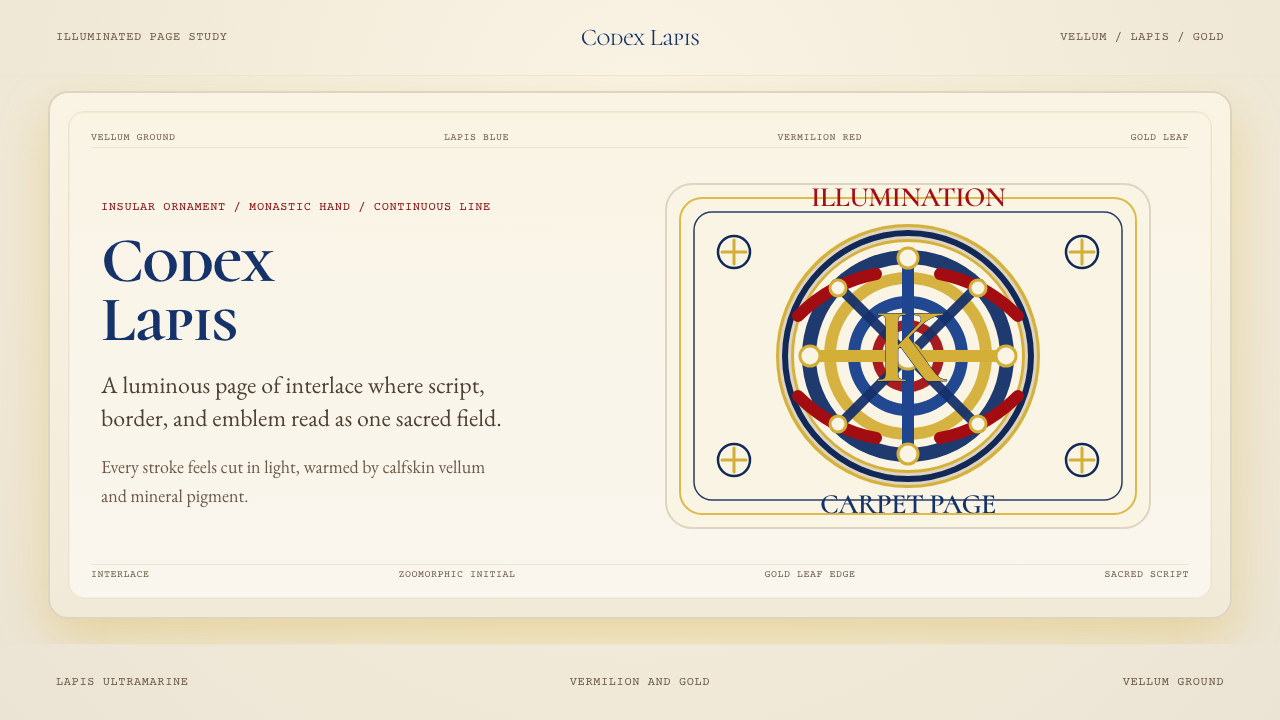 Book of Kells Celtic (800)Sacred and precise. Vellum cream, lapis, vermilion, and gold knotwork.
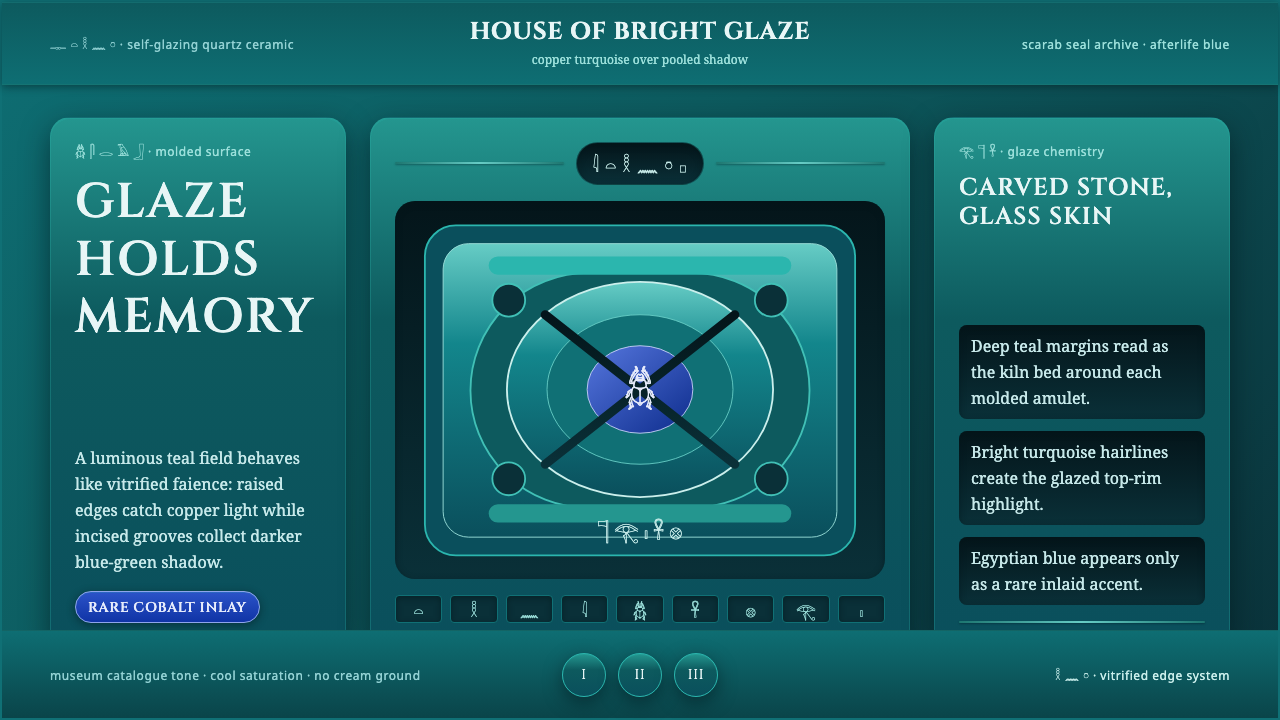 Egyptian FaienceGlaze carries the afterlife. Deep teal grooves, copper-turquoise rims, rare c…
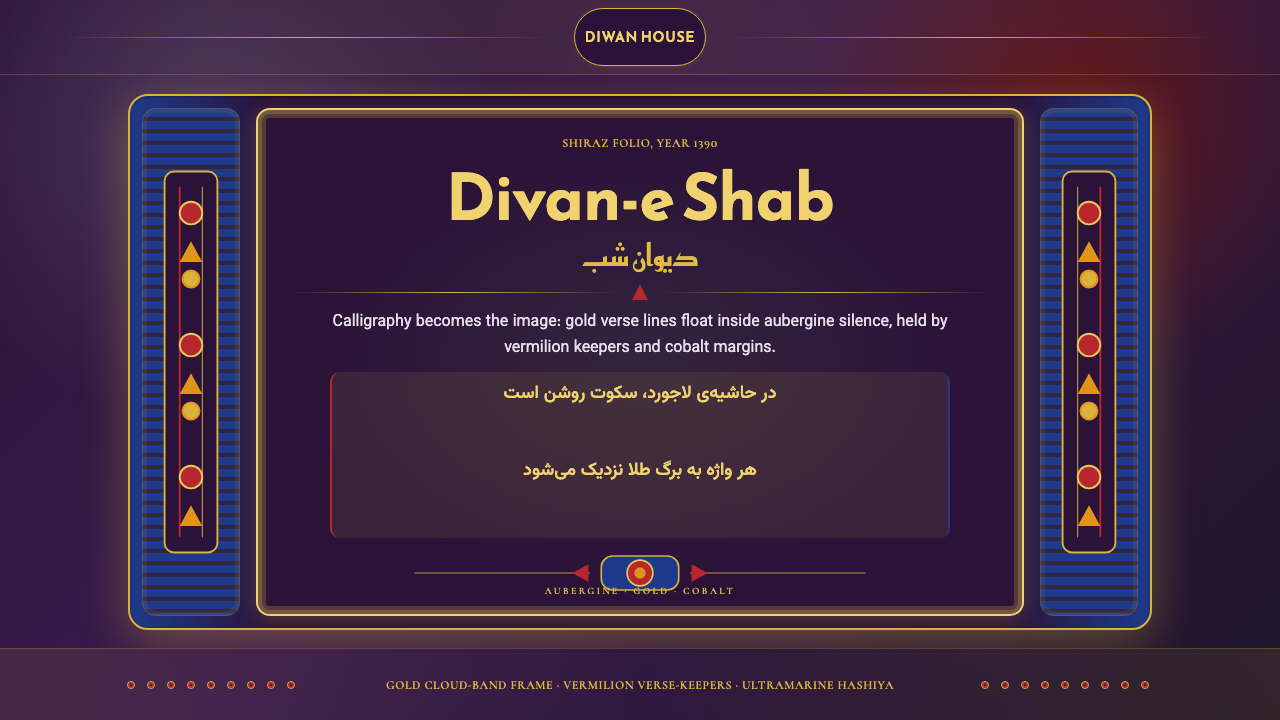 Iranian Shiraz Poetry Divan 1390Midnight manuscript glow. Aubergine fields, gold Kufi type, cobalt margins.