What is Versailles Rococo Ornament?
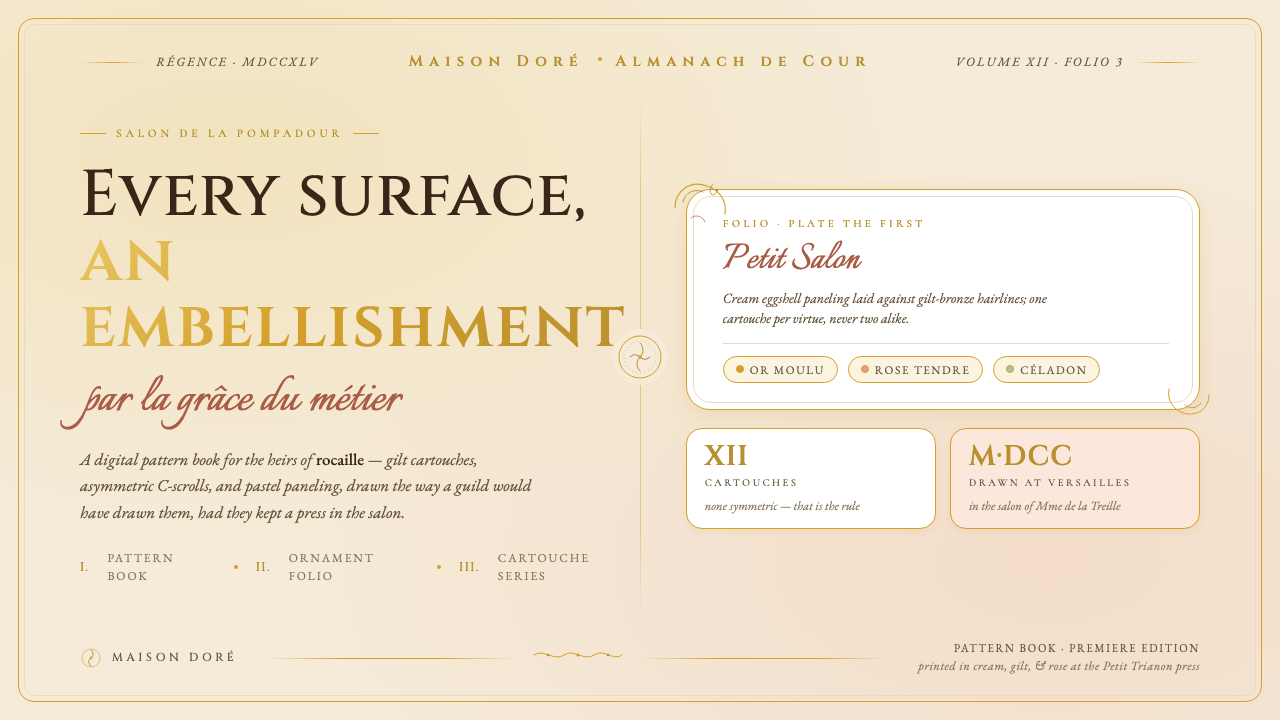
Versailles Rococo is the grammar of impossibly refined excess — every panel gilded, every curve answered by another curve, every surface a canvas for the royal art of beautiful abundance.
Versailles Rococo Ornament in brief
Versailles Rococo Ornament is the visual language of the French court between roughly 1700 and 1760 — the years spanning the Régence and the reign of Louis XV. It is a style defined by layered gilt ornament, asymmetric curvilinear forms, pale pastel grounds, and an absolute conviction that every available surface deserves embellishment. Where the late Baroque of Louis XIV imposed grandeur through symmetry and scale, Rococo introduced intimacy, wit, and deliberate asymmetry — an ornamental grammar that felt personal rather than imperial.
The style's defining visual motifs are the C-scroll and S-curve, the rocaille shell, the cartouche (an ornamental frame of scrollwork enclosing a painted or gilt field), and the trellis of climbing roses or vine tendrils. These elements appear not in isolation but in cascading combination: a cartouche becomes the frame for a painted scene; the painted scene is surrounded by cherubs modeled in low relief; the cherubs rest on foliate brackets that curve into the paneling itself. The effect is one of deliberate visual richness, in which the eye is invited to travel from ornament to ornament rather than rest on a single focal point.
The palette is cream, pale gold, and soft pastels — dusty rose, sky blue, sage green, and ivory — with ormolu gilt (fire-gilded bronze) used for hardware, frames, and three-dimensional ornamental details. The style is light in tone even when dense in ornament. Shadows are minimal, surfaces read as warm and reflective, and the overall impression is of a room or composition saturated with refined delight rather than solemn grandeur.

Where does Versailles Rococo Ornament come from?
The roots of Versailles Rococo lie in a deliberate reaction against the ponderous formality of the Sun King's court. Louis XIV's Versailles — designed by Charles Le Brun under the doctrine of royal magnificence — was a machine of symbolic domination: symmetrical, axial, overwhelming in scale. When Louis XV came to power in 1723 (with the Duc d'Orléans as regent from 1715), the court's appetite shifted. The grand appartements of the palace were increasingly regarded as ceremonially correct but humanly inhabitable only with great discomfort. A new aesthetic sensibility sought rooms that were smaller, lighter, more personal — and the ornamental vocabulary adjusted to match.
The Régence period (1715–1723) was the transitional moment. Designers including Charles Cressent and Juste-Aurèle Meissonnier began introducing asymmetry into ornament that had previously been rigidly mirrored. Meissonnier, appointed designer to the King's Chamber in 1726, was particularly radical: his published engravings showed cartouches in which no element on the left was answered by a corresponding element on the right, frames in which the scrollwork appeared to grow and twist organically rather than follow a geometric program. This asymmetric principle — called genre pittoresque by contemporaries — became the hallmark of the mature Rococo.
The style's cultural context was inseparable from the role of Madame de Pompadour, who became Louis XV's favorite in 1745 and exercised direct influence over royal artistic commissions for nearly twenty years. Pompadour was not merely a patron but an aesthetic intelligence: she directed the decoration of the Petit Trianon, championed the porcelain manufactory at Sèvres, and personally supervised the production of decorative objects for the royal apartments. Her taste — light, refined, feminine in the eighteenth-century sense — became the authoritative expression of what Versailles Rococo should look and feel like. The Boucher paintings commissioned for her apartments, the lacquered furniture, the Sèvres porcelain in her signature rose Pompadour ground color, all bear the coherence of a single sustained aesthetic vision.
The style's geographical reach extended well beyond Versailles. By the 1730s and 1740s, French ornamental engravings were being exported throughout Europe, and craftsmen in Bavaria, Prussia, Austria, and England were adapting the Rococo vocabulary to local traditions and materials. The German courts produced some of the most exuberant variations — the Amalienburg pavilion near Munich and the Würzburg Residenz represent the style at its most spatially ambitious. But Versailles itself remained the reference point: it was the French court's specifically restrained, aristocratic variant of Rococo — distinguished from German effusion by a certain tonal elegance — that set the international standard and that the style designation 'Versailles Rococo' is understood to invoke.
What defines the Versailles Rococo Ornament look?
Asymmetric Curvilinear Ornament
The defining structural principle of Versailles Rococo is asymmetry in service of organic energy. C-scrolls and S-curves do not mirror each other; instead, they cascade and interlock in configurations that appear to grow rather than be constructed. A cartouche will carry more ornamental weight on one side than the other; a bracket will curl in one direction while its neighbor curls in the opposite. This deliberate imbalance is not disorder — it is a sophisticated alternative to the classical axiom that beauty requires symmetry. The asymmetry gives the ornament a sense of arrested movement, as though the gilt bronze were caught mid-flow.
Ormolu Gilt and Pastel Grounds
The signature color relationship of Versailles Rococo pairs warm gilt against pale, chalky grounds. The walls, paneling, and flat surfaces are held in creams, soft ivories, and dusty pastels — rose, sky blue, and celadon appear frequently — while ormolu hardware, frame moldings, and applied ornaments read as warm gilded accents. The palette is never cold or stark: the gilt introduces warmth, and the pastels absorb it without competing. This combination produces an interior luminosity that is simultaneously luxurious and delicate, quite distinct from the heavy gold-on-dark-ground of High Baroque.
Rocaille Shell and Nature Motifs
The word 'rocaille' — from the French for rock and shell — names the style's most characteristic secondary motif: representations of shells, coral, rock formations, and water-worn surfaces that appear throughout cartouche surrounds, fireplace hoods, mirror frames, and ceiling corners. These natural references are never literal; they are stylized to the point of abstraction, rendered as crisp three-dimensional ornamental forms in plaster or gilt bronze. Alongside shells, the style deploys climbing roses, vine tendrils, laurel branches, and cherubs (putti) in painted or relief form, weaving a narrative of abundance and pastoral delight through every compositional level.
Hand-Painted Scenic Panels
A distinctive feature of Versailles Rococo interiors — and the source of its most direct visual character in two-dimensional applications — is the hand-painted cartouche panel. Within an elaborate gilt surround, a small scene is painted in the manner of François Boucher: cherubs at play, garlands of flowers, pastoral vignettes of shepherdesses and lambs, or mythological scenes treated with an air of cheerful irreverence rather than classical gravity. The painting style is loose, warm, and theatrical — shadows are soft, flesh tones are rosy, and flowers are rendered with a painterly freedom that contrasts deliberately with the precision of the gilt ornament surrounding them.
Layered Ornamental Depth
Versailles Rococo operates through accumulation. No single ornamental element is meant to be read in isolation; each motif exists as part of a layered hierarchy in which the eye moves from the broadest organizing structure (a painted wall panel, a carved door surround) to progressively finer detail (the gilt molding, the rocaille shell at a corner, the flower painted within the cartouche, the individual petal of that flower). This principle of embedded ornamentation at multiple scales is perhaps the style's most demanding feature to apply — it requires committing to detail at every level of resolution rather than applying surface complexity only at the outermost layer.
Sinuous Furniture and Object Forms
In its three-dimensional expression, Versailles Rococo extended its curvilinear logic from walls and ceilings into the form of furniture and decorative objects. Charles Cressent's commodes feature cabriole legs that swell and narrow with an almost biological fluidity, drawer fronts that bulge outward in a bombé curve, and ormolu mounts whose foliate scrollwork flows across surfaces without beginning or end. The goal is the elimination of the right angle: where Baroque furniture imposed structure through mass and symmetry, Rococo furniture suggests growth, movement, and an aristocratic refusal to be geometrically constrained.
Theatrical Scale Contrast
Versailles Rococo creates visual rhythm through deliberate scale contrast between the architectural ground and the ornamental detail applied to it. A wall panel might occupy several meters of cream-painted boiserie, interrupted by a cartouche that could be measured in hand-spans, which itself contains a painted scene rendered at the scale of a miniature. This orchestration of scales — from the architectural to the intimate — is one of the style's most sophisticated spatial achievements, and it translates directly into a principle for contemporary design: the style requires both a large organizing field and the commitment to populate it with detail at multiple, progressively smaller scales.

Who shaped Versailles Rococo Ornament?
Meissonnier was appointed designer to the King's Chamber in 1726 and is credited with radicalizing the Rococo's formal vocabulary. His engraved ornamental designs — widely circulated across Europe — broke decisively with bilateral symmetry, introducing cartouches and frames in which the scrollwork appeared to grow asymmetrically like a living form. His influence extended far beyond France: German and Austrian craftsmen adapted his published designs into the exuberant plasterwork of Bavarian churches and Prussian palace interiors. Meissonnier represents the intellectual core of the mature Rococo — the designer who gave the style its most principled argument for asymmetry as a positive aesthetic value.
Boucher was First Painter to the King from 1765 and the period's most emblematic pictorial voice. His paintings — pastoral scenes populated by rosy-cheeked shepherdesses, plump cherubs, and mythological figures treated with cheerful lightness — supplied the imagery that animated Rococo interiors. His decorative panels appeared on Sèvres porcelain, in tapestry cartoons for the Beauvais and Gobelins workshops, and as overdoor paintings in royal and aristocratic apartments throughout France. Boucher's color sensibility — warm flesh tones, soft blues and pinks, a pervading quality of artificial outdoor light — is as definitive for Versailles Rococo as his subject matter, and any contemporary application of the style must reckon with his pictorial logic.
As Louis XV's chief mistress and artistic advisor from 1745 until her death in 1764, Pompadour exercised more sustained influence over the visual culture of Versailles Rococo than any single designer or craftsman. She directed the redecoration of the Petit Trianon, championed the establishment of the Sèvres porcelain manufactory, and oversaw the commissioning of Boucher's most important decorative cycles. Her personal aesthetic — preferring refinement and delicacy over sheer grandeur, lightness over mass, and the intimate over the monumental — became the defining taste of the mature style. The rose Pompadour ground color on Sèvres porcelain bears her name, and with it the style's most characteristic chromatic fingerprint.
Cressent was the Régence and early Louis XV period's most celebrated cabinetmaker, whose furniture represents the translation of Rococo ornamental principles into three-dimensional form. His commodes — with their swelling bombé fronts, cabriole legs of exaggerated elegance, and ormolu mounts of extraordinary quality — demonstrate how completely the style rejected the right angle as an organizing principle. Cressent's ormolu work was so accomplished that he was repeatedly prosecuted by the guild of metalworkers for exceeding his permitted craft boundaries; he modeled and cast his own mounts rather than outsourcing them, treating the gilt bronze as a primary sculptural medium rather than a secondary decoration.
Gabriel served as Premier Architecte du Roi from 1742 and is responsible for the built form of the Versailles Rococo interior at its most architecturally coherent. His design for the Petit Trianon (completed 1768, technically on the cusp of the Neoclassical reaction) and the remodeling of royal apartments within the palace established the spatial proportions, boiserie configurations, and ornamental densities that define the canonical Versailles interior. Where Meissonnier was radical and Boucher was pictorial, Gabriel was integrative — the architect who gave the ornamental excess of the court a disciplined spatial container without extinguishing its character.
How do you use Versailles Rococo Ornament today?
Versailles Rococo is one of the most compositionally demanding historical styles to apply in contemporary design, because its visual richness requires genuine commitment to ornamental detail rather than surface-level gestures toward complexity. Understanding what the style is structurally doing — building layered hierarchies of ornament at progressively finer scales, using asymmetric curvilinear forms to create organic energy, pairing pale grounds against warm gilt accents — is the prerequisite for applying it coherently rather than merely imitating its most recognizable surface features.
For presentation slides, the style divides naturally between cover treatments and content organization. A Rococo cover page works best when a single large cartouche or ornamental frame occupies the center or an asymmetric position, enclosing the title text within a field that reads as a painted or gilt panel. The background should hold a pale, chalky ground — ivory or dusty rose — with gilt ornamental borders at edges or corners. Content slides require a lighter hand: use ornamental rules or delicate scroll corners as structural dividers rather than full cartouche surrounds, and keep body text in a clean serif that reads as period-appropriate without becoming illegible. Data slides can incorporate ornamental frames around chart areas, treating each chart as a panel in a decorated cabinet, but the data itself should remain visually clear — the ornamentation frames the information rather than competing with it.
For web interfaces, Versailles Rococo is well suited to luxury product pages, high-end hospitality and event platforms, editorial mastheads, and any context where the user experience is meant to feel exclusive and historically resonant. Dashboard and utility applications are generally not good matches — the style's ornamental density conflicts with the scannability requirements of data-heavy interfaces. Where it applies, the approach is to use ornamental motifs as micro-details at the edges of interaction elements: a subtle scroll border on a modal overlay, a gilded rule separating sections, a cartouche shape used as a container for a pricing tier. The background hierarchy — pale cream primary, warmer ivory secondary, gilt accent — should be established first and applied consistently before any ornamental elements are introduced.
For editorial and marketing work, Versailles Rococo supports aspirational, celebratory, and heritage-positioning content particularly well. A magazine spread or editorial layout can use a large asymmetric ornamental border to frame a hero image, with body text set in a period-appropriate serif at a comfortable measure. Marketing pages for luxury goods, events, or cultural institutions benefit from the style's authority: a full-width header with a cream ground, gilt ornamental border, and centered serif headline establishes the tone immediately. Smaller ornamental vignettes — a single shell motif, a minimal scroll corner — can be used as pull-quote decorations or section markers throughout a longer document, providing visual rhythm without requiring full ornamental density on every page.
The most common mistake when applying Versailles Rococo is mistaking surface gilding for the style's substance. A dark background with bright gold overlays is not Rococo — it is a generic luxury gesture that lacks the style's defining characteristics of pale grounds, asymmetric curvilinearity, and layered ornamental depth. Equally problematic is applying a single ornamental element (one cartouche, one scroll border) to an otherwise clean modernist layout and calling it Rococo: the style requires internal consistency across multiple ornamental levels to read as intentional. The second common error is treating the style as symmetrical — adding matching ornamental elements to both sides of a composition — which directly contradicts the genre pittoresque asymmetry that defines it. Authentic application requires accepting that the composition will be weighted differently on each side, and trusting that the ornamental logic will produce its own balance.

Versailles Rococo Ornament — FAQ
What is the difference between Rococo and Baroque, and why does it matter for design?
The most important practical distinction is symmetry versus asymmetry. Baroque design — particularly the Louis XIV French Baroque — is axiomatically symmetrical: every element on the left is answered by a corresponding element on the right, and the organizing axis is always legible. Rococo deliberately breaks this rule: C-scrolls and S-curves cascade without mirroring, cartouches carry unequal ornamental weight on each side, and the composition is balanced through visual tension rather than bilateral correspondence. In application, this means that adding symmetric ornamental borders to a layout will read as Baroque rather than Rococo, regardless of the motifs used. The second important distinction is tone: Baroque aims for grandeur and domination, Rococo aims for delight and refinement. Darker grounds, heavier mass, and more solemn color relationships belong to Baroque; pale pastels, light gilt, and a sense of graceful abundance belong to Rococo.
Can Versailles Rococo work in digital interfaces, or is it too ornate for screens?
It can work, but it requires selective application rather than wholesale transplantation. The style's physical expression — deep-relief plasterwork, fire-gilded bronze, hand-painted boiserie — does not translate directly to a screen, and attempting to simulate these textures digitally tends to produce results that feel costume-like rather than genuinely luxurious. What does transfer successfully is the style's compositional logic: asymmetric layouts with ornamental frames, pale grounds with gilt accent lines, cartouche-shaped containers for featured content, and a serif typographic hierarchy that reads as period-coherent. The most effective digital applications use the style's ornamental vocabulary sparingly — two or three motifs applied consistently and with quality — rather than attempting full interior-decoration density, which overwhelms the screen and conflicts with interactive usability.
How do I avoid making Rococo look kitsch or costume-like in modern work?
The primary risk is over-referencing. Kitsch Rococo occurs when every available surface is covered in ornament without any structural justification, when the ornamental elements are lifted directly from historical sources without being redrawn or refined, and when the palette substitutes shiny metallic fills for the warm, matte quality of genuine gilt. The antidote is restraint in deployment and quality in execution. Use ornamental elements sparingly — one refined cartouche border rather than three competing ones — and invest in the quality of each individual element rather than compensating quantity for quality. The pale ground is as important as the gilt: without the breathing room of the cream or ivory field, the ornament reads as clutter rather than abundance. Finally, the asymmetry must be genuine: if the composition is symmetrical with ornamental appliqué added to both sides, it will read as stage set decoration rather than authentic Rococo structure.
What typographic choices are most compatible with Versailles Rococo?
The style pairs most naturally with high-contrast, transitional or old-style serif letterforms — the kind of type that would have been set in French printing houses of the early eighteenth century. These are typefaces with pronounced contrast between thick and thin strokes, bracketed serifs, and a calligraphic axis of stress. The type should feel like it belongs to the same cultural moment as the ornament: elegant, refined, and legible at the scale of a printed book or panel inscription rather than a billboard. Very modern geometric sans-serifs — the kind associated with mid-twentieth-century Swiss design — will read as anachronistic and oppositional to the ornamental richness. If a more legible sans-serif is needed for interface contexts, it should be a humanist design with some calligraphic character rather than a purely geometric one. Scale contrast within the type hierarchy is important: the style supports generous size differences between heading and body levels, reinforcing the ornamental principle of detail at multiple scales.
Is Versailles Rococo a style appropriate for brand identity, or mainly for editorial and decorative contexts?
It is a viable brand identity style, but the category fit is narrow. The style communicates heritage, exclusivity, refinement, and European cultural authority. It is well suited to luxury goods brands (particularly fashion, jewelry, hospitality, and fragrance), cultural institutions with deep historical collections, events and galas seeking a period atmosphere, and publishing or editorial contexts where the subject matter engages with European history or aristocratic culture. It is not appropriate for technology products, financial services seeking to convey transparency and accessibility, food and beverage brands targeting young or casual audiences, or any context where the user relationship depends on directness and informality. The style makes strong implicit claims about the nature of the brand — claims about age, tradition, and cultural capital — that must be genuine or the style will read as affectation. A startup using Versailles Rococo visual language without substantive heritage to reference risks appearing absurd rather than luxurious.
Related design styles
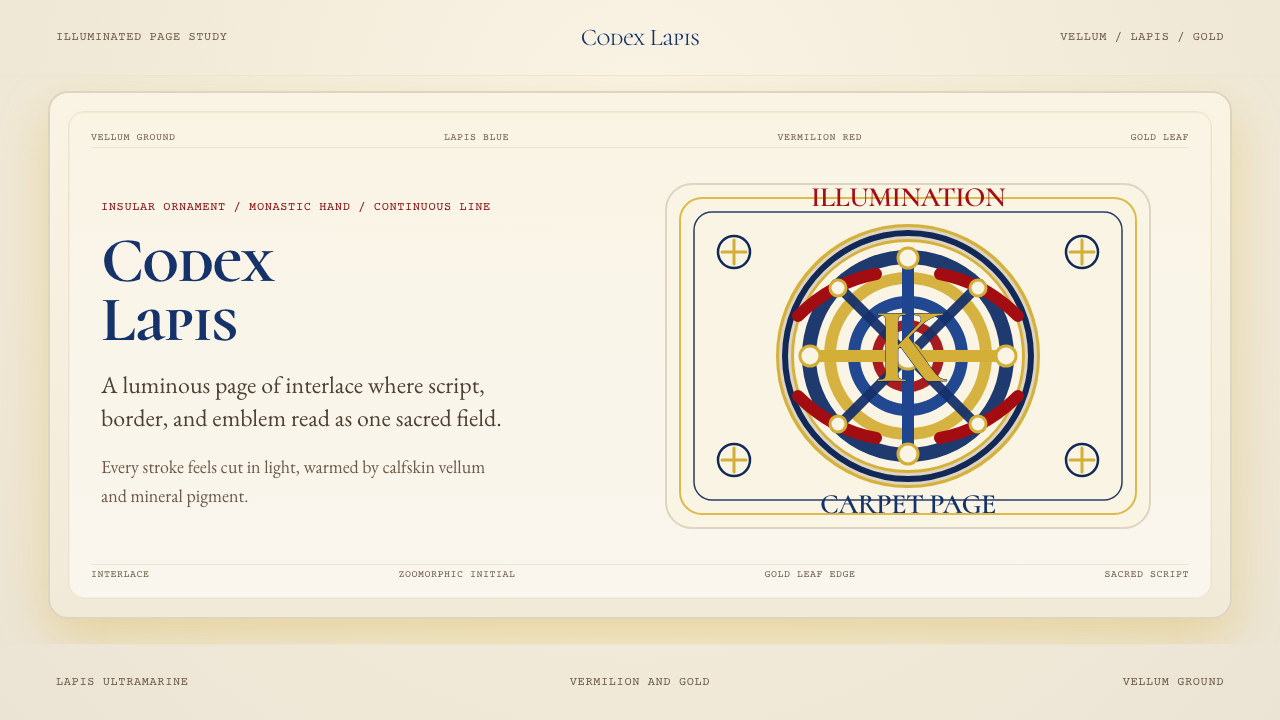 Book of Kells Celtic (800)Sacred and precise. Vellum cream, lapis, vermilion, and gold knotwork.
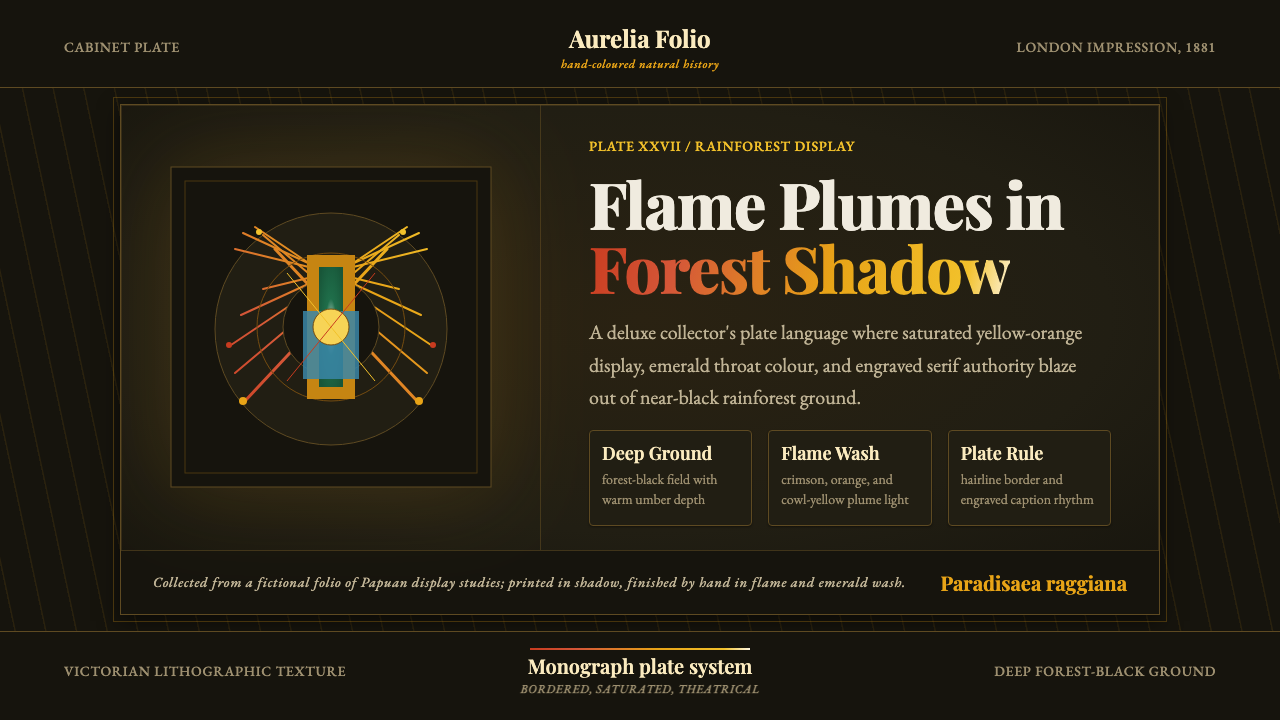 Bird of Paradise MonographTheatrical plate-book darkness. Flame plumes blaze from a bordered forest-bla…
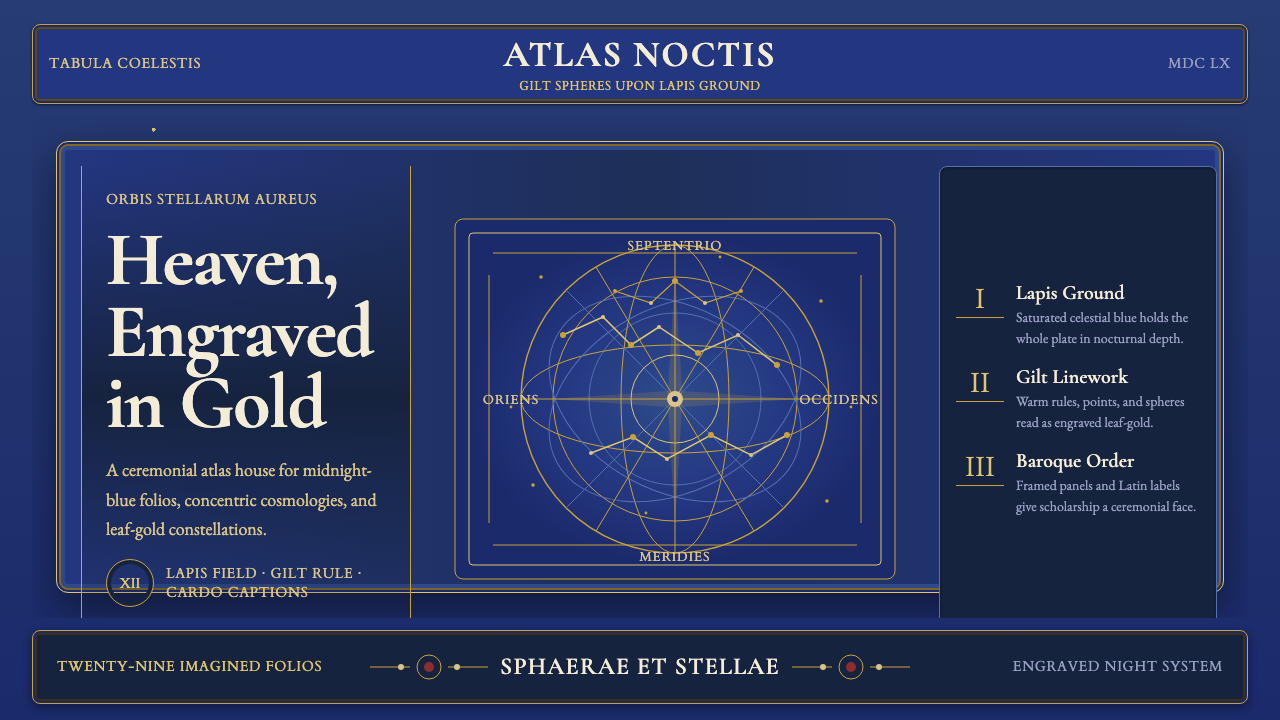 Cellarius Celestial AtlasCelestial luxury on lapis. Gilt serif type, star fields, and concentric chart…
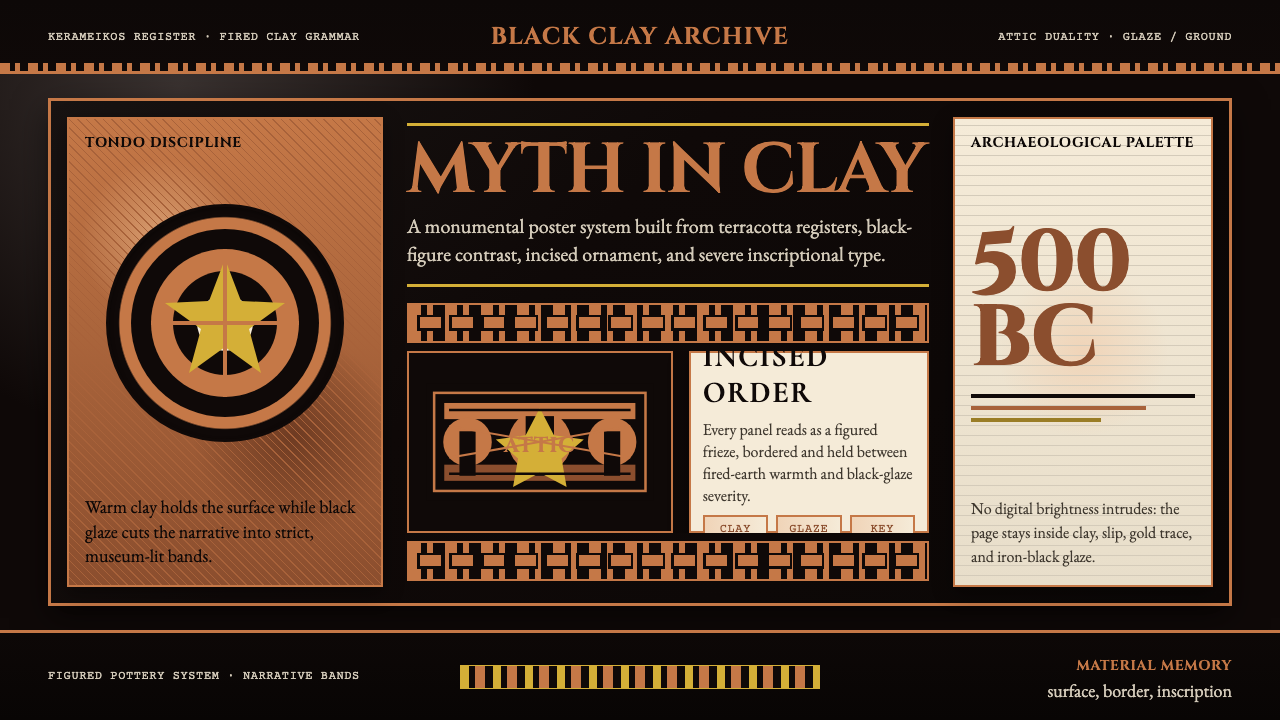 Greek Vase Attic (500 BC)Archaeological severity. Jet-black glaze, terracotta bands, and meander borde…
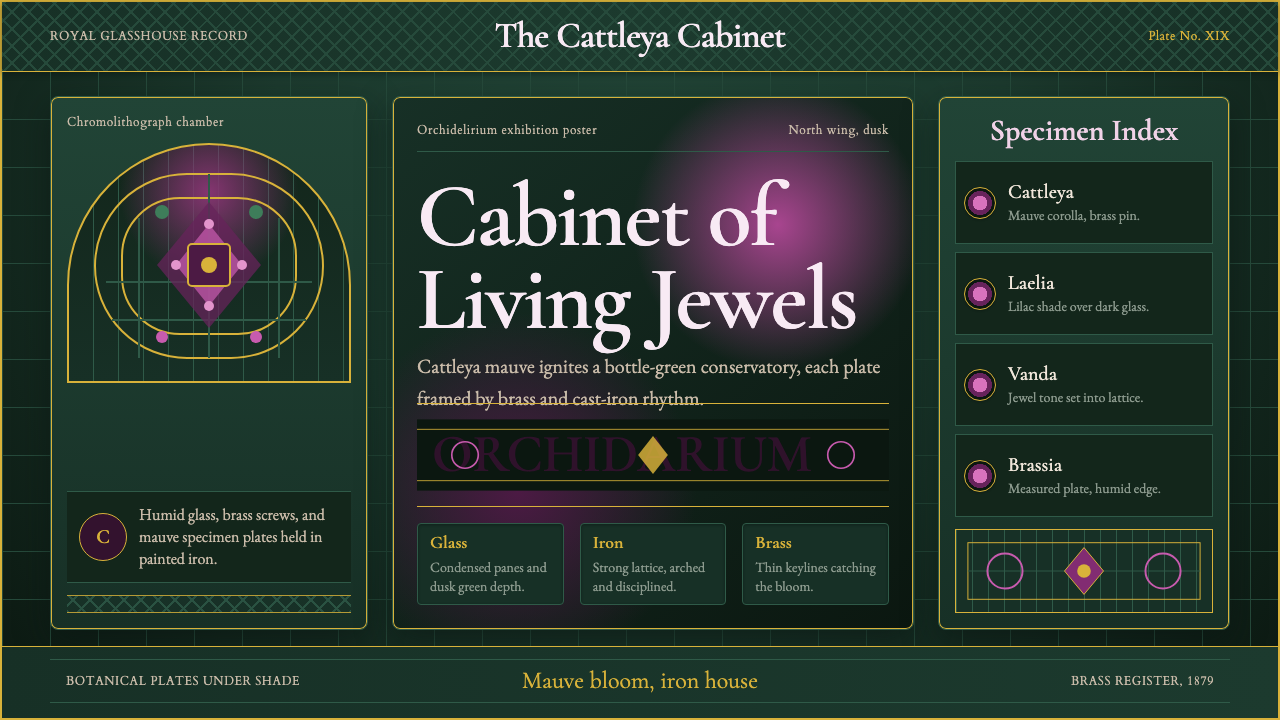 Orchid ConservatoryLush Victorian darkness. Cattleya mauve and brass sit inside bottle-green iro…
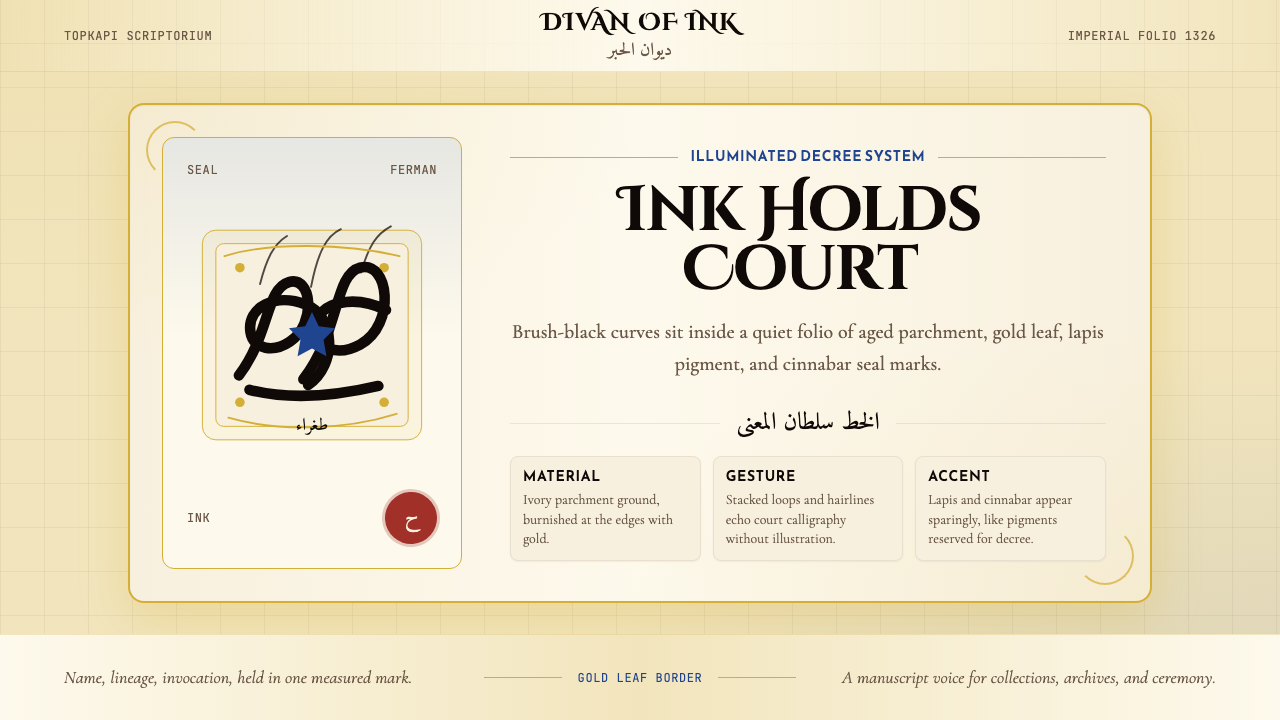 Ottoman Tughra CalligraphyImperial ink holds court. Gold borders, lapis panels, and Cinzel tughra-like…