What is Rajasthani Pichwai (Nathdwara)?
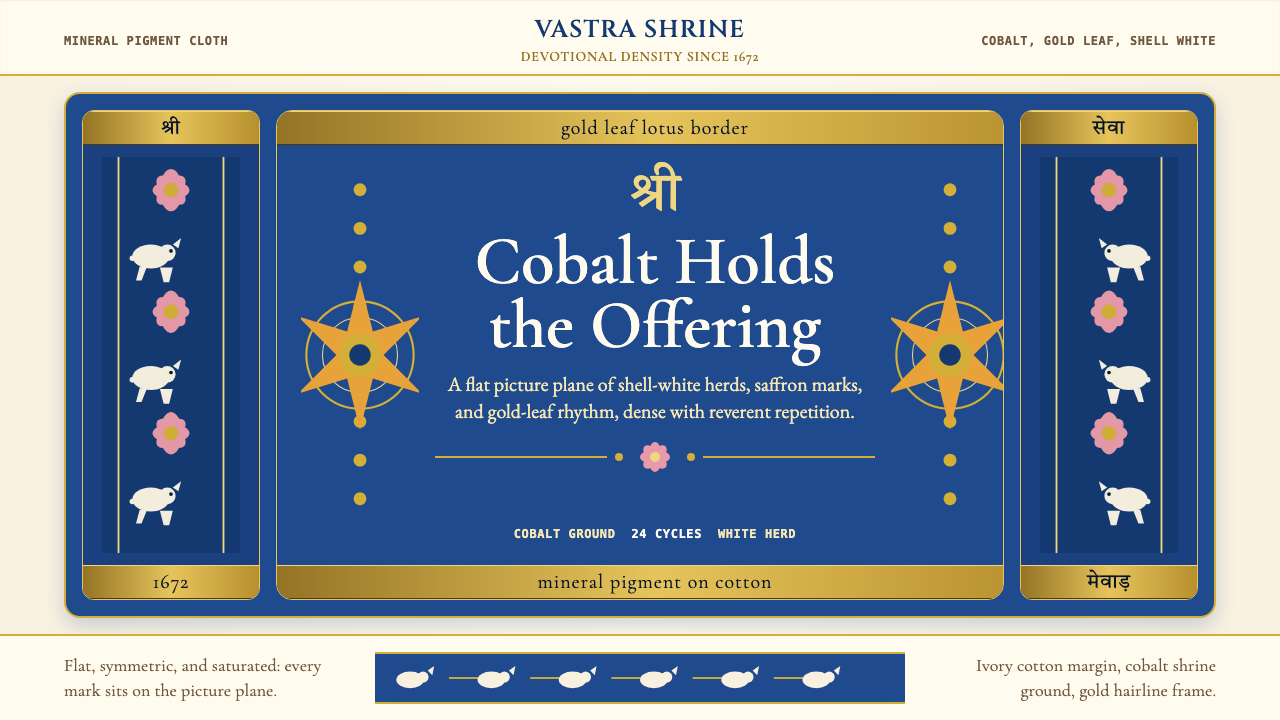
Pichwai is devotional density made visible — centuries of cobalt, gold leaf, and lotus-strewn ponds painted in reverence behind the throne of Krishna.
Rajasthani Pichwai (Nathdwara) in brief
Pichwai (from the Sanskrit pichhe, 'behind', and wai, 'hanging') is a tradition of large-scale devotional cloth painting originating in Nathdwara, a temple town in the Rajsamand district of Rajasthan, India. The paintings are created to hang directly behind the idol of Shrinathji — the seven-year-old form of the god Krishna — inside the Nathdwara temple. Each composition is seasonal and liturgical: different Pichwais depict the monsoon festival of Hindola, the winter solstice celebration of Makar Sankranti, the lotus-bloom of the rainy season, or the lantern-lit nights of Sharad Purnima. The paintings are not static wall decoration but living ritual objects whose display marks the turning of the devotional calendar.
Visually, Pichwai is built on a logic of sacred abundance. The picture plane is dense and flat, with no Western perspective or recession into distance. Compositions are symmetrical and centripetal — every element orbits around Krishna, who appears at the center wearing a peacock-feather crown and a necklace of wildflowers. Surrounding him are dozens of white cows rendered in near-identical form, a procession of gopika milkmaids, and vast fields of pink lotus blossoms on cobalt water. Gold-leaf borders frame the entire field in interlocking vine and floral patterns. The palette is anchored by deep, jewel-saturated mineral pigments: cobalt and ultramarine for sky and water, ivory and shell-white for the sacred cows, saffron and warm ochre for lamplight and garments, and burnished gold for borders and divine ornament.
Unlike decorative folk traditions, Pichwai is a disciplined iconographic system. The proportions of the figures, the number of cows, the arrangement of the lotus fields, and the placement of attendant figures are governed by long-established conventions passed from master to apprentice within Nathdwara studio families. The result is a style that reads simultaneously as richly ornate and internally coherent — every inch of canvas carries meaning, yet the composition never feels arbitrary.

Where does Rajasthani Pichwai (Nathdwara) come from?
The story of Pichwai begins with a forced journey. In 1669, the Mughal emperor Aurangzeb ordered the destruction of Hindu temples in Mathura, the sacred city associated with Krishna's birth. To protect the idol of Shrinathji — a naturally formed black stone image believed to embody Krishna himself — the Vallabhacharya Pushtimarg sect undertook a year-long pilgrimage by ox cart across Rajasthan. In 1672, the cart's wheels sank into the mud at the site of present-day Nathdwara, which devotees interpreted as the god's will to remain there. A new temple was built, and Nathdwara — whose name means 'gateway to the Lord' — became the spiritual and artistic center of the Pushtimarg tradition.
The Pichwai form developed in direct response to the needs of this temple. The idol of Shrinathji required a visually elaborate backdrop that could be changed according to the liturgical calendar, providing the god's eyes (nazar) with an appropriate environment for each feast and season. Early Pichwais were produced by artists attached to the temple, working under the supervision of the goswami priests who served as both religious and artistic authorities. The Joshi and Soni families of Nathdwara emerged as the most prominent studio lineages, developing and codifying the conventions that define the tradition: the scale of the figures, the rendering of the cows' coats, the geometry of the lotus fields, and the grammar of the gold-leaf border.
Stylistically, Pichwai absorbed and synthesized the Mewar school of Rajput painting, which had flourished in Udaipur under the patronage of the Mewar kings. Mewar painting was itself a sophisticated court tradition, combining bold mineral pigments with fine line-work and a preference for symmetrical, hierarchical compositions. When Nathdwara artists began producing Pichwais in large numbers during the eighteenth and nineteenth centuries, they drew on this visual vocabulary but adapted it to the demands of devotional practice: figures became more stylized, compositions more repetitive and iconic, and the gold-leaf work more elaborate, reflecting the theology that Shrinathji's world should be experienced as a realm of perfected, unchanging abundance.
The twentieth century brought both commercial pressures and a renewed interest in preservation. As Pichwai painting gained collectors and institutional recognition, workshops in Nathdwara expanded production, sometimes at the cost of quality. A significant revival movement beginning in the 2010s sought to reconnect the tradition with its finest historical examples, with artists such as Pooja Singhal gaining international attention for work that applied Pichwai's visual grammar to contemporary subject matter while maintaining hand-ground mineral pigments, hand-spun cotton grounds, and the strict iconographic conventions of the Nathdwara lineage. Today, Pichwai is recognized under the geographical indication system that protects the term for works produced by artists from the Nathdwara tradition.
What defines the Rajasthani Pichwai (Nathdwara) look?
Palette
Pichwai's color identity is built on four anchors: deep cobalt and ultramarine for sky and water, warm ivory and shell-white for the sacred cows and Krishna's dhoti, saffron and burnt ochre for garment accents and lamplight, and burnished gold for borders and divine ornament. These pigments were traditionally hand-ground from minerals — lapis lazuli, indigo, white chalk — giving them an opacity and luminosity that synthetic dyes cannot replicate. The palette is saturated and declarative, with no pastels, no gradients, and no desaturated neutrals: every color carries devotional weight.
Flat Picture Plane
Pichwai compositions are entirely flat. There is no atmospheric perspective, no cast shadow to suggest depth, no foreshortening to imply a three-dimensional body. Figures, animals, and botanical elements occupy the same visual plane, layered and overlapping but never receding. This flatness is not a technical limitation — it is a theological statement. The world of Shrinathji is not a naturalistic world; it is a perfected, timeless realm where all elements are simultaneously present and equally radiant.
Symmetry and Repetition
The compositional logic of Pichwai is centripetal and symmetrical. Krishna occupies the vertical and horizontal center; cows, gopika attendants, and lotus clusters mirror each other across a central axis. Repetition is not a shortcut but a devotional device — the dozens of nearly identical white cows are a meditation on multitude, expressing the infinite abundance of Krishna's Vrindavan world. The repeated lotus motif across border, background, and foreground creates a visual rhythm that functions like a mantra: constant, structured, and calming.
Gold-Leaf Borders
Every Pichwai is framed by one or more bands of elaborate gold-leaf ornamentation. These borders typically feature interlocking lotus vines, peacock feathers, or floral medallions rendered in beaten gold applied directly to the cloth ground. The border is not decorative in the secular sense — it defines a sacred threshold between the ordinary world and the divine interior of the composition. In the most elaborate festival Pichwais, the border may occupy a quarter of the total surface area, its density signaling the importance of the occasion depicted.
Sacred Iconography
Pichwai is governed by an exact iconographic code. Krishna's figure follows strict proportional rules and is invariably depicted with blue-black skin, a peacock-feather crown (morpankh), a flute, and a garland of forest flowers (vaijayanti mala). The white cows of Vrindavan appear in groups whose number is prescribed by tradition for each festival type. Lotus flowers carry specific symbolic weight: the open bloom represents divine purity and enlightenment; the closed bud represents potential. Seasonal indicators — monsoon clouds in grey-blue, autumn full moons, winter stars — tell the viewer exactly which moment in the liturgical year is depicted.
Mineral Pigments on Cotton
Traditional Pichwai is executed on hand-spun, hand-woven cotton cloth prepared with a ground of chalk and gum to seal the weave and provide a smooth painting surface. The pigments are mineral-based: natural ultramarine and indigo for blues, vermilion and red ochre for warm tones, orpiment for yellow, carbon black for outlines. These pigments are opaque and matte, giving Pichwai its characteristic velvety, non-reflective surface that absorbs rather than bounces temple lamplight. Gold is applied as beaten leaf over a gum adhesive. The combination of matte ground and gold leaf creates a deliberate visual tension between richness and restraint.
Density as Devotion
Where minimalist traditions treat empty space as a positive element, Pichwai treats the filling of space as an act of devotion. A finished Pichwai typically has no resting zones: every area of sky becomes a lotus vine, every interval between cows becomes a spray of flowers or a peacock feather, every border segment carries a complete ornamental unit. This horror vacui — the compulsion to fill — is not anxiety but abundance theology translated into visual form. To leave the canvas empty would be to withhold from the god; to fill it completely is an act of offering.

Who shaped Rajasthani Pichwai (Nathdwara)?
The philosopher-saint Vallabhacharya founded the Pushtimarg sect — the 'path of grace' — whose theology of devotional service (seva) to Krishna as a child-god created the liturgical framework that Pichwai was developed to serve. His teaching that the divine is best approached through joyful, abundant offering rather than austerity directly shaped the visual logic of Pichwai: the packed composition, the lavish gold, and the seasonal changing of paintings are all expressions of seva as Vallabhacharya defined it. The Nathdwara temple and its artistic tradition exist because of the pilgrimage his followers undertook to protect the Shrinathji idol in 1672.
The Joshi and Soni family lineages of Nathdwara are the primary custodians and transmitters of the Pichwai tradition. Working as hereditary studio families attached to the Nathdwara temple, they codified the compositional conventions, color recipes, and iconographic rules that define authentic Pichwai across generations. Their workshops trained apprentices through direct transmission — grinding pigments alongside masters, copying canonical compositions before developing individual fluency — a pedagogy that preserved technical knowledge that would otherwise have been lost when synthetic materials became available. Many contemporary Pichwai artists working in India and internationally can trace their training lineage back to these families.
Among the contemporary artists who have brought Pichwai to international attention, Pooja Singhal is among the most recognized. Her work maintains strict fidelity to the technical demands of the Nathdwara tradition — hand-ground mineral pigments, natural gold leaf, hand-prepared cotton grounds — while extending the iconographic vocabulary to address subjects beyond the traditional liturgical themes. Her pieces have been exhibited internationally and collected by institutions interested in the living evolution of the tradition. She has also been a vocal advocate for the geographical indication protection of the Nathdwara Pichwai name, arguing that the term should be legally reserved for works produced by artists trained within the tradition.
The rulers of the Mewar kingdom, particularly those of the Sisodia Rajput lineage based in Udaipur, were the direct patrons of the courtly Rajput painting tradition from which Pichwai evolved. Their courts supported ateliers of skilled painters working in the Mewar style: bold mineral pigments, fine line-work, hierarchical compositions, and a preference for depicting the life of Krishna in the forests of Vrindavan. When Nathdwara became the center of the Shrinathji cult after 1672, the Mewar court extended patronage to the temple artists, enabling the development of Pichwai as a distinct genre that preserved and elaborated the Mewar visual tradition within a strictly devotional context.
How do you use Rajasthani Pichwai (Nathdwara) today?
Applying Pichwai to contemporary design work — presentations, web interfaces, editorial layouts, or marketing materials — requires understanding what the style is actually doing structurally, not simply borrowing its surface patterns. The core principle is devotional density: the frame is fully inhabited, every element has a place in a hierarchical system, and richness is achieved through repetition of a limited motif vocabulary rather than through variety. Designers who grasp this distinction can use Pichwai's logic meaningfully; those who treat it as a pattern library will produce pastiche.
For presentation slides, Pichwai's vocabulary translates most effectively to cover slides, section dividers, and data-light storytelling slides. A cover slide benefits from the style's centripetal composition: a central visual element — a lotus medallion, a peacock-feather arc, a symmetrical golden border frame — anchors the eye while title text sits either within the composition's center or in a clean reserved band at the top or bottom. The deep cobalt and saffron palette works well on both light cotton-white grounds and rich dark grounds. Content slides should be treated with restraint: use one Pichwai-derived ornamental element — a lotus divider, a corner border detail — to signal the visual system without overwhelming the information. Data slides can adopt the style's circular and petal geometries for chart forms: donut charts rendered in the cobalt-saffron palette, radial diagrams that echo the mandala-like compositional logic of the original paintings.
For web interfaces and dashboards, Pichwai's symmetrical, hierarchical logic is well-suited to hero sections, landing pages, and product showcases where visual impact is the primary goal. The approach: establish an ivory or warm-white ground, use a deep cobalt or midnight-blue as the dominant accent for key headings and primary interactive elements, and introduce the gold only as a border or highlight weight — not as a fill color. Navigation and body text should remain in a neutral dark tone to ensure readability against the ornamental accents. Pricing pages can use the style's hierarchical symmetry to create tier cards that feel weighted and authoritative: centered layouts, gold-accent borders distinguishing the premium tier, and lotus or vine motifs used sparingly as section breaks. The mistake to avoid is applying the full Pichwai density to functional UI components — reserve the ornamental richness for hero and showcase zones.
For editorial and marketing work, Pichwai offers a powerful visual register for cultural contexts, luxury positioning, and festive or seasonal campaigns. A magazine spread or campaign visual can use the style's border logic — a full gold-leaf frame containing a central image — to create immediate visual authority. The repetition principle applies to pattern backgrounds: a half-drop of stylized lotus or peacock elements at reduced opacity creates depth without overwhelming the foreground content. For marketing contexts, the saffron-cobalt palette reads as both warm and premium, associating the work with craft and heritage. Ensure that any text set over Pichwai-patterned backgrounds is in a high-contrast neutral — white on cobalt, near-black on ivory — to maintain legibility.
The most common mistake when applying Pichwai aesthetics is conflating its density with chaos. Authentic Pichwai is dense but rigorously ordered: every lotus is placed, every cow is proportioned, the border is a distinct zone separate from the field. Designers who apply Pichwai motifs without this underlying order produce a visual noise that reads as decorative wallpaper rather than a coherent style. A second common error is using the gold element too freely — in the original tradition, gold marks the sacred threshold and the divine. Applied to every interactive element or heading, it loses its ability to signal hierarchy. Use it sparingly, as the tradition does: for borders that define the sacred interior, for the most important tier of information, and for the single visual element that the entire composition serves to frame.

Rajasthani Pichwai (Nathdwara) — FAQ
What makes Pichwai different from other Indian decorative painting styles?
Pichwai is distinguished primarily by its liturgical function and iconographic precision. Unlike Madhubani, Warli, or Pattachitra — folk traditions whose motifs and formats vary significantly between artists and regions — Pichwai is a temple art with fixed iconographic rules: the figure of Shrinathji is depicted according to proportional canons, the white cows appear in specified numbers for each festival type, and the seasonal indicators follow an established visual grammar. Pichwai is also unusual in scale: the large cloth hangings could be several meters in height, dwarfing the idol they frame. Aesthetically, the combination of deep mineral pigments, gold-leaf borders, and the flat, saturated color field places Pichwai apart from the finer, more illustrative line-work of Mughal miniature painting and the more gestural approach of folk traditions.
How does the seasonal calendar affect Pichwai compositions?
The liturgical calendar of the Pushtimarg sect specifies a different appearance (swaroop) for the Shrinathji idol on every significant feast day, and the Pichwai displayed behind the idol must match. For the Hindola (swing) festival of the monsoon season, the composition centers on Krishna in a flower-covered swing amid dense rain clouds rendered in grey-blue. For Sharad Purnima (the autumn full moon), the background is lit by dozens of oil-lamp flames, the lotus ponds are rendered in moonlit silver-white, and the overall palette shifts toward cool silvers and warm golds. For winter festivals, bare trees and night skies replace the lush lotus fields of summer. The seasonal specificity means that major Pichwai workshops historically maintained a cycle of distinct compositions — one for each significant festival — rotating them throughout the year.
Can Pichwai aesthetics work in digital interfaces without looking kitsch?
Yes, but success depends on restraint and structural understanding rather than pattern application. The styles that translate well to digital contexts are Pichwai's compositional logic — symmetry, hierarchy, centripetal focus — and its color palette's boldness. What typically produces kitsch is the wholesale importation of Pichwai surface patterns into contexts where there is no underlying structural order to justify them. A digital application that uses deep cobalt as its primary brand color, reserves gold as a premium-tier signal, and constructs layouts with centripetal visual hierarchy is meaningfully drawing on Pichwai. An application that wallpapers a signup screen in lotus patterns is not. The tradition's density belongs to sacred objects; contemporary UI components should inherit its logic, not its literal surface.
Is it appropriate to use Pichwai aesthetics for non-Indian brands or content?
The question is less about geographical origin and more about intentionality and depth of engagement. A brand that uses Pichwai motifs decoratively, without understanding their iconographic meaning, risks producing work that reads as superficial appropriation — lotus patterns as exotic decoration, gold borders as generic luxury signaling. A brand that engages with the tradition seriously — understanding the seasonal logic, the iconographic system, the material vocabulary — and is transparent about that engagement, can produce work that genuinely honors the tradition while finding contemporary application. The distinction mirrors the difference between applying Bauhaus as a structural principle versus borrowing its color palette: one is an intellectual engagement with a system, the other is surface pastiche. Consulting with artists or scholars from the tradition and crediting Nathdwara as the source is both respectful and practically useful for establishing authenticity.
What is the difference between an authentic Pichwai and a commercially reproduced one?
The differences are material, technical, and iconographic. An authentic Nathdwara Pichwai is painted on hand-prepared natural cotton with hand-ground mineral pigments and genuine gold leaf; the preparation of materials alone may take days. Commercially reproduced versions are typically printed on synthetic fabric or machine-woven cotton, use acrylic or synthetic pigments that have a different surface quality — shinier, less matte — and apply gold paint rather than gold leaf. Iconographically, authentic works follow the proportional canons and compositional rules of the Nathdwara tradition; commercial reproductions often introduce simplified or altered motifs, incorrect figure proportions, or generic 'Indian' decorative elements that have no place in the Pichwai grammar. The geographical indication protection now in place for Nathdwara Pichwai is intended to formalize this distinction legally, though enforcement remains a challenge.
Related design styles
 Bhutanese Drukpa Kagyu ThangkaDevotion made cobalt. Gold frames, Cormorant serif, and vermilion marks hold…
 Armenian ErkatʿagirDevotional lapis reigns. Gold rules and angular serif glyphs frame a sacred g…
 Bhutanese Dzong (Fortress Red)Monumental red holds the page. Cobalt frames and gold bands lock the fortress…
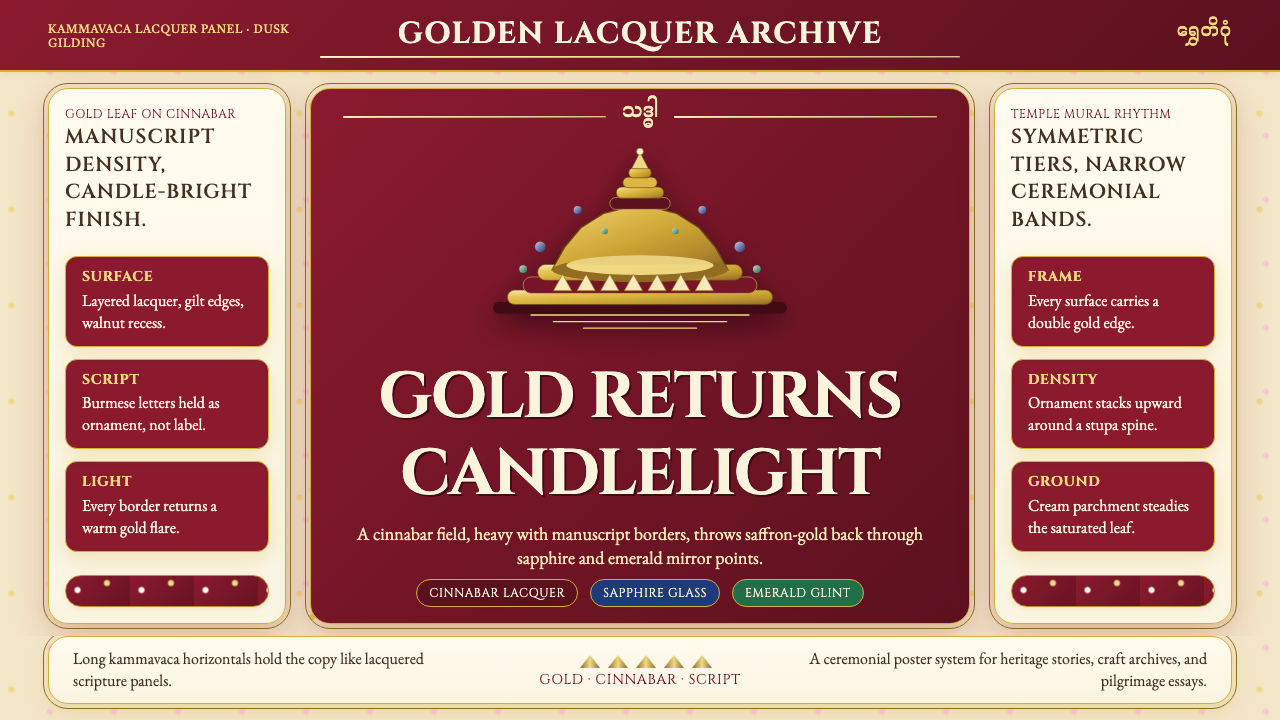 Burmese Shwedagon Gold-LacquerOpulence catches fire. Gold-leaf gradients on cinnabar panels frame a stupa s…
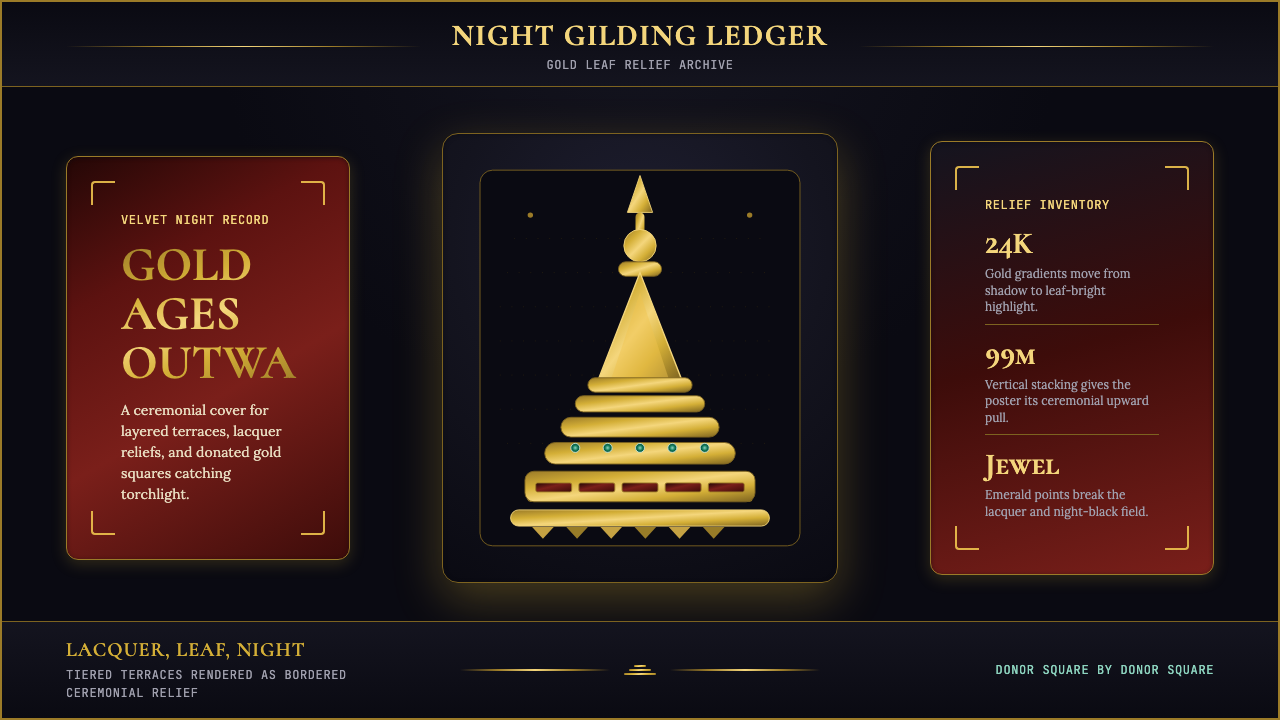 Burmese Shwedagon Stupa ReliefGold refuses restraint. Velvet black, teak-red lacquer, and tiered gradients…
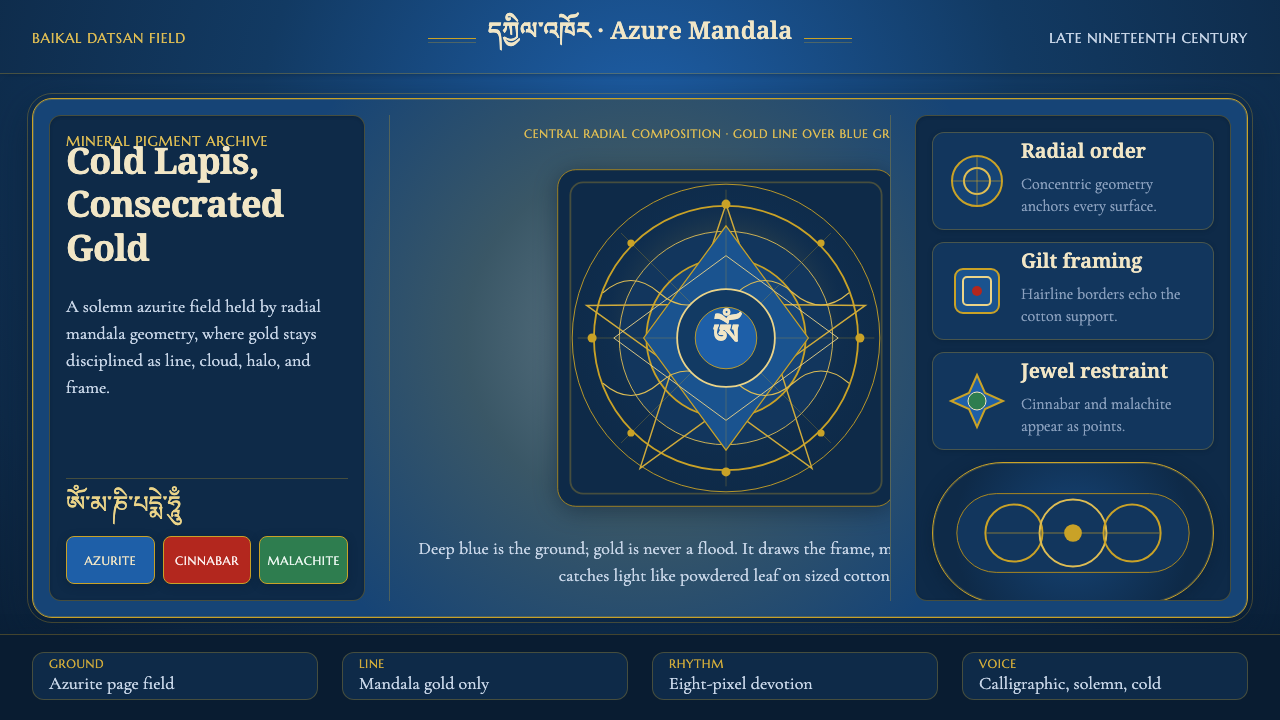 Buryat Buddhist Datsan ThangkaCold lapis holds silence. Gold mandala lines frame a solemn azurite field.