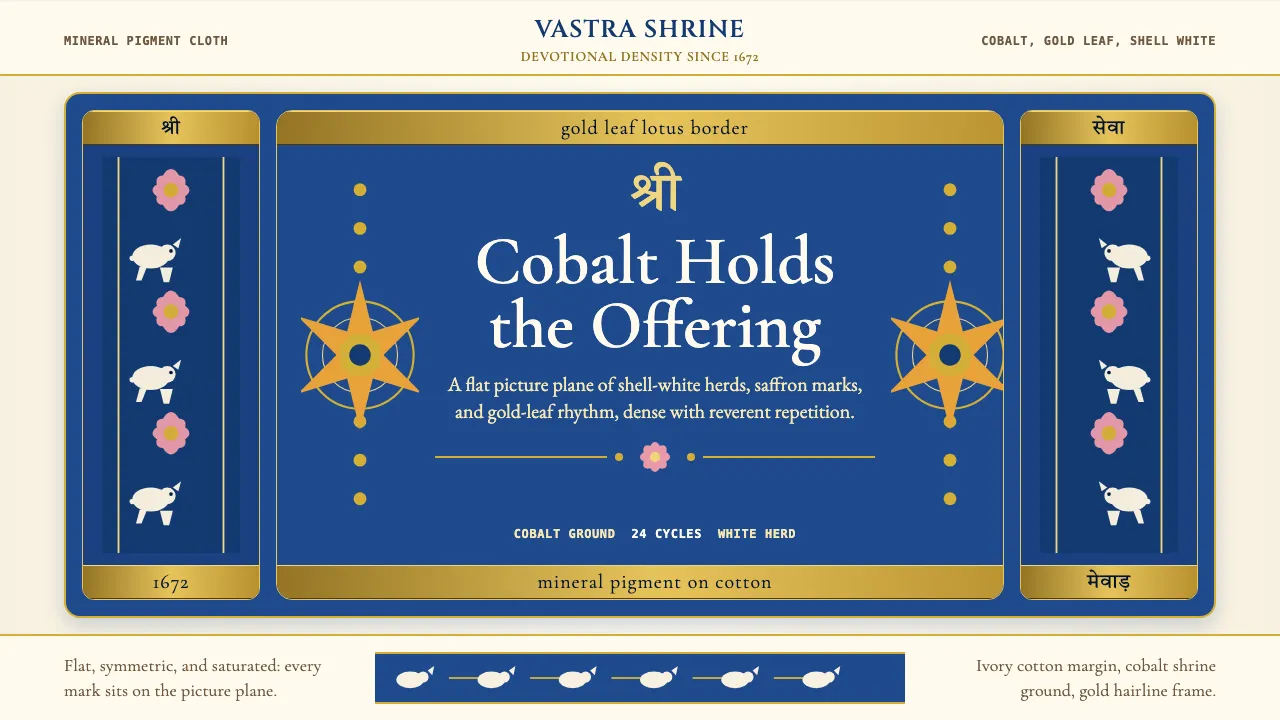
About Rajasthani Pichwai (Nathdwara)
Pichwai is the devotional cloth-painting that hangs behind the Shrinathji-Krishna idol at the Nathdwara temple in Rajasthan, continuous since 1672. Large hand-painted cotton hangings depict Krishna among lotus-strewn ponds and dozens of identical white cows, framed by gold-leaf borders.
The aesthetic chord is **cobalt + gold + white + saffron**: jewel-saturated mineral pigment, flat picture-plane, repeated devotional motifs, no Western perspective. Composition is symmetric, dense, and reverent — devotional density, not minimalism.
- Origin
- Nathdwara, Rajsamand district, Rajasthan, India
- Era
- 1672 onward (Shrinathji relocation to Nathdwara); continuous through Mewar tradition; current revival ~2010s–2024
- Key figures
- Vallabhacharya Pushtimarg sect · Nathdwara goswami priests · Joshi-Soni studio families · Pooja Singhal
- Movements
- Vaishnava devotional cloth-painting · Mewar Rajasthani painting · Pushtimarg seva tradition
Rajasthani Pichwai (Nathdwara) design spec
Colors
Typography
The other 11 sections — buttons, cards, spacing, motion, techniques and more — open once you unlock. Download the DESIGN.md or send it to your AI in one click. Unlock once, yours forever.
Sign up nowStyles similar to Rajasthani Pichwai (Nathdwara)
Also inspired by crafts & folk art, with a close feel.
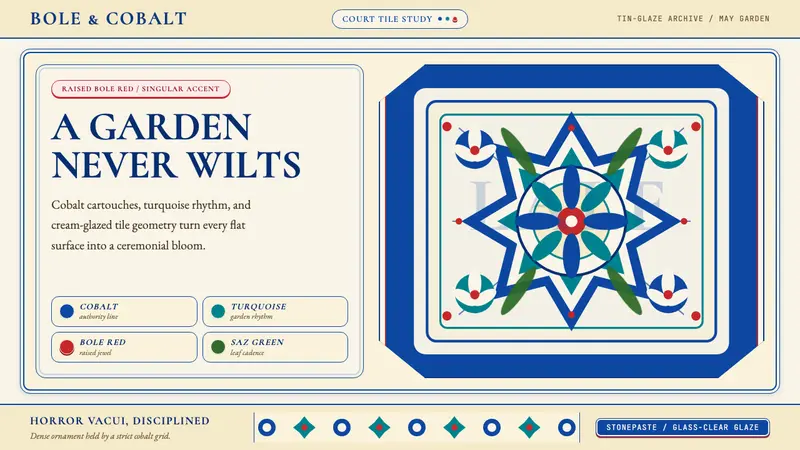 Turkish İznik CeramicBlooms with discipline. Cobalt grid and cream glaze hold turquoise motifs with one bole-red jewel.
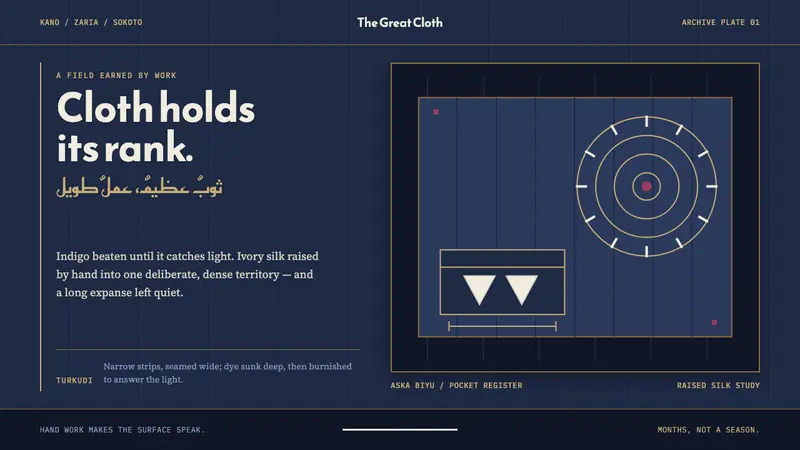 Hausa Babban RigaRank is worked, not announced. Burnished indigo holds raised ivory geometry in one dense zone.
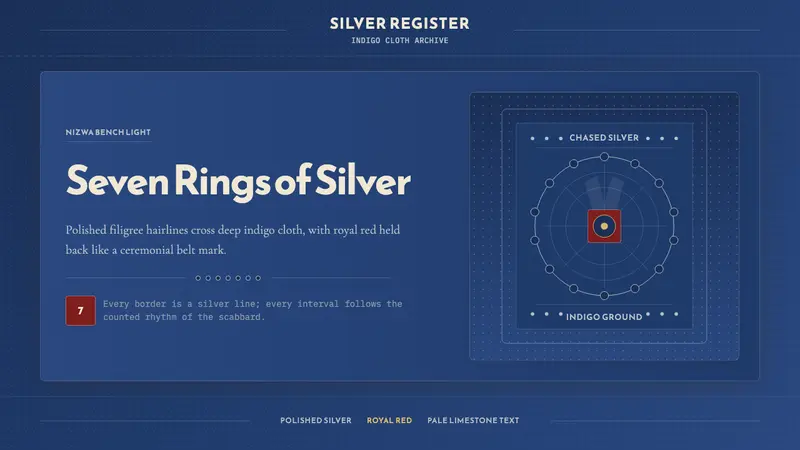 Omani Khanjar Silver DaggerFormal craft gleams. Silver hairlines and seven-ring rhythm rest on indigo cloth.
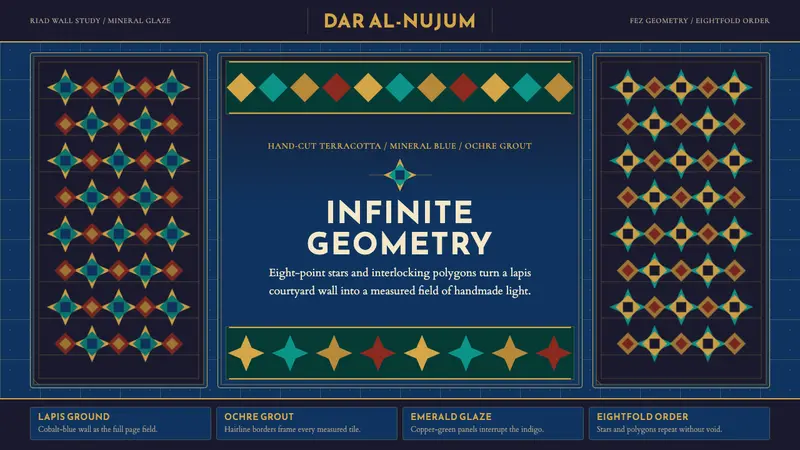 Moroccan Zellige TileLuxurious geometry without void. Lapis ground, ochre borders, and eight-point stars tessellate.