What is Ming Blue-and-White Porcelain?
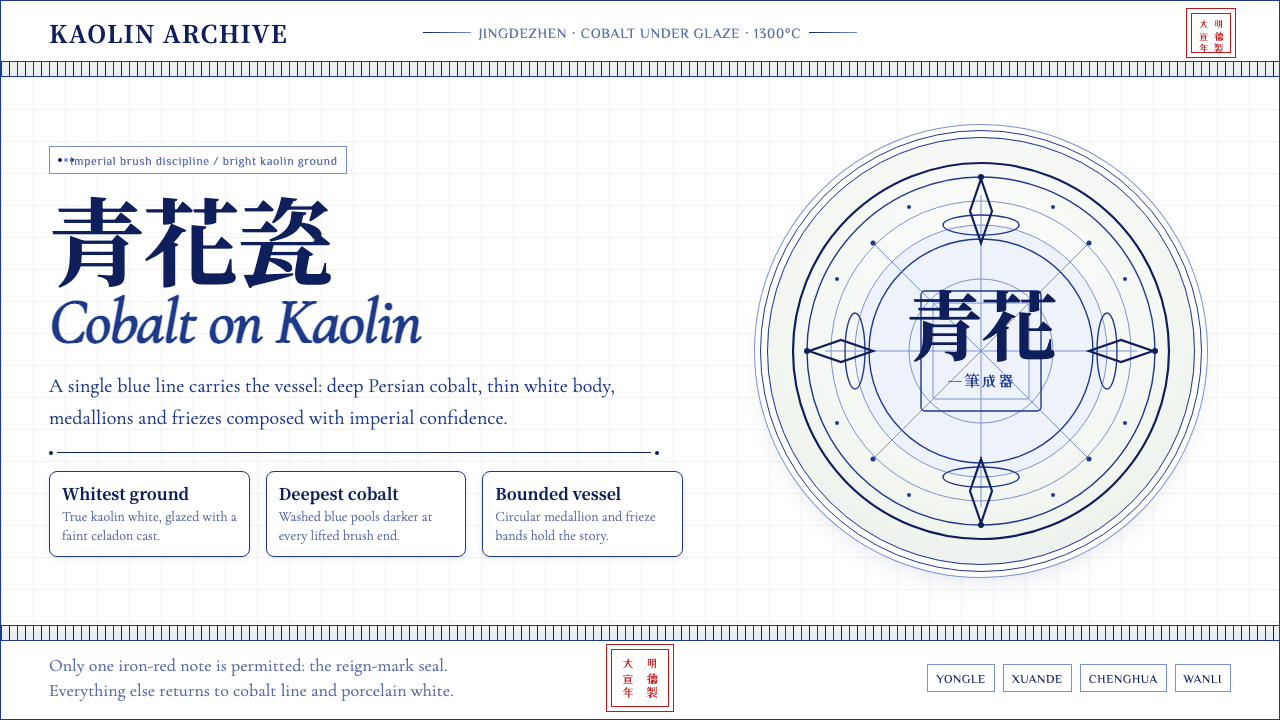
Ming Blue-and-White is the porcelain that Delft spent two centuries trying to imitate — imperial cobalt brushed over pure kaolin white, fired until every line sang.
Ming Blue-and-White Porcelain in brief
Ming Blue-and-White porcelain is the visual language of imperial restraint taken to its highest pitch: a pure, milk-white kaolin body painted with cobalt oxide — yielding a deep, luminous blue — then fired at temperatures that glass and most metals could not survive. The result is a surface that is simultaneously hard and delicate, its brushwork locked permanently into the glaze. Nothing is applied on top; everything lives inside.
The aesthetic discipline is severe. The ground must be as white and as unblemished as possible. The blue must be as deep and as clear as the night sky over the Yellow Sea. The brushstroke must have the confidence and flow of a calligrapher at full speed — no hesitation, no correction, no second pass. Dragons encircle the shoulder of a jar; lotus scrolls wrap the belly; scholars and mountains compress into a medallion no wider than a thumb. Every centimeter is narrated space, yet the whole never feels crowded because the white ground breathes between every motif.
What separates Ming Blue-and-White from later imitations — European Delftware, Japanese Arita, Qing reproductions — is the quality of the cobalt and the confidence of the line. The finest pieces from the Yongle and Xuande reigns were made with imported Persian cobalt known as Sumali blue (sumaliqing), which burned with a spontaneous darkness at high temperature, producing the characteristic ink-spot pooling that connoisseurs call heiban, or black stipple. No subsequent tradition fully replicated this specific depth of tone.

Where does Ming Blue-and-White Porcelain come from?
Blue-and-white porcelain did not begin with the Ming dynasty. Its roots lie in the Yuan period (1271–1368), when Jingdezhen potters first learned to paint in cobalt under a transparent glaze, producing large display pieces — platters, jars, vases — intended for the Central Asian and Middle Eastern export markets. The cobalt itself came via the Silk Road from Persia, and the early designs often blended Chinese motifs with Islamic geometric sensibilities. The famous David Vases, dated by inscription to 1351, survive as the clearest evidence of how accomplished Yuan blue-and-white had already become.
When Zhu Yuanzhang overthrew the Yuan and founded the Ming dynasty in 1368, he initially restricted luxury production, but his successors quickly recognized the diplomatic and economic power of fine porcelain. The Yongle Emperor (r. 1402–1424) brought Jingdezhen's imperial kilns to full production, and it was under his reign and that of his successor Xuande (r. 1425–1435) that the aesthetic reached what most scholars consider its classical peak. Yongle pieces are known for their exceptionally thin bodies and elegant floral arabesques. Xuande pieces introduced a slightly thicker, more robust form, with bolder compositions and the iconic reign mark — six characters in two rows of standard script inside a double circle — that became the model all subsequent kilns tried to replicate.
The Chenghua period (1465–1487) is celebrated for a different quality: delicacy to the point of translucency, and the development of the doucai (contending colors) technique, in which underglaze blue outlines are filled in with overglaze enamels after firing. Pure blue-and-white from this reign tends toward smaller, more intimate objects — cups, saucers, small jars — painted with scholarly restraint. The Wanli period (1573–1620) represents a final flourishing of extraordinary output volume, fueled by the massive demand from the maritime export trade. Kraak ware — the paneled, radiating-compartment style that flooded European markets and prompted the Dutch imitation industry — was largely a Wanli product.
The kilns at Jingdezhen operated under the direct supervision of an imperial commissioner. By the Xuande period this supervisory role had been systematized: potters, painters, glaze specialists, and kiln masters all worked in a division of labor whose output was recorded, inventoried, and matched against strict court specifications. Pieces that passed inspection bore the reign mark; those that failed were smashed. This institutional discipline — ruthless quality control under imperial authority — is one reason the best Ming blue-and-white has never been surpassed in technical consistency. Tang Ying, the great superintendent of the Qing imperial kilns who came two centuries later, wrote admiringly of the Ming potters and dedicated much of his career to understanding what they had achieved.
What defines the Ming Blue-and-White Porcelain look?
Palette
The palette is intentionally binary: a pure, cool white ground against one single blue, ranging from the steely midnight of Xuande sumaliqing to the somewhat brighter, more even tone of mid-Ming domestic cobalt. There is no secondary hue, no warm accent, no neutral gray midtone. The white carries the negative space; the blue carries every narrative detail. This extreme restraint — a two-color system in which one of the two colors is the ground itself — produces a graphic clarity that no polychrome tradition achieves.
Ground Quality
The white ground of the finest Ming pieces — particularly Yongle and Xuande — is not simply white; it has a subtle warmth and translucency that later Qing reproductions, which tend toward a glassier, cooler white, rarely match. This quality comes from the specific composition of the Jingdezhen kaolin and petuntse (china stone) mix, and from the way the high-fire reduction atmosphere affected the glaze surface. The ground reads as alive, not as a dead backdrop.
Brushwork
Ming blue-and-white is painted with a brush, not printed or stenciled, and the best painters worked with the speed and authority of practiced calligraphers. A dragon's scale pattern consists of hundreds of small overlapping arc strokes, each placed without hesitation. Lotus petals have a pointed flick at the tip that can only be made in a single, uninterrupted gesture. The sumaliqing cobalt, being particularly fluid, recorded every quality of the stroke — pressure, speed, angle — permanently into the glaze. This is not illustration; it is calligraphy applied to form.
Narrative Wrap
Ming decorative programs treat the vessel as a continuous narrative surface, not a flat field with a central image. Dragons, phoenixes, lotus scrolls, and scholar-in-landscape scenes circle the entire circumference without beginning or end — the composition is designed to be read while rotating the piece in the hand. Borders and registers (horizontal banding) organize the vertical dimension: a shoulder band, a body register, a foot band, each with its own motif vocabulary. The result is a total visual environment wrapped around a three-dimensional form.
Reign Mark
The six-character reign mark — giving the dynasty name and the emperor's reign title — appears on the base of the vessel in standard-script regular script, arranged in two columns of three characters, usually within a double circle or double square. This mark is not decorative in the casual sense; it is an official imperial imprimatur, equivalent to a government seal. The discipline required to write these six characters faultlessly in the cramped, curved space of a vessel base, after the piece has already been painted and before it enters the kiln, is itself a measure of the workshop's standard.
Black Stipple (Heiban)
The sumaliqing cobalt used in Yongle and Xuande wares contains trace impurities — particularly manganese and iron — that at high temperature produce localized dark pooling within the blue. These spontaneous dark concentrations, called heiban (black stipple) or heidie (black spots), are not defects; they are proof of authenticity. Connoisseurs read them the way a wine expert reads sediment: as evidence of origin and process. No synthetic cobalt or later domestic Chinese cobalt fully reproduces this effect. The stipple gives the blue a depth and vitality that flat, evenly toned cobalt cannot achieve.
Form and Function Unity
Ming imperial porcelain was not merely decorative. The forms — yuhuchunping (pear-shaped) vases, meiping (prunus) vases, large covered jars, stem cups, ewers — were each designed for specific ritual or ceremonial uses at court. The decorative program reinforces the function: a ewer used in Buddhist ritual carries lotus and cloud-scroll motifs; a jar for wine storage carries grape-vine and squirrel patterns borrowed from Central Asian textile traditions. Form, decoration, and use speak the same language.

Who shaped Ming Blue-and-White Porcelain?
The Yongle Emperor, third ruler of the Ming dynasty, oversaw the most ambitious expansion of the Jingdezhen imperial kilns. Under his reign, the importation of Persian sumaliqing cobalt was systematized, enabling the dense, spontaneously pooling blue that defines the early Ming aesthetic. Yongle pieces — particularly the sweetmeat boxes, ewer forms, and large platters made for both court use and diplomatic gifts — are among the most refined objects in the history of world ceramics. His court also hosted the great treasure fleet voyages of Zheng He, and blue-and-white porcelain served as a key diplomatic currency on those expeditions.
The Xuande reign is widely regarded as the single greatest period in the history of blue-and-white porcelain. The emperor was himself a painter and calligrapher, and his personal aesthetic sensibility is visible in the confidence and clarity of the brushwork produced during his decade on the throne. Xuande reign marks are the most copied of all Chinese imperial marks — a fact that both confirms and complicates authentication. The technical achievements of his kilns — the specific depth of the sumaliqing blue, the quality of the glaze surface, the consistency of the firing — have never been equaled.
The Chenghua period refined blue-and-white toward a different ideal: smaller, more intimate objects, with a domestic cobalt that burned less intensely but more evenly than sumaliqing. The Chenghua aesthetic is delicate, almost understated — tiny chicken cups, small wine jars, cylindrical brush holders — painted with a fineness that requires magnification to fully appreciate. The period also saw the development of doucai, a technique in which underglaze blue outlines are completed with overglaze colored enamels, producing a polychrome effect of great delicacy. Chenghua pieces are among the most expensive individual lots ever sold at auction.
The Wanli period was the age of mass export. The kilns at Jingdezhen produced blue-and-white in quantities that no earlier reign had approached, flooding the maritime trade routes of Southeast Asia, the Middle East, and eventually Europe. The characteristic Wanli export style — dense, busy compositions, paneled borders, radiating medallions — became known in Europe as Kraak ware and directly inspired the founding of the Delft pottery industry. Wanli pieces are rarely as refined as Xuande or Chenghua work, but they represent the most globally consequential chapter in Chinese porcelain history: the moment when a single Chinese aesthetic reshaped ceramic traditions on four continents.
Tang Ying served as superintendent of the imperial kilns at Jingdezhen during the Yongzheng and Qianlong reigns of the Qing dynasty, more than a century after the Ming's fall. He is included here because his detailed written records — technical treatises, poem sequences, official reports — are among the most valuable sources for understanding what Ming potters actually did and why it was so difficult to reproduce. Tang Ying spent years attempting to reverse-engineer the Ming sumaliqing effect using available Qing-era materials and never fully succeeded. His humility in the face of the Ming achievement is itself testimony to its stature.
How do you use Ming Blue-and-White Porcelain today?
Ming Blue-and-White translates most naturally to design contexts that require authority without aggression, visual richness without color complexity, and a sense of craft and intention behind every mark. The core discipline is the same as the original kilns: a generous white or near-white ground, one deep and clear blue as the sole chromatic actor, and brushwork-derived line as the primary decorative vocabulary. Any layout that follows these three constraints will have the essential character of the style.
For presentation slides, the style excels on cover pages where the compositional logic of Ming vessels can be borrowed directly: a large central motif — a dragon, a lotus medallion, an architectural cartouche rendered in the blue-on-white idiom — anchors the slide, while the title appears in a typeface chosen for calligraphic elegance rather than geometric starkness. Content slides should treat the blue sparingly: use it for key data labels, section headers, or a single emphatic rule line, letting the white field carry most of the text. Data visualizations — bar charts, flow diagrams, tables — take on a dignified, porcelain-like quality when rendered in a single deep blue against white, with no secondary palette.
For web interfaces, the style suits applications where perceived craft and cultural authority are values — luxury e-commerce, museum digital collections, cultural heritage platforms, premium editorial sites. The approach: a near-white background that carries a faint warmth (not a sterile technical white), deep blue reserved for interactive elements, active states, and primary calls to action. Secondary interface elements — borders, dividers, inactive states — are expressed in very light, desaturated blue-grays that echo the white ground without disrupting it. Navigation and typography should favor a typeface with calligraphic heritage — brushstroke-informed letterforms rather than purely geometric construction.
For editorial and marketing design, the combination of extreme restraint and visual richness makes Ming Blue-and-White unusually versatile. A magazine spread can use a single large blue illustration or pattern panel against a white field to achieve immediate visual authority. Marketing materials benefit from the style's association with rarity and precision: product photography floated on pure white with a single blue accent element reads as premium without requiring any explicit luxury signaling. Print collateral — invitations, certificates, packaging — gains a handcrafted quality when decorative registers are built from brushstroke-style line work rather than digital geometric fills.
A common mistake when applying this style is treating blue as simply a brand color to be used at any weight and in any context. Authentic Ming Blue-and-White uses blue exclusively for painted marks — the content layer — never as a background or field color. Reversing this (white marks on a blue ground) is a legitimate variant but should be used sparingly, as a deliberate contrast moment rather than a default. A second common error is over-pattern: the visual richness of Ming decoration works because it is bounded by generous white ground on all sides. Filling every surface with pattern produces claustrophobia, not luxury. Let the white breathe.

Ming Blue-and-White Porcelain — FAQ
What makes a Ming piece identifiably different from Qing blue-and-white?
The most immediate difference is in the quality and character of the blue. Ming cobalt — especially sumaliqing from the Yongle and Xuande periods — has a depth and spontaneous variation that no later period replicated: the blue pools, bleeds slightly at the edges of brushstrokes, and produces the characteristic dark stipple. Qing cobalt, while technically consistent and often intensely saturated, tends toward a flatter, more uniform tone. A second difference is in brushwork confidence: Ming painters worked at speed; Qing painters working in the revival tradition often over-refined, producing technically perfect but slightly static line. A third difference is in the white ground: Ming whites carry warmth; Qing whites tend toward a cooler, glassier surface.
Is it appropriate to use pattern and illustration in this style, or should layouts be spare?
Both are appropriate, but the key is the ratio of decorated surface to open ground. Ming vessels themselves are heavily decorated — a Xuande jar might cover sixty or seventy percent of its surface with motifs — but the white ground is always present as rest and breath between elements. In layout terms, this means a design can be visually rich without being dense: a single large decorative panel in deep blue against a white field will read as Ming in character; five competing blue panels on the same spread will not. Use pattern as a focal architectural element, not as wallpaper.
Can this style work for dark-mode or dark-background interfaces?
With significant caution. The historical style is fundamentally light-ground: white or near-white is not a stylistic choice but the structural base on which the blue is legible. A dark inversion — white marks on a dark ground, or a navy field with white motifs — moves away from Ming Blue-and-White and toward a different, possibly compelling aesthetic, but it should be understood as a departure rather than an application of the style. If a dark variant is required, the most coherent approach is a very deep, near-black navy field with white brushwork, reserving the full cobalt blue for accent moments only. Mixing cobalt blue on black with cobalt blue on white in the same interface produces confusion rather than richness.
How do I distinguish genuine Ming influence from generic blue-and-white pastiche?
The test is whether the blue is doing the same work as cobalt brushwork on porcelain: marking narrative content against a white ground, with the confidence and variation of handmade line. If the blue is being used as a background fill, as a gradient, as a soft drop shadow, or as a block of flat color with no internal variation, it has lost the essential logic of the style. Similarly, if the white is not truly white — if it carries visible texture, pattern, or color — then it is no longer functioning as the kiln-fired ground that gives the blue its legibility. Authentic application keeps the white as pure and quiet as the best Xuande body: everything speaks through the blue marks on silence.
Why did the Delft potters fail to truly copy Ming Blue-and-White despite two centuries of effort?
The short answer is materials and fire. Dutch Delftware is earthenware coated in an opaque tin glaze, fired at much lower temperatures than Chinese porcelain. The fundamental problem is that no amount of skill can make tin glaze behave like a high-fire transparent porcelain glaze: the surface quality, translucency, and depth that make Ming blue-and-white luminous are properties of the glaze chemistry and the firing temperature, not of the decorative program. Delft potters could copy the motifs — and they did, prolifically — but the blue they painted on tin glaze is inherently different in character from cobalt embedded under a transparent high-fire glaze. The harder problem was the kaolin body itself: European potters did not discover true porcelain clay sources until the early eighteenth century, at Meissen. Until then, they were trying to reproduce the effect of a material they had never touched.
Related design styles
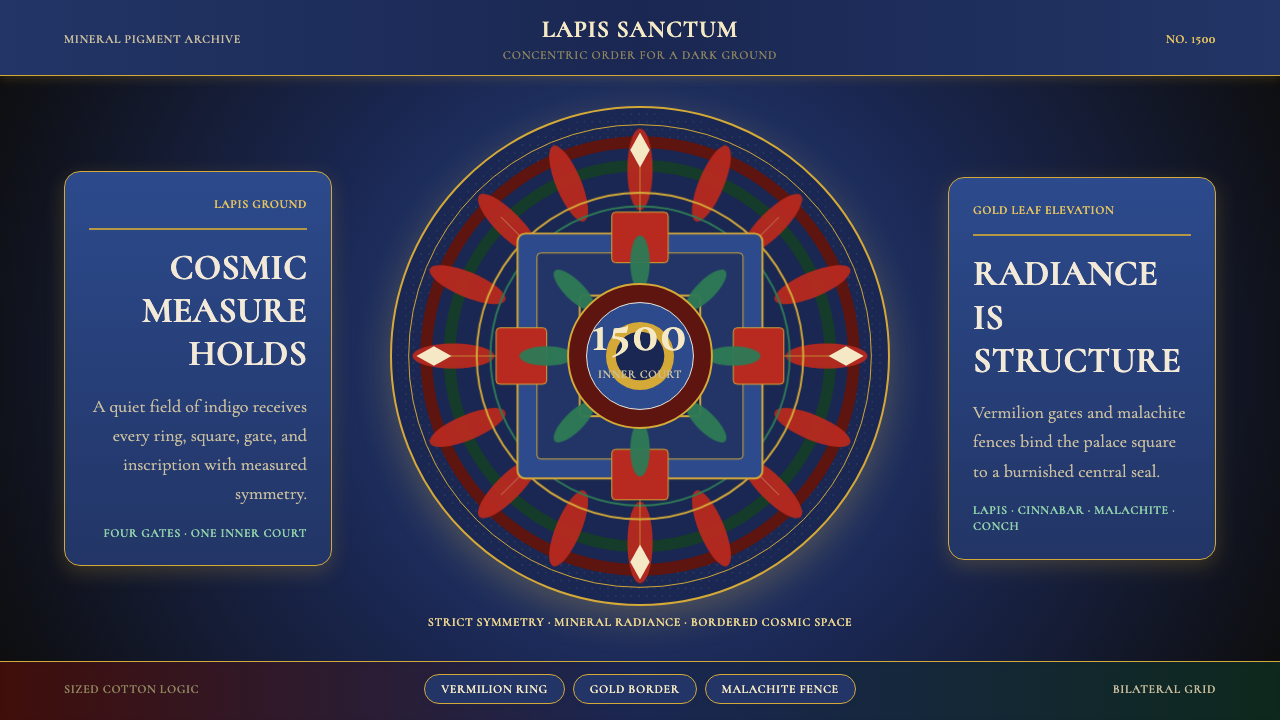 Tibetan Thangka Mandala (1500)Cosmic order, burnished dark. Lapis ground, gold borders, vermilion rings.
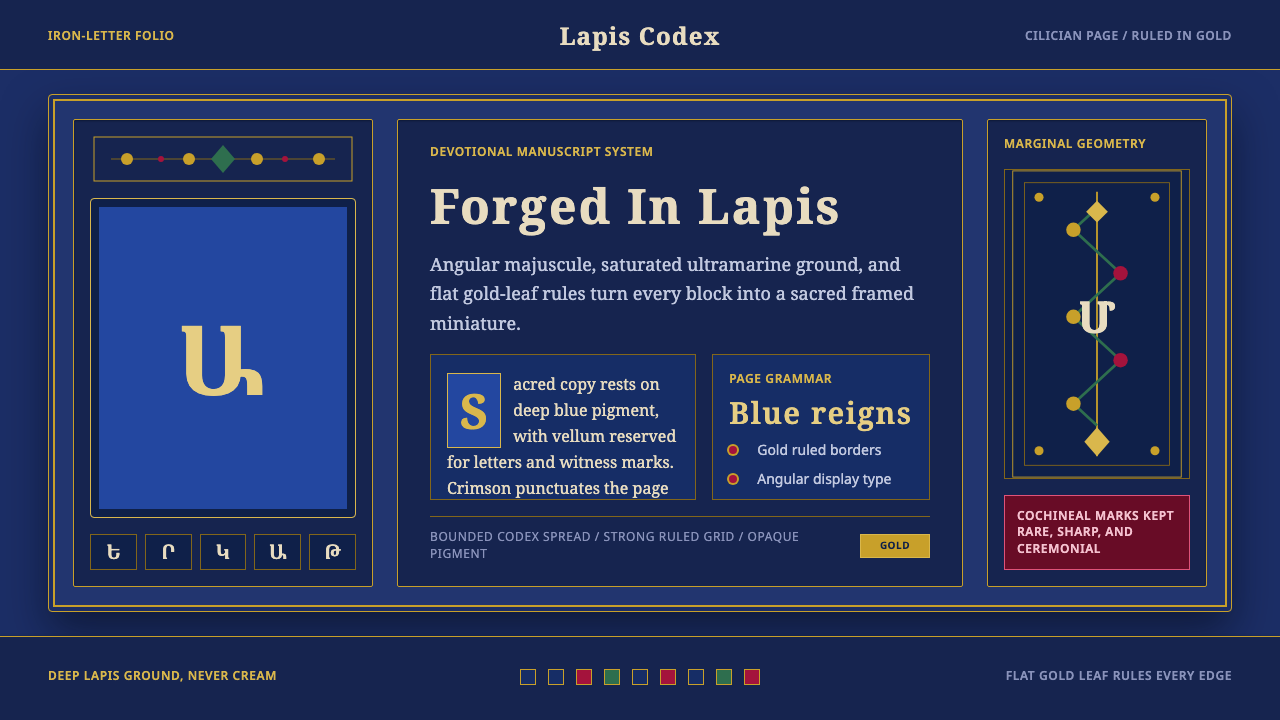 Armenian ErkatʿagirDevotional lapis reigns. Gold rules and angular serif glyphs frame a sacred g…
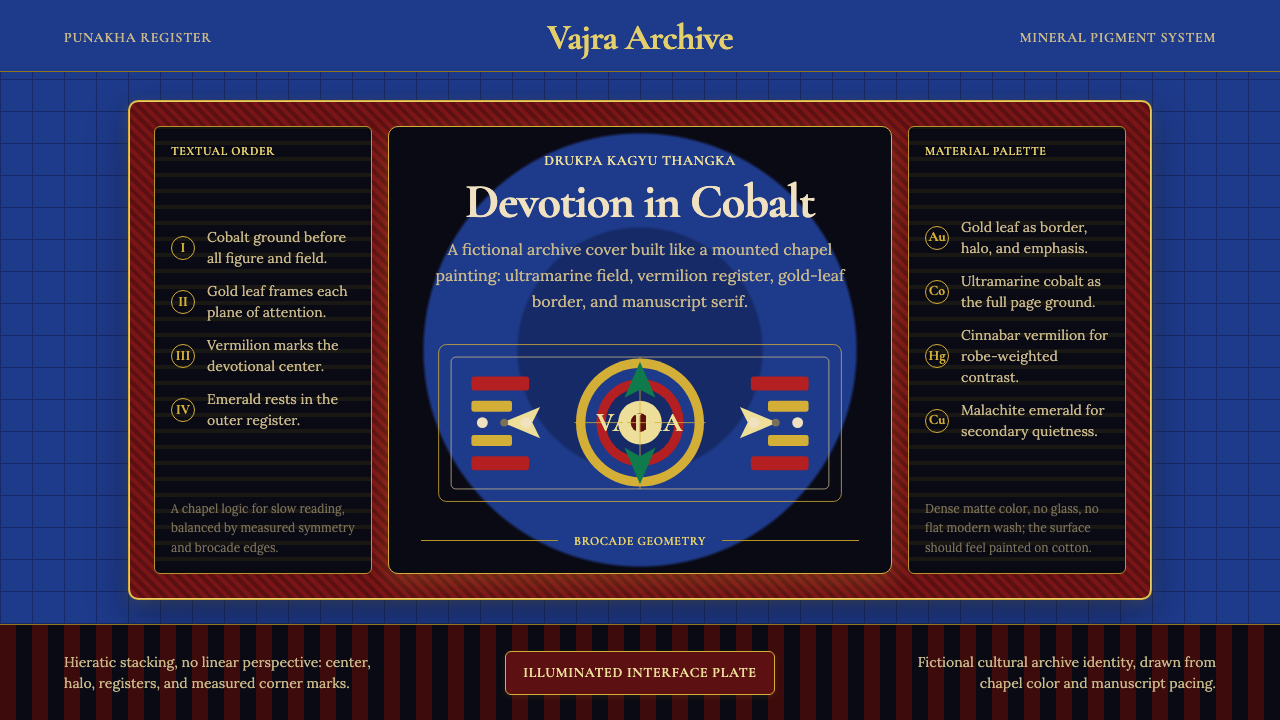 Bhutanese Drukpa Kagyu ThangkaDevotion made cobalt. Gold frames, Cormorant serif, and vermilion marks hold…
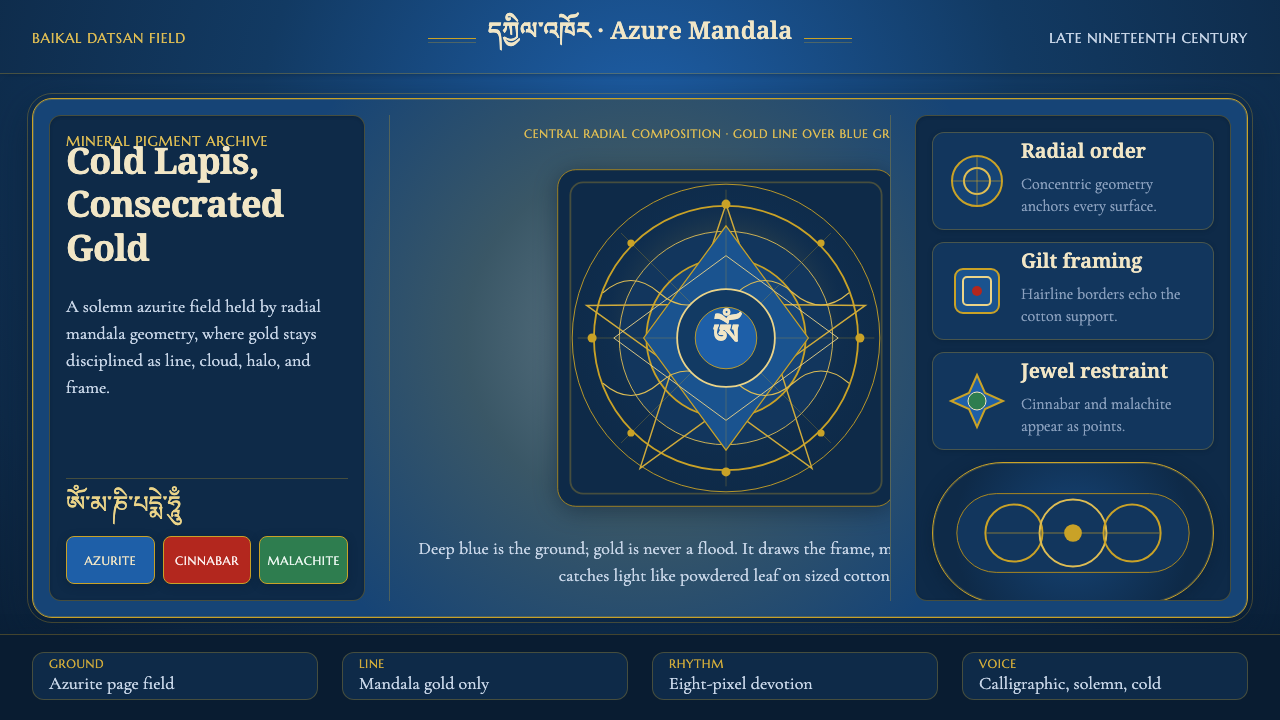 Buryat Buddhist Datsan ThangkaCold lapis holds silence. Gold mandala lines frame a solemn azurite field.
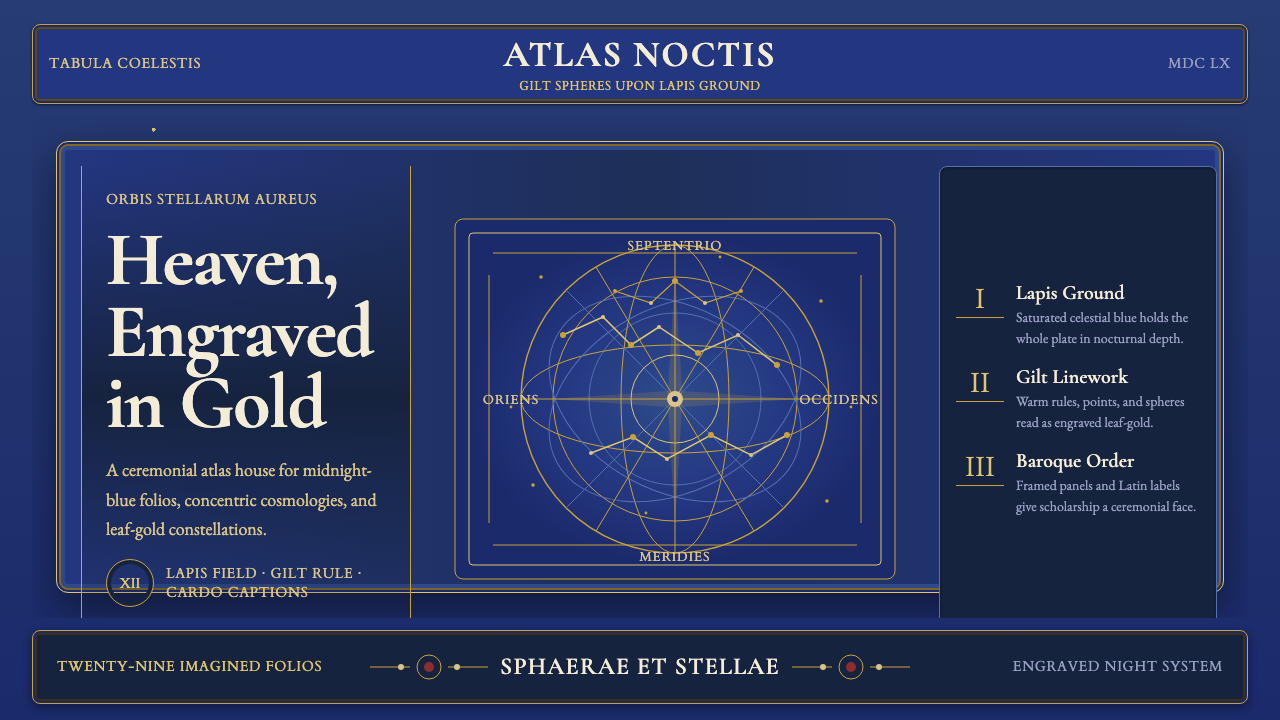 Cellarius Celestial AtlasCelestial luxury on lapis. Gilt serif type, star fields, and concentric chart…
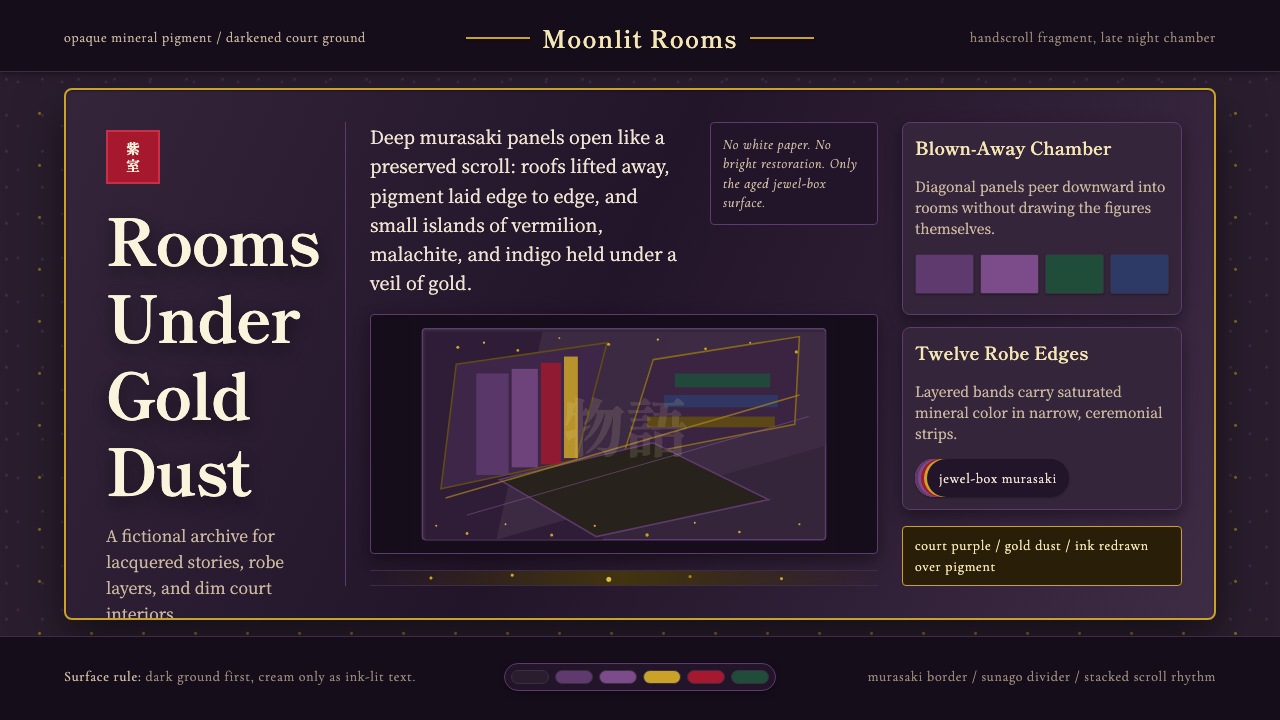 Heian Genji ScrollAged court opulence. Murasaki ground, gold dust, and stacked scroll panels.