What is Tibetan Thangka Mandala (1500)?
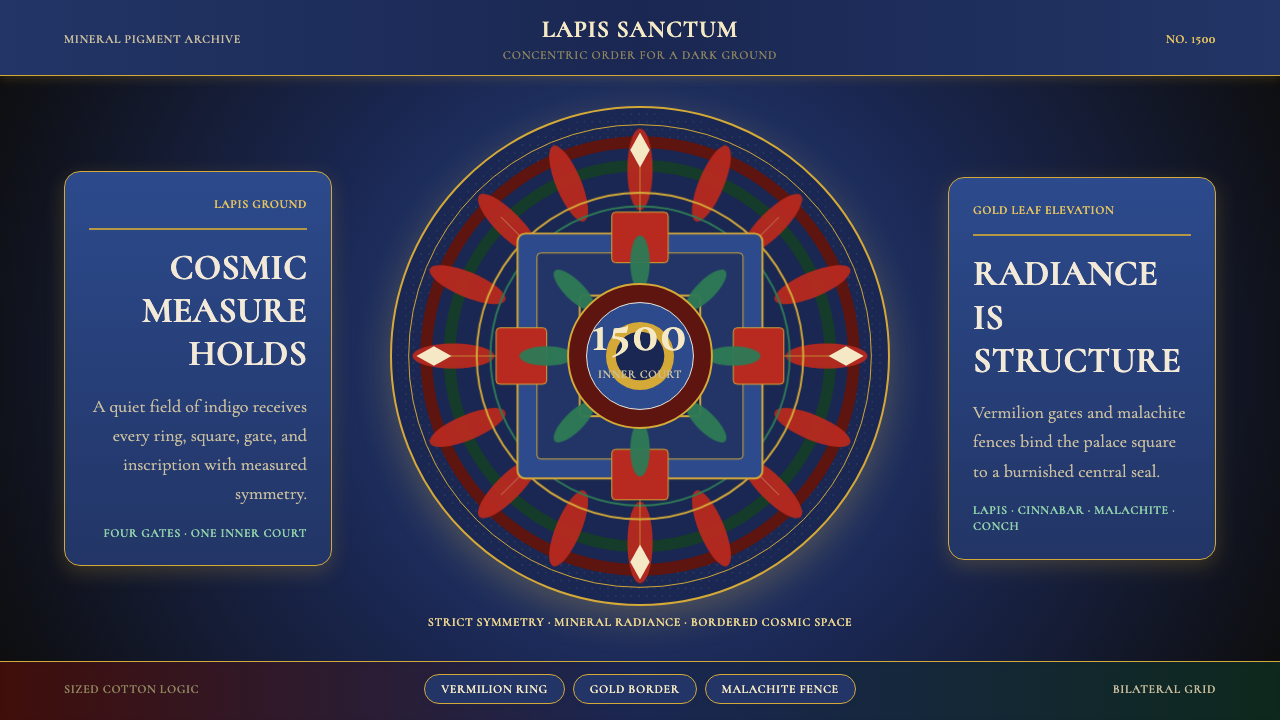
Tibetan thangka mandala painting encodes the entire cosmos into concentric rings of fire, lotus, and gold — a sacred geometry so precise it doubles as a design system.
Tibetan Thangka Mandala (1500) in brief
Tibetan thangka mandala painting is one of the most rigorously codified visual traditions in the world. Produced across monastic ateliers in Lhasa, Shigatse, and the Kham region from roughly the eleventh century onward, these scroll paintings on sized cotton use mineral pigments of remarkable intensity: lapis lazuli ground to a deep, saturated indigo for the cosmic ground, cinnabar producing the blazing vermilion of lotus petals and fire rings, malachite yielding the protective emerald of outer barriers, and beaten gold leaf reserved for the radiance of divine figures.
Unlike traditions that developed organically through individual artistic expression, thangka composition is governed by canonical iconometric texts. Every mandala follows a fixed cosmological architecture: concentric rings of flame, vajra fences, and lotus petals surround a central palace with four directional gates, each aligned to a cardinal point and guarded by protective deities. The proportions are not aesthetic preferences but sacred measurements derived from scripture, making the mandala simultaneously a devotional object, a meditation support, and a precision diagram of enlightened reality.
The visual effect is one of radical symmetry punctuated by concentrated jewel color. The dark indigo ground recedes, pulling the eye inward through successive rings of saturated hue toward the innermost sanctum. Gold does not merely decorate — it functions as sacred luminance, marking the boundary between the transcendent and the visible world. This combination of extreme geometric precision and deeply saturated mineral color produces an aesthetic unlike anything in European or East Asian painting: austere and opulent simultaneously.
Where does Tibetan Thangka Mandala (1500) come from?
The thangka as a portable scroll painting emerged in Tibet during the eleventh century, coinciding with the second diffusion of Buddhism from India and Nepal into the Tibetan plateau. Early practitioners brought iconographic models from the great monastic universities of northern India — Nalanda and Vikramashila — and Tibetan artists adapted these models to their own mineral-rich environment and devotional needs. The word thangka derives from the Tibetan for 'recorded message' or 'thing that can be rolled up,' reflecting its essential nature as a portable teaching object that could travel with nomadic communities and be deployed in temporary ceremonial spaces.
By the fifteenth and sixteenth centuries, distinct regional schools had crystallized. The Menri school, founded by the master Menla Dondrup in the late fifteenth century in Tsang province, established the proportional canon that most Tibetan painters still follow: it specifies the precise measurements for every deity form, from the width of an eye to the curve of a halo. The Karma Gardri school, associated with the tenth Karmapa Chöying Dorje in the early seventeenth century, introduced softer shading influenced by Chinese ink-wash painting into the Tibetan vocabulary while retaining the strict iconometric framework. These two schools together define what most people recognize as classical Tibetan painting.
Mandala composition in particular draws on the Kalachakra tradition — a tantric system introduced into Tibet from India in the early eleventh century whose mandala design specifies a five-hundred-and-thirty-two deity arrangement across concentric circles, all governed by a single proportional grid. The Kalachakra mandala became a template for subsequent mandala traditions in Tibet, Nepal, Bhutan, and Mongolia, demonstrating how a single iconographic program could propagate across an entire cultural sphere while maintaining extraordinary formal precision.
Western scholarly attention to thangka came relatively late. Art historian David Jackson's comprehensive studies in the late twentieth century documented the major stylistic lineages and established the critical vocabulary for understanding regional and temporal differences. This scholarship helped reframe thangka from a purely ethnographic curiosity to a technically demanding fine-art tradition whose compositional logic has attracted the attention of designers, architects, and cognitive scientists studying the neurological effects of mandala geometry on attention and perception.
What defines the Tibetan Thangka Mandala (1500) look?
Color Ground
The dominant ground in classical thangka is a deep, saturated indigo derived from lapis lazuli — the richest, most expensive blue available to medieval painters. Against this ground, other hues read as luminous jewels rather than flat pigments. The indigo is not merely a background but a cosmological statement: it represents the infinite expanse of enlightened mind, the ground from which sacred form arises. Secondary grounds include midnight black for wrathful deity compositions and warm terracotta for certain regional variants. In each case, the ground is absolute rather than graduated.
Sacred Palette
Thangka color is strictly mineral and symbolic. Vermilion from cinnabar denotes divine action, protective energy, and the fire rings that guard the mandala perimeter. Malachite green marks the outer barriers and the body color of certain protective deities. White, derived from calcite, signifies purity and the bodies of peaceful forms. Gold leaf, applied over a red clay base and burnished to mirror brightness, marks all divine radiance, sacred script, and architectural ornament within the palace structure. Each color carries iconographic meaning that overrides any naturalistic consideration: a deity's body may be blue, green, or white regardless of human anatomy.
Concentric Architecture
The mandala is not a decorative pattern but a three-dimensional sacred palace rendered in strict two-dimensional projection. The concentric rings moving outward from the center represent successive courtyards, gates, and protective barriers of a celestial architecture. This reading requires the viewer to mentally rotate the image: the square palace at the center is seen from above, while the gates at each cardinal direction project outward as if in elevation. The tension between plan view and elevation within a single image is a defining compositional feature, producing a spatial complexity that flat abstraction alone cannot achieve.
Bilateral Symmetry
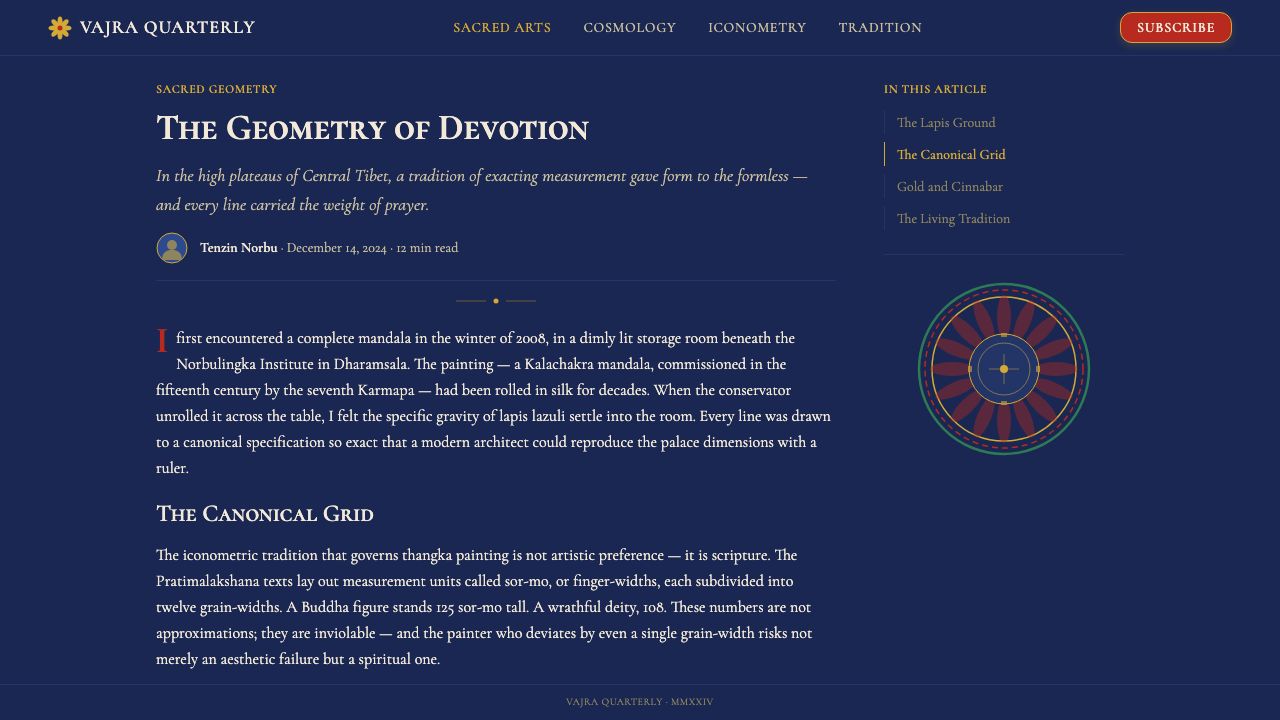
Mandala composition is governed by absolute bilateral symmetry along both horizontal and vertical axes, with the central deity as the organizing pivot. This symmetry is not the relaxed balance of decorative art but a metaphysical statement: the cosmos is equally ordered in all directions from the enlightened center. Deviations from symmetry — which do occur in subsidiary narrative registers around the main image — read as deliberate departures signaling different ontological status. The strict symmetry of the mandala interior makes even small asymmetries in the outer registers visually charged.
Line Weight and Gold Outline
Thangka line work is among the most demanding in any painting tradition. Outlines are drawn with mineral pigment at a consistent, controlled weight — neither the swelling-and-tapering of Chinese brushwork nor the mechanical uniformity of printmaking, but a calm, assured regularity that suggests the hand of a practitioner whose mind is as stable as the line itself. Gold is applied not only as broad areas of divine radiance but also as the finest possible outlines delineating folds within garments, individual hair strands, and the internal geometry of ornament. The contrast between broad mineral fields and hairline gold detail is a signature of the tradition's highest registers.
Hierarchical Scaling
Size in thangka follows sacred hierarchy, not perspectival recession. The central deity is depicted at the largest scale; attendant figures, protective deities, and narrative vignettes diminish in size according to their rank in the cosmological order, not their position in space. This means a figure in the foreground may be smaller than one depicted behind it if the latter holds higher ontological status. The result is an image that simultaneously operates as a devotional hierarchy chart and a visual meditation guide — the eye naturally travels inward and upward toward the figures of greatest authority.
Decorative Grammar
Thangka ornament is not added for visual richness but for iconographic precision. Every element — the flame patterns, the lotus petals, the vajra ornaments, the cloud scrolls in the outer registers — belongs to a fixed symbolic vocabulary whose meanings are specified in text. The lotus represents pure arising from impurity; the vajra thunderbolt represents indestructible reality; the cloud scroll marks the boundary between sacred and earthly space. None of these elements can be rearranged or substituted without changing the meaning of the image. Ornament here is grammar, not decoration.
Who shaped Tibetan Thangka Mandala (1500)?
The founder of the Menri school of Tibetan painting in the late fifteenth century, Menla Dondrup codified the proportional canon that governed Tibetan figure painting for the following five centuries. His system specified exact measurements for every deity in the Buddhist pantheon — a visual grammar that allowed painters across different monasteries and regions to maintain iconographic consistency despite the absence of photographic reproduction. The Menri canon is the closest equivalent in any pre-modern painting tradition to a rigorous design specification document.
The tenth Karmapa was both a senior Buddhist hierarch and an accomplished painter who founded or patronized the Karma Gardri school in the early seventeenth century. Under his influence, Tibetan thangka absorbed elements of Chinese painting — particularly softer shading techniques and naturalistic landscape rendering in the outer registers — without abandoning the strict iconometric framework of the interior mandala. The Karma Gardri school's synthesis demonstrates how a codified sacred art tradition can accommodate external aesthetic influences while maintaining its doctrinal core intact.
A master painter of the seventeenth century closely associated with the fifth Dalai Lama's cultural renaissance in Lhasa, Chöying Gyatso exemplifies the thangka tradition at the height of its political and artistic confidence. Working during a period when the Ganden Phodrang government consolidated Tibetan political authority, his work reflects the ambition to produce images that were simultaneously devotional objects, diplomatic gifts for neighboring rulers, and demonstrations of cultural supremacy. The largest thangkas of this period — some measuring several stories in height when fully unfurled — required the coordination of entire monastic workshops and months of preparation.
The American art historian David Jackson produced the first systematic scholarly account of Tibetan painting styles and their historical development, culminating in his landmark volume 'A History of Tibetan Painting' published in 1996. By documenting the major lineages — Menri, Karma Gardri, Khyenri, and others — and establishing a chronological framework for their development, Jackson made it possible to speak of thangka as a complex art historical field rather than a uniform ethnographic artifact. His work established the critical vocabulary that allows scholars and designers alike to identify specific schools and periods within what might otherwise appear to be a single undifferentiated tradition.
A living master of classical Menri-school thangka working in Bhutan, Tashi Norbu represents the continuity of the tradition into the present day. His training follows the apprenticeship model that has governed thangka transmission for centuries: years of grinding pigments, copying proportion canons, and painting subsidiary figures before being permitted to attempt a central deity. His contemporary practice demonstrates that the tradition's constraints — the canonical proportions, the mineral palette, the strict symmetry — are not limitations but a framework within which individual mastery becomes visible through refinement rather than invention.
How do you use Tibetan Thangka Mandala (1500) today?
Applying thangka mandala aesthetics to contemporary design requires understanding the tradition's underlying logic before borrowing its surface appearance. The mandala is not an ornamental pattern — it is a hierarchical spatial system in which every element's position, scale, and color carries fixed relational meaning. Designers who treat it as wallpaper will produce results that look busy and culturally appropriative; designers who engage with the underlying system — center-out hierarchy, jewel color against deep ground, symmetry as meaning — will find it yields interfaces and compositions of unusual authority.
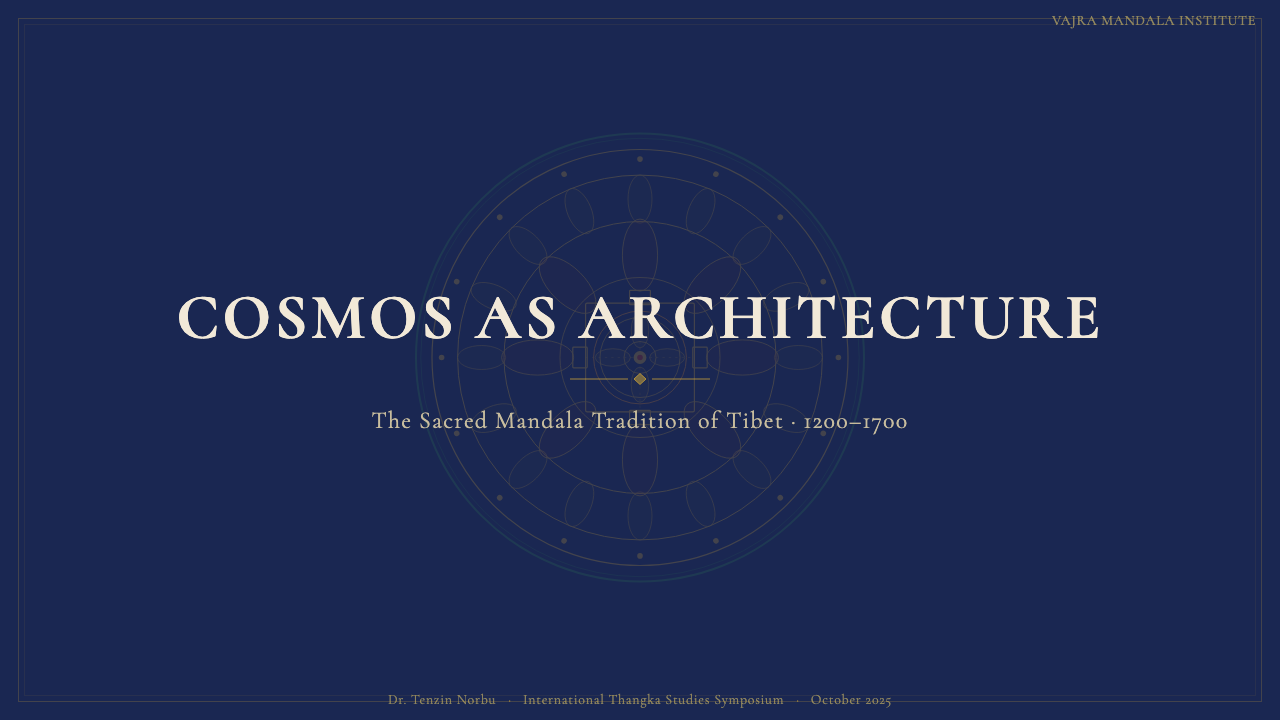
For presentation slides, the tradition's most transferable quality is its treatment of the dark ground as a canvas for concentrated luminous color. A cover slide can use a deep indigo or midnight field with a single focal motif rendered in saturated warm tones at the center, surrounding text in white or pale gold at a smaller scale. The hierarchical scaling principle applies directly: the central headline should be notably larger than any supporting text, and the surrounding information should decrease in size and luminosity as it moves outward from the center. Resist the temptation to use multiple saturated hues simultaneously — one anchoring warm tone against deep blue is more powerful than a full spectrum.
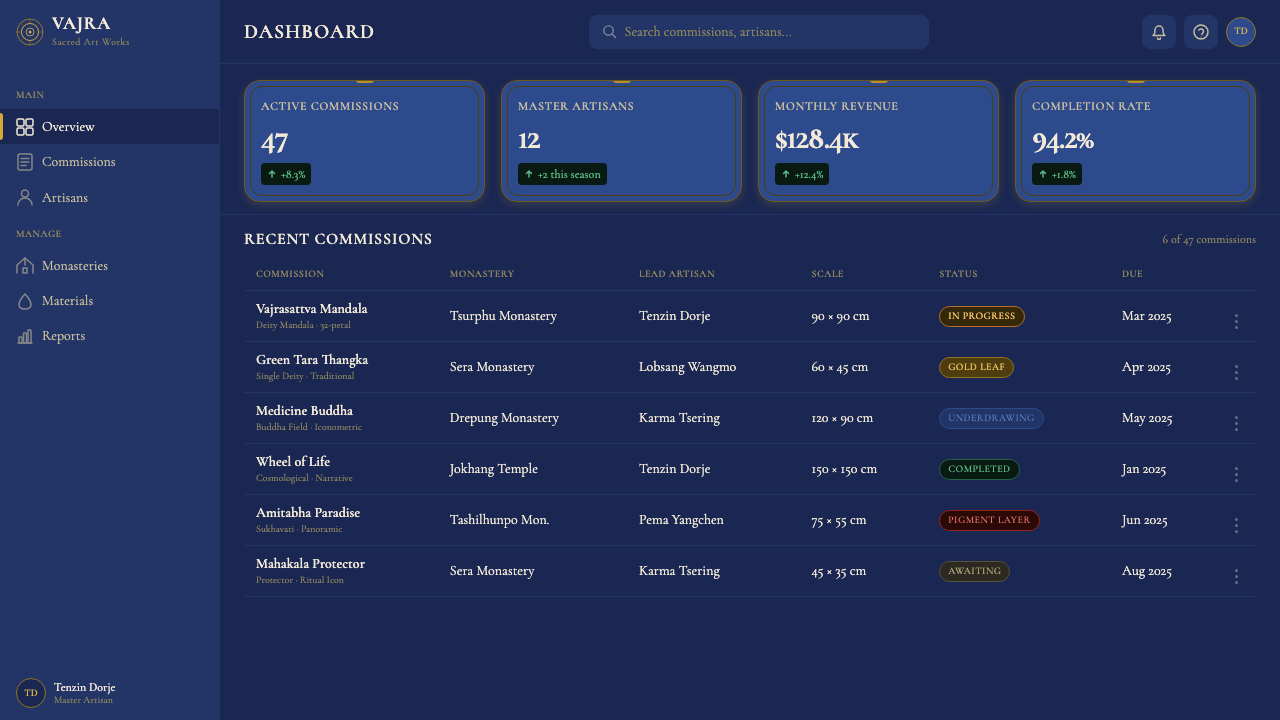
For web dashboards and data visualization, the mandala system offers a rigorous model for radial layouts and concentric information hierarchy. A dashboard organized around a central metric with secondary indicators arranged in concentric rings follows the same spatial logic as the mandala palace. Deep-field dark mode interfaces are particularly well-served by the thangka palette: indigo or deep slate as the ground, with data highlighted in warm amber or vermilion tones that read as luminous against the dark field. Navigation and chrome elements should be restrained — the decorative weight belongs to the data, just as secondary registers in a thangka defer to the central mandala.
For editorial and marketing work, the tradition's most useful contribution is its treatment of the relationship between frame and interior. Thangka paintings always exist within a textile mounting — bands of silk brocade frame the painted surface in a specific color sequence. In editorial applications, this translates to a deliberate framing strategy: content sits within clearly defined borders, and the transitions between sections are treated as meaningful thresholds rather than invisible divisions. Advertising work can borrow the tradition's jewel-on-dark-ground principle: isolated objects, product shots, or type set against a very deep ground will carry the concentrated intensity of thangka iconography without requiring any direct stylistic quotation.
A common mistake when applying this aesthetic is confusing opulence with complexity. Thangka paintings appear elaborate because every element is rendered with extraordinary precision, not because many different things are happening simultaneously. The deepest trap for contemporary designers is multiplying the number of colors, textures, or competing focal points. Authentic application restrains itself: one deep ground, one or two concentrated hues, one clear center, and meticulous attention to whatever is present. Adding more elements degrades the concentrated luminosity that makes the tradition visually powerful.
Tibetan Thangka Mandala (1500) — FAQ
Is using mandala imagery in design culturally appropriative?
The question deserves serious consideration. The mandala is a living sacred form in Tibetan Buddhism, not a historical artifact, and its use in contexts that trivialize or decoratively neutralize its meaning is legitimately contested by practitioners. The most defensible design approach engages with the tradition's structural logic — its hierarchy, its color system, its spatial organization — rather than lifting its specific iconographic symbols (deity forms, seed syllables, or the specific deity arrangements of canonical mandalas). There is a meaningful difference between a dashboard organized on concentric radial principles and a logo that appropriates a specific Kalachakra mandala. The former learns from structural thinking; the latter borrows sacred content without acknowledgment.
How does the thangka palette work on light backgrounds rather than dark grounds?
The jewel-color system is specifically designed for the deep-ground context and loses much of its power on light backgrounds. The vermilion, malachite green, and gold that read as luminous concentrations of color against deep indigo become merely saturated hues on white or cream — competent, even attractive, but ordinary. If a light-ground layout is required, the most effective approach is to invert the logic: use the deep indigo as a concentrated accent or feature-block color rather than the ground, and allow the jewel tones to appear as small focal elements within that indigo field. A white-ground design that borrows thangka color wholesale tends to look more like South Asian decorative textile design than Tibetan painting, which may or may not suit the project's intent.
Can thangka-inspired design work for minimal or text-heavy interfaces?
It can, but requires selective application. The tradition's most transferable lessons for text-heavy layouts are the hierarchical scaling principle and the deep-ground concentration strategy, not its decorative vocabulary. A long-form reading interface might apply thangka logic by using a very deep, slightly warm dark background with text rendered in a color that reads as warm white — recalling the relationship between gold inscription and deep ground in the thangka surface itself. Section headings and callouts might be rendered in a single jewel tone. The decorative layer — the borders, the flame rings, the lotus motifs — should be entirely absent. The goal is to retain the luminous focus of the tradition without its iconographic specificity.
What distinguishes genuine thangka visual logic from generic 'Tibetan-inspired' decoration?
The defining difference is whether the design uses the tradition's structural principles or merely its surface motifs. Generic Tibetan-inspired decoration typically borrows the color palette (deep blue, gold, vermilion) and overlays it with either Tibetan script as decoration or lotus and vajra motifs without regard for their compositional role. Genuine engagement with thangka visual logic means applying the mandala's spatial hierarchy — center-out organization, concentric structure, radial symmetry — and the tradition's color grammar — deep ground as cosmological field, gold as luminous marker of hierarchy, jewel tones as activated focal elements — in ways that produce compositions with the same concentrated spatial authority, even without any explicitly Tibetan iconographic content.
How should gold be used in contemporary applications of this aesthetic?
In thangka, gold is sacred luminance — it is reserved for whatever carries the highest ontological weight in the composition: divine bodies, inscriptions, architectural ornament within the palace structure. In contemporary design, gold functions best when it follows the same scarcity principle. Using gold as a general accent or as a background texture diffuses its authority into mere decoration. The most effective contemporary applications treat gold as a marker of primary hierarchy: the element that is most important on any given surface — a headline, a key metric, a featured price point — is the one that receives gold treatment. Everything else defers. The same discipline that makes gold sacred in the thangka tradition makes it powerful in contemporary work.
Related design styles
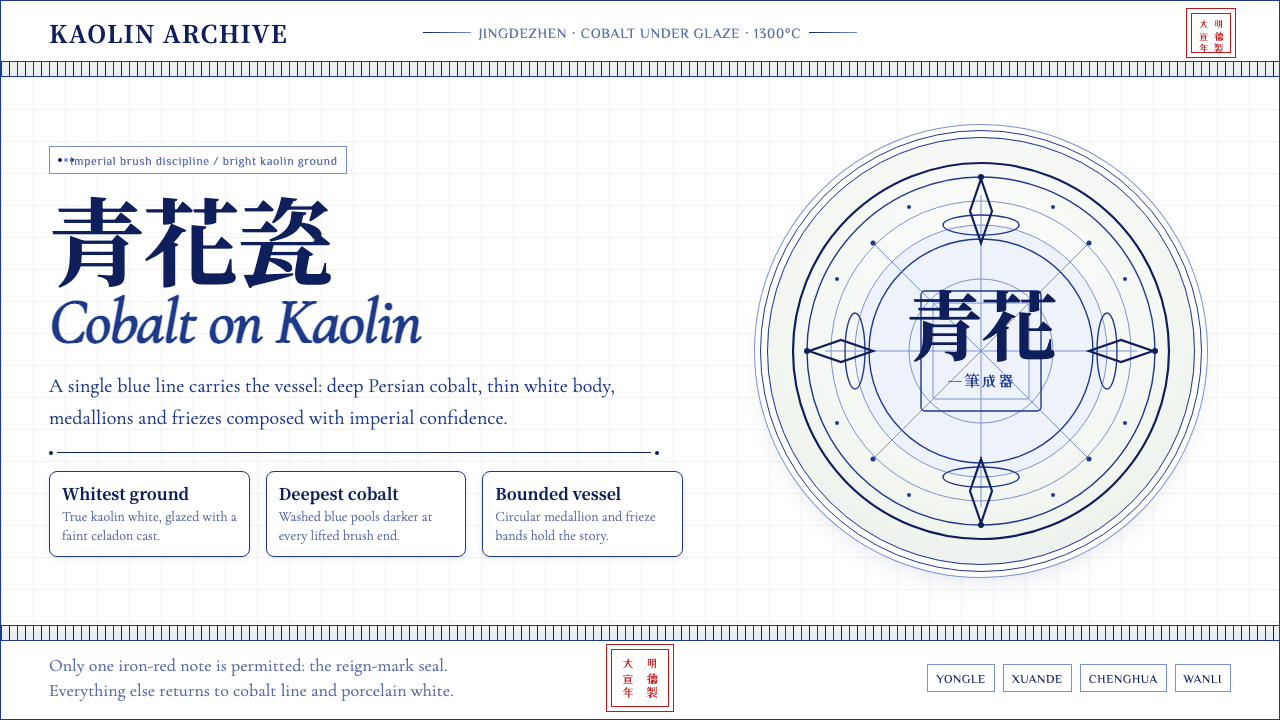 Ming Blue-and-White PorcelainImperial restraint sings. Deep cobalt hairlines circle kaolin white with one…
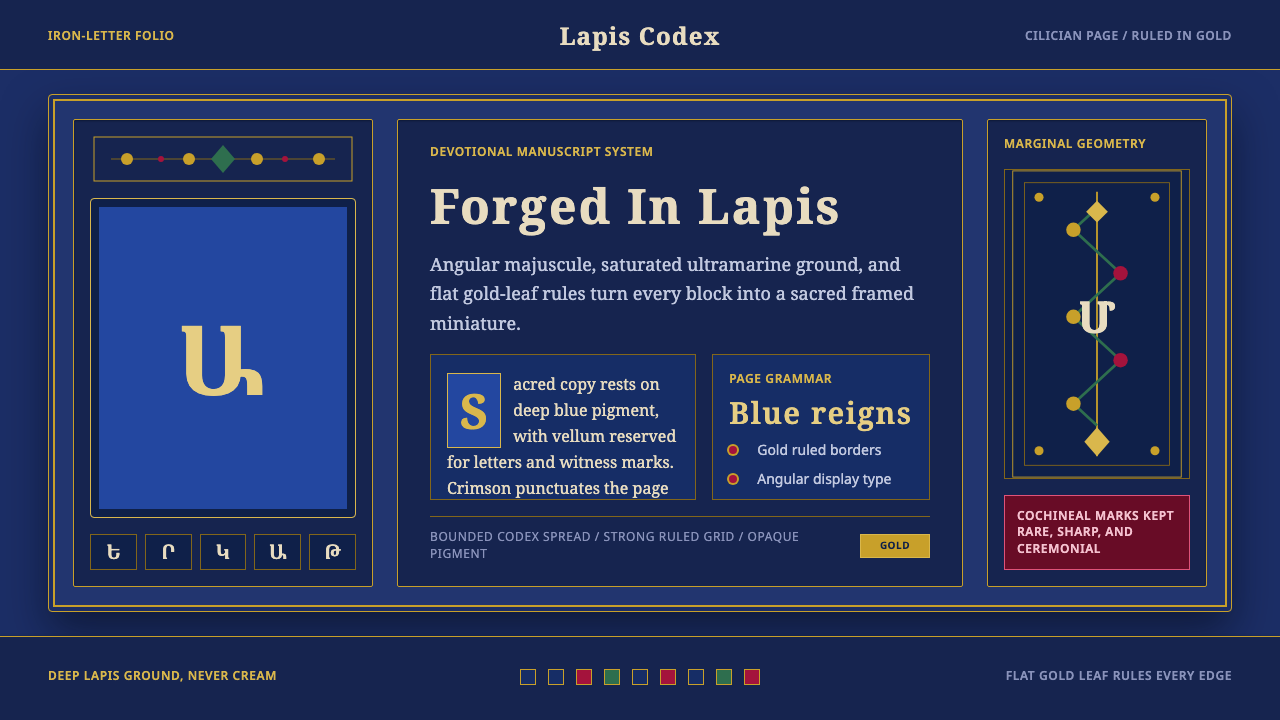 Armenian ErkatʿagirDevotional lapis reigns. Gold rules and angular serif glyphs frame a sacred g…
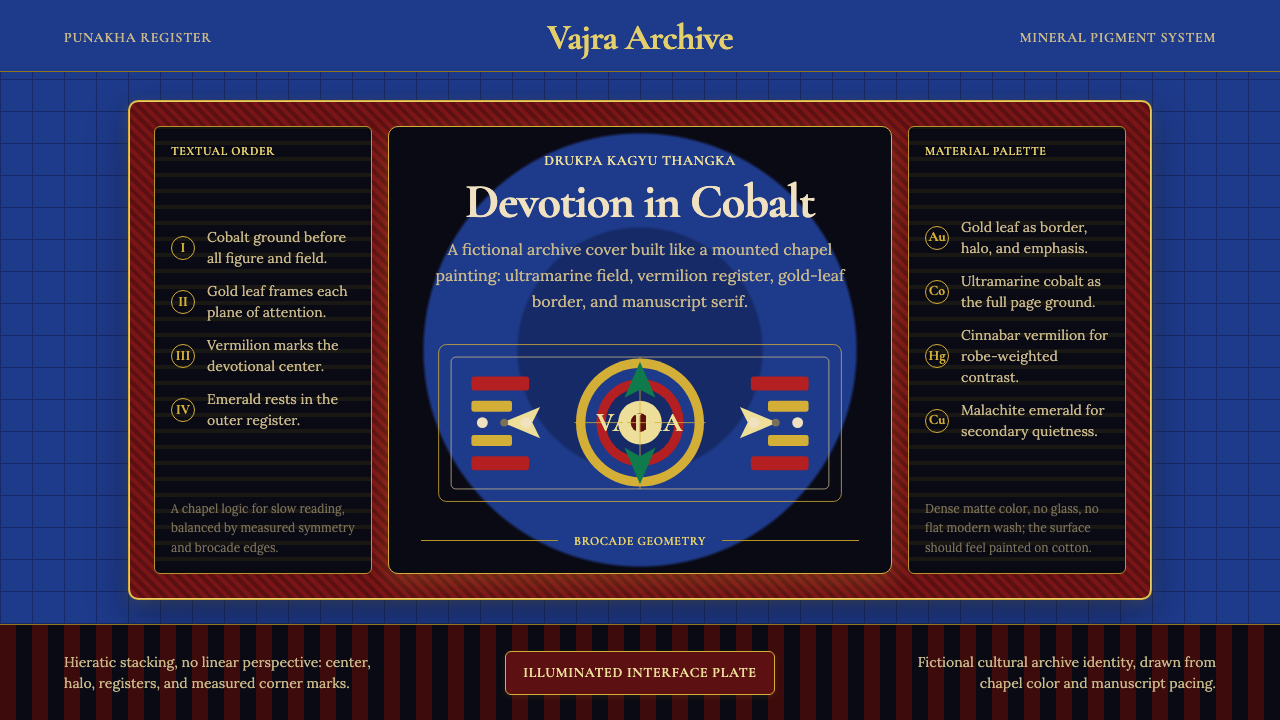 Bhutanese Drukpa Kagyu ThangkaDevotion made cobalt. Gold frames, Cormorant serif, and vermilion marks hold…
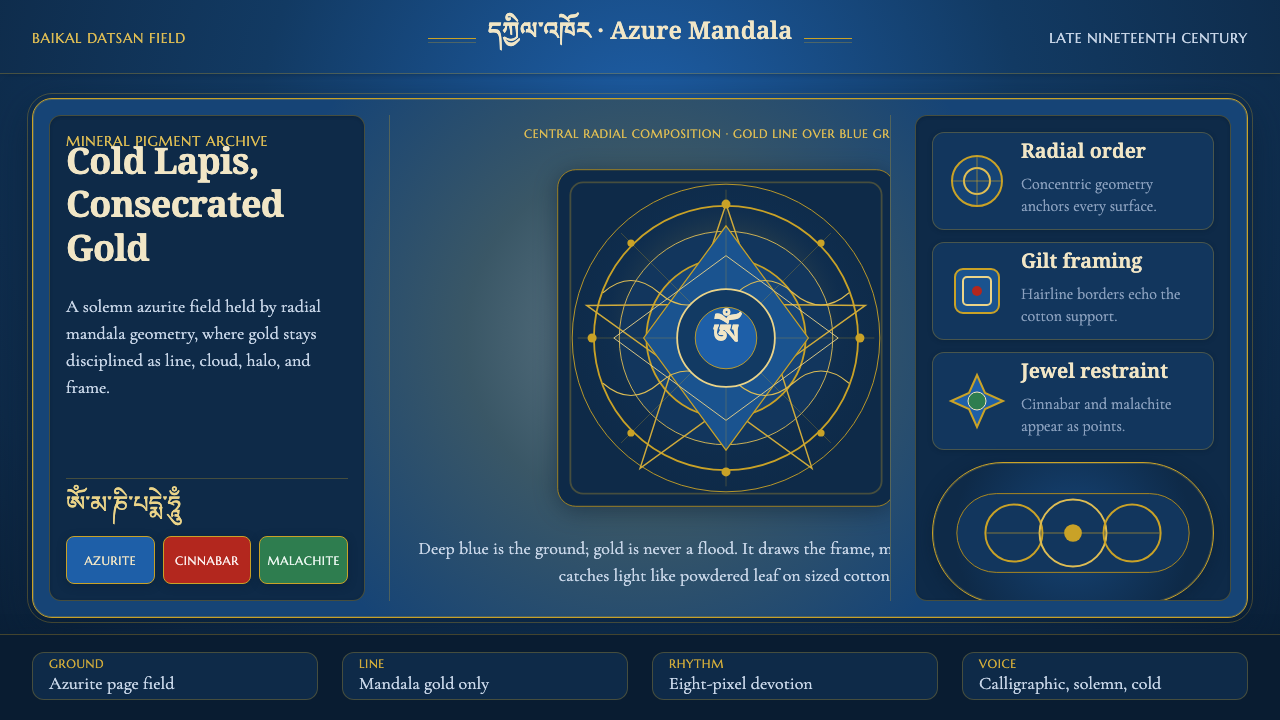 Buryat Buddhist Datsan ThangkaCold lapis holds silence. Gold mandala lines frame a solemn azurite field.
 Cellarius Celestial AtlasCelestial luxury on lapis. Gilt serif type, star fields, and concentric chart…
 Heian Genji ScrollAged court opulence. Murasaki ground, gold dust, and stacked scroll panels.