What is Tibetan Thangka Mandala?
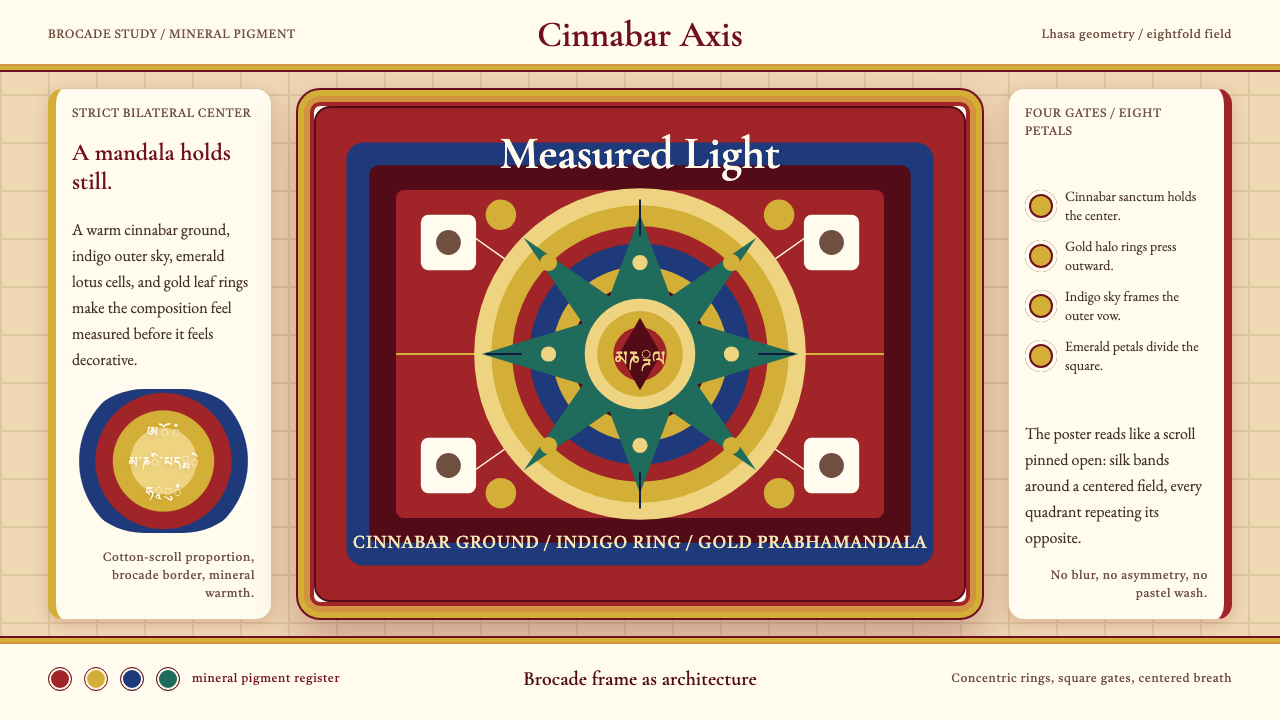
Eight centuries of sacred geometry compressed into a single scroll: Tibetan Thangka Mandala is devotional art where every circle, color, and gilded halo carries the weight of an unbroken iconographic canon.
Tibetan Thangka Mandala in brief
Tibetan Thangka Mandala is Vajrayana Buddhism's most concentrated visual meditation instrument — scroll paintings executed on primed cotton or silk, wrapped in layered silk brocade borders, depicting tutelary deities and mandala geometries according to iconometric measurement canons refined over eight centuries. The word thangka derives from the Tibetan meaning 'recorded message', and each painting functions simultaneously as portable altar, teaching aid, and object of contemplative focus. No element of the composition is arbitrary: the deity's hand gesture, the angle of a lotus petal, the sequence of concentric rings enclosing the central figure — all are prescribed by texts such as the Tibetan Kangyur and the iconometric treatises that govern proportional measurement.
The color language of the Tibetan tradition is warmer and more saturated than its Bhutanese or Mongolian cousins. Saturated cinnabar red — derived historically from mineral vermilion — dominates large background fields and the layered brocade border. Deep indigo holds the sky behind mountain ranges; emerald green fills lotus petals and vegetation registers at the composition's base. Gold leaf, applied in quantity on halos, jewelry, and architectural elements, is not an accent but a structural material: it marks presence, sanctity, and radiating enlightenment energy. The palette is never pastel and never muted; intensity is a theological value, not an aesthetic preference.
The mandala geometry embedded within a thangka is itself a cosmological diagram — a palace of the mind rendered in two dimensions. Concentric squares represent palace walls; concentric circles mark transitional thresholds. Attendant deities populate cardinal and intercardinal positions according to their rank and symbolic function. The organizing principle is perfect bilateral symmetry on every axis simultaneously, which sets it in sharp contrast to traditions such as Bauhaus or Japanese wabi-sabi where asymmetry carries expressive weight. In Thangka Mandala, symmetry is not a compositional device; it is an ontological statement about the nature of enlightened reality.

Where does Tibetan Thangka Mandala come from?
The thangka tradition emerged from the convergence of Indian Buddhist manuscript illustration, Nepalese Newari metalwork and painting conventions, and Central Asian pictorial traditions carried along the Silk Road into the Tibetan plateau. The earliest surviving thangkas date to the eleventh and twelfth centuries, a period when the second diffusion of Buddhism into Tibet (chidar) was generating intense demand for devotional objects. Monasteries required portable images that could travel with itinerant teachers and be unfurled before assembled communities; the scroll format answered both needs simultaneously. By the thirteenth century, the first codified iconometric measurement systems — specifying the proportional relationships of every feature of the deity's body — were being compiled from Indian Pala sources and adapted to Tibetan devotional requirements.
The Yuan dynasty (1271–1368) and its Mongol rulers proved decisive patrons. Kublai Khan's sponsorship of Tibetan Buddhism — particularly the Sakya school — channeled imperial resources into large-scale thangka production for both monastic and court settings. This period established the tradition of multi-workshop production, where specialists in deity outlines, color filling, gold-leaf application, and brocade mounting each contributed their expertise to a single object. The Ming dynasty (1368–1644) continued this patronage model and introduced Chinese aesthetic influences: more elaborate landscape registers in the lower and upper registers of the composition, greater attention to silk brocade border conventions imported from Chinese court textiles.
The major regional painting schools crystallized between the fourteenth and seventeenth centuries. The Menri school, founded by Menla Döndrup in the fifteenth century, established what became the dominant central Tibetan canon: warm tonal relationships, precise deity proportions derived from the Kalachakra Tantra measurement system, and an emphasis on jewel-like color saturation. The Karma Gardri school, associated with the Karma Kagyu lineage and flourishing particularly in the Kham region of eastern Tibet, developed a naturalistic landscape vocabulary drawn partly from Chinese landscape painting, setting deities against atmospheric mountain scenery rendered in softer, cooler tonalities. These schools were not mutually exclusive — Kham workshops frequently synthesized both traditions.
The twentieth century brought both rupture and diaspora. The political upheavals of the 1950s and 1960s in Tibet forced large numbers of trained artists, teachers, and their materials into exile communities across India, Nepal, and Bhutan. Far from ending the tradition, this diaspora energized it: institutions such as the Norbulingka Institute in Dharamsala (founded 1988) systematically documented iconometric canons, trained new generations of painters, and established quality standards that could be transmitted outside the monastery system. Contemporary thangka production spans from traditional devotional commission in diaspora communities to limited-edition fine-art works collected internationally, with practitioners maintaining fidelity to the same measurement texts their predecessors used in the fifteenth century.
What defines the Tibetan Thangka Mandala look?
Color Palette
The Thangka Mandala palette is built from mineral and earth pigments that produce a characteristic luminous density unavailable to synthetic paints. Cinnabar red — warm, slightly orange-leaning — dominates backgrounds and brocade borders. Indigo holds the upper sky registers. Emerald green fills vegetal and architectural elements. Ochre and warm earth tones model flesh and distant terrain. Gold leaf — applied over a red clay base — covers halos, crowns, and ornamental jewelry. These colors are never softened toward pastel and never dulled toward earth tones for decorative effect; their saturation intensity is the theological point.
Concentric Symmetry
The defining structural principle of the mandala is perfect radial and bilateral symmetry simultaneously. The central deity occupies a lotus throne at the exact geometric center; every surrounding register — rings of fire, vajra fences, lotus petals, attendant deity rows — mirrors itself across both horizontal and vertical axes. This symmetry is not approximated or gestural; it is measured and rule-governed by iconometric canons. The effect is one of absolute visual equilibrium, as if the composition were generating its own gravitational center.
Layered Spatial Registers
A fully realized thangka is divided into distinct horizontal registers that each carry separate narrative and symbolic content. The upper register typically depicts lineage masters and Buddhas of the five directions in smaller scale. The central register holds the principal deity and mandala. The lower register shows offering goddesses, protector deities, and landscape elements including water, earth, and stylized mountain ranges. These registers are spatially compressed — not depicted in perspective — so that sacred geography is legible as diagram rather than experienced as illusionistic space.
Gold as Structure
Gold leaf in Thangka Mandala is not decorative highlight but structural material. Halos emanate from deity heads as concentric rings of burnished gold that mark the boundary between the sacred figure and the surrounding pictorial space. Crowns, jewelry, throne backs, and architectural ornaments are fully gilded. The gold does not simulate reflected light; it is presented as intrinsically luminous. This treatment creates a visual hierarchy so strong that the gold-covered areas read as categorically different from the painted areas — a distinction between what belongs to the sphere of enlightenment and what exists within ordinary phenomena.
Iconometric Proportion
Every figure in a thangka is drawn according to a body-unit measurement grid derived from the principal deity's face measurement. The overall body height, the distance between facial features, the length of fingers and posture of limbs — all are specified numerically in the iconometric treatises and checked against a preliminary grid sketched directly onto the primed ground. This is not artistic convention in the modern sense; it is a doctrine holding that deviation from correct proportion produces a painting without spiritual potency. The precision required rivals architectural drafting.
Brocade Border System
The silk brocade border that frames a thangka is as compositionally significant as the painting it contains. Borders are typically constructed from multiple bands of patterned silk in alternating warm and cool tones — deep red, orange-gold, and blue — that echo and frame the palette of the central image. The outermost band is usually a contrasting dark tone that functions as a visual full stop. This layered framing system transforms the thangka from a painting into an object — a complete artifact in which the textile and painted surfaces are conceived as a single composition.
Flame and Lotus Motifs
Two repeating motifs organize the transition between spatial zones throughout the composition. Stylized flame patterns — pointed, alternating red-orange and yellow-white — form the outermost protective ring of the mandala, signifying the burning away of conceptual obscurations. Lotus forms appear as thrones, as petal-rings enclosing deity positions, and as decorative ground lines. The lotus motif is always rendered in a highly conventionalized manner — each petal precisely outlined and filled with flat color — that maintains its diagrammatic readability at any scale. Both motifs are ancient pan-Buddhist symbols given a distinctively Tibetan formal treatment.

Who shaped Tibetan Thangka Mandala?
Menla Döndrup was a fifteenth-century Tibetan painter credited with founding the Menri school, which established the dominant iconometric canon for central Tibetan thangka production. His systematization of deity proportions — codified in terms of a face-unit body measurement grid — gave painters across the region a shared technical language that remained authoritative for centuries. The Menri school's warm tonal palette and precise compositional geometry became the benchmark against which later regional variants defined themselves, and his influence persists in contemporary academic Tibetan Buddhist art training.
The Karma Gardri school, associated with the Karma Kagyu lineage of Tibetan Buddhism, flourished principally in the Kham region of eastern Tibet from the sixteenth century onward. Its masters developed a naturalistic landscape vocabulary drawn from Chinese landscape painting — particularly the atmospheric mountain scenery of Song and Ming dynasty masters — and integrated it with Vajrayana deity iconography. Where the Menri school emphasized jewel-like chromatic intensity and geometric formalism, the Karma Gardri painters introduced receding spatial depth, softer tonal modulation, and a more painterly treatment of clouds, water, and vegetation. Their synthesis produced some of the most visually complex thangkas in the tradition.
The Norbulingka Institute, established in Dharamsala, India in 1988, represents the most systematic institutional response to the twentieth-century disruption of the thangka tradition. Founded under the patronage of the Fourteenth Dalai Lama, it combined a traditional arts training program — in which students complete multi-year apprenticeships in thangka painting, wood carving, and textile production — with a research and documentation mission to record iconometric texts and measurement canons before living knowledge holders were lost. Norbulingka trained painters now work across Asia, Europe, and North America, and the institute's standardized training materials have become a de facto international curriculum for Tibetan Buddhist art.
The Gar lineage refers to a succession of painter-teachers associated with the western Tibetan region, whose distinct approach emphasized the integration of Kashmiri artistic influences — particularly their handling of architectural elements, ornamental patterning, and the treatment of deity faces with finer, more delicate features — into the broader Tibetan thangka vocabulary. The Gar masters represent the historical porousness of the Tibetan tradition to its Himalayan neighbors, demonstrating that even within the strict framework of iconometric canons, significant regional aesthetic identities emerged through sustained contact with adjacent artistic cultures.
The generation of thangka painters working today in exile communities across India, Nepal, the United States, and Europe occupies a position without historical precedent: trained in traditional iconometric methods but operating outside the monastic patronage system that originally sustained the art form. Leading figures among contemporary practitioners have navigated this position by accepting both devotional commissions from Buddhist centers worldwide and fine-art commissions from secular collectors, maintaining technical fidelity to the measurement canons while adapting format, scale, and mounting conventions to contemporary art-world contexts. Their work constitutes a living test of whether a tradition defined by sacred function can sustain its formal integrity outside that function.
How do you use Tibetan Thangka Mandala today?
Thangka Mandala is among the most visually distinctive historical design systems available to contemporary practitioners, precisely because its principles are so different from the Western modernist tradition that dominates graphic and UI design education. Applying it correctly requires understanding what the visual system is actually doing: using radial symmetry to establish a gravitational center, using color saturation to signal sacred hierarchy rather than to create mood, using geometric concentric structure to organize information at multiple simultaneous levels. The style cannot be applied superficially without becoming pastiche; its power depends on committing to its structural logic.
For presentation slides, the Thangka Mandala vocabulary works most powerfully on cover and section-break pages where a single strong impression is the goal. A cover benefits from a centralized mandala-derived composition: a bold geometric rosette or concentric ring structure anchors the title at the exact visual center, surrounded by carefully balanced decorative registers that echo the brocade border logic. The rich, saturated background — deep cinnabar red or indigo — with gold-toned title typography creates immediate visual authority. Content slides should be treated more sparingly: a narrow decorative band at the top or bottom references the brocade border without overwhelming the information. Data slides can adopt the concentric-ring logic as an organizing metaphor for radial charts, progress rings, or hierarchical relationship diagrams.
For web interfaces, the style is best suited to immersive editorial experiences, cultural institution homepages, cultural product landing pages, and luxury brand contexts where visual richness and craftsmanship signaling are primary objectives. Dashboard and productivity interfaces generally benefit less from this vocabulary, as the high visual density competes with scannability. When applied to a pricing or feature page, the approach works through contrast: a richly decorated hero section in the full palette, transitioning to a much quieter content area that uses only one or two colors from the system — deep red or gold — as accent tones against a near-neutral ground.
For editorial and marketing applications, the Thangka Mandala vocabulary supports extraordinarily strong cover and poster treatments. A book cover or event poster in this style leads with a centralized deity-position composition — a product, face, or graphic mark at the geometric center, surrounded by concentric decorative rings — against a deeply saturated background. Marketing materials for cultural events, museum exhibitions, spiritual wellness brands, or high-craft luxury goods benefit from the style's combination of visual opulence and geometric precision. The brocade border logic translates directly into editorial page furniture: richly patterned header and footer bands that frame the content zone without competing with it.
A common mistake when applying Thangka Mandala aesthetics is treating the palette as purely decorative surface and ignoring the structural role of symmetry and concentric organization. Layouts that borrow the warm colors and gold accents but retain asymmetric, editorial-grid structure produce a visual confusion — the colors signal one system while the composition signals another. A second frequent error is under-committing to the background saturation: a timid or desaturated version of cinnabar red reads as merely 'warm red' rather than as a deliberate invocation of the tradition's visual intensity. The style rewards full commitment to its structural logic far more than partial adoption of its surface elements.

Tibetan Thangka Mandala — FAQ
Is Tibetan Thangka Mandala the same as general mandala art?
They share the concentric geometric organizing principle but differ substantially in every other respect. The term mandala (Sanskrit: circle) is applied broadly across Hindu, Jain, and Buddhist traditions, and in contemporary usage has been extended to any radially symmetric decorative pattern. Tibetan Thangka Mandala is a specific, highly codified tradition: its geometry is iconometrically prescribed rather than freely designed, its color relationships are fixed by iconographic convention rather than aesthetic preference, and the central element is always a Vajrayana deity with a specific identity and symbolic program. Using this style implies the full visual system — saturated mineral palette, gold-leaf hierarchy, brocade border logic, concentric deity registers — not merely a symmetric circle pattern.
Can this aesthetic work on a light or white background?
Authentic thangkas are never executed on white or light grounds — the tradition requires a primed and toned surface, typically in warm ochre or deep red, that gives subsequent paint layers their characteristic luminosity. A light-background application is possible in contemporary design contexts but requires substantial adaptation. The approach that works is to treat the light ground as a negative space system — reserving the saturated palette for defined graphic elements such as concentric rings, borders, and central motifs — while keeping the majority of the surface quiet. This creates an effect closer to a museum artifact documentation aesthetic than to the immersive total-color experience of an authentic thangka, which may or may not serve the design intent.
How do I use the gold element without looking kitschy?
In authentic thangkas, gold is structural and hierarchical rather than decorative. The discipline that prevents kitsch is function: gold appears only where the iconometric canon assigns it — halos, crowns, throne details — not as a general-purpose glamor layer. In contemporary design, the equivalent discipline is restriction: use gold-toned elements exclusively for the single highest-priority item in the hierarchy (a primary call-to-action, the central feature of a mandala-derived motif, the outermost border band) and withhold it from everything else. Gold paired with the full warm saturated palette reads as opulent; gold applied sparingly against a deeply saturated red or indigo ground reads as precise and authoritative. The difference is restraint in surface coverage.
What kinds of projects are a poor fit for this style?
The Thangka Mandala vocabulary struggles in contexts requiring visual neutrality, speed, or iterative information consumption. Productivity tools, enterprise software dashboards, news platforms, and e-commerce experiences benefit from lower visual density and faster cognitive processing than this style permits. The high chromatic intensity and symmetrical gravity of the mandala composition draw the eye to the center and hold it there — excellent for contemplative or high-impact single-message contexts, counterproductive for linear reading or task-completion interfaces. The style also sits uneasily beside corporate or institutional visual identities that depend on restraint for their authority signals; the richness can undermine rather than reinforce trust in those contexts.
How does the Tibetan tradition differ from other Buddhist painting traditions such as Japanese or Zen-influenced aesthetics?
The contrast is almost total. Japanese ink painting traditions influenced by Chan and Zen Buddhism prize emptiness, incompleteness, and the expressive potential of unpainted ground — a branch reaches across a white field; a brushstroke implies a mountain without describing it. This aesthetic, shaped by the wabi-sabi sensibility, values the evocative fragment over the complete statement. Tibetan thangka operates from the opposite premise: the painting surface must be completely and precisely filled according to an iconometric program, every space accounted for by a deity figure, decorative register, or symbolic element. Where Zen aesthetics celebrate absence, Thangka Mandala insists on fullness. Where Zen asymmetry suggests naturalness, Thangka symmetry asserts cosmic order. Both are Buddhist art traditions, but they represent fundamentally different visual theologies.
Related design styles
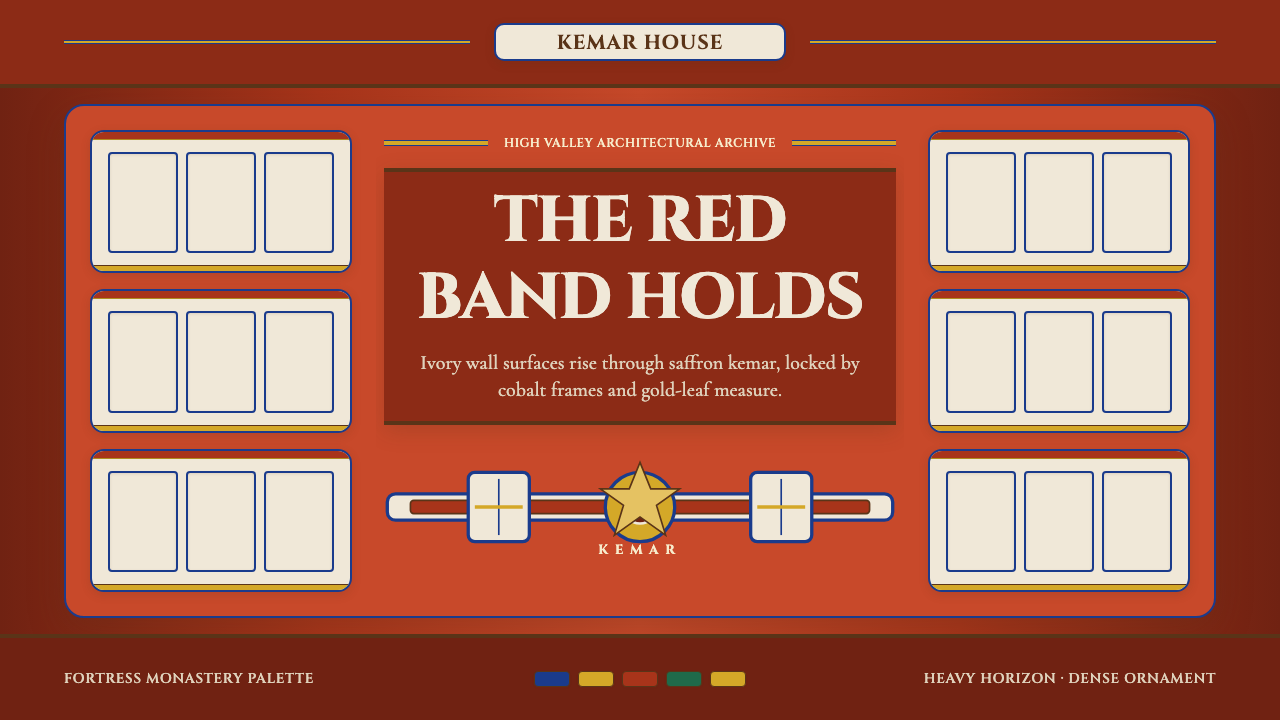 Bhutanese Dzong (Fortress Red)Monumental red holds the page. Cobalt frames and gold bands lock the fortress…
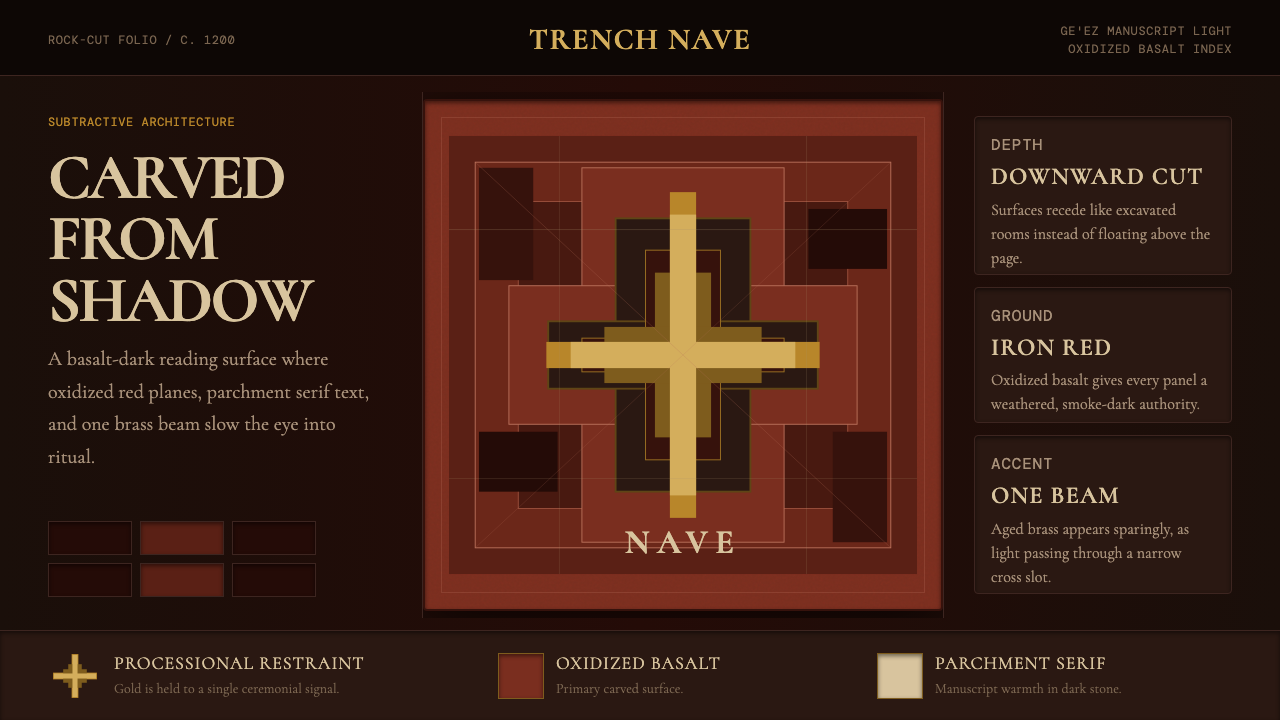 Ethiopian Lalibela Rock-Hewn Church (c.1200)Sacred weight in shadow. Oxidized basalt, parchment serif, and one aged-gold…
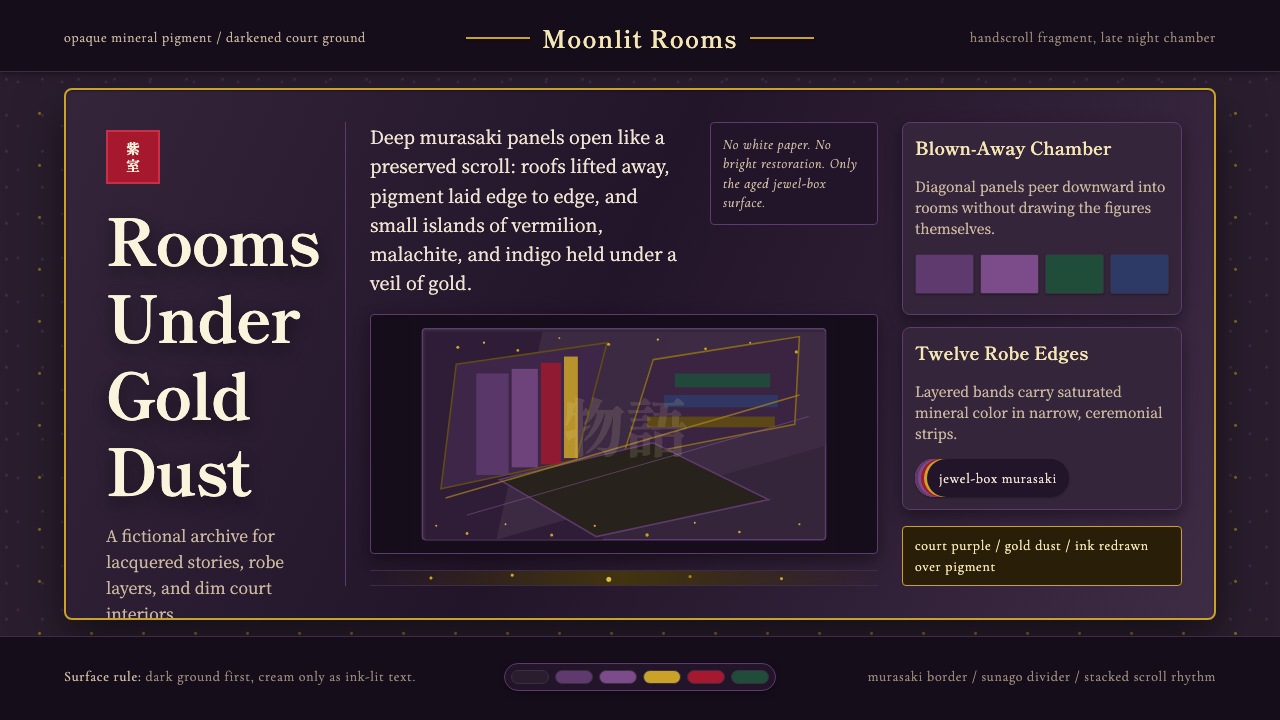 Heian Genji ScrollAged court opulence. Murasaki ground, gold dust, and stacked scroll panels.
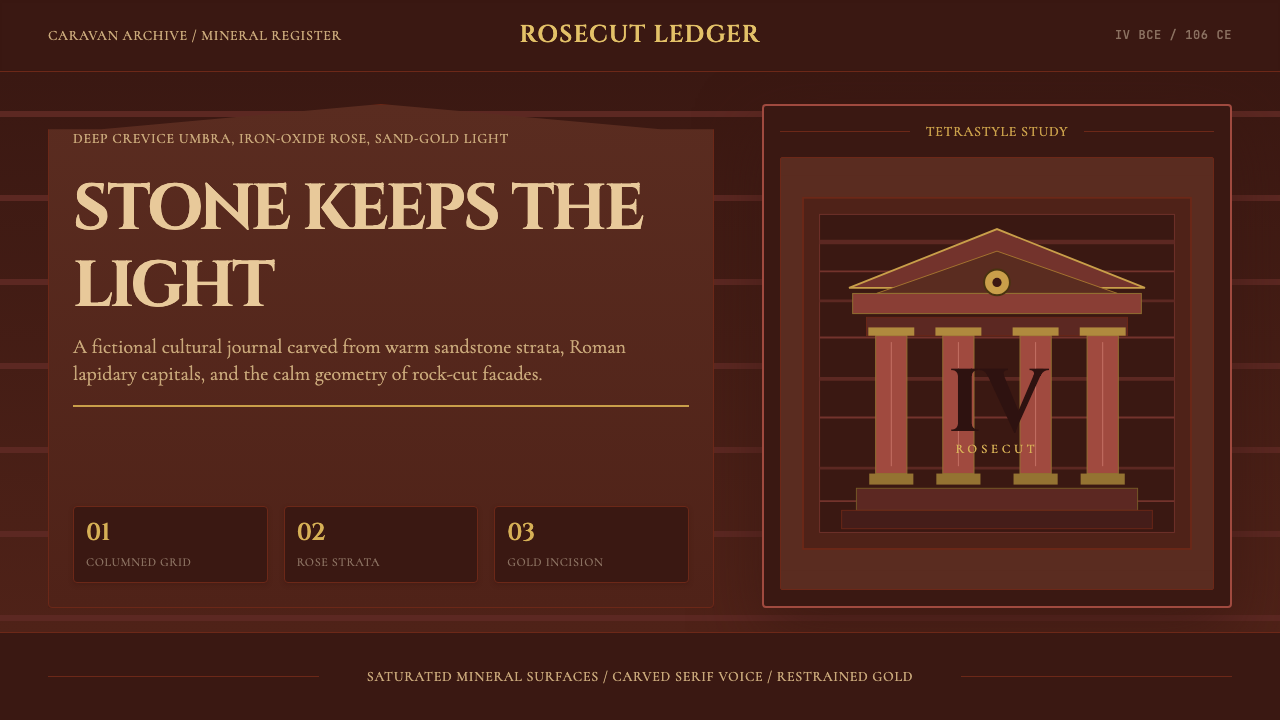 Jordanian Petra Rose NabataeanGeology feels monumental. Crevice umbra, rose strata, and Cinzel capitals car…
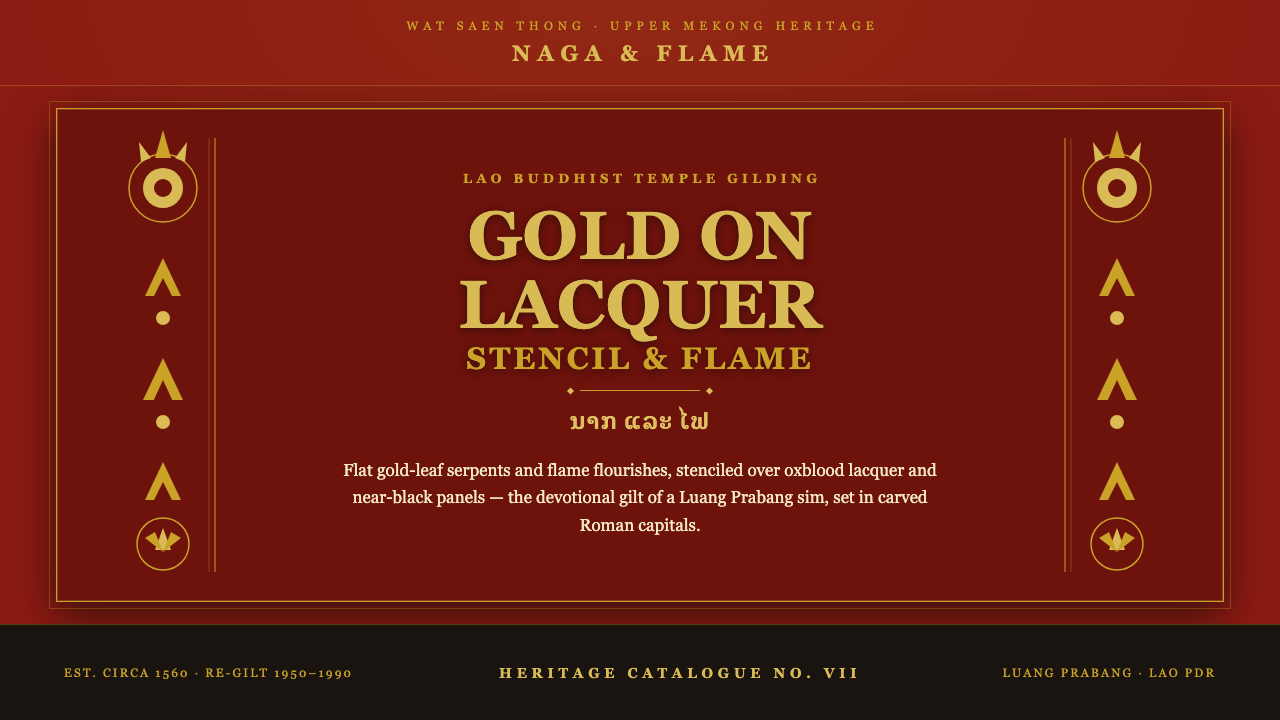 Lao Naga Temple StencilDevotional gilt, not chrome. Flat gold-leaf naga and flame stencils glow on o…
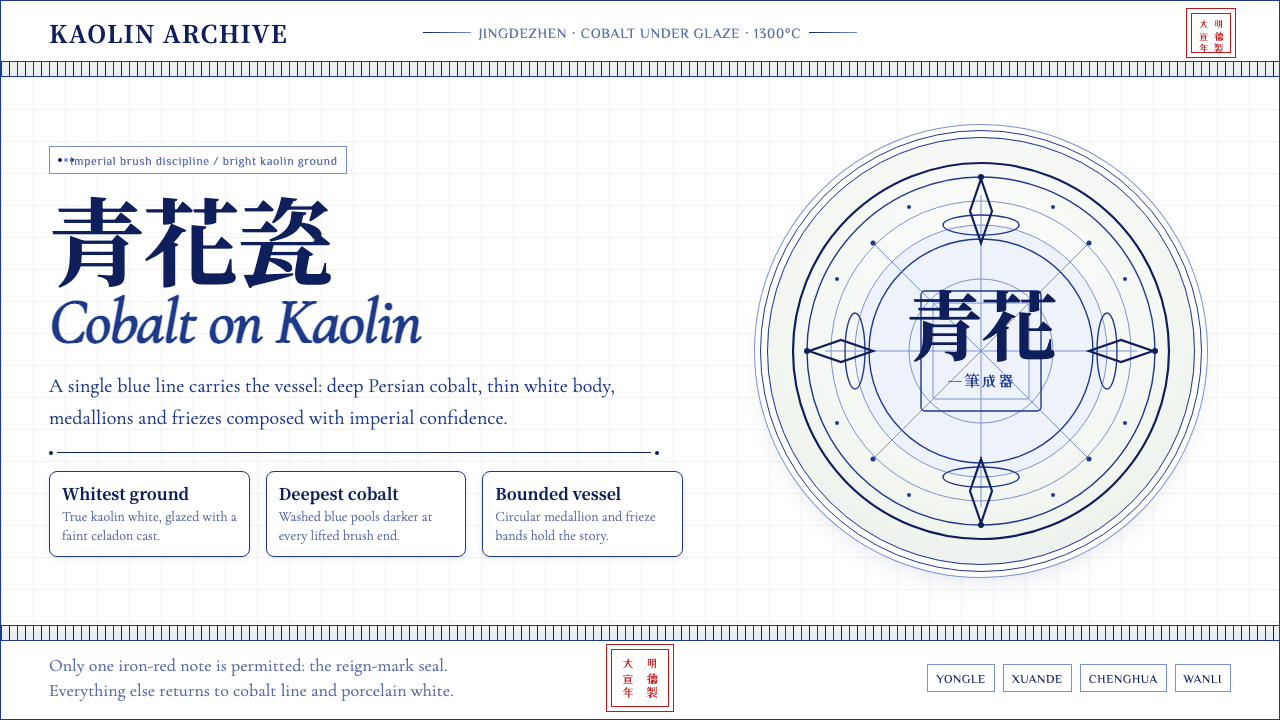 Ming Blue-and-White PorcelainImperial restraint sings. Deep cobalt hairlines circle kaolin white with one…