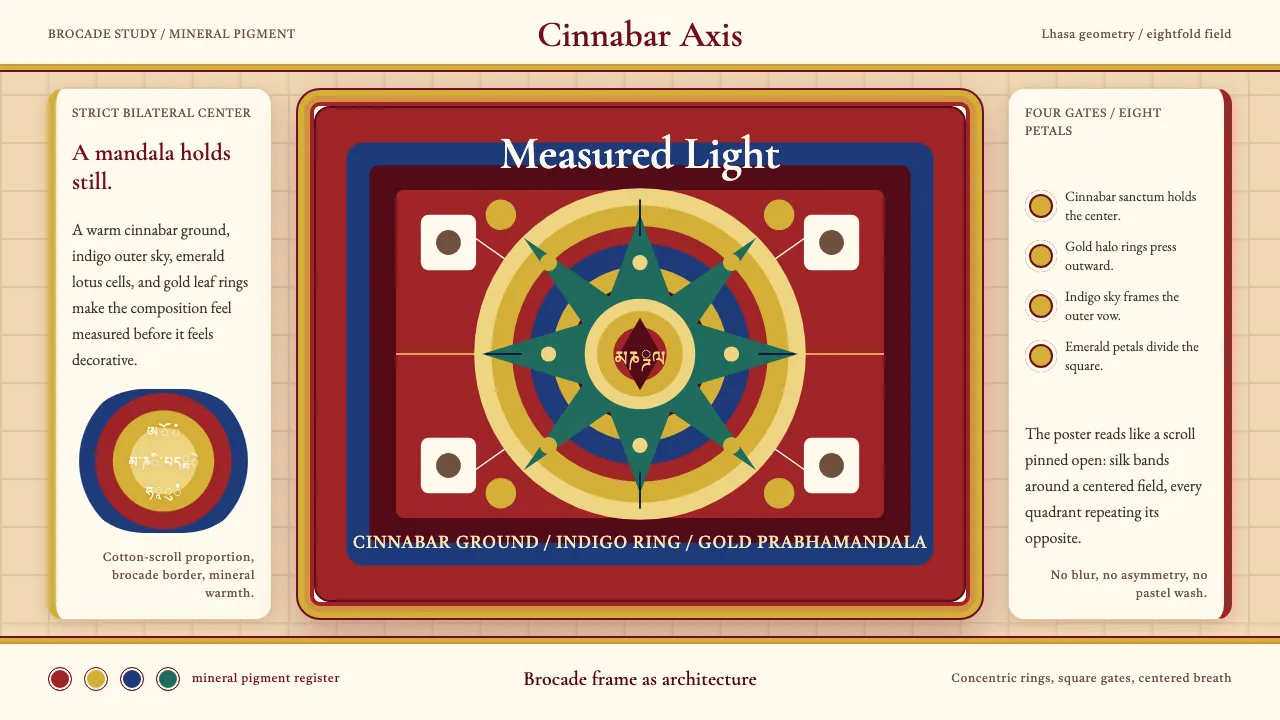
About Tibetan Thangka Mandala
Tibetan Thangka Mandala is Vajrayana Buddhism's most concentrated visual meditation machine — scroll painting on cotton or silk, framed in silk brocade, depicting deity portraits and mandala geometry following 800-year-old iconographic measurement rules.
The Tibetan branch trends warmer than its Bhutanese cousin: saturated cinnabar red, deep indigo sky, emerald petals, and heavy gold-leaf on halos and jewelry. A single deity sits centered in concentric rings of attendants, framed by mountain landscape and brocade silk borders.
- Origin
- Tibet (Lhasa, Shigatse, Kham, Amdo) and Tibetan-Buddhist diaspora across Bhutan, Nepal, Mongolia, Ladakh
- Era
- 7th century onward; peak Yuan–Ming patronage 1300–1500; continuous Karma-Kagyu / Gelug / Sakya / Nyingma school production; 20c diaspora studios
- Key figures
- Menla Döndrup · Gar lineage masters · Karma Gardri school painters · Norbulingka Institute
- Movements
- Vajrayana Buddhist art · Tibetan-Mongol cultural-religious circuit · Tibetan diaspora cultural preservation
Tibetan Thangka Mandala design spec
Colors
Typography
The other 11 sections — buttons, cards, spacing, motion, techniques and more — open once you unlock. Download the DESIGN.md or send it to your AI in one click. Unlock once, yours forever.
Sign up nowStyles similar to Tibetan Thangka Mandala
Also inspired by crafts & folk art, with a close feel.
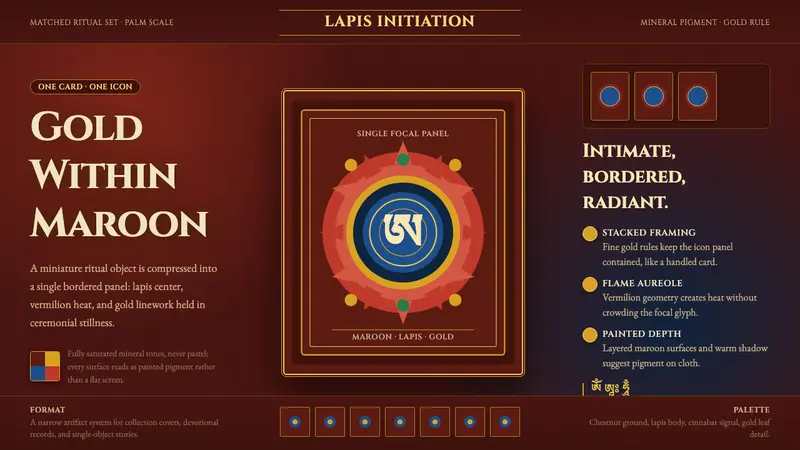 Tibetan Tsakli Initiation CardsPalm-sized radiance. Gold rules, lapis centers, and vermilion flame on maroon pigment.
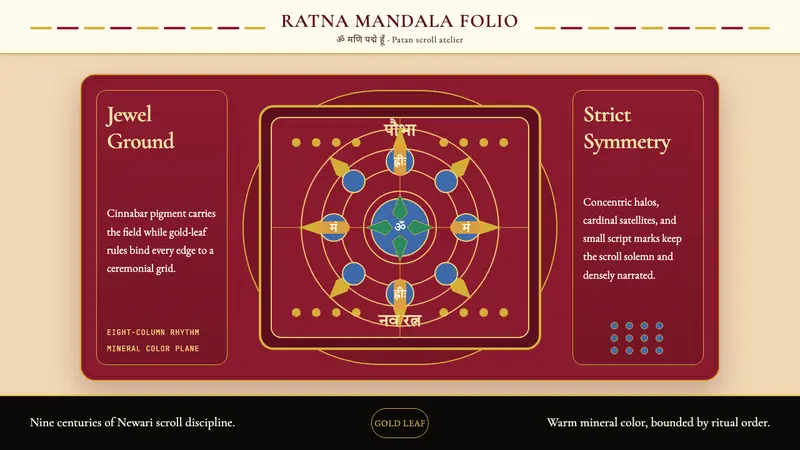 Nepali Paubha (Newari Scroll)Sacred density. Cinnabar ground, gold-leaf frame, lapis rings in strict symmetry.
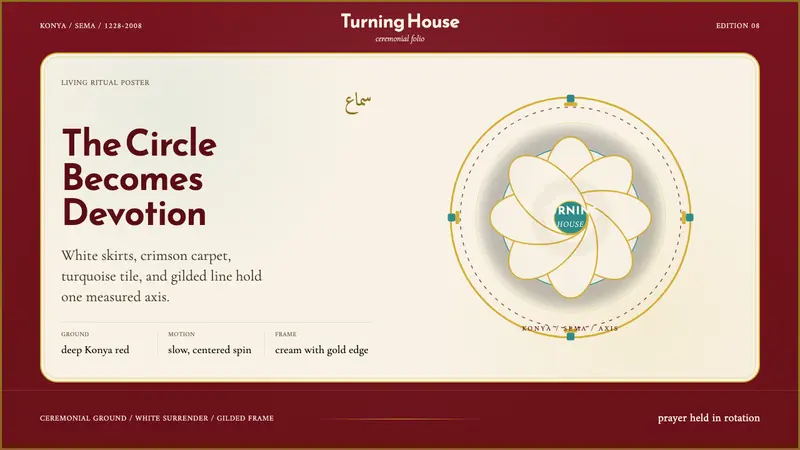 Sufi Whirling (Konya)Ritual in motion. Crimson field, white arcs, turquoise tile, and gold filigree.
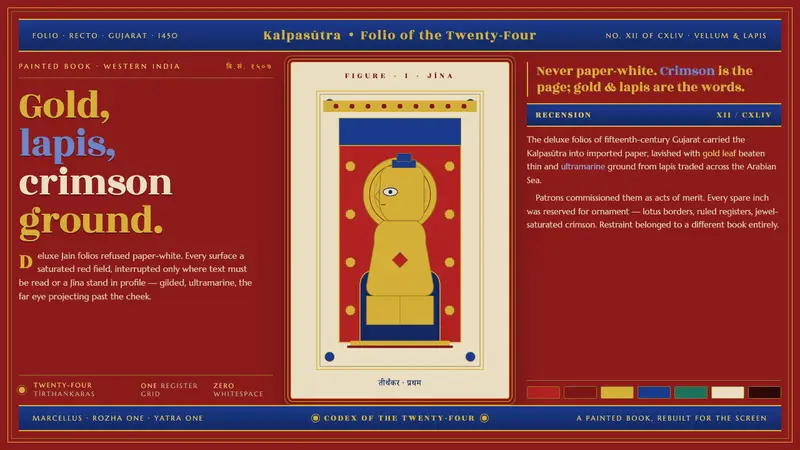 Jain Kalpasutra ManuscriptNever paper-white. Gold leaf and lapis figures on jewel-crimson, lotus-ruled like a 15th-c folio.