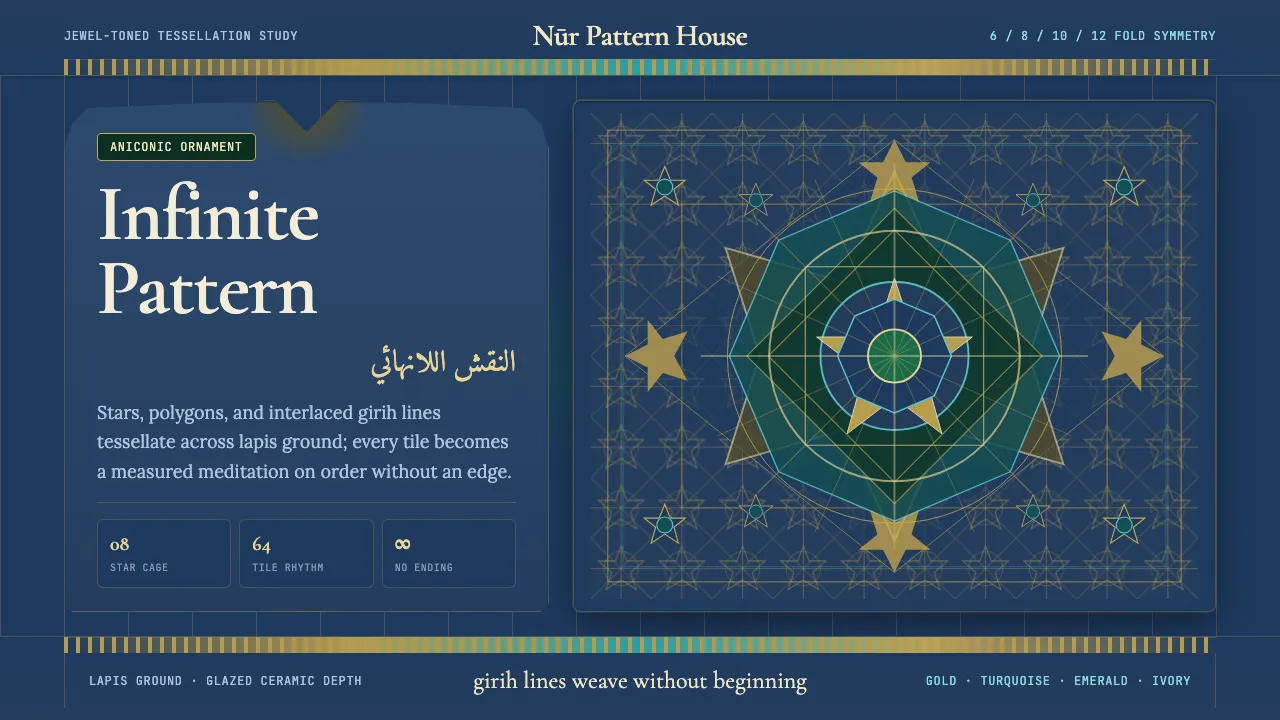
About Islamic Geometric Art
Islamic geometric art is the infinite pattern — stars, polygons, and arabesques tessellating without beginning or end, reflecting the mathematical order of creation. From the Alhambra in Granada to the Shah Mosque in Isfahan, this tradition achieved a geometric complexity that Western mathematics only caught up to centuries later.
Built on 6-, 8-, 10-, and 12-fold symmetry, girih lines weave over-under across jewel-toned grounds of lapis, gold, turquoise, and emerald. Every surface is filled; every motif is a meditation on the infinite.
- Origin
- Baghdad, Damascus, Cairo, Isfahan, Granada, Istanbul
- Era
- 8th–17th century peak (Umayyad through Ottoman); living tradition ongoing
- Key figures
- Anonymous master geometers · Eric Broug · Keith Critchlow
- Movements
- Zellij tilework · Girih patterns · Arabesque
Islamic Geometric Art design spec
Colors
Typography
The other 11 sections — buttons, cards, spacing, motion, techniques and more — open once you unlock. Download the DESIGN.md or send it to your AI in one click. Unlock once, yours forever.
Sign up nowStyles similar to Islamic Geometric Art
Also inspired by crafts & folk art, with a close feel.
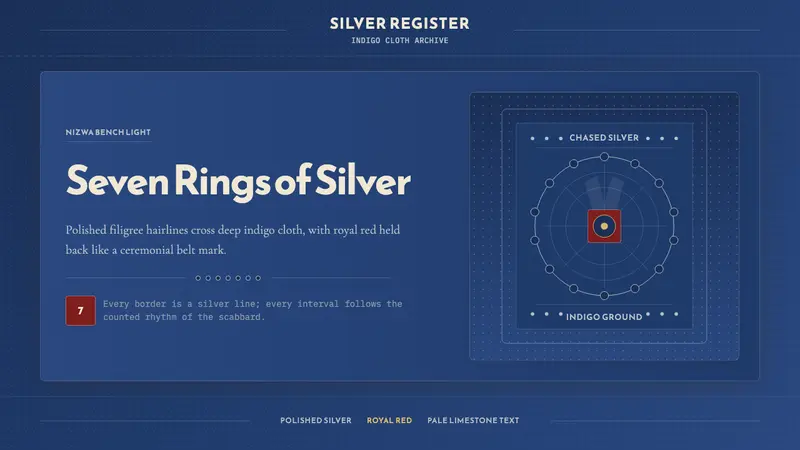 Omani Khanjar Silver DaggerFormal craft gleams. Silver hairlines and seven-ring rhythm rest on indigo cloth.
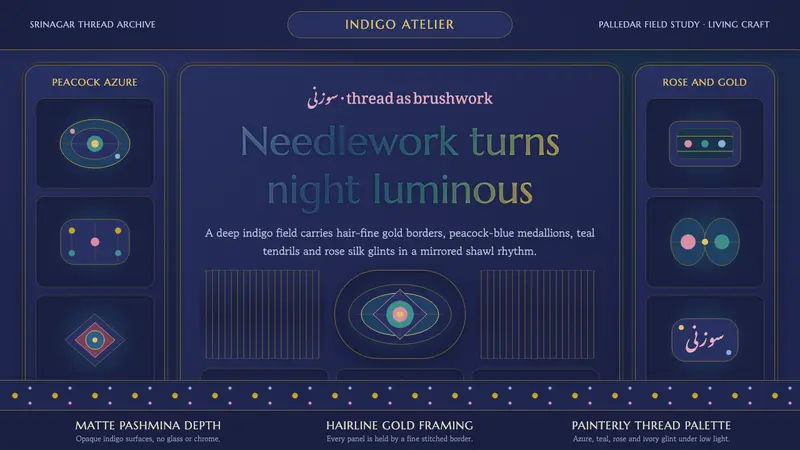 Kashmiri Sozni Shawl EmbroideryNight made luminous. Indigo ground, gold hairlines and silk medallions stitch the frame.
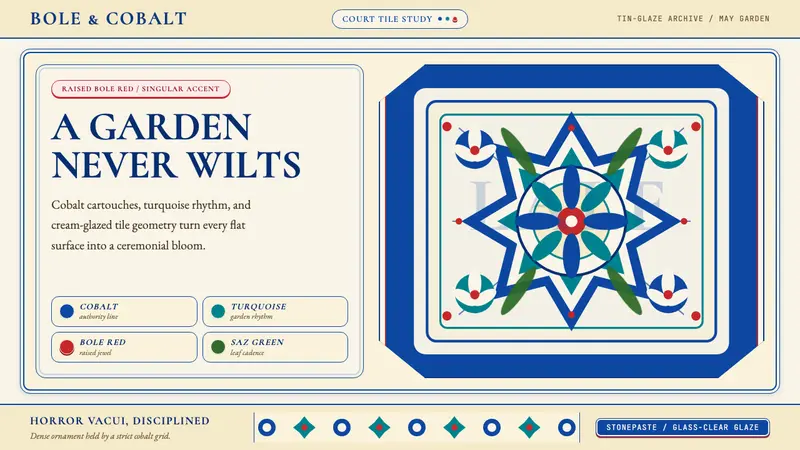 Turkish İznik CeramicBlooms with discipline. Cobalt grid and cream glaze hold turquoise motifs with one bole-red jewel.
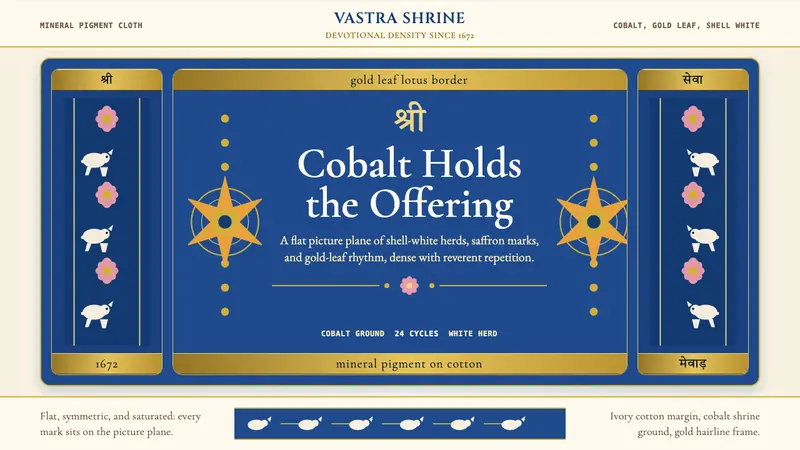 Rajasthani Pichwai (Nathdwara)Devotional density in cobalt. Gold borders, shell-white herds, lotus pink on ivory cotton.