What is Celtic Knotwork?
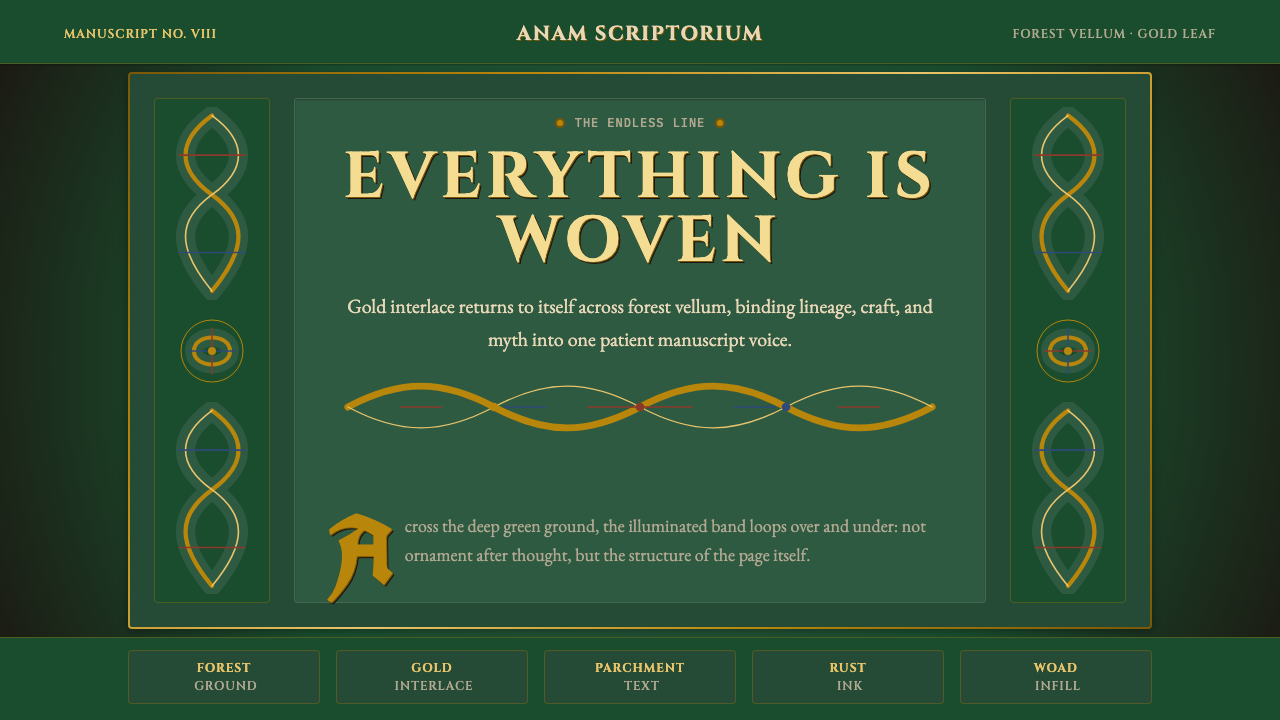
Celtic Knotwork weaves fifteen centuries of sacred geometry into a single unbroken line — where every strand returns to its origin and nothing ever truly ends.
Celtic Knotwork in brief
Celtic Knotwork is a decorative tradition rooted in the Insular art of early medieval Ireland, Scotland, and Northumbria, characterized by continuous interlaced bands that loop, cross, and return on themselves without visible beginning or end. The style encompasses zoomorphic animal interlace, geometric plaitwork, spiral knotwork derived from La Tène metalwork, and the illuminated carpet pages that remain its most recognizable expression. At its core is a single governing idea: the endless line as metaphor for eternity, interconnection, and the cyclical nature of life and spirit.
Unlike ornamental traditions that rely on symmetrical repeat patterns applied to a neutral field, Celtic Knotwork is structurally generative — the knot is both the pattern and the structure. Each intersection is a crossing-over decision: one strand passes above, the other below, in alternating sequence. Follow any strand and it will eventually return to itself, having threaded through every other strand in the composition. This interlocking logic gives the style its characteristic density and the hypnotic quality that draws the eye inward.
The visual palette of historical Celtic work is drawn from the materials of manuscript illumination: deep forest greens from verdigris and malachite pigments, warm gold from actual gold leaf or orpiment, deep blue from lapis lazuli or woad, iron-rust red from red lead, and the warm cream of prepared calfskin vellum. These are not colors chosen for decorative effect alone — they were the colors that the physical craft made available, and their particular warmth and depth reflect centuries of material refinement.

Where does Celtic Knotwork come from?
The roots of Celtic interlace are not exclusively Celtic. Early evidence of interlaced banding appears in Roman mosaic floors and Coptic textile work from Egypt, and similar plaiting motifs were common across the late antique Mediterranean. What distinguishes the Insular tradition is the degree to which these borrowed motifs were systematized, densified, and elevated into a primary artistic vocabulary rather than marginal decoration. Between roughly the fifth and ninth centuries CE, the monasteries of Ireland and the Scottish isles transformed plaitwork into an autonomous art form whose complexity has no parallel in the broader European tradition.
The Book of Kells, produced around 800 CE at the monastery of Iona or a closely related scriptorium and now held at Trinity College Dublin, represents the pinnacle of this tradition. Its carpet pages — full compositions given over entirely to interlaced knotwork with no text — contain knot patterns of extraordinary intricacy, with individual bands often finer than a human hair and compositions that would occupy a modern analyst for hours to trace completely. Contemporary scholars believe the illuminators used grids and compasses to plan the geometry before laying in the ink, a level of systematic preparation that anticipates modern design systems thinking. The Lindisfarne Gospels, produced around 715 CE at the monastery off the Northumbrian coast, and the Lichfield Gospels provide parallel examples of the tradition at comparable sophistication.
The standing stone crosses of Ireland and Scotland — the High Crosses of Muiredach at Monasterboice, Clonmacnoise, and Iona among the most celebrated — translated the interlace tradition into monumental carved stone. Working in sandstone and granite without the benefit of modern tools, the Pictish and Irish carvers achieved knotwork panels of sustained complexity, often combining geometric interlace with figural panels depicting biblical narrative. These crosses were public works in the fullest sense: theological and political statements visible at distances, whose knotwork borders served both as decoration and as symbolic framing for the sacred scenes within.
The Celtic Revival of the nineteenth century reintroduced knotwork to a broad European and American audience, filtered through Romantic nationalism and the antiquarian scholarship of figures such as George Bain, whose 1951 book Celtic Art: The Methods of Construction remains the foundational practical guide to drawing Celtic knots geometrically. Bain's contribution was to reconstruct the grid-based method he believed the original illuminators used, making the tradition reproducible and learnable outside a monastic context. The Revival also connected knotwork to Irish cultural identity politics in ways that persist today — Celtic Knotwork is simultaneously an art-historical category, a living craft tradition, and a cultural signifier with strong contemporary resonance.
What defines the Celtic Knotwork look?
The Endless Line
The defining structural feature of Celtic Knotwork is the unbroken strand that passes continuously through the composition, looping over and under other strands in strict alternation. A correctly drawn Celtic knot contains no loose ends and no breaks — every strand returns to itself, forming a closed loop. This is not merely a visual convention but a structural rule: any composition where a strand terminates is technically a plait rather than a knot. The endless quality was understood by medieval illuminators as carrying spiritual meaning — the infinite, the eternal, the indivisibility of divine order.
Color and Material Warmth
The authentic Celtic palette is drawn from mineral and organic pigments applied to warm vellum: deep forest green, burnished gold, lapis blue, iron-rust red, and the undyed cream of the support itself. These colors are never cold or purely synthetic — they carry the warmth of their material origins. In application, gold and green are primary; blue and red are accents used to distinguish zoomorphic elements or to mark structural divisions within complex compositions. The ground — whether cream vellum or deep green — is always substantive, never neutral white.
Geometric Underpinning
Behind every Celtic knot lies a grid. Historical analysis of the Book of Kells and the Lindisfarne Gospels reveals the use of precisely ruled frameworks — based on squares, diamonds, and circular segments — from which the visible interlace pattern is derived. George Bain's reconstruction of this method shows that even the most complex knotwork carpet page can be reduced to a finite set of geometric decisions: grid spacing, crossing pattern, terminal treatment. This geometric discipline gives the style its precision and its capacity for infinite variation within a consistent structural grammar.
Zoomorphic Interlace
A major subcategory of Insular art, zoomorphic interlace replaces geometric bands with stylized animal bodies — typically birds, wolves, serpents, and hybrid creatures — whose elongated limbs, necks, and tails become the interlacing strands. The animals are not depicted naturalistically but abstracted to the degree required for the strand-logic to hold: a bird's neck may spiral three times before connecting to its tail, a wolf's limbs may braid through three other creatures. Zoomorphic panels were used especially in Gospel book illumination to frame canon tables and initial letters.
Spirals and La Tène Heritage
Alongside true knotwork, Celtic design employs a family of spiral motifs inherited from the earlier Iron Age La Tène tradition of continental Europe, transmitted through metalwork — torcs, fibulae, shield bosses — before appearing in manuscript form. The characteristic trumpet spiral, triskele, and triple spiral connect outward points through curved, expanding lines that accelerate toward their centers. These spirals operate differently from interlace — they expand outward rather than folding back — but they share the same visual logic of continuous motion and are often combined with true knotwork in the same composition.
Illuminated Initials and Text Integration
In manuscript tradition, Celtic Knotwork rarely appears in isolation from text. The illuminated initial — a letter enlarged and elaborated to fill a substantial portion of the page — is one of the tradition's signature formats. These initials are not merely decorated letterforms; they are architectural structures in which the letter's body becomes a framework for knotwork panels, zoomorphic figures, and spiral ornament. The Chi-Rho page of the Book of Kells, which opens the account of the Nativity, is the most celebrated example: the letters themselves dissolve into a composition of extraordinary complexity containing the figures of angels, cats, mice, and at least one otter.
Monumental Scale and Stone Carving
Celtic Knotwork was not confined to the intimate scale of manuscript pages. The carved High Crosses of Ireland and Scotland carried knotwork patterns at a monumental scale, cut into sandstone and granite using iron chisels without the benefit of any power tools. The translation from pen-and-pigment to mallet-and-chisel required a simplification of line — carved knotwork tends toward broader bands and more widely spaced crossings than manuscript work — but retained the essential structural logic. This cross-media character is fundamental to understanding the style: it is not a technique but a grammar, equally at home at the scale of a marginalia detail and the scale of a two-metre stone monument.

Who shaped Celtic Knotwork?
The monastery on the island of Iona, off the western coast of Scotland, is the most likely origin of the Book of Kells, which was begun there and possibly completed after the community fled Viking raids to Kells in County Meath around 806 CE. Iona was the founding house of the Columban network of monasteries that spread from Ireland across Scotland and into Northumbria, and its scriptorium represented the intellectual and artistic center of what scholars now call the Columban tradition. The style developed at Iona synthesized Irish La Tène spiral traditions with Mediterranean interlace motifs introduced through contact with Coptic and Byzantine manuscripts.
Muiredach mac Domhnaill, an abbot of Monasterboice in County Louth who died in 923 CE, is the figure most directly associated with the high cross that bears his name — the Muiredach Cross, regarded as the finest surviving example of Irish High Cross carving. An inscription at its base reads 'a prayer for Muiredach by whom this cross was made.' The cross stands over five metres tall and combines figural biblical panels with knotwork and spiral borders of extraordinary refinement, demonstrating the mature integration of narrative and ornamental traditions that defined the ninth and tenth century Irish monastic aesthetic.
Eadfrith, Bishop of Lindisfarne from 698 CE until his death in 721 CE, is identified in a colophon added to the Lindisfarne Gospels in the tenth century as the scribe and illuminator of the manuscript. Whether the attribution is accurate — some scholars believe the work may have involved multiple hands — Eadfrith or the scriptorium tradition he led produced one of the most technically demanding examples of Insular illumination. The carpet pages of the Lindisfarne Gospels show knotwork of a precision and regularity that modern analysts have confirmed required mathematical planning comparable to the kind of systematic layout work done in contemporary design software.
George Bain (1881–1968) was a Scottish artist and art educator who devoted decades to the systematic analysis and reconstruction of Celtic design methods. His 1951 book Celtic Art: The Methods of Construction, published after years of careful study of illuminated manuscripts and carved stones, demonstrated that the complex knotwork of the Book of Kells and the High Crosses was generated by geometric grid systems that any trained practitioner could reproduce. Bain's work was decisive in transforming Celtic Knotwork from an inaccessible historical artifact into a living craft tradition, and his method — drawing the grid, setting the crossing pattern, then tracing the strand — remains the standard pedagogical approach used in Celtic art workshops worldwide today.
The Picts — the pre-Gaelic inhabitants of northern and eastern Scotland — developed a parallel tradition of carved symbol stones that incorporated interlace alongside a unique system of abstract symbols whose meanings remain undeciphered. Pictish carved stones of the seventh through ninth centuries show interlace work of sophistication comparable to the finest manuscript illumination, adapted to the very different material conditions of outdoor stone carving in the Scottish climate. The Pictish contribution is often overlooked in favor of the Irish manuscript tradition, but the cross-slabs at Nigg, Hilton of Cadboll, and Meigle demonstrate that the interlace grammar was shared across linguistic and cultural boundaries, adapted locally while maintaining its essential structural logic.
How do you use Celtic Knotwork today?
Celtic Knotwork is among the most context-specific historical styles in the designer's toolkit — it carries deep cultural and temporal associations that actively shape how audiences receive a design. Applied thoughtfully, it conveys depth, craft, continuity, and a certain austere beauty. Applied carelessly, it reads as costume or kitsch. The difference between the two lies almost entirely in understanding what the style is doing structurally, not just what it looks like on the surface.
For presentation slides, Celtic Knotwork works best when applied with discipline and economy. A cover slide benefits from a single large knotwork or spiral motif set against a deep forest-green or midnight-blue ground, with title text in a carved-stone serif face placed in high contrast. The knot should be used as a framing or anchoring element, not as wallpaper — one considered piece of interlace positioned at a corner or as a central medallion reads as intentional craft; a tiled pattern reads as clip art. Content slides should restrain the ornament drastically: a knotwork divider border at the top or bottom of a slide, with the body given over to clean text hierarchy on a cream ground, preserves the visual grammar without overwhelming the information. Data slides can use knotwork-derived line motifs — interlaced borders around chart panels — to give structure without turning charts into decoration.
For web interfaces and dashboards, the style is best suited to landing pages, about pages, heritage product displays, and cultural institution sites rather than functional utility screens. The appropriate application involves forest-green or deep-ground hero sections with gold-toned typographic headings, cream-ground content sections with generous margin, and narrow knotwork border elements used as structural dividers rather than decoration. Interactive elements — buttons, links, hover states — should use the gold and rust tones as accent colors for their active states, maintaining the palette's material warmth. Pricing pages can use knotwork medallion motifs to distinguish tier cards, but the functional text within each card should be held in a clean, well-spaced serif to remain readable.
For editorial and marketing applications, Celtic Knotwork provides a rich vocabulary for heritage branding, cultural event promotion, literary publishing, whiskey and spirits, artisan food and beverage, and any context where craft provenance is a desired association. A well-executed editorial spread uses a single large carpet-page-derived illustration or border to establish the cultural register on the opening page, then carries the palette — forest green, gold, cream — through the remaining pages without repeating the dense knotwork. Marketing materials work well with the style's poster-like quality when the interlace is used at large scale and high contrast: a single knotwork initial at cover scale, a spiral motif treated as a full-bleed background element at reduced opacity. The style's connection to handcraft means that paper, printing, and material finish choices are especially important — uncoated stock, letterpress or foil detailing, and warm-white rather than cool-white backgrounds all reinforce the aesthetic's integrity.
A common and serious mistake when applying Celtic Knotwork is treating the interlace as a purely surface texture — a background pattern or clip-art border — rather than as a structural element with its own internal logic. Designs that tile a knotwork pattern across a background without regard for compositional placement read as generic medievalism rather than authentic Celtic design. A related error is combining Celtic ornament with sans-serif or modernist typography on the assumption that the contrast is sophisticated — more often it reads as incoherent, because the two systems carry opposite assumptions about the relationship between ornament and structure. Celtic Knotwork pairs most naturally with serif typefaces that have their own historical depth: carved-stone capitals, humanist serifs, and blackletter forms all work; neutral geometric sans-serifs fight the style. Finally, oversaturation of the palette — using all four of the tradition's colors simultaneously at full intensity — produces muddy visual results. In historical work, one color dominated at a time, with others appearing as accents; contemporary work should respect the same economy.

Celtic Knotwork — FAQ
Is Celtic Knotwork the same as Viking or Norse ornament?
They are related but distinct. Both traditions use interlace, and there was genuine historical exchange between them — the Viking Age brought Norse settlers into close contact with Insular art in Ireland, Scotland, and Northumbria, and Hiberno-Norse art blends both traditions in objects like the Ardagh Chalice and various Viking-period brooches. However, the structural grammar differs: Celtic interlace follows a strict over-under alternation with no loose ends, while Norse interlace (particularly in the Urnes and Jelling styles) is characterized by animal bodies in more fluid, asymmetric compositions with ribbon-like beasts that grip and bite each other. Pure Celtic Knotwork also lacks the aggressive figural drama of Norse work; its zoomorphic elements tend toward abstraction rather than narrative. The two traditions are best understood as cousins that shared vocabulary while developing distinct grammars.
Can Celtic Knotwork work in a contemporary or minimal design context?
It can, but the accommodation must be made on the style's terms rather than the contemporary design language's terms. The most successful contemporary applications use a single, well-resolved knotwork element — a border, a medallion, a terminal ornament — as a deliberate gesture against the surrounding minimalism, rather than attempting to strip the interlace down until it reads as a modern pattern. Celtic Knotwork simplified to abstraction loses its defining structural logic and becomes indistinguishable from generic geometric ornament. Conversely, a single confident piece of historically informed interlace, placed with precision against a clean modern layout, creates productive visual tension. The contrast works when the knotwork is allowed to be fully itself — complex, dense, historically rooted — within an otherwise restrained composition.
How do I distinguish authentic Celtic Knotwork from generic medieval-inspired pattern?
The primary test is structural: trace any strand in the composition. If it returns to itself after threading continuously through all other strands in alternating over-under fashion with no breaks, it is structurally a true knot. If strands terminate, if crossings are inconsistent, or if the pattern is simply a repeated tile without internal strand continuity, it is a generic plaitwork or faux-Celtic pattern. The secondary test is geometric: authentic Celtic compositions are derived from grid systems whose geometry can be identified and reconstructed. Authentic work also tends to have consistent band width throughout the composition, because the grid disciplines the strand spacing. Generic Celtic-inspired work often has irregular band widths that reveal improvised rather than geometrically planned construction.
What are the right contexts for Celtic Knotwork, and where does it misfire?
Celtic Knotwork is most at home in contexts where craft, heritage, depth of tradition, and a certain patient intricacy are desired values: literary publishing, whiskey and spirits branding, cultural institution identity, historical documentary design, premium artisan goods, and any communication whose purpose is to evoke the long view of human making. It struggles anywhere that demands speed, frictionless modernity, or emotional lightness — consumer tech interfaces, fast-food branding, children's educational products, and ultra-minimal luxury positioning all work against the style's fundamental character. It also misfires when applied ironically or superficially, since the style has enough cultural weight that careless application reads as disrespect rather than playfulness. The question to ask is whether the product or communication genuinely benefits from an association with deep time, handcraft, and the kind of beauty that rewards slow attention — if the answer is yes, Celtic Knotwork is a powerful choice.
Does Celtic Knotwork have to be dark and heavy, or can it be used in light, airy compositions?
The historical palette is warm and substantive rather than inherently dark — the canonical ground is cream vellum, not black, and the gold and green of the illuminated tradition carry significant luminosity. A light variant of the style, using cream or warm off-white as the primary ground with gold and forest-green as the ornamental colors and a warm deep tone for text, is historically grounded and produces compositions that feel refined rather than heavy. What does not work is moving the palette toward cool, pastel, or desaturated tones — these drain the style of the material warmth that is central to its character. Similarly, reducing the density of the interlace to the point of sparseness undermines the style's essential logic: a Celtic knot at very low density simply looks unresolved. The style tolerates light grounds and moderate scale perfectly well; it does not tolerate thinness or coolness.
Related design styles
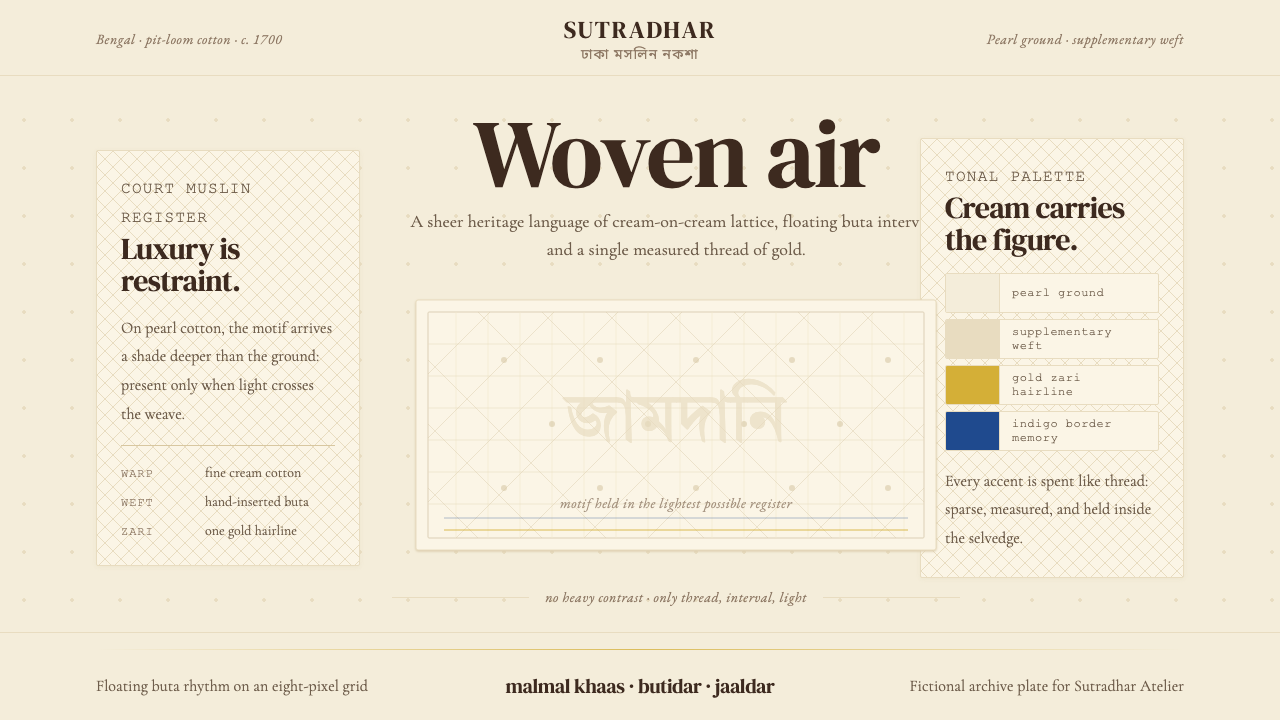 Bengali Jamdani WeavingLuxury whispers. Pearl cream, tonal buta, and one gold hairline make woven ai…
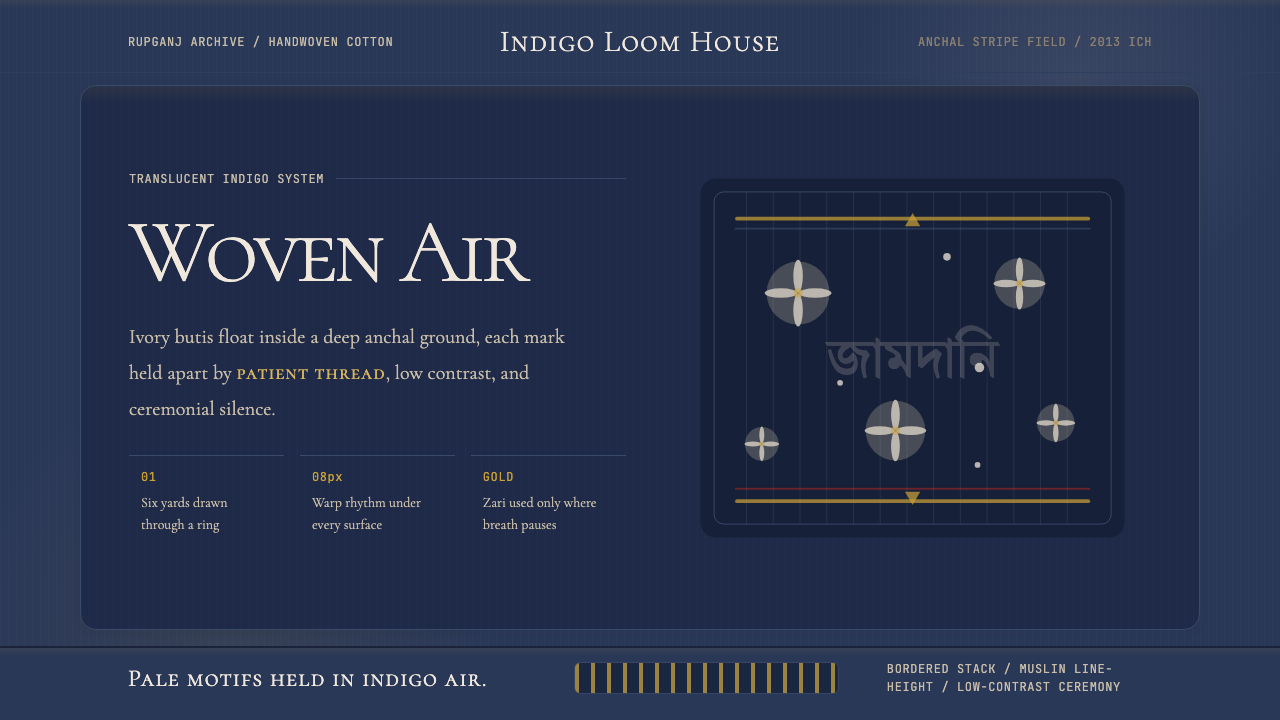 Bengali Jamdani MuslinBreathes like woven air. Indigo ground, ivory butis, and threadline borders s…
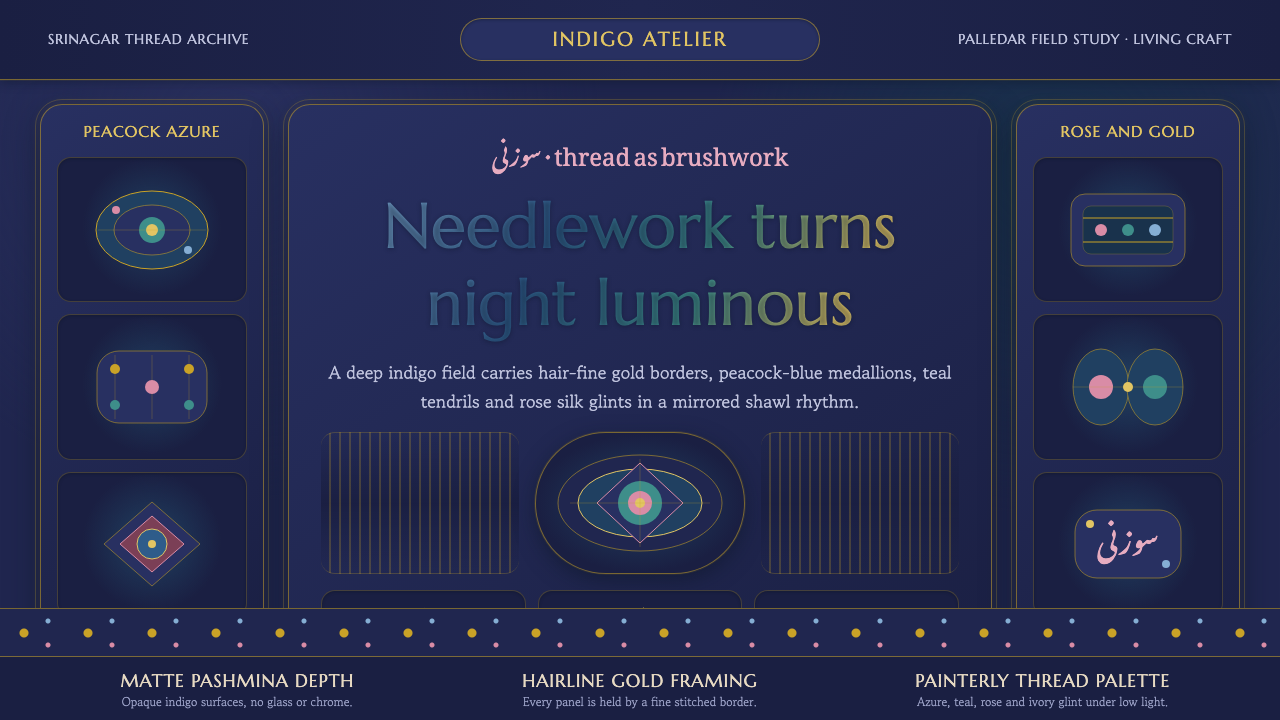 Kashmiri Sozni Shawl EmbroideryNight made luminous. Indigo ground, gold hairlines and silk medallions stitch…
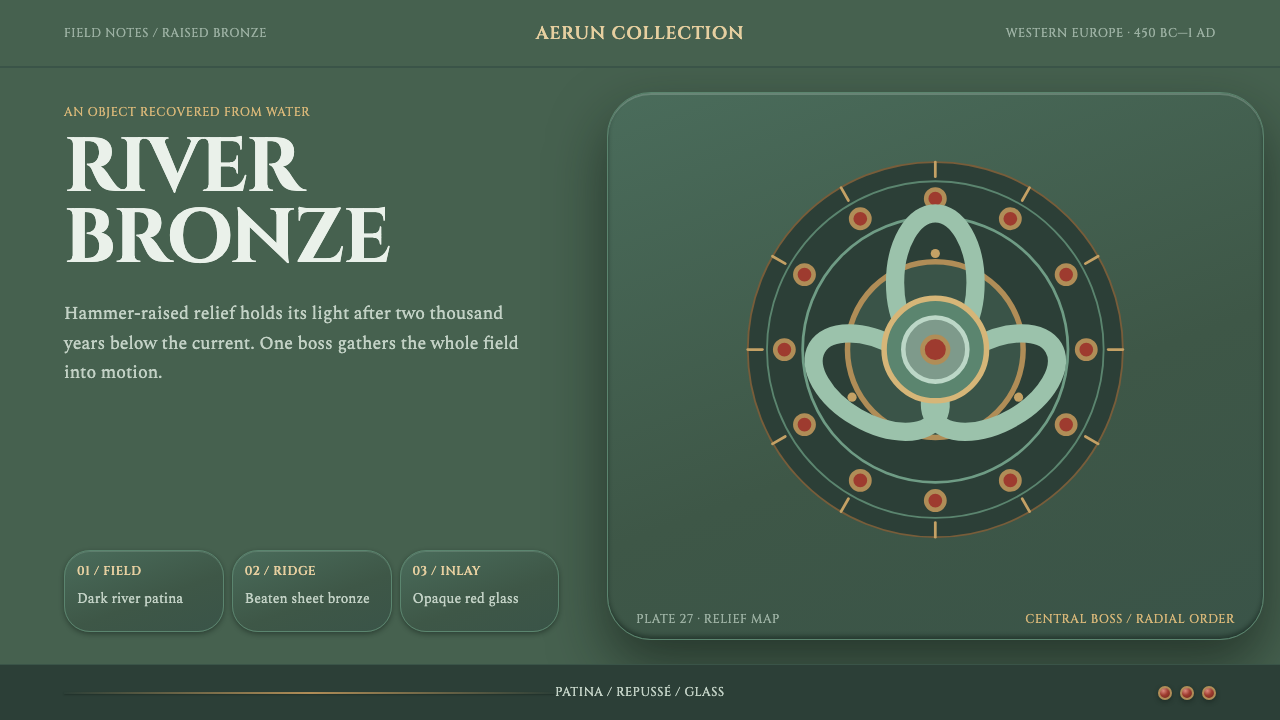 La Tène Celtic MetalworkMetalwork that still moves. Patina-green relief radiates from a bronze boss,…
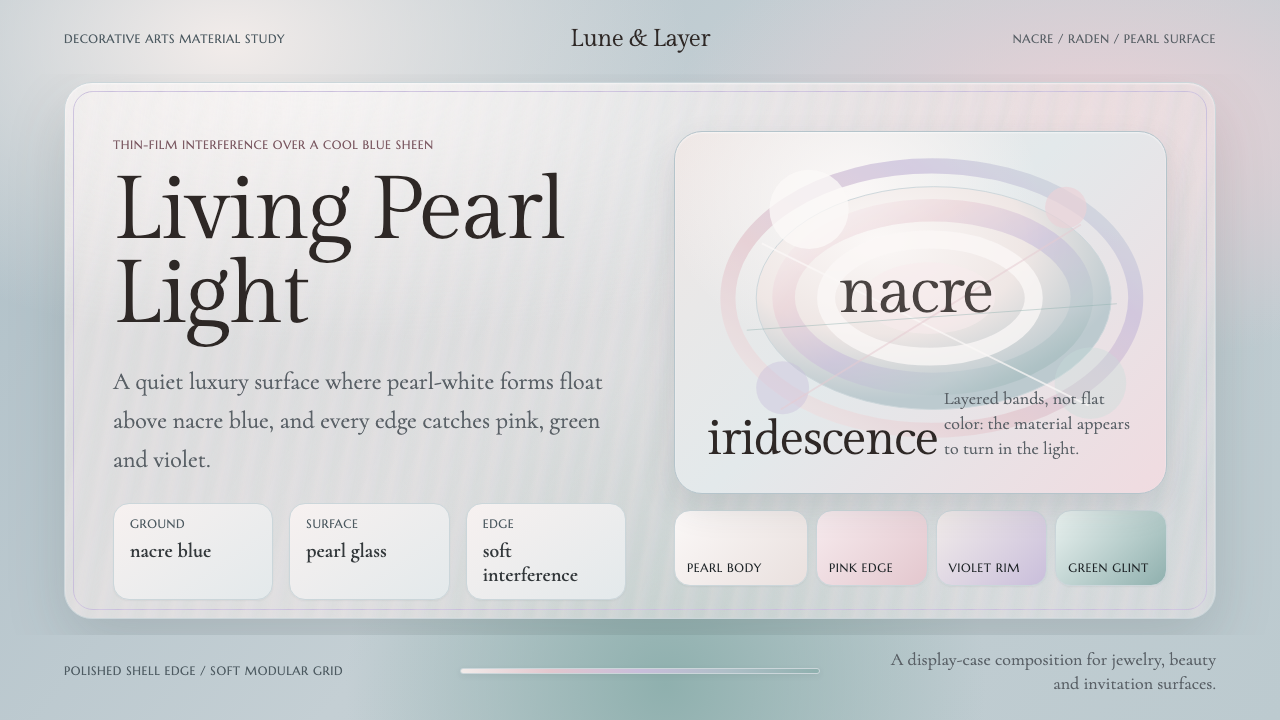 Mother-of-Pearl NacreQuietly expensive shimmer. Nacre blue ground with pearl panels and pink-viole…
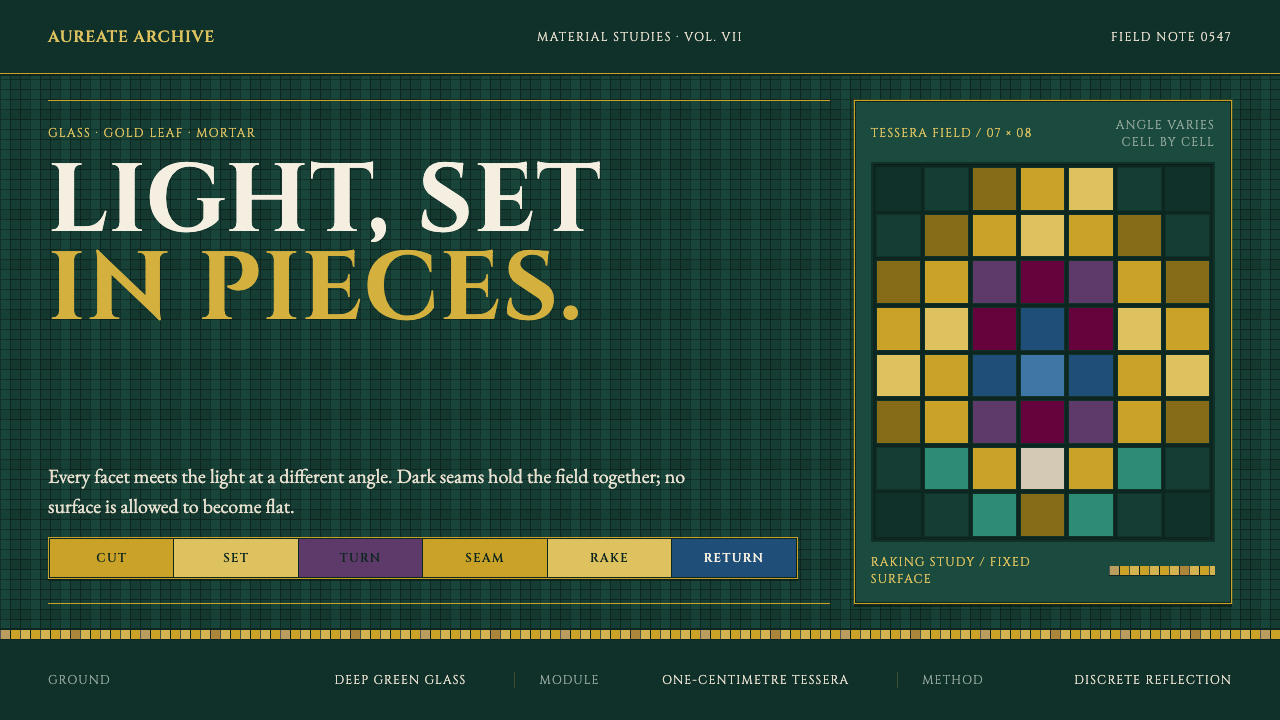 Ravenna Gold MosaicLight lives between pieces. Gold cells, green glass and dark seams make the s…