What is Bengali Jamdani Weaving?
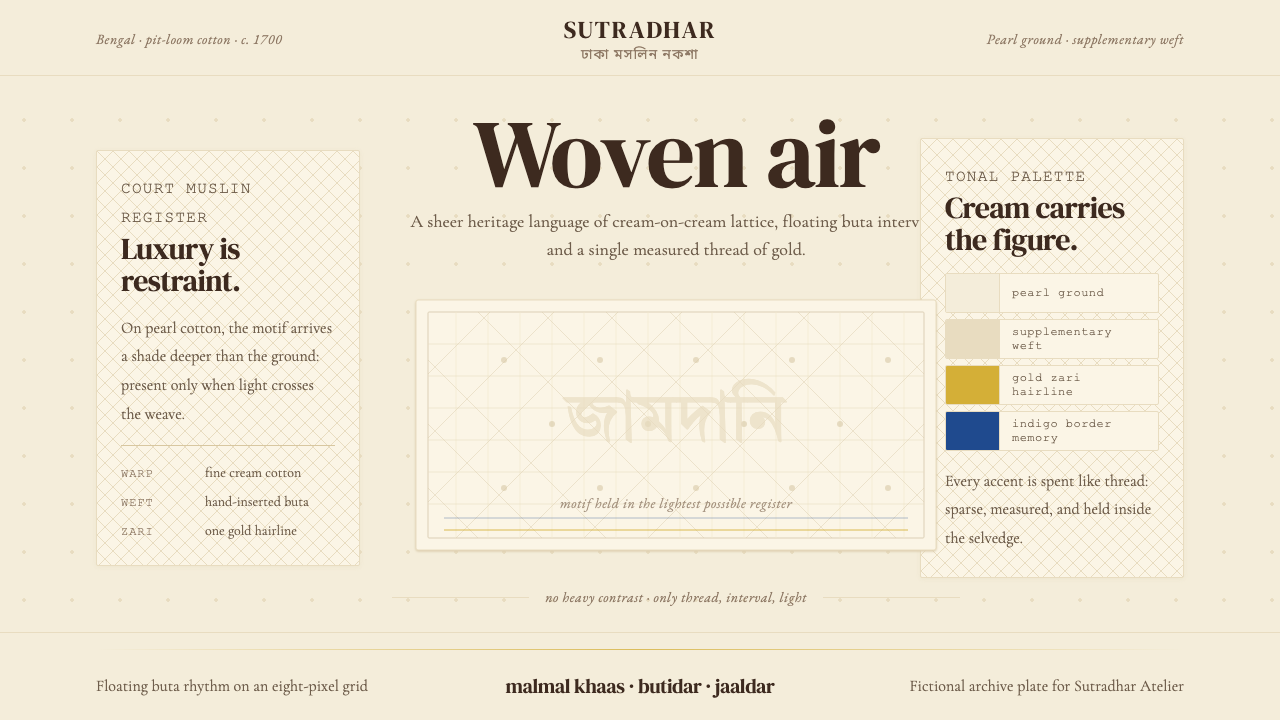
Jamdani is woven air — a millennium-old Bengali tradition of floating tonal floral motifs on a pearl-cream ground so fine that a whole sari could pass through a finger-ring.
Bengali Jamdani Weaving in brief
Jamdani is Bengal's supplementary-weft handloom tradition: weavers on a pit-loom hand-insert extra threads — tonal cotton or zari (metallic yarn) — into a pre-laid warp to build up floating motifs that appear to hover above the ground cloth. The technique produces a fabric so lightweight and sheer that Mughal chroniclers called it woven air, flowing water, and evening dew. A single sari can take weeks or months of coordinated two-person weaving; each motif is placed one thread at a time, with no mechanical jacquard shortcut.
The aesthetic philosophy of Jamdani is the opposite of display. Its beauty lies in restraint and in the near-invisible: a cream-on-cream floral spray (butidar), a tonal paisley buta just a shade deeper than the ground, an occasional hairline of gold-zari catching the light. The palette is deliberately narrow — pearl-white or undyed cotton grounds, thread motifs in the same white or a close analogue, with the rarest and most celebratory pieces adding a sliver of red, gold, or deep indigo at the border. Saturation, contrast, and visual loudness are entirely absent from the canon.
UNESCO inscribed Jamdani weaving on its Intangible Cultural Heritage list in 2013, acknowledging that the craft is not merely a textile tradition but a living repository of spatial thinking, bodily knowledge, and aesthetic discipline accumulated over at least five hundred years of continuous practice in the Bengal delta.

Where does Bengali Jamdani Weaving come from?
The earliest textual references to Bengal's fine muslin tradition date to around the first century CE, when Greek, Roman, and Arab traders recorded their encounters with a cotton cloth of extraordinary fineness from the Ganges delta region. The specific supplementary-weft technique that defines Jamdani appears to have developed and consolidated during the Sultanate period (roughly the thirteenth to sixteenth centuries), drawing on Persian and Central Asian weaving vocabularies introduced through trade and courtly exchange. The name itself is likely Persian in origin: 'jam' may derive from the Persian word for cup or vessel, 'dani' a suffix denoting container — though the precise etymology remains debated among textile historians.
The Mughal period, from roughly 1500 to 1800, was Jamdani's golden age and the era that shaped the aesthetic standards the tradition still observes. Mughal emperors established dedicated karkhanas (imperial workshops) in Dhaka — then called Dacca and the administrative capital of Bengal — where master weavers produced cloth exclusively for the court and for gifts to foreign dignitaries. Emperor Aurangzeb's daughter is said to have been reprimanded for appearing indecent when dressed in seven layers of Jamdani; the cloth's translucency was not a flaw but the measure of its perfection. The most prized grades received poetic names: woven air, running water, evening dew, Shah Jahan's favourite. These were not metaphors of marketing but technical classifications recognized at court.
The collapse of Mughal power and the subsequent consolidation of British colonial rule dismantled the imperial patronage system on which Jamdani's highest-end production depended. The British East India Company's commercial policies, the flooding of Indian markets with cheap machine-woven cloth from Lancashire mills, and the infamous documented mutilation of Dacca weavers' thumbs — whether historically verified or legendary, this story became the symbol of the colonial destruction of an artisan economy — all contributed to a severe contraction of the craft through the nineteenth century. By 1900, the finest grades of Jamdani had almost ceased to be woven.
Revival came in waves. In the late nineteenth and early twentieth centuries, Bengal's swadeshi movement — the campaign for Indian self-reliance — explicitly championed handloom textiles as both cultural assertion and economic resistance. Post-partition (1947) and then post-independence Bangladesh (1971) both invested in Jamdani as national heritage, centering production on the Rupganj and Narayanganj districts just outside Dhaka. In West Bengal, the towns of Shantipur, Phulia, and Murshidabad maintained parallel weaving traditions. The 2013 UNESCO recognition brought renewed international attention and design-world interest, prompting collaborations between master weavers and contemporary fashion designers across South Asia and Europe.
What defines the Bengali Jamdani Weaving look?
Tonal Ground
The defining visual quality of Jamdani is its tonal near-monochrome: the ground cloth and the supplementary-weft motifs are in the same color family, separated by no more than a whisper of value. Pearl-white ground with cream motifs, undyed cotton ground with slightly bleached thread patterns — the eye must work slightly to distinguish figure from field. This tonality is not a limitation but the aesthetic point: luxury declared through subtlety rather than contrast.
Supplementary-Weft Float
The technical signature of Jamdani is the supplementary weft: additional threads that are not structurally necessary for the cloth's integrity but are inserted by hand to form motifs that float above the surface of the plain-weave ground. Each motif requires a separate length of thread; weavers work in pairs, one on each side of the loom, passing the supplementary thread back and forth to build up the pattern row by row. The resulting surface has a subtle three-dimensionality — the motif sits fractionally above the ground — that catches light differently as the fabric moves.
Traditional Motif Vocabulary
The classic Jamdani motif repertoire is drawn from a synthesis of Bengali folk imagery, Mughal court aesthetics, and Persian ornamental traditions. The buta is the essential single-floral or paisley-shaped unit, scattered across the ground in a butidar (all-over) arrangement or marshalled into jalar (lattice) and tercha (diagonal stripe) compositions. The lotus, the creeper, and the stylized fish appear in border treatments. These motifs are not printed from templates; they exist in the weaver's visual memory, handed down through apprenticeship, and vary in character from master to master.
Extreme Sheerness
At the highest levels of the tradition, Jamdani fabric is woven so fine that the cloth is essentially transparent, with a hand — the tactile quality of the fabric — that is simultaneously present and barely there. This sheerness is achieved through extraordinarily fine-count thread, tight and even tension across the warp, and the pit-loom's naturally humid working environment in the Bengal delta, which keeps the threads supple. Grading in the Mughal court moved from Woven Air (the finest) downward through a recognized hierarchy of textile densities.
Disciplined Accent
Where color beyond the tonal ground appears, it is deployed with extreme economy. A single hairline of gold zari at the selvedge or border; a narrow stripe of deep red or indigo reserved for wedding saris; a small zari motif catching the light amid acres of white — these accents are meaningful precisely because they are rare. The sensibility is the opposite of decorative maximalism: every non-tonal element must justify its presence, and its rarity is its value.
Craft Knowledge as Visual Form
Jamdani's visual character is inseparable from its making: there are no printed patterns, no mechanical shortcuts, no two pieces exactly alike. Slight irregularities in thread tension, minor variations in motif spacing, the individual rhythm of each weaver's hand — all register in the finished cloth as a quality of aliveness that machine production cannot replicate. This means that when Jamdani's visual language is translated into digital or print design, it is essential to distinguish between imitating the outcome (cream palette, tonal motifs) and understanding the logic (restraint, tonal discipline, the value of near-invisibility).
Negative Space as Protagonist
In Jamdani composition, the ground — the unmarked white or cream field — is not background but active participant. Motifs are placed so that the space between them breathes; a well-composed buta arrangement gives as much visual weight to the intervals as to the floral units themselves. This handling of open space is a deliberate aesthetic choice rooted in the same sensibility that makes the tonal restraint meaningful: the ground is not absence but presence, the silence that makes the whisper audible.

Who shaped Bengali Jamdani Weaving?
A master weaver from the Rupganj district of Narayanganj, Saiful Islam represents the continuity of Dhaka's Jamdani tradition into the present day. He is among the craftsmen whose practice has been documented by textile researchers and government heritage programs as part of the post-UNESCO recognition effort to map and preserve the living chain of transmission. His work demonstrates the butidar all-over arrangement at its most refined, with motif spacing that reflects decades of accumulated spatial judgment.
Born in Chittagong and trained as a model in London, Bibi Russell returned to Bangladesh in the 1990s to launch a sustained campaign for the revival and international recognition of traditional Bengali handloom craft, including Jamdani. Her 'Fashion for Development' initiative brought Jamdani-woven cloth into international fashion shows and retail contexts, introducing the aesthetic to audiences outside South Asia without stripping it of its artisanal origins. She has been a central figure in connecting master weavers with contemporary design commissions.
The founder of the Indian fashion label péro, Aneeth Arora has repeatedly worked with Jamdani and other Indian handloom traditions, integrating supplementary-weft techniques into contemporary silhouettes. Her approach treats the textile's inherent language — tonal restraint, the visible logic of the weave, imperfect irregularity — as the design, rather than subordinating the cloth to a pattern applied on top of it. Her work has brought Jamdani to the attention of an international fashion audience that engages with craft-forward design.
A textile designer and researcher based between Kolkata and the handloom clusters of West Bengal, Mainak Banerjee has worked to document and reinterpret the Jamdani traditions of Shantipur and Phulia — the West Bengal counterparts to Dhaka's tradition. His practice bridges archival research and contemporary application, recovering dormant motif patterns from nineteenth-century trade records and reintroducing them into commission work. He represents the scholarly-practitioner model through which much handloom revival knowledge is transmitted.
How do you use Bengali Jamdani Weaving today?
Translating Jamdani's visual language into contemporary design work requires understanding what makes the tradition visually distinctive: it is not the motifs themselves but the tonal discipline — the insistence on near-invisibility, on figure and ground so close in value that the eye must actively look. Any design application that introduces strong contrast, saturated accent colors, or visual loudness has departed from the Jamdani sensibility, even if it retains the paisley and floral shapes. The transfer works best when designers treat restraint not as a default but as a committed structural choice.
For presentation slides, Jamdani's language suits cover pages that need to project quiet authority rather than aggressive energy. A cover built in this idiom uses a very pale, near-neutral ground — cream, warm white, or the faintest blush — with a tonal motif pattern rendered in a shade only marginally deeper, placed asymmetrically or in a corner scatter. The title sits in a refined, medium-weight serif in the same neutral family, with a single very fine hairline rule as the only accent. Content slides should maintain the same restraint: narrow type hierarchies defined by weight shift rather than color shift, generous margins treated as active ground rather than waste, and data visualizations in tonal monochrome with a single refined accent for the most important value.
For web interfaces, dashboards, and pricing pages, the Jamdani aesthetic translates into an elevated, spa-like quietness that works well for premium, wellness, luxury, or high-craft-positioned brands. The approach calls for an off-white or warm cream background across all surfaces; body text in a warm near-black rather than pure ink; interactive elements differentiated by a tonal shift — a slightly warmer or cooler cream — rather than a contrasting color. Borders, if used, should be hairline-fine and in the same tonal family as the surface. The single permissible accent — used for primary calls to action, selected states, or a logo mark — draws from the Jamdani tradition of the gold zari hairline: very thin, very precise, and used nowhere else.
For editorial design and marketing materials, Jamdani's sensibility supports a kind of cultivated quietness that reads as sophisticated rather than empty. A long-form article layout in this mode gives the body text generous leading and wide outer margins, with pull-quotes set in a size just slightly larger than body and in the same tonal weight — no bold, no color. Section openers might carry a very light tonal motif pattern as a background field behind the headline, giving depth without contrast. Marketing pages work when they commit fully to the near-monochrome: full-width feature blocks in warm white with cream type, a single refined color accent used once per page for the primary action. The error is adding accent colors out of anxiety that the design is too quiet — that quiet is the message.
The most common mistake when applying Jamdani visual principles is introducing contrast where the tradition demands its absence. Using a deep, saturated motif color against a pale ground — even a beautiful combination in its own right — destroys the tonal logic and produces something that looks Mughal-inspired or Indo-Persian rather than Jamdani. Similarly, multiplying accent colors, adding decorative borders in a contrasting tone, or using multiple different motif scales simultaneously fragments the composition's deliberate stillness. A second, subtler error is treating the tonal palette as automatically luxurious without applying the compositional discipline: a cream background with cream type but no attention to spacing, hierarchy, or motif placement produces a muddy ambiguity rather than the Jamdani quality of restrained precision.

Bengali Jamdani Weaving — FAQ
What is the difference between Jamdani and ordinary muslin?
Muslin is the base fabric — an extremely fine, plain-weave cotton cloth that Bengal has been producing since antiquity. Jamdani is a specific form of decorated muslin in which supplementary weft threads are hand-inserted to create floating motifs on the muslin ground. All Jamdani is muslin, but not all muslin is Jamdani. The Jamdani technique requires significantly more time, skill, and coordinated two-person labor than plain muslin, and the supplementary-weft motifs are what give the fabric its characteristic combination of sheerness and subtle surface texture.
Can Jamdani visual principles work in dark-mode interfaces?
It is possible but requires significant adaptation, because the tradition is fundamentally light-ground: the pearl-cream field is not incidental but load-bearing for the tonal effect. A dark inversion can preserve the core logic — tonal near-monochrome, motifs only marginally different in value from the ground, a single hairline accent — by using a very deep warm neutral as the ground and floating motifs in a slightly lighter value of the same warm neutral. The gold zari accent translates naturally to a fine warm gold line in dark mode. What does not translate is any version that places high-contrast light motifs against a dark ground: that produces a completely different visual argument.
How does Jamdani relate to other South Asian textile traditions that use supplementary weft?
Supplementary-weft handloom traditions exist across South and Southeast Asia — from the Banarasi brocades of Varanasi to the paithani silk saris of Maharashtra to the ikat weaves of Odisha and Telangana. What distinguishes Jamdani is the specific aesthetic discipline: while Banarasi work uses supplementary weft to build dense, jewel-toned zari brocade patterns against strongly contrasting grounds, Jamdani uses the same technical principle to achieve the opposite effect — tonal restraint, near-invisibility, and the deliberate refusal of contrast. The technique is shared; the philosophy is distinct.
What does the UNESCO Intangible Cultural Heritage designation actually mean for Jamdani?
The 2013 inscription on UNESCO's Representative List of the Intangible Cultural Heritage of Humanity — jointly submitted by Bangladesh and India — does not provide legal protection for the weaving practice or the name Jamdani, nor does it restrict who can use the motifs commercially. Its practical effects have been to increase international visibility, attract cultural tourism and design-world interest, strengthen the case for government funding of training programs and weaver cooperatives in Bangladesh and West Bengal, and give master weavers a platform for international cultural exchange. It has not resolved the economic precarity of most working weavers, whose daily income remains well below what the global market for heritage textiles might suggest.
Is there a risk of cultural appropriation when designers outside Bengal use Jamdani motifs?
The question is real and debated in both the craft and design communities. Using Jamdani motifs in commercial design without attribution, without economic benefit flowing to the weaving communities, or without understanding their cultural significance is widely considered extractive. The more defensible approaches involve explicit acknowledgment of the tradition's origins and living practitioners, commissioning work directly from Jamdani weavers rather than reproducing motifs independently, using the visual logic of the tradition — tonal restraint, the aesthetic of near-invisibility — rather than lifting specific motifs, and, where heritage-linked design is central to a commercial proposition, considering whether a portion of that value can flow back to the source communities. These are not legal obligations but considerations of professional ethics in design practice.
Related design styles
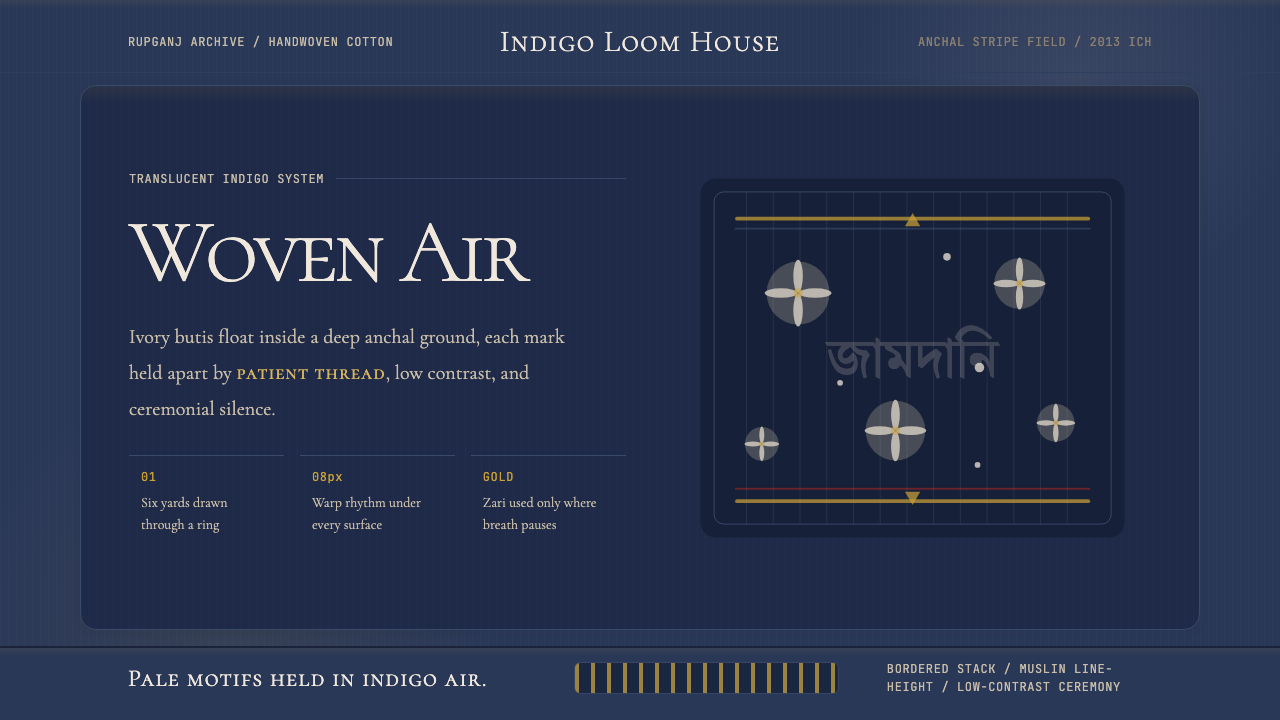 Bengali Jamdani MuslinBreathes like woven air. Indigo ground, ivory butis, and threadline borders s…
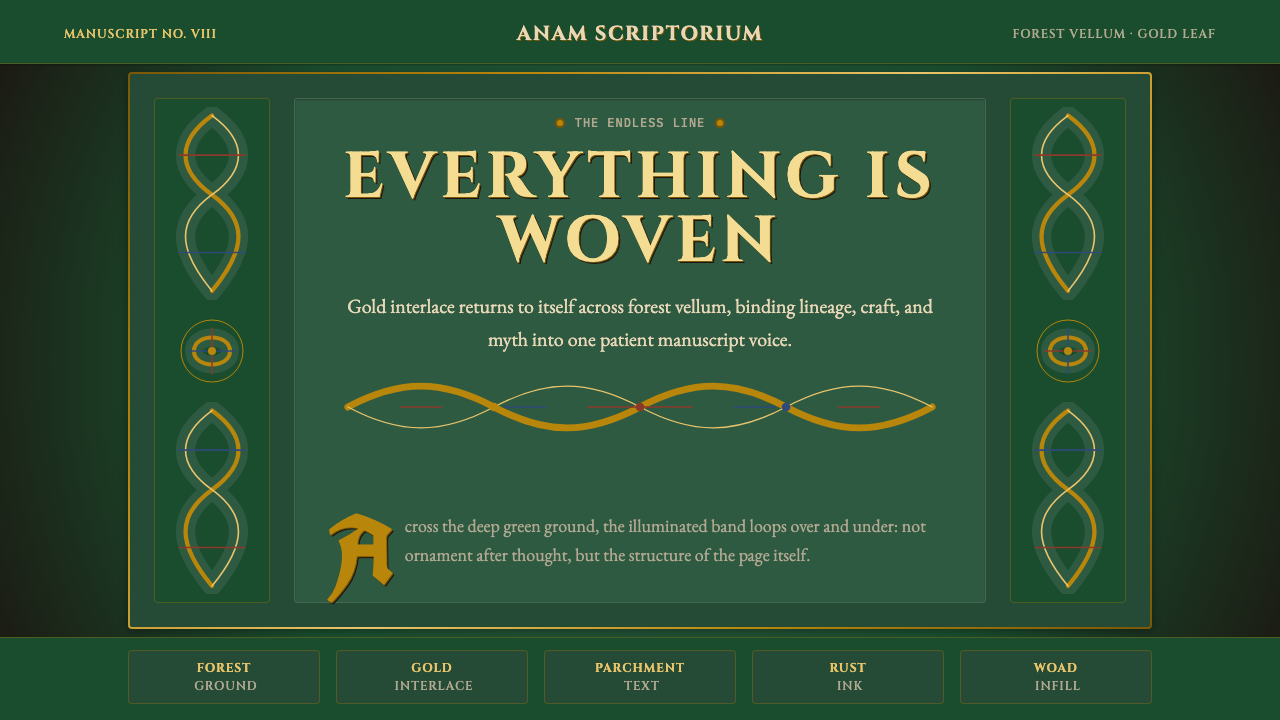 Celtic KnotworkEverything is connected. Gold Cinzel interlace frames forest-green vellum.
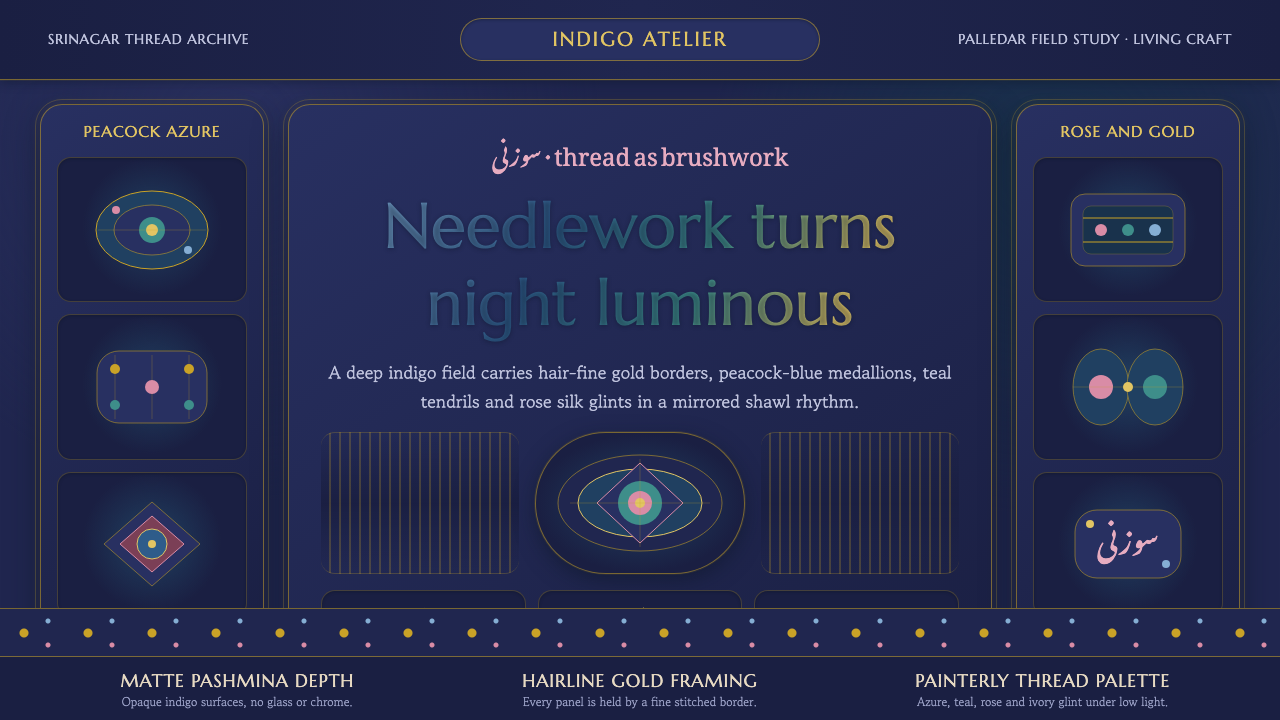 Kashmiri Sozni Shawl EmbroideryNight made luminous. Indigo ground, gold hairlines and silk medallions stitch…
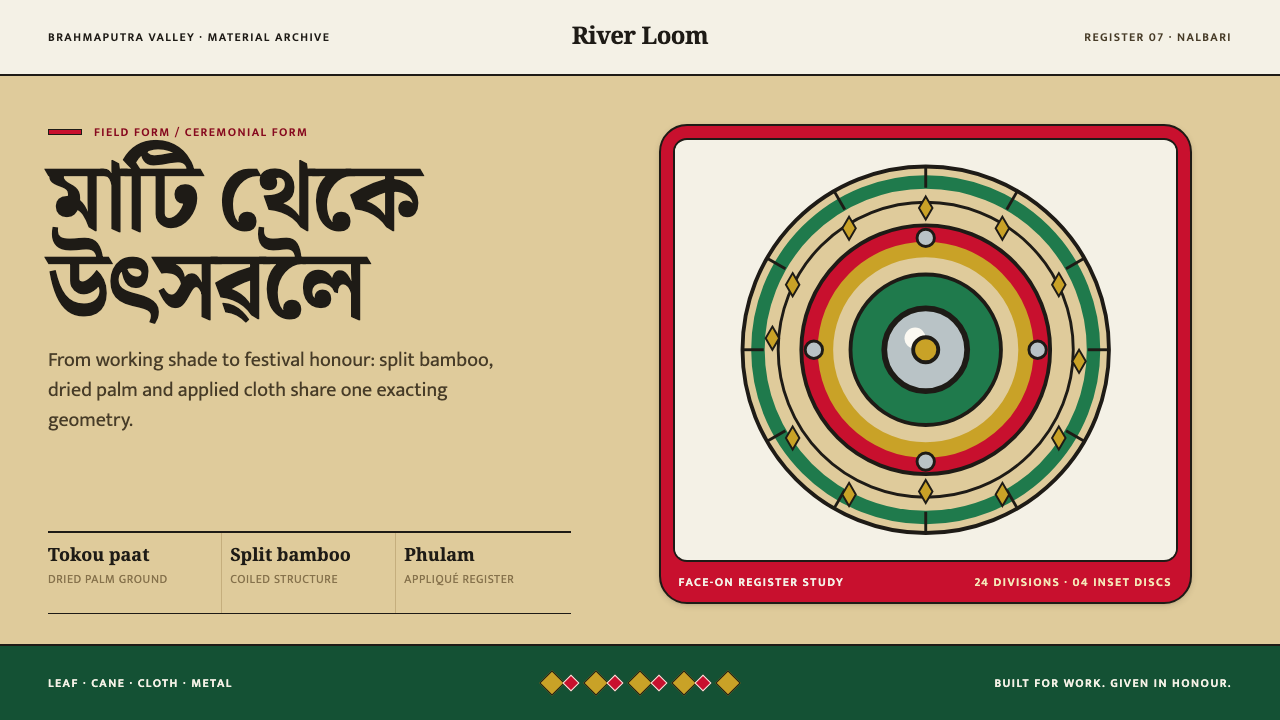 Assamese JapiWork becomes ceremony. Straw-gold rings carry green appliqué, festival red an…
 Cham My Son TowersWall before ornament. Greyed brick bays recede around cut shadows and sandsto…
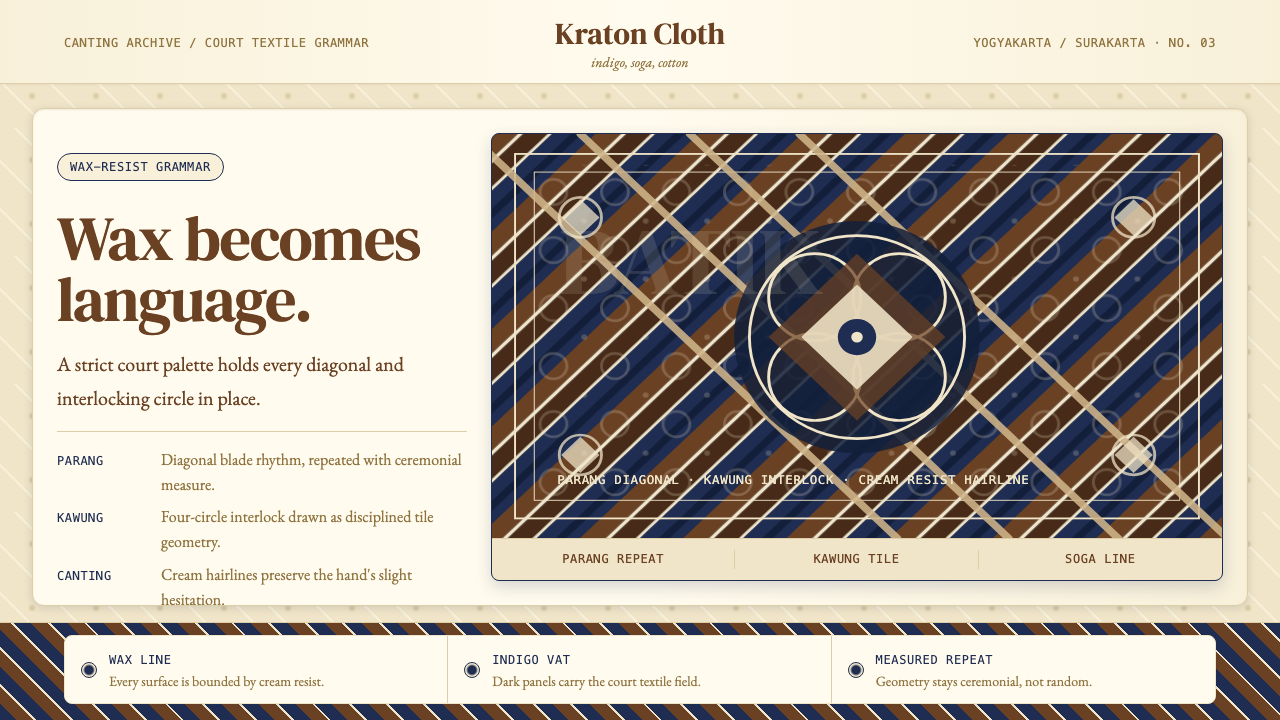 Javanese BatikCeremonial repetition. Indigo, soga, and cream frame a tiled canting motif.