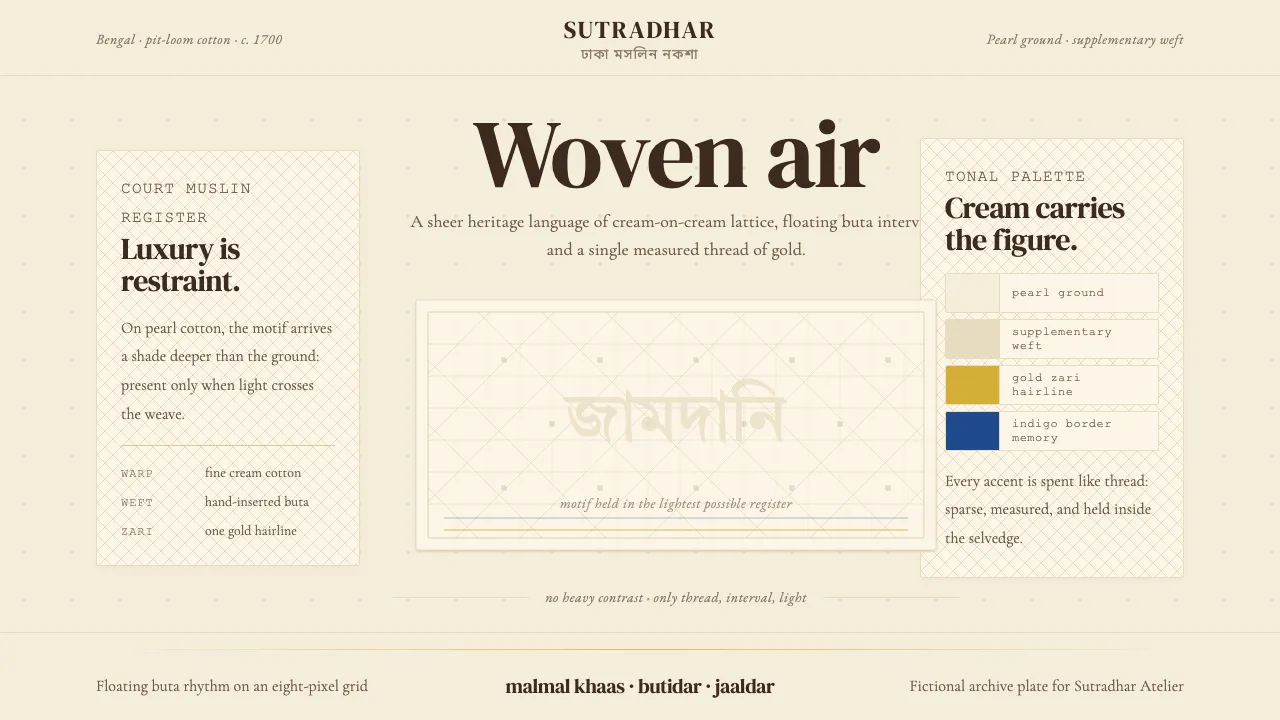
About Bengali Jamdani Weaving
Jamdani is Bengal's transparent supplementary-weft cotton-weaving tradition — woven air so fine a sari passes through a finger-ring. On a pit-loom in Dhaka or Murshidabad, weavers hand-insert tonal cotton or zari motifs into a pearl-cream warp, building paisley, lattice and lotus across the ground.
The aesthetic says luxury is restraint, not saturation. Pearl-white ground, cream-on-cream butidar floral spray, a rare hairline of gold-zari — the discipline is subtle craft and tonal whisper, the opposite of loud contrast.
- Origin
- Bengal — Dhaka (Bangladesh), Murshidabad, Phulia, Shantipur (West Bengal, India)
- Era
- Pre-Mughal references c.1 CE; peak Mughal 1500–1800; revived post-1947 in East Pakistan / Bangladesh; UNESCO ICH 2013
- Key figures
- Saiful Islam · Bibi Russell · Aneeth Arora · Mainak Banerjee
- Movements
- Mughal court textile patronage · Pre-industrial supplementary-weft handloom · UNESCO ICH preservation
Bengali Jamdani Weaving design spec
Colors
Typography
The other 11 sections — buttons, cards, spacing, motion, techniques and more — open once you unlock. Download the DESIGN.md or send it to your AI in one click. Unlock once, yours forever.
Sign up nowStyles similar to Bengali Jamdani Weaving
Also inspired by crafts & folk art, with a close feel.
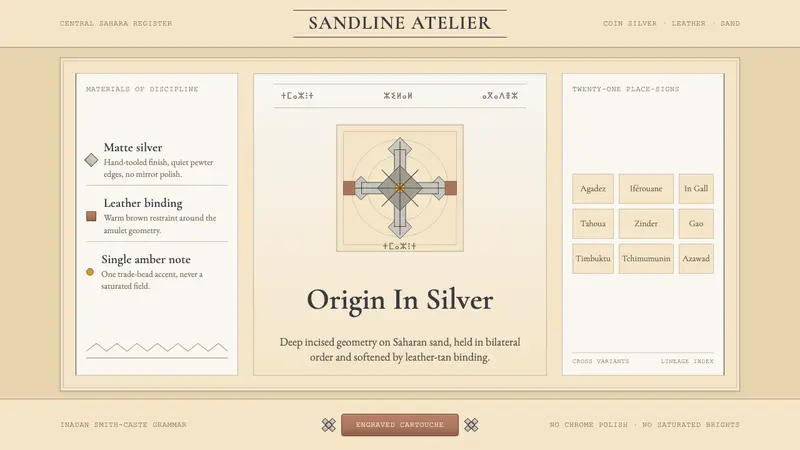 Tuareg Silver Jewelry (Sahara)Strict desert luxury. Matte silver geometry on Saharan sand, bound by leather-tan lines.
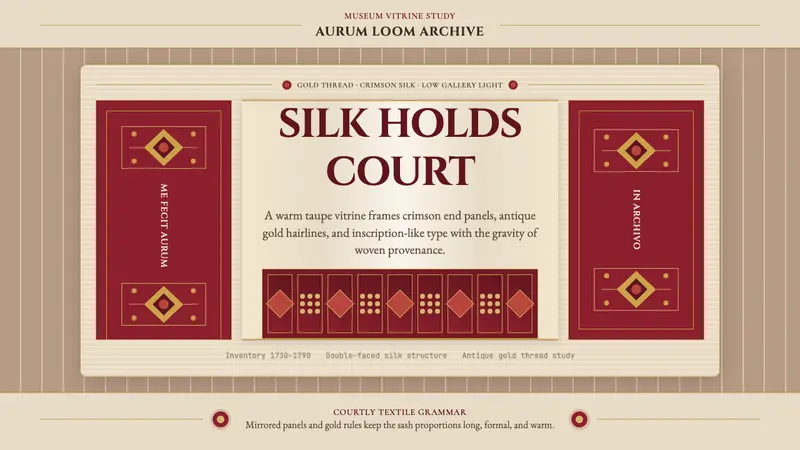 Belarusian Slutsk SashCourtly silk, vitrined. Taupe ground, crimson panels, Cinzel type, antique gold hairlines.
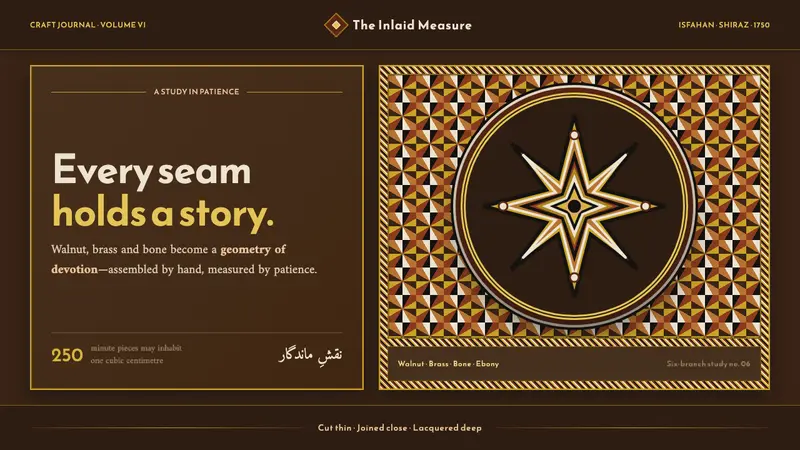 Persian Khatam MarquetryPatience becomes pattern. Brass-and-bone stars tessellate across lacquered walnut.
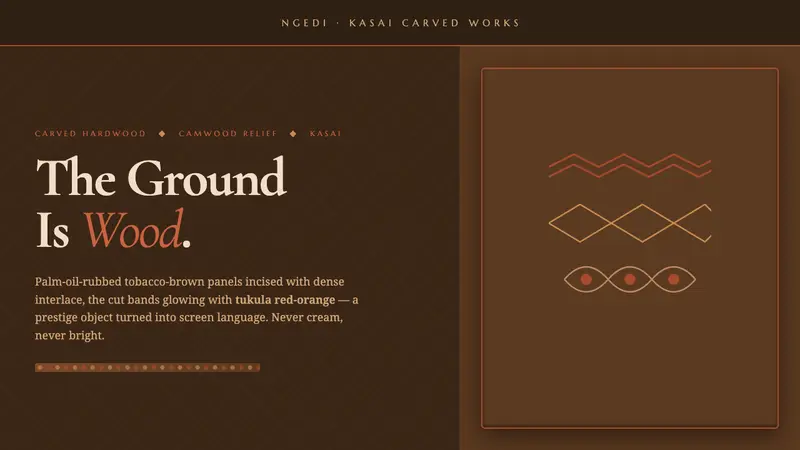 Kuba Calabash BrownPrestige in dark wood. Calabash brown ground, dense incisions, tukula red relief.