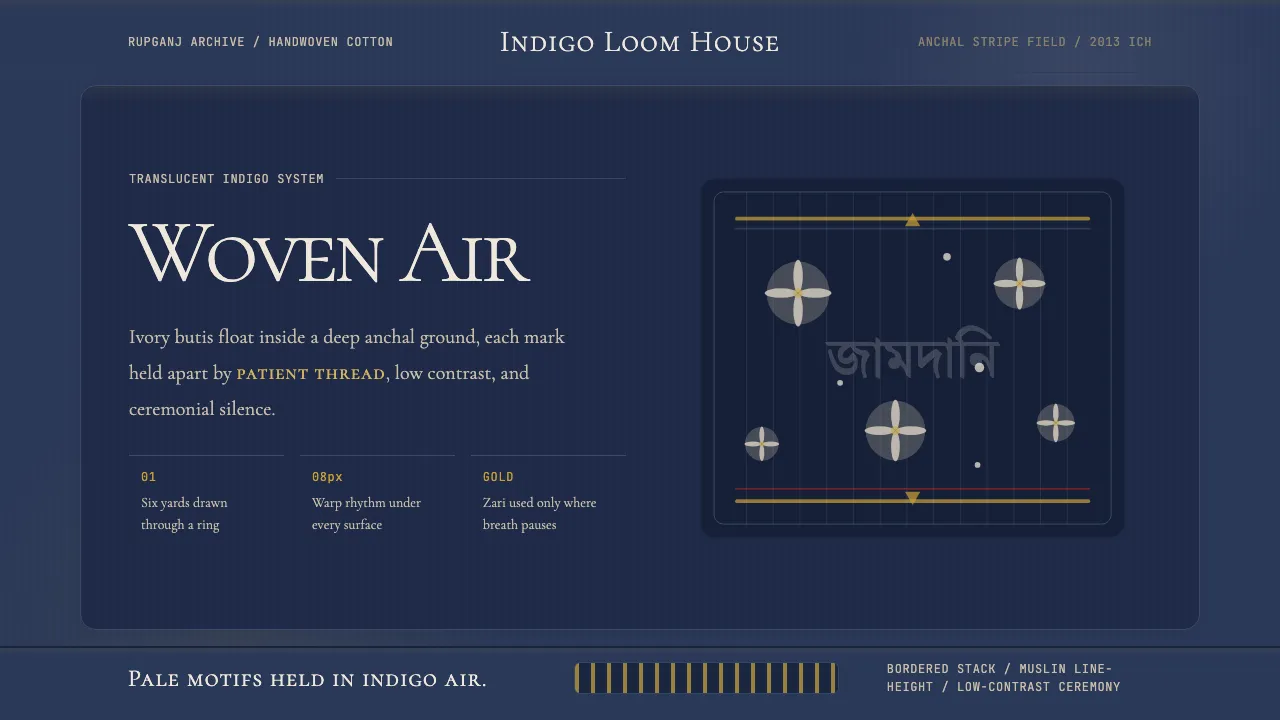
About Bengali Jamdani Muslin
Jamdani is the pinnacle of Mughal court cotton — a muslin so impossibly fine that a six-yard sari passes through a finger ring. Its floral motifs are not printed or embroidered but woven in by hand with a discontinuous supplementary weft, each buti placed one thread at a time on the loom. The aesthetic is pale-on-pale, flowers appearing to float inside translucent fabric.
This design system takes its ground from the indigo anchal border-stripe that frames a jamdani sari's edge. Deep indigo becomes the page; ivory-thread florals and dawn-gray muslin tones provide restrained, low-contrast accents. Typography breathes with generous line-height, and every layout honours the negative space that makes jamdani's motifs visible against air.
- Origin
- Bangladesh (Rupganj, Sonargaon, Dhaka district); West Bengal (Phulia, Shantipur)
- Era
- 16th century Mughal court onward; near-extinction 1830–1947; revival post-1947; UNESCO ICH 2013
- Key figures
- Mughal court weavers under Akbar and Jahangir · Ruby Ghuznavi · Sonia Ashmore · Bangladesh National Crafts Council
- Movements
- Mughal court muslin · Dhakai jamdani · post-1947 Bengali handloom revival · UNESCO ICH 2013
Bengali Jamdani Muslin design spec
Colors
Typography
The other 11 sections — buttons, cards, spacing, motion, techniques and more — open once you unlock. Download the DESIGN.md or send it to your AI in one click. Unlock once, yours forever.
Sign up nowStyles similar to Bengali Jamdani Muslin
Also inspired by crafts & folk art, with a close feel.
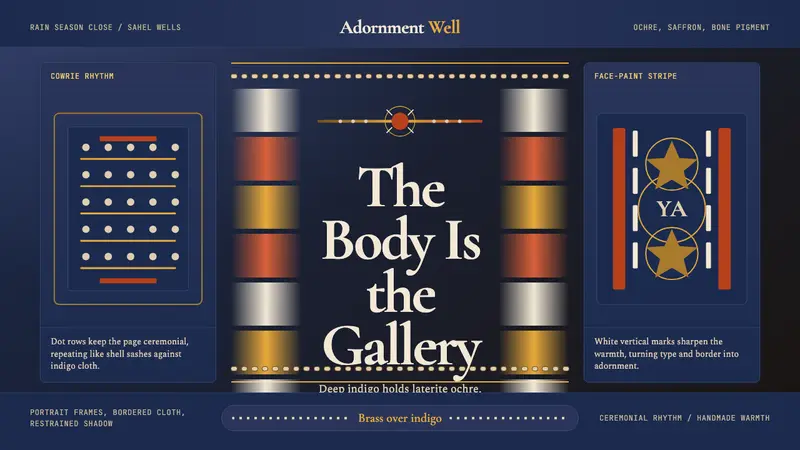 Wodaabe Gerewol Charm FestivalRitual intensity, ornamented. Indigo ground, ochre pigment, cowrie dots, brass linework.
 Bahraini Dhow Pearl-Diving BoatMineral and sun-bleached. Gulf turquoise, canvas cream, and pearl rows frame the logbook.
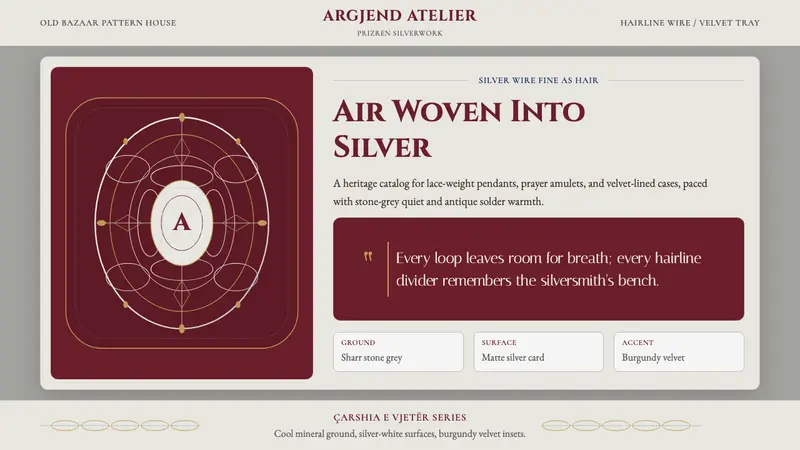 Kosovar Prizren Filigree SilverAir becomes ornament. Burgundy velvet and stone grey frame Cinzel type with coiled wire geometry.
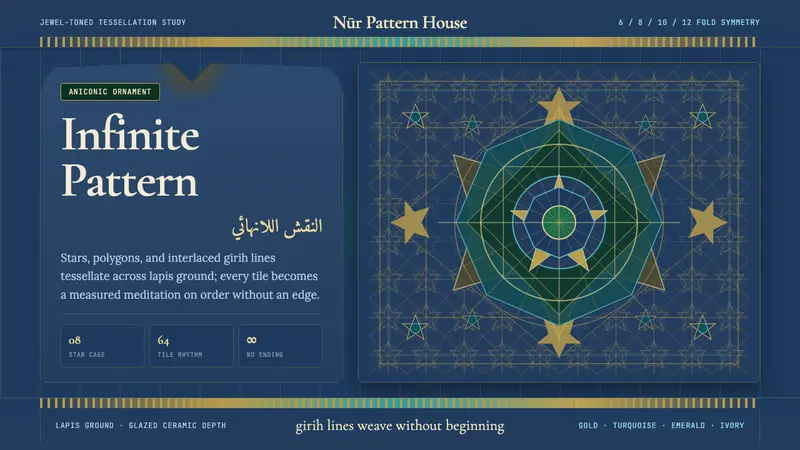 Islamic Geometric ArtInfinite order, fully tiled. Lapis ground with gold girih lines and turquoise star cells.