What is Albanian Bektashi Sufi (Tekke)?
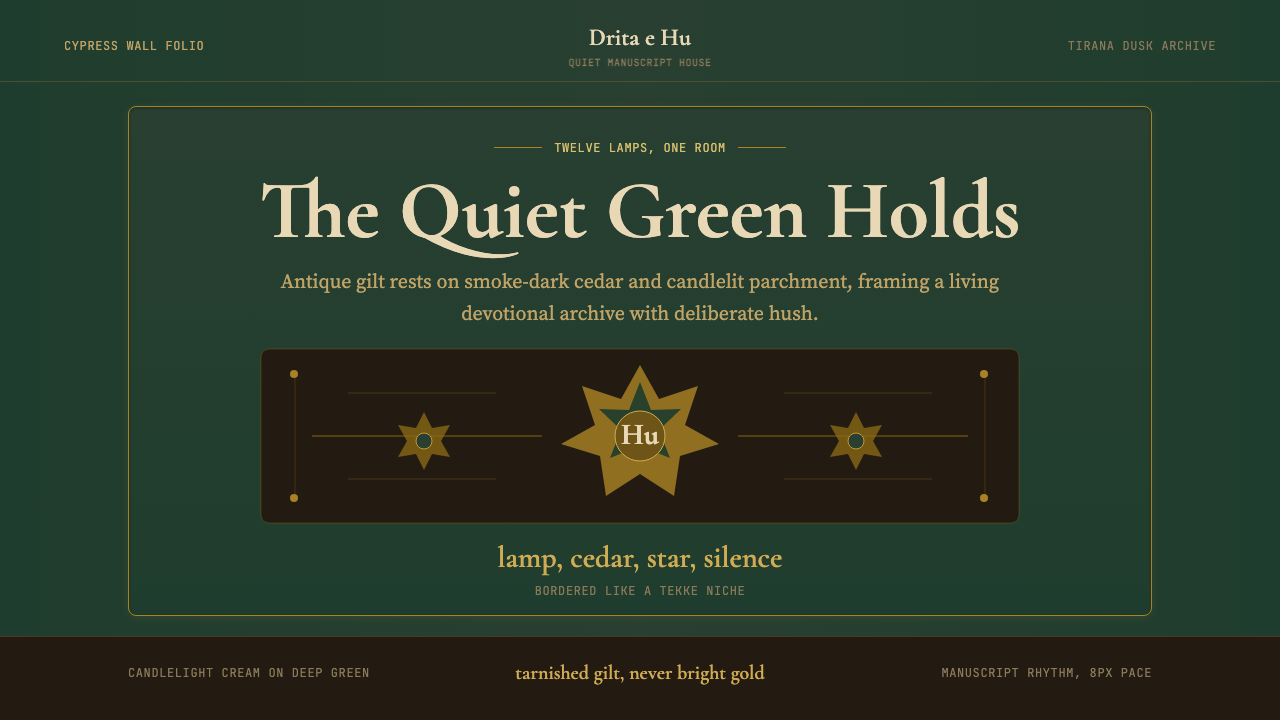
The Albanian Bektashi Sufi (Tekke) style distills centuries of heterodox Sufi devotion into a visual language of cypress green, tarnished gilt, and the solemn hush of a dusk tekke niche.
Albanian Bektashi Sufi (Tekke) in brief
The Albanian Bektashi Sufi (Tekke) design style draws its vocabulary from the material world of the tekke — the Bektashi dervish lodge — as it exists in Albania: soot-darkened cedar beams above a polished stone floor, brass oil lamps whose flame barely shifts the shadows, aged manuscripts whose ink has oxidized to a warm umber, and walls tinted in the deep, muted green that the Bektashi order has used to mark its identity for centuries. This is not a decorative exercise in Orientalist pastiche; it is a precise translation of a specific sacred architecture into a graphic system.
What distinguishes this style from other Sufi-adjacent aesthetics is its rootedness in Albanian rather than Ottoman metropolitan culture. The Bektashi order was expelled from Turkey in 1925 and relocated its world headquarters to Tirana, where it has remained ever since. This migration gave Albanian Bektashi culture a singular character: a tradition that developed in relative isolation, absorbing the austerity and earth tones of Albanian highland material culture while preserving the order's central symbols — the twelve-pointed star of the twelve imams, Nesta'liq calligraphic script, and the cypress as an emblem of spiritual aspiration and the afterlife.
Visually, the style is dark and contemplative. Its ground is the deep, forested green of Bektashi robes and tekke walls, or the near-black of smoke-darkened wood. Against these recessive grounds, gilt and aged gold create focal accents — not as decoration but as the pointing finger of devotion, marking what matters: the calligraphic inscription above the tomb, the twelve-pointed star medallion at the apex of the arch. Light in this system is always constrained, as if seen through a small window or filtered through latticed wood, never the broad wash of open sky.
Where does Albanian Bektashi Sufi (Tekke) come from?
The Bektashi Order was founded in 13th-century Anatolia, attributed to a wandering dervish mystic named Haji Bektash Veli, whose life story blends hagiography with folk memory to produce a figure part healer, part social leveler, and part orthodox critic. The order he inspired was formally organized in later centuries around the Bektashi tekke at Hacıbektaş in central Anatolia, and it spread across the Ottoman Empire by aligning itself with the Janissary corps — the professional military — giving it both political protection and wide geographic reach. The order's theology was notably heterodox: it incorporated elements of Shia devotion to the twelve imams, Alevi folk religion, and a philosophical openness unusual in the Ottoman religious landscape, including a tradition of relative gender inclusion within tekke ritual life.
Bektashism reached the Albanian highlands through Ottoman expansion, finding particularly fertile ground among communities whose Christianity and Islam had long coexisted in a pragmatic folk religious blend. Albanian Bektashi culture developed its own regional character over the centuries: the tekkes of Kruja, Gjirokaster, and Frasher became sites of local saints' veneration, pilgrimage, and an artistic tradition rooted in locally available materials — hand-carved cedar, locally woven textiles in the order's identifying greens, and small-scale illuminated manuscripts produced by tekke scribes. The poet and nationalist figure Naim Frashëri (1846–1900), whose verse meditations on Bektashi spirituality became foundational texts of the Albanian national awakening, exemplifies how thoroughly the order had woven itself into Albanian cultural identity by the nineteenth century.
The forced expulsion of the order from Turkey in 1925, following Atatürk's abolition of all dervish orders, gave Albanian Bektashism an unexpected historical prominence. The order's leadership under Baba Mondi relocated to Tirana, formally establishing Albania — and specifically the tekke complex on the southern edge of the capital — as the seat of the world Bektashi papacy. This made Tirana the only city in the world to serve as headquarters of a Sufi order. The Albanian state's subsequent Stalinist-era suppression of religion (1967–1991, when Albania officially declared itself the world's first atheist state) drove tekke life underground but did not extinguish it; when religious practice was permitted again, the Bektashi order reconstituted itself with remarkable speed.
The order's material culture, preserved through decades of concealment, reveals what survived: carved wooden mihrab niches painted in the order's deep green, portable brass lamps carried out of tekkes before state confiscation, illuminated manuscripts hidden in family homes, and the twelve-pointed star motifs incised into plaster before whitewash was applied. The aesthetic recovered from this period has a quality of deliberate concealment and restraint — beauty compressed into small objects and quiet surfaces, ready to be carried away, hard to destroy. It is this material quality — compressed devotion, the grandeur of things kept small — that the design system inherits.
What defines the Albanian Bektashi Sufi (Tekke) look?
Color: Cypress Green and Tarnished Gold
The dominant ground tone is a deep, muted forest green — the color of aged Bektashi robes, tekke exterior plaster, and the cypress trees that mark both sacred sites and graveyards in Albanian tradition. This green sits close to black in luminosity, creating a sense of contained depth rather than expansive openness. Against it, the accent register belongs to tarnished gilt: not the bright yellow of fresh gold leaf but the warmer, more complex tone of metal that has aged in lamplight over decades. Secondary surfaces recall aged parchment and smoke-stained cedar — warm neutrals that neither compete with the green nor brighten the composition, but instead build a layered sense of material time.
Symbolic Geometry: The Twelve-Pointed Star
Where Bauhaus reaches for the circle, square, and triangle as universal forms, Bektashi visual culture organizes itself around the twelve-pointed star — the ithna'ashari or twelve-rayed form that represents the twelve imams of Shia Islam and the twelve gates of spiritual initiation in Bektashi doctrine. This form recurs at every scale: incised into plaster above a tekke doorway, woven into textile borders, stamped in brass on lamp housings, and rendered in gilt tile work in the innermost sanctuary. When applied to digital or print design, this geometry becomes the primary decorative anchor — used sparingly, as the central medallion of a page or the closing mark of a section, rather than as surface pattern.
Calligraphy: Nesta'liq Script as Image
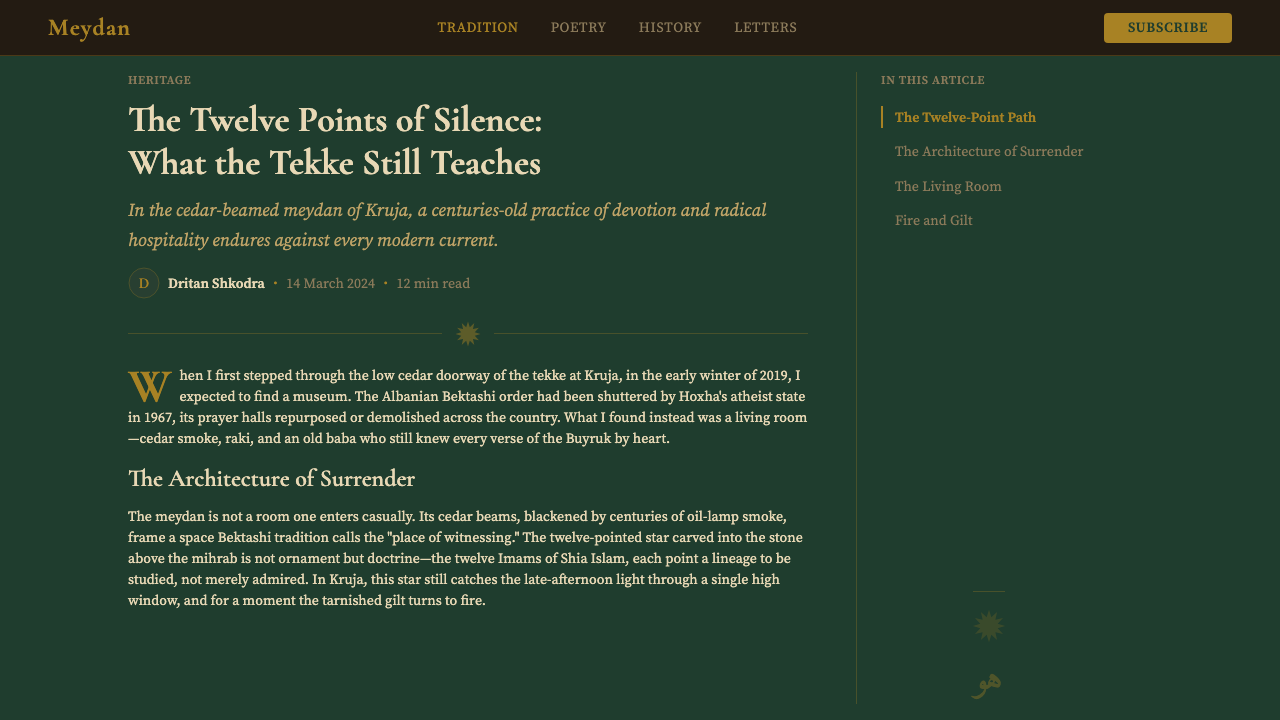
Bektashi tekke interiors are never purely typographic in the Western sense; they are calligraphic. Nesta'liq — the flowing, diagonal script developed in Persia and used across the Ottoman world — functions here not merely as text to be read but as visual presence: a band of inscription above a tomb is also an architectural element, a golden stroke across a dark wall. In design translation, this means that when text needs to carry sacred or ceremonial weight, it is set with a quality of deliberate slowness — wide letter-spacing, generous line-height, a sense that each character was placed with care rather than composed for speed. The script registers as image before it registers as information.
Light: Constrained and Directional
In a Bektashi tekke, natural light enters through small, often latticed windows; oil lamps cast warm pools that do not fully illuminate their surroundings. This quality of constrained light — light that reveals rather than floods — is central to the design system's spatial logic. Shadow is not absent; it is structural. The visual hierarchy is built on contrast between the lit surface and the surrounding dark, so that an element set against the deep green ground must be luminous enough to read clearly while remaining embedded in the same tonal atmosphere. Gradients and diffuse glow are used sparingly to suggest the edge where lamplight meets shadow, not to simulate photographic light.
Materiality: Weight and Age
The tekke's material palette — cedar, aged brass, parchment, hand-woven wool, fired tile — has a heaviness and temporal depth that distinguishes it sharply from the lightness of modernist design systems. In translation, this means surfaces that suggest texture without literally reproducing it: a background that reads as deep rather than flat, a gold accent that feels warmed by time rather than newly applied. Smoothness is not the goal; a certain roughness — the slight irregularity of hand-made objects — is part of the authentic register. Typography in this system favors letterforms with calligraphic heritage, and layout elements carry a sense of deliberate, weighty placement rather than frictionless floating.
Restraint: Sacred Economy
Bektashi visual culture is not opulent in the manner of Ottoman imperial architecture; it is contemplative. The tekke does not compete with the mosque for splendor — it retreats from splendor into gathered quiet. Design in this tradition uses ornament as punctuation rather than wallpaper: a single twelve-pointed star above a doorway is more powerful than a field of stars across a surface. This economy of ornament means that every decorative element must justify its presence by carrying specific symbolic weight. White space — or in this system's case, deep green space — is not emptiness but the breathing room in which the sacred detail becomes visible.
Dark Ground as Devotional Space
Unlike most Western design traditions that default to light grounds for legibility, the Albanian Bektashi system is native to dark. The deep green or near-black background is not an inversion of a light system — it is the primary ground from which meaning emerges. This has practical implications: contrast must be managed carefully, since dark-ground compositions can easily lose their hierarchy in low light or on low-quality screens. Elements achieve visibility not through loudness but through precise tonal placement — a carefully calibrated luminosity difference between the background, the secondary surfaces, and the lit focal points. The darkness itself is the atmosphere; everything within it is a form of revelation.

Who shaped Albanian Bektashi Sufi (Tekke)?
The 13th-century Anatolian mystic to whom the order traces its founding, Haji Bektash Veli is revered in Bektashi practice not merely as a historical founder but as a continuing spiritual presence. His tekke shrine at Hacıbektaş in central Turkey remains a pilgrimage site for both Bektashis and Alevis. The doctrinal breadth attributed to him — tolerance across religious difference, the spiritual equality of men and women within tekke life, a philosophy that placed inner purity above outer ritual form — defined the order's cultural posture for seven centuries. In design terms, his legacy manifests as openness within structure: the style accommodates complexity without dissolving into chaos.
Naim Frashëri (1846–1900) was the defining literary figure of the Albanian National Awakening and a devout Bektashi. His poetry wove together Sufi mysticism and Albanian national consciousness in ways that neither tradition had previously attempted, using the Persian-influenced verse forms he encountered through his Bektashi education to articulate a secular-spiritual vision of Albanian identity. The convergence in his work — Ottoman literary form, Albanian language, Bektashi devotion, and nationalist thought — exemplifies how the Bektashi order in Albania became a carrier of cultural synthesis rather than religious exclusivity. His verse remains foundational to Albanian literature and is still recited at tekke gatherings.
Baba Mondi was the Bektashi leader who oversaw the order's relocation from Turkey to Albania following the 1925 expulsion and established the Tirana tekke as the world headquarters. His tenure marks the moment when Albanian Bektashism ceased to be a regional expression of a Turkish-centered order and became a globally significant institution in its own right. The physical form of the Tirana headquarters under his direction — its architecture, its use of materials, its relationship to the surrounding Albanian landscape — set the aesthetic template for Albanian Bektashi visual culture in the modern period.
Baba Rexheb Beqiri (1901–1995) was a Bektashi leader who, following his exile during Albania's communist period, established the first Bektashi tekke in the Western world — the Albanian-American Bektashi Tekke in Taylor, Michigan — in 1954. His life spans the full arc of twentieth-century Bektashi displacement and reconstruction: born in the Ottoman period, educated in the Albanian tekke tradition, exiled by communism, and ultimately responsible for carrying that tradition across the Atlantic. His scholarly and devotional writings in Albanian and English helped preserve the order's intellectual heritage during the period when physical tekke practice was suppressed in Albania itself.
The visual culture of Albanian Bektashism was produced not by named artists in the Western sense but by generations of anonymous tekke craftsmen — carpenters who shaped the ornate wooden ceilings and carved mihrab niches, metalworkers who fashioned the brass lamps and incense burners, weavers who produced the green-dyed textiles, and scribes who illuminated the manuscripts. This collective, anonymous creativity is itself part of the tradition's aesthetic logic: beauty in service of devotion, skill in service of the sacred, with no individual signature competing for attention. The design system inherits this collectivist sensibility — ornament is never personal expression, always communal offering.
How do you use Albanian Bektashi Sufi (Tekke) today?
Applying the Albanian Bektashi Sufi (Tekke) style requires committing to its core tonal logic before considering any other element. The style is fundamentally dark-ground, and attempts to apply individual surface details — a twelve-pointed star here, a gold accent there — over a light or neutral background produce a pastiche that loses the system's spatial atmosphere entirely. Begin by establishing the deep cypress green or near-black as the primary canvas, then introduce the secondary parchment and cedar neutrals as intermediate grounds, and finally place the gilt or bright accents only where deliberate focus is required.
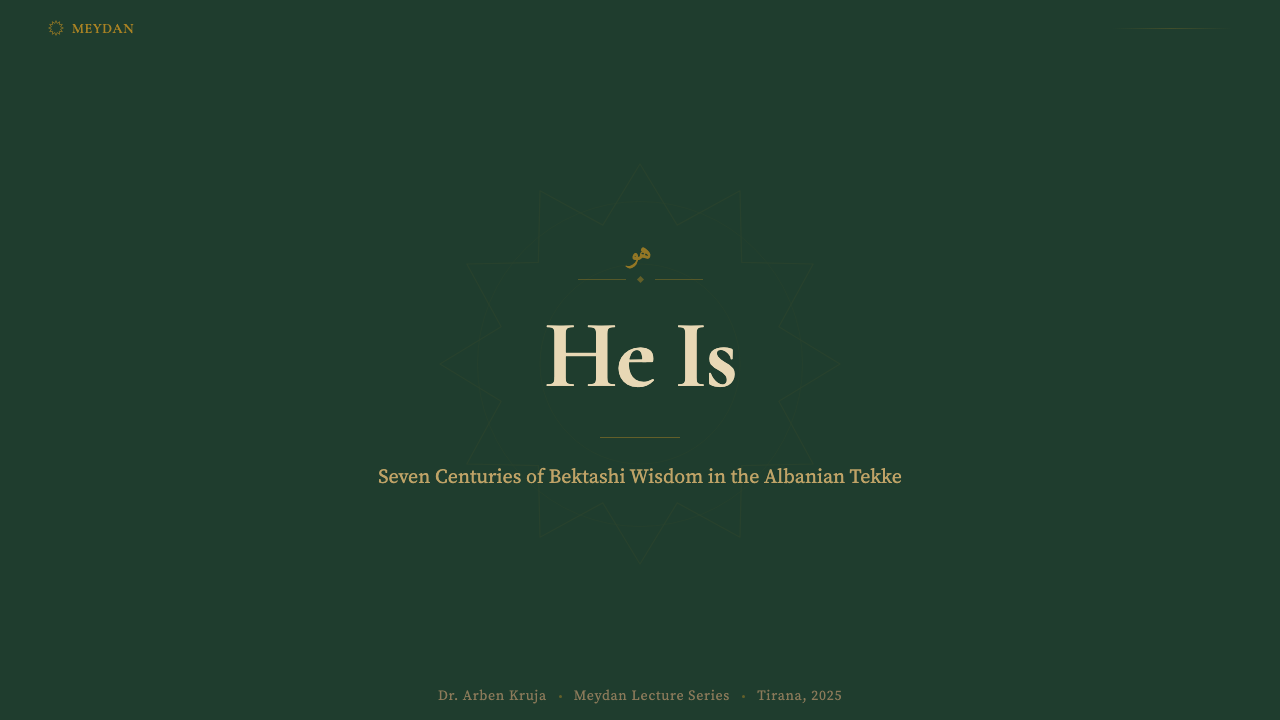
For presentation slides, this style works best for contexts that require gravitas rather than playfulness: keynote addresses, cultural institution presentations, ceremonial or commemorative decks, or any presentation where the speaker wants to project a sense of depth and considered authority. The cover page benefits from extreme restraint — a single twelve-pointed star medallion, a few lines of generous-spaced type in the warm gold register, and nothing else competing for attention against the dark ground. Content slides should maintain the dark background and use warm neutral text for body content, reserving the gilt accent for key terms, section headings, or data labels that need to stand apart.
For web interfaces, the style is best suited to editorial contexts, cultural organization websites, luxury brand identity pages, and archival or heritage projects — any digital space where immersive atmosphere matters more than immediate conversion. Navigation should be minimal and typographic, relying on the weight and spacing of letters rather than iconography. Cards or feature blocks should use the deep green as their ground, with shadow rendered in near-black rather than soft gray, creating a sense of depth within the dark atmosphere rather than floating above a light surface. Interactive states — hover, focus, active — are signaled by shifts in gilt luminosity rather than color changes.
For editorial and marketing work, the style supports long-form reading experiences: book covers and interior pages, heritage brand packaging, documentary film titles, and cultural exhibition materials. In editorial layout, generous margins and slow typographic rhythm are as important as the color system. A full-width chapter opening with a twelve-pointed star inset and a single line of widely-spaced text in the gilt register creates more presence than a densely designed spread. Marketing applications should resist the temptation to brighten the palette for attention; the style's power lies precisely in its willingness to be quiet in a loud environment.
A common mistake when applying this style is confusing it with generic dark-luxury or dark-Islamic aesthetics that borrow surface elements without the underlying devotional economy. The Bektashi system is not opulent in the manner of Ottoman court art, which layers pattern over pattern in a rhythm of visual abundance; it is instead compressed and restrained, allowing significant empty space to carry weight. If your composition feels busy, crowded, or decoratively layered, you have left the Bektashi register and entered a different tradition entirely. Strip back every ornamental element until only those carrying specific symbolic meaning remain.
Another frequent error is treating the gold or gilt tones as straightforwardly decorative highlights, applied wherever visual interest is needed. In the source tradition, gilt marks the sacred — the inscription above the tomb, the star at the summit of the arch, the illuminated passage in the manuscript. Overuse of the gold register collapses this hierarchy of attention. Reserve it for no more than two or three focal points per composition, and allow the deep green ground and warm neutrals to do the structural work of the layout.
Albanian Bektashi Sufi (Tekke) — FAQ
Is this style appropriate for non-religious or secular design projects?
Yes, with awareness of its origins. The Albanian Bektashi aesthetic carries deep spiritual and cultural significance for the communities it comes from, and designers working in adjacent spaces — cultural institutions, heritage brands, meditation or wellness platforms, editorial long-reads on spirituality or history — should acknowledge that origin rather than treating it as anonymous exotica. That said, the visual system translates well to secular contexts that share its core values: contemplation over transaction, depth over surface, restraint over abundance. It would be incongruous applied to high-energy consumer brands, fast-paced entertainment platforms, or any context that celebrates speed and novelty — not because of the religious content, but because the fundamental visual logic conflicts.
How does this style differ from other Ottoman or Islamic design traditions?
Ottoman imperial design — Iznik tilework, Topkapi palace interiors, the great mosque aesthetic — is characterized by dense geometric surface pattern, intense color saturation in turquoise and cobalt, and a principle of visual abundance that treats the entire surface as a field for ornament. The Bektashi aesthetic is its functional opposite: sparse, dark-ground, compressed. Where the imperial mosque announces authority through overwhelming richness, the Bektashi tekke practices a kind of aesthetic poverty as devotional statement. The twelve-pointed star appears once, above a doorway, not tiled across every surface. This is not a less sophisticated tradition — it is a different philosophy of sacred space, one that values silence, concealment, and the earned attention of the visitor who notices the single inscription rather than being overwhelmed by pattern.
Can the twelve-pointed star be simplified or replaced with a simpler geometric element?
The twelve-pointed star is semantically loaded in Bektashi culture — it represents the twelve imams and is not interchangeable with other geometric forms. Designers who want to work in the general aesthetic register of the Bektashi tekke without invoking the specific symbolic vocabulary can use related but less charged geometric elements: the eight-pointed star common across many Islamic traditions, simple foliate arch shapes, or the cypress silhouette that recurs throughout Albanian sacred architecture. However, removing all of these symbolic anchors risks producing a generic dark-green aesthetic rather than one that carries the specific cultural weight of the source tradition. The style's power comes from its specificity.
How should typography be chosen for this style?
Typography in the Bektashi system should carry a quality of deliberateness and historical weight. For Latin-script design, this means avoiding typefaces that feel purely digital or geometric-modernist; letterforms with some reference to calligraphic origins — a trace of pen angle, a slight variation in stroke weight — are more congruent with the tradition's visual logic than perfectly rationalized contemporary type. Serif faces with humanist proportions, or semi-formal uncial-adjacent forms, integrate more naturally into the system than precision-geometric grotesks. The typeface choice matters less than how it is used: wide letter-spacing, generous leading, and a hierarchy built on scale and luminosity rather than decorative distinction will bring almost any appropriate typeface into alignment with the aesthetic.
Why is Albania, rather than Turkey or Iran, the center of this tradition?
The Bektashi order's headquarters relocated to Albania in 1925 not by choice but because Atatürk's secularist reforms abolished all Sufi orders in Turkey, leaving Albania — where the order had a strong historical presence — as the only viable alternative. Iran, despite its Shia heritage, was not a hospitable environment for a heterodox order that incorporated non-Shia elements and maintained a tradition of cultural syncretism. Albania's particular position — between Ottoman and European influence, with a folk religious culture that had long absorbed multiple traditions — made it uniquely receptive. The order's prolonged existence under Albanian communism, surviving through concealment rather than state support, gave it a resilience and a particular aesthetic quality — the beauty of what is kept small, carried quietly, and revealed only to those who know to look — that distinguishes Albanian Bektashism from any other branch of the broader Sufi world.
Related design styles
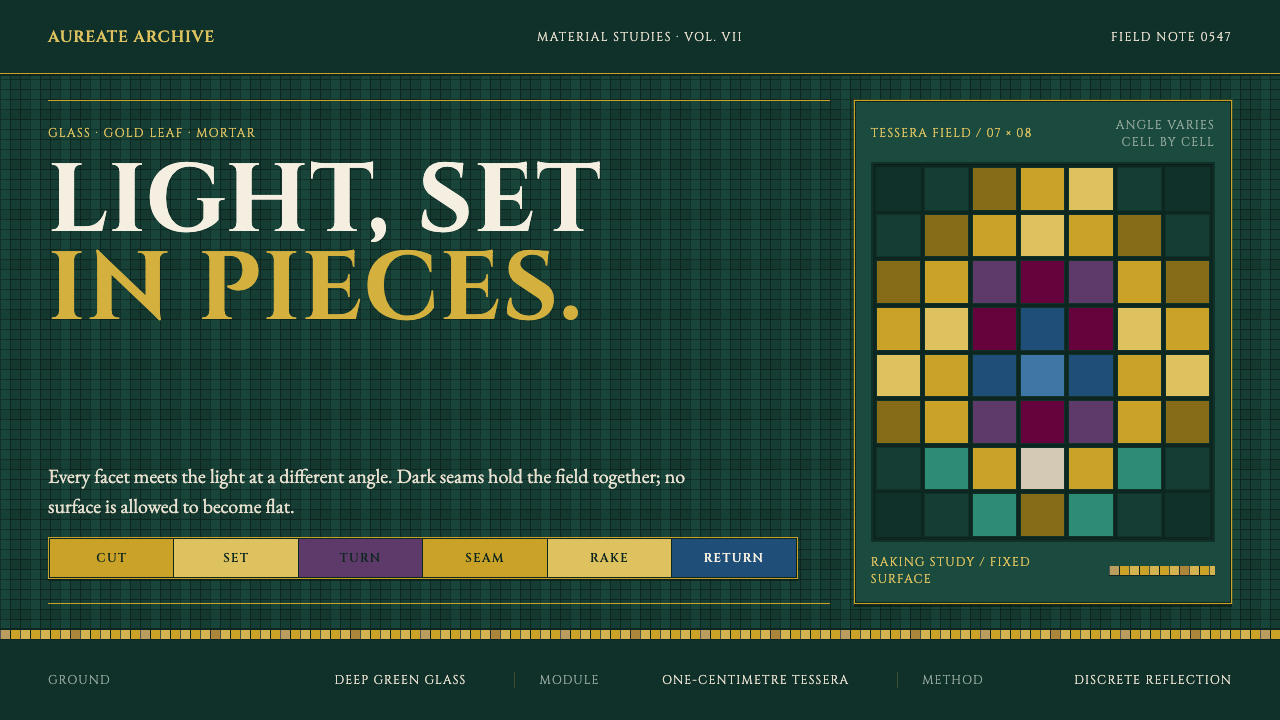 Ravenna Gold MosaicLight lives between pieces. Gold cells, green glass and dark seams make the s…
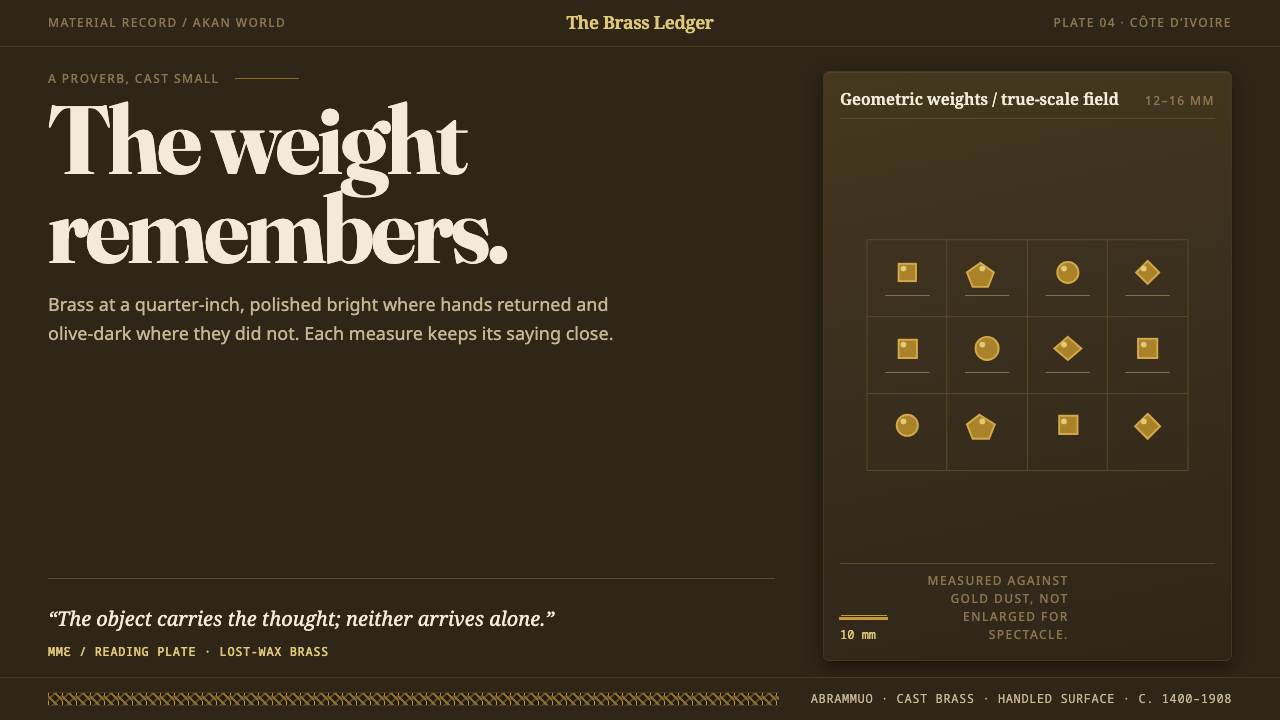 Baule GoldweightWear is the ornament. Burnished brass and olive recesses make every small wei…
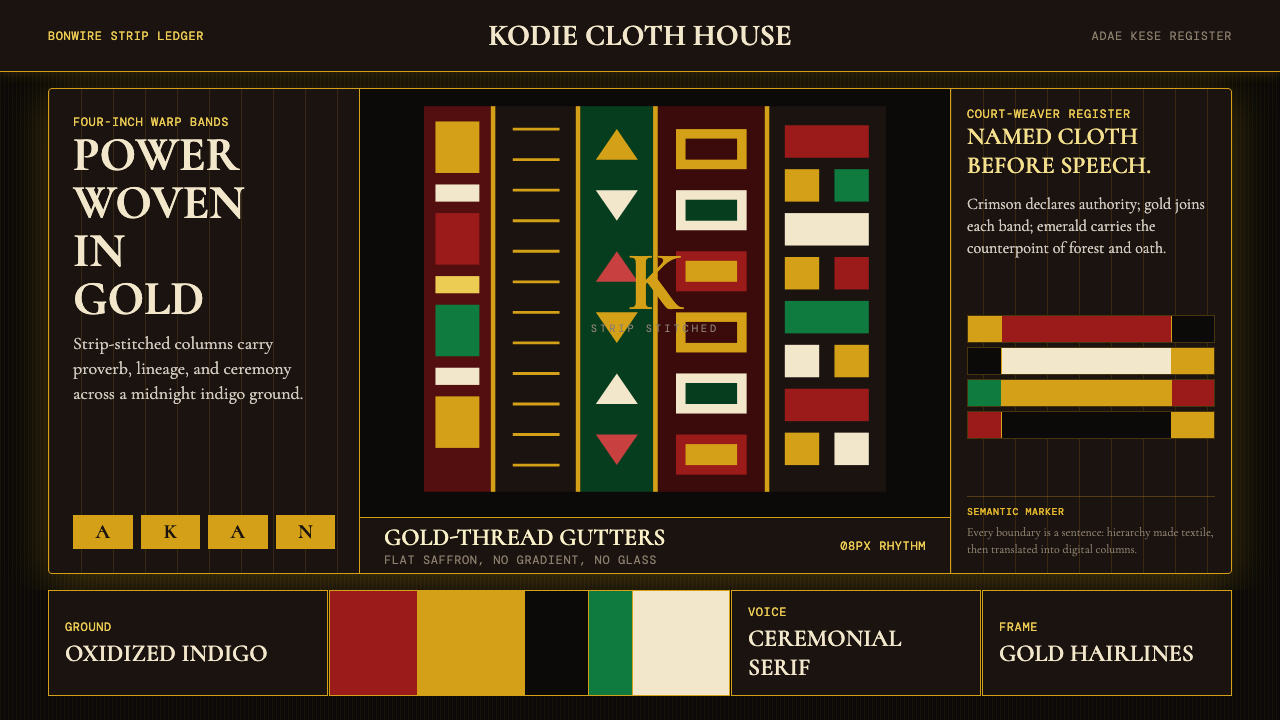 Ghanaian Kente (Asante Royal Gold)Royal authority, woven dark. Gold gutters stitch crimson and indigo strips in…
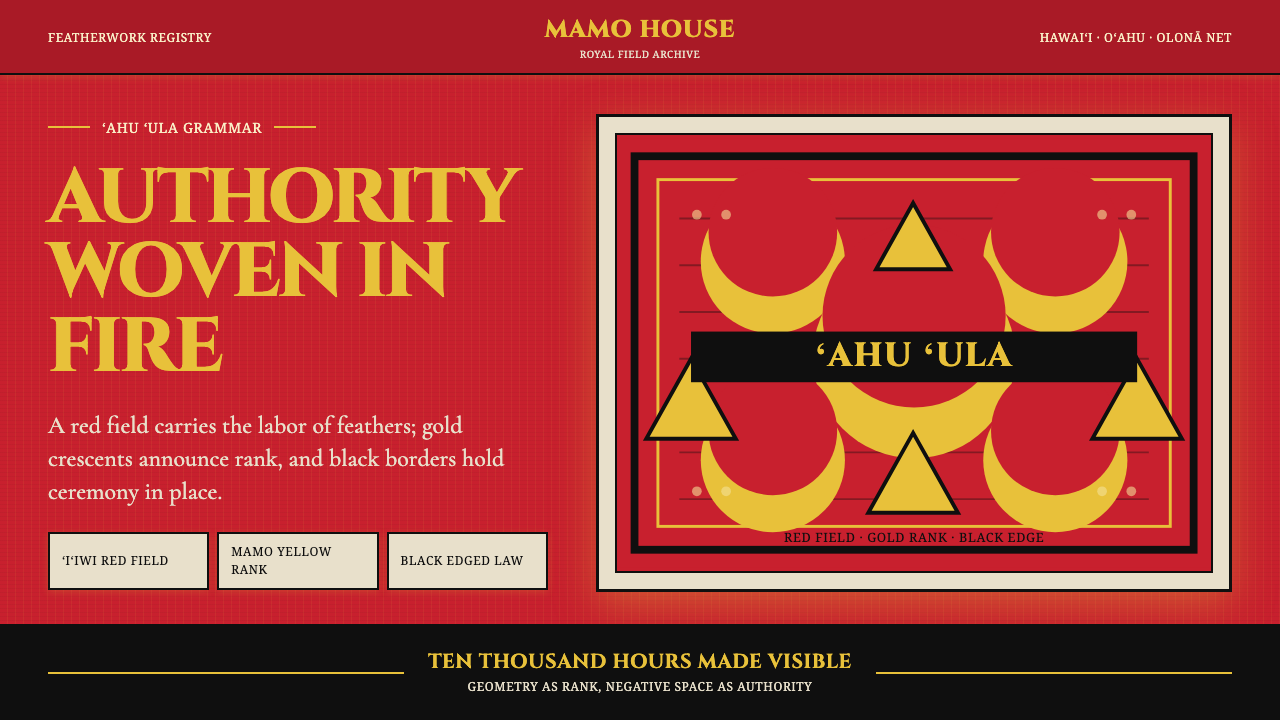 Hawaiian Feather Cape (ʻAhu ʻUla)Ceremony has weight. Red feather fields, mamo yellow crescents, black borders.
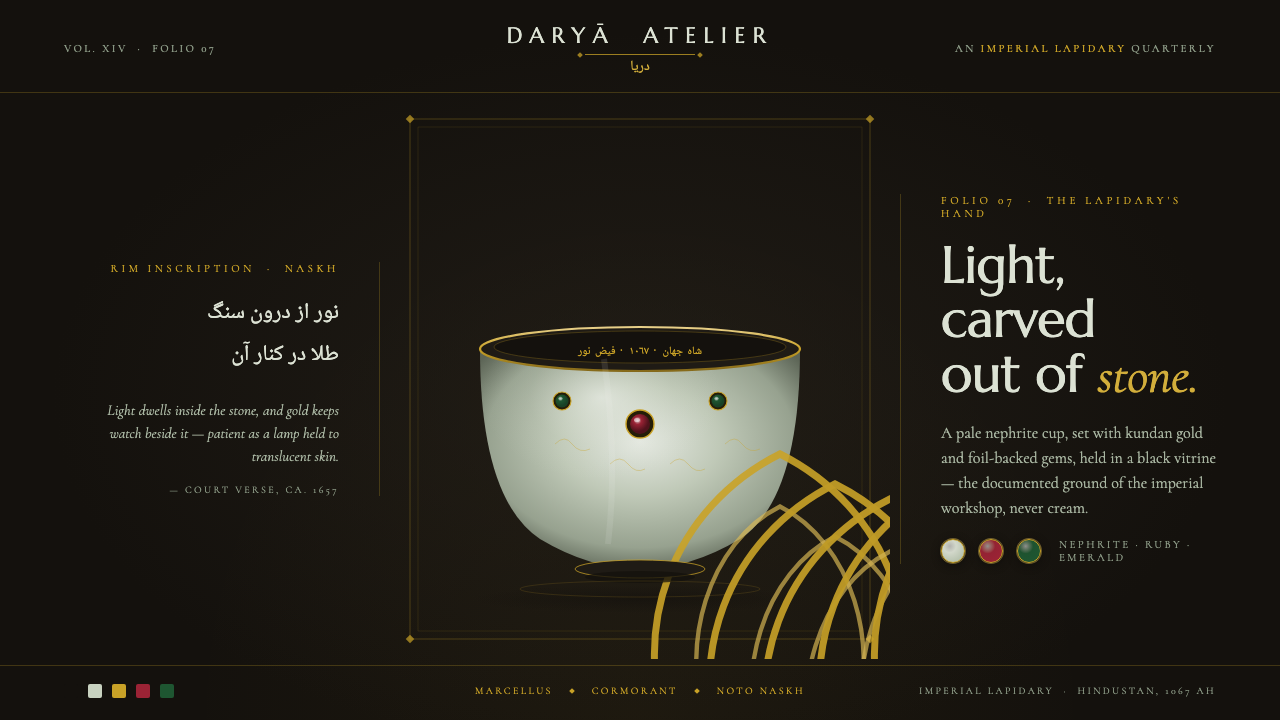 Mughal Jade CarvingImperial luxury, lit from inside. Pale nephrite glows on black, kundan gold f…
 Solomon Shell Money & Pearl InlayDignity inlaid in darkness. Pearl cream and nautilus blue form strict shell-s…