What is Ghanaian Kente (Asante Royal Gold)?
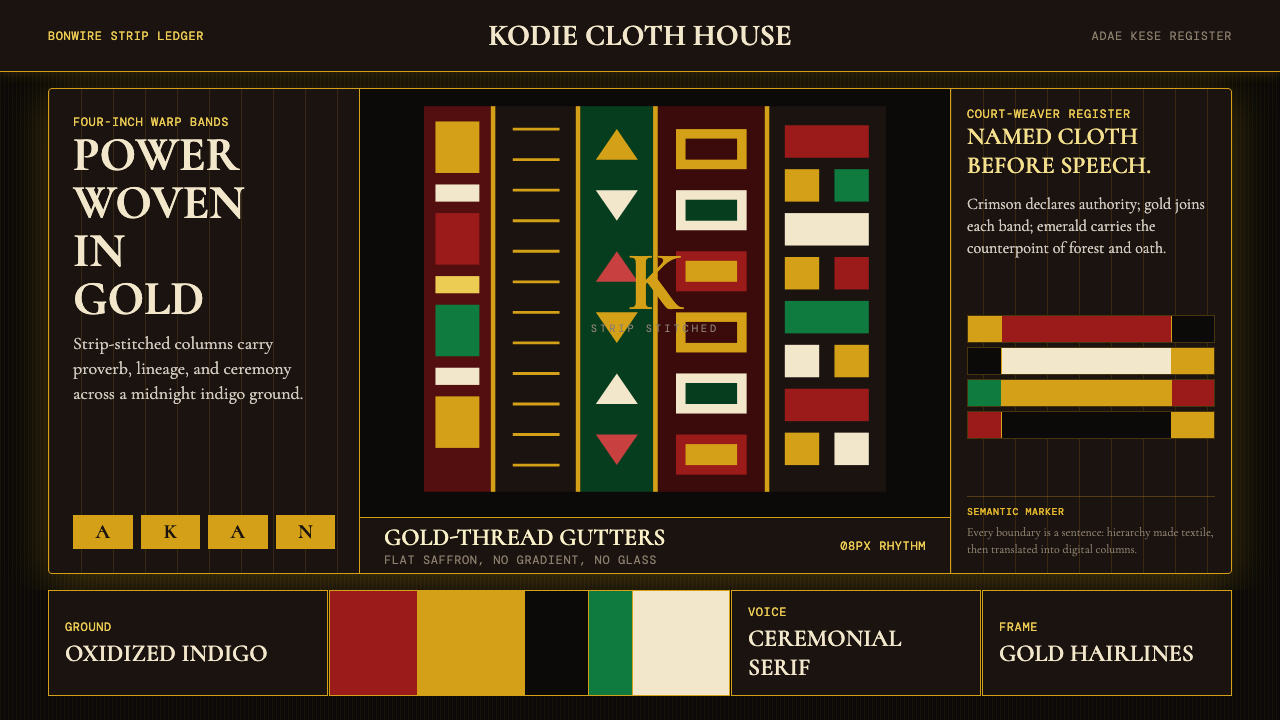
Woven in narrow silk strips and stitched into cloths reserved for royalty, Ghanaian Kente is a visual language where every color and pattern carries the weight of Asante royal authority.
Ghanaian Kente (Asante Royal Gold) in brief
Ghanaian Kente — specifically the Asante royal variant sometimes called Royal Gold — is a textile tradition transformed into a comprehensive visual language. Its characteristic appearance comes from narrow warp-faced strips, each roughly four inches wide, woven separately on a horizontal strip loom and then stitched edge to edge into a larger cloth. The resulting surface is an intricate mosaic of geometric bands and blocks: warp stripes run vertically along each strip, while weft patterns appear as horizontal interruptions, creating a rich interplay of vertical and horizontal registers.
The palette is deep and warm, anchored by a triad of indigo midnight, kola-nut crimson, and saffron gold against dark grounds. This is not the bright, high-key palette of festive folk textiles — Asante royal kente is grave and luminous, the gold catching light like hammered metal while the indigo recedes into authoritative depth. The darkness of the ground is deliberate: it connotes the serious weight of governance, spiritual power, and ancestral memory rather than celebration for its own sake.
What makes kente a design system rather than merely a fabric is its codified symbolism. Named cloth patterns function like sentences: each carries a specific proverb, historical reference, or statement of status. The Asantehene — the paramount king — wore cloths that no commoner could use. Particular color combinations and weft patterns were assigned to specific ranks, occasions, and moral concepts. The cloth is, in effect, a wearable archive of Asante philosophy and social order.
Where does Ghanaian Kente (Asante Royal Gold) come from?
The Asante kingdom was founded in 1701 under Osei Tutu I, the ruler who united the Akan clans of the forest zone in what is now Ghana's Ashanti Region. Central to this founding was the Golden Stool, the sacred throne believed to embody the collective soul of the Asante people — an object conjured, according to tradition, by the great priest Okomfo Anokye from the sky itself. The material culture of the Asante state was always intertwined with assertions of spiritual legitimacy, and kente cloth was no exception: it was simultaneously regalia, political statement, and ritual object.
Strip-weave textiles existed across West Africa before the Asante kingdom's founding, but the specific tradition associated with Bonwire — a weaving village near Kumasi that remains the acknowledged center of kente production — developed into its royal form during the eighteenth and nineteenth centuries, roughly coinciding with the Asante Empire's period of greatest territorial and commercial power (1764–1867). The name most often associated with the tradition's origin is Otaa Kraban, a master weaver from Bonwire credited with developing or perfecting the distinctive strip-weave technique. The technical refinement of the loom, combined with access to imported silk unravelled from European trade cloth, allowed Bonwire weavers to produce the lustrous, complex surfaces that became synonymous with Asante power.
Asantehene Kwaku Dua I, who reigned from 1834 to 1867, presided over a period when kente's formal vocabulary was substantially elaborated. Under his reign, the system of named patterns became more formally codified, with specific designs reserved for the paramount king and others designated for different ranks of chiefs, elders, and court functionaries. The cloth became not merely decorative regalia but an actively administered sartorial code — a textile bureaucracy parallel to the administrative structures of the empire itself.
The Asante kingdom faced sustained military pressure from the British throughout the nineteenth century, culminating in the sack of Kumasi in 1874 and the formal annexation of the Asante territories in 1902. The colonial period disrupted the kente economy but did not extinguish it; Bonwire weavers adapted, producing cloths for a broader market while maintaining the tradition's technical and symbolic core. After Ghanaian independence in 1957, kente was deliberately elevated by Kwame Nkrumah as a symbol of Pan-African cultural pride. Its subsequent international visibility — worn at diplomatic events, graduations, and celebrations by people of African descent worldwide — represents a second life for a tradition originally confined to the Manhyia Palace court.
What defines the Ghanaian Kente (Asante Royal Gold) look?
Dark Ground and Luminous Accent
Unlike many West African textiles that favor bright, saturated grounds, Asante royal kente works from deep midnight indigo or near-black bases. Against this darkness, gold reads with almost metallic luminosity — not cheerful yellow but the deep warmth of burnished metal. Crimson threads appear as secondary accents, their warmth cutting through the indigo in controlled bursts. The visual hierarchy is clear: darkness establishes authority; gold claims attention; crimson punctuates meaning.
Strip-Stitched Vertical Rhythm
The cloth's structure is inseparable from its aesthetic: narrow vertical strips, each a self-contained composition, are seamed together to create the full cloth. The seam lines become design elements — subtle vertical breaks that establish a repeating columnar rhythm across the entire surface. No single strip dominates; the cloth reads as a whole while retaining the visual grain of its construction. This structural visibility, where the method of making is legible in the finished object, gives kente a material honesty that purely printed or woven-whole textiles lack.
Warp and Weft as Register Hierarchy
Within each strip, the warp direction and weft direction carry different types of information. The warp — the threads running along the length of the strip — creates the ground color field and the continuous color bands that identify the cloth's primary palette. The weft — threads running across the strip, inserted row by row — creates the pattern interruptions: the block checks, the interlocking geometric motifs, and the named figurative elements that carry symbolic meaning. Reading a kente cloth requires understanding both registers: the warp says what color-authority is present; the weft says what it means.
Named Pattern as Encoded Meaning
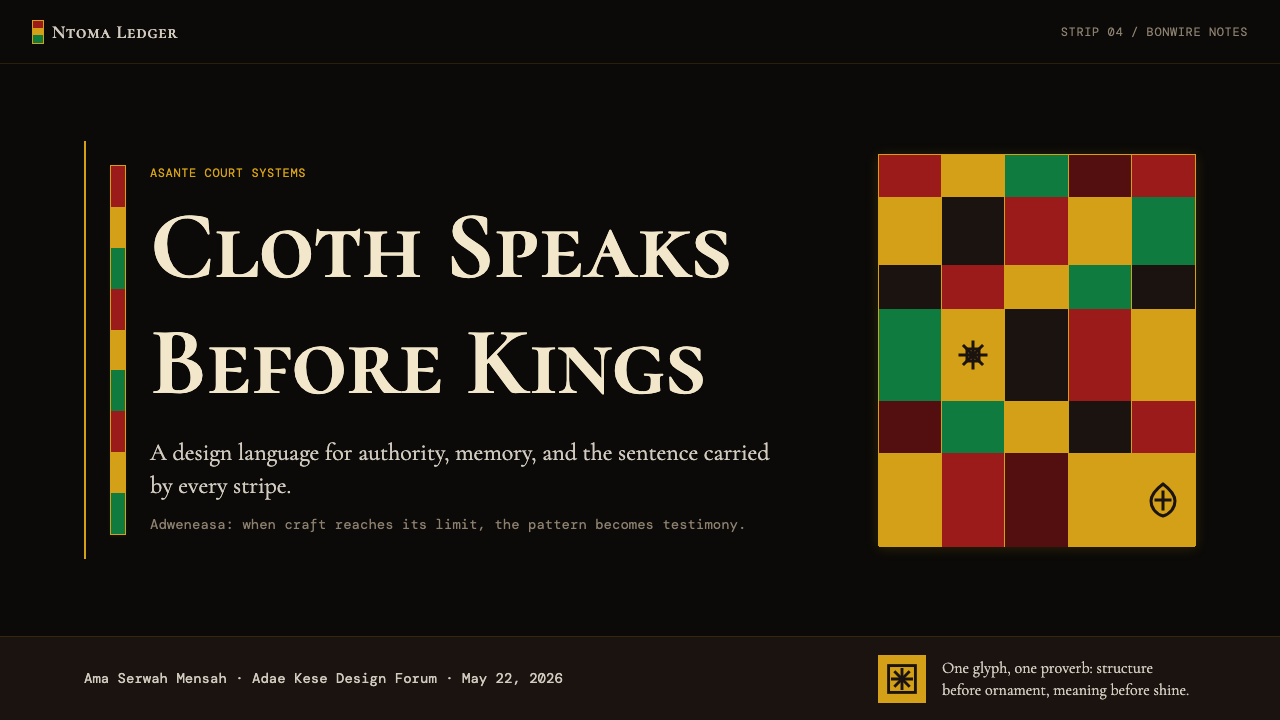
Kente patterns are not decorative variations but a lexicon. Each named pattern — and there are hundreds in the Asante tradition — encodes a proverb, a historical event, a moral concept, or a statement of royal prerogative. Adweneasa, literally 'my skill is exhausted,' refers to the supreme effort required to produce the most complex weaves and is reserved for the highest-ranking wearers. Sika Futuro, 'gold dust,' evokes royal treasury and the material foundation of Asante power. The cloth, worn at the Adae Kese festival or during durbar ceremonies, was legible to informed observers as political speech, not merely adornment.
Adinkra as Semantic Marker
Alongside the woven patterns, Asante visual culture developed a parallel symbolic vocabulary in adinkra — geometric glyphs, each with a defined meaning, traditionally stamped onto mourning cloth but also integrated into royal regalia, architecture, and metalwork. The visual logic of adinkra complements kente: while kente encodes meaning through color relationships and woven structure, adinkra encodes it through discrete, self-contained geometric symbols. Together they constitute a comprehensive visual writing system — not alphabetic, but equally systematic — that runs through all Asante material culture.
Ceremonial Weight and Material Gravity
Authentic royal kente in silk has a specific material character: it drapes with weight, catches light from multiple angles as the wearer moves, and produces a rustling sound as strips shift against each other. The visual and physical experience are inseparable. In any digital translation of the kente aesthetic, this material gravity must be approximated through compositional weight — generous proportions, strong color contrasts, a sense that every element earns its position — rather than through texture simulation or surface decoration.
Symmetry Within Asymmetric Whole
Individual warp strips in kente are internally symmetrical — the pattern within a strip mirrors across its center axis — but the assembled cloth is not symmetrically composed as a rectangle. Strips of different widths, different pattern densities, and different color emphases are combined according to the weaver's judgment to create a balanced but non-repetitive whole. This principle — local symmetry contributing to global rhythmic balance without rigid overall symmetry — is one of the more transferable structural logics of the kente tradition.
Who shaped Ghanaian Kente (Asante Royal Gold)?
Otaa Kraban is the Bonwire master weaver credited in Asante oral tradition with developing or perfecting the strip-weave technique that defines kente. The historical record of his life is sparse, but his name functions in the tradition the way Walter Gropius's name does in design modernism — as the origin point to which the formal vocabulary traces back. His technical innovations, particularly in managing the complex interleaving of warp-faced strips to produce integrated geometric and figurative patterns, established the formal grammar that later weavers elaborated.
Founder of the Asante kingdom in 1701, Osei Tutu I established the political and ceremonial framework within which kente became royal regalia. His creation of the Asante confederacy from previously autonomous Akan clans required a shared symbolic order, and the assignment of specific cloths and regalia to different ranks was part of this project. The transformation of kente from a regional textile tradition into a court-controlled semiotic system — where cloth patterns encode political relationships — is inseparable from the state-building project he initiated.
The great Asante priest and political strategist who, together with Osei Tutu I, is credited with founding the kingdom. Tradition holds that Okomfo Anokye conjured the Golden Stool from the sky, providing the spiritual foundation for the new state. His role in Asante culture is that of the legitimating mystic — the figure whose cosmological authority underwrote political power. The visual culture of the Asante, including the symbolic vocabulary of kente patterns, derives its authority partly from this cosmological founding moment that Okomfo Anokye embodies.
Ruler from 1834 to 1867, Kwaku Dua I presided over the period of kente's greatest formal codification. Under his reign, the named-pattern system became more deliberately administered, with specific designs formally reserved for the paramount king and others graded through the hierarchy of chiefs and court officials. He was also a major patron of Bonwire weavers, and the most complex and technically demanding cloths of the tradition are associated with his court. His period represents the apex of kente as a fully developed royal semiotic system rather than a regional craft.
Ghana's first president and the architect of the country's independence in 1957, Nkrumah made the decision to wear kente cloth at international diplomatic events and to promote it as a symbol of African cultural dignity in the post-colonial era. His deliberate adoption of kente for state occasions gave the cloth a second political life, transforming it from a specifically Asante royal tradition into a pan-Ghanaian and eventually pan-African cultural emblem. This shift is why kente is now recognized worldwide and worn by people of African descent as a statement of cultural pride and historical continuity.
How do you use Ghanaian Kente (Asante Royal Gold) today?
The kente aesthetic transfers to digital design through its structural logic rather than its surface texture. The key principles to carry across are: deep grounds that read as authoritative rather than decorative, strong vertical rhythm established by repeating columnar structures, color used symbolically and hierarchically rather than atmospherically, and meaningful pattern variation that rewards close reading. The goal is a design language that feels ceremonially weighted — not playful or casual, but serious and considered.
For presentation slides, the kente vocabulary works powerfully on cover and chapter-divider pages. A cover built on this system uses deep midnight indigo as the ground, positions the title in warm gold at commanding scale, and introduces a secondary crimson accent for a subtitle or date. The column-stitched metaphor translates directly to multi-column layouts where each column is treated as a self-contained strip with its own internal pattern — different content blocks that maintain their distinct character while contributing to the whole. Data slides benefit from the color hierarchy: use gold for the primary metric or category the audience should focus on, crimson for a secondary comparison, and reserve indigo or near-black for background and supporting labels.
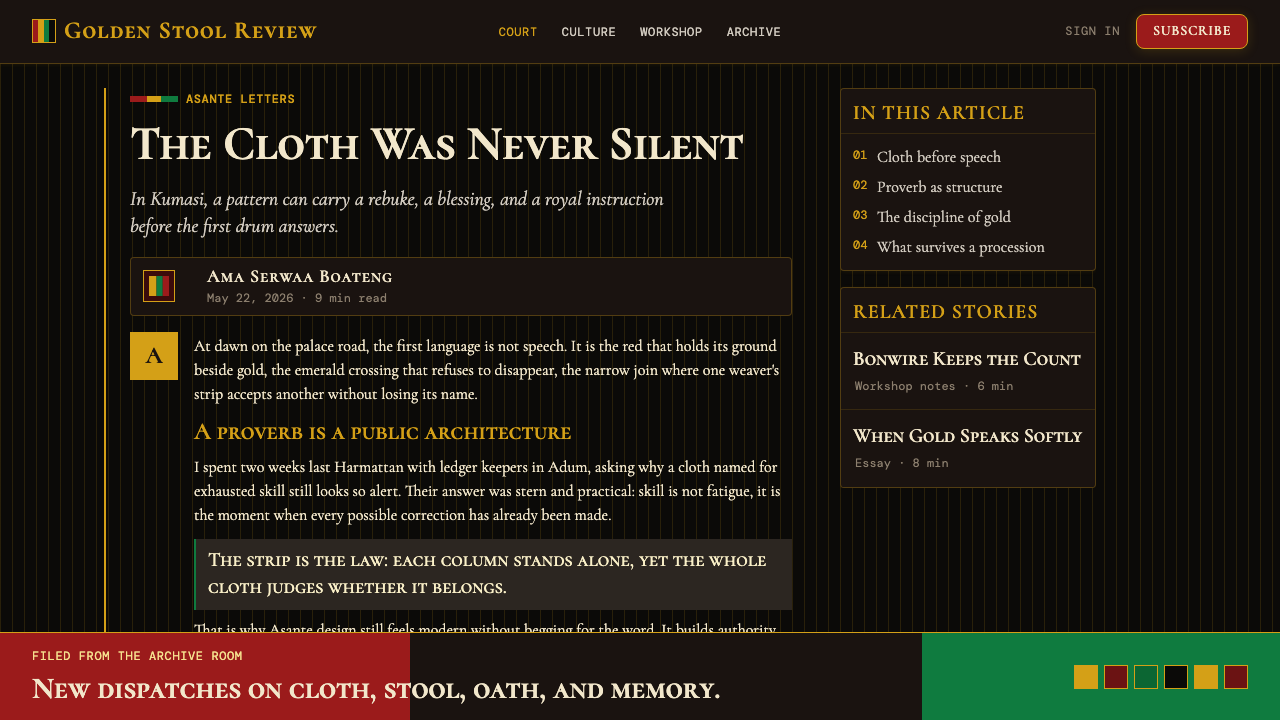
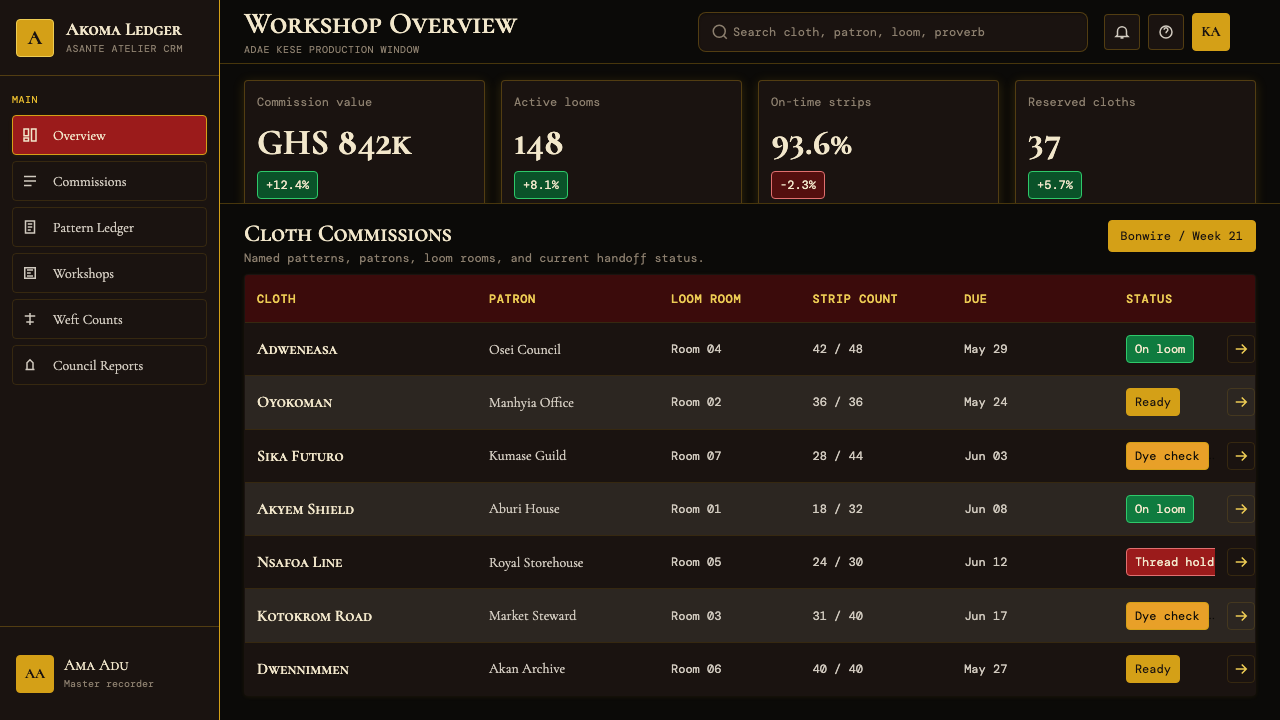
For web interfaces, the kente system suits contexts that require visible authority and clear hierarchy: executive dashboards, formal reporting tools, cultural institution websites, or any product positioning itself as serious and substantive. The approach: establish the deepest color as the navigation or header ground, let the main content area breathe slightly lighter, and use gold as the exclusive interactive accent color — links, active states, calls to action. Avoid using the full palette simultaneously; let two tones dominate while the third serves only as sparingly applied emphasis. Card components should carry meaningful visual weight — generous padding, strong color contrasts — rather than the light-touch treatment appropriate to more casual styles.
For editorial and marketing work, the strip-stitch metaphor suggests layouts built from vertical bands of content, each with its own color ground and typographic rhythm, assembled horizontally like a piece of cloth being constructed. Full-bleed feature blocks can alternate between gold-on-indigo and indigo-on-gold, with crimson reserved for the most important pull-quotes or calls to action. This approach works particularly well for cultural event programs, heritage institution materials, and brands that want to communicate depth and ceremonial significance rather than playfulness or approachability.
A common mistake is treating the kente color palette as decorative brightness — using indigo, gold, and crimson simultaneously at high saturation across every element, which produces visual noise rather than royal authority. Authentic application requires restraint: the deep ground should account for the majority of the color mass, gold appears where it will carry maximum weight, and crimson functions as punctuation rather than a continuous color presence. Another frequent error is applying surface-level kente motifs — geometric weave patterns as CSS borders or background textures — without understanding the structural logic they represent. The pattern vocabulary of kente is meaningful because it encodes specific content; using it as generic decoration inverts its purpose.
Ghanaian Kente (Asante Royal Gold) — FAQ
Is kente specific to the Asante, or is it a broader Ghanaian tradition?
Kente is primarily associated with the Asante people of the Ashanti Region, centered on the weaving village of Bonwire near Kumasi. However, the Ewe people of the Volta Region and neighboring Togo also have a distinct strip-weave tradition that is sometimes called kente, though it differs in pattern vocabulary, color use, and cultural meaning. Asante kente and Ewe kente are related but not identical — they share the strip-weave technique but carry different symbolic systems and social functions. When people refer to kente in the context of Asante royal regalia, they are specifically describing the Asante tradition from Bonwire.
Can the kente aesthetic work in a light-background digital design, or does it require a dark ground?
The deep ground is central to the royal Asante variant — the darkness is not incidental but structural to the system's meaning, establishing the gravity against which gold achieves its luminosity. A light-background interpretation is possible but shifts the register significantly: it becomes more festive or folk-adjacent rather than courtly and authoritative. If a light ground is required by the project context, the recommendation is to reduce the palette to gold and warm crimson accents on near-white, use very strong typographic weight to maintain visual authority, and apply deep indigo or near-black as the exclusive color for structural elements like navigation, borders, and headers.
How does kente relate to other West African visual traditions?
Kente sits within a larger West African tradition of textile-based visual communication that includes Yoruba aso-oke strip weaving from Nigeria, Malian bogolanfini mud cloth, and Cameroon's royal ndop cloth. What distinguishes kente from these related traditions is its specific combination of silk or fine cotton, the complexity and density of its weft-pattern vocabulary, the degree to which specific patterns are formally codified and rank-assigned, and the historical continuity of its production in a specific place — Bonwire — under royal patronage. West African textiles generally treat cloth as a communicative surface; kente represents perhaps the most elaborately codified example of that principle.
What distinguishes using kente as cultural inspiration versus cultural appropriation in design?
The distinction lies in whether the design engages with the tradition's structural logic and meaning or merely borrows its surface appearance. Kente's visual system is grounded in specific symbolic content — named patterns encode specific proverbs and social relationships, colors carry specific rank-based meanings, the strip structure reflects the physical process of its production. Design work that understands and works with these structural principles, acknowledges the tradition's origin and context, and uses the vocabulary in ways that respect its weight and gravity, is engaging in cultural inspiration. Work that simply extracts the color palette or geometric surface patterns as aesthetic decoration — without understanding or acknowledging what they mean — treats a complex symbolic system as wallpaper.
Why does the Asante royal kente tradition use dark grounds when other festive African textiles tend toward brightness?
The dark ground of Asante royal kente is a deliberate statement of gravity rather than a limitation. The Asante court aesthetic placed ceremonial seriousness above festive exuberance — a cloth worn by the Asantehene at state occasions was required to communicate authority, ancestral continuity, and spiritual weight rather than joy or celebration. The depth of the indigo ground creates the contrast necessary for gold to read with maximum luminosity; a bright ground would dilute gold into one bright element among many. There are kente variants with lighter grounds for less formal occasions, confirming that the darkness is a choice rather than a technical constraint. The gravity of the dark ground is the cloth's first and most legible statement about the rank of its wearer.
Related design styles
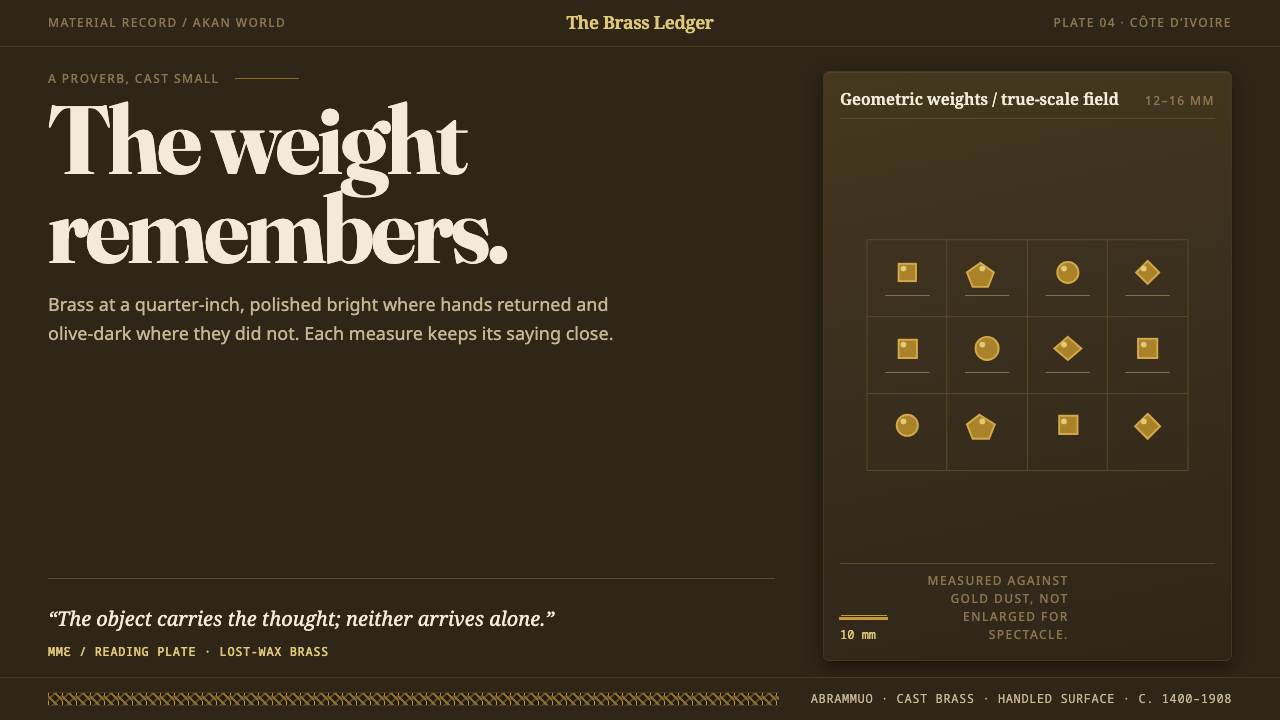 Baule GoldweightWear is the ornament. Burnished brass and olive recesses make every small wei…
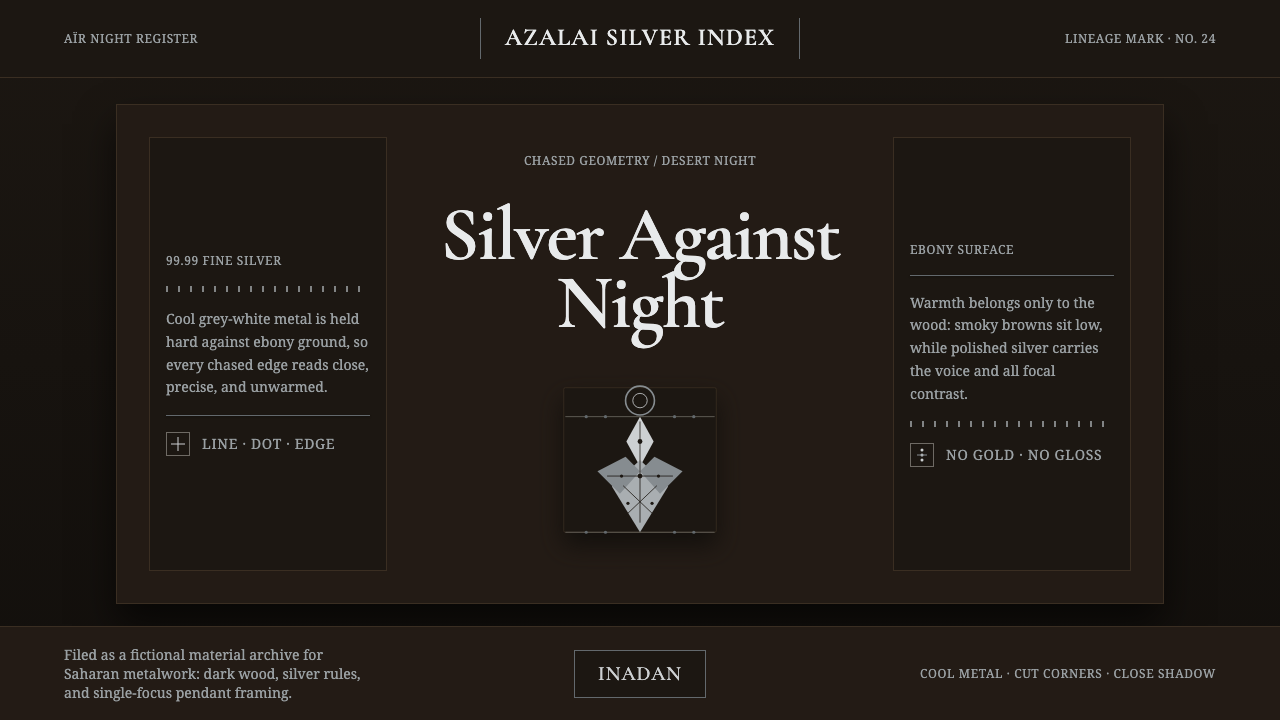 Tuareg Agadez Cross SilverSilver refuses warmth. Cool chased geometry cuts across ebony-dark surfaces.
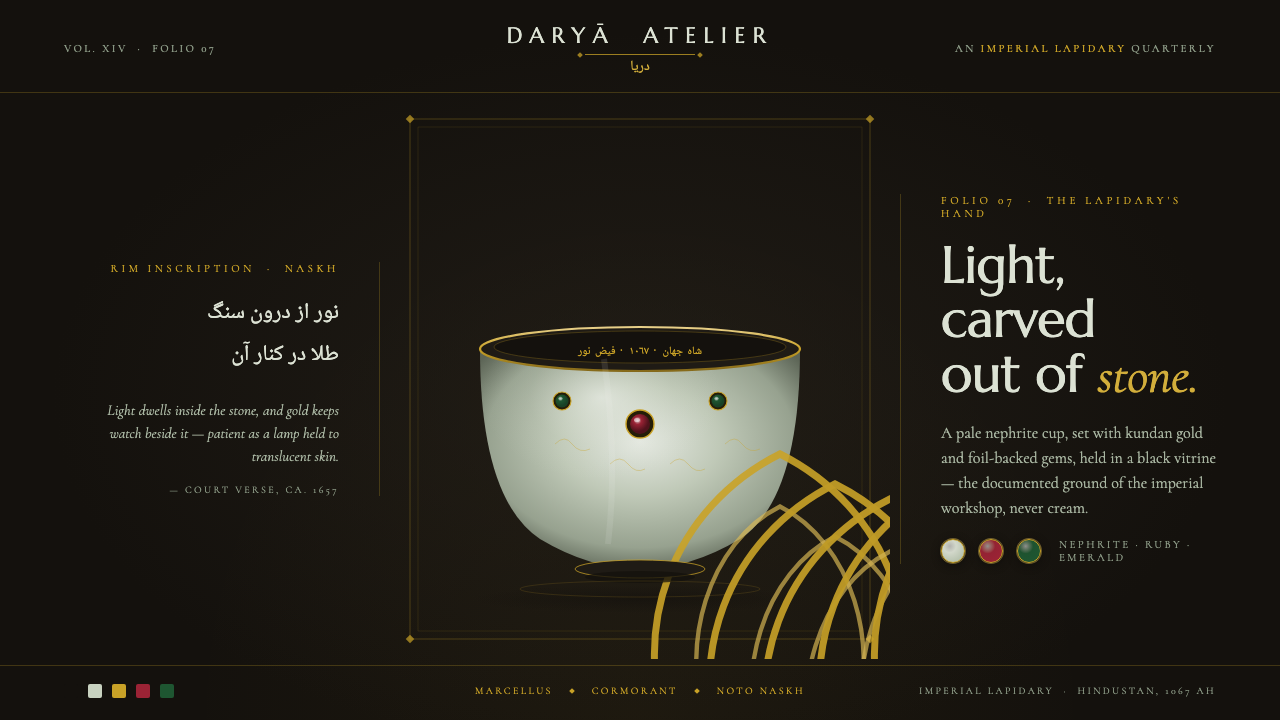 Mughal Jade CarvingImperial luxury, lit from inside. Pale nephrite glows on black, kundan gold f…
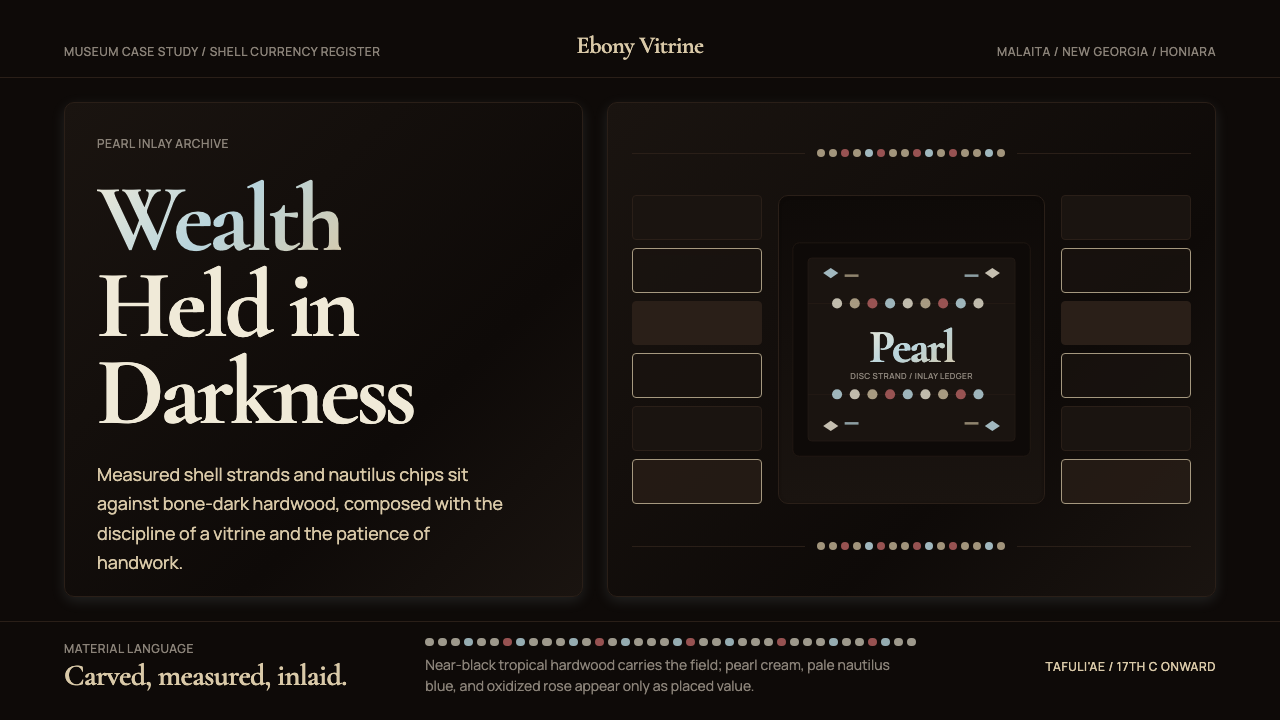 Solomon Shell Money & Pearl InlayDignity inlaid in darkness. Pearl cream and nautilus blue form strict shell-s…
 Albanian Bektashi Sufi (Tekke)Sacred quiet in cypress green. Gilt stars and Cormorant type frame a dusk tek…
 Bidriware Black MetalMonochrome luxury, hammered by hand. Matte-black Deccan patina threaded with…