What is Bhutanese Tiger's Nest Cliff Monastery?
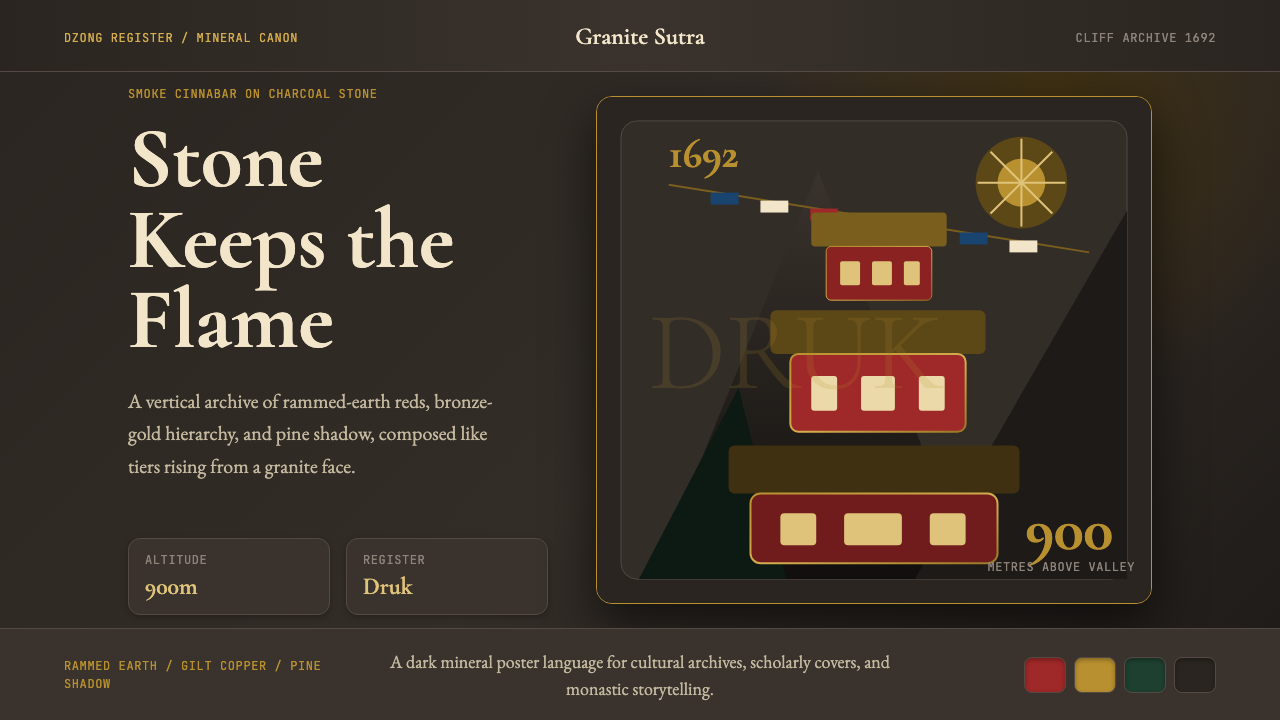
Paro Taktsang defies gravity and ornament alike — a monastery hammered into living granite nine hundred metres above the valley floor, where cinnabar earth, bronze gilt, and deep conifer green compose a visual language that is simultaneously sacred, severe, and magnificently alive.
Bhutanese Tiger's Nest Cliff Monastery in brief
The Bhutanese Tiger's Nest Cliff Monastery design system takes its name and its entire visual logic from Paro Taktsang, the most celebrated sacred site in the Kingdom of Bhutan. Built in 1692 into the sheer granite face of the Paro Valley, the monastery translates the raw materiality of its cliff setting — mineral reds, metallic golds, slate charcoals, and the dark evergreen of the forests below — into an architectural vocabulary that has remained remarkably consistent across three centuries of Bhutanese building practice.
What distinguishes this system from the broader category of Himalayan or Tibetan Buddhist aesthetics is its specifically Bhutanese character. Bhutan is not Tibet, and its visual tradition is not a diluted version of Lhasa. The Drukpa Kagyu school of Buddhism, which has been the state religion since the Zhabdrung Ngawang Namgyal unified the kingdom in the seventeenth century, produced an architectural and decorative canon with its own proportional rules, its own palette emphases, and its own hierarchy of sacred markings. The cinnabar red of Bhutanese walls is deeper and earthier than its Tibetan counterpart. The dzong fortress tradition — massive whitewashed citadels that serve simultaneously as administrative and religious centers — introduced an architectural severity that kept ornament disciplined and structural.
As a design system, Bhutanese Tiger's Nest Cliff Monastery operates through three dominant tonal registers: the smoke-red of rammed cinnabar earth, which commands attention and signals primary hierarchy; the bronze-gold of gilt finials and roof ornaments, which marks sacred or premium distinction; and the deep charcoal of the granite cliff itself, which grounds the entire composition and absorbs the surrounding brightness into itself. A secondary register of deep pine green, drawn from the conifer forests that cling to the cliffs below the monastery, provides the only organic softening in an otherwise mineral palette.
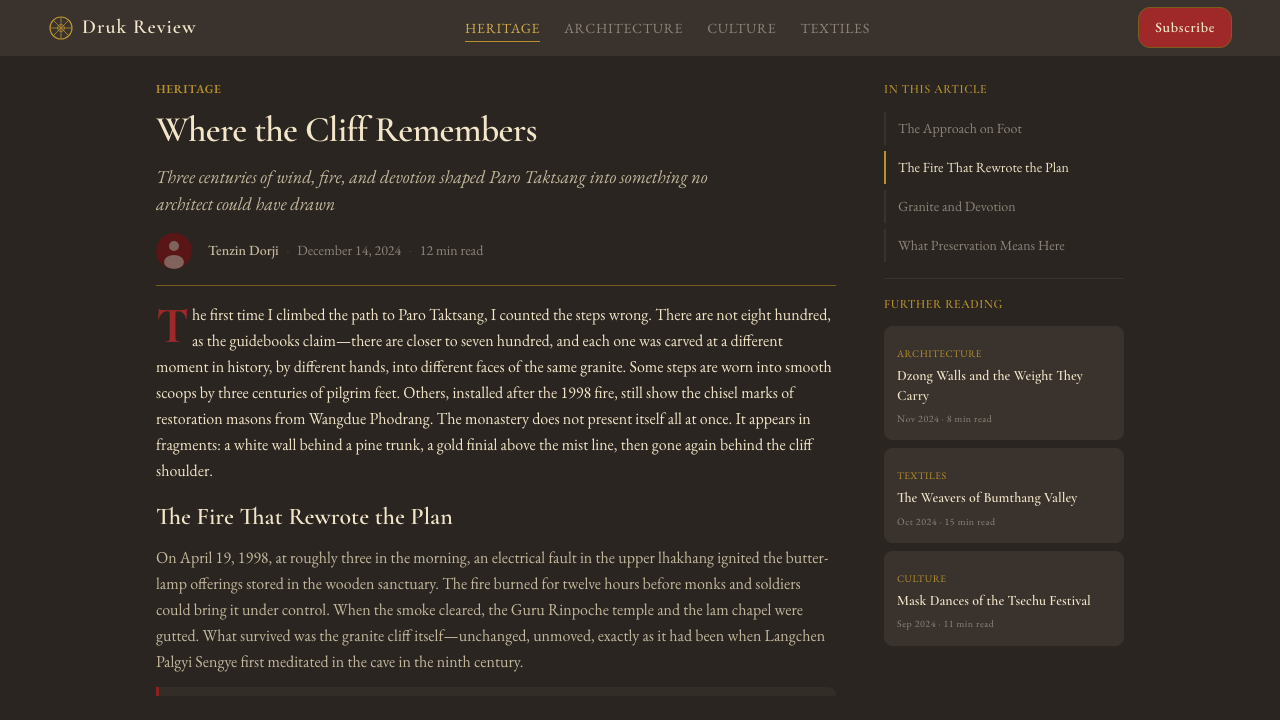
See the Bhutanese Tiger's Nest Cliff Monastery design system
Where does Bhutanese Tiger's Nest Cliff Monastery come from?
The historical root of Taktsang stretches back to the eighth century, when Guru Rinpoche — Padmasambhava, the Indian tantric master who brought Vajrayana Buddhism to the Himalayas — is said to have flown to the site on the back of a tigress and meditated in a cave for three months, subduing local demons and consecrating the ground. The cave he occupied became the innermost sanctum around which all subsequent construction was arranged. Whether understood literally or as sacred legend, this founding narrative established the site as one of Bhutan's most powerful pilgrimage destinations centuries before the current monastery was built.
The present complex was commissioned in 1692 by the fourth desi (secular ruler) of Bhutan, Tenzin Rabgye, who recognized the site's spiritual authority and chose to formalize it through permanent architecture. Tenzin Rabgye worked within the dzong aesthetic that Zhabdrung Ngawang Namgyal had established as the visual language of Bhutanese state power during his unification campaigns of the 1620s and 1630s. The Zhabdrung — himself a religious and political figure of enormous consequence, who fled persecution in Tibet and remade Bhutan as an independent Buddhist kingdom — had developed a building tradition that combined the fortified practicality of hill citadels with the ceremonial richness of monastic space. Taktsang applied this tradition to an extreme topographic condition: a cliff face so steep that construction required workers to be lowered on ropes.
The visual identity of the monastery was shaped by the specific requirements of Drukpa Kagyu devotion. Unlike some Tibetan schools that favor a lighter, more gilt-saturated palette, Drukpa Kagyu spaces in Bhutan tend toward deeper, earthier tones — the dark cinnabar, the heavy charcoal, the restrained use of gold as accent rather than field. Prayer flags — long streamers of silk in white, blue, red, green, and yellow — are strung from the monastery across the chasms to adjacent rock faces, introducing the only elements that move in the composition. Their fading and renewal over time became part of the visual experience: color that ages into the rock rather than fighting it.
Taktsang was severely damaged by fire in 1998, and the reconstruction undertaken by the royal government of Bhutan between 1998 and 2004 became a deliberate act of cultural preservation. The rebuilding adhered strictly to the pre-fire visual canon — the same cinnabar wash on the walls, the same proportional system for windows and cornices, the same bronze-gold on the ritual objects and roof ornaments. King Jigme Khesar Namgyel Wangchuck, who has made Bhutanese cultural continuity a pillar of royal policy, has continued to support the kind of architectural stewardship that keeps the monastery's visual language fixed even as contemporary materials are used in its maintenance. The result is a site that looks, from a distance, almost exactly as it appeared in seventeenth-century paintings — a remarkable achievement in a part of the world where heritage is perpetually under pressure.
What defines the Bhutanese Tiger's Nest Cliff Monastery look?
Cinnabar Earth Red
The dominant hue of the system is a smoke-red drawn from rammed cinnabar earth — a tone that reads as simultaneously warm and austere, neither the bright vermilion of Chinese imperial architecture nor the lighter ochre-red of many Tibetan monasteries, but something denser and more mineral. This red functions as the primary attention register in the system: it covers the largest surface areas, anchors the composition, and signals primary hierarchy. Its smokiness — the sense that it absorbs light rather than reflecting it — prevents it from reading as decorative. It is a constructive color, the color of the wall itself.
Bronze-Gold Hierarchy
Gold in this system is not a background or a field; it is an accent of sacred distinction. Historically derived from the gilt finials, roof ornaments, and ritual objects of Bhutanese monastery interiors, the bronze-gold tone in the design system marks the highest tier of hierarchy — the element or label that is spiritually or structurally paramount within a given composition. It appears sparingly, which is what gives it authority. Used broadly, it becomes decoration; used at precise focal points, it reads as consecration. The bronze character of the gold — heavier and older than a bright yellow-gold — keeps it legible against the dark grounds that dominate the system.
Charcoal Granite Ground
The dark ground of the system is the cliff itself — a charcoal that carries the texture and density of granite, not the flat neutral of a digital dark mode. Against this ground, both the cinnabar red and the bronze-gold take on a new quality: the red deepens and intensifies, the gold glows rather than glares. The charcoal serves a compositional function that lighter grounds cannot: it absorbs competing brightness and enforces the primacy of the palette's two main active colors. The system is dark at its core not for atmosphere or drama, but because the cliff is dark, and the monastery was built into the cliff rather than placed on top of it.
Pine Green Anchor
Drawn from the conifer forests that cling to the valley walls below the monastery, deep pine green provides the one organic element in an otherwise entirely mineral palette. It does not soften the system; rather, it anchors it — providing the fourth reference point that prevents the composition from feeling suspended in abstraction. In the monastery's context, the green is the ground of the physical world, the living base from which the sacred cliffs rise. In the design system, it functions similarly: secondary backgrounds, supporting content areas, or navigational regions that need to feel grounded rather than elevated.
Vertical Emphasis and Tiered Massing
Paro Taktsang does not spread horizontally — it stacks. Multiple distinct temple buildings at different elevations on the same cliff create a composition of tiered platforms, each with its own roof line and cornice, each slightly different in proportion, all bound together by a shared palette and the unifying white plaster of the connecting walls. In the design system, this translates to a strong vertical preference in layout: content stacks rather than spreads, hierarchy reads top-to-bottom rather than left-to-right, and distinct tiers within a single screen or document are separated by clear horizontal dividers that echo the cliff's natural ledges.
Prayer-Flag Silk Accents
The only elements in the monastery's visual composition that are not mineral or architectural are the prayer flags: long horizontal streamers of silk in a sequence of five traditional colors — white, blue, red, green, and yellow — that span the chasms between cliff faces. In the design system, this translates to a specific use of accent color: brief, horizontal, and sequential, functioning like a data band, a progress indicator, or a color-coded legend. The accent is never used as a fill or a background; it is always a narrow horizontal register — a whisper of color across a dark or neutral ground, referencing the flutter of silk against granite.
Ornament as Sacred Law
Unlike minimalist systems that eliminate ornament on principle, the Bhutanese Tiger's Nest system includes specific decorative elements — but each one carries a defined sacred function. The gilt finials mark points of transition between the earthly and the divine. The cornice overhangs signal the boundary between interior and exterior, protected and exposed. The carved wooden window frames establish viewing apertures as acts of deliberate framing rather than merely structural openings. In the design system, this means that decorative elements are not forbidden, but they must earn their place: each visible mark should be traceable to a hierarchical or functional purpose, not applied for visual richness alone.
See the Bhutanese Tiger's Nest Cliff Monastery design system
Who shaped Bhutanese Tiger's Nest Cliff Monastery?
The eighth-century Indian tantric master Padmasambhava, known in Bhutan as Guru Rinpoche, is the spiritual originator of the Taktsang site. According to Bhutanese Buddhist tradition, he flew to the cliff on a tigress — who was a transformation of his consort Yeshe Tsogyal — and spent three months in the cave that became the monastery's innermost sanctum. His legendary presence established the site as one of the most sacred in the Vajrayana world, and his iconography — particularly the distinctive red hat and the vajra held in the right hand — became the visual touchstone from which much of the monastery's decorative program derives.
The Zhabdrung — 'at whose feet one prostrates' — was a Tibetan Buddhist master who arrived in Bhutan in 1616 after fleeing a succession dispute in Tibet. Over the following decades he unified the country's warring fiefdoms, established the Drukpa Kagyu school as the national religion, and created the dual secular-religious governance structure that defined Bhutanese statecraft for centuries. His most consequential architectural act was the development of the dzong typology: massive whitewashed fortress-monasteries whose visual grammar — rammed earth walls, inward-tapering towers, internal courtyards governed by strict proportional rules — became the foundational language of Bhutanese architectural identity, within which Taktsang's entire visual vocabulary sits.
The fourth desi of Bhutan, Tenzin Rabgye served as the secular regent of the country from 1680 to 1694 and is credited as the patron who commissioned the construction of the current Paro Taktsang monastery in 1692. His decision to build was not merely pious; it was also a political act that reinforced the Drukpa Kagyu establishment's authority over the sacred landscape of western Bhutan. The monastery he commissioned applied the mature dzong aesthetic — by then standardized across the kingdom — to the peculiar conditions of a cliff site, producing a building that became the most recognizable image of Bhutan itself.
The fifth and current king of Bhutan, known affectionately as the Dragon King, has made the continuity of Bhutanese cultural identity — including its architectural and visual heritage — a defining theme of his reign. His government's oversight of the post-1998 fire reconstruction of Taktsang, which adhered strictly to the pre-fire visual canon rather than taking the opportunity to modernize, reflects a deliberate policy of aesthetic conservation. Under his patronage, Bhutan's building standards require new government and religious structures to maintain the dzong aesthetic, ensuring that the visual language first codified under the Zhabdrung remains the dominant architectural idiom of the kingdom.
No single architect or designer is credited with the specific forms of Bhutanese monastic architecture; the tradition was carried by generations of anonymous master builders — lopon, or chief craftsmen — who transmitted the proportional rules, the correct cinnabar-to-white ratios for wall painting, the method for calculating roof overhang, and the ritual requirements for window orientation by apprenticeship and practice. This anonymous transmission is itself part of the tradition's visual authority: the forms are not attributed to individual genius but to accumulated sacred knowledge, which gives the aesthetic its quality of inevitability — as though it could not have been otherwise.
How do you use Bhutanese Tiger's Nest Cliff Monastery today?
The Bhutanese Tiger's Nest Cliff Monastery system is among the most architecturally coherent of Himalayan-derived design languages, and its power depends on respecting the hierarchy it encodes. Before applying any element, understand the three-tier color logic: the smoke-red is structural and primary, the bronze-gold is sacred and premium, the charcoal is the ground. Reversing or conflating these tiers — using gold as a background, for example, or treating charcoal as merely a dark mode alternative — collapses the system's internal logic and produces something that looks like a borrowing rather than a commitment.
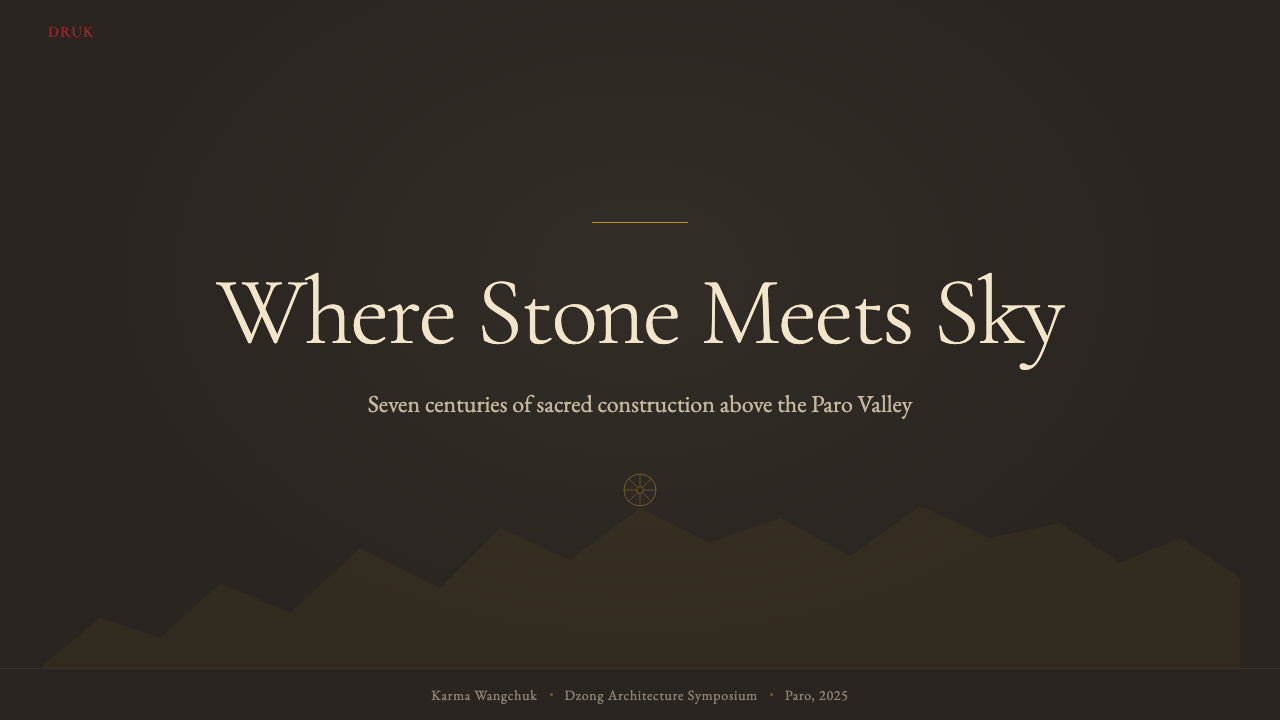
For presentation slides, the system produces strong results on both cover and content pages. A cover slide should lean into the system's verticality and mineral weight: a tall composition with the title in a light, warm-toned type against a deep charcoal field, a narrow bronze-gold horizontal rule below the headline, and a smoke-red element — a block, a band, a vertical rule — anchoring one edge. Content slides benefit from the tiered structure: section headers in a slightly lighter charcoal or in the smoke-red, body text in a warm off-white, and call-out data points or labels in bronze-gold to signal hierarchical importance. Data visualizations should use the palette's full sequence — smoke-red for primary series, bronze-gold for secondary, pine green for tertiary — rather than introducing outside colors.
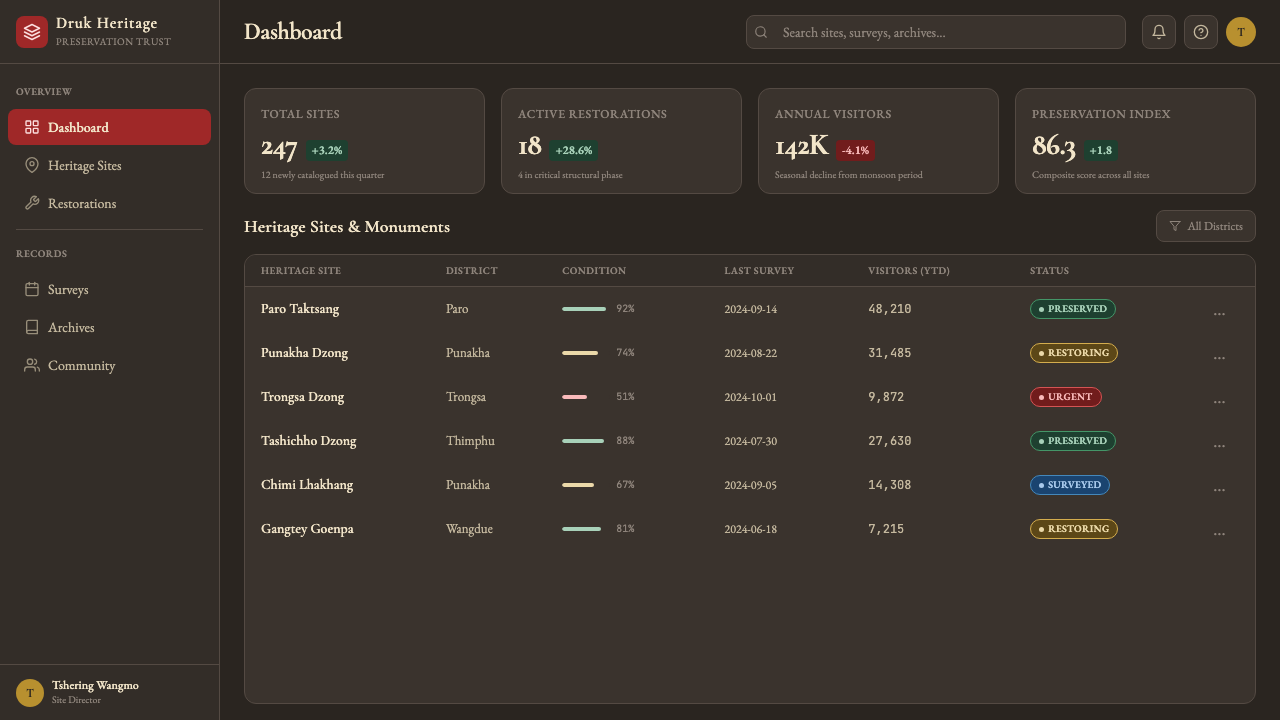
For web and dashboard interfaces, the system is particularly well-suited to contexts where depth, authority, and a sense of deliberate craft are valued: financial products, cultural institutions, premium subscription platforms, or any application that wants to signal care and precision rather than friendliness and speed. The charcoal dark ground works as a primary background; a slightly lighter derivative of the charcoal handles card and panel surfaces. Interactive elements — buttons, active states, selected items — use the smoke-red, reserving bronze-gold for tier labels, badges, or the single most important call-to-action on any given screen. Navigation should be restrained and typographic, with minimal iconography.
For editorial and marketing applications, the style's poster-like quality — derived from the monastery's tendency to present itself as a single bold mass against a sky — translates into strong full-width hero blocks and section dividers. A marketing page should alternate between charcoal-ground and a slightly off-white ground for different sections, using the smoke-red consistently for primary calls-to-action and the pine green for supporting or secondary sections. Bronze-gold appears only at the highest tier of the page hierarchy: the primary headline, the pricing badge, the key feature callout. Resist the temptation to use it broadly — in this system, gold that appears everywhere is no longer gold.
The most common mistake when working with this system is treating it as generically dark and moody rather than specifically mineral and sacred. The charcoal ground should feel like granite — dense and particular — not like a generic dark backdrop. The smoke-red should feel earthy and absorbed, not bright or aggressive. If the palette starts to feel cinematic or luxury-lifestyle, it has drifted from the system's register. The corrective is always to return to the source: a cliff face, a rammed-earth wall, a gilt ornament catching thin Himalayan light. The system's authority comes from geological and spiritual specificity, not from general dark elegance.
See the Bhutanese Tiger's Nest Cliff Monastery design system
Bhutanese Tiger's Nest Cliff Monastery — FAQ
How is this system different from Tibetan Buddhist design?
The most important distinction is national: Bhutan developed its own architectural and visual tradition under the Drukpa Kagyu school and the Zhabdrung's dzong-building program, distinct from Gelug-dominated Lhasa. The Bhutanese palette runs deeper and earthier — the cinnabar is darker, the use of white is more architectural than decorative, the gold is used as an accent of hierarchy rather than a field of celebration. Structurally, the dzong aesthetic emphasizes severity and mass over the layered richness of Tibetan monastery interiors. There is also a specific relationship to the landscape: Bhutanese buildings are designed to be read from a distance against mountain and sky, which requires boldness and legibility at scale rather than the intricate close-up ornament that characterizes much Tibetan interior work.
Can this dark-ground system work for consumer-facing products, or is it too austere?
It depends entirely on what the product is communicating. The system's register is sacred, mineral, and ancient — it communicates depth, authority, and rarity rather than warmth, playfulness, or accessibility. This makes it well-suited for products in the premium, cultural, or contemplative space: high-end travel, meditation or wellness applications aimed at a disciplined rather than casual audience, archival or heritage institutions, financial platforms communicating stability and long duration. It struggles in contexts that require emotional warmth, broad accessibility, or the sense of ease and speed. The monastery does not invite the casual visitor; it rewards the determined pilgrim. Any product using this system should be comfortable with the same implicit ask of its user.
What is the role of prayer flags in the design system, and how literal should that reference be?
The prayer flags in the original monastery serve a specific spatial function: they bridge the void between cliff faces, marking a transition across empty space. In the design system, the reference should be structural rather than literal. The flag sequence — its five colors in a horizontal band — informs the use of accent color as a narrow sequential register rather than as fill or background. A progress bar, a data band, a color-coded tag row, a thin top-of-card accent line: these are legitimate translations of the flag's spatial logic. An actual prayer-flag graphic or a decorative textile motif would be too literal, reducing a structural principle to cultural decoration. The flags are interesting because they move across a void; in interface design, the equivalent is a marking that spans or measures rather than fills.
How should the system handle light mode, given that the canonical palette is dark-ground?
A light inversion is possible but requires understanding what the dark ground is actually doing. The charcoal is not simply the absence of light — it is the cliff, the geological mass that gives the monastery its context. In a light inversion, the cliff becomes a deeply warm off-white or pale stone — not pure white, which would strip the mineral quality entirely. The smoke-red remains the primary active color; the bronze-gold may lighten slightly but should stay in the warm metallic register rather than shifting to a bright yellow-gold. Pine green holds its deep tone even on a light ground. The light variant works best when it is understood as viewing the monastery in full Himalayan midday sun rather than at dusk: the forms are the same, the light has changed.
Is this system appropriate for brands that have no direct connection to Bhutan or Buddhism?
The system is appropriate for any brand that genuinely aligns with the values it encodes: depth over surface, endurance over novelty, the reward that comes from sustained engagement rather than immediate gratification. These are not uniquely Bhutanese or Buddhist values — they appear in many cultural contexts and many product categories. What the brand should avoid is treating the system as exotic wallpaper: using the cinnabar because it is unusual, or the bronze-gold because it reads as luxurious, without committing to the structural logic that makes the palette coherent. Used with understanding, the system offers something that most contemporary design language cannot: a palette that feels genuinely ancient without being archaic, and genuinely sacred without being inaccessible.
Related design styles
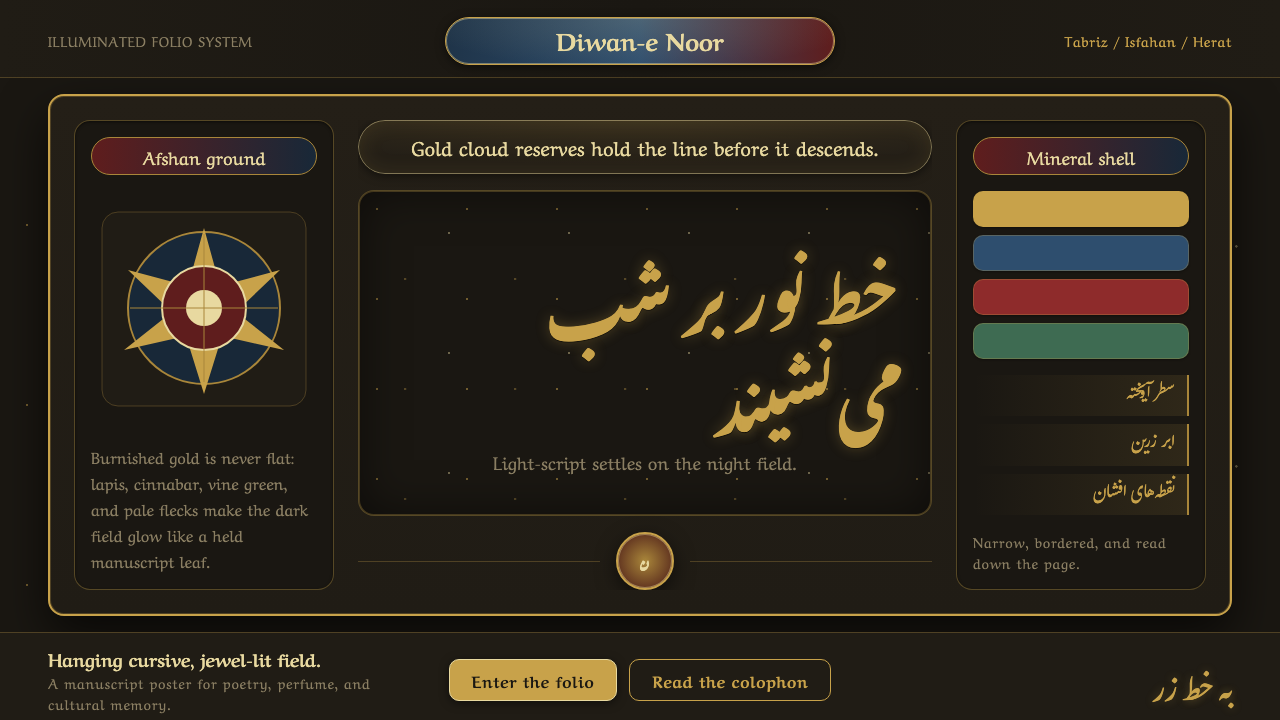 Persian Nastaliq CalligraphyGold script breathes in darkness. Afshan flecks, lapis cartouches, and sloped…
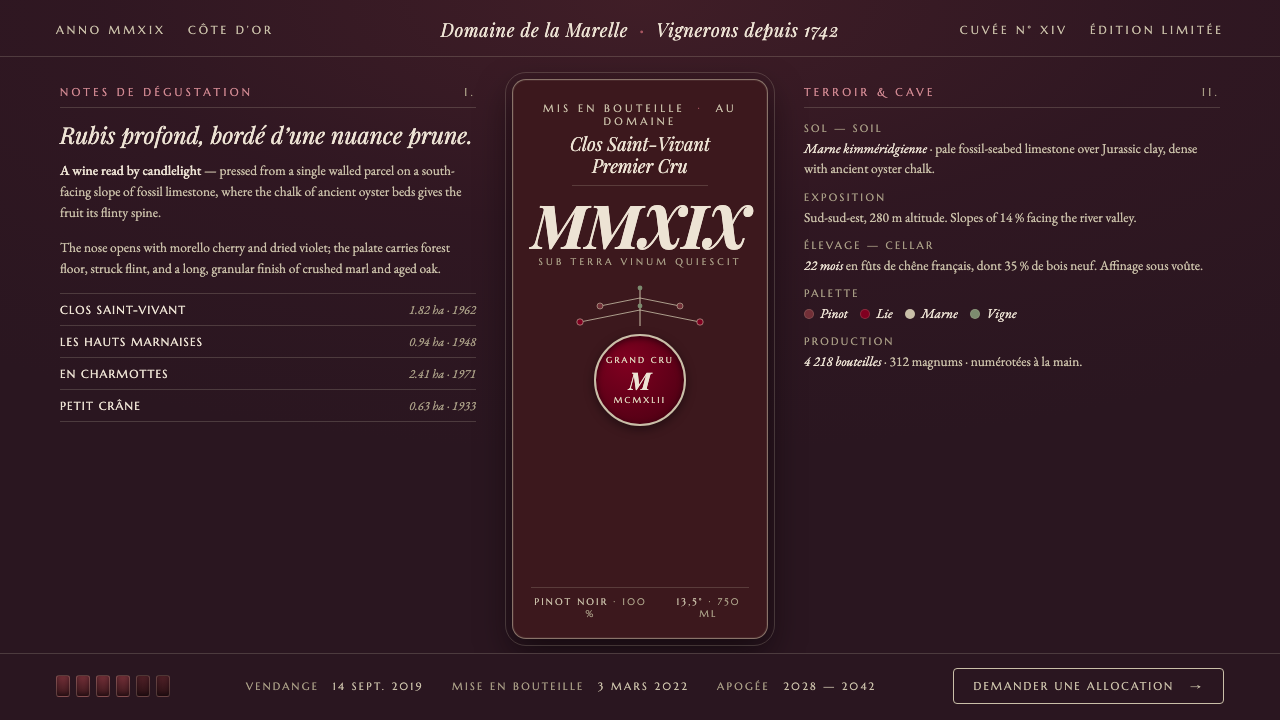 Burgundy VineyardRead by candlelight in a wine-lees cellar. Aged purple-red Pinot on near-blac…
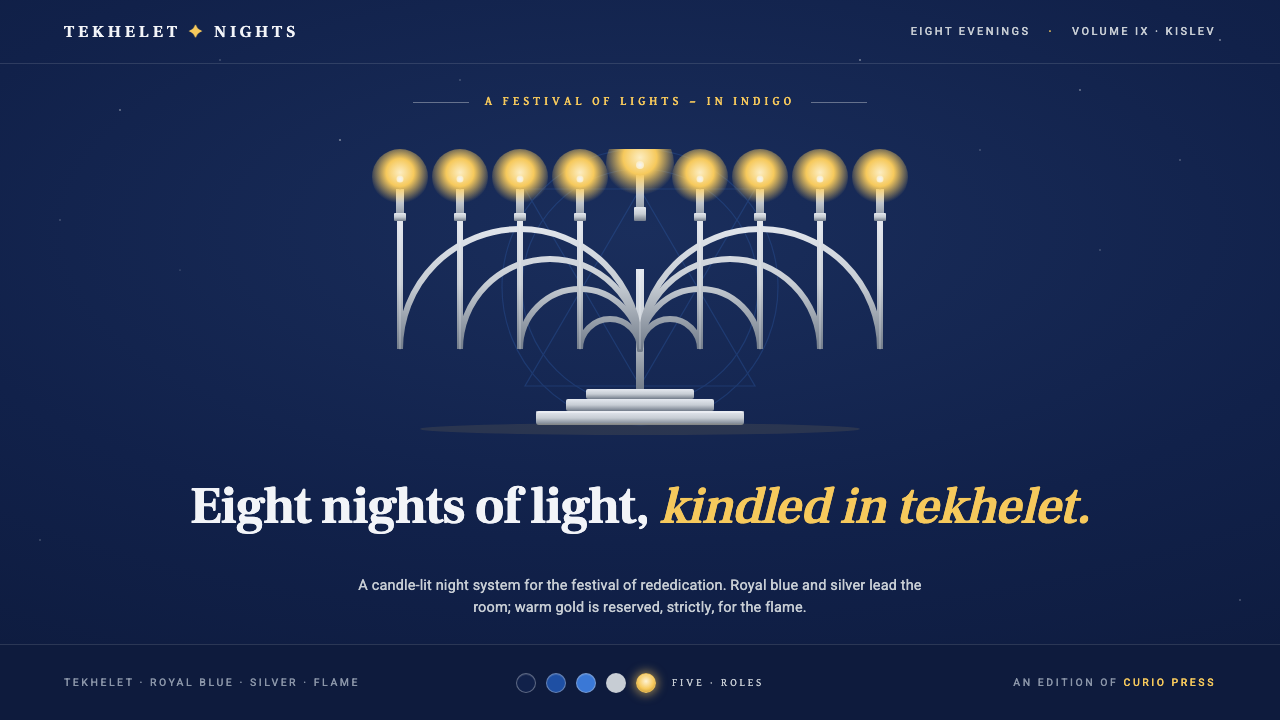 Hanukkah MenorahEight nights kindled in tekhelet. Royal blue and silver hold the dark room; g…
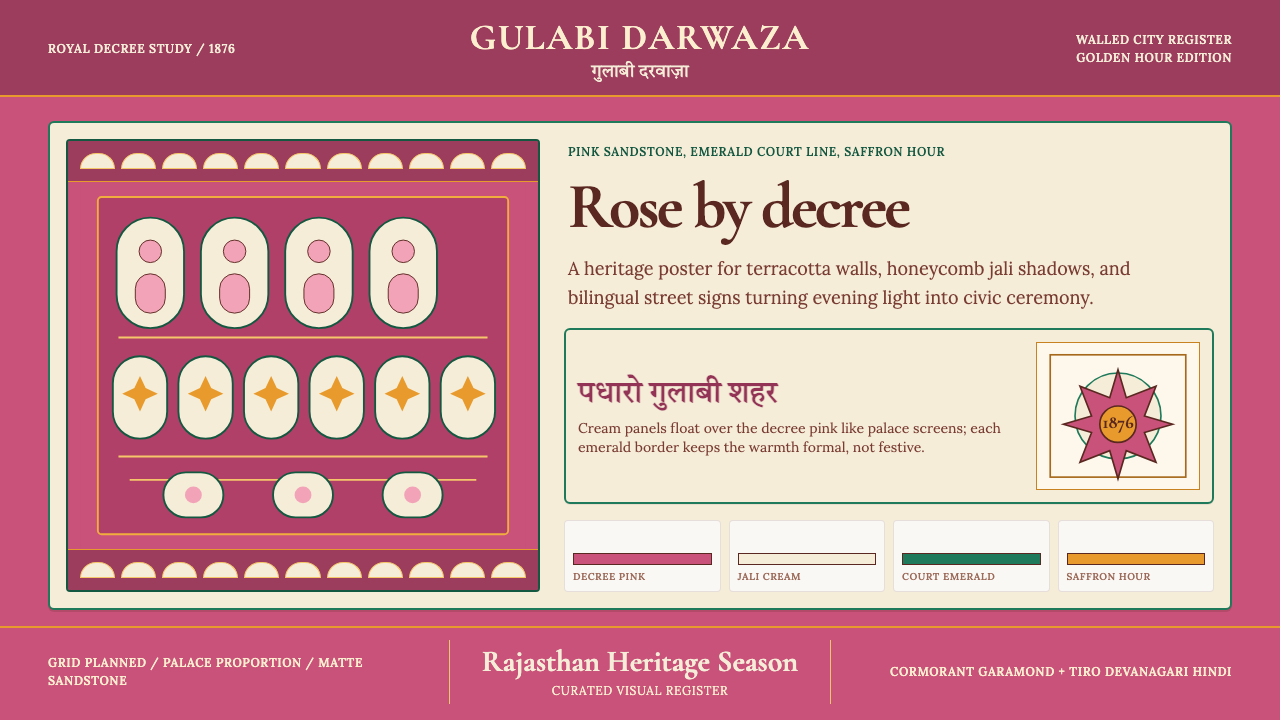 Jaipur Pink City RajasthanRoyal warmth, ordered by decree. Pink sandstone, cream jali, emerald borders.
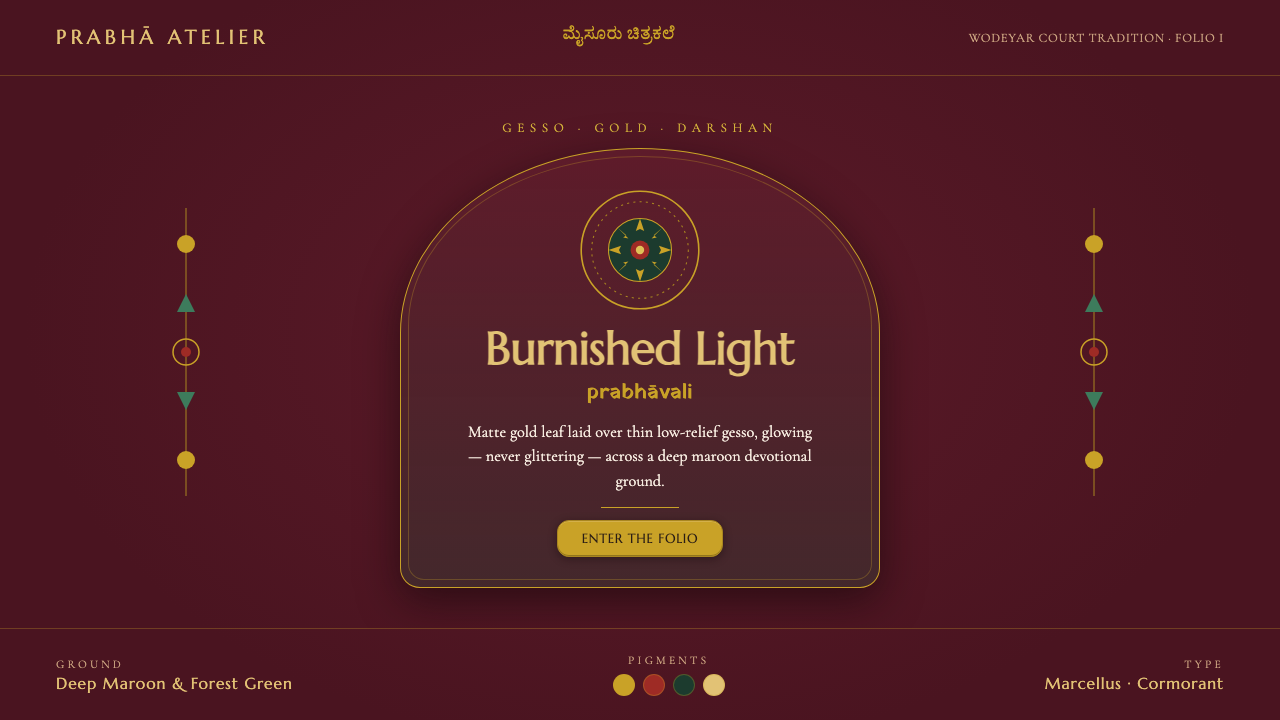 Mysore Gesso Gold PaintingGold that glows, never glitters. Matte burnished leaf over gesso on deep maro…
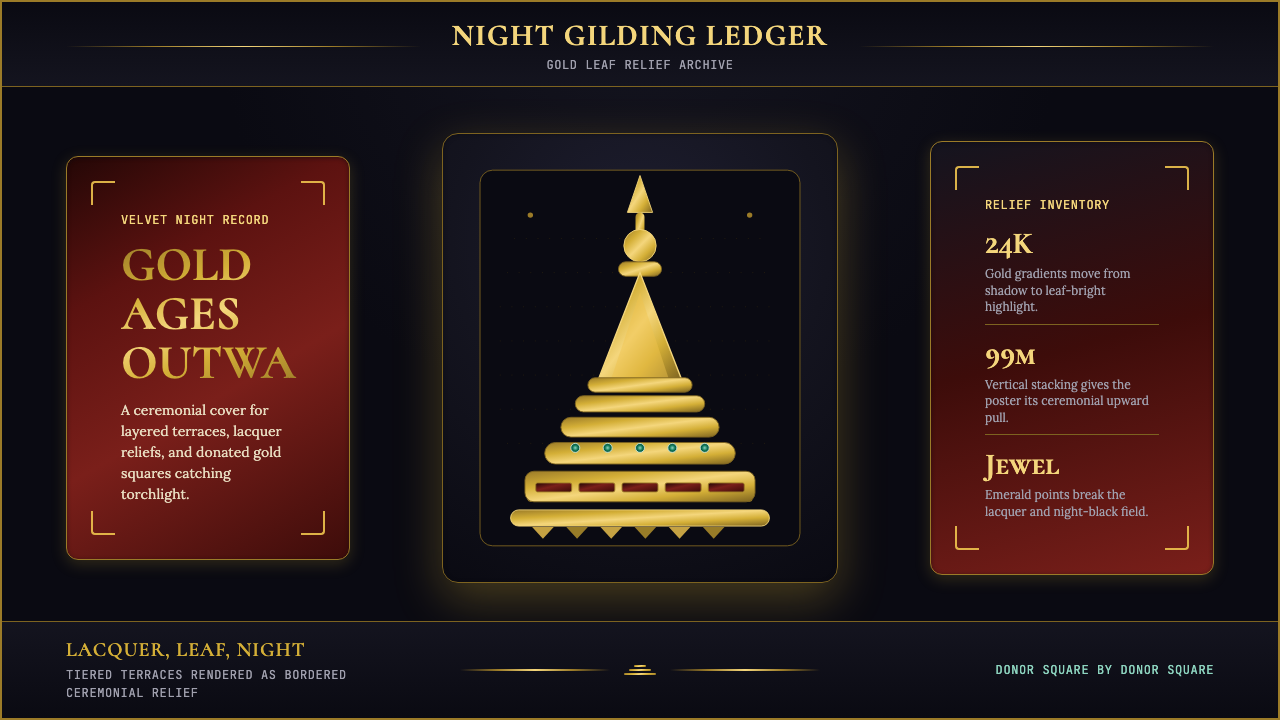 Burmese Shwedagon Stupa ReliefGold refuses restraint. Velvet black, teak-red lacquer, and tiered gradients…