What is Malaysian Songket (Gold-Thread Weave)?
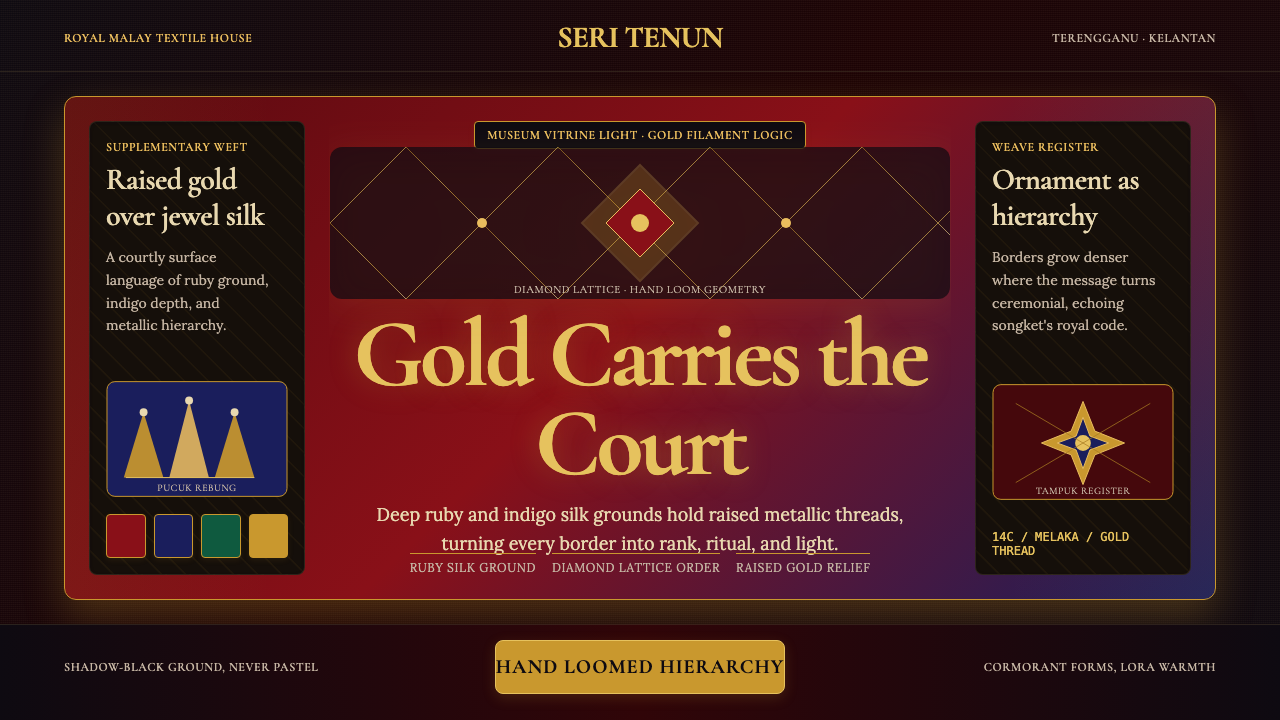
Songket is the textile crown of the Malay world — silk threaded with gold by hand on ancient looms in Terengganu and Kelantan, worn only by royalty for centuries and now translated into a design language of extraordinary ceremonial richness.
Malaysian Songket (Gold-Thread Weave) in brief
Songket is a supplementary-weft textile: a base cloth of silk — typically dyed in deep, jewel-saturated tones of ruby, indigo, or forest green — is woven on a traditional backstrap or frame loom, then interlaced with additional metallic threads that float above the ground weave to create raised, luminous patterns. The result is cloth that catches light in two registers simultaneously: the matte depth of the silk ground and the warm gleam of the gold above it. No photograph fully captures this duality, which is why songket has historically been evaluated in motion — held up to candlelight in a palace chamber, draped on a body that turns and shifts.
As a design system, songket translates this layered luminosity into interface terms. Deep, saturated grounds carry surface ornament that appears to hover above the page rather than sit flat upon it. The ornament itself is almost always geometric — diamond lattices, star-burst rosettes, floral grids locked to the weft-repeat logic of the loom — and it is organized into registers and borders in the same way a length of cloth is divided into field, border, and selvedge. Every surface reads as simultaneously dense with pattern and disciplined with order. The richness is not chaotic; it is the richness of a system that has been refined over centuries of court use, where excess and error were both forbidden.
What distinguishes songket from surface-decoration styles that merely add richness is the structural coherence beneath the ornament. The gold pattern is not applied to the silk after the fact; it is woven into it during the same process that creates the ground, emerging from the same interlocking grid of warp and weft. A songket-derived interface inherits this integrity: gold accents are not decorative stickers pasted onto a dark background but are built into the spatial hierarchy from the start — they mark interactive states, signal tier, and define the most important divisions of space in the same way the supplementary weft marks the hierarchy of the cloth. Remove the gold and what remains should still be a coherent, legible structure.
Where does Malaysian Songket (Gold-Thread Weave) come from?
The word songket is thought to derive from the Malay word sungkit, meaning to hook or pick — a direct description of the weaving technique in which individual metallic threads are picked up and interlaced by hand, one motif at a time, using a small pointed tool. This labor-intensive process means that a single length of high-quality songket can take weeks or even months to complete, and the most elaborate court cloths historically required the sustained work of multiple weavers. The craft almost certainly arrived in the Malay Peninsula via the Indianized coastal courts of the fourteenth and fifteenth centuries, carried along the same trade routes that brought Indian silk, Chinese porcelain, and Islamic architectural motifs into dialogue with indigenous Malay material culture.
As the Melaka Sultanate grew into one of the great maritime trading emporia of the early modern world — its port at the height of the fifteenth century drawing merchants from Gujarat, China, Java, Arabia, and the Swahili coast — the demand for luxury textiles to mark courtly rank and facilitate diplomatic gift-giving intensified sharply. Gold cloth was already a universal currency of prestige across the Indian Ocean world, and songket emerged as the Malay world's own interpretation of that tradition: a cloth that was simultaneously a display of technical mastery, a portable statement of political status, and a medium of artistic expression governed by aesthetic conventions as exacting as any courtly protocol.
Under the Terengganu and Kelantan sultanates on the northeastern peninsula, songket production became a state craft in the fullest sense. Weaving was confined to royal compounds and the households of court nobles; the cloth was regulated by sumptuary traditions that matched specific patterns, color combinations, and the density of gold thread to specific ranks. A cloth woven for a sultan was not merely more expensive than one woven for a minor noble — it was a categorically different object, governed by rules of use, display, storage, and inheritance that encoded the entire social order of the sultanate in textile form. Certain patterns were reserved exclusively for the ruler; to wear them without entitlement was not mere fashion violation but a political transgression.
Colonial disruption and the commercialization of the twentieth century gradually broke open the sumptuary framework. By the time Malaya achieved independence in 1957, songket had begun its transition from exclusively court textile to national costume, worn at state ceremonies, weddings, and formal occasions across all social strata. The Terengganu songket revival of the period after 1970 — partly supported by state craft institutions and partly driven by the growing middle-class market for traditional dress — brought new weavers into the craft and introduced synthetic metallic threads as a more affordable alternative to genuine gold filament. Contemporary songket exists in a wide range of registers: from master weavers in Terengganu still producing cloth at the highest level of technical and material excellence, to fashion designers incorporating songket motifs into contemporary garments, to machine-made approximations sold in tourist markets. The living tradition continues to negotiate between preservation and reinvention, with the resulting aesthetic tension itself becoming part of what the style means.
What defines the Malaysian Songket (Gold-Thread Weave) look?
Jewel-Tone Ground
The base of a songket-derived palette is always a deep, jewel-saturated silk tone: ruby, indigo, forest green, or midnight teal. These are not muted or desaturated contemporary neutrals — they carry the full chromatic weight of ceremonial cloth dyed with natural pigments at their most intense. The depth of the ground color is not incidental to the aesthetic; it is what makes the gold readable as warm luminosity rather than harsh brightness. Against a pale or neutral ground, gold merely looks yellow. Against a deep ruby or indigo ground, gold glows with the quality of metallic thread catching candlelight in a dim palace chamber. Backgrounds that are too pale or too neutral flatten the relationship between ground and ornament, losing the essential sense of embedded richness that defines the system.
Gold as Hierarchy
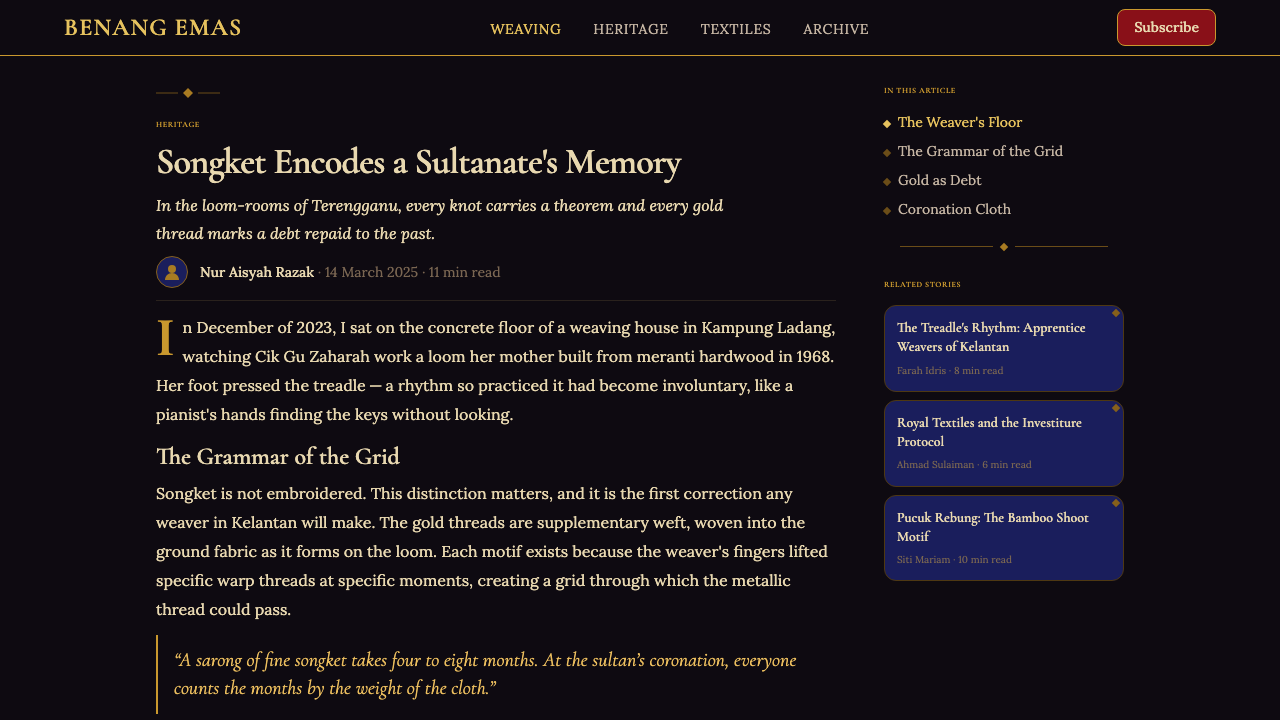
Gold in a songket system is never deployed as mere decoration. In the original textile, the supplementary gold thread marks the most important zones of the cloth — the central field pattern, the border registers, the end panels — in a hierarchy that corresponds directly to the garment's social significance. A cloth destined for a sultan might have gold covering eighty percent of the visible surface; one made for a commoner might have gold only in the borders, or none at all. In an interface derived from this logic, gold functions the same way: it appears where the most important things are. Primary headings receive it; the most consequential interactive elements receive it; the borders and dividers that define the highest-level spatial zones receive it. Applying gold to secondary or tertiary elements violates the system's underlying logic and produces visual confusion rather than clarity. The metallic accent works precisely because its distribution is always meaningful — it tells the viewer what to look at first, what carries the most weight, what is most worth attending to.
Diamond Lattice Geometry
The most characteristic motif in songket is the diamond lattice — rows of interlocking diamond shapes, each potentially containing a smaller floral or star unit at its center, organized into a field that covers the entire ground of the cloth with mathematically consistent repetition. This structure is not decorative caprice but a direct expression of the loom's technical logic: the supplementary weft can only float in ways determined by the interval of the base weave, so geometry emerges as the natural language of the technique. Different intervals produce different diamond proportions; different supplementary thread densities produce different gold-to-silk ratios within each repeat unit. In a design system, this principle translates to pattern elements that are always locked to an underlying grid, always repeating with mathematical consistency, and always oriented at angles that reinforce the diagonal energy characteristic of the original textile.
Surface Relief and Luminosity
Authentic songket has physical dimensionality: the supplementary gold thread sits slightly above the silk ground, creating a micro-relief that catches raking light from the side while remaining nearly invisible under direct overhead illumination. This behavior — dramatically visible in certain lights, almost absent in others — gives the cloth a quality of latent presence, of richness that reveals itself gradually rather than announcing itself all at once. Examining a fine piece of songket is an experience of discovery: what first reads as a dark jewel-colored cloth gradually reveals layers of ornament as the viewing angle shifts. In interface design, the equivalent is a sense of controlled stratification across depth layers: gold elements that appear to hover just above their grounds, ornamental borders that feel as though they have been laid onto a surface rather than printed into it, card components that convey the impression of layered materials rather than a flat arrangement of colored zones. This depth effect is achieved through precise management of shadow direction and softness, edge contrast, and the distinction between matte grounds and slightly more luminous surface elements — never through literal emboss filters or texture overlays, which look digital rather than textile.
Zonal Border Structure
A length of traditional songket is divided into distinct named zones: the main field carrying the primary repeat pattern, inner and outer border bands running along the long edges with their own coordinated but distinct motifs, a narrower selvedge, and often a separate end panel with a denser or differentiated pattern marking the hem. This zoning is not merely organizational — it is a spatial hierarchy encoded in textile form. The cloth communicates where the center of attention is, where the boundaries are, and where the transitions between zones occur, all through visual means that a viewer can read without being told. Each zone has its own characteristic motif, its own gold density, its own spatial scale; together they produce a composition that feels resolved at every level of magnification. Interface systems derived from songket inherit this principle: pages and components are articulated through layered frames and border registers that give each spatial zone its own distinct character, with ornamental density increasing as the viewer's attention moves toward the most important zone and diminishing toward the periphery. A page with no zonal structure — equal treatment everywhere — cannot be songket-derived in any meaningful sense.
Ceremonial Restraint within Richness
Despite its visual density, traditional songket is never chaotic. Every motif is placed with a precision that reflects its origin in a counted-thread process where each placement is a deliberate physical act requiring skill and attention. The restraint is structural: gold is present across the entire cloth, but it is always organized into a legible pattern logic rather than deployed as undifferentiated overall texture. The diamonds align; the borders register correctly at each corner; the floral units within the lattice are consistent in scale and placement. A songket-derived interface should possess this same quality — dense but not overwhelming, elaborate but always legible. The moment ornament begins to compete with content rather than frame it, or when pattern density becomes uniform across all zones, the system has broken from its source logic.
Museum Vitrine Light
There is a particular quality of light associated with the finest songket — the cool, focused illumination of a museum display case, where a cloth is shown against deep velvet and lit to reveal simultaneously the depth of its dye and the three-dimensional lift of its gold thread. This is not the warm ambient light of daily use but the dramatized, directional light of deliberate display: every detail made visible, every surface rendered at its most precise. This atmospheric register — curated, focused, slightly dramatized — is the quality that songket-inspired interfaces aim to evoke. Deep grounds, focused highlight zones, and the sense that each surface has been carefully considered and placed for viewing are all expressions of this aspiration. The interface should feel like something that has been prepared for presentation, not assembled for casual use.
Who shaped Malaysian Songket (Gold-Thread Weave)?
One of Malaysia's most prominent songket researchers and practitioners, Norhaiza Noordin has dedicated her career to documenting historical songket patterns and reviving weaving techniques that had fallen out of active use. Her work bridges archival scholarship and living craft practice: she has catalogued motifs from museum collections across Malaysia and the broader Malay world, traced their geographic and dynastic origins, and trained younger weavers in the precise counting sequences required to reproduce historically accurate cloths. Her research has established rigorous documentation of the relationship between specific pattern types and specific courts or regions, challenging the flattening of regional variation that occurs when songket is treated as a single undifferentiated tradition. Her publications and exhibitions have significantly raised the international profile of songket as a subject of serious textile scholarship rather than merely a decorative regional craft.
A weaver from Terengganu who became one of the central figures in the post-independence documentation and preservation of traditional songket techniques, Tengku Ismail Tengku Su worked within the royal weaving tradition and contributed significantly to efforts to codify and transmit the technical knowledge that had previously been passed down only through direct apprenticeship within court households. His practice represented the transitional generation between purely court-based production and the more broadly accessible craft revival that followed Malaysian independence, when the challenge became preserving the standards and pattern vocabulary of the court tradition while making that knowledge available to a wider circle of weavers outside the royal compound.
A royal patron and practitioner associated with the Terengganu court, Tengku Marina Ibrahim has played a significant role in elevating songket's status as national cultural heritage rather than allowing it to retreat into purely archival or museum status as traditional dress fell out of everyday use. Through both personal practice and sustained institutional engagement, she has contributed to positioning songket not merely as a regional craft of the northeastern peninsula but as a symbol of Malaysian national identity on both domestic and international stages. Her involvement in state ceremonies and diplomatic contexts has kept the most formal and technically demanding register of songket production visible in contemporary public life.
A figure associated with the institutional preservation and promotion of Malaysian traditional crafts through formal governmental and cultural organizations, Dato' Muhammad Ali Ibrahim represents the administrative dimension of craft heritage work that is as essential as the weaving practice itself. The sustained funding, documentation, and public promotion of songket that state institutions have provided — particularly during the decades when younger generations were more attracted to modern industries than to the demanding apprenticeship required by traditional weaving — required people who could navigate between cultural advocacy and bureaucratic and political structures. This institutional work ensured that craft schools could be established, master weavers could be formally recognized, and pattern archives could be maintained even when purely market-driven forces would have allowed the most demanding techniques to lapse.
While not an individual, Institut Kraf Negara in Kuala Lumpur deserves recognition as the primary institutional custodian of Malaysian traditional craft knowledge, including songket. Established in 1981 under the Ministry of Rural Development, it has trained thousands of craftspeople across textile and craft disciplines, maintained pattern and technique archives, hosted exhibitions and competitions, and provided a formal framework within which the transmission of songket knowledge could continue outside the royal court context in which it had previously been exclusively embedded. The Institute represents Malaysia's deliberate policy decision to treat traditional craft as a form of living cultural heritage requiring active institutional support — not merely a decorative practice to be documented after the fact.
How do you use Malaysian Songket (Gold-Thread Weave) today?
Applying a songket-derived visual system demands a clear, continuous understanding of the relationship between ground and ornament. The foundational principle is that the deep ground is not a background — it is the primary surface, the silk, and everything placed upon it must justify its presence in terms of the hierarchy of the whole cloth. The most common foundational error is inverting this relationship: placing light or bright grounds under dark content, or treating the gold ornamental layer as the primary information carrier rather than as the hierarchical frame for content that lives beneath it. In authentic songket, the ground is always dominant in mass; the gold is always secondary in area but primary in perceived luminosity and importance. The interface must reflect the same arithmetic.
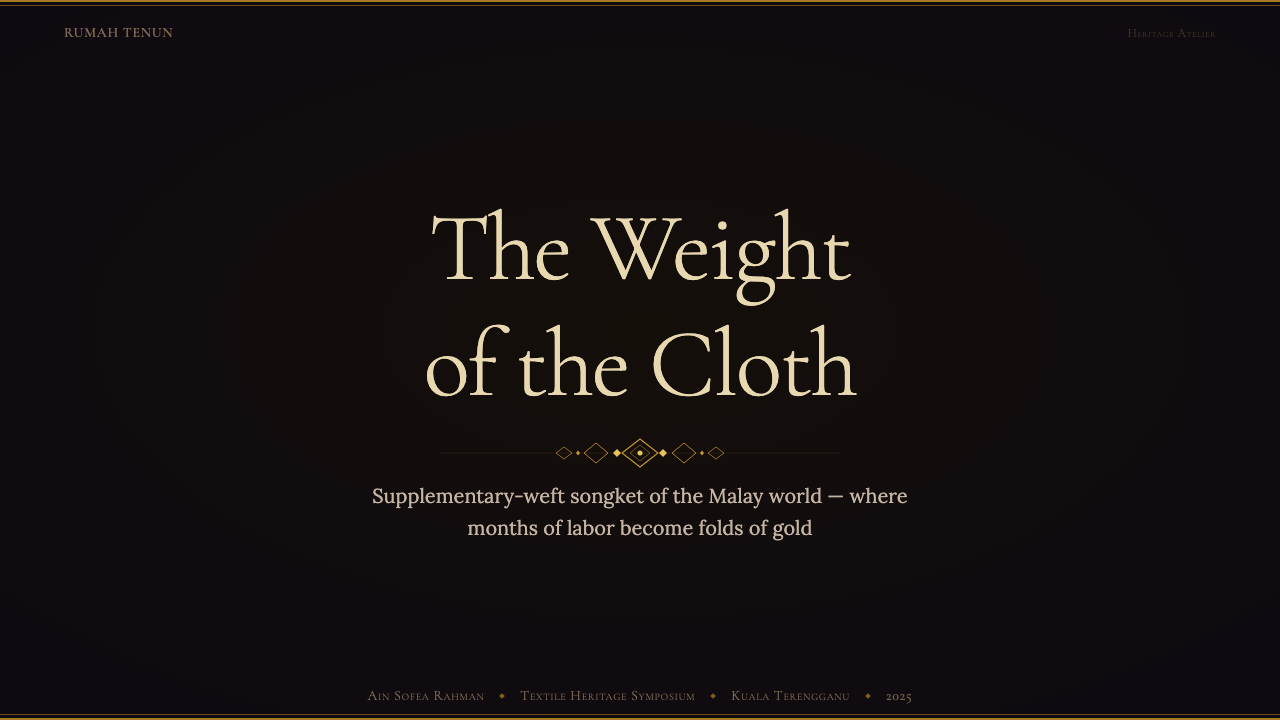
For presentation slides, a songket palette works best on cover pages, section-break pages, and any moment in the presentation where ceremonial weight and occasion-signaling are appropriate. A cover page built from a deep ruby or indigo ground, with a diamond-lattice border band running along the bottom or framing the composition's edges, and a title set in warm near-gold type against the dark field, achieves the right quality of prepared occasion. For content slides, pull back significantly from full ornamental density: carry the deep ground color, retain the gold accent for the most important headings and active data points, but reduce the ornamental layer to a single structural element — a border rule, a heading underline, a section mark — so that the content reads clearly against the ground rather than competing with the pattern. Data visualizations benefit from the style's natural hierarchy: category colors drawn from the jewel-tone palette, with gold reserved for the highest-value or most-important data series.
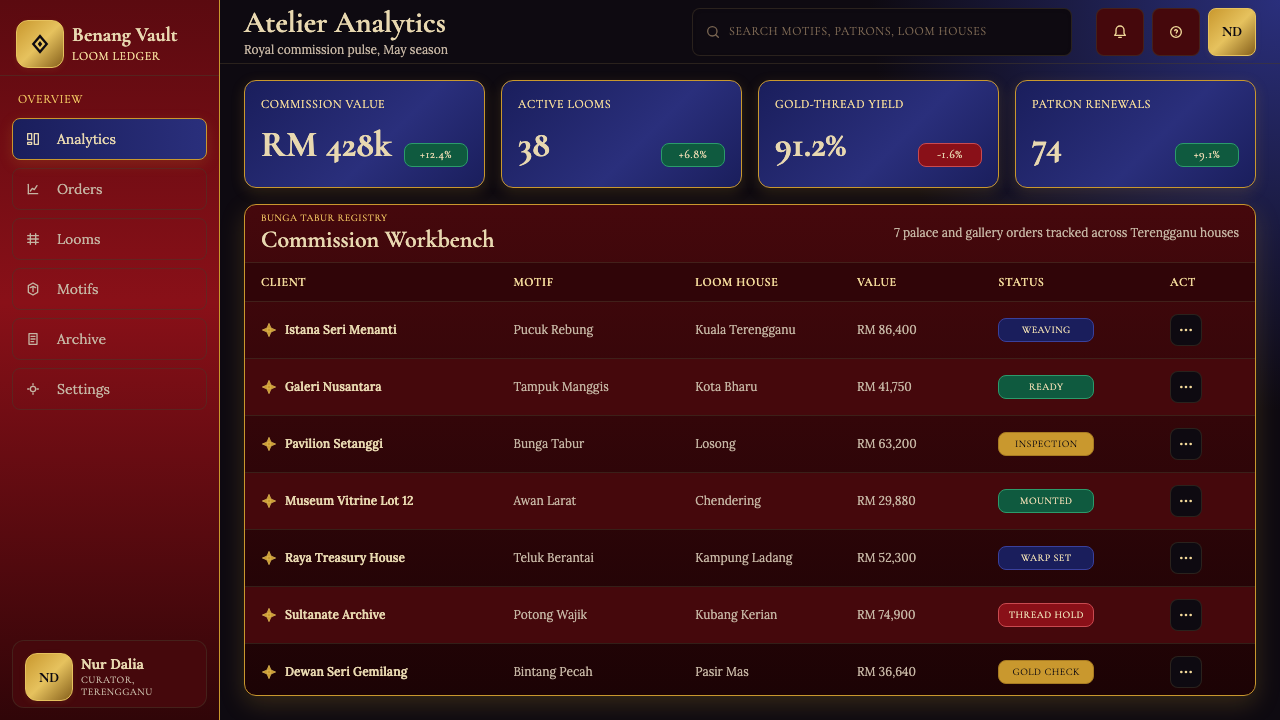
For web interfaces, songket translates most naturally into premium, heritage, and ceremonial product contexts: luxury goods, cultural institutions, government communications, fashion, formal hospitality, and any brand positioning itself as simultaneously rooted in tradition and visually distinguished. The deep ground and gold hierarchy work extremely well for pricing and tier differentiation — the highest-value tier can be marked with a richer ground color and denser gold treatment, making the distinction feel earned through material quality rather than merely labeled through typography. Dashboard interfaces are possible but require more selective application: use the deep ground for the most important panels and reserve lighter treatment for secondary areas, keeping the gold for genuinely interactive or most-important elements.
For editorial and marketing contexts, the songket vocabulary is well suited to campaigns and publications aimed at evoking Southeast Asian heritage, luxury positioning, or the combination of tradition and contemporary sophistication. Full-width section dividers with deep jewel-tone grounds and gold-ruled borders communicate ceremony and considered quality without resorting to generic luxury signaling. The diamond-lattice motif works as a background texture at reduced opacity in editorial layouts — adding the quality of a layered surface without competing with text legibility. Print materials, packaging, event design, and environmental graphics can support the full ornamental weight of the system; digital interfaces require more disciplined selectivity.
The most consistent mistake in adapting songket for digital or screen contexts is treating it as a color palette — picking up the jewel tones and gold accent without internalizing the structural logic of ground, ornament, and hierarchy that gives those colors their meaning. A dark background with gold text is not songket unless the distribution of gold follows a spatial logic equivalent to the supplementary weft's path through the cloth. A second common error is applying ornamental pattern at uniform density across all surfaces simultaneously, so that the page reads as an undifferentiated field of richness rather than a structured space with a clear center and periphery. The system's ceremonial weight works precisely because it is not distributed equally — the most ornamented surface is always the most important one, and the gradient from center to edge, from primary to secondary, must remain legible throughout.
Malaysian Songket (Gold-Thread Weave) — FAQ
How is songket different from batik, and does that distinction matter for design?
Batik and songket are both major Malaysian textile traditions, but they operate through fundamentally different processes and produce different visual logics. Batik is a resist-dye process: wax or paste is applied to cloth to block dye penetration, producing patterns through the interaction of dyed and undyed zones. The result privileges fluid color fields, organic edge quality — the slight irregularity of the wax resist is considered part of the aesthetic — and layered chromatic depth. Songket, by contrast, is a weave-structure pattern: the design is created by the physical path of the supplementary thread through the loom, producing a surface with actual physical relief and a hard, mathematically counted geometry. For design purposes, this distinction is consequential. A batik-derived aesthetic tends toward color fields that flow and bleed, with organic irregularity as a feature. A songket-derived aesthetic tends toward geometric precision, physical depth, and the strict grid logic of a counted weave structure. Conflating the two produces work that captures the richness of neither.
Can songket work effectively in a light or white background context?
It can be adapted, but the result is a fundamentally different visual register — more contemporary craft documentation than courtly textile, closer to a museum catalog label than to the experience of the cloth itself. On a light ground, the jewel-tone and gold vocabulary becomes a set of accent tones rather than a total atmospheric environment, and the style loses its essential quality of embedded, ambient richness. The depth of the dark ground is not incidental to songket's effect — it is the precondition for the gold to behave as warm luminosity rather than as bare yellow. Some contemporary Malaysian designers have explored this light-background inversion deliberately, treating songket motifs as graphic elements on white grounds to produce work that is more accessible and less ceremonially heavy. This is a legitimate reinterpretation. But it should be understood as departing from the style's core register rather than applying it.
What distinguishes authentic songket-inspired design from generic Asian luxury aesthetics?
The difference is structural specificity. Generic luxury design aggregates surface signals: gold tones, dark grounds, vaguely Southeast Asian geometric or floral motifs applied without a coherent underlying logic, and an overall impression of ceremonial richness. Authentic songket-derived design is governed by the logic of a specific weave structure: the diamond lattice has a counted interval logic, not a random scatter; the border registers are structured like the named zones of a textile, not decorative bands added for visual variety; the gold appears where the supplementary weft would physically be, not wherever a highlight looks appealing. The practical test is to ask whether removing the gold ornament reveals a coherent spatial structure — a legible hierarchy of zones, borders, and field — or merely an empty dark rectangle. If the answer is the latter, the design is using songket as surface dressing rather than as a spatial system.
Is it appropriate to use songket-inspired design for brands and contexts outside Malaysia?
Context and intent matter significantly. Songket is a living craft tradition with specific cultural and royal significance in Malaysia — it is not a decommissioned historical style that has passed into the general design vocabulary without cultural weight. Using its visual system in a way that acknowledges its origins, engages with its aesthetic logic at the level of actual structure rather than surface borrowing, and applies it in contexts that share some genuine connection to its cultural domain is more respectful and more aesthetically coherent than simply appropriating its surface appearance for exotic visual effect. Contexts where this typically works without controversy include Southeast Asian heritage brands, luxury products with genuine regional connection, cultural institutions presenting Malaysian or Malay-world content, and design work that explicitly references and contextualizes its source. Contexts requiring more careful consideration include brands with no cultural connection that adopt the style purely for its exotic connotations, and applications that reduce the complex weave-structure logic to surface pattern without understanding what is being borrowed.
How do you handle the songket motifs at screen resolution without losing their textile character?
The most important adaptation principle is proportioning the ornamental motifs relative to the content they frame, not relative to the screen or viewport as a whole. In a length of cloth, the diamond lattice repeat is scaled to the human body — legible at garment scale, not overwhelming at close inspection. The screen equivalent is to ensure that geometric motifs serve as structural frames for content areas rather than as overall wallpaper. A full-viewport tiled songket lattice at full saturation will overwhelm any content placed over it; the same motif reduced in opacity, confined to border zones, or scaled to very large statement elements reads as spatial structure rather than visual noise. The physical quality of the original — the slight relief of raised thread, the directional shift of metallic surface — is best approximated through careful layering and tonal contrast between grounds and surface elements, not through literal emboss effects or texture overlays that look digital rather than textile.
Related design styles
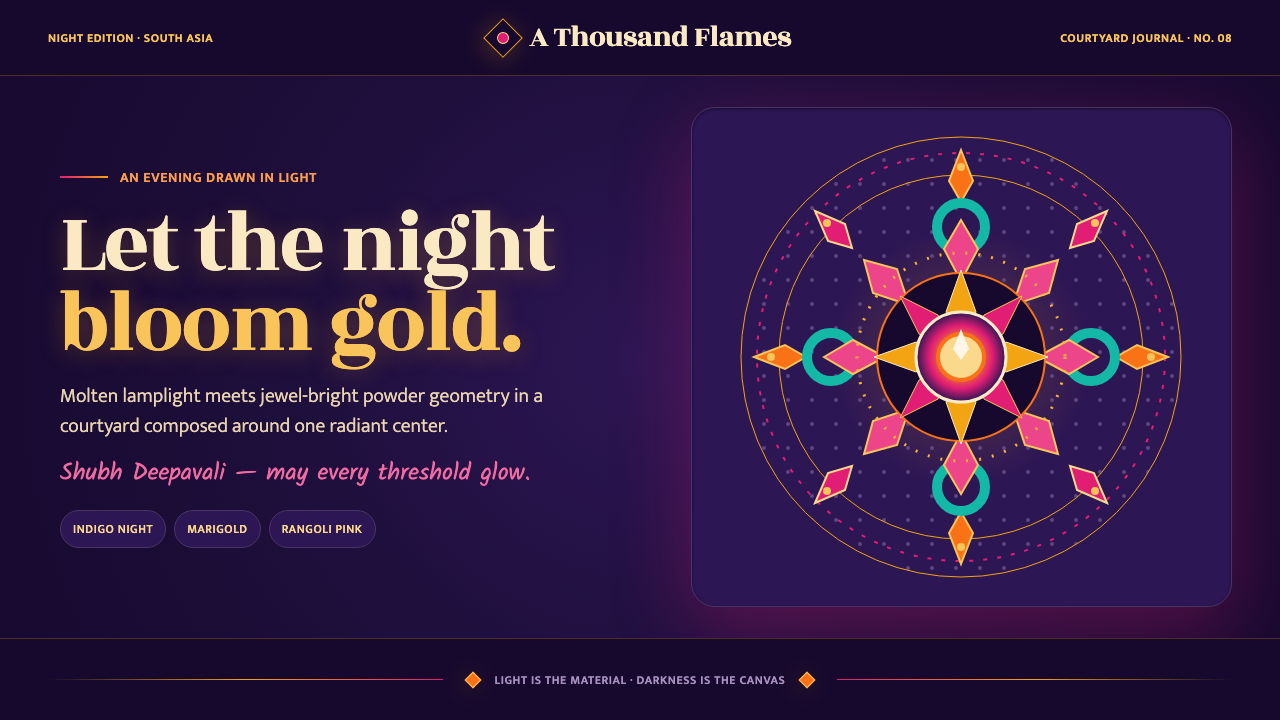 Diwali Festival of LightsNight blooms from within. Molten gold and jewel-bright rangoli radiate across…
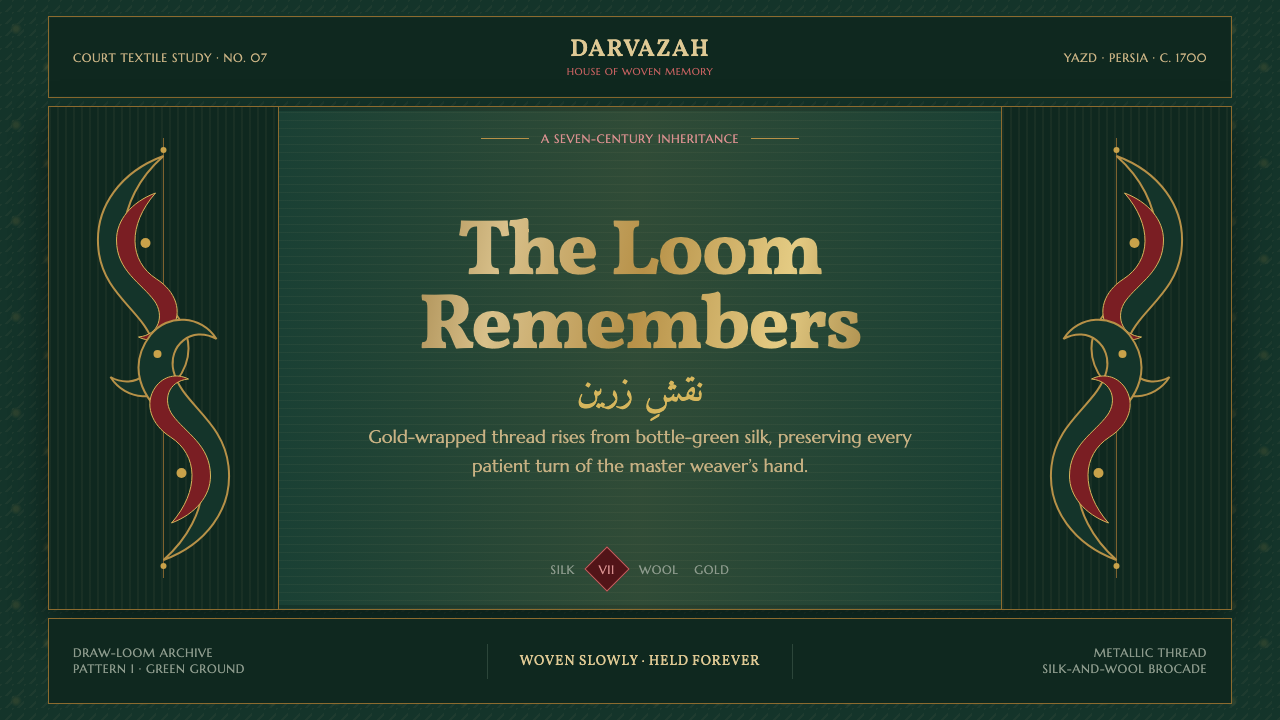 Persian Termeh BotehRoyal brocade, densely alive. Antique-gold boteh climbs across lustrous bottl…
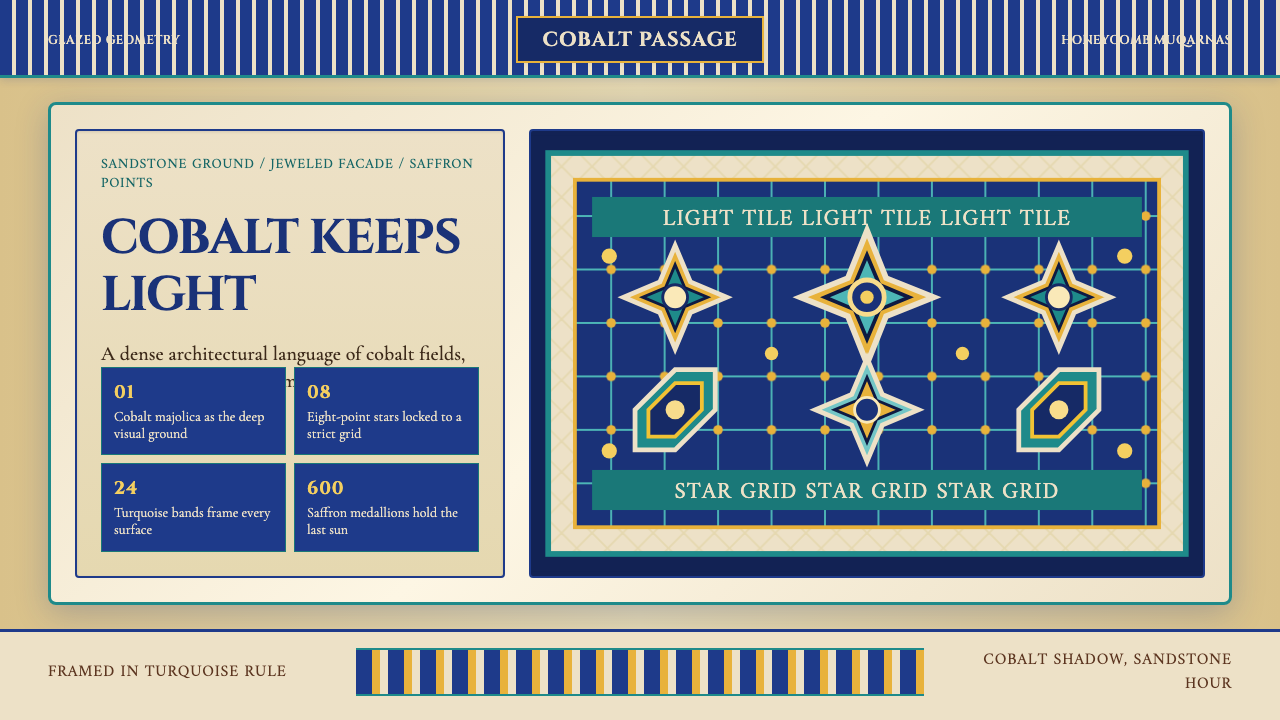 Uzbek Samarkand Shah-i-ZindaOpulent tile memory. Cobalt grids, turquoise bands, and saffron medallions cr…
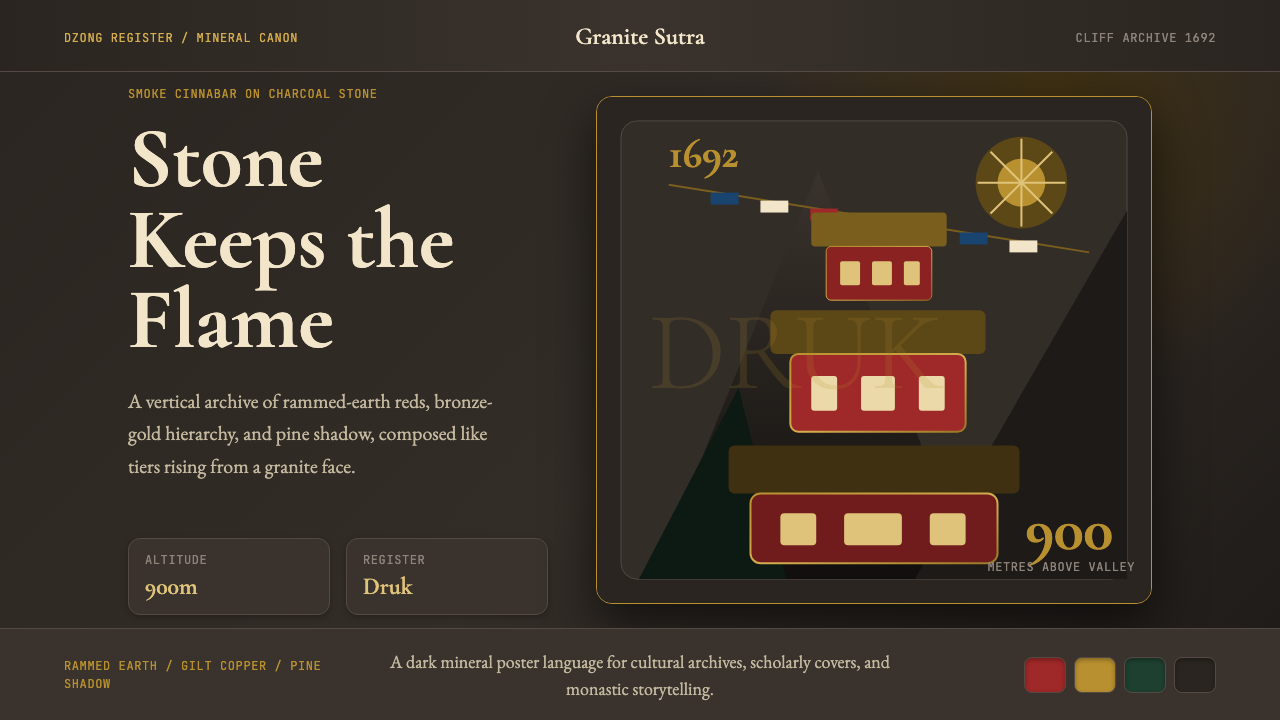 Bhutanese Tiger's Nest Cliff MonasterySacred altitude, mineral-dark. Cinnabar tiers and bronze rules climb charcoal…
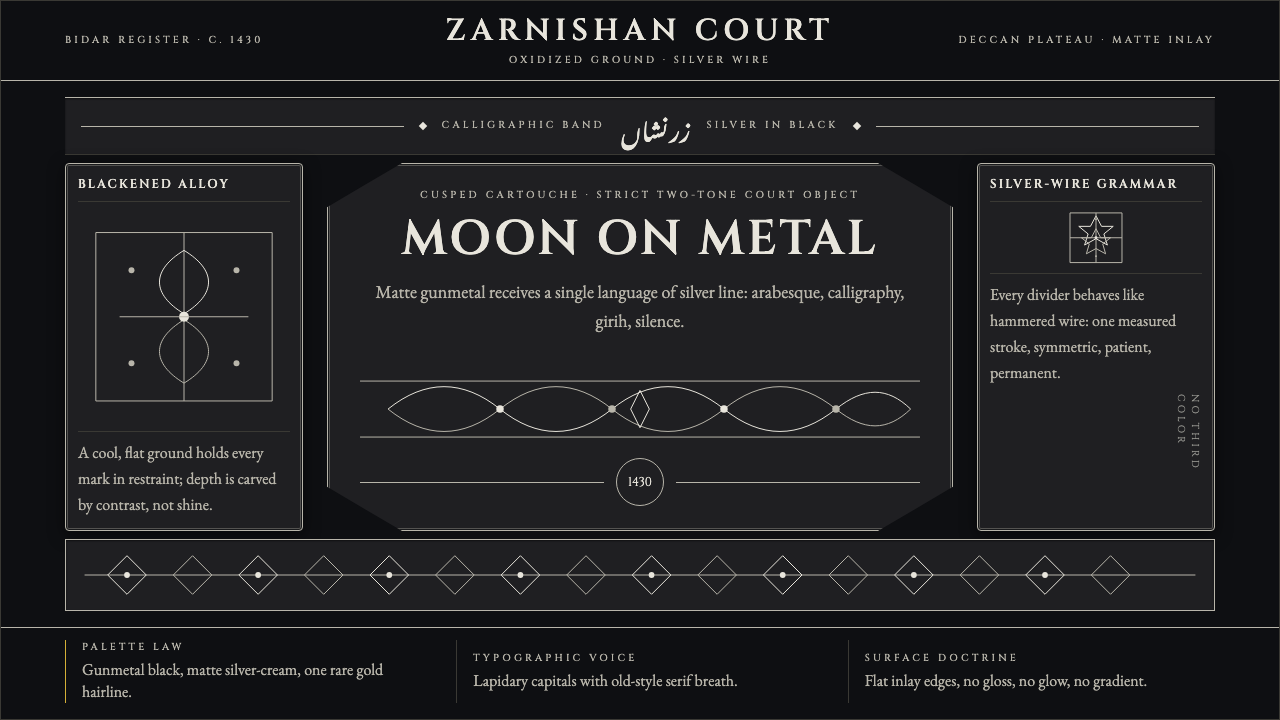 Bidri Deccan MetalworkCourtly darkness, tooled by silver. Cinzel caps and hairline arabesques cut g…
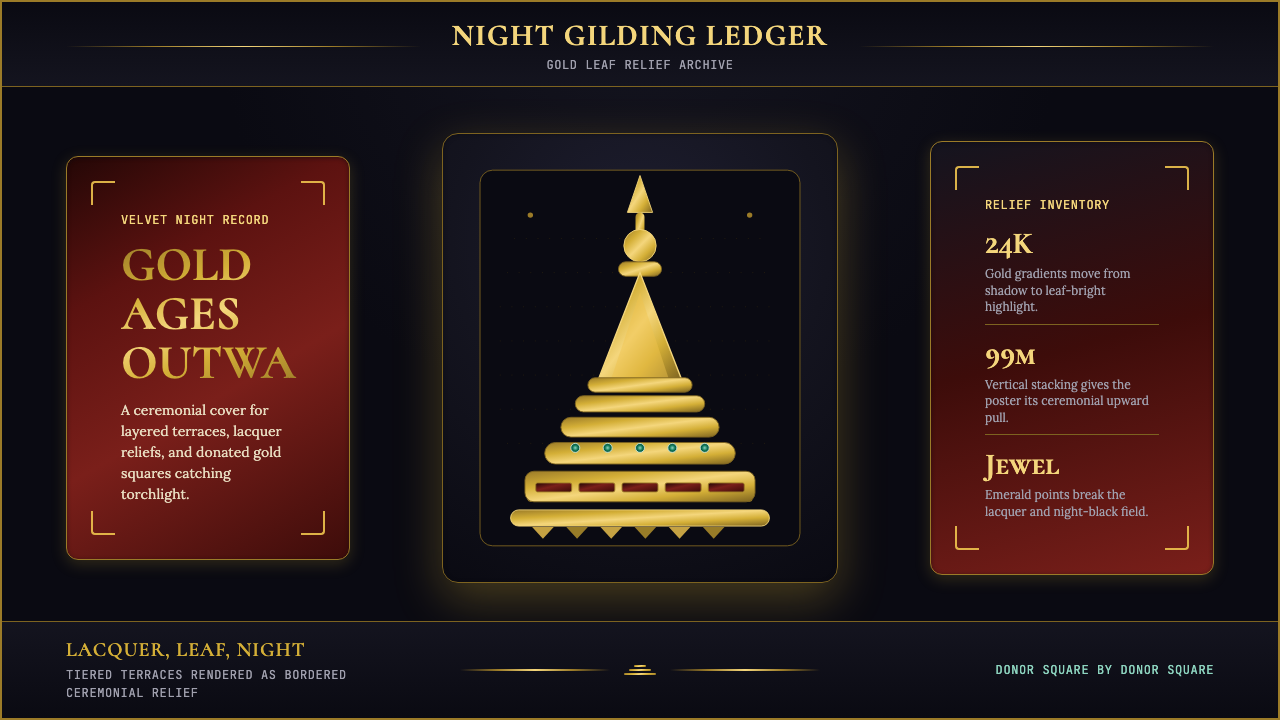 Burmese Shwedagon Stupa ReliefGold refuses restraint. Velvet black, teak-red lacquer, and tiered gradients…