What is Jaipur Pink City Rajasthan?
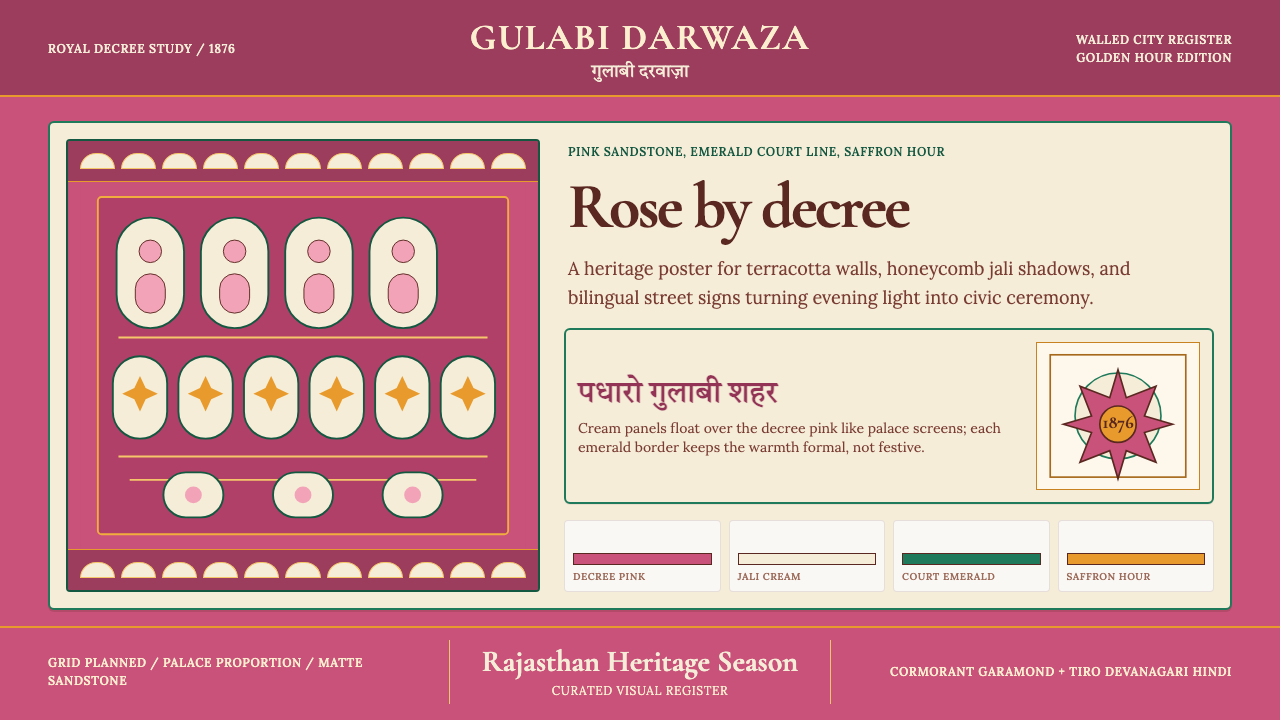
A royal decree in 1876 painted an entire walled city pink overnight — and gave the world its first deliberate urban brand.
Jaipur Pink City Rajasthan in brief
The Jaipur Pink City aesthetic is one of the rare design systems rooted not in a school or movement but in a single royal command. When Maharaja Sawai Ram Singh II ordered the walled city of Jaipur painted in terracotta pink ahead of the 1876 visit of the Prince of Wales, he established a chromatic identity so powerful that more than a century later it still governs every façade within the old city walls — by municipal law. This is a style born from ceremony, maintained by statute, and amplified by modern heritage tourism.
Visually, the system rests on a handful of recurring elements that feel simultaneously ancient and surprisingly contemporary: a warm, dusty pink drawn from local sandstone, lattice screens (jali) in pale cream that filter harsh desert light into geometric shadow patterns, emerald and teal accents borrowed from Rajput court interiors, and saffron moments that echo both festival and devotion. The result is layered in the truest sense — not applied decoration but a visual language that developed organically from climate, craft, and court culture over nearly three centuries.
Applied to modern design contexts, the Jaipur palette carries an unmistakable warmth and cultural authority that purely synthetic palettes cannot replicate. It works because its proportions are already calibrated: the dominant pink is always dusty rather than saturated, the cream lattice is always the mid-tone bridge, and the jewel-toned accents appear sparingly, echoing the way precious stones were used in Rajput miniature painting — as focal points, not fields.

Where does Jaipur Pink City Rajasthan come from?
Jaipur was founded in 1727 by Maharaja Sawai Jai Singh II, a ruler as accomplished in astronomy as in statecraft. Breaking from the hilltop defensive tradition of older Rajput citadels, Jai Singh commissioned the architect Vidyadhar Bhattacharya to design a city on the plains according to the principles of Vastu Shastra, the ancient Hindu system of spatial arrangement. The result was one of the first planned cities in the Indian subcontinent: a grid of nine rectangular sectors (chowkris) organized around a central palace complex, with broad avenues, uniform building heights, and systematic proportions that would have impressed a European Baroque planner. The city's buildings were constructed primarily from the pink-hued sandstone quarried at nearby Khatoo and Jodhpur — the stone itself gave the city its characteristic warmth long before any decree made it official.
The city's original palette was therefore not a design decision in the modern sense but a geological fact. The sandstone used in monuments like the Hawa Mahal (Palace of Winds), completed around 1799 under Sawai Pratap Singh, and the Jantar Mantar observatory complex already gave Jaipur a coherent warm ochre-pink tone. Mughal influence brought with it the refinement of jali screens — intricate lattice panels in white or pale stone, originally developed in Agra and Delhi, which in Jaipur were adapted to the local sandstone vocabulary and deployed on façades to provide shade, ventilation, and visual texture simultaneously. The Hawa Mahal's façade, with its 953 small casement windows behind honeycombed jali screens, remains the most iconic synthesis of these two elements.
The famous pink decree of 1876 is often presented as a simple story — paint the city pink to honor a royal guest — but its implications were more significant. Maharaja Sawai Ram Singh II was a reforming ruler who introduced photography to Rajasthan, established schools for girls, and managed the transition to British suzerainty with considerable political skill. His decision to paint the entire walled city a uniform terracotta pink was simultaneously an act of hospitality (pink being the color of welcome in Rajput tradition), a display of political sophistication (presenting a unified, ordered city to the British Crown's heir), and, in retrospect, an act of early urban branding of remarkable effectiveness. The decree was not temporary; subsequent rulers maintained it, and it became codified in municipal regulation.
The modern identity of Jaipur as the Pink City was further shaped by Maharani Gayatri Devi, wife of Maharaja Sawai Man Singh II, who became one of the most celebrated women in post-independence India and an international fashion icon. Her effortless synthesis of Rajput tradition with mid-century cosmopolitan elegance — receiving guests at City Palace in traditional Rajasthani dress while hosting dignitaries from the Kennedy circle — helped project Jaipur as a place where ancient visual culture and modern sophistication coexisted. The Indian heritage-tourism revival of the 1970s and 1980s, and subsequently the global appetite for artisan craft and 'authentic' travel, transformed Jaipur's chromatic identity from a local regulation into an internationally recognized brand, embedding the Pink City aesthetic into the consciousness of designers, photographers, and travelers worldwide.
What defines the Jaipur Pink City Rajasthan look?
The Terracotta Pink Ground
The defining chromatic note is a warm, dusty pink that sits closer to terracotta than to pastel. It carries the earthy weight of sandstone — slightly muted, never candy-bright, always warm in undertone. This is not a delicate color; it holds its presence under harsh midday sun and glows differently at dawn and dusk. In design applications, it functions as a full-page or large-area ground rather than an accent, because its natural dustiness prevents it from overwhelming the eye. Paired with cream or off-white, it reads as noble and warm; paired with jewel tones, it recedes gracefully to support them.
Jali Lattice Ornament
The jali — an intricate pierced screen of stone or plaster — is the system's most distinctive formal element. Jali patterns are geometric in their underlying logic (grids of stars, octagons, or interlocking diamonds) but organic in their density and visual rhythm, which shifts as light conditions change. In two-dimensional design, the jali motif translates into patterned overlays, card borders, or background textures that suggest depth and craftsmanship without requiring literal reproduction of the architectural form. The defining quality is the interplay between solid and void: neither the filled shapes nor the open spaces dominate; they are in continuous dialogue.
Jewel-Tone Court Accents
Rajput palace interiors — from the Sheesh Mahal (Palace of Mirrors) to the painted haveli chambers of Shekhawati — are saturated with emerald green, deep teal, peacock blue, and rich cobalt, applied in tiles, frescoes, and inlay work. These colors function as focal-point accents against the dominant pink and cream ground: never backgrounds themselves, always small concentrated areas of intensity. In design, this translates to using jewel tones for interactive elements, data highlights, or typographic emphasis — the visual equivalent of a single emerald tile in a pink sandstone wall.
Saffron and Gold Ceremony
Saffron — the warm orange-yellow of marigold garlands, Rajasthani turbans, and Hindu ceremony — appears throughout Jaipur's visual life as a signal of festivity and importance. In the Pink City palette, saffron and its warm golden relatives serve as the highest-emphasis accent: the color used for the most critical call-to-action, the hero moment, or the primary data point that must not be missed. Unlike the steady warmth of the terracotta pink ground, saffron carries energy and urgency. Its restraint is important: overused, it loses its ceremonial authority.
Devanagari and Bilingual Layering
Jaipur's visual environment is inherently bilingual: Devanagari script for Hindi appears alongside Latin script in signage, shop fronts, and official notices throughout the old city. The two scripts have notably different rhythmic qualities — Devanagari's horizontal headline stroke (shirorekha) and vertical letterforms create a dense, woven texture, while Latin letterforms are more open and vertically variable. In design, treating both scripts as equally considered typographic choices — not a translation appended as an afterthought — is central to the Jaipur aesthetic. The interplay of scripts itself becomes a visual texture, echoing the layering of jali patterns.
Warm Shadow and Texture
Unlike design systems that use cool neutral shadows, the Jaipur palette produces shadows with a warm, amber-tinged character — consistent with how late-afternoon Rajasthani light actually behaves, tinting sandstone shadows toward ochre and rust rather than gray. In design applications, depth and elevation are suggested through warm-toned overlays and subtle textural variation rather than cool drop shadows. Card surfaces might carry a faint suggestion of the pitted, hand-applied texture of lime plaster; dividers might have the rough-edged quality of carved sandstone rather than the pixel-precise line of a digital ruler.
Structured Grandeur — Ordered, Not Chaotic
For all its ornamental richness, the Jaipur aesthetic is deeply ordered. Jai Singh II's original city plan imposed a rigorous grid; the uniform pink façades create visual coherence across wildly varied architectural programs; jali patterns, however intricate, are always based on repeating geometric units. This is the crucial distinction between the Pink City aesthetic and merely decorative Rajasthani pastiche: richness of detail is contained within a clear hierarchical structure. Applied to design, this means ornamentation should always serve a layout logic — borders frame content areas, patterns occupy clearly bounded fields, and the eye always has a clear primary object to rest on.

Who shaped Jaipur Pink City Rajasthan?
The founder of Jaipur (1727) and the intellectual force behind its grid-planned layout, Jai Singh II was as much scientist as ruler. His Jantar Mantar observatory complexes — built in five Indian cities, with the Jaipur installation being the largest — demonstrate the same passion for systematic spatial organization that shaped the city's urban plan. The sandstone buildings commissioned under his rule established the material palette and architectural vocabulary that all subsequent Jaipur building would inherit and elaborate.
The maharaja whose 1876 decree transformed the city's identity irreversibly, Ram Singh II was a modernizing ruler who embraced photography, education reform, and public infrastructure alongside his famous aesthetic command. The decree's genius was not the pink itself but its uniformity — by insisting that every building within the walls adopt the same terracotta tone, he achieved a visual coherence that no subsequent individual building decision could undo. His reign represents the moment Jaipur's geological palette became a conscious civic design system.
The Bengali architect and urban planner who translated Sawai Jai Singh II's ambitions into the actual city grid, Bhattacharya applied the principles of Vastu Shastra — the ancient Sanskrit treatise on spatial arrangement — to produce a city plan of exceptional rational clarity. His nine-sector layout, with its differentiated zones for different trades and communities, established the ordering logic that would make Jaipur's visual richness legible rather than chaotic. He represents the tradition of learned, systematic design thinking that underlies what can seem to casual observers like organic urban exuberance.
Maharani of Jaipur and one of the most photographed women of the mid-twentieth century, Gayatri Devi exercised a different kind of design influence: she embodied the Pink City aesthetic for an international audience. Her personal style — Rajasthani textiles in jewel tones, impeccable draping, and an ease with both palace ceremony and cosmopolitan fashion — demonstrated that the Jaipur visual vocabulary could coexist with modernity without condescension in either direction. Her memoirs and the attention she brought to Jaipur were foundational to the city's emergence as a destination for design-conscious global travelers.
Sawai Pratap Singh commissioned the Hawa Mahal in 1799, producing what is now the most reproduced image of Jaipur worldwide. The five-storey façade of 953 small casement windows set within honeycombed jali screens — designed to allow royal women to observe street life while remaining unseen — is also one of the most elegant solutions to a spatial problem in Indian architectural history. The building synthesizes the entire Jaipur aesthetic in a single elevation: terracotta pink sandstone, intricate jali ornament, ordered geometric repetition, and a silhouette dramatic enough to read from a distance against a bright sky.
How do you use Jaipur Pink City Rajasthan today?
The Jaipur Pink City palette is one of the most evocative historical design systems available to contemporary designers, and also one of the most frequently misapplied. Its richness is structural — it emerges from the specific proportional relationships between terracotta pink, cream, jewel-tone accents, and saffron ceremony moments — and superficial borrowing, such as using a bright pink with gold accents and calling it Rajasthani, will read as costume rather than design. Applying the system correctly requires understanding that the pink is always dusty and large-area, the cream is always the bridging mid-tone, and the accents are always small and concentrated.
For presentation slides, the system provides an unusually strong cover-page vocabulary. A full-bleed terracotta pink ground with title type in cream or off-white, a jali-pattern border or corner ornament, and a single saffron accent on a key word or subhead produces a slide that feels ceremonial and authoritative without resorting to stock-photo illustration. Content slides work best on near-white or very pale cream grounds, with the pink and jewel tones reserved for section headers, data callouts, and chart accent colors. Data slides benefit from the palette's natural hierarchy: terracotta for the primary series, emerald or teal for the secondary series, saffron for the highlighted exception — a chromatic encoding that carries emotional weight as well as visual distinction.
For web UI and dashboards, the Jaipur system rewards restraint. The temptation to apply jali patterns as backgrounds or card textures throughout an interface should be resisted; pattern ornament works best as a contained decorative border on hero sections, empty states, or modal headers — areas with enough scale to do justice to the geometric complexity. Dashboard data visualization benefits from the jewel-tone accent family: the range of emerald, teal, cobalt, and peacock blue provides enough chromatic separation to distinguish multiple data series while remaining visually harmonious against cream and off-white grounds. Pricing pages and feature matrices can use the terracotta pink as the highlighted or recommended tier background, creating a warm, inviting emphasis quite unlike the cold blue typically used for this purpose.
For editorial and marketing design, the style excels in contexts that combine heritage authority with contemporary appeal — travel, luxury, craft, food, cultural institutions, and any brand that wishes to signal depth of tradition without appearing antiquated. A marketing hero section in full terracotta pink with cream type and a saffron call-to-action button has the poster-like boldness of a Rajasthani festival announcement. Editorial page layouts work well with the jali motif as a decorative column separator or pull-quote border, with jewel-tone drop caps or section numerals providing focal points within a predominantly warm cream body. The bilingual layering principle — treating multiple scripts as equal visual partners — is particularly valuable for brands operating across South Asian and international markets.
The most common mistake when applying the Jaipur palette is chromatic overload: deploying terracotta pink, saffron, emerald, and teal simultaneously at high saturation produces visual noise rather than Rajasthani richness. Authentic Jaipur design is dominated by the pink and cream ground, with jewel accents appearing sparingly — as single tiles in a sandstone wall, not as a field of competing colors. A second common mistake is using the jali pattern at small scale, where its geometric logic becomes unreadable and it degrades into undifferentiated visual texture. The pattern requires sufficient scale to communicate the interplay of solid and void that is its defining quality. When in doubt, use less pattern and more plain terracotta pink: the ground is always the hero.

Jaipur Pink City Rajasthan — FAQ
Is the Jaipur Pink City palette appropriate for digital products, or is it inherently too 'heritage' in feel?
The palette is entirely appropriate for digital products, but it works best when the product itself benefits from associations of warmth, cultural depth, and crafted quality. Travel platforms, hospitality products, artisan marketplaces, food and beverage brands, and cultural institutions are natural fits. The risk of feeling 'too heritage' typically arises from applying the jali ornament too literally or the terracotta pink at too high a saturation — both choices pull the design toward tourism-brochure pastiche. Used with restraint — dusty pink as a ground, cream as a primary text surface, jewel tones as data or interaction accents — the palette reads as warm and distinctive rather than dated.
How does the Jaipur palette differ from other South Asian or Indian regional design traditions?
Indian visual culture is extraordinarily diverse, and Jaipur's Pink City aesthetic is specifically Rajput-Mughal hybrid in its formal vocabulary — not representative of Indian design broadly. Key distinctions: the terracotta-pink sandstone ground is characteristic of Rajasthan's geology and is not shared by, say, the whitewashed architecture of coastal Kerala or the wooden haveli carving traditions of Gujarat. The jali lattice is also specifically Mughal-influenced (it was refined under the Mughal emperors and adapted across North India), distinguishing it from Southern Indian temple ornament or Bengal's terracotta temple panels. The Pink City is a specific, historically documented aesthetic tied to a specific city, a specific political moment, and specific material conditions.
Can the Jaipur system work in dark-mode interfaces?
It can, but dark mode inverts the palette's natural logic in ways that require careful management. The historic Jaipur environment is fundamentally light: sandstone surfaces are pale, the sky is bright and harsh, and the jewel tones appear as concentrated points of color within a warm-light field. A dark inversion replaces this with a deep warm brown or charcoal ground — closer to the interior of a Rajput palace at night than to the exterior city. In this context, the jewel tones (emerald, teal, cobalt) can serve as primary surface accents, the cream becomes a type and highlight color, and the terracotta pink works as a mid-tone or accent rather than the dominant ground. Saffron remains effective as the highest-emphasis signal. The result reads as richer and more intimate than the light version — palace interior rather than sunny bazaar.
How literally should jali patterns be reproduced, and when does ornament become excessive?
Jali ornament functions as a controlled zone of complexity within a largely calm layout — the same role it plays architecturally, where it frames a window opening rather than covering an entire wall. In design, literal reproduction of a specific historical jali pattern (photographed or digitized from an actual screen) is more authentic and interesting than a generic 'lattice' pattern, but even a literal reproduction must be confined to a clearly bounded area. The ornament becomes excessive when it competes with content for attention — when a user's eye has to work to locate the type or data within the visual noise of a dense pattern. A reliable rule: if the jali pattern is visible but the content remains clearly primary, the balance is correct. If the pattern is the first thing the eye goes to, it has been applied too broadly or at too prominent a scale.
Is the Pink City style suited to brands that have no connection to India or Rajasthan?
The Pink City aesthetic, like all historically specific styles, carries cultural associations that a designer should engage with honestly. Used thoughtfully — where the warmth, the sense of ceremony, and the layered ornamental richness serve a genuine product purpose — the style can be appropriate for brands outside India, just as Bauhaus or Art Deco are legitimately applied in contexts far from their origins. The test is whether the style is chosen for structural reasons (its proportions, its warmth, its authority) or merely for exotic novelty. Superficial application — a logo with a generic 'Indian' lotus and a random saffron-pink gradient — is not engagement with the Pink City aesthetic at all; it is borrowed imagery without understanding. Designers should ask whether the system's values (warmth, ceremony, ordered richness) align with the product's values, not whether the product has a geographic link to Rajasthan.
Related design styles
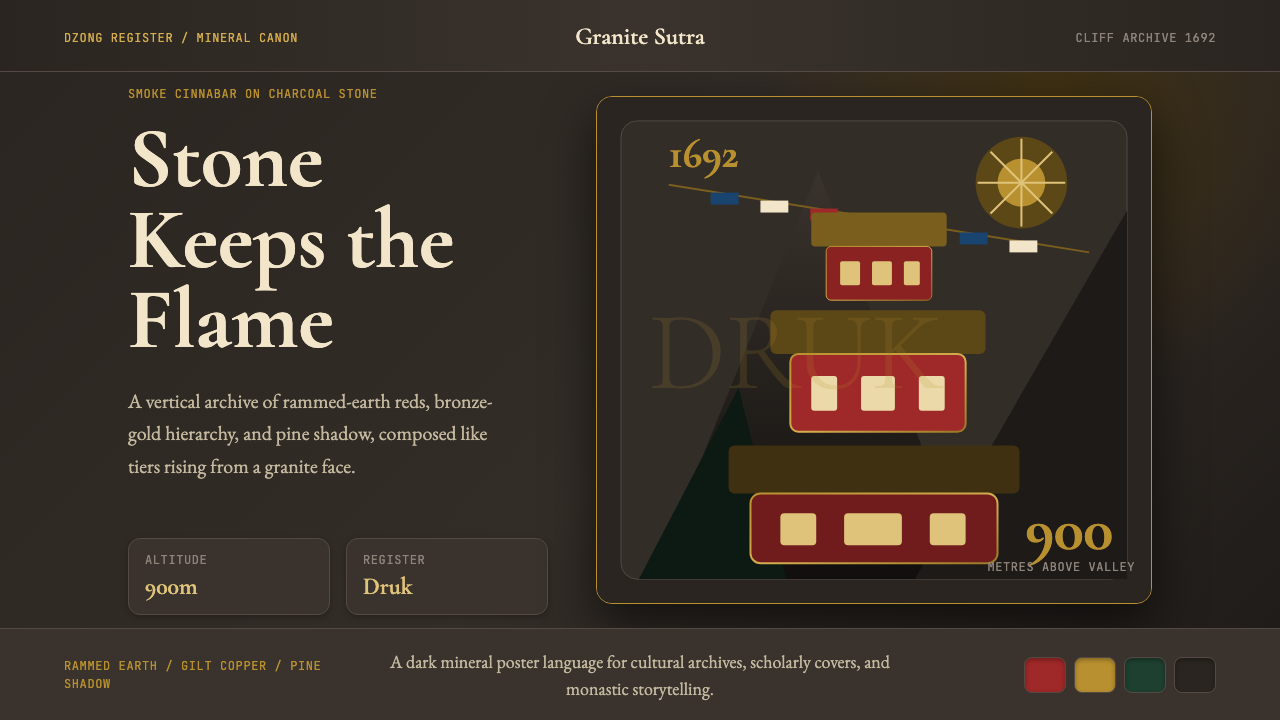 Bhutanese Tiger's Nest Cliff MonasterySacred altitude, mineral-dark. Cinnabar tiers and bronze rules climb charcoal…
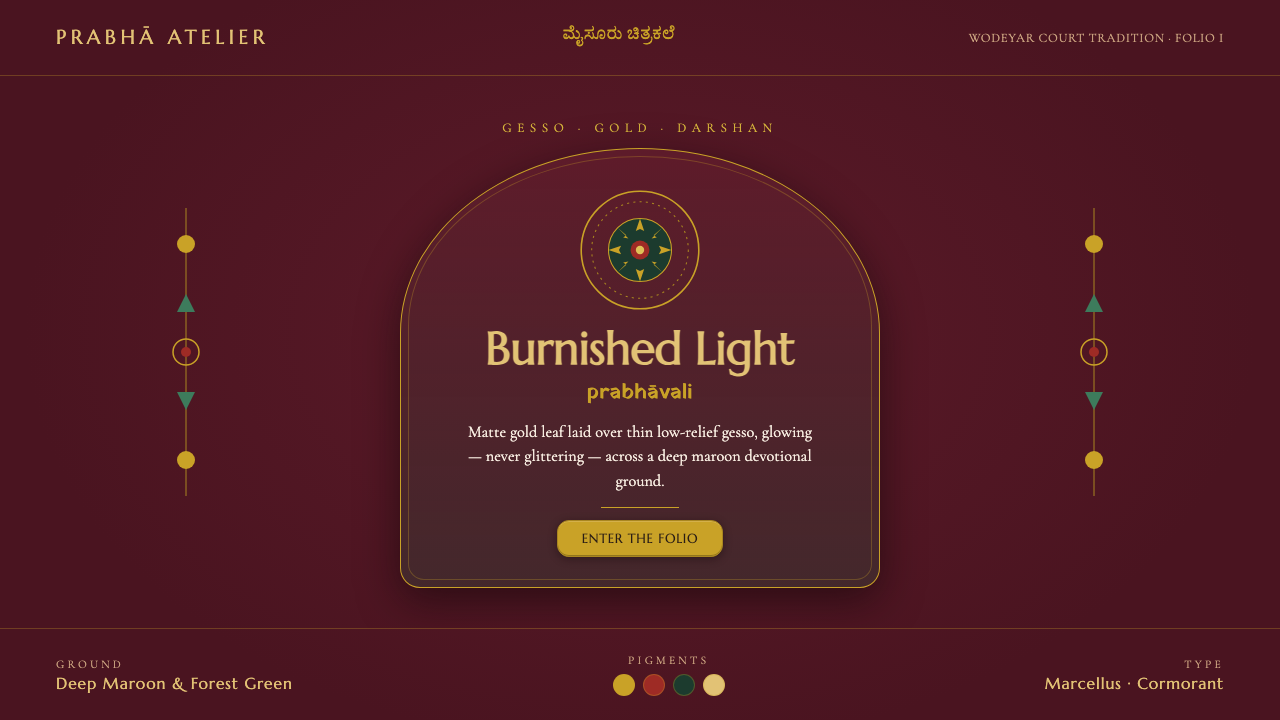 Mysore Gesso Gold PaintingGold that glows, never glitters. Matte burnished leaf over gesso on deep maro…
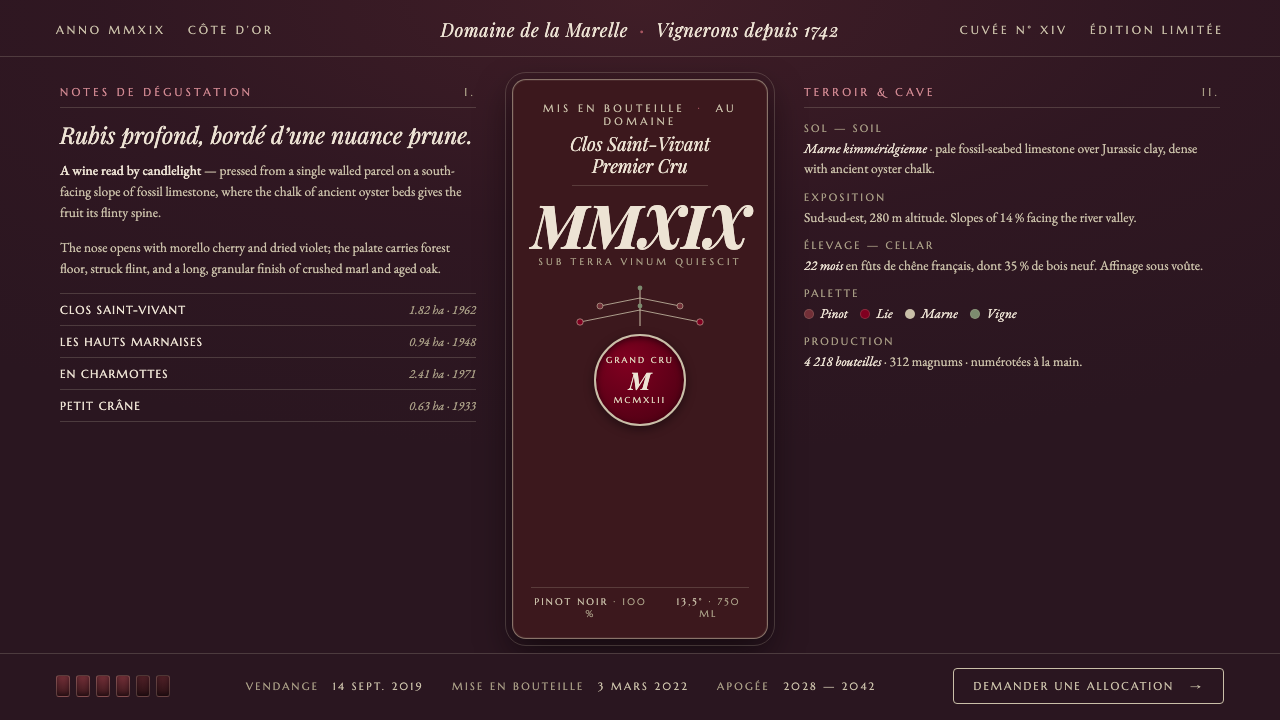 Burgundy VineyardRead by candlelight in a wine-lees cellar. Aged purple-red Pinot on near-blac…
 Hanukkah MenorahEight nights kindled in tekhelet. Royal blue and silver hold the dark room; g…
 Persian Nastaliq CalligraphyGold script breathes in darkness. Afshan flecks, lapis cartouches, and sloped…
 Andhra Cheriyal Scroll PaintingSaturated oral memory. Mineral red registers, mustard diamonds, and serif son…