What is Bulgarian Kazanlak Rose Valley?
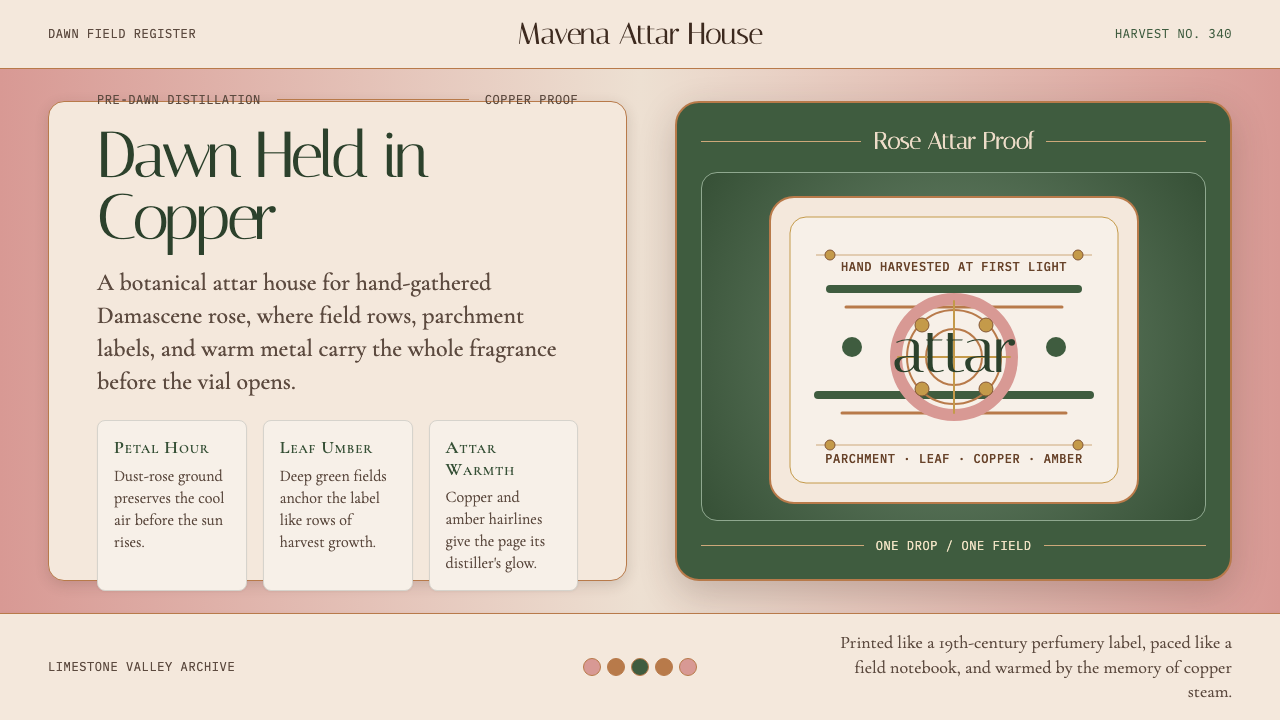
From Ottoman-era copper alembics to the perfume counters of Paris, the Kazanlak Rose Valley produced a visual language as layered as attar itself — dust-rose fields, deep leaf-green, and the warm gleam of distillery brass.
Bulgarian Kazanlak Rose Valley in brief
The Bulgarian Kazanlak Rose Valley design aesthetic draws on three centuries of rose-attar culture in central Bulgaria's Thracian Plain. It is a style rooted in the sensory world of pre-dawn harvest — the cool grey of limestone walls before sunrise, the dusty blush of opened Rosa damascena petals, the deep forest green of rose-leaf foliage, and the amber warmth of copper still-pots condensing steam into oil. These are not arbitrary colors; they are the colors of a specific agricultural moment, and the design language treats them with the same care a perfumer reserves for its source materials.
Unlike design aesthetics that arrive fully formed from a single movement or school, the Kazanlak Rose style is the product of layered historical sediment: Ottoman horticultural practice, nineteenth-century botanical illustration, the label typography of European perfumery houses, and the folk-craft traditions of Bulgarian hand-weavers and embroiderers. The result is an aesthetic that feels at once archival and organic — simultaneously a scientific record and a sensory experience.
Typography within this aesthetic borrows from apothecary elegance and distiller's notebooks. Headline faces carry the upright authority of a nineteenth-century botanical label — formal without stiffness — while body text reads as running field notes, intimate and precise. Small capitals and generous letter-spacing recall the traditional layout of perfume labels where every gram of attar is accounted for with the same gravity as gold.
Where does Bulgarian Kazanlak Rose Valley come from?
The history of rose cultivation in the Kazanlak region begins with Ottoman expansion into the Balkans in the late seventeenth century. Around the 1680s, Turkish planters introduced Rosa damascena — the Damask rose, prized for its exceptionally high oil content — to the limestone-fed valleys between the Balkan Mountains to the north and the Sredna Gora range to the south. The geology mattered: the thin, well-drained limestone soils, combined with the microclimate created by the mountain ranges on either side, produced rose petals with an attar yield far exceeding what could be achieved in the original Syrian cultivation zones. By the early nineteenth century, Kazanlak had become the world's principal source of rose oil.
The peak of the Bulgarian rose industry came in the period from roughly 1820 through the late nineteenth century, when Ottoman merchants and later independent Bulgarian traders controlled most of the global supply of rose attar shipped to Paris, London, Vienna, and Istanbul. The copper alembic distilleries that filled the valley's farmyards during May and June were the engine of the economy, and their visual culture — the amber condensation vessels, the hand-written weight ledgers, the botanical labels in Cyrillic and Ottoman script — became the raw material from which the region's design vocabulary would eventually be distilled.
Bulgarian independence in 1878 and the subsequent modernization of the rose industry brought new forms of visual documentation: botanical surveys commissioned by the Bulgarian Agricultural Ministry, illustrated catalogs produced by the growing perfumery export trade, and festival posters for the Kazanlak Rose Festival that began formalizing in the 1930s. Each of these layers added to the visual archive that designers working in this style draw on today. Key figures who helped shape both the cultural and commercial identity of the Kazanlak rose include Hristo Damyanov, who worked to systematize attar production in the mid-nineteenth century, and Petar Hadzhinikolov, whose accounts of the valley's economy and trade routes document the period of maximum commercial importance.
The modern Rose Festival — held annually in Kazanlak in late May or early June — has itself become a design tradition. Festival graphics across the decades have accumulated into a visual archive that blends folk-embroidery motifs, botanical exactitude, and the commercial language of perfumery into a coherent regional identity. The historian and novelist Vera Mutafchieva, who documented Bulgarian social and material culture across her career, helped frame the rose industry not merely as agricultural history but as a carrier of national cultural meaning — a framing that continues to inform how designers approach this aesthetic.
What defines the Bulgarian Kazanlak Rose Valley look?
Color Palette
The palette centers on three interlocking tones drawn directly from the rose harvest. Dust-rose — the muted, slightly greyed pink of a Damask rose petal opened at dawn — serves as the dominant ground. Deep rose-leaf green, closer to the undersurface of the leaf than to fresh spring foliage, anchors the major surface areas. Copper-warm amber, the color of heated attar in a glass condensation vessel, provides the accent that unifies the palette's warmth. Supporting tones are drawn from the valley itself: the off-white of limestone walls, the soft grey-beige of morning mist, and the near-black of distillery wood ash. No color in this palette is saturated to full intensity; every tone carries some dust, some warmth, some memory of age.
Typography
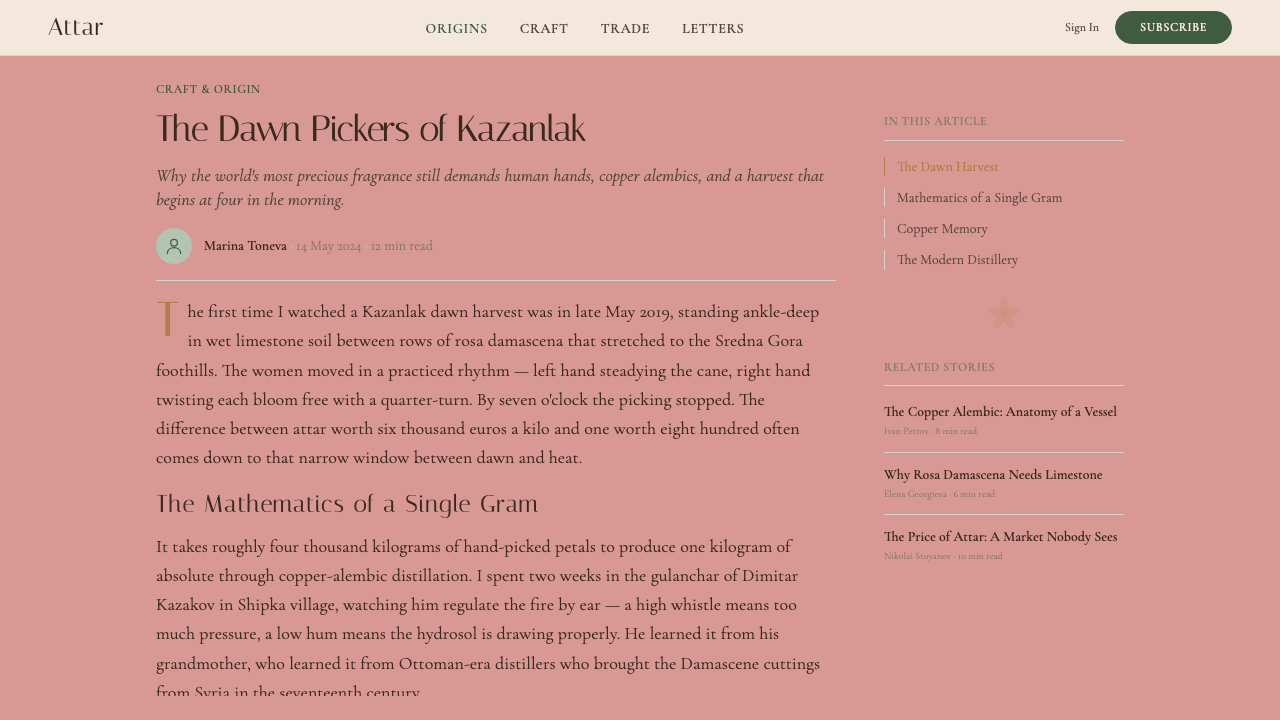
The typographic identity sits in the tradition of nineteenth-century apothecary and botanical label design. Display headlines use upright, high-contrast typefaces with fine hairlines and pronounced thick-thin strokes that recall the labeling conventions of European perfumery houses — authoritative and legible at a distance, yet richly detailed up close. Body text is set in a classical roman with old-style figures, at a comfortable measure that rewards reading rather than scanning. Small capitals appear frequently in subheadings and attributions, set with wider-than-standard spacing, evoking the weight and ceremony of a botanical classification. All-caps settings are used sparingly, and when they appear, letter-spacing is wide enough to treat each letter as an individual object.
Surface and Texture
Where most digital design aesthetics trend toward either pure flatness or highly simulated depth, the Kazanlak Rose style occupies a middle ground that might be called archival texture. Backgrounds carry a faint quality suggesting aged paper, pressed botanical specimens, or the slightly rough surface of handmade label stock — not a digital noise effect, but an impression of physical substrate without explicit simulation. Copper and brass elements have a warm, slightly matte sheen that reads as metallic through tone and highlight placement rather than through any literal reflection map. This restraint keeps the aesthetic from tipping into steampunk pastiche.
Ornamental Language
Unlike stripped-down modernist aesthetics, the Kazanlak Rose style permits — and indeed requires — a restrained use of botanical ornament. Thin-line botanical engravings of Rosa damascena branches, single blooms, and leaf clusters serve as border elements, dividers, and background motifs. Geometric frames derived from Bulgarian folk embroidery — particularly the repeating diamond and cross-stitch patterns of traditional aprons and tablecloths — appear at a scale small enough to read as texture rather than decoration. These elements are always rendered in a tonal variation of the surrounding field rather than in a contrasting color, keeping them subordinate to the typographic hierarchy.
Composition and Layout
Layouts in this style favor a centered symmetry that recalls both the label design of European perfumery and the formal organization of botanical journal plates. The primary reading axis is vertical, with headline, subheadline, body text, and attribution stacked in deliberate sequence. Margins are generous — wide enough to accommodate botanical borders and to give each central element a sense of ceremonial isolation. Asymmetric elements, when they appear, are confined to accent positions: a copper ornament off-axis left, a small botanical spray in a lower corner. The overall effect is that of a designed object meant to be held and read closely, not scanned at a glance.
Light and Shadow
The lighting logic of this aesthetic is diffuse and warm rather than harsh or directional. Shadows, where they appear, are soft and low-contrast — the shadow of a copper vessel in morning light, not the sharp cast shadow of noon. Drop shadows on card elements are warm-toned and spread generously, suggesting ambient light from a window rather than an overhead source. This warmth is the opposite of the cold, neutral drop shadows common in contemporary UI design. The effect reads as physical, aged, and inviting — as if the interface were illuminated by the same early-morning light under which the rose petals are harvested.
Material Evocation
Every visual decision in this style alludes to a physical material without literally simulating it. The dust-rose ground evokes petal rather than representing it; the deep green surface calls to mind leaf without depicting one; the copper accent suggests the alembic without rendering it. This allusion-without-depiction is the style's most demanding quality and its most important discipline. The moment any element becomes literal — a photographic rose, a rendered copper pot — the aesthetic tips from evocative to illustrative, and the tension that gives the style its depth dissolves.
Who shaped Bulgarian Kazanlak Rose Valley?
A mid-nineteenth century figure closely associated with the systematization of rose-attar production in the Kazanlak valley. Damyanov worked to establish consistent distillation practices at a moment when the Bulgarian rose industry was expanding rapidly to meet European demand, helping to transform what had been a craft-scale operation into something approaching an organized industry. His name is associated with the period in which the visual culture of the trade — its labeling, packaging, and presentation — first began to consolidate into recognizable conventions.
A chronicler of the Kazanlak region's economic and cultural life whose accounts of rose-valley trade routes and market relationships provide the most detailed documentary record of the industry at its height. Hadzhinikolov's writings describe the physical culture of rose production — the tools, the vessels, the schedules, the smells — with an attention to material detail that has made his work an invaluable source for both historians and designers seeking to ground their visual work in the sensory reality of the original context.
Bulgarian historian and novelist whose scholarly and literary work reframed the rose-valley culture not merely as agricultural or commercial history but as a carrier of Bulgarian national identity across periods of Ottoman rule, liberation, and modernization. Mutafchieva's contribution to the design aesthetic is indirect but real: by insisting on the cultural and emotional weight of material practices — the rose harvest, the distillery, the festival — her writing helped establish the interpretive framework within which contemporary designers approach this visual tradition with seriousness rather than nostalgia.
More tradition than individual, the Kazanlak Rose Festival has been an annual event since the early twentieth century, formalized in its modern form in the 1930s. Its festival posters, procession imagery, and printed ephemera constitute the primary design archive from which the contemporary aesthetic is assembled. Across nearly a century of festival graphics, certain visual decisions recurred consistently enough to constitute a grammar: the centering of Rosa damascena as the dominant motif, the combination of botanical and folk-embroidery elements, the use of warm metallic accents against floral ground colors. The festival's visual archive is, in effect, the style's design system.
Not a human figure but the biological fact at the center of the entire aesthetic. The Damask rose — brought to the Balkans from Syria via Ottoman trade routes — produces petals with an oil content and fragrance profile unlike any other cultivar. Its visual form, a dense, multi-layered bloom of muted, dusty pink set against dark green serrated leaves, directly generated the palette and compositional conventions of the Kazanlak style. Understanding the design system requires understanding the plant: its dawn-flowering habit (which dictated the harvest schedule and thus the culture of early-morning work and light), its color under different conditions of dew and sun, and its transformation from fresh petal to distilled essence.
How do you use Bulgarian Kazanlak Rose Valley today?
The Bulgarian Kazanlak Rose Valley aesthetic is best deployed when a design project needs to communicate sensory richness, artisanal authenticity, and a kind of quiet heritage authority — without resorting to the visual clichés of either generic 'vintage' or generic 'luxury.' It is a style that rewards careful application and punishes careless borrowing: the dust-rose and leaf-green palette looks considered when all elements are tonally consistent, but immediately dated when mixed with contemporary high-saturation palettes or default sans-serif typefaces.
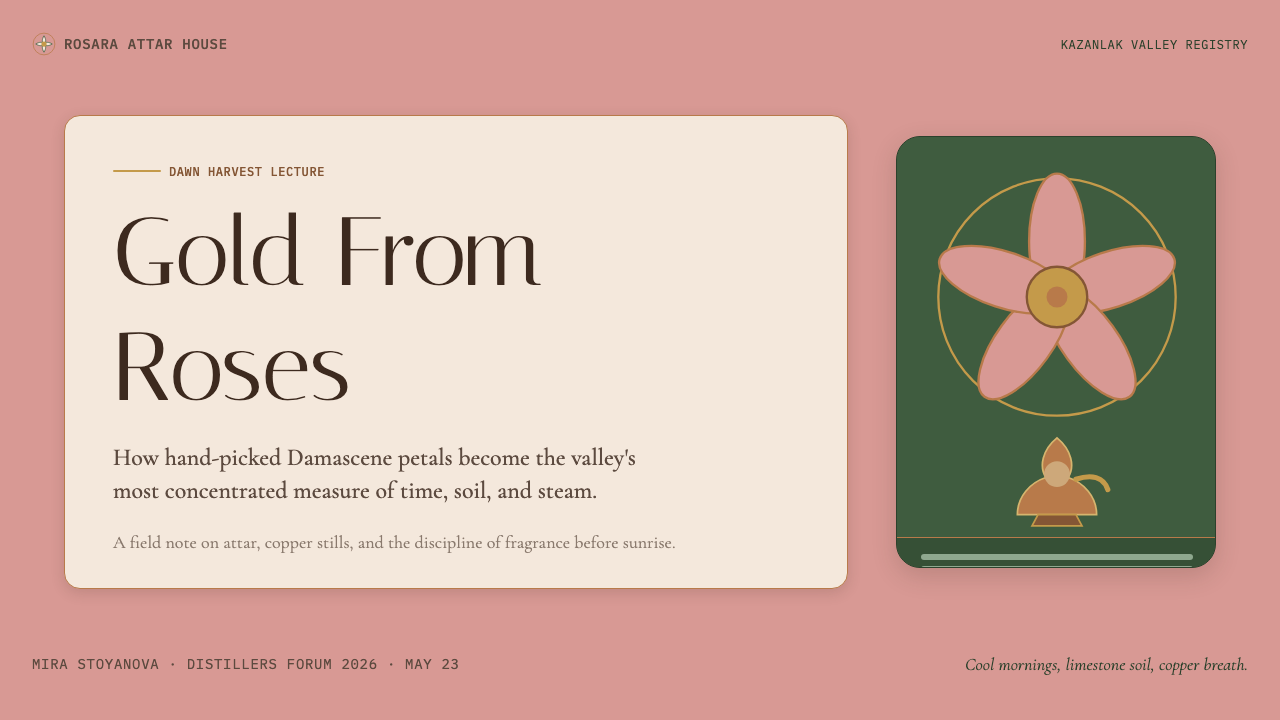
For presentation slides, this style works with unusual effectiveness on both cover pages and content pages that need to communicate expertise and care. A cover benefits from the centered, symmetrical composition borrowed from perfumery label design: the title set in a high-contrast display face at the center, framed above and below by thin botanical borders in a tonal variation of the ground color, with a copper-warm accent used only for the most important name or date. Content slides should carry the wide margins and vertical reading axis into the interior: one idea per slide, headline in the display face, body in the classical roman, with section breaks marked by a thin ornamental rule rather than a geometric divider.
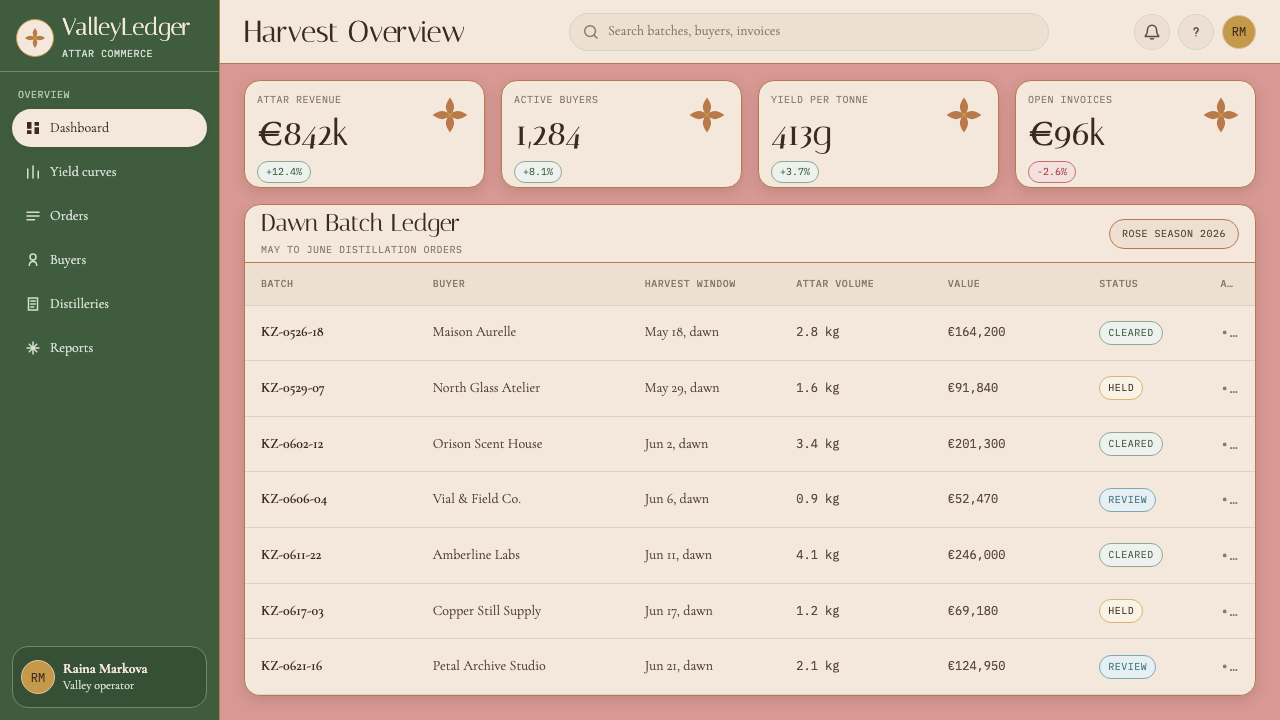
For web interfaces, this palette and typographic approach is particularly effective for products in the premium goods, wellness, botanical, hospitality, and cultural heritage sectors. Dashboard and pricing page layouts should use the centered vertical axis for the primary call-to-action hierarchy, with generous whitespace treating each tier card as an isolated object — the way a perfume bottle sits alone on a shelf — rather than a member of a grid. Navigation should be typographic, with the display face used for section names and the classical roman for secondary labels. Data visualization, where needed, should use the three core palette colors as distinct encoding channels, with the copper accent reserved for the most critical metric.
For editorial and marketing work, the style's strongest application is in brand identity systems for products with genuine artisanal or heritage provenance — where the visual language can be grounded in the product's actual material culture rather than borrowed as decoration. In this context, the botanical ornament and symmetrical label-derived layouts work not as nostalgia but as an accurate signal of the product's values. Marketing materials in this style benefit from restraint in color application: the dust-rose ground should dominate, with deep green used for the secondary structural areas, and copper reserved for the single most important element on any given surface.
A common mistake when working with this aesthetic is over-literalizing it — adding photographic roses, explicit copper textures, or decorative flourishes beyond what the restrained botanical engraving tradition supports. The style's power comes from evocation, not illustration. A dust-rose background already smells of petals; adding a rose photograph destroys the evocative quality by converting it into decoration. Similarly, mixing warm metallic elements from other traditions — gold leaf effects, Art Nouveau flowing lines — undermines the specific historical coherence that gives the style its authority. The botanical engraving and the folk-embroidery frame must remain the only sources of ornament, rendered at tonal rather than chromatic contrast.
Bulgarian Kazanlak Rose Valley — FAQ
Is this style too niche for a modern digital product?
The style is historically specific but not limiting when applied correctly. What makes it niche is also what makes it distinctive: in a digital landscape saturated with neutral-palette minimalism and high-saturation gradient aesthetics, the dusty warmth and botanical authority of the Kazanlak Rose vocabulary signals a very specific set of values — heritage, sensory care, artisanal quality — without stating them explicitly. Products in the premium food, beauty, wellness, hospitality, and cultural heritage categories can benefit directly from this specificity. Outside those categories, the aesthetic can still function if the brand narrative has a genuine connection to handcraft, natural materials, or historical depth. What it cannot do is serve as a neutral container for any content: the style makes claims, and those claims need to be true of the product.
How do you handle dark-mode versions of this aesthetic?
A dark inversion of the Kazanlak Rose palette is workable but requires careful recalibration. The strategy is not to simply invert the ground color but to shift the reference point from pre-dawn light to the interior of a nineteenth-century distillery at night: deep charcoal walls, the warm amber glow of oil lanterns on copper vessels, and the deep green of foliage reduced to shadow. In practice, this means using a very dark, warm-toned charcoal (not cold grey, and not pure black) as the ground, maintaining the copper accent as a warm highlight, and using the muted dust-rose as a secondary accent rather than the dominant surface. The leaf green becomes even deeper, reading more as shadow than color. The critical discipline is maintaining the palette's warmth: a cold dark mode is a different aesthetic entirely.
What distinguishes this style from generic 'vintage botanical' design?
Generic vintage botanical design borrows the surface elements of nineteenth-century scientific illustration — detailed engraved line drawings, aged paper textures, muted palettes — without the cultural and material specificity that gives those elements meaning. The Kazanlak Rose aesthetic is grounded in a particular geography, a particular plant, a particular industry, and a particular moment in commercial and craft history. This specificity shows in the palette (which is derived from the actual colors of the rose harvest, not from a general vintage warmth), in the typographic references (which point to perfumery labels and botanical journals from the Bulgarian and Ottoman traditions, not to a generic 'old print' look), and in the ornamental language (which combines Bulgarian folk embroidery with botanical engraving rather than using generic Victorian flourishes). Specificity is the antidote to pastiche.
Can this style work for a technology product?
It can, but with significant adaptation. Technology products that have a genuine story about natural materials, artisanal data curation, or deep heritage (botanical databases, agricultural technology, fragrance AI tools, cultural preservation platforms) can leverage the style's authority and warmth with credibility. Products without that narrative connection risk creating a visual disjunction between aesthetic and product promise — the warm botanical language signals handcraft and slowness, which is the opposite signal of most technology positioning. The adaptation that works best is using the palette and typographic system while abandoning the botanical ornament in favor of the cleanest possible layout: the color temperature and typeface family carry the aesthetic signal without the decorative elements that would feel incongruous in a purely digital product context.
How should data and charts be handled within this aesthetic?
Data visualization within the Kazanlak Rose aesthetic should treat charts and graphs as botanical specimens rather than as geometric abstractions. This means using the three core palette tones as the primary encoding channels, with values mapped to the warmth spectrum from leaf-green (coolest, often used for reference or secondary data) through dust-rose (mid-range or positive) to copper-warm amber (highlight or critical value). Grid lines should be light and warm-toned, not cold grey. Axes and labels are best set in the classical roman typeface at a small size with generous letter-spacing, as if annotating a botanical plate. The most common mistake is importing high-saturation chart colors from a default palette — these immediately break the tonal consistency that gives the style its coherence.
Related design styles
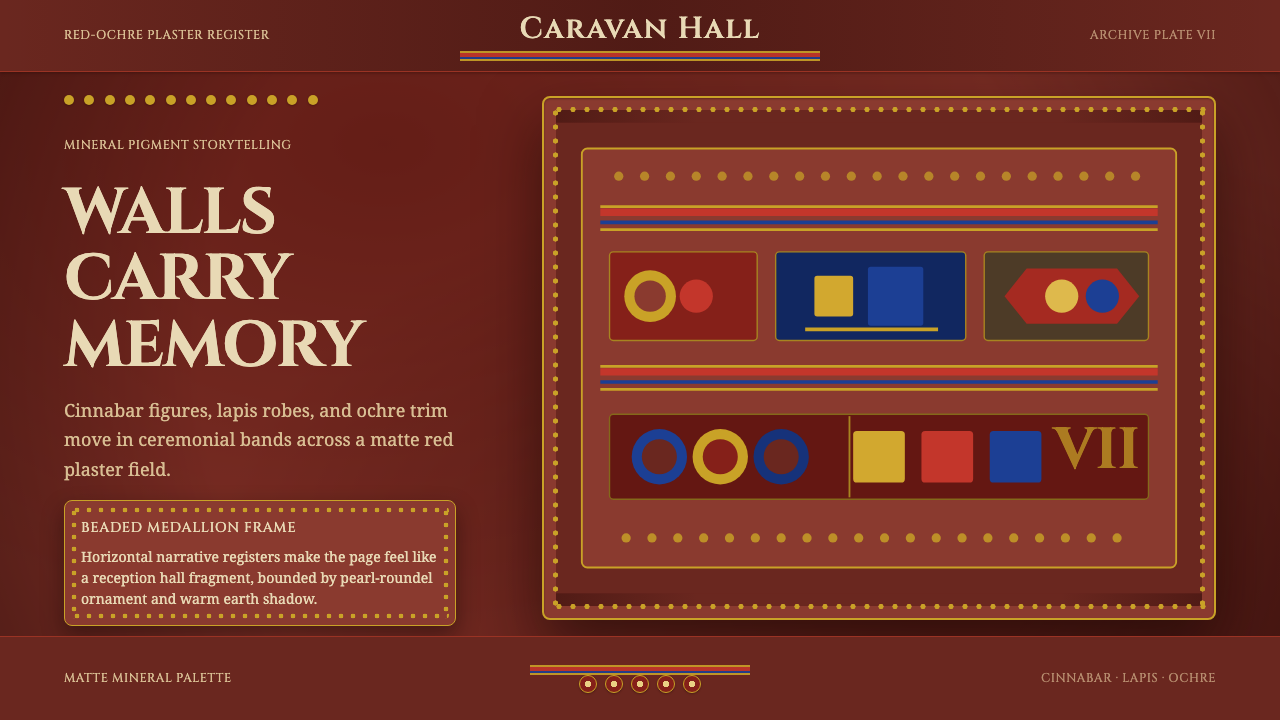 Sogdian FrescoAncient ceremony glows. Cinnabar, lapis and ochre stack into beaded fresco ba…
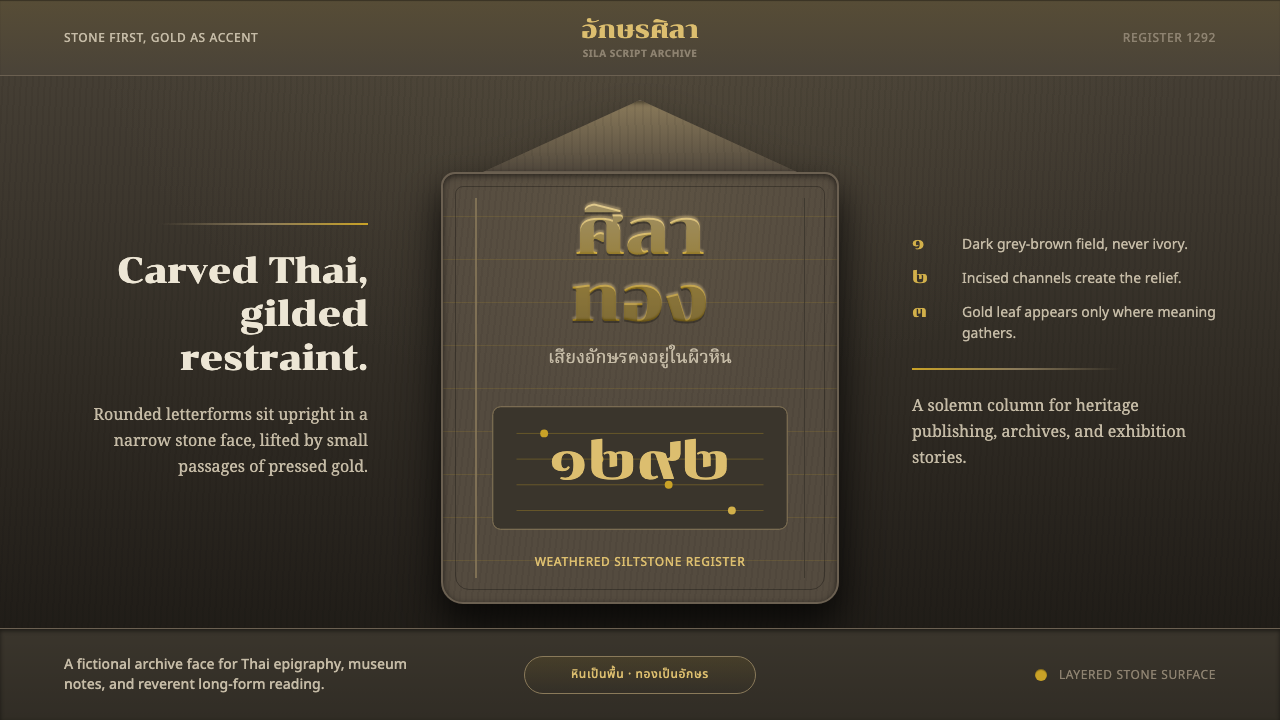 Sukhothai Thai ScriptStone carries the script. Chonburi Thai letters glint gold on dark siltstone.
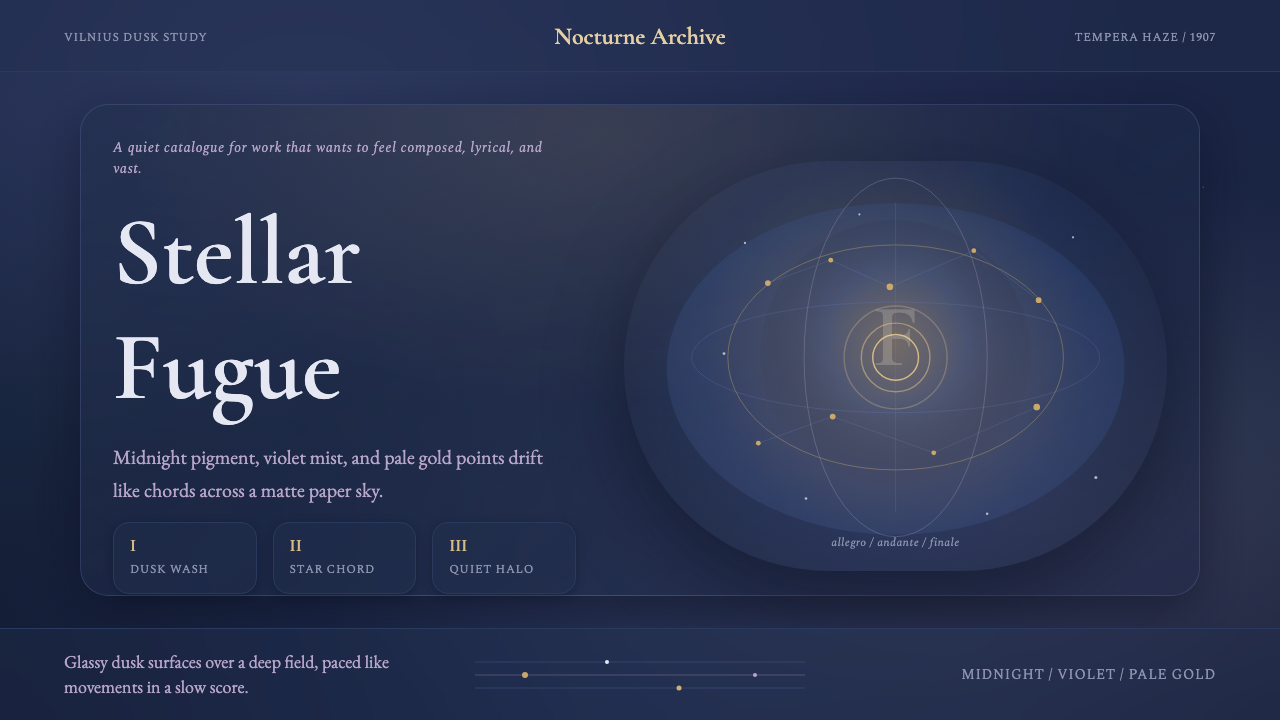 Čiurlionis SymbolismCosmos becomes music. Midnight blue-violet washes and pale gold stars drift i…
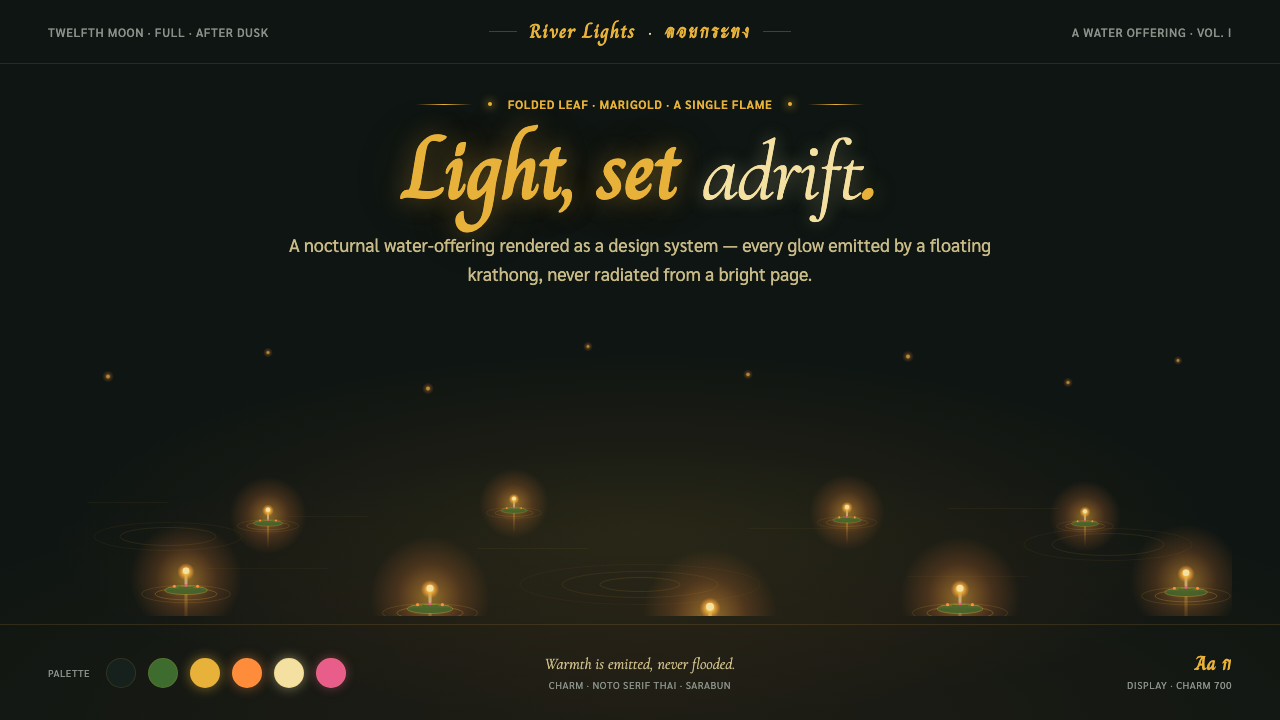 Loy KrathongLight, set adrift. Candle-gold flames on near-black river water — warmth emit…
 Bashkir Honeycomb Felt OrnamentSteppe craft feels weighty. Umber felt holds blue honeycomb and raw-wool hook…
 Belarusian RushnykRed carries meaning. Madder rhombs crowd aged flax edges while the woven cent…