What is Burmese Kalaga Tapestry?
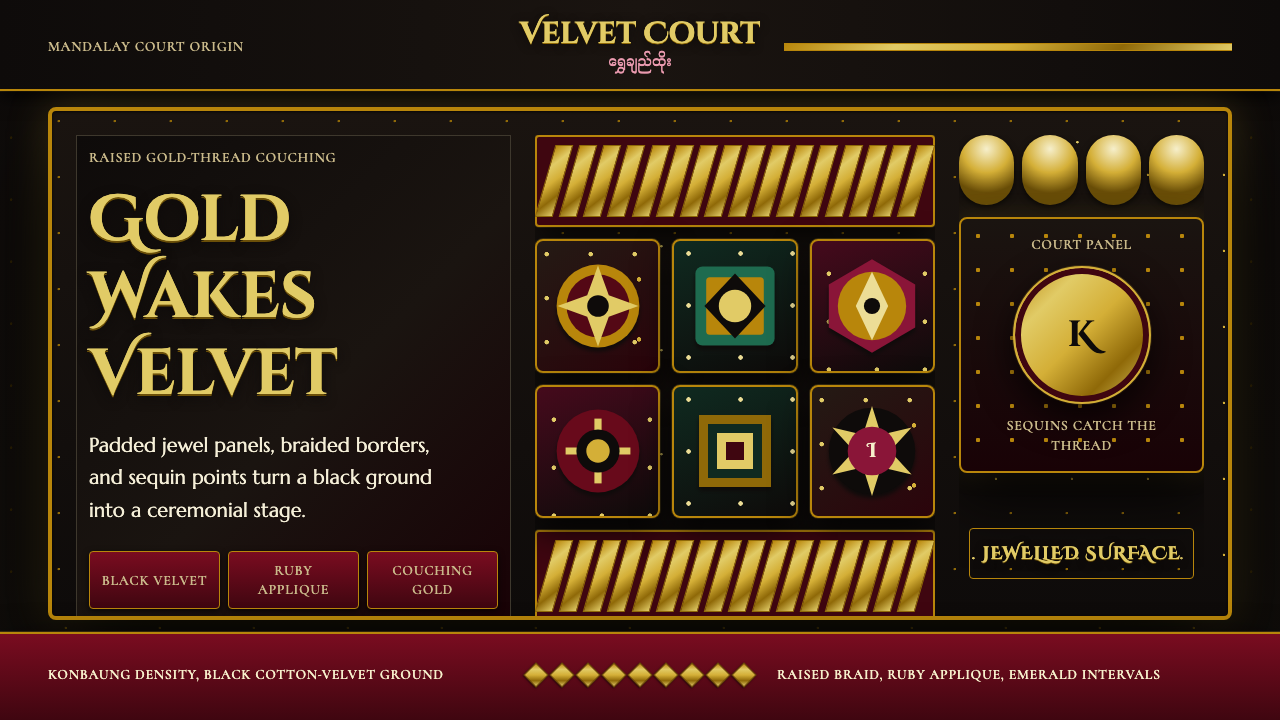
Kalaga — shwe-chi-doe, the embroidery of golden thread — is the raised, jewelled tapestry art of the Konbaung court at Mandalay: black cotton-velvet grounds, padded mythological figures, couched metallic thread, and cascades of sequins that turn cloth into theater.
Burmese Kalaga Tapestry in brief
Shwe-chi-doe is the royal textile art of Burma, practiced at the Konbaung court in Mandalay from at least the eighteenth century. The name translates as 'embroidery of golden thread,' but the technique is far more than needlework: figures are first padded with cotton wadding to create three-dimensional relief, then outlined in couched gold and silver metallic thread, and finally encrusted with sequins, mirror glass, and semi-precious stones against a deep black cotton-velvet ground. The result is not a woven image but a sculptural one.
The dominant visual logic is one of maximum contrast and radiant surface density. Deep black grounds make gold thread and sequins blaze. Figures drawn from Hindu-Buddhist mythology — celestial dancers called apsaras, heroic characters from the Ramayana epic, Nats (Burmese animist spirits), and royal regalia — are rendered with jewelled precision, their contours defined by multiple rows of couched metallic thread. Color within the figures tends to ruby red, emerald green, and sapphire blue — the palette of gemstones rather than paint.
Historically, Kalaga tapestries were prestige objects: court hangings, throne-room screens, and ceremonial gifts that demonstrated royal patronage and the skill of court embroiderers. After the British annexation of Upper Burma in 1885 and the exile of King Thibaw, the craft dispersed into the broader Burmese market, where it has continued — in both fine and commercial forms — ever since. Today the style is recognized internationally as one of Southeast Asia's most visually distinctive textile traditions.
Where does Burmese Kalaga Tapestry come from?
The Konbaung dynasty (1752–1885) unified Burma under a succession of powerful kings who made Mandalay their final capital in 1857. Royal patronage of the arts was not incidental to power — it was its most visible expression. Shwe-chi-doe tapestries were produced in dedicated court workshops staffed by specialist embroiderers whose techniques were closely guarded guild knowledge. The craft drew on older traditions of Burmese appliqué and the metallic-thread embroidery that had long been used for monks' robes, but it systematized these into a monumental format suited to palace display.
The iconographic program of Kalaga tapestries was inseparable from Burmese court cosmology. The Ramayana — known in Burma as the Yama Zatdaw — provided the primary narrative source, with scenes from the epic cycle rendered across tapestries sometimes several meters wide. Figures of the Nat spirits, the thirty-seven guardian deities of the Burmese animist tradition, also appeared frequently, as did celestial musicians, royal elephants, and the many-tiered pyathat (spire) that symbolized royal authority. Every iconographic choice encoded a message about legitimate power and divine favor.
The British annexation of 1885 brought the royal workshops to an abrupt end. King Thibaw and Queen Supayalat were exiled to India, the palace at Mandalay was occupied and looted, and the court embroiderers lost their institutional base. Many dispersed into the broader craft economy, establishing commercial workshops in Mandalay and later Yangon. The loss of royal patronage paradoxically broadened the style's reach: tapestries that had been restricted to court use became available to merchants, monasteries, and eventually tourists and collectors. Colonial-era export demand created a new market that kept the craft alive through the twentieth century, though often at the expense of technical refinement.
In the post-independence period and particularly since the late twentieth century, there has been sustained effort among Burmese craftspeople and cultural organizations to revive the most demanding court-level techniques — multi-row couching, dense sequin laying, and the intricate padding work that gives Kalaga figures their sculptural character. Contemporary practitioners in Mandalay maintain workshops producing both traditional iconographic pieces and — increasingly — designs that adapt the visual language of shwe-chi-doe for international audiences while preserving its technical vocabulary.
What defines the Burmese Kalaga Tapestry look?
Ground and Contrast
The defining substrate of shwe-chi-doe is deep black cotton velvet — a ground chosen specifically for its light-absorbing quality. Against this darkness, every couched metallic thread and every sequin becomes a point of concentrated light. The effect is theatrical in the most literal sense: the tapestry is its own stage lighting. Nothing about the background is neutral; it is an active compositional decision that maximizes the radiance of everything placed upon it.
Raised Relief and Dimensionality
What distinguishes Kalaga from flat embroidery is its three-dimensional relief. Figures are padded with cotton wadding before the outer embroidery is applied, so they literally project from the cloth surface. Major figures — a celestial dancer, a royal warrior — might rise considerably from the ground, casting small shadows and catching light at different angles as the viewer moves. This dimensionality is not incidental decoration; it is the defining technical and visual achievement of the tradition.
Couched Metallic Thread
The contours of every figure are defined by couched gold and silver metallic thread — thread that is too stiff to pass through fabric and is instead laid on the surface and stitched down with fine silk thread. Multiple rows of couching build up ridges that frame each figure with glittering precision. In the most accomplished pieces, the couching itself becomes a compositional element, with varied thread gauges and densities creating tonal gradations within the metallic drawing.
Sequin and Mirror Work
Sequins — called shwe-pone in Burmese — are applied in dense, overlapping fields to fill garments, wings, halos, and architectural elements within the composition. Traditionally made from hammered metal, contemporary examples also use glass and plastic. The overlapping arrangement is deliberate: it creates a scale-like texture that catches and redirects light as the viewer's angle shifts, making the tapestry appear to shimmer. Small mirrors are used for eyes and jewelry details, providing sharp focal points of reflected light within the broader shimmer.
Gemstone Color Palette
Beyond gold and silver, the color palette of shwe-chi-doe draws explicitly from the vocabulary of precious stones: ruby red for garments and crowns, emerald green for foliage and wings, sapphire blue for sky fields and water. These are saturated, jewel-toned colors deployed in discrete fields rather than blended. The palette is not naturalistic — the sky need not be the color of a real sky — but symbolic, associating figures and elements with royal materials of recognized cultural value.
Narrative Iconography
Shwe-chi-doe compositions are never abstract or purely decorative — they are narratives. Every major figure is identifiable by iconographic convention: a specific headdress marks a king, a particular gesture identifies a Nat spirit, a weapon or animal mount signals a hero from the Ramayana cycle. Trained viewers can read the tapestry as they would a text. This commitment to legible narrative means that compositions are organized around figures rather than around pure pattern, with decorative fields of sequins serving as backdrop rather than subject.
Maximal Density and Surface Horror Vacui
Unlike many East Asian textile traditions that prize negative space, shwe-chi-doe operates by a principle of maximum surface coverage. Empty ground is an absence to be filled. Even background areas between figures are colonized by decorative borders, floral motifs, and fields of sequin work. The result is a visual density that demands sustained attention — the more closely you look, the more detail emerges. This horror vacui is not chaos; it is disciplined abundance, each element placed with intentional care.
Who shaped Burmese Kalaga Tapestry?
The masters of shwe-chi-doe were specialist court embroiderers whose names were almost never recorded — consistent with a tradition in which the patron's glory, not the artisan's identity, was the work's stated purpose. What we know of them comes from the tapestries themselves: the consistent technical vocabulary across pieces from a single workshop suggests close transmission of skill between master and apprentice, with guild-like control over particular techniques. The padded-relief method and the specific couching patterns used to build up metallic contours are sufficiently distinctive that scholars can sometimes identify workshop origin.
King Mindon (r. 1853–1878) founded Mandalay in 1857 and presided over what is generally considered the golden age of Konbaung court arts. Under his reign, the royal textile workshops produced some of the most technically ambitious Kalaga tapestries known, as the king actively patronized traditional crafts as assertions of Burmese cultural sovereignty in the face of increasing British encroachment. The tapestries produced in this period — dense with Ramayana scenes and royal iconography — represent the style at its most concentrated and self-confident.
The Ramayana as received and adapted in Burmese tradition — the Yama Zatdaw — is not simply an imported Hindu text but a culturally transformed narrative central to Burmese literary, theatrical, and visual culture. Its heroes, demons, and celestial beings provided the primary cast of characters for Kalaga tapestries. The epic's themes of righteous kingship, cosmic battle, and divine intervention mapped perfectly onto the political theology of the Konbaung court, making it the preferred iconographic source for prestige textile commissions. Knowledge of the Yama Zatdaw was assumed in any cultivated court viewer.
The thirty-seven Nats are the guardian spirits of the Burmese animist tradition, officially codified by King Anawrahta in the eleventh century as a concession to existing folk belief alongside the imposition of Theravada Buddhism. As recognizable figures with established iconographies, they appeared regularly in Kalaga tapestries alongside Buddhist and Hindu-derived imagery — a testament to the synthetic cosmology of Burmese court religion. Their presence in tapestries was not merely decorative but functionally protective: a tapestry depicting Nat figures was understood to invoke their guardianship.
Although individual embroiderers rarely achieved named recognition, the colonial and post-colonial period produced several workshop proprietors whose establishments became known by reputation in Mandalay's craft economy. The transition from royal commission to market production required artisans to develop new business models while preserving technical standards — a tension that some workshops navigated by maintaining a two-tier production: high-end commissions using traditional techniques alongside more quickly produced commercial pieces for the export and tourist trade. This pragmatic division helped keep the demanding court techniques alive as living practice rather than museum artifact.
How do you use Burmese Kalaga Tapestry today?
Shwe-chi-doe as a design reference is maximalist by nature, and any application of it requires committing to that logic rather than hedging. The style does not function at half-intensity: a single sequin-like detail on an otherwise flat layout is a non sequitur. The visual system operates through cumulative density — gold contours, jewel-toned fields, layered shimmer — and requires a consistent compositional register to read as shwe-chi-doe rather than as generic ornament. The first question before applying this style is whether the context can support its unapologetic richness.
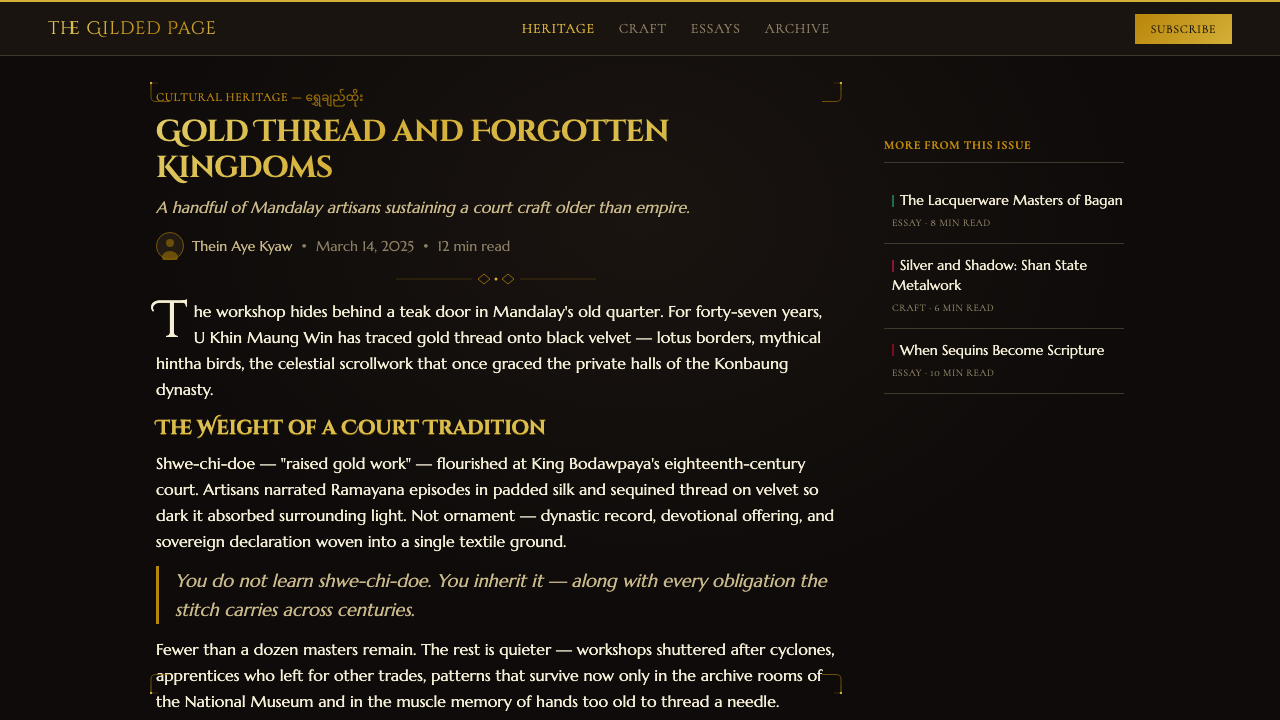
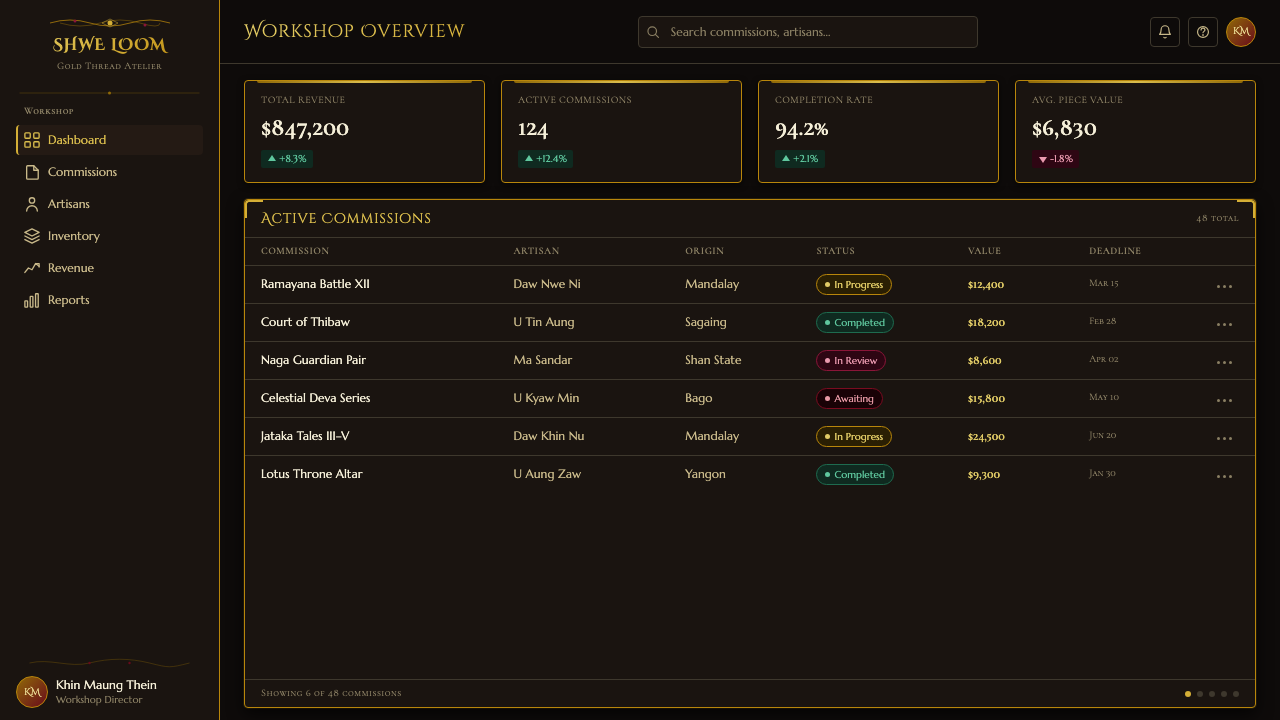
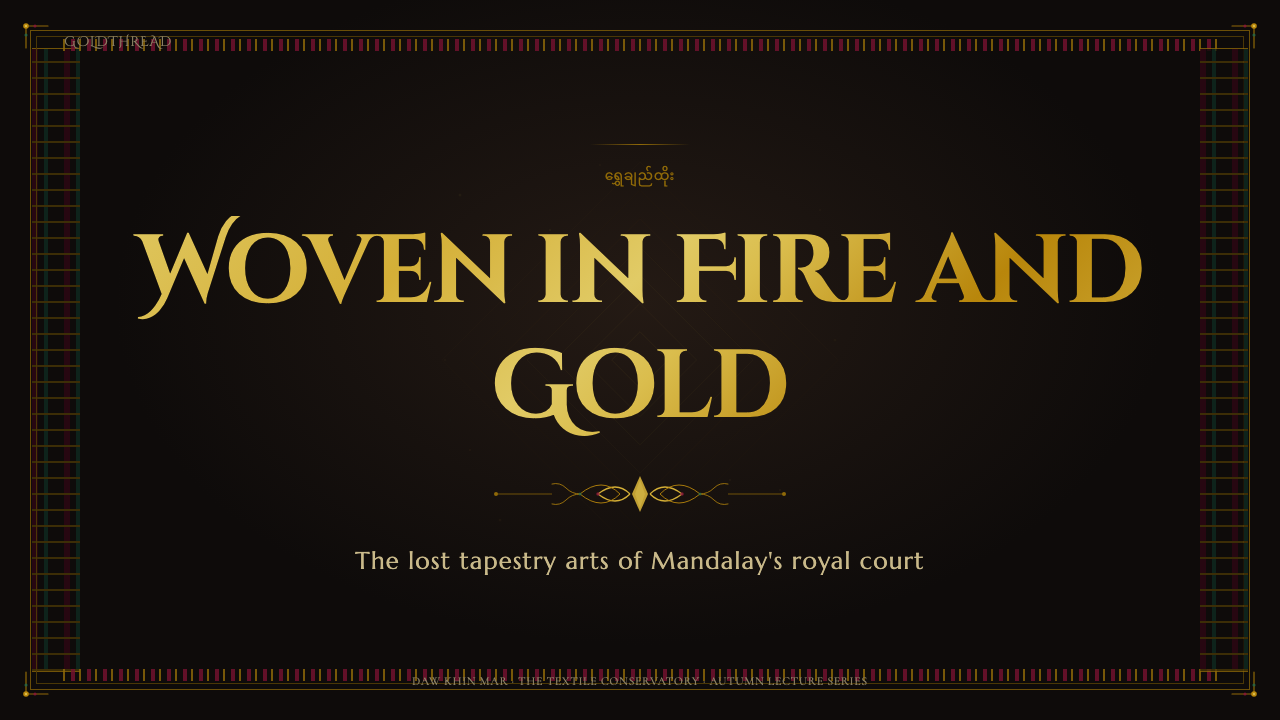
For presentation slides, shwe-chi-doe is most effective on cover and divider pages where a single dominant composition can occupy the full frame. A black ground is mandatory — it is not a color choice but a structural one. Title text works best in gold or cream, set in generous proportions with substantial spacing so that the letterforms breathe against the dense imagery. Content slides should not attempt the full decorative density of the cover; instead, pull one element — a border motif, a sequin-pattern texture applied to an accent block — and let white or deep black carry the rest. Data slides can adopt the jewel-tone palette for chart elements, with ruby reds, emerald greens, and sapphire blues as categorical colors against a dark ground.
For web interfaces, shwe-chi-doe is best suited to luxury, heritage, or cultural contexts where richness and craft signal is the desired user experience. A dark-ground hero section with gold type and a Kalaga-referencing textile illustration or photographic background creates an immediate sense of ceremonial weight. Navigation and body sections should simplify dramatically: let the hero carry the visual complexity while the functional areas use the palette's accent colors on clean dark or light grounds. Attempting full textile density across an entire interface will produce visual exhaustion rather than luxury.
For editorial and marketing contexts, the style performs best as a framing device. A full-bleed shwe-chi-doe-referencing image — a photograph of an actual Kalaga, or an illustration in the tradition — as a section background or article header signals cultural authority and craft lineage. Pull quotes can be set against jewel-tone color fields with gold border rules. Print applications are particularly effective: the style was designed for physical objects and the tactile associations of velvet, gold thread, and sequins translate well into paper with embossed or foil-stamped finishing.
The most common mistake when working with shwe-chi-doe is importing the ornamental density without the structural logic. The tapestries are not random accumulations of decoration — every sequin field, every couched border, every figure placement follows the iconographic logic of the composition. When adapted for screen or print, this structural intentionality must be preserved: decorative elements should frame and direct attention rather than simply fill space. A second frequent error is lightening the background — switching from deep black to grey or beige — which collapses the contrast that gives the style its electric quality. The gold does not glow against grey; it only glows against darkness.
Burmese Kalaga Tapestry — FAQ
Is Kalaga tapestry the same as other Southeast Asian textile traditions?
Kalaga is distinctively Burmese and should not be conflated with related but different traditions from neighboring cultures. It shares the use of metallic thread with Thai royal textiles and Indonesian court work, and the sequin and mirror work has parallels in South Asian traditions — particularly the shisha embroidery of Gujarat and Rajasthan, which also uses mirrored glass. However, the defining characteristic of Kalaga — the raised cotton-wadding padding that creates sculptural relief — is specific to the Burmese shwe-chi-doe tradition and sets it apart from all comparable flat embroidery traditions in the region. The iconographic program drawing on Burmese Buddhism, Nat worship, and the localized Ramayana cycle is also distinctively Burmese.
Why is the background always black? Can the style work on other grounds?
The black velvet ground is not an arbitrary color choice — it is a structural component of the visual system. Black maximizes the apparent luminosity of gold thread and sequins by providing maximum contrast. On any lighter ground, the metallic elements lose much of their radiance because the contrast differential shrinks. Historically, occasional pieces used deep burgundy or midnight blue grounds as alternatives — both dark enough to preserve the contrast logic — but these remain exceptions. For contemporary applications, working on a ground lighter than deep charcoal will almost certainly flatten the characteristic shimmer and undermine the style's essential quality.
How does shwe-chi-doe relate to Buddhism? Is it a religious art form?
The relationship is complex. The Konbaung court was Theravada Buddhist, and Buddhist iconography — monks, temple architecture, sacred animals, and scenes from the Jataka tales (stories of the Buddha's previous lives) — appeared in Kalaga tapestries. However, the dominant iconographic source, the Ramayana, is Hindu-derived, and the inclusion of Nat spirits represents pre-Buddhist animism. Shwe-chi-doe is more accurately described as a court art that synthesized the multiple religious and mythological strands of Burmese elite culture, rather than a specifically Buddhist art form. Many pieces had no religious function at all and were purely prestige objects. Today, some tapestries are made for temple decoration, while others are produced for secular display and collection.
What is the difference between authentic court-quality Kalaga and commercial pieces?
The primary technical markers are the padded relief and the couching work. In fine court-level pieces, figures have pronounced three-dimensional relief — the padding is substantial, carefully shaped to the figure's anatomy, and covered with tight embroidery that preserves the form's contours. The couched metallic thread is applied in multiple rows with consistent tension, building crisp ridges. In commercial pieces, padding is often minimal or absent, relief is shallow or flat, and couching may be replaced by printed metallic effects or single-row outlines. The density of sequin work also varies significantly: authentic pieces have sequins applied so densely that no backing fabric shows through, while commercial pieces are often sparse. The iconography is a secondary marker: court pieces follow strict iconographic conventions that identify specific figures, while commercial work often conflates or simplifies.
Can shwe-chi-doe inspire digital design, or is it too tactile to translate?
The tactile qualities — the actual raised relief, the physical shimmer of sequins, the weight of velvet — cannot be replicated on screen, and attempting to simulate them with drop shadows and texture overlays typically produces a kitsch result rather than an authentic reference. The productive approach is to abstract the visual logic rather than simulate the materials. Black grounds with high-contrast gold and jewel-tone accents, compositional density built through layered graphic elements rather than textile texture, and the ornamental border logic that frames figures within the composition — these translate effectively to screen and can produce digital work that reads as shwe-chi-doe in spirit without pretending to be a textile. The key is committing to the underlying aesthetic values: maximum contrast, jewel-tone color, narrative iconographic structure, and the unapologetic richness that is the style's defining character.
Related design styles
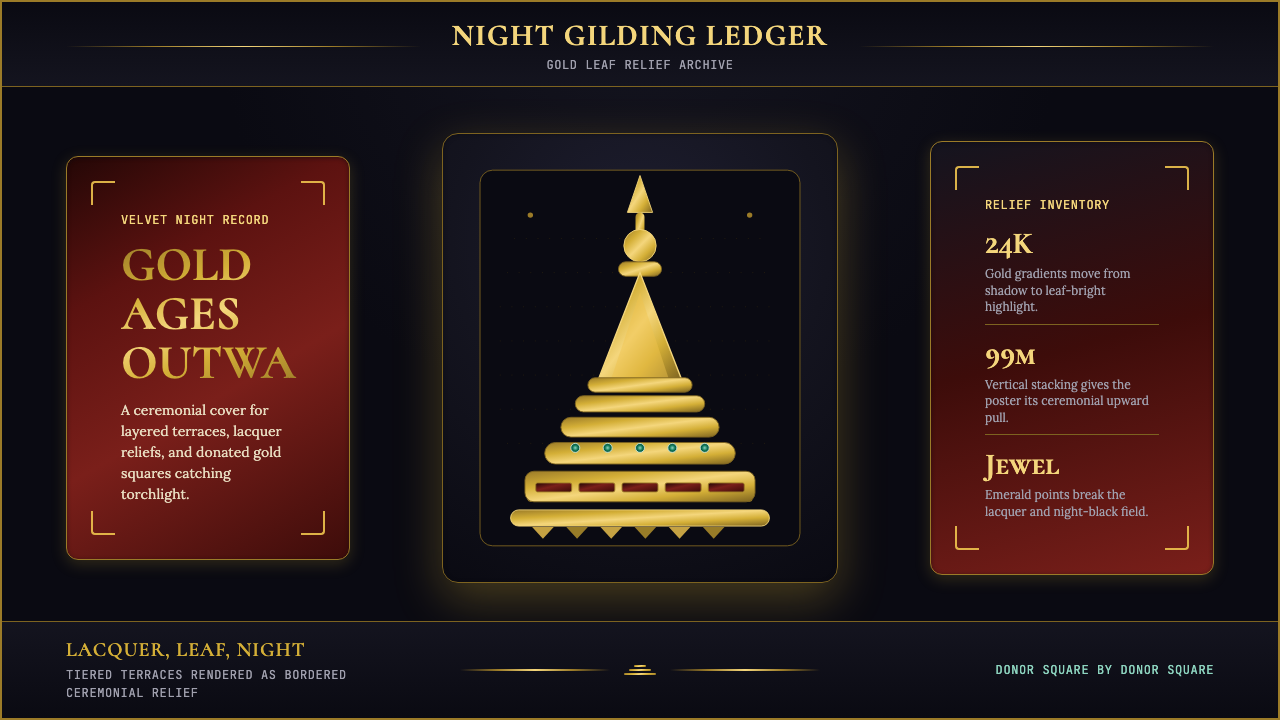 Burmese Shwedagon Stupa ReliefGold refuses restraint. Velvet black, teak-red lacquer, and tiered gradients…
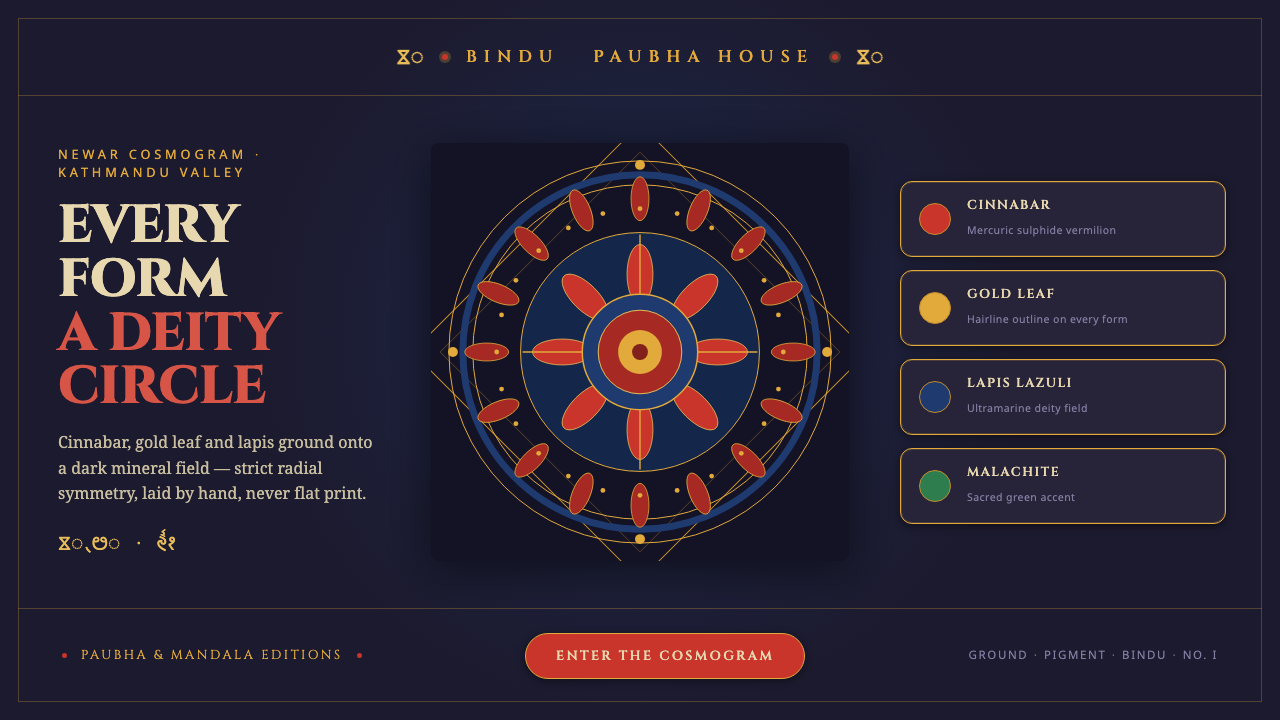 Kathmandu Tantric MandalaSacred geometry as interface. Cinnabar, gold and lapis rings radiate from one…
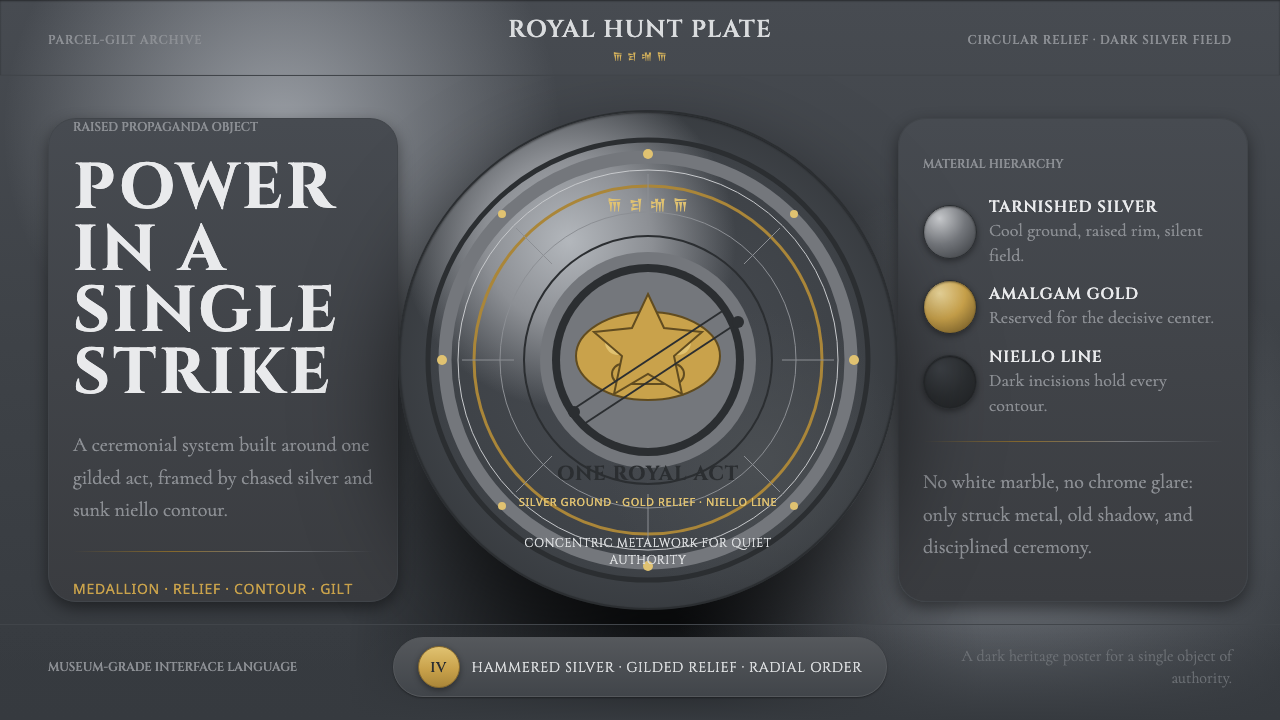 Sasanian Silver PlateRegal metal, held in silence. Tarnished silver frames one restrained gold rel…
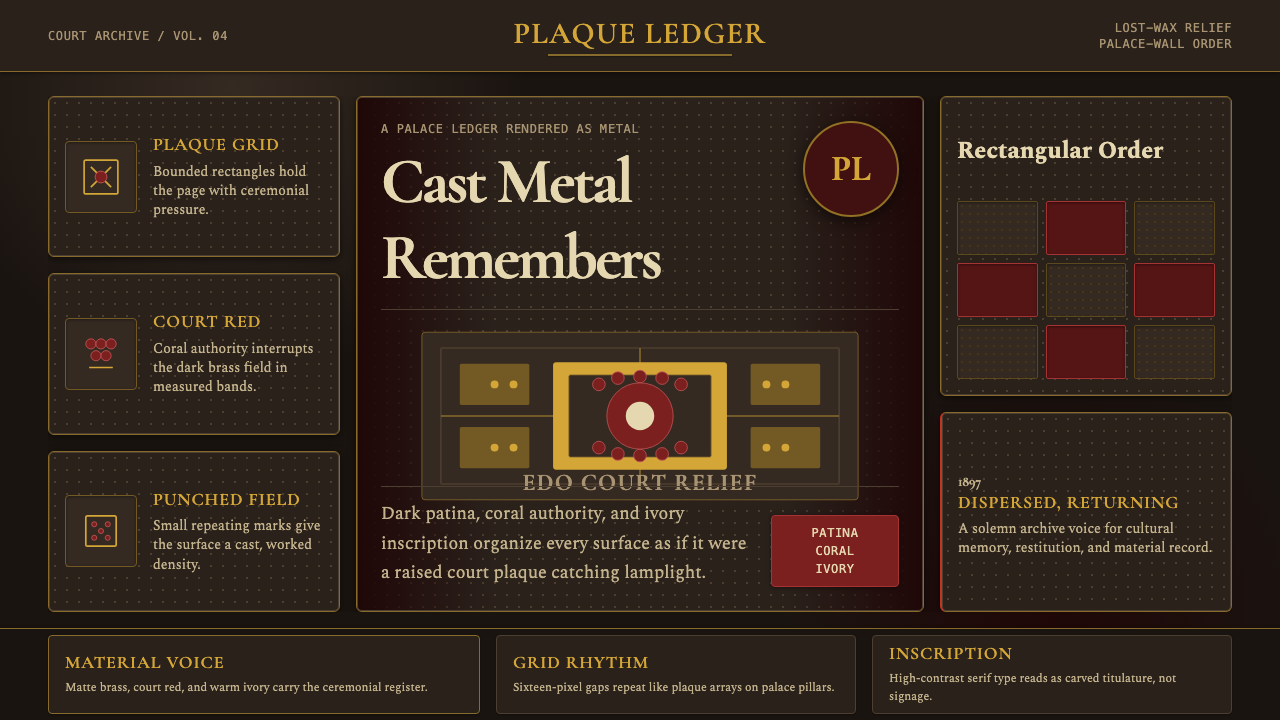 Benin Bronze Oba CourtCourt gravity in cast metal. Patinated brass grid, coral red panels, ivory se…
 Bhutanese Drukpa Kagyu ThangkaDevotion made cobalt. Gold frames, Cormorant serif, and vermilion marks hold…
 Bhutanese Dzong (Fortress Red)Monumental red holds the page. Cobalt frames and gold bands lock the fortress…