What is Babylonian Hammurabi Stele?
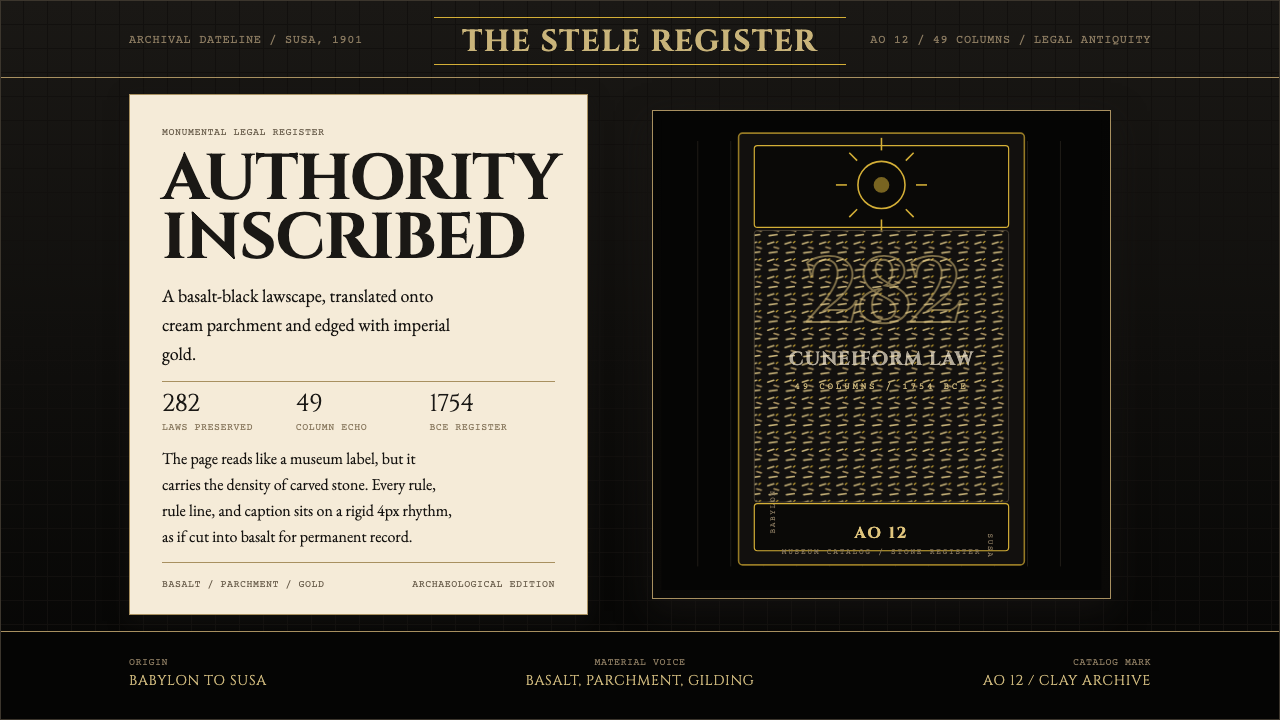
Four thousand years before digital dashboards, Hammurabi carved 282 laws into basalt — and every design choice on that monument still communicates authority, permanence, and absolute clarity.
Babylonian Hammurabi Stele in brief
The Babylonian Hammurabi Stele design system draws its entire visual logic from a single historical object: the seven-foot basalt pillar commissioned by King Hammurabi of Babylon around 1754 BCE to proclaim his law code to the ancient world. The aesthetic is archaeological and monumental — warm basalt-black grounds, cream-toned parchment panels for content, and imperial gold reserved for the moments of highest emphasis, the way gilding appears on ancient cylinder seals. Stone-sharp geometry and inscription-weight typography complete the effect.
What makes this system unusual is its commitment to scholarly authenticity rather than fantasy. The visual references are specific — the actual proportions of the Louvre stele, the rhythm of dense cuneiform columns, the bas-relief composition of king and sun-god at the monument's apex — and they are interpreted through restrained, principled abstraction. There are no hieroglyphic pastiche elements, no theatrical shadows, no cinematic lighting. The discipline is the same as the original object: authority does not decorate itself.
The result is a design system that feels simultaneously ancient and completely functional. It is well-suited to interfaces and documents where gravity, precision, and institutional weight are the desired impression — legal and financial platforms, archival and reference tools, scholarly publications, and high-stakes data environments where the user should feel they are reading something permanent.

Where does Babylonian Hammurabi Stele come from?
The Stele of Hammurabi was created during the reign of Hammurabi, sixth king of the First Babylonian Dynasty, who ruled from approximately 1792 to 1750 BCE. Hammurabi's kingdom unified much of Mesopotamia — the land between the Tigris and Euphrates rivers in what is now Iraq — through a combination of military conquest and diplomatic consolidation. The law code inscribed on the stele was not Hammurabi's invention from nothing; earlier Mesopotamian legal collections existed, including the Laws of Ur-Nammu from around 2100 BCE. But Hammurabi's code, at 282 provisions inscribed in Akkadian cuneiform, was the most comprehensive of its era and was designed explicitly for public proclamation: the stele was displayed in the city of Babylon so that any literate citizen could read the law.
The object's physical design was itself an argument. The monument is a rounded-top basalt pillar, chosen for stone's resistance to weathering and its association with permanence. At the top, a bas-relief scene depicts Hammurabi standing before Shamash, the Babylonian sun god of justice, receiving the laws — or in some readings, presenting them for divine ratification. This image establishes divine authority for the legal text below. The remaining surface is covered in dense columns of cuneiform, approximately forty-nine columns across obverse and reverse faces, written in a formal register of Akkadian. The visual effect is one of total coverage — not a single surface wasted, every available plane given over to the weight of law.
The stele remained in Babylon for over a millennium until it was seized as war spoil by the Elamite king Shutruk-Nahhunte around 1155 BCE and carried to the Elamite capital Susa, in modern-day Iran. There it stood for another three thousand years, unknown to the modern world, until the French archaeological mission to Susa led by Jacques de Morgan excavated it in three fragments between December 1901 and January 1902. The fragments were reassembled and transported to the Louvre in Paris, where the stele has been displayed ever since — first in the Salle des Antiquités sémitiques and later in its current permanent home, where it draws visitors specifically to see what complete, codified law looks like in physical form.
The scholarly decipherment of the text was accomplished remarkably quickly. Jean-Vincent Scheil, a Dominican priest and Orientalist attached to the expedition, published a full transliteration and French translation in 1902, the same year the stele arrived in Paris. Scheil's reading made the code accessible to the international scholarly community almost immediately, and within a few years the Hammurabi Code was being discussed in legal history, biblical scholarship, and comparative linguistics. The stele became the most famous object in Mesopotamian archaeology and remains among the most recognized ancient artifacts in any collection worldwide. Its design vocabulary — the monumental column, the dense inscribed field, the god-and-king summit composition — has entered the visual language of authority across cultures.
What defines the Babylonian Hammurabi Stele look?
Color
The palette is built around three anchoring tones derived directly from the monument: a deep, warm basalt-black for grounds and structural elements; a soft, aged cream or parchment tone for content panels where body text lives; and an imperial gold — warm and slightly burnished rather than bright yellow — reserved for the highest-priority accents, borders, and ornamental marks. A fourth tone, a cool stone-gray, functions as a midtone for secondary elements and dividers. Color is never decorative here; each tone carries a categorical meaning tied to its place in the original monument.
Typography
The typographic model is the carved inscription: letterforms that feel cut into a surface rather than printed onto one, with strong vertical strokes and controlled horizontal stress. Display type is set at monumental scale, wide-tracked, and often spaced with the deliberate openness of stone-carved text where each character must be individually chiseled. Body text sits in a dense, upright register — compact but highly legible, echoing the rhythm of cuneiform columns. No script or calligraphic typefaces appear; every form should feel lapidary, made to last millennia rather than seasons.
Surface and Texture
Unlike many historical design systems that embrace flat digital surfaces, the Hammurabi Stele aesthetic allows for the suggestion of material surface — but only through restrained, non-photographic means. Content panels may carry the very faint visual memory of aged parchment or worn stone, rendered through subtle tonal variation rather than any explicit texture map or photographic overlay. The goal is legibility first, with just enough material warmth to distinguish the surface from pure neutrality. Heavy-handed texturing immediately collapses the scholarly tone into theatrical decoration.
Grid and Proportion
The stele's physical proportions — tall, narrow, and self-contained — inform the preferred aspect ratios for content containers. Vertical orientations are favored over wide horizontal ones; where wide layouts are necessary, they are organized into clearly distinct column zones echoing the inscription's columnar structure. Grid lines are not hidden infrastructure but expressed as visible rules and borders that divide the surface the way column separators divide a cuneiform text. The forty-nine cuneiform columns of the original monument are an evocative reference, not a literal specification.
Geometry and Ornament
Ornament exists in this system — which distinguishes it fundamentally from zero-ornament modernist traditions — but it is governed by the principle of inscription: ornament should feel as though it was carved rather than drawn. Border elements are composed of repeated geometric units that reference cuneiform wedge marks and cylinder-seal motifs without directly copying them. The bas-relief composition at the stele's apex — god and king, enthroned and standing — provides the logic for image hierarchy: figures of authority occupy summit positions, their scale signaling rank. Decorative elements are restrained and symmetric; complexity is found in density, not in elaboration.
Contrast and Legibility
The system demands high contrast at every hierarchical level: warm gold on basalt-black for primary emphasis, near-black type on parchment cream for body content, and gold rule lines on dark grounds for structural division. Intermediate low-contrast relationships are avoided; the monument's original purpose was public proclamation — the law had to be readable at a distance, in daylight, on a carved surface. This insistence on bold contrast gives the system strong accessibility characteristics and makes it particularly effective in environments where rapid information scanning is required.
Scale as Authority
The original stele is physically imposing — nearly two and a half meters tall — and the design system encodes scale as its primary hierarchy signal. Display elements are large not for emphasis in the contemporary attention-economy sense, but because large scale communicates institutional weight. A page number or section label in this system may be nearly as large as body text; a chapter heading occupies a substantial portion of its page. This willingness to commit space to hierarchy markers, rather than compressing them, is what gives the system its monumental feeling even at screen scale.

Who shaped Babylonian Hammurabi Stele?
Hammurabi reigned as the sixth king of the First Babylonian Dynasty from approximately 1792 to 1750 BCE. Through a sustained campaign of military conquest and diplomatic alliance, he expanded Babylonian rule across Mesopotamia, unifying city-states that had previously competed for regional dominance. His law code — the text inscribed on the stele — was not merely a legal instrument but a political document that asserted Babylonian supremacy over conquered territories and framed that supremacy as divinely sanctioned justice. Hammurabi is represented on the stele itself in the bas-relief at its apex, standing before the god Shamash in a posture of reception or presentation that established the iconographic model for the divine-human authority relationship in ancient Near Eastern art.
Shamash was the Babylonian and Assyrian deity of the sun and of justice — the divine patron of law, fairness, and the exposure of wrongdoing. The bas-relief at the apex of the Hammurabi Stele depicts Shamash enthroned, presenting Hammurabi with the symbols of royal authority — the rod and ring — which in some scholarly interpretations are instruments of measurement and construction, signifying that the law is a built, measurable structure. Shamash's presence on the monument was essential to its authority: the code was not merely Hammurabi's decree but a transcription of divine will. In design terms, Shamash's summit position and larger seated scale established the visual grammar of authority through placement and proportion that the design system inherits.
Jacques de Morgan was a French engineer, archaeologist, and geologist who directed the French Archaeological Delegation in Persia at the turn of the twentieth century. His excavation campaigns at Susa — the ancient Elamite capital where the Hammurabi Stele had lain buried for three millennia — produced one of the most consequential single-season discoveries in the history of Near Eastern archaeology. Between December 1901 and January 1902, his team unearthed the three basalt fragments that, when reassembled, constituted the stele. De Morgan's systematic approach to stratigraphy and artifact documentation ensured that the object was recovered with enough contextual information to situate it historically and physically, making its subsequent scholarly analysis possible.
Jean-Vincent Scheil was a Dominican priest and Assyriologist who accompanied the French expedition to Susa and accomplished the first complete decipherment and publication of the Hammurabi Code text. Working with remarkable speed, Scheil produced a full transliteration and French translation of the Akkadian cuneiform in 1902, the same year the stele arrived at the Louvre. This publication transformed the stele from a visually impressive but opaque object into one of the most studied texts in ancient legal history. Scheil's reading made it possible to compare Hammurabi's provisions with Mosaic law, earlier Mesopotamian codes, and later Roman legal precedents — situating the monument at the center of debates about the origins of codified law that continue to this day.
Shutruk-Nahhunte was an Elamite king who ruled from approximately 1185 to 1155 BCE and conducted a series of military campaigns against Babylonian cities that rank among the most destructive in ancient Mesopotamian history. Among his documented spoils — which he transported to his capital Susa and had inscribed with records of his conquests — was the Stele of Hammurabi, removed from Babylon around 1155 BCE. Shutruk-Nahhunte's appropriation of the stele was itself an act of symbolic authority: to possess another king's law monument was to supersede his claim to divine-backed legitimacy. The stele's three-thousand-year sojourn in Susa was therefore an accident of conquest as much as of geography, and it accounts for the object's preservation in a region where it would eventually be excavated by modern archaeologists.
How do you use Babylonian Hammurabi Stele today?
The Hammurabi Stele system is best understood as a palette of institutional gravity. Before applying it, consider whether the product or document genuinely calls for the weight it carries — this is not a system that softens or flatters, and audiences will perceive its seriousness whether or not the content earns it. When the match is right — legal technology, compliance platforms, archival databases, financial reporting, academic publishing, civic government interfaces — it is extraordinarily effective at communicating permanence and trustworthiness without any verbal claim to those qualities.
For presentation slides, the system works across both cover and content pages with distinct approaches for each. A cover page benefits from the stele's vertical compositional logic: the title set in inscription-weight type at a large, spaced scale against the basalt-black ground, with a narrow gold border rule framing the content area as a monument frames its inscription field. A single gold ornamental element — a horizontal rule or a minimal geometric mark — serves the function of the bas-relief apex: it tells the viewer where to look first. Content slides should be treated as inscription panels: a generous margin on the left serving as a metadata or label column, the main content in dense, legible columns to the right, and section markers as bold horizontal rules in gold or cream rather than decorative dividers. Data slides take on a lapidary quality — charts and figures should be rendered in the palette's tonal hierarchy, with the most critical data points emphasized in gold, supporting data in parchment cream, and structural elements in basalt-black.
For web interfaces, the system is particularly suited to dashboards, legal and compliance portals, financial data platforms, and institutional reference tools where the user needs to trust the information before acting on it. The approach: ground the layout in basalt-black or a very deep warm dark, reserve the parchment cream tone for all primary reading surfaces, and apply gold with strict discipline — interactive elements such as primary calls to action, critical alerts, and navigation highlights only. Component edges should be sharp and defined rather than rounded; card components carry visible border rules in stone-gray or gold rather than floating on shadows. For pricing or tier comparison pages, the stele's columnar structure translates directly: each tier occupies a defined column, gold highlights the recommended tier, and the visual weight of the layout communicates that the decision being made has permanence.
For editorial and marketing work, the system supports dense, authoritative information hierarchies. An editorial layout using this aesthetic places a wide, clearly bounded content column on a parchment ground, with a narrower left margin carrying section metadata, folios, and classification labels in a smaller, more open typographic setting — the cuneiform margin of the stele, in effect. Section breaks are marked by full-width gold rules rather than white space or decorative ornament. Marketing pages using the system should resist the temptation to add photographic backgrounds or imagery that suggests warmth or lifestyle; the system's authority comes precisely from its refusal to court the viewer. Instead, feature blocks alternate between basalt-black grounds with gold and cream type and parchment grounds with near-black type, producing a rhythm of contrast that reads as confident iteration rather than variation for variety's sake.
The most common mistake when applying this system is misunderstanding the role of gold. Because gold is the system's most distinctive and visually active tone, it attracts designers who want to use it broadly — as background fills, as decorative pattern, as typographic color for body text. This dissolves the system's logic entirely. Gold in the Hammurabi Stele system is emphasis, not decoration; it should appear where the original monument's gilding appeared — at borders, at key structural markers, at the single most important element on any given surface. A layout where gold appears more than three or four times at meaningful scale has already lost the system's gravitational center. Similarly, softening the palette — introducing warm amber tones, graduated backgrounds, or rounded geometry — immediately collapses the archaeological severity that makes the system distinctive. The design should feel excavated, not designed.

Babylonian Hammurabi Stele — FAQ
How does the Hammurabi Stele system differ from other dark, gold-accented design themes?
The critical difference is the source of the gold and black logic. Many dark-gold themes derive from luxury branding — the black is opulent, the gold is precious, the overall effect is jewelry-store or financial-product advertising. The Hammurabi Stele system's black is basalt: geological, heavy, permanent. Its gold is inscription-emphasis: restrained, categorical, earned by context. The parchment cream tone — absent from most luxury-black-gold systems — is the most telling marker. It introduces the specific warmth of aged written material rather than the cold gleam of a display case. When in doubt, look at how the typography is handled: luxury systems tend toward elegant thin weight; the Hammurabi system favors strong vertical strokes with the weight of carved stone.
Can this system be adapted for consumer-facing products, or is it strictly institutional?
It can be adapted, but with honest awareness of what the adaptation costs. The system's authority communicates credibility, permanence, and seriousness — qualities that translate well for any consumer product where trust is the primary purchase driver: high-value insurance products, long-term investment platforms, estate planning services, premium legal document tools. It will struggle, and may actively repel users, in contexts that call for approachability, warmth, playfulness, or emotional intimacy. A consumer wellness app, a social platform, or a food and beverage brand applying this system without modification will likely produce an experience that feels correctional rather than inviting. The honest question is not whether the aesthetic can be adapted but whether the product's emotional contract with its users genuinely aligns with what the system communicates.
What is the correct use of the parchment cream tone — background only, or can it be used for elements?
The parchment cream tone functions primarily as the reading surface — the content panel ground, the equivalent of the stele's inscribed field. As a background for body text on dark grounds, it is also highly effective: cream text on basalt-black is the standard inversion for dark-mode content areas. What cream should not do is appear as a decorative element on a light ground, where it will collapse into invisibility, or as an emphasis color competing with gold. The practical rule: cream defines reading surfaces; gold defines emphasis points; basalt-black defines structural grounds. When these three roles are respected, the system maintains its categorical clarity. When they overlap — cream used for call-to-action buttons, gold used as a large background field — the hierarchy dissolves and the system reads as merely dark and ornate.
How should imagery and photography be treated within this system?
Photography and figurative imagery are difficult to incorporate without disrupting the system's archaeological register. Where imagery is necessary, the most consistent approach is high-contrast duotone treatment using the system's own palette — basalt-black and parchment cream, or basalt-black and gold — which transforms photographic subjects into something closer to relief or print. Silhouetting against a dark ground also works well. What the system cannot accommodate gracefully is naturalistic, full-color photography with ambient lighting, because such imagery imports the logic of the present-day visual world into a composition that is making an argument about permanence and historical weight. Ancient maps, manuscript pages, seal impressions, and cuneiform tablet photographs, if needed, integrate naturally — they are from the same visual universe as the stele.
Is this system appropriate for digital dark mode, and how should dark-mode implementation differ from light mode?
This system is, in a meaningful sense, natively dark-mode: the original stele is a dark monument with light inscription. The basalt-black ground with parchment and gold content is the primary orientation, and it translates directly to dark-mode digital interfaces. The light-mode variant — where parchment cream becomes the ground and near-black or basalt serves as type — is the adaptation, not the default. In practice, this means the light-mode version requires more care: the gold tends to lose some of its gravitas on a light ground, and the contrast structure that makes the system legible on dark grounds needs to be recalibrated. A light-mode implementation works best when gold is used more sparingly than in dark mode, with stone-gray rules and borders carrying more of the structural work, and near-black type sitting in high contrast against the cream ground.
Related design styles
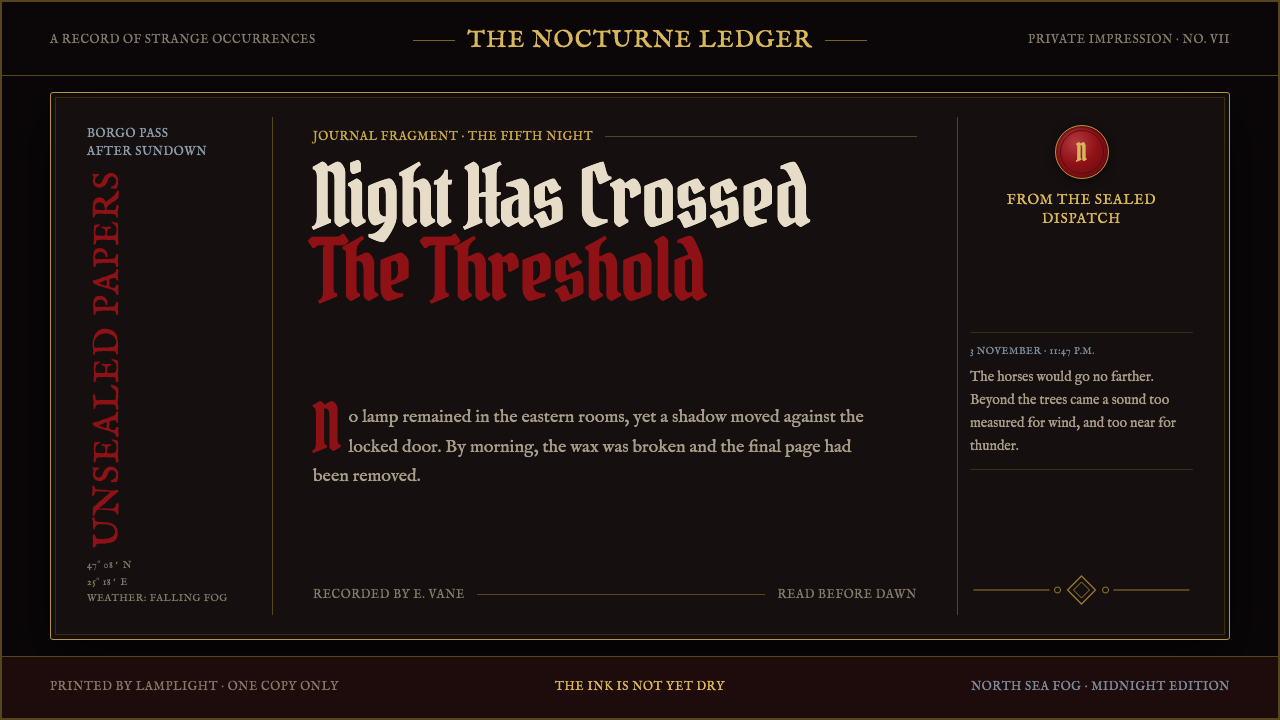 Dracula Gothic (1897)Victorian dread after dark. Blood-red initials and tarnished gilt haunt coffi…
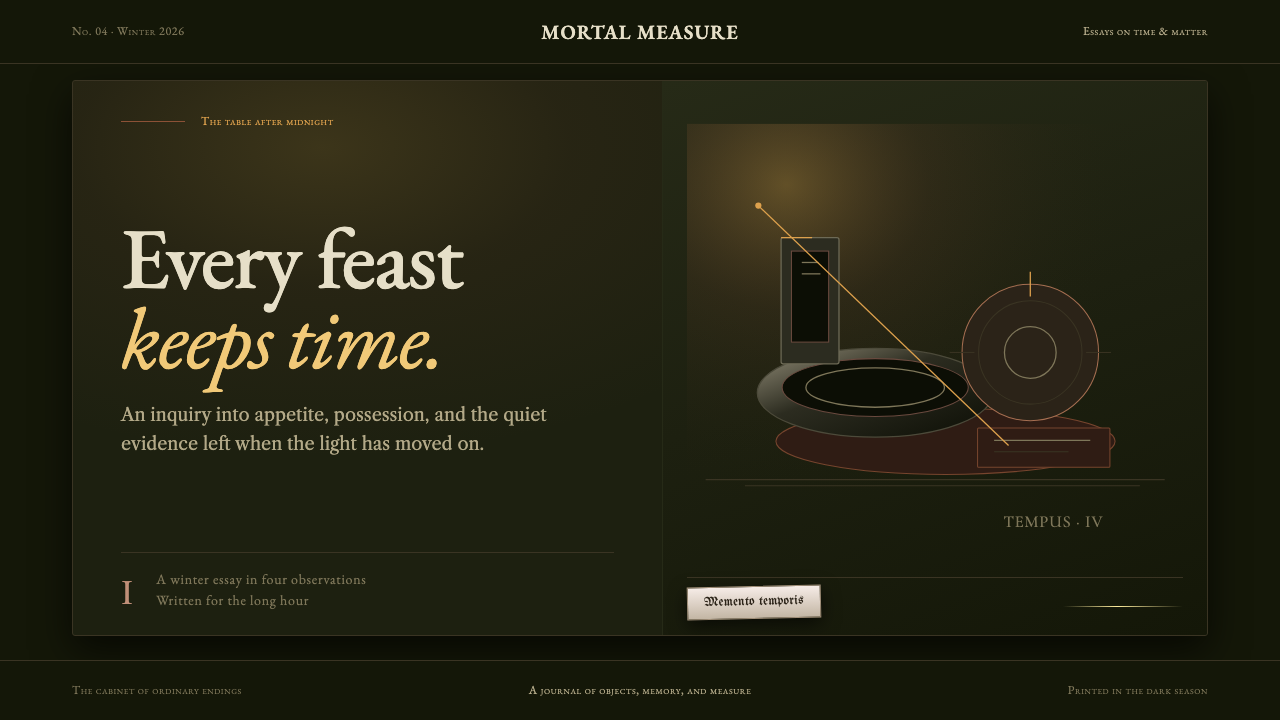 Dutch VanitasTime waits at the table. Olive-black depths, earth-brown type, and one candle…
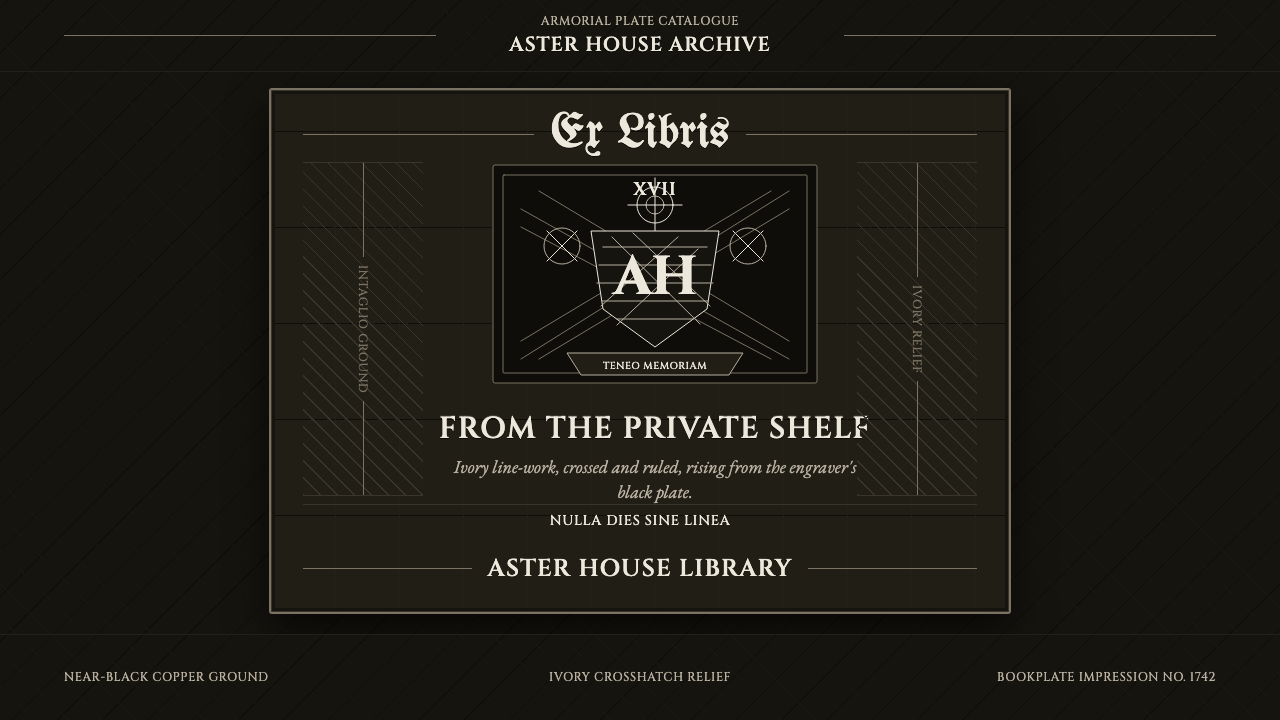 Ex Libris BookplateScholarly ownership, cut in ivory. Cinzel caps and crosshatch rules rise from…
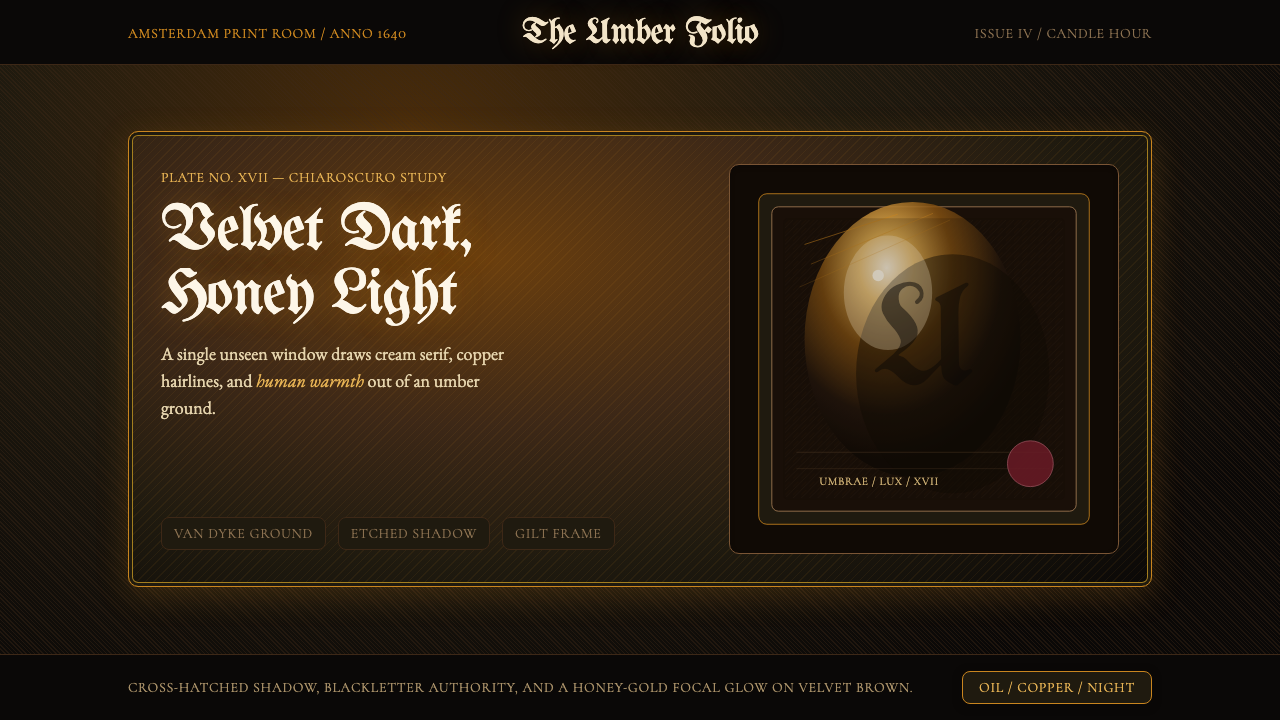 Rembrandt BaroqueDarkness becomes theatre. Honey-gold spotlight and blackletter rise from Van…
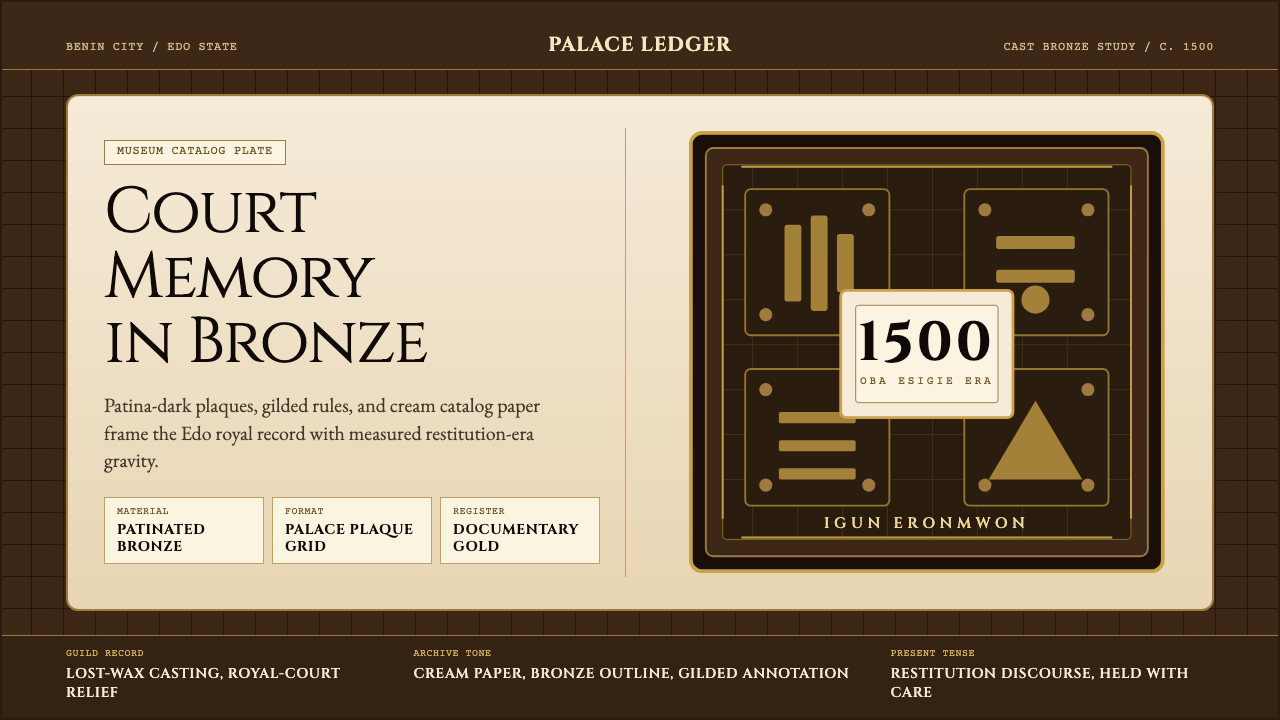 Benin Bronze (Edo, 1500)Royal memory, cast in bronze. Cream plaques and gilded lines carry museum gra…
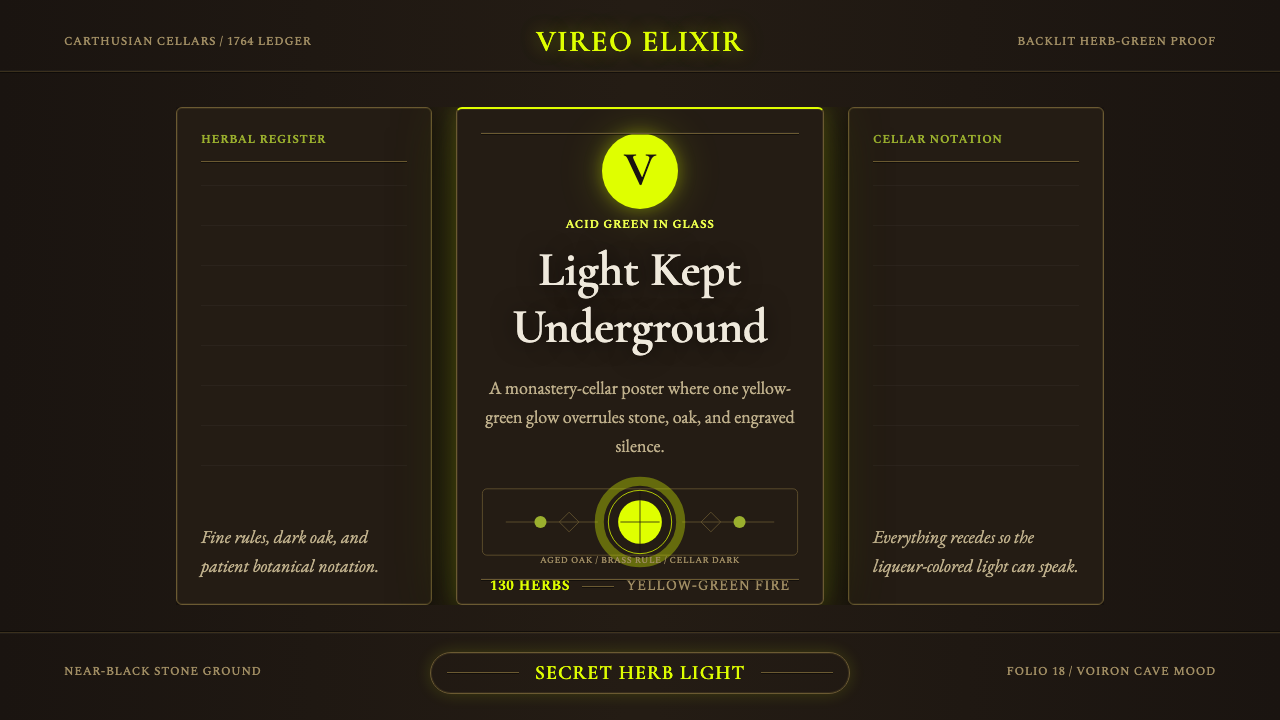 Chartreuse Liqueur GreenAcid glow rules the cellar. Cormorant Garamond and brass hairlines frame yell…