What is Benin Bronze (Edo, 1500)?
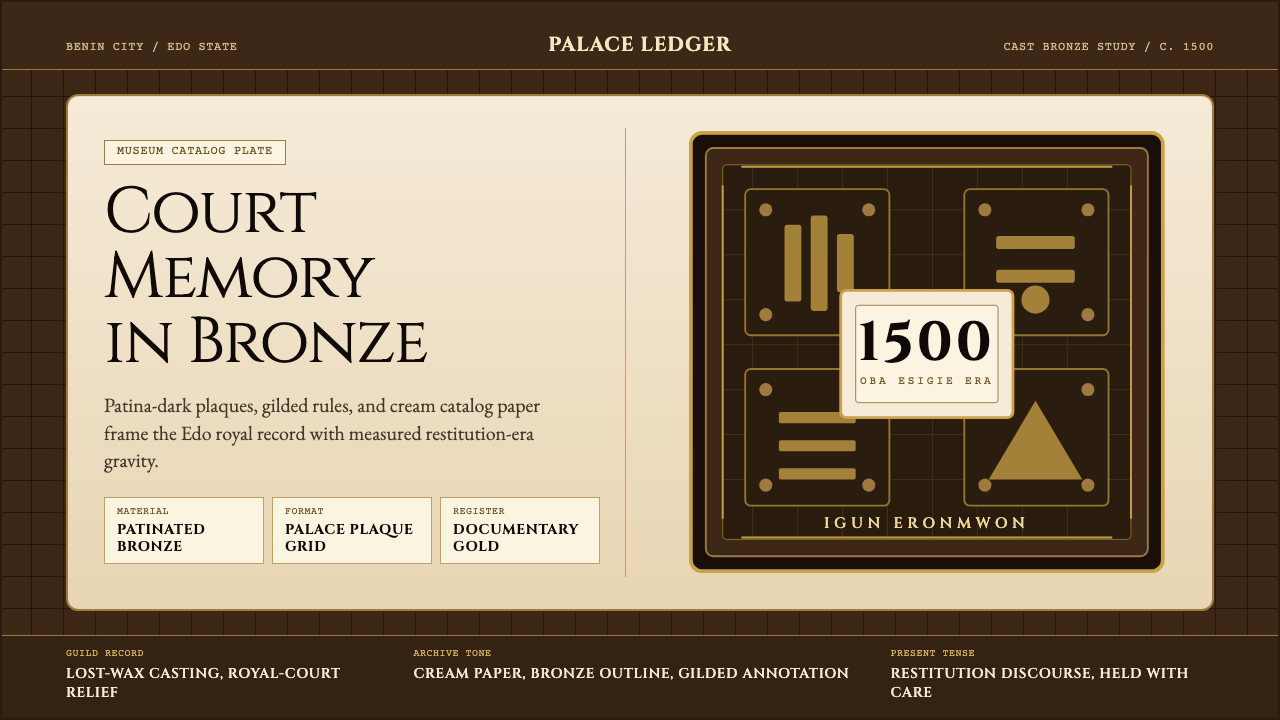
Cast in brass by royal guild smiths and kept behind palace walls for five centuries, the Benin Bronzes encode a kingdom's entire history in metal — and now ask the modern world what it owes them.
Benin Bronze (Edo, 1500) in brief
The Benin Bronzes are a corpus of several thousand brass and bronze plaques, portrait heads, freestanding figures, and ceremonial objects produced for the royal palace of the Oba — the divine king — of Benin City in what is now Edo State, southern Nigeria. Despite the name, the majority are cast from brass rather than pure bronze, the alloy sourced initially from trade with North Africa and later, beginning in the fifteenth century, from Portuguese maritime commerce. The works span roughly six centuries of continuous production by a hereditary guild of smiths, the Igun Eronmwon, whose craft knowledge was transmitted father to son under royal charter.
Visually, the pieces are distinguished by extraordinary technical refinement. The lost-wax casting method — in which a wax model is encased in clay, fired to drive out the wax, and then filled with molten metal — allowed craftsmen to capture facial features, woven textiles, coral beadwork, and military insignia in exacting relief. The surface reads as warm, deep amber in freshly polished brass, darkening over centuries to a rich, dimensional green-black patina that museum light turns into something between sculpture and painting. Portrait heads convey psychological individuality rarely matched in contemporaneous West African traditions. Rectangular narrative plaques, which once lined the palace pillars, function as both historical record and royal propaganda — dense with figures in layered relief, each detail of dress or weapon or posture carrying coded meaning.
As a design vocabulary, Benin Bronze draws on three visual registers at once: the warm metallic amber and gold of polished brass; the cool, aged green of oxidized bronze; and the spare, authoritative graphic language of museum catalog and scholarly documentation. Together they produce an aesthetic that is simultaneously ancient and archival — carrying the weight of deep time without collapsing into nostalgia. The palette is uncommonly dark and warm for a formal design system, the compositions tend toward density and layering rather than sparse geometry, and the overall effect conveys institutional gravity, cultural specificity, and a quality of hard-won permanence.

Where does Benin Bronze (Edo, 1500) come from?
The Edo kingdom of Benin traces its founding mythology to the Ogiso dynasty, but the political and artistic order recognizable in the bronzes dates to the Oba dynasty established around the thirteenth century. The Igun Eronmwon — the brass-casters' guild — was reportedly founded under Oba Oguola, who, according to oral history, requested a smith from the neighboring Yoruba city of Ife to teach the technique of brass casting to his court. From that founding moment, the guild operated under direct royal patronage: only the Oba could commission cast brass work, and the guild lived adjacent to the palace, their hereditary quarter still existing in Benin City today.
The apex of production came during the reign of Oba Esigie (r. approximately 1504–1550), a period that coincided with the expansion of Portuguese maritime trade along the West African coast. The Portuguese brought brass manillas — anklet-shaped ingots — as trade goods, and the Benin court converted these imports directly into raw material for the palace workshops. This access to abundant brass enabled a dramatic increase in both volume and scale of casting. Esigie was also the first Oba to commission a series of large rectangular plaques that would eventually number in the hundreds, documenting court ceremonies, military victories, diplomatic encounters, and dynastic history in a format that scholars have compared to illustrated manuscripts. The analogy is apt: both the European Renaissance codex and the Benin palace plaque served as official memory in visual form.
The kingdom remained a sophisticated and powerful polity for centuries after Esigie's reign, though production volumes varied with political fortunes. Oba Ehengbuda (r. approximately 1578–1608) is associated with a particularly rich period of casting, and multiple Obas across the seventeenth and eighteenth centuries continued to commission portrait heads — typically cast on the occasion of a royal death to honor the predecessor on an ancestral altar. These heads became progressively more stylized over time: the tall coral collar grew taller, the features more conventionalized, reflecting a shift from portraiture toward emblematic representation of the office of kingship itself.
The collection came to global attention — and was scattered globally — through the British Punitive Expedition of 1897. A British force, mounted in response to the killing of a trade delegation, looted the Oba's palace and removed approximately three to five thousand objects, which were subsequently sold to fund the expedition and dispersed across European museums, auction houses, and private collections. The British Museum in London holds the largest institutional collection; significant holdings also exist in Berlin's Humboldt Forum, the Ethnologisches Museum, the Weltmuseum Wien, and many other institutions. Since 2018, spurred by the Savoy-Sarr Report commissioned by the French government, the question of restitution has moved from academic debate to active negotiation. Several European institutions have agreed in principle to return objects; the Edo Museum of West African Art, under construction in Benin City, is designed to receive them. Oba Ewuare II, the current Oba, has been the primary voice of the restitution claim, giving the ancient artistic tradition a living, continuing institutional presence.
What defines the Benin Bronze (Edo, 1500) look?
Palette
The palette anchors itself in three tones derived directly from the material history of the bronzes: a warm, burnished amber-gold for freshly worked brass; a deep, muted green-black for centuries of oxidized patina; and a near-neutral warm cream standing in for ivory, aged parchment, and the linen mount of a museum display case. Against these three grounds, an accent of deeper ochre and a near-white highlight complete the system. The palette reads simultaneously luxurious and scholarly — it belongs to a king's treasury and a university archive at the same time.
Surface and Texture
Unlike design systems built on flat, clean digital surfaces, Benin Bronze embraces the suggestion of material depth. Backgrounds carry a faint, directional grain evoking cast metal or aged paper — enough to imply physical substance without simulating a specific photograph. Borders and dividing lines have weight and slight irregularity, as if incised rather than printed. The overall surface quality is that of something made rather than generated: tactile, deliberate, and slightly warm.
Relief and Layering
The defining spatial logic of the original plaques is stratified relief — multiple layers of figures and motifs overlapping at different depths, each plane casting a subtle shadow on the one below. Applied to screen and print, this translates to a layering discipline in which elements are organized at distinct visual depths using shadow, overlap, and scale differentiation. Shadows, when used, are cast rather than ambient: they have a definite direction and a consistent angle, implying a single, raking light source in the manner of a gallery spot aimed at a bronze plaque.
Typography Register
Type selections favor a quality of inscribed authority — letterforms with visible structure, moderate contrast between thick and thin strokes, and a slight formality that stops short of stiffness. Serif display type in the manner of classical inscriptions anchors titles and headings, lending the weight of stone or metal. Body text benefits from clear, open proportions to remain readable against the warm, textured grounds. Captions and metadata call for a narrower, more scholarly register — evocative of the compact annotation style found in museum catalog entries.
Iconography and Motif
The original bronzes draw on a specific iconographic vocabulary: the mudfish (symbolizing the Oba's link between human and spirit realms), the leopard (royal power and ferocity), the Portuguese soldier (a recurring alien presence in court imagery), the coral-bead regalia, the ceremonial sword known as the eben, and the guilloche-patterned border that frames many plaques. A design system drawing on this tradition uses these motifs sparingly and accurately — as framing devices, as stamp-like decorative marks, or as watermark-level background elements — rather than as decoration applied without cultural grounding.
Density and Hierarchy
Benin palace plaques are deliberately dense — they were meant to be read slowly, their meaning accumulated across repeated viewing. A design system carrying this character does not fear information density; instead, it manages density through clear hierarchical structure. Primary content is large and centered or prominently placed; secondary content is smaller and flanked by generous spacing that separates it from, rather than integrates it with, the primary layer. The overall impression is of a composition that rewards close reading rather than one that yields all its information at a glance.
Gravity and Ceremony
The original bronzes were ceremonial objects housed in a royal palace — they were never meant to be casual or quickly consumed. This ceremonial weight carries into the design system as a general disposition against throwaway elements: there are no playful squiggles, no informal doodle-like marks, no light-hearted pastels. Every compositional choice carries intentional weight. This gravity is an asset in contexts where trust, authority, and depth of expertise must be communicated — and a mismatch in contexts calling for approachability and lightness.

Who shaped Benin Bronze (Edo, 1500)?
Oba Esigie, who ruled approximately from 1504 to 1550, presided over the most documented flowering of Benin brass casting. His reign coincided with sustained Portuguese contact, which supplied the brass manillas that fueled an expansion in workshop output. Esigie was a warrior-king who also engaged in diplomatic correspondence with the Portuguese crown, and it was during his rule that the rectangular narrative plaques — the form most frequently reproduced in global museum collections — reached their full development. He is also credited with elevating his mother, Idia, to the position of Queen Mother, a role commemorated in some of the most psychologically compelling portrait heads in the entire corpus.
The thirty-ninth Oba of Benin and the incumbent monarch, Ewuare II has transformed the ancient institution of kingship into a highly visible advocate for the return of Benin artworks scattered across European institutions. Since his coronation in 2016, he has met with museum directors, addressed international forums, and been a principal interlocutor in negotiations with German, British, and Dutch institutions. His public presence gives the restitution movement a legitimate traditional authority — it is not merely a postcolonial academic argument but a living king pressing a claim on behalf of his ancestors and his community.
The French art historian Bénédicte Savoy and the Senegalese economist and philosopher Felwine Sarr co-authored the 2018 report commissioned by French President Emmanuel Macron on the restitution of African cultural heritage. Their report — which recommended the unconditional return of objects taken without consent during the colonial period — shifted the institutional conversation decisively. It led directly to France's restitution of twenty-six Benin objects to the Republic of Benin in 2021 (a different, adjacent nation) and set the terms for ongoing negotiations with British, German, and other European institutions. Savoy and Sarr did not discover the Benin Bronzes — scholars had debated their status for decades — but they gave the argument a policy instrument that changed what was possible.
The Igun Eronmwon — the hereditary guild of brass casters — is not a single individual but an institution that functions almost like a co-author of the entire corpus. Founded under royal charter and headquartered in their traditional quarter of Benin City (Igun Street, which still exists), guild members have passed the lost-wax casting technique from father to son across some thirty generations. The guild was recognized by UNESCO as part of the Intangible Cultural Heritage of Humanity in 2023. Unlike most craft traditions whose knowledge is dispersed or interrupted, the Igun Eronmwon represent genuine continuity: contemporary guild smiths can trace an unbroken chain of instruction back to the fifteenth century.
Oba Ehengbuda, who ruled approximately from 1578 to 1608, is associated with an exceptionally refined period of portrait head casting. The heads attributed to his era display a shift toward greater psychological individualization — the coral collar is taller, the features more precisely observed, and the overall surface modeling more complex than in earlier works. Ehengbuda is also noted in court oral history for compositions that integrated the human figure more fully into narrative scenes, including mounted warriors on horseback — a technical challenge in lost-wax casting that the guild met with remarkable success.
How do you use Benin Bronze (Edo, 1500) today?
Benin Bronze is one of the few historical design systems whose application requires genuine cultural awareness rather than merely visual imitation. Deploying it effectively means understanding that the aesthetic carries specific meaning — it signals antiquity, institutional authority, material richness, and an ongoing conversation about cultural ownership and restitution. For products and communications where those associations are relevant and welcome, the style delivers a depth of presence that is genuinely difficult to achieve with more contemporary systems. For products where those associations are irrelevant or awkward, a different system will serve better.
For presentation slides, the style suits high-stakes communications: pitch decks for institutions, academic conference presentations, exhibition catalogs, and any context where the content is dense, consequential, and merits slow reading. Cover slides work best with a single large motif — a panel detail, an abstracted plaque border, or a bold catalog-style heading — set against a warm near-black or deep amber ground. Content slides should treat information in hierarchical layers: a primary statement at display scale, supporting text at reading scale, and footnote-level annotation at caption scale. Data visualizations take on the quality of scholarly diagrams — bar and area charts rendered in the palette's amber and cream tones against a dark ground, with annotations in the narrow, scholarly type register.
For web interfaces, Benin Bronze is best suited to contexts with genuine archival or institutional weight: museum digital experiences, academic research platforms, cultural heritage documentation tools, auction-catalog-style pricing pages, or editorial mastheads for serious long-form journalism. The approach centers on a warm dark ground with cream and amber content layers. Navigation is typographic and sparing — wordmarks and section labels in the inscribed display type, with no casual icon decoration. Cards and content panels are bordered rather than shadowed, with borders carrying visible weight in the manner of a ruled folio.
For editorial and marketing contexts, the style supports long-form feature writing, annual reports, academic journals, and institutional communications where gravitas is the primary register. A full-width editorial spread works well with a large bronze-toned image occupying one page, the opposing page carrying typeset text with a generous outer margin reserved for annotations and pull quotes. Marketing communications that adopt this system signal that the brand takes itself seriously and positions its audience as discerning adults — the tone is closer to a museum catalog or a financial publication than to a consumer lifestyle brand.
The most common mistake when applying Benin Bronze is treating the amber-and-dark palette as a simple dark-mode alternative and adding contemporary interface conventions — soft card shadows, rounded corners, high-saturation accent colors, or playful microcopy — without regard for the aesthetic logic the palette implies. The style's authority comes from restraint and coherence. A second common error is using the historical motifs — the mudfish, the leopard, the guilloche border — as generic decoration without acknowledging their specific cultural meaning. Applied casually, this tips from informed reference into appropriation. The appropriate use is either to employ the motifs with clear cultural contextualization, or to work with the palette and typographic register alone, leaving the figurative vocabulary aside entirely.

Benin Bronze (Edo, 1500) — FAQ
Is it appropriate to use Benin Bronze aesthetics in commercial design work?
The question deserves a more nuanced answer than a simple yes or no. Using the palette, layering logic, and typographic register of this system — the formal visual properties derived from how museum scholars present the bronzes — is qualitatively different from reproducing the sacred iconography of the original objects. A design system inspired by the aesthetic language of Benin court arts and their archival documentation is an act of informed reference; using the eben sword motif or a specific head portrait as a logo mark, without cultural context, is a different matter. Responsible application involves transparency about the source, restraint with the figurative vocabulary, and an awareness that the bronzes are still the subject of active legal and diplomatic proceedings.
How does Benin Bronze differ from other African-inspired design aesthetics?
Most commercially available African-inspired aesthetics draw on a generalized vocabulary — Kente patterns, Adinkra symbols, warm savanna palettes — that blurs national, ethnic, and historical specificity in favor of continental signaling. Benin Bronze is tightly historically specific: it is tied to a single court tradition, a dateable period, a named guild, a specific material technology, and an ongoing political discourse about ownership and restitution. This specificity is both its strength and its limitation. Used with accuracy, it carries a depth and particularity that generic Afrocentric aesthetics cannot approach. Used casually, it conflates distinct traditions in exactly the way the original objects resist.
Can the style work in a light-background application, or does it require a dark ground?
The historic bronzes are typically photographed against dark or near-neutral grounds in museum contexts, and the design system's dark-ground variant is the more authoritative expression. However, a light-ground version is entirely viable and is often more practical for long-form reading contexts. The key is reversing the relationship correctly: warm cream becomes the dominant background, deep green-black is reserved for display type and primary borders, and the amber-gold accent is used for emphasis rather than ground. The layering logic remains — borders, incised-style rules, and cast-shadow detail — but the overall register shifts from nocturnal and monumental toward daytime archival and scholarly.
How should imagery and photography be incorporated into this design system?
Photography works best when treated in a manner consistent with museum reproduction standards: full-frame detail shots of the bronze surfaces themselves, high-contrast images emphasizing material texture, and catalog-style documentation photography with controlled, raking light. When photography depicts people or scenes unrelated to the historical bronzes, it benefits from processing that aligns it with the palette — warm amber toning, increased contrast, slightly reduced mid-tone saturation — so that it reads as part of the same visual system rather than as a foreign element dropped into an archival layout. The original objects' surface qualities — the incised lines, the raised relief, the grain of aged metal — are far more evocative than generic stock imagery.
Is there a risk that this aesthetic reads as 'dark mode' rather than as something historically grounded?
Yes, and it is a real design risk worth managing actively. A dark background with amber accents, absent other signals, can read as a generic premium dark UI. The differentiating elements are: the warm, slightly textured ground (as opposed to a flat cool dark); the inscribed-quality typography with visible stroke contrast; the cast-shadow rather than drop-shadow depth treatment; the bordered rather than shadowed card convention; and the deliberate density of the composition. Taken together, these signal a historical reference rather than a contemporary dark-mode aesthetic. If any one of these elements is omitted in favor of a more contemporary convention, the historical grounding weakens perceptibly — and the design risks reading as sophisticated but placeless.
Related design styles
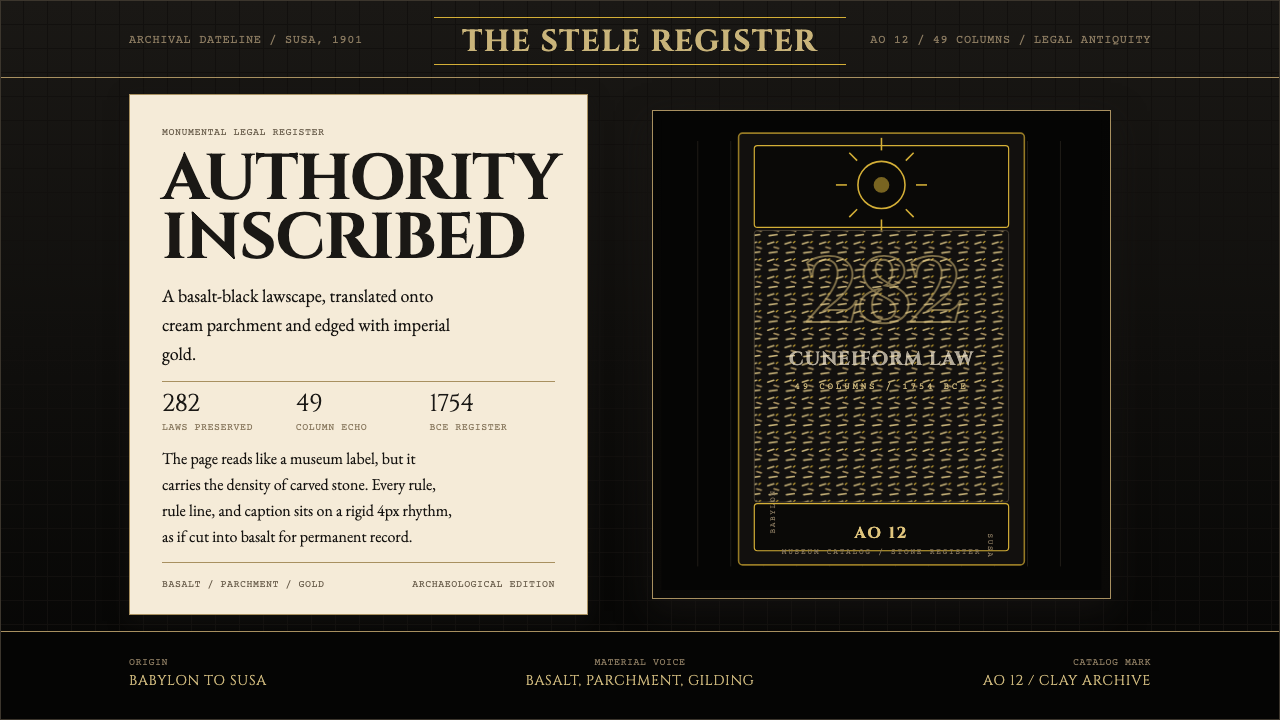 Babylonian Hammurabi SteleAuthority carved in stone. Basalt-black grids, parchment panels, and imperial…
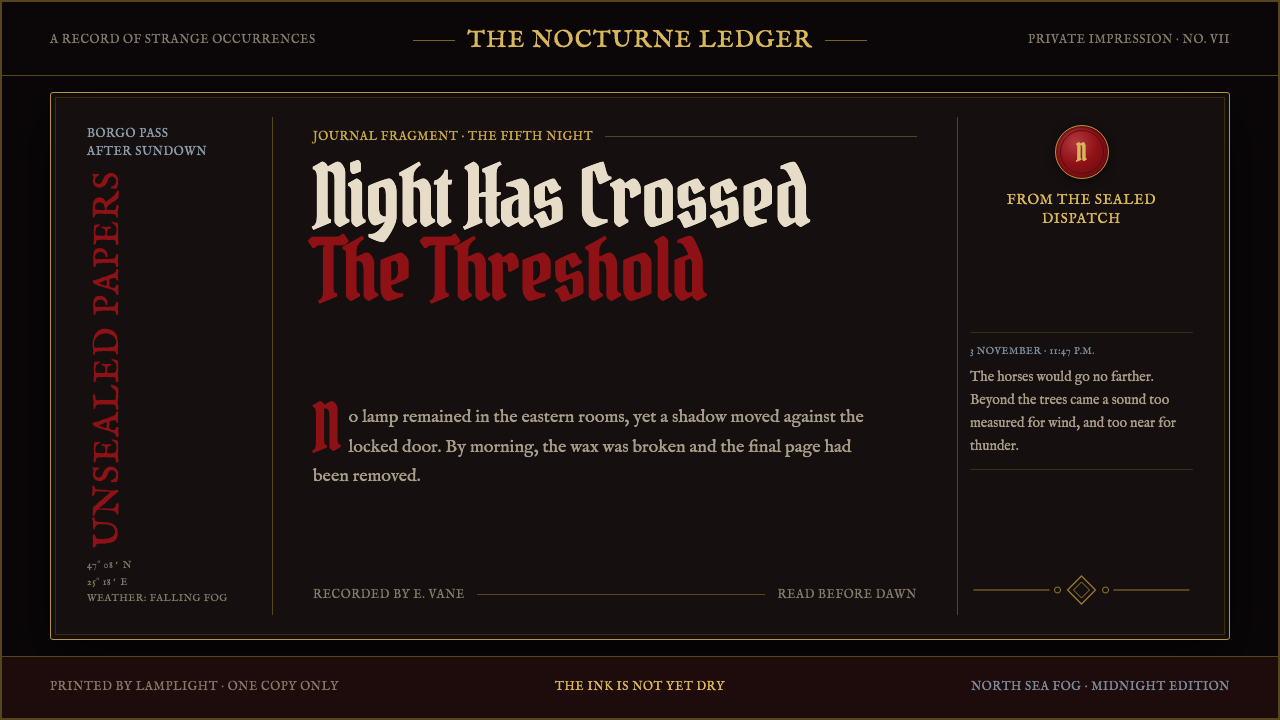 Dracula Gothic (1897)Victorian dread after dark. Blood-red initials and tarnished gilt haunt coffi…
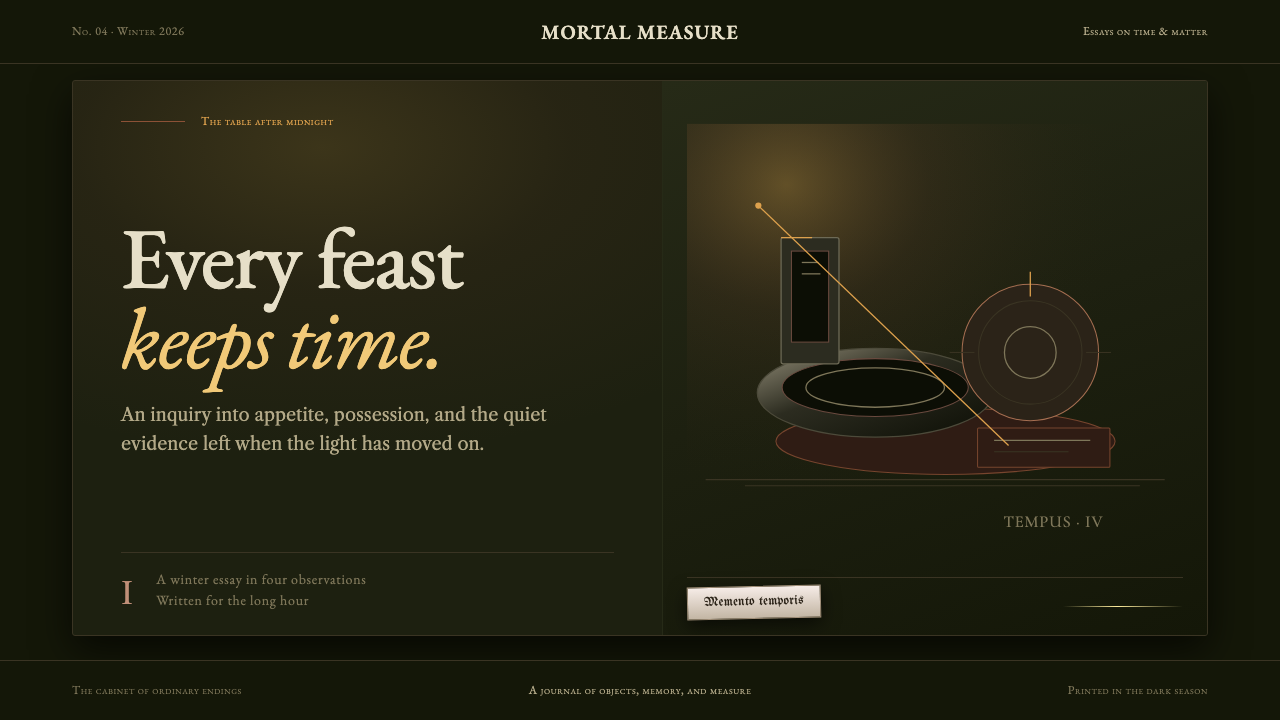 Dutch VanitasTime waits at the table. Olive-black depths, earth-brown type, and one candle…
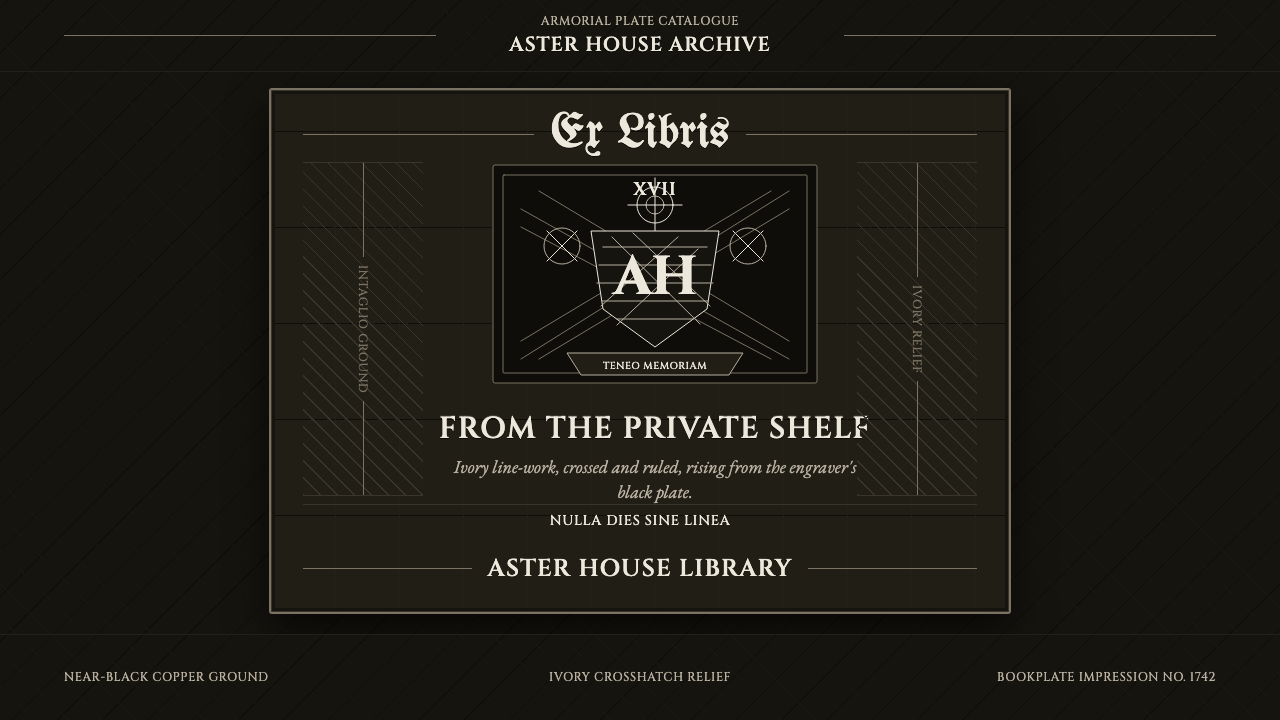 Ex Libris BookplateScholarly ownership, cut in ivory. Cinzel caps and crosshatch rules rise from…
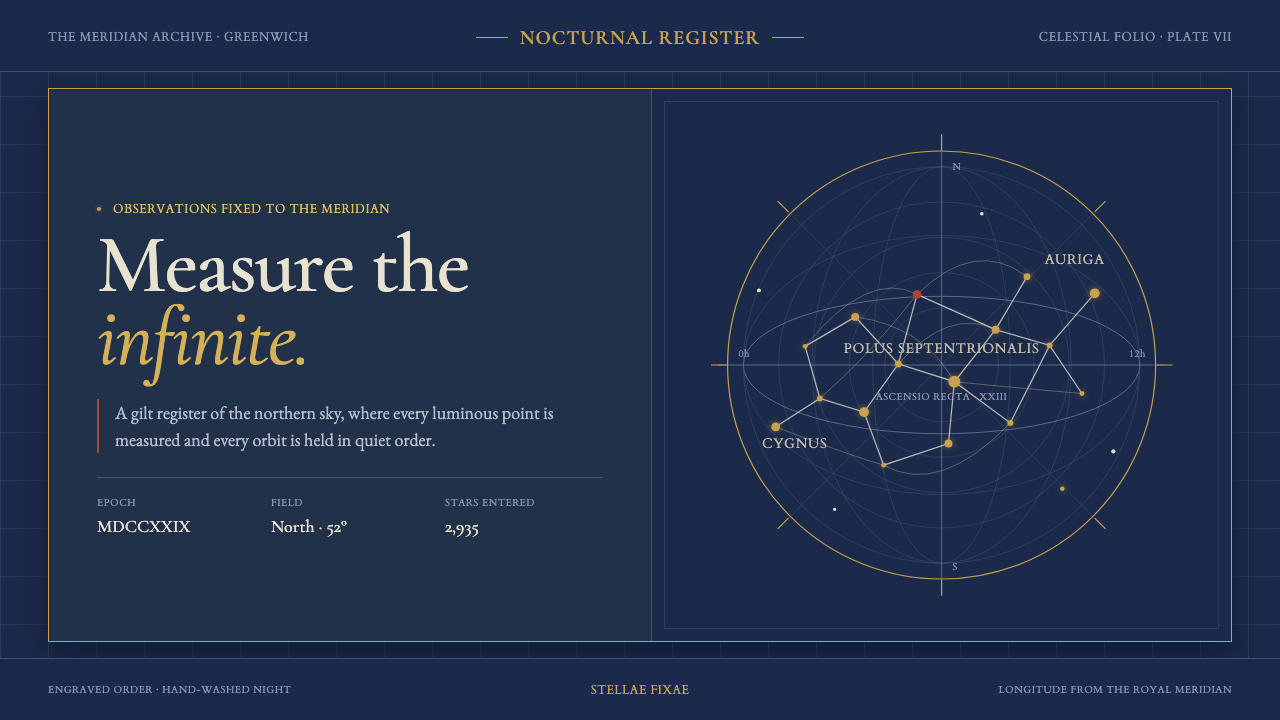 Flamsteed Atlas CoelestisMeasurement wears mythology. Ivory engravings and gilt stars cross a deep ind…
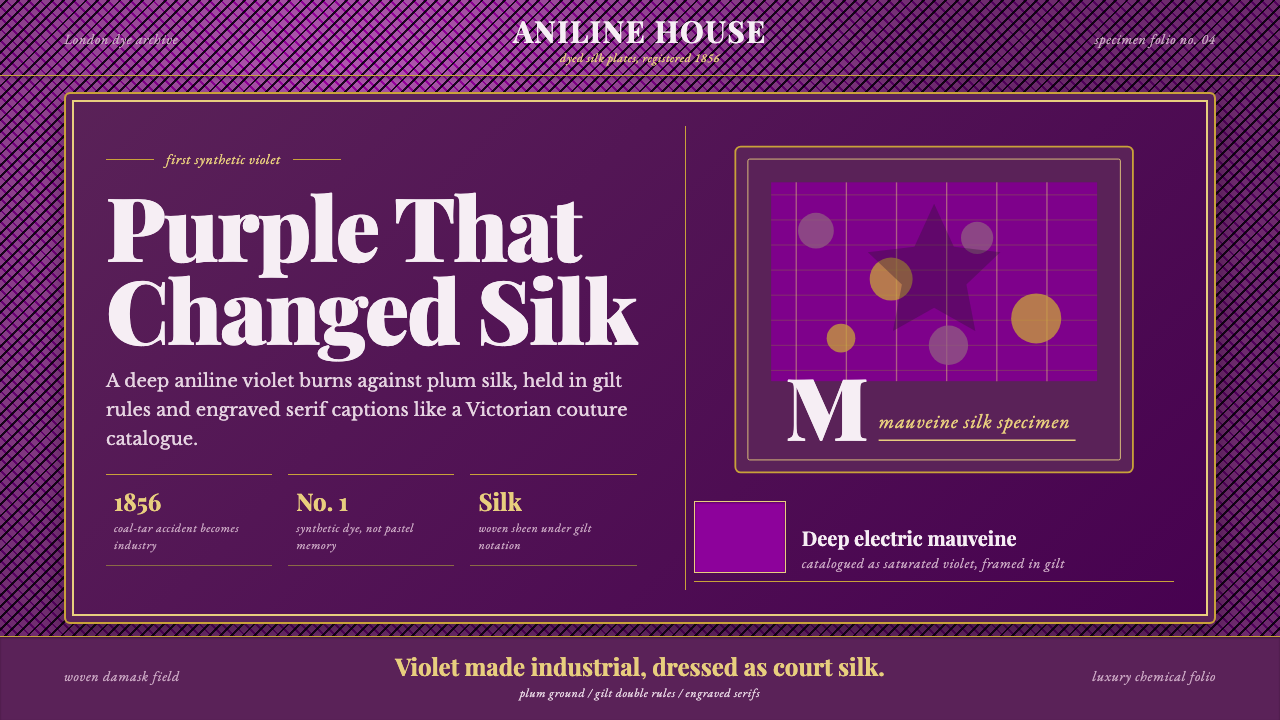 Mauveine (Perkin 1856)Electric purple, framed as luxury. Gilt rules and Playfair serifs turn dye in…