What is Vermeer Dutch Golden Age?
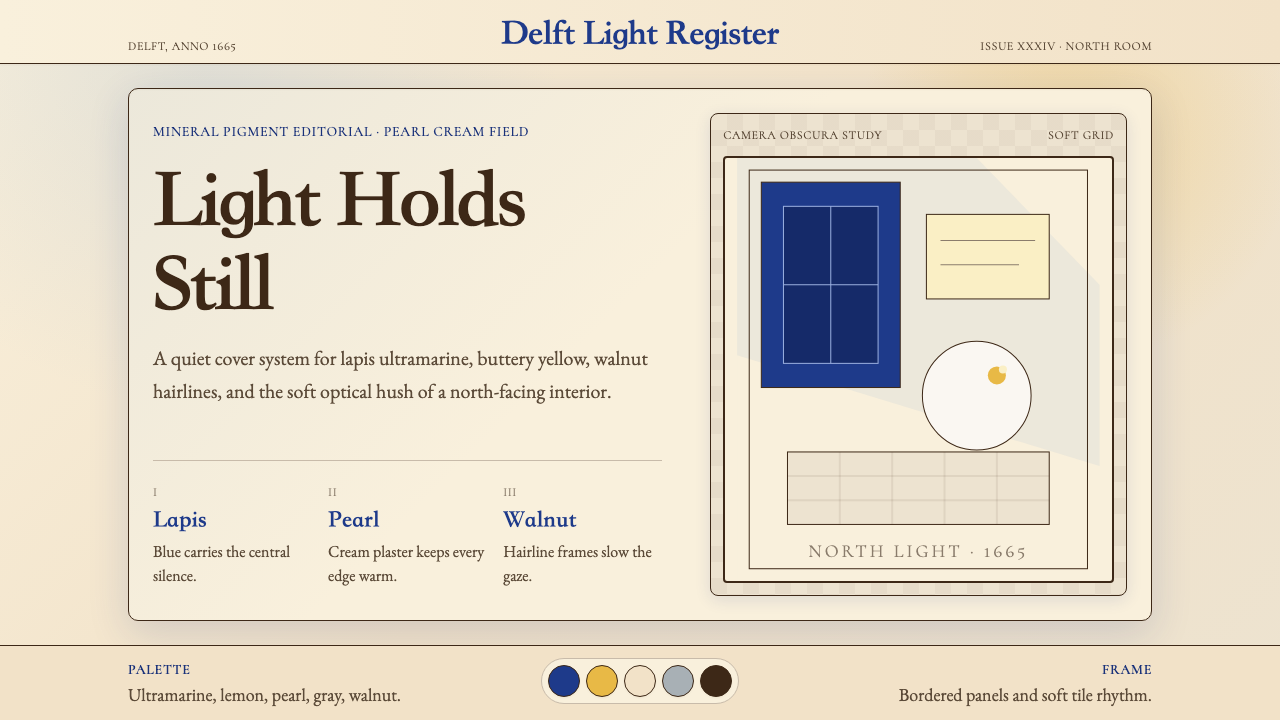
In every Vermeer, a north window carves stillness from shadow — and that quality of light, patient and precise, is this system's founding principle.
Vermeer Dutch Golden Age in brief
The Vermeer Dutch Golden Age aesthetic draws from Johannes Vermeer's approximately thirty-four surviving paintings, produced in Delft between roughly 1656 and 1675. The visual language is defined by the quality of cool, diffused north-window light falling across domestic interiors — pearl-white plaster walls, lapis lazuli ultramarine drapery, buttery lemon-yellow jackets, warm walnut and ebony furniture. Every surface is rendered with the optical precision that led later scholars to speculate Vermeer used a camera obscura as a compositional aid.
As a design aesthetic, this system translates mineral-pigment richness into a contemplative editorial register. The palette is narrow and deeply saturated only in specific roles — the famous Vermeer blue anchors weight, the warm creams and off-whites carry light, and muted ochres and umbers tie background planes together. Compositions are intimate in scale, centered on a single subject or gesture, with generous peripheral silence. Nothing competes with the central luminous moment.
The style is best described as meditative clarity — the opposite of Baroque theatrical drama, even though it shares the same era. Vermeer was interested in ordinary moments rendered extraordinary by attention: a woman reading a letter, milk being poured, a lace-maker bent over her pillow. That same quality of devoted, unhurried attention to a single subject is what distinguishes a genuine Vermeer-derived design from surface-level period pastiche.

Where does Vermeer Dutch Golden Age come from?
Johannes Vermeer was born in Delft in 1632, the son of a silk-weaver turned art dealer. He lived his entire life within a few streets of the market square, joined the painters' guild of Saint Luke in 1653, and died in 1675 leaving his wife Catharina Bolnes and eleven children deep in debt. During his lifetime he had a modest regional reputation; the grand rediscovery came nearly two centuries later, in 1866, when the French journalist and critic Théophile Thoré-Bürger published a landmark article attributing some seventy paintings to Vermeer's hand. The subsequent verification and pruning of that attribution list to the current approximate thirty-four is itself a story of connoisseurship, scientific analysis, and occasional fraud.
Vermeer worked within the Delft School, a loose grouping of Dutch Golden Age painters — including Pieter de Hooch and Carel Fabritius — who shared an interest in the domestic interior as subject, in architectural perspectival space, and in the careful observation of how light behaves on different surfaces. The Dutch Golden Age was made possible by the extraordinary commercial wealth of the Dutch Republic: Amsterdam and the port cities controlled a significant fraction of global trade, and this prosperity created both a large merchant class with disposable income to spend on paintings and a domestic culture that prized the home as a site of comfort, order, and moral virtue. Genre painting — scenes of everyday middle-class life — arose to meet this demand.
The camera obscura hypothesis, debated since the art historian Philip Steadman's geometric analysis in 2001, holds that Vermeer projected the scene through a lens onto a ground-glass screen or canvas and traced the optical image. Whether or not this is literally true — and many scholars remain skeptical — the hypothesis captures something essential about the Vermeer aesthetic: the interest in optical truth, in the way light halos around a white collar or halates on a window ledge, in the slight softening of objects not at the plane of sharpest focus. These are qualities derived from optical instruments, whether or not Vermeer used one.
The pigments Vermeer used were among the most expensive available in seventeenth-century Europe. Natural ultramarine, ground from lapis lazuli mined in Afghanistan and traded across the continent, cost more per weight than gold. Vermeer used it lavishly — not just in skies but in shadows, in fabric folds, in the modulation of wall plaster — which is part of why his estate was insolvent at his death. Lead white, smalt, yellow ochre, vermilion, and bone black round out the palette. These were applied in thin, translucent glazes over opaque underlayers, which accounts for the luminous depth that distinguishes Vermeer's surfaces from those of contemporaries working more directly.
What defines the Vermeer Dutch Golden Age look?
Light Source
All illumination enters from a single direction — invariably the left side, from a high north-facing window. This produces a characteristic gradient: one side of every form catches cool, bright daylight while the opposite side recedes into warm, muted shadow. The light is diffused and soft rather than the raking theatrical spotlight of Caravaggio or the Dutch tradition of candlelight painters. Interiors are neither fully lit nor dramaticaly dark — they are in a state of luminous equilibrium, where shadows still hold color and the lit surfaces glow with contained radiance.
Palette Restraint
The Vermeer palette is simultaneously rich and narrow. The dominant ground tones are creamy off-whites, warm stone beiges, and chalky plaster greys — large, quiet fields that give luminous accents room to breathe. Against these grounds, two signature chromatic moments define each composition: a deep lapis-derived blue, cool and saturated, and a warm lemon or golden yellow. These two accent colors rarely appear at full intensity simultaneously; more often one dominates while the other plays a supporting role in a smaller area. Supporting neutrals — warm umber, muted ochre, dark ebony brown — provide structural framing without competing.
Compositional Framing
Vermeer's compositions are structured by architectural elements — window frames, wall surfaces, table edges, tiled floors — that create a series of rectangles within the rectangle of the picture plane. These inner frames anchor the subject and establish measured spatial recession. The subject is almost never centered symmetrically; instead, it occupies a slightly off-center position within a generous field, often with empty foreground space that creates breathing room between the viewer and the scene. Furniture, maps, and fabric create secondary planes that layer depth without busy detail.
Texture and Surface
Vermeer differentiates surfaces through the behavior of light on them rather than through outline or graphic contrast. Silk catches light at sharp angles and produces bright specular highlights; wool absorbs and scatters it; plaster is matte and slightly granular; pearls produce a soft, rounded glow distinct from metallic shine. In design application, this translates to a strong material hierarchy: surfaces that should advance use brighter, cooler treatment; surfaces that should recede use warmer, more diffuse treatment. The eye learns to read value gradation as material identity.
Focused Stillness
Every Vermeer shows a figure in the midst of an ordinary, absorbed action — reading, pouring, weighing, sewing. There is no narrative drama, no conflict, no audience address. The figure is complete within itself. In design terms, this translates to compositions with a single clear primary focus — one object, one data point, one headline — surrounded by sufficient quiet space that the eye is not required to choose between competing elements. Secondary information supports rather than competes.
Optical Softness
Objects at the edges of Vermeer's compositions — or those not at the artist's plane of sharpest attention — are rendered with less edge definition, a technique consistent with the depth-of-field behavior of a lens. This is distinct from generic soft-focus or blurring: foreground elements can be softened while midground elements are sharply delineated. In design application, this principle supports selective focus through varying levels of visual sharpness across a composition — sharp edges at the center of attention, softer treatment in supporting zones — without resorting to literal photographic blur.
Intimate Scale
Vermeer's paintings are physically small — the largest, The Art of Painting, measures roughly half a meter by less than half a meter on its smallest dimension. They are paintings made to be seen closely, in a domestic setting, at human scale. This intimate dimensionality is a core aesthetic value: no element overwhelms, nothing is monumental, everything is considered at the scale of a person in a room. Design derived from Vermeer should maintain this quality of considered intimacy — tight spatial relationships, measured proportions, a sense that each element has been placed with deliberate, quiet care rather than broad gestural confidence.

Who shaped Vermeer Dutch Golden Age?
Vermeer (1632–1675) was a Delft painter who joined the Guild of Saint Luke in 1653. Extraordinarily little is documented about his working methods, patrons, or training — he left no letters, no drawings, and only the thirty-four or so paintings. His output was low relative to contemporaries, suggesting either a very deliberate working pace or concurrent activity as an art dealer. His rediscovery by Thoré-Bürger in 1866 sparked the modern Vermeer cult; subsequent generations of critics, novelists, and scientists have debated the camera obscura question, the identity of sitters, and the sourcing of his extraordinary lapis ultramarine. His Girl with a Pearl Earring (c. 1665) became one of the most recognized images in Western art history.
Pieter de Hooch (1629–1684) was Vermeer's near-contemporary in Delft before moving to Amsterdam. His domestic interiors share the formal preoccupations that define the Delft School: perspectival architectural space, the fall of light through doors and windows, figures absorbed in household tasks. De Hooch is more architecturally complex than Vermeer — he often shows multiple rooms or outdoor-indoor transitions — and less interested in the concentrated luminous moment. Comparing the two painters clarifies what is specifically Vermeer's: the reduction to a single window, a single figure, a single arrested gesture.
Thoré-Bürger (1807–1869) was a French art critic and political journalist who, in exile following the failed revolutions of 1848, used the pen name 'William Bürger' and threw himself into Dutch seventeenth-century art. His 1866 article in the Gazette des Beaux-Arts was the first systematic scholarly treatment of Vermeer, correctly attributing works scattered across European collections under various names and establishing the canon that subsequent scholarship would refine. Without Thoré-Bürger's detective work, the Vermeer aesthetic as we understand it would not exist as a distinct design language — it would remain a handful of unnamed genre paintings.
Catharina Bolnes (1631–1687) was Vermeer's wife and, with her mother Maria Thins, a significant financial and social support during his career. Their marriage required Vermeer to convert to Catholicism — an uncommon but not impossible arrangement in the Dutch Republic. After his death, Catharina fought creditors and attempted to preserve his estate; she is believed by some scholars to appear in one or more of his paintings, though no identification is certain. Her role is a reminder that the Vermeer interior is also a record of real domestic life, made within a specific household with specific economic and social pressures.
How do you use Vermeer Dutch Golden Age today?
The Vermeer aesthetic is among the most specifically calibrated historical styles available to contemporary designers — its strength comes from restraint, not richness, and from the quality of a single focused moment rather than variety or busyness. Applying it correctly means committing to its core discipline: one light direction, a limited palette weighted toward quiet creams and deep blues with warm accent, generous empty space around a single subject, and deliberate material hierarchy established through light and shadow rather than outline.
For presentation slides, the Vermeer approach works exceptionally well on feature or cover slides where a single image or idea deserves full attention. A cover benefits from a large central figure or object set against a warm off-white or plaster-grey ground, lit from the left, with title type set in a warm dark brown or deep blue rather than pure black. Content slides should be treated as document pages rather than infographics: generous margins, a comfortable text measure, section headers set in a slightly larger size with more weight, and visual dividers that evoke a ruled edge or a dark wooden frame. Data slides should resist the temptation of color-coding multiple series — Vermeer works best when data is presented in one or two tones, with the main value in the characteristic blue and supporting values in warm neutrals.
For web interfaces and dashboards, the style suits contexts where trustworthiness, depth, and considered quality are the dominant values — financial products, premium editorial platforms, professional portfolio sites. The approach: a warm off-white or very light stone background carries all primary content; deep lapis blue appears as the primary interactive and accent color; text uses a warm near-black rather than pure black, reducing the stark contrast that would feel more Swiss than Dutch. Card components should have a softened shadow — not the hard-offset Bauhaus kind, but a gentle diffused shadow that evokes the way furniture sits against a plastered wall. Navigation should be understated, typographic, and uncluttered.
For editorial and marketing work, Vermeer-derived layouts achieve their greatest power in long-form reading environments and hero sections where a single image can hold sustained attention. An article layout works well with a wide measure for immersive body text, restrained use of the ultramarine accent for pull-quotes or section markers, and imagery treated with a slight warm cast that recalls period pigment. Marketing pages benefit from the contrast between large, quiet hero spaces and carefully placed detail moments — a single product on a neutral ground, lit from the side, with enough peripheral space that the product appears to breathe. The style pairs exceptionally well with photography of still-life subjects, textiles, ceramics, and objects with surface texture.
A common mistake when applying this style is treating the Vermeer palette as simply muted or desaturated — adding grey to all colors and calling it done. Authentic Vermeer-derived work is not low-chroma across the board; the blues are genuinely deep and saturated, the yellows are warm and clear, and only the grounds and neutrals are kept quiet. Simultaneously, another error is using too many accent colors: a Vermeer composition typically uses one dominant chromatic accent. Using both the ultramarine blue and the warm yellow as coequal accents in the same composition breaks the focused quality that defines the style. Choose one to lead; let the other appear only briefly.

Vermeer Dutch Golden Age — FAQ
Is the Vermeer style the same as general Dutch Golden Age design?
No. The Dutch Golden Age produced an enormous range of visual work — from the high-contrast theatrical drama of Rembrandt's chiaroscuro to the exuberant floral arrangements of Jan Davidsz de Heem, from Delft blue-and-white ceramics to the topographical precision of cartographic prints. Vermeer's domestic-interior genre represents one specific strain within this breadth: the Delft School's interest in daylit interiors, absorbed figures, and optical surface rendering. The Vermeer aesthetic is defined by restraint, interior stillness, and the quality of diffused north light — qualities that are not typical of the broader Dutch Golden Age, which frequently favors drama, richness, and decorative complexity.
Can the Vermeer aesthetic work in a dark or night-mode interface?
With significant adaptation, yes — but the canonical Vermeer aesthetic is fundamentally a light-ground system. The characteristic luminosity comes from cool north light falling on warm pale surfaces; on a dark background, that specific light quality disappears. A dark adaptation works best if it is conceived as a candlelit Vermeer rather than a daylit one — deep warm grounds in deep amber or umber tones, with the characteristic blue used as a cooler accent rather than the dominant anchor. The lemon yellow should be used very sparingly in dark contexts, as it can become glaring. Be aware that dark adaptations will feel closer to the broader Dutch Golden Age tradition of night-scene or candlelight painting than to Vermeer specifically.
How does the Vermeer style handle typography?
The Vermeer aesthetic has no direct historical typography reference in the way that Bauhaus has its Universal typeface or Art Nouveau has its organic letterforms — Vermeer was a painter, not a typographer or printer. Contemporary application therefore draws on the visual qualities of the painting rather than period Dutch typography. The appropriate typeface sensibility is warm, humanist, and unhurried: letter forms with subtle contrast in stroke weight, a slight lean toward traditional rather than geometric construction, and generous spacing that allows each letter to breathe. Heavy geometric sans-serifs feel alien to the system; so do highly stylized display faces. Type should recede into the composition as furniture recedes into a Vermeer interior — present, functional, and quietly considered, never competing with the central luminous subject.
What types of products or brands are a poor fit for this style?
The Vermeer aesthetic performs poorly in contexts that require speed, high energy, or loud visual signaling. Entertainment platforms, fast food brands, youth fashion, sports and fitness products, and anything that relies on immediate high-impact attention-grabbing will find the style's quietness working against the communication goal. The style is also a poor fit for highly technical products where diagrammatic clarity — precise edge differentiation, multiple color-coded categories, dense information — takes precedence over atmosphere. Finally, products or services that need to communicate global accessibility and cultural neutrality may find the style's very specific Western European seventeenth-century reference carries unwanted cultural weight.
How do you balance the characteristic Vermeer blue with the warm neutrals without one overpowering the other?
The key is proportion, not value. Vermeer blue is a genuinely saturated, cool, and deep hue — it reads as heavy and anchoring in even a small area. Warm creams and beiges are large, quiet fields. The relationship that works is the same one Vermeer himself used: let the warm neutral occupy the majority of the composition, reserve the blue for a meaningful minority — a focal drapery, a significant UI element, a key data bar — and trust that a small area of deep blue against a large area of quiet warm will create the luminous contrast you are after. When the blue area grows beyond roughly a quarter of the composition, the balance tips and the warmth of the ground disappears. Introducing the lemon yellow as a tertiary accent at very small scale — a highlight, a label, a small detail — can restore warmth without expanding the blue.
Related design styles
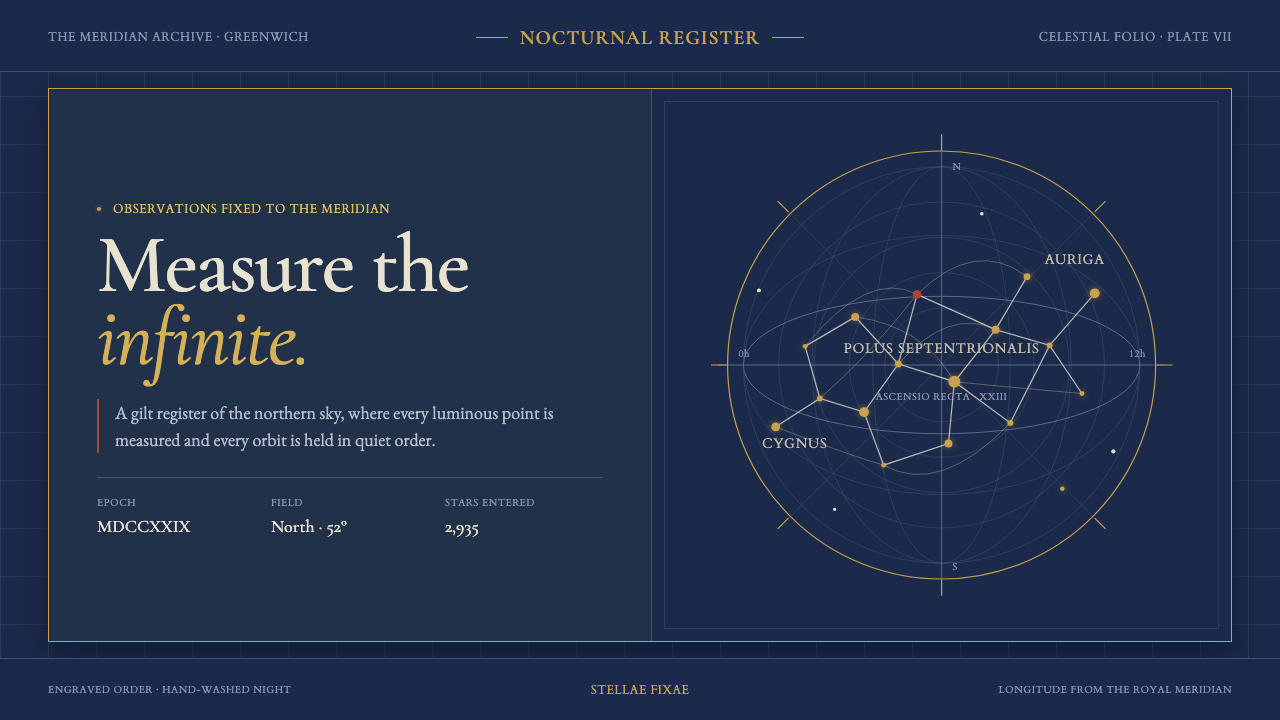 Flamsteed Atlas CoelestisMeasurement wears mythology. Ivory engravings and gilt stars cross a deep ind…
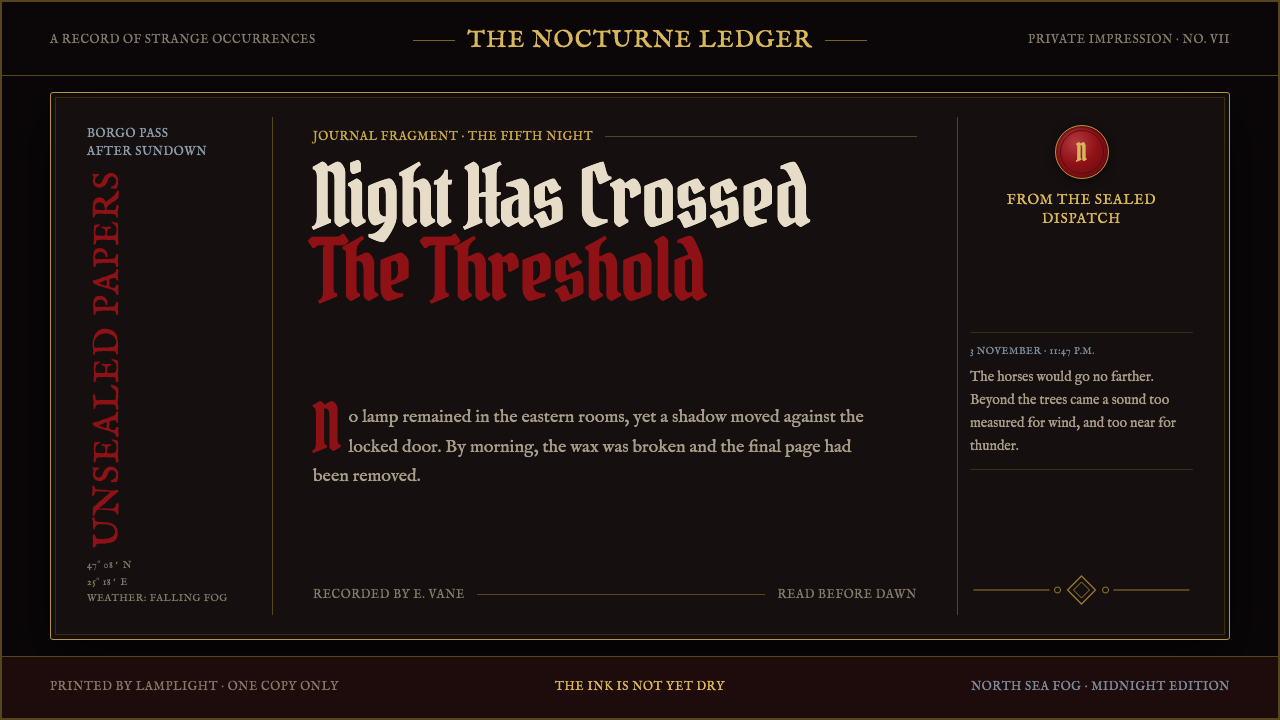 Dracula Gothic (1897)Victorian dread after dark. Blood-red initials and tarnished gilt haunt coffi…
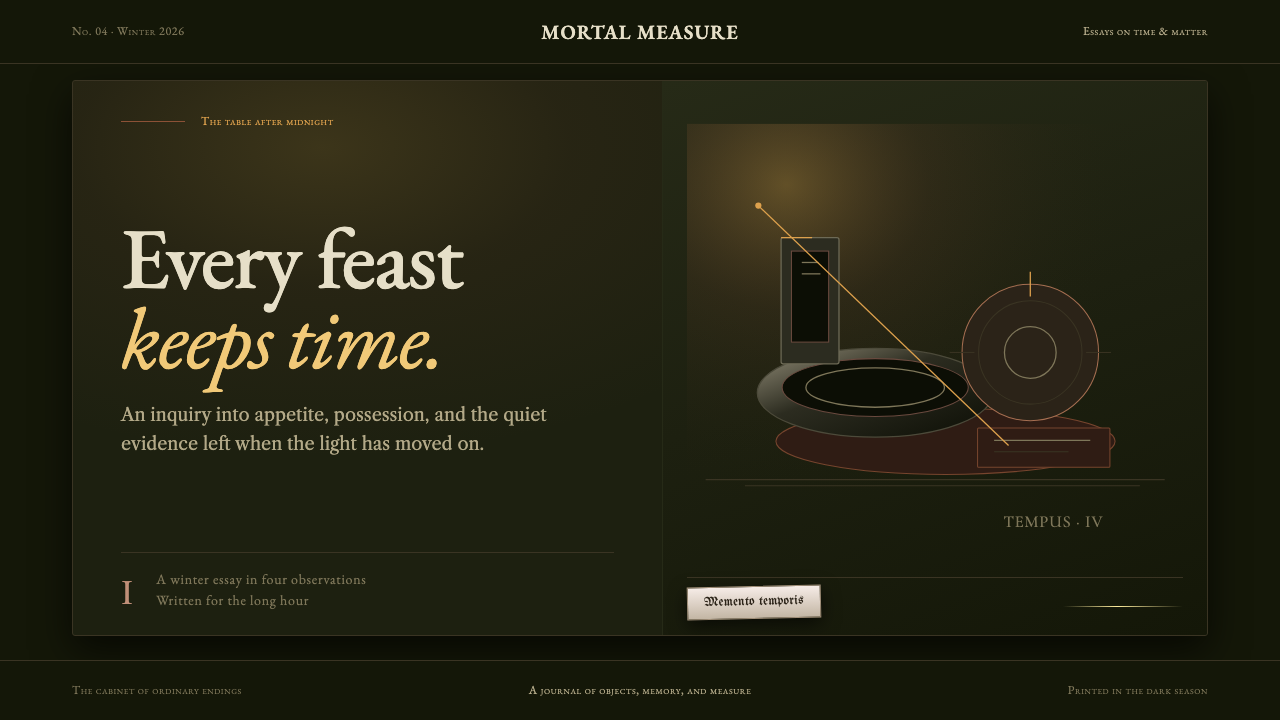 Dutch VanitasTime waits at the table. Olive-black depths, earth-brown type, and one candle…
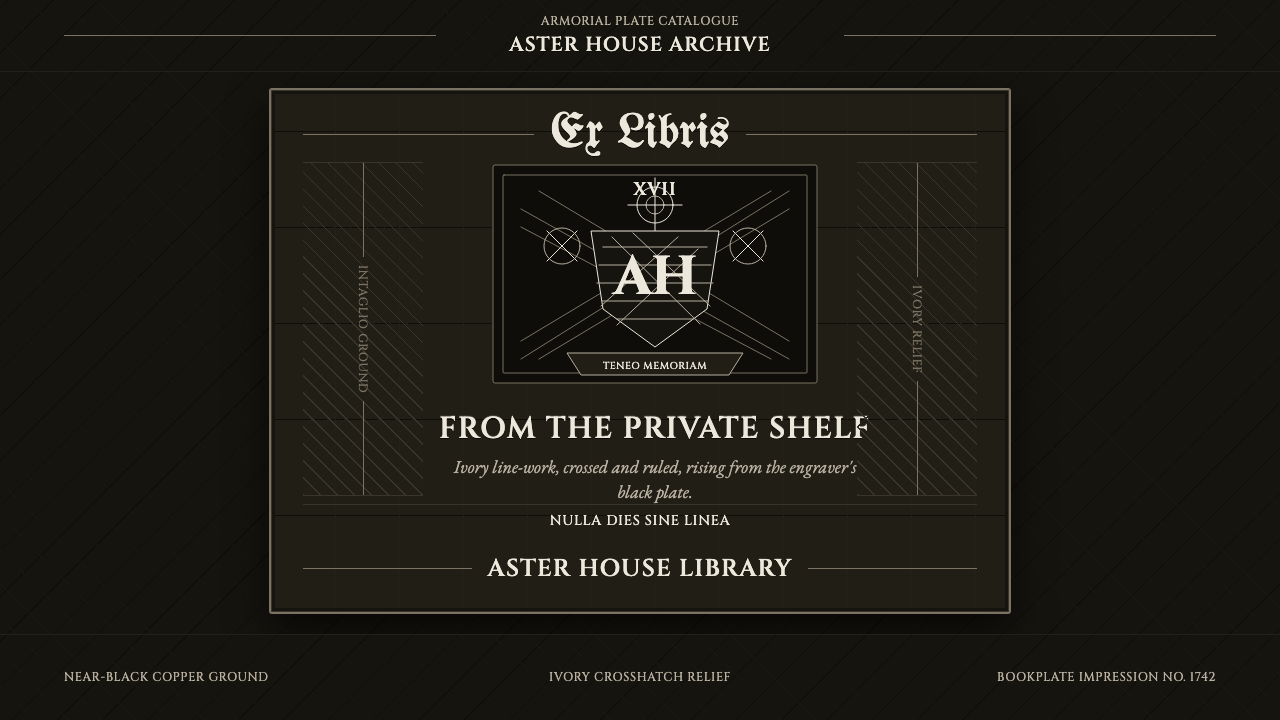 Ex Libris BookplateScholarly ownership, cut in ivory. Cinzel caps and crosshatch rules rise from…
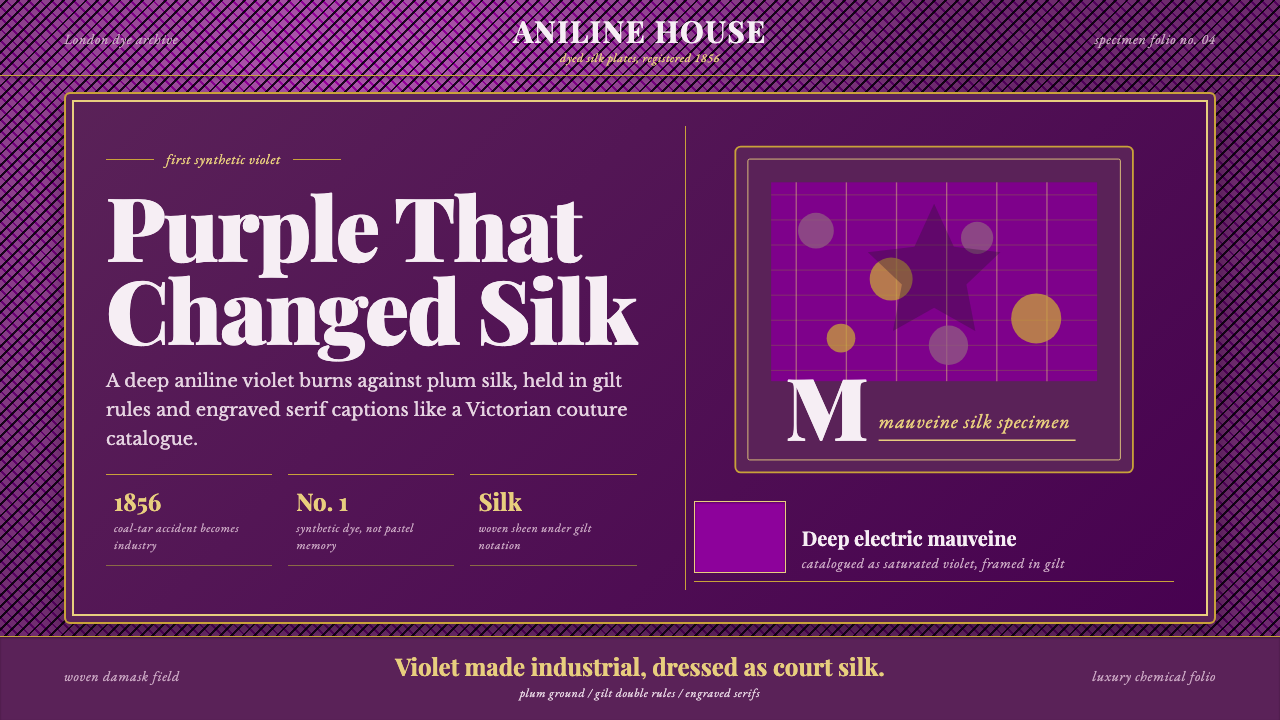 Mauveine (Perkin 1856)Electric purple, framed as luxury. Gilt rules and Playfair serifs turn dye in…
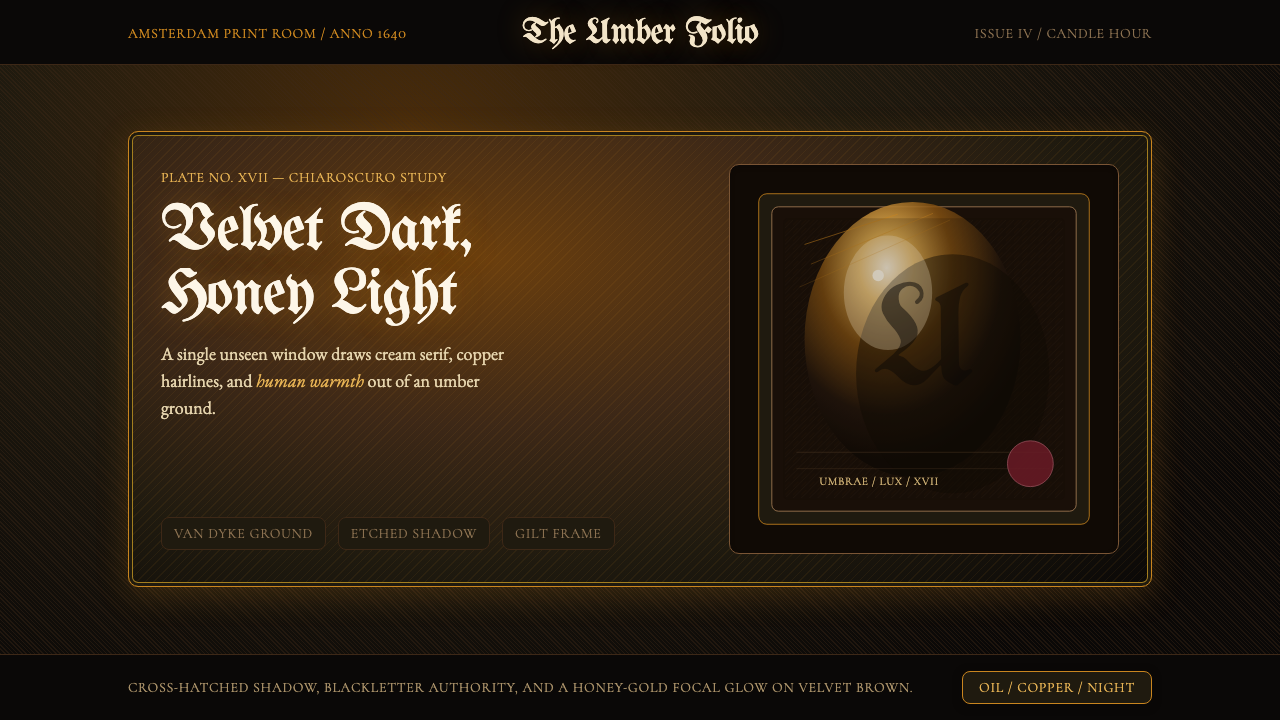 Rembrandt BaroqueDarkness becomes theatre. Honey-gold spotlight and blackletter rise from Van…