What is Rembrandt Baroque?
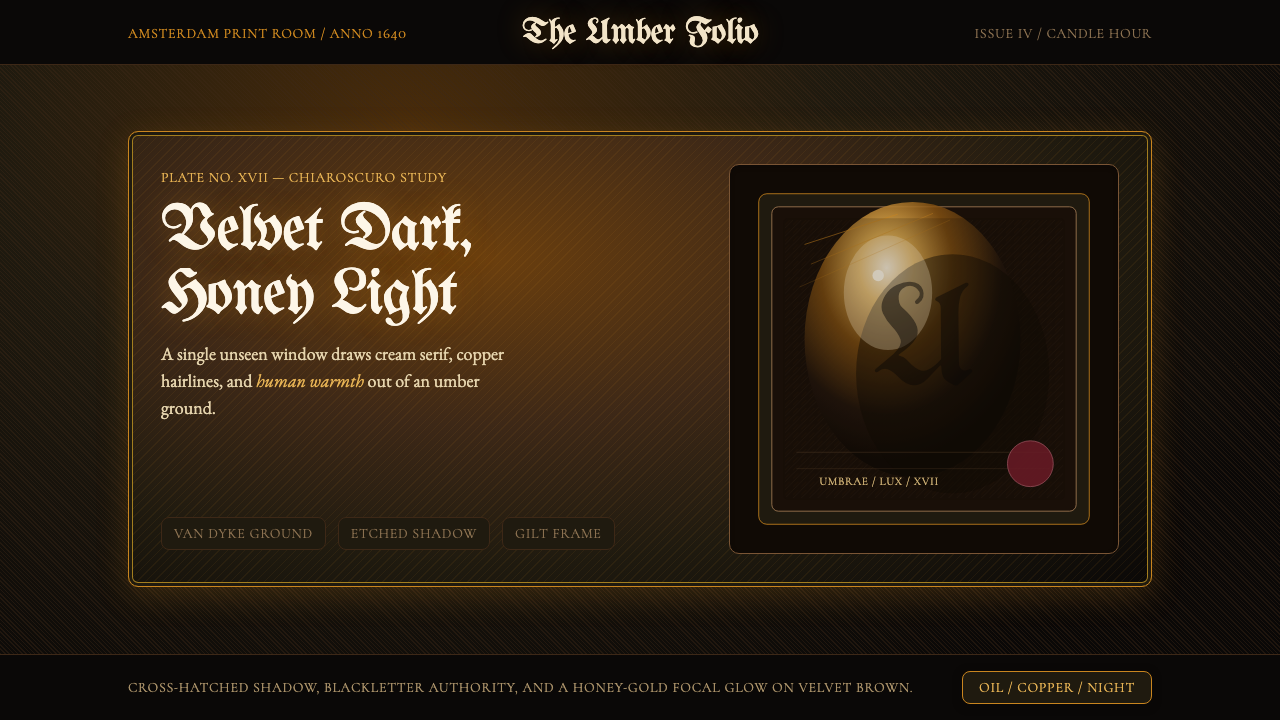
Rembrandt's chiaroscuro — a single face pulled from velvet darkness by an unseen light — becomes a design system built on honey-gold highlights, deep earth-pigment grounds, and the theatrical silence of a Dutch master's studio.
Rembrandt Baroque in brief
Rembrandt Baroque is a design aesthetic rooted in the visual language of seventeenth-century Dutch oil painting and etching — above all in the work of Rembrandt van Rijn (1606–1669), whose mastery of chiaroscuro, the dramatic interplay of concentrated light and deep shadow, remains unmatched in Western art history. As a contemporary design system, it translates that pictorial vocabulary into interface, print, and presentation contexts: warm earth-pigment grounds deepening toward near-black at the edges, honey-gold highlights that feel sourced from candlelight or a low Amsterdam sun, blackletter headings that carry the weight of illuminated manuscripts, and cross-hatch textures echoing the copper-plate etching traditions Rembrandt helped transform.
The style is deliberately theatrical. Where Bauhaus isolates and clarifies, Rembrandt Baroque envelops and reveals — information emerges from darkness rather than being arranged on a neutral field. This makes it one of the most emotionally legible historical design vocabularies available: it communicates depth, gravity, craft, and antiquity without resorting to pastiche. Used well, it feels less like decoration and more like light falling through a high window onto something worth seeing.
Its defining characteristic is restraint within drama. The palette is narrow — warm browns, near-blacks, and a single luminous gold — but it achieves enormous tonal range through graduation rather than hue variety. The warmth of the earth pigments prevents the darkness from reading as cold or aggressive, which is what distinguishes Rembrandt Baroque from generic dark-mode design. Every compositional decision is oriented around a single question: where does the light fall?

Where does Rembrandt Baroque come from?
Rembrandt Harmenszoon van Rijn was born in Leiden in 1606, the eighth of nine children of a miller. He enrolled at Leiden University at fourteen but left within a year to study painting — first under a local master, Jacob van Swanenburch, then in Amsterdam under the history painter Pieter Lastman. Lastman's influence was decisive: he introduced Rembrandt to the Italian Baroque, particularly to the work of Caravaggio and his Dutch followers, the Utrecht Caravaggists, who had brought to the Netherlands a radical new handling of light — tenebrism, in which figures emerge from a near-total darkness as if spotlit. Rembrandt absorbed this influence and then exceeded it, developing a chiaroscuro that felt not theatrical but intimate, as though the light source were always just out of frame and always warm.
By the late 1620s, Rembrandt had returned to Leiden and set up an independent studio with Jan Lievens. This early Leiden period produced small, intensely detailed paintings notable for their psychological precision: the aging face of his mother, the contorted expression of a repentant Judas. In 1631 he moved permanently to Amsterdam, then the wealthiest city in Europe, and rapidly became the most sought-after portrait painter in the Dutch Republic. Amsterdam's prosperity — built on the spice trade, the textile industry, and a vast network of colonial commerce — generated a merchant class hungry for portraits that conveyed dignity and individual character without the dynastic symbolism required by aristocratic patronage. Rembrandt satisfied this demand while introducing a warmth and psychological interiority that his competitors could not match.
The 1640s, identified in the source designation as Rembrandt's peak production period, were also the decade in which his style matured into its most recognizable form. His palette darkened, his brushwork loosened, and his interest shifted from surface detail to the emotional atmosphere created by light. His etchings from this period — the so-called 'Hundred Guilder Print' of around 1647–1649 is the supreme example — demonstrate his revolutionary command of the copper plate: fine parallel hatching building tonal gradients from white highlight to near-total shadow across a single sheet. These printmaking techniques, translated into texture and tonal logic, are the technical foundation on which the Rembrandt Baroque design vocabulary rests.
The Dutch Golden Age context matters for understanding the style's specific warmth. Dutch painters of the seventeenth century worked in oil on panel or canvas, using pigments ground from natural earth minerals — raw umber, burnt sienna, yellow ochre, lead white, lamp black — and bound in linseed or walnut oil that yellowed slightly with age, contributing to the amber warmth that characterizes seventeenth-century Dutch painting when viewed today. Rembrandt in particular favored thick impasto whites that catch light physically, surrounded by thin, transparent glazes of brown and black that recede into shadow. This interplay of material opacity and translucency is what gives his surfaces their extraordinary luminosity — and it is this quality, translated into the warm-ground-and-gold-highlight logic of the design system, that distinguishes Rembrandt Baroque from simpler dark-aesthetic approaches.
What defines the Rembrandt Baroque look?
Chiaroscuro Light Logic
The defining principle of the style is not darkness but the relationship between darkness and a single concentrated light source. Composition is organized around where the light falls: the focal element — a heading, a key data point, a call-to-action — sits in the zone of maximum luminosity, surrounded by a graduated darkening that reaches near-black at the outermost edges. No element at the periphery competes with the illuminated center. This is fundamentally different from conventional dark-mode design, which distributes content uniformly across a dark field. In Rembrandt Baroque, the darkness is active and directional — it guides the eye inward.
Warm Earth-Pigment Palette
The color range is derived from the natural mineral pigments available to seventeenth-century Dutch painters: deep Van Dyke brown as the dominant ground, warm raw umber and burnt sienna in the mid-tones, and a honey-gold or amber for highlights. Near-black is achieved through deep warm brown rather than neutral or cool black, preserving the palette's warmth even at its darkest. There are no cool grays, no blue-blacks, and no desaturated neutrals — every dark tone retains its amber undertone. This warmth is what prevents the style from reading as cold, gothic, or oppressive, and what gives it its quality of firelit intimacy.
Blackletter and Calligraphic Typography
Display typography in Rembrandt Baroque draws from the blackletter and textura traditions of medieval Northern European manuscripts and early printed books — the same letterforms visible in the title pages of books published in Amsterdam in the 1640s. These are weighty, architectural letterforms with strong vertical stress, dense ink coverage, and fine hairline cross-strokes. They are used exclusively for headings and display text; body text should adopt a warm-ground-optimized serif with strong contrast between thick and thin strokes, echoing the quality of letterpress impression. The contrast between monumental display type and restrained body text is itself a chiaroscuro move — visual weight concentrated at the point of entry.
Cross-Hatch Texture
Rembrandt's copper-plate etchings built tonal gradients through systematically layered parallel lines — single hatching for lighter tones, cross-hatching for deeper shadow. As a design texture, this grid of fine diagonal marks appears in background fields, in shadow areas of components, and as subtle surface treatment on dark grounds. Applied lightly, it prevents flat dark areas from reading as pure void and introduces the hand-crafted material quality of printmaking. The texture should always be subordinate to composition — dense enough to be perceived on close inspection, light enough not to interrupt reading.
Tonal Graduation over Color Contrast
Where Bauhaus uses hue contrast — primary red against cream, primary blue against white — to establish hierarchy, Rembrandt Baroque uses tonal contrast: light versus dark within a narrow warm-brown-to-gold range. Hierarchy is communicated through luminosity: the brightest element is the most important. This means color is not the primary organizational tool; brightness is. A secondary element at the same hue as the primary can be demoted simply by darkening it. The system is therefore highly legible even in environments where color rendering is limited, such as print on uncoated paper or aged screen displays.
Vignette and Edge Darkening
A characteristic compositional device of Rembrandt's paintings is the vignette: the background darkens toward the edges of the canvas, focusing attention on the lit subject at center. As a design principle, this translates to a gradient or tonal shift from a slightly lighter center ground to a considerably darker edge — applied to full-page backgrounds, card components, and section panels. The effect is not dramatic when well-executed; it is subliminal, subtly pushing the viewer's attention inward. Vignetting should be applied with restraint: heavy-handed application reads as theatrical rather than atmospheric.
Gilded Accent as Focal Signal
Honey-gold or amber — the color of candlelight, of aged linseed oil, of a single beam crossing a dark room — serves as the sole high-chroma accent in the palette. It is applied to the single most important element in any composition: the primary call-to-action, the chart's key data series, the section header that the reader must not miss. Using it on more than one element simultaneously dilutes the spotlight effect and collapses the hierarchy. The gold accent should feel earned — as though a beam of light has naturally selected that one element from the surrounding darkness.

Who shaped Rembrandt Baroque?
Rembrandt (1606–1669) is the central figure and namesake of the style. His contribution was not simply a technique but a philosophy of light: the conviction that darkness is not the absence of visual interest but its fullest condition, and that a single concentrated beam of warm light, correctly placed, communicates more about a subject than any amount of surface detail. His roughly three hundred paintings, nearly three hundred etchings, and two thousand drawings represent the most sustained investigation of chiaroscuro in the history of Western art. His self-portrait series — spanning four decades from youth to old age — remains the most complete document of a European artist's life available from the seventeenth century.
Lastman (1583–1633) was Rembrandt's principal teacher and the conduit through which Italian Baroque influence — particularly the tenebrism of Caravaggio and Elsheimer — entered Dutch painting. Lastman had traveled to Italy in the early 1600s and returned to Amsterdam with firsthand knowledge of the new dramatic lighting conventions. His history paintings, though today far less celebrated than his student's, provided the technical and compositional foundation on which Rembrandt built. Without Lastman's Italian influence, the specific quality of Rembrandt's darkness — warm rather than cold, intimate rather than theatrical — might not have developed as it did.
Hals (c. 1582–1666) was Rembrandt's chief contemporary rival for supremacy in Dutch portraiture and represented an alternative approach to Baroque naturalism: loose, gestural brushwork that captured the spontaneous social energy of his subjects rather than their psychological interiority. Where Rembrandt's portraits draw the subject out of shadow with concentrated light, Hals's place subjects in a more even illumination and distinguish themselves through the immediacy of paint handling. The contrast between the two approaches clarifies what is specifically Rembrandt's: the darkness, the warmth, and the sense that the light source itself is an editorial choice rather than a neutral ambient condition.
Saskia (1612–1642), Rembrandt's wife from 1634 until her early death, appears in more than sixty of his paintings, drawings, and etchings — and her face, particularly in the golden-lit portraits of the late 1630s, has become inseparable from the visual identity of the Rembrandt Baroque style. Her portrayal in works such as 'Saskia as Flora' (1634) established the archetype of the honey-gold illuminated figure against a dark ground: warmly lit, richly costumed, and emerging from shadow as though the darkness itself is paying her homage. For the design system, she is the model of the illuminated subject — the element that earns the gold accent.
Segers (c. 1589–c. 1638) was an experimental printmaker and painter whose radical etching techniques — printing on colored cloth, adding hand-painted tints, building up atmospheric tone through unusually dense aquatint-like surfaces — profoundly influenced Rembrandt, who owned eight of Segers's paintings and substantially reworked at least one of his copper plates. Segers's printmaking pushed the etching medium toward landscape and atmosphere in ways that anticipate Rembrandt's own atmospheric tonal prints. As a figure in the Rembrandt Baroque design genealogy, he represents the experimental and material dimension of the tradition: the willingness to manipulate surface, ground, and mark to achieve tonal effects unavailable through conventional means.
How do you use Rembrandt Baroque today?
Rembrandt Baroque is among the most distinctive historical styles available to contemporary designers, but it is also one of the most easily misapplied. The visual language depends on a single organizing principle — concentrated warm light emerging from deep shadow — and every element of a composition should serve that principle. Before applying any specific technique, designers should identify the one element in each view that most needs to command attention. Everything else is shadow.
For presentation slides, Rembrandt Baroque creates extraordinary impact on cover and section-divider pages. A cover should work like a Dutch master's portrait: the title and a single supporting visual emerge from a near-black vignette ground, lit by a warm honey-gold highlight concentrated at center. The blackletter or high-contrast serif headline sits in the zone of maximum luminosity; any subtitle or date information recedes into the darker mid-ground. Content slides should maintain the dark ground but lighten the approach: a warm deep-brown background, body text in a cream or warm off-white, section headings in gold, and data elements treated as lit objects against shadow. Avoid placing multiple items in gold simultaneously — if the data table header, the chart's key series, and the call-out box are all gold, the focal logic collapses.
For web interfaces, Rembrandt Baroque is well-suited to premium, high-margin product pages, editorial platforms, and luxury brand dashboards where conveying craft and historical authority matters more than the clean neutrality of conventional tech UI. The approach: a deep warm-brown body background with a subtle vignette darkening toward the viewport edges; cream or warm near-white for body text; gold reserved for the primary call-to-action button, the active navigation state, and the key metric in any data display. Card components should have slightly lighter warm-brown backgrounds than the surrounding ground — not white cards against a dark background, which breaks the tonal logic, but warm-brown cards that are one or two tones lighter than the page ground. Interactive states should shift toward more gold rather than toward lighter grays.
For editorial and marketing work — book covers, event posters, premium packaging, report covers — the style achieves its highest natural expression. A full-bleed dark ground with a single vignette-lit image or typographic focal point is exactly the compositional logic the style was designed for. Marketing copy should be set in a single weight of a high-contrast serif, with pull quotes or callouts in the blackletter display face. Cross-hatch texture applied lightly to the background prevents the dark ground from appearing flat or digitally generic. For print work, the palette should be reproduced in warm rich black for the ground rather than a four-color neutral black, preserving the amber undertone on press.
A common mistake when applying Rembrandt Baroque is interpreting the style as simply a dark theme with gold accents. This misses the essential principle: in authentic Rembrandt Baroque, darkness is not a background setting but a compositional actor. Designers who treat the dark ground as passive — as a canvas to place content on — produce work that looks like generic dark mode with decorative gold touches rather than like a Dutch Golden Age composition. The test: could you remove all the content from the design and still see, in the ground tones alone, where the eye is supposed to travel? If the answer is yes, the chiaroscuro logic is working. If the background is uniformly dark, the style has been flattened into decoration.
Avoid the temptation to introduce cool colors, blue-tinted blacks, or desaturated neutrals. These break the warmth that distinguishes Rembrandt Baroque from gothic or horror aesthetics. Similarly, avoid mixing the cross-hatch texture with soft gradients — the two techniques operate on opposite logics (mark-making versus smooth transition) and produce visual incoherence when combined. When in doubt, simplify: fewer elements, narrower palette, and more deliberate use of the gold accent will always produce more authentic results than elaborate layering.

Rembrandt Baroque — FAQ
Is Rembrandt Baroque the same as dark mode?
No — dark mode is a display preference that replaces light grounds with dark grounds while preserving a neutral, evenly illuminated layout. Rembrandt Baroque is a compositional system in which darkness is an active organizing force, not a background color. In dark mode, all elements are equally visible against the dark field. In Rembrandt Baroque, visibility is deliberately graduated: the most important element is the most luminous, and luminosity decreases as elements approach the edges of the composition. The warmth of the palette is also decisive: dark mode typically uses near-neutral or cool-leaning darks; Rembrandt Baroque uses deep warm browns with amber undertones, which read as fundamentally different in emotional register.
Can Rembrandt Baroque work for data-heavy interfaces, or is it purely editorial?
It can work for data interfaces, but requires careful adaptation. The style's tonal hierarchy is well-suited to emphasizing a single key metric — the gold accent naturally functions as a data spotlight — but it resists the kind of equal-weight data grids that many analytical dashboards require. Effective adaptations reserve the honey-gold highlight for the single most critical data point or chart series, use cream or warm near-white for secondary labels and axis text, and set grid lines and supporting structure in a dark warm-brown that reads as near-invisible against the ground. Color-encoded categorical data works within the palette if each additional category is assigned a slightly cooler or more muted warm tone — never a fully saturated primary. The constraint is productive: it forces designers to identify what the dashboard's most important signal actually is.
How do I avoid the style reading as gothic, Halloween, or horror rather than as Baroque?
The distinction is almost entirely in palette temperature. Gothic and horror aesthetics use cold, desaturated, or blue-tinged darks — charcoals, slate grays, blue-blacks. Rembrandt Baroque uses exclusively warm, amber-tinged darks — deep Van Dyke brown, warm raw umber, burnt sienna in the mid-tones. If any cool tone enters the ground palette, the warmth collapses and the style migrates toward gothic. The gold accent also plays a key role: it should be warm amber-gold, not greenish or silvery. Finally, typography matters: gothic aesthetics often use jagged, sharp letterforms; Rembrandt Baroque blackletter should be full and rounded in its strokes, derived from the humanist Northern European manuscript tradition rather than the pointed German Fraktur tradition.
What kinds of content or brands should avoid this style?
Rembrandt Baroque is poorly suited to contexts that depend on lightness, openness, or clinical neutrality: healthcare and medical platforms, children's and educational products, civic and government interfaces, environmental or sustainability brands, and any application where accessibility requires maximum contrast on light grounds. The style's warmth and darkness can also work against food and consumer packaged goods brands where bright, fresh-feeling color is essential. It is equally inappropriate for technology products that want to signal forward-looking innovation rather than historical craft — the style reads as legacy and depth rather than velocity and disruption. Most importantly, it requires a confident, high-quality visual execution to succeed; applied tentatively or with low-resolution assets, it risks looking muddy and illegible rather than dramatically atmospheric.
Is the cross-hatch texture essential, or can Rembrandt Baroque work without it?
The texture is characteristic but not definitional. Rembrandt Baroque can function without cross-hatch texture as long as the core principles — warm earth-pigment palette, chiaroscuro tonal logic, single gold accent, blackletter or high-contrast serif display type, and vignette-darkened grounds — are present. The texture becomes essential in print contexts where flat dark areas would otherwise appear as dead, featureless voids, and in digital contexts where the design needs to distinguish itself from conventional dark-mode work. When the texture is omitted, the style shifts toward a cleaner, more contemporary expression of the same principles — still recognizably Baroque in its light logic, but less explicitly seventeenth-century in surface quality. Both are legitimate; the choice should be driven by context and reproduction medium rather than by a rule.
Related design styles
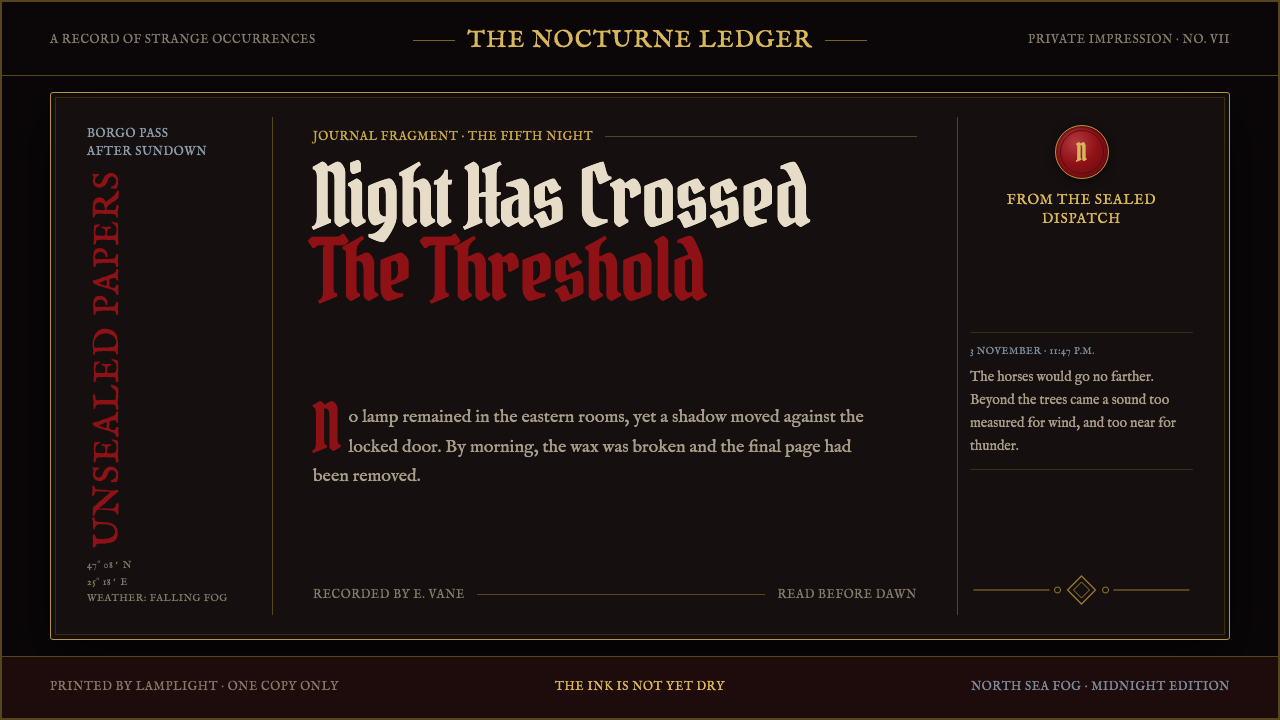 Dracula Gothic (1897)Victorian dread after dark. Blood-red initials and tarnished gilt haunt coffi…
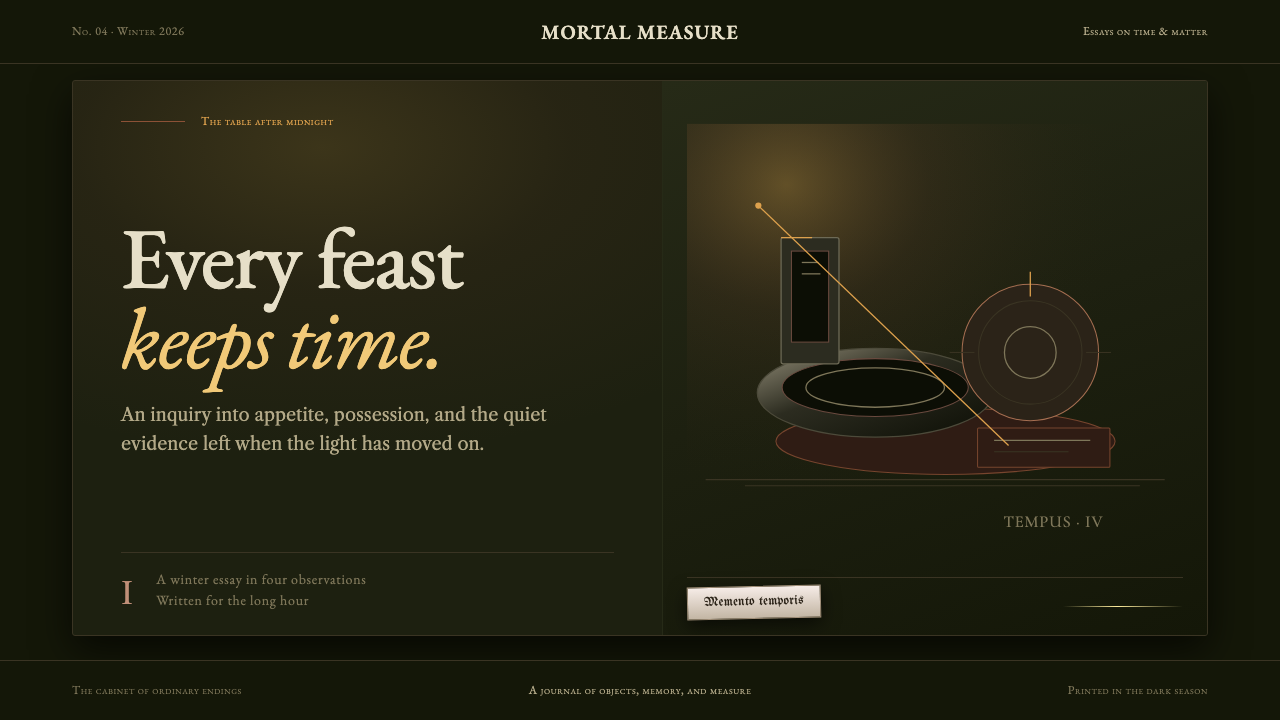 Dutch VanitasTime waits at the table. Olive-black depths, earth-brown type, and one candle…
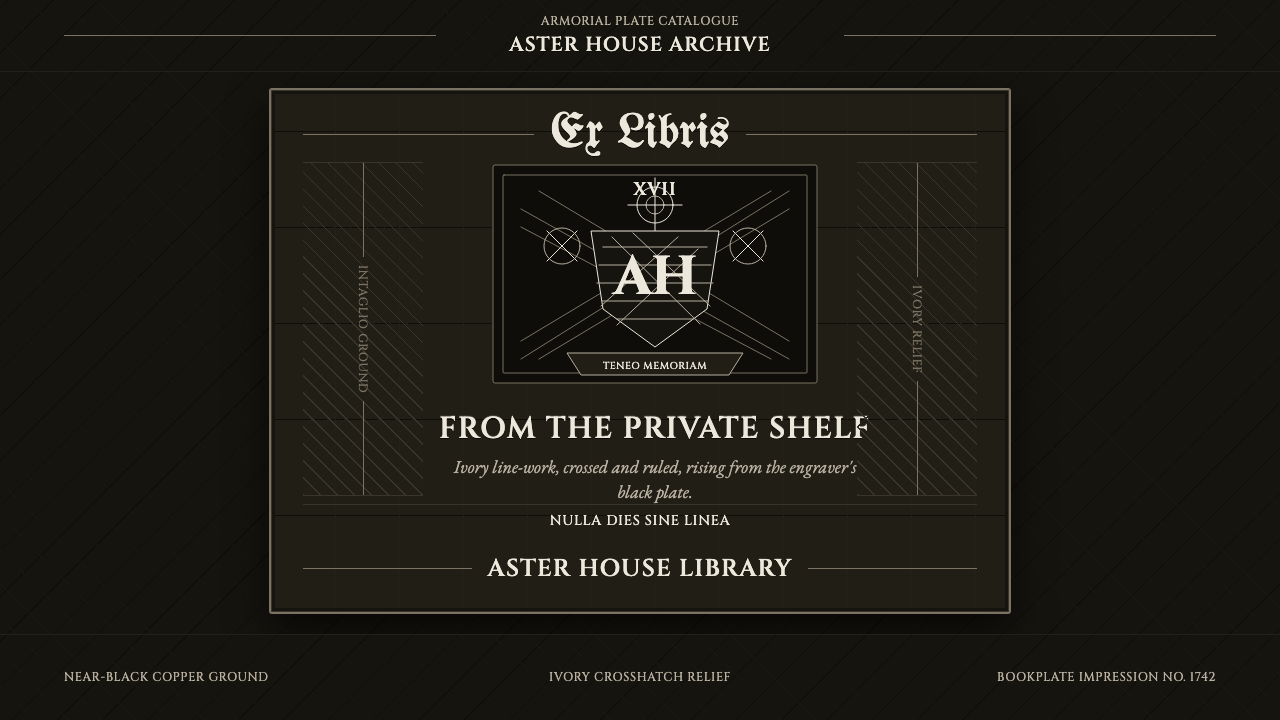 Ex Libris BookplateScholarly ownership, cut in ivory. Cinzel caps and crosshatch rules rise from…
 Babylonian Hammurabi SteleAuthority carved in stone. Basalt-black grids, parchment panels, and imperial…
 Chartreuse Liqueur GreenAcid glow rules the cellar. Cormorant Garamond and brass hairlines frame yell…
 Flamsteed Atlas CoelestisMeasurement wears mythology. Ivory engravings and gilt stars cross a deep ind…