What is Caravaggio Tenebrism?
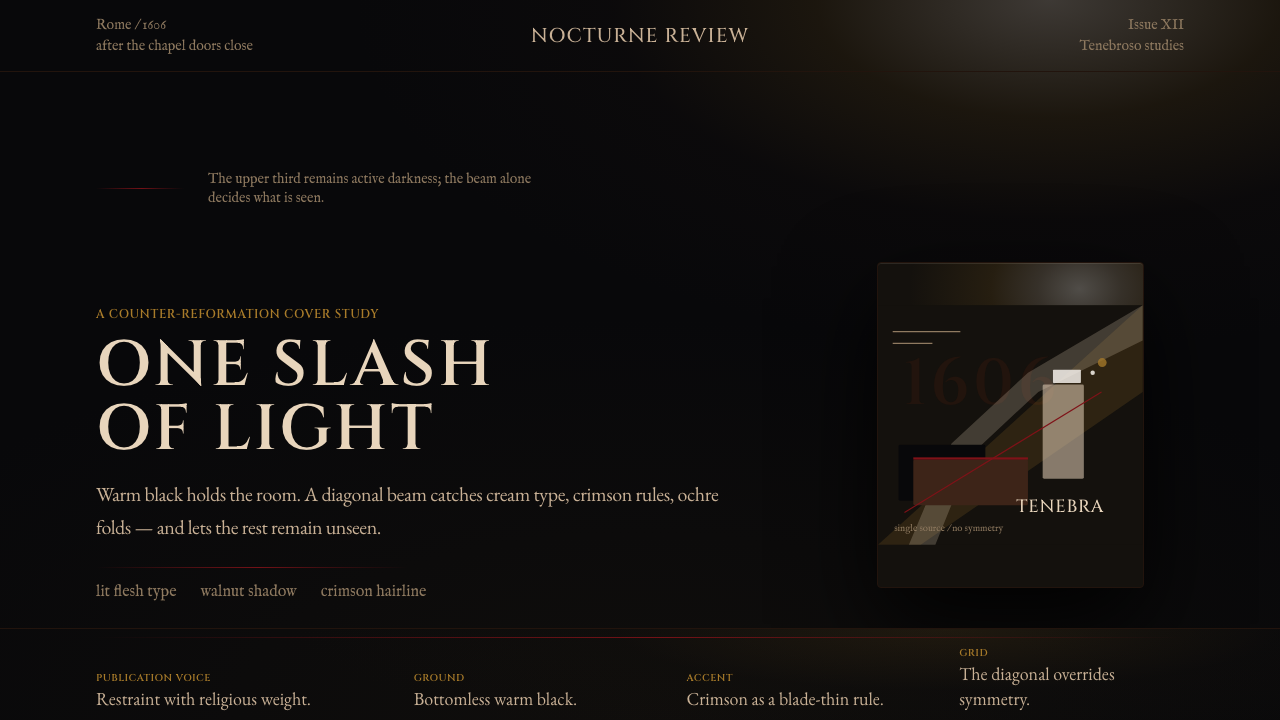
Caravaggio abolished the background — he replaced it with nothing, and let one raking slash of candlelight do all the work.
Caravaggio Tenebrism in brief
Tenebrism — from the Italian tenebroso, meaning murky or shadowed — is a mode of painting, and by extension a design sensibility, defined by extreme contrast between a single concentrated light source and a near-total surrounding darkness. Unlike chiaroscuro, which models form through a gradual tonal transition from light to shadow, tenebrism makes darkness an active agent: the void is not merely the absence of light but a presence in its own right, pushing the illuminated subject forward with almost physical force.
Where most Western painting before 1600 used background, landscape, or architectural setting as compositional support, Caravaggio simply deleted them. The figures in his mature Roman canvases — the calling of Matthew, the martyrdom of Peter, the supper at Emmaus — emerge from a ground that is not dusk or interior shadow but something closer to absolute night. The light arrives from a single unseen source, usually positioned above and to the side of the canvas, and it selects with ruthless specificity: a knuckle, a brow ridge, the weave of a linen sleeve. The rest of the world does not exist.
Translated into contemporary design practice, tenebrism produces a visual vocabulary of unusual emotional authority. Vast warm-black or near-black fields anchor the composition. Content surfaces from the dark like an object emerging from polished walnut. Accent tones — deep crimson, ochre, the color of lit skin and aged paper — function as the sole points of warmth in an otherwise severe field. The diagonal implied by the light source becomes the layout's organizing axis, replacing the conventional horizontal or grid alignment with something more dynamic and theatrical.

Where does Caravaggio Tenebrism come from?
Michelangelo Merisi da Caravaggio was born in Milan in 1571 and arrived in Rome around 1592, working initially as an assistant in the studio of Giuseppe Cesari. His earliest independent works showed a precocious interest in naturalism — the wilting leaves in a basket of fruit, the grime under a fingernail — but his first major public commissions, for the Contarelli Chapel in San Luigi dei Francesi beginning around 1599, introduced the technique that would define his legacy. The Calling of Saint Matthew placed sacred subject matter in an identifiably Roman tavern interior, lit from a source outside the picture plane, generating a theatrical confrontation between divine light and ordinary human darkness that scandalized and riveted contemporary viewers in equal measure.
The technique was not invented from nothing. Caravaggio absorbed the tonal darkness of Lombard painting — particularly the sfumato and shadow traditions inherited from Leonardo — and pushed them toward an extreme his predecessors had not reached. His innovation was not the shadow itself but the completeness of it: where earlier painters allowed reflected light to model forms within the shadow, Caravaggio suppressed that modeling to the point of near-abstraction. The dark areas in his late works are genuinely close to flat. What survives in the light is lit with an intensity bordering on violence.
Between 1606 and his death in 1610, Caravaggio was a fugitive, having killed a man in a brawl in Rome. He worked in Naples, Malta, and Sicily, producing late paintings — the Beheading of Saint John the Baptist in Valletta, the Nativity with Saints Francis and Lawrence in Palermo — that pushed his tenebrism further still: larger dark fields, more isolated figures, a compositional austerity that anticipates the emptiness of much later modernist work. These late works were seen by many subsequent painters, and their influence spread rapidly.
The school that followed Caravaggio — loosely called the Caravaggisti — spread tenebrism across Europe within a generation. In Naples, Jusepe de Ribera developed a Spanish variant that was rougher, harder, and even more confrontational in its treatment of suffering bodies. In France, Georges de La Tour refined the formula into nocturnal candlelit devotional scenes of extraordinary stillness. In Italy, Artemisia Gentileschi brought to the technique a concentrated psychological intensity — particularly in her repeated treatments of Judith — that exceeded even her teacher Orazio's facility. By the mid-seventeenth century, Rembrandt in Amsterdam was absorbing the lessons of the Caravaggisti through Dutch intermediaries, producing the Northern European tenebrism that most contemporary viewers associate with dramatic chiaroscuro. The influence did not fully exhaust itself until the Rococo period displaced Baroque gravity with levity in the early eighteenth century.
What defines the Caravaggio Tenebrism look?
Dominant Darkness
The ground of a tenebrism composition is not a background color but an active void — a deep, warm-toned black that reads as infinite depth rather than flat surface. This darkness is not neutral; it has the temperature of unlit interior space, slightly warmer than cool blue-black, carrying the feel of old oak, wax, and stone. The darkness occupies the majority of the composition — often seventy percent or more — and everything that emerges from it does so because the darkness permits it.
Single Raking Light
One light source, always unseen, enters the composition from an upper corner — typically upper right — and rakes across the subject at a diagonal. This raking angle means the light does not illuminate broadly but catches edges, textures, and planes that face it directly: the ridge of a nose, the fold of a sleeve, the top of a knuckle. Planes that face away fall immediately back into the black. The light does not blend softly into shadow; it stops.
Warmth of the Illuminated
What the light reveals is warm — the ochre and raw-sienna of candlelit flesh, the deep crimson of fabric and blood, the aged cream of illuminated linen. These are the only hues permitted: the palette of firelight, not daylight. There are no cool blues, no greens, no lavenders in the lit areas. The warmth of the lit subject against the depth of the dark ground creates the style's characteristic emotional temperature — intimate, urgent, slightly threatening.
Suppressed Modeling
In the shadow areas, traditional tonal modeling is almost entirely suppressed. Earlier painters had used gradual mid-tones within shadows to describe the volume of forms even in their unlit portions. Tenebrism refuses this — the transition from lit to unlit is abrupt, close to binary. Figures and objects partly in shadow simply cease to be described. The eye cannot reconstruct what the dark has swallowed. This is not a technical limitation but an aesthetic choice with profound compositional consequence: depth is implied, not modeled.
Diagonal Composition
Because the light source is positioned off-axis — upper corner rather than frontal or overhead — every composition organized by tenebrism inherits a strong diagonal. This diagonal is the axis of dramatic tension: movement along it implies revelation or concealment, approach or withdrawal. Symmetry becomes structurally impossible; the style demands asymmetry as a formal condition. Horizontals and verticals exist only in tension with the dominant diagonal, never as organizing principles in their own right.
Peasant Realism
Caravaggio's tenebrism is inseparable from his insistence on depicting sacred figures as ordinary people — dirty feet, calloused hands, working-class faces placed in the positions of saints and apostles. This democratic subject matter was as scandalous to contemporary critics as the technique. In design terms, the lesson is that the style confers gravity and significance on whatever it illuminates, regardless of whether that subject is conventionally elevated. The style is not elitist; it is theatrical.
Theatrical Stillness
Tenebrism compositions are often intensely dramatic in subject matter but remarkable for their frozen quality — the moment before or immediately after violent action, suspended. This stillness is a product of the technique: when so much of the visual field is suppressed by darkness, what remains is heightened to an almost unreal clarity. The eye cannot scan freely; it is directed by the light to a small number of elements, and those elements carry enormous weight. In design, this principle translates to extreme restraint in the number of active elements per composition.

Who shaped Caravaggio Tenebrism?
Caravaggio (1571–1610) is the originating figure of tenebrism, though he never used the term and worked within the broader category of naturalist painting. His Roman period — the Contarelli and Cerasi chapel commissions in particular — established the compositional and tonal vocabulary that subsequent painters across Europe adapted. His personal turbulence, including a killing in 1606 that sent him into years of fugitive exile across Naples, Malta, and Sicily, intensified rather than diminished his output. The late works produced during this exile are among the most formally radical paintings of the seventeenth century.
Gentileschi (1593–c.1656) is the most significant woman painter of the Baroque period and one of the most psychologically penetrating of all the Caravaggisti. Trained initially by her father Orazio, himself a capable tenebrist, she brought to the style a concentration on female interiority and physical agency that distinguishes her work sharply from her contemporaries. Her multiple treatments of Judith Slaying Holofernes — combining tenebrism's dramatic contrast with an unsparing attention to the mechanics of violent action — remain among the most analyzed paintings of the seventeenth century.
La Tour (1593–1652) represents the contemplative strain of tenebrism — French rather than Italian, devotional rather than violent, candlelit rather than dramatically raked. His nocturnal scenes, typically showing a single figure or small group gathered around a visible candle flame, reduce the technique to its most essential elements: one warm point of light, one or two illuminated faces, and a surrounding darkness that is genuinely peaceful rather than menacing. His work demonstrates that tenebrism need not imply drama; it can equally imply intimacy and concentration.
Ribera (1591–1652) was a Spanish painter who spent his career in Naples under Spanish viceregal rule, and his tenebrism represents the harshest and most physically unsparing branch of the Caravaggisti. Where Caravaggio illuminated peasant realism with an almost miraculous concentration of light, Ribera pushed his aging, suffering, and martyred figures into conditions of extreme physical specificity — wrinkled skin, distended veins, the precise anatomy of pain. His influence on subsequent Spanish painting, including Velázquez and Zurbarán, was profound and long-lasting.
Rembrandt (1606–1669) absorbed tenebrism through Dutch intermediaries who had studied in Rome — the Utrecht Caravaggisti including Hendrick ter Brugghen and Gerard van Honthorst — and developed it into a distinctly Northern European idiom. His adaptation is warmer, more golden, and more interested in psychological interiority than in physical drama. Where Caravaggio's light is hard and selective, Rembrandt's tends to suffuse slightly, to pick out surfaces without completely annihilating adjacent ones. The result is tenebrism softened by sympathy, and it produced the version of dramatic chiaroscuro that most of the contemporary world recognizes first.
How do you use Caravaggio Tenebrism today?
Tenebrism is among the most emotionally potent historical aesthetics available to contemporary designers, precisely because it works against expectation. Most digital design reaches toward brightness, open space, and generous light; tenebrism reverses this entirely, treating darkness as the primary surface and light as the exception. Applied correctly, it does not read as merely dark-mode design — it reads as intentional, authoritative, and weighted. The difference lies in the warmth of the dark ground, the specificity of what is lit, and the diagonal tension that drives the composition.
For presentation slides — covers and content pages alike — tenebrism works as a directorial style: it makes the audience feel they are being shown something rather than told something. A cover slide built on tenebrism principles places a single central image or typographic element in a cone of warm light against a surrounding near-black, with the light entering from above and to one side. The title should sit in a warm cream or ochre-tinted tone — the color of candlelit text — never in pure white. Content slides should resist the temptation to illuminate everything: one or two elements per slide receive the full tenebrism treatment; the remainder fade toward the dark. Data visualizations — charts and diagrams — can adopt the style's accent palette of deep crimson, ochre, and warm ivory to distinguish series and tiers, with the chart itself appearing to emerge from a very dark field.
For web interfaces, tenebrism is best suited to high-stakes contexts where gravitas and luxury positioning are primary goals: premium pricing pages, editorial features, brand launch pages, and portfolio showcases in architecture, fashion, film, and fine art. The approach requires commitment to a very dark background — not the medium gray of conventional dark mode, but something close to genuine black, warmed with the temperature of candlelight. Surface elements — cards, modals, navigation — should emerge from this ground with only a subtle increase in tone, not by becoming dramatically lighter. Interactive states use the warm accent palette — a crimson hover, an ochre focus ring — rather than bright blue or white highlights. Dashboard interfaces can adopt tenebrism for analytical drama: key metrics illuminated, secondary data in near-shadow.
For editorial and marketing applications, tenebrism rewards scale. A full-page magazine spread or a hero section on a marketing landing page benefits from the style's theatrical quality: one large element pulled into light, everything else receding. The style supports strong typographic hierarchy when type weight and size are used to replicate the light-and-dark contrast — large, warm-toned headlines against very dark fields, fine-weight supporting text barely lifted from the ground tone. In social media cards and poster formats, the diagonal tension of the style translates directly: a composition organized on a diagonal implies movement and urgency in a format that is otherwise static.
A common mistake when attempting tenebrism is treating it as a simple dark-color-scheme decision. The tell is an even, flat dark background combined with white or bright-colored foreground elements — which produces conventional dark mode, not tenebrism. Authentic tenebrism requires that the dark ground have warmth and depth, that the lit elements be carefully limited in number and area, that accent colors draw from the candlelight palette rather than from saturated brand primaries, and that the composition organize itself along a diagonal axis. Equally problematic is illuminating too much: if more than roughly a third of the composition is actively lit, the darkness loses its authority and the style collapses into generic dark design. The discipline of restraint — deciding what does not get light — is the central creative act.

Caravaggio Tenebrism — FAQ
Is tenebrism just another name for dark mode design?
No — the distinction is fundamental. Dark mode is a system-level color scheme that substitutes dark surfaces for light ones across all interface elements, typically with no compositional intent. Tenebrism is a deliberate compositional approach in which darkness is the primary subject and light is used with extreme selectivity to create dramatic hierarchy. In tenebrism, the dark is warm, active, and spatially deep; in dark mode, it is usually a neutral gray or blue-black serving as a background convention. The two can coexist — a dark-mode interface can apply tenebrist compositional logic — but they are not the same thing, and most dark-mode design is not tenebrism.
Can tenebrism work for bright, consumer-friendly products?
Rarely, and only with significant adaptation. The style's fundamental qualities — darkness as primary field, warmth as accent, asymmetric diagonal tension — produce an atmosphere of weight, gravity, and controlled intensity that is the opposite of the lightness, openness, and accessibility that consumer-friendly products typically need to communicate. Tenebrism is most at home in contexts where the user is meant to feel that they are engaging with something serious, valuable, or rare: luxury retail, premium content platforms, high-end portfolio work, cinematic interfaces. Applying it to a productivity app or a children's educational tool will produce friction between style and purpose that no amount of technical execution can resolve.
How does tenebrism handle color beyond its warm accent tones?
Strictly — which is to say, it mostly does not. The authentic tenebrism palette is narrow by design: the dark ground, one or two warm accent tones drawn from the candlelight register (ochre, crimson, aged cream, the color of lit flesh), and nothing else. Cool tones, saturated brand primaries, or multiple competing accent colors all violate the internal logic of the style. In contemporary applications, modest extensions are possible — a deep teal or slate used as a secondary accent can work if it remains considerably darker than the main lit tone — but the key constraint is that no color should be lighter or more saturated than the principal lit element. The moment two colors compete for the position of the light, the composition loses its center.
What is the difference between tenebrism and chiaroscuro?
Chiaroscuro — the Italian term for light-dark — describes the general technique of using tonal contrast to model three-dimensional form on a flat surface. It is a broad category that encompasses everything from the subtle tonal modeling of the Flemish masters to the dramatic contrasts of Baroque painting. Tenebrism is a specific, extreme form of chiaroscuro in which the darkness is so dominant and the suppression of mid-tones so thorough that the technique stops functioning as a modeling tool and starts functioning as a compositional principle. The shorthand: chiaroscuro describes how light and shadow model form; tenebrism describes what happens when the shadow wins.
Does the style suit data-dense interfaces or is it purely atmospheric?
It can work for data-dense interfaces, but requires careful discipline. The central tenebrist constraint — that only a small portion of the composition receives active light — maps surprisingly well onto information hierarchy: the most important metric or data point receives the full accent treatment, less critical information lives in mid-dark zones, and truly secondary data recedes toward the dark ground. The risk is that dense data environments naturally require many elements at similar emphasis levels, which conflicts with the style's demand for a single dominant light. The solution is to think in clusters: a card or panel is the unit that receives tenebrism treatment; within the card, conventional hierarchy applies. The darkness lives between cards, not within them.
Related design styles
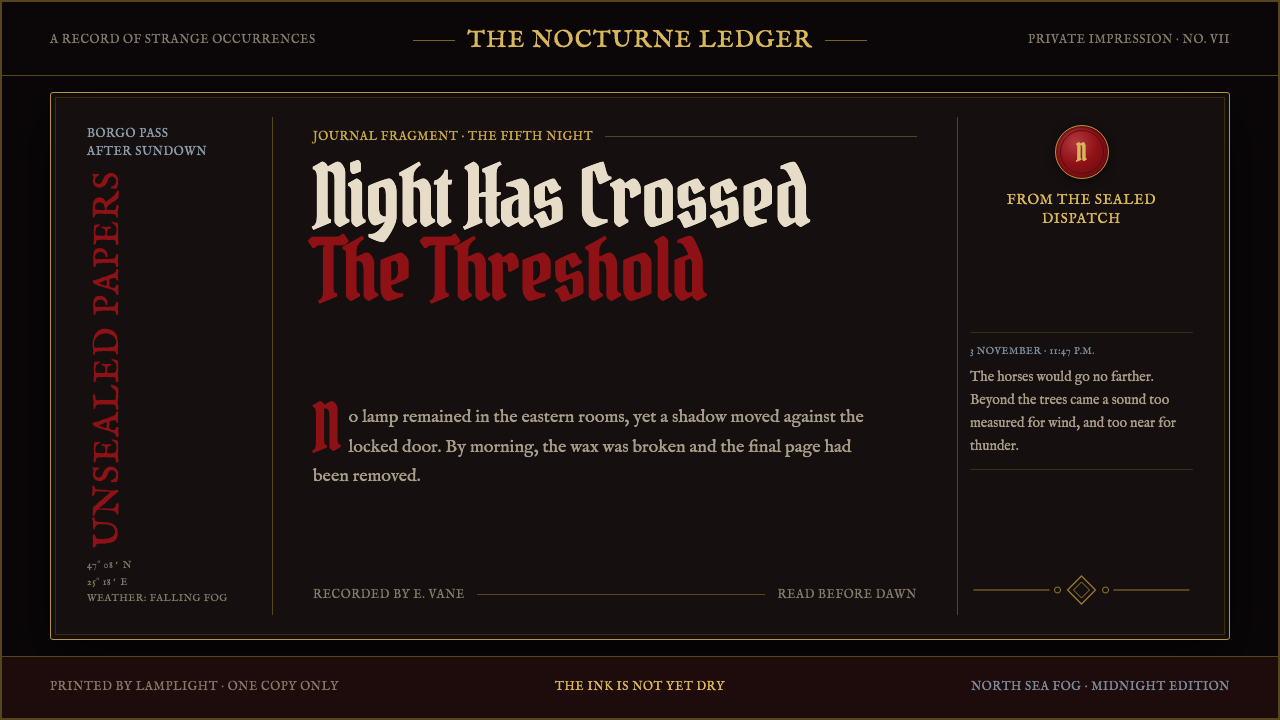 Dracula Gothic (1897)Victorian dread after dark. Blood-red initials and tarnished gilt haunt coffi…
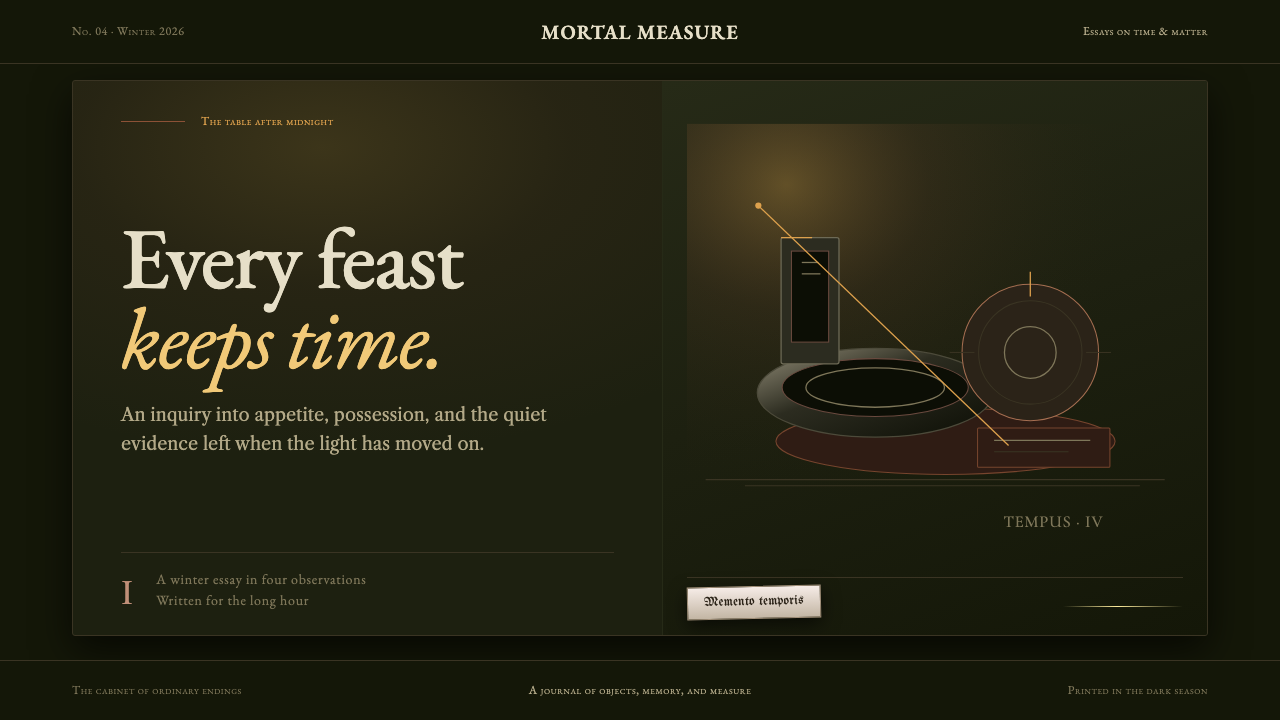 Dutch VanitasTime waits at the table. Olive-black depths, earth-brown type, and one candle…
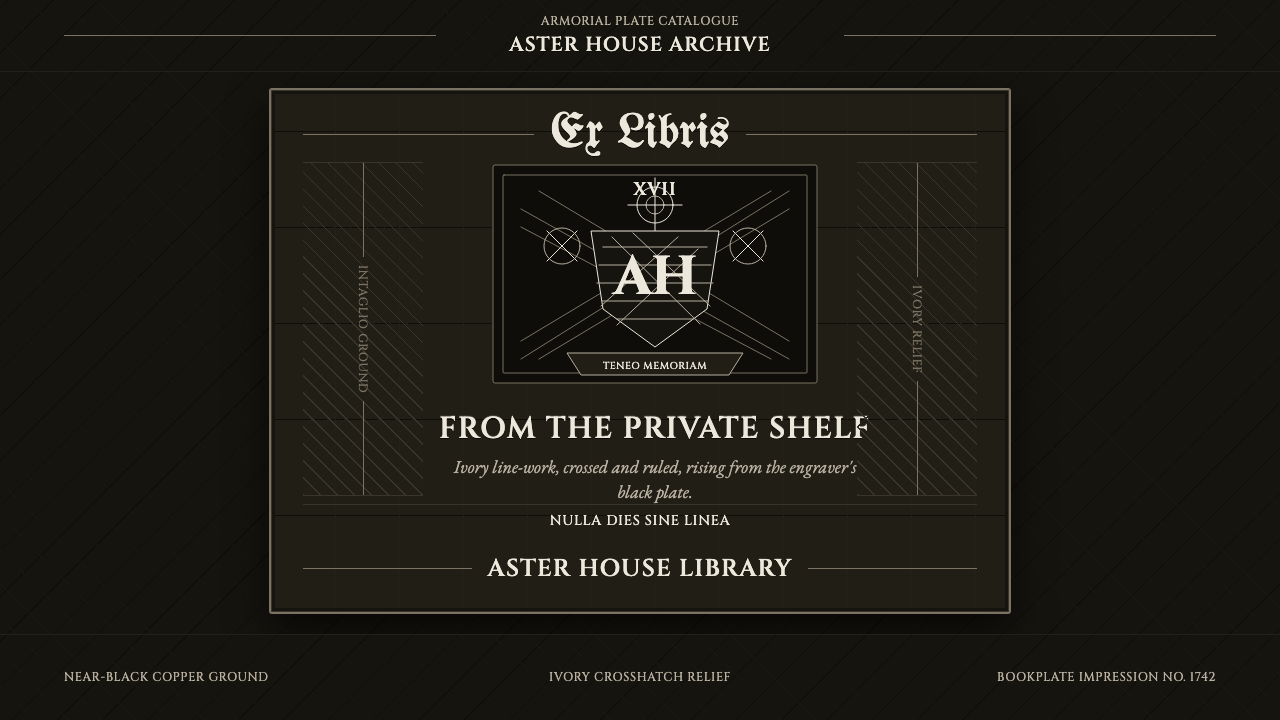 Ex Libris BookplateScholarly ownership, cut in ivory. Cinzel caps and crosshatch rules rise from…
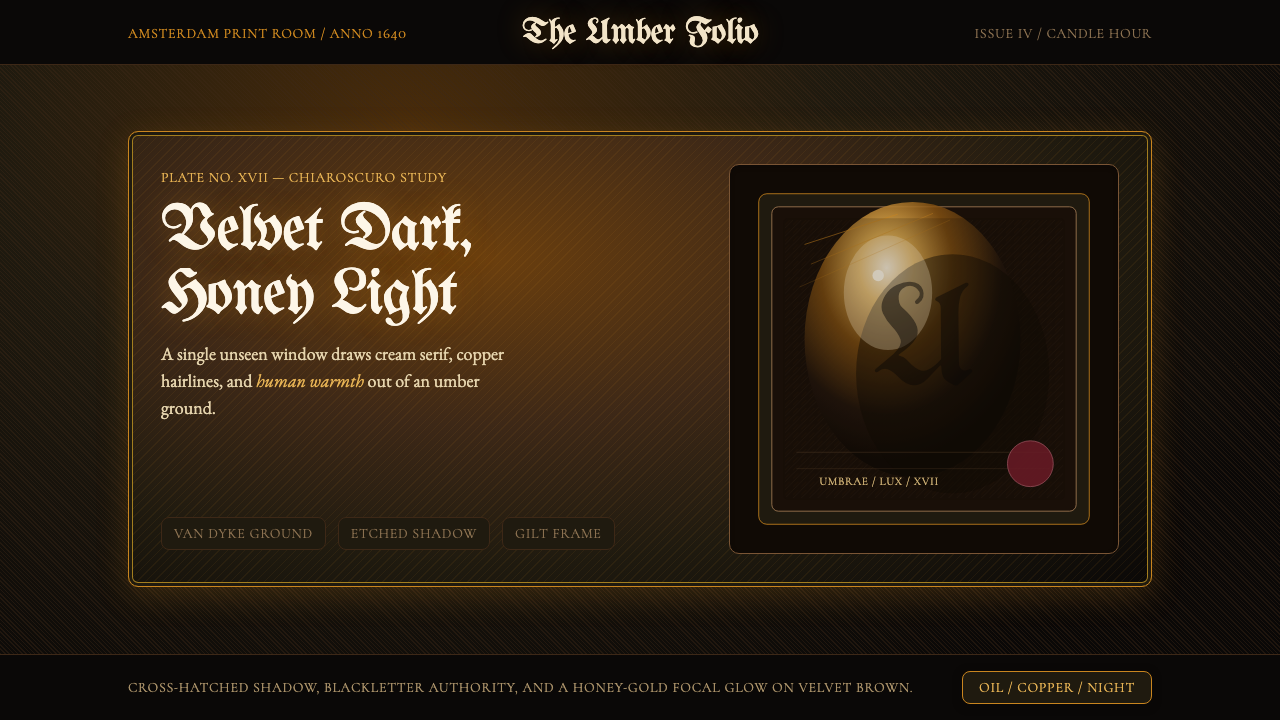 Rembrandt BaroqueDarkness becomes theatre. Honey-gold spotlight and blackletter rise from Van…
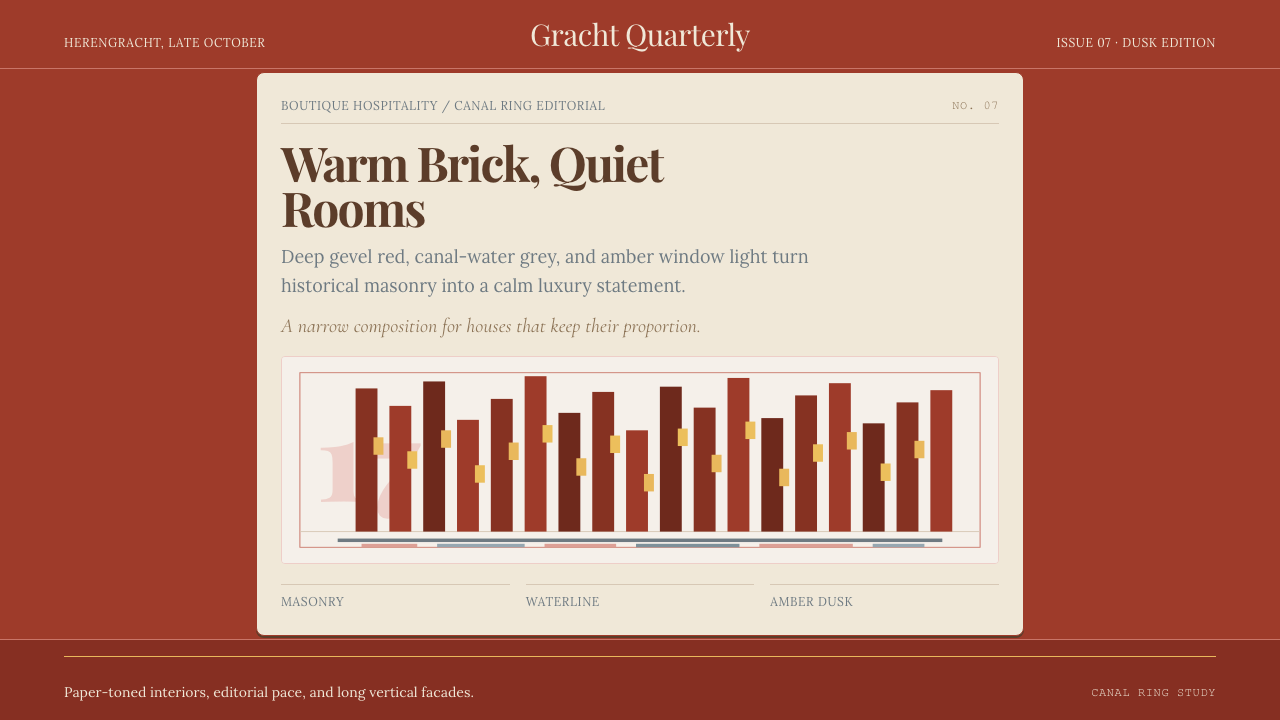 Amsterdam Canal HouseQuiet luxury in brick and cream. Playfair serif, narrow columns, amber window…
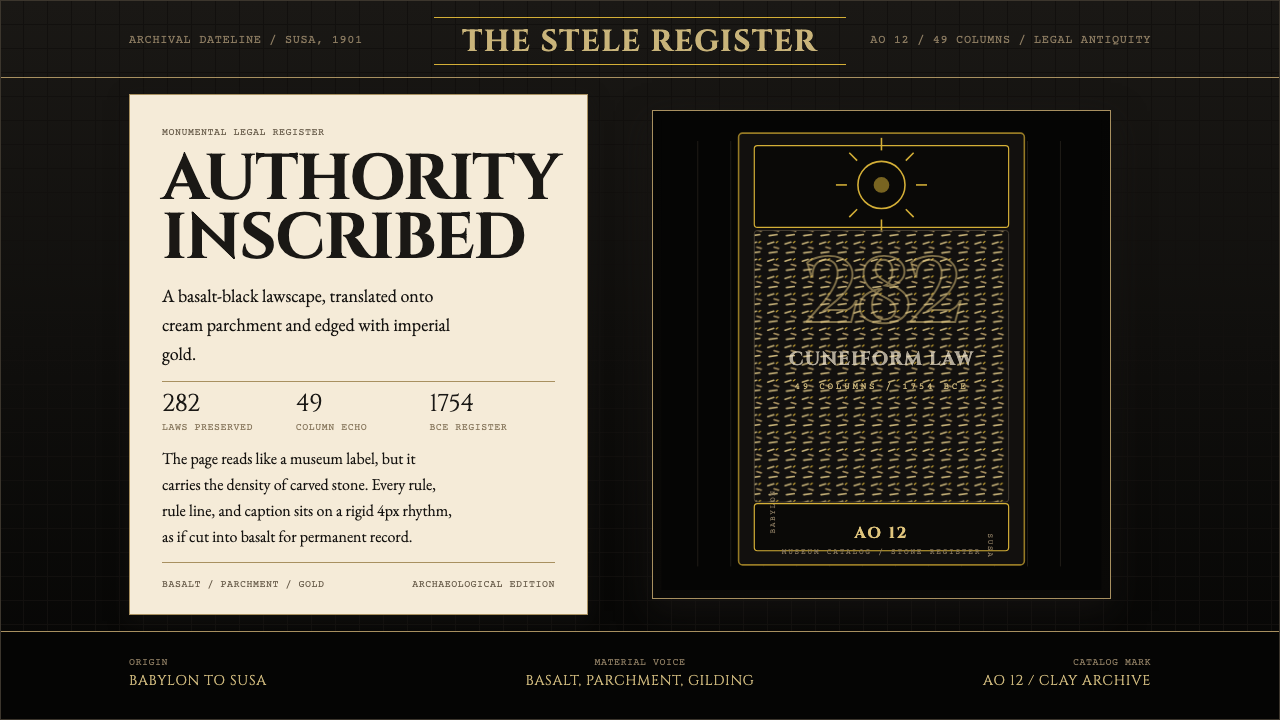 Babylonian Hammurabi SteleAuthority carved in stone. Basalt-black grids, parchment panels, and imperial…