What is El Greco — Toledo Mannerism?
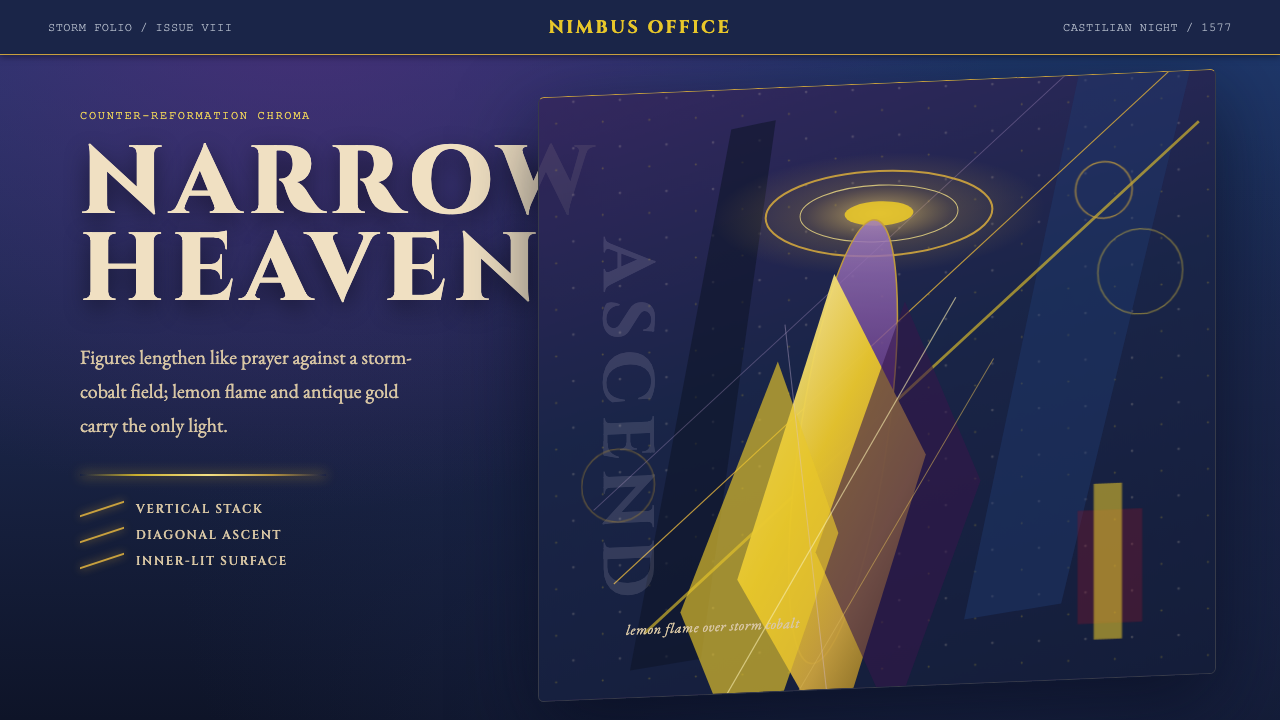
El Greco bent the human figure toward heaven and set the sky on fire — and every choice he made became a design system three centuries before anyone called it that.
El Greco — Toledo Mannerism in brief
El Greco — Toledo Mannerism is a visual style derived from the late-sixteenth-century painting of Doménikos Theotokópoulos, known as El Greco, during his Toledo period from 1577 until his death in 1614. The style is defined by extreme vertical elongation of figures, a palette anchored by storm-bruised cobalt and charged with lemon-flame yellow and electric violet, and a light source that seems to originate inside the canvas rather than from any external sky or sun. The effect is simultaneously ecstatic and unsettling — devotional art pushed so far toward the visionary that it ceased to belong to its own century.
Unlike Renaissance systems grounded in classical proportion, Mannerism deliberately violated those rules as an expressive strategy. El Greco's figures stretch to eight, nine, or even ten heads tall — proportions no anatomy textbook would endorse — because spiritual urgency, not physical accuracy, was the point. Drapery behaves like flame, twisting and rising rather than falling under gravity. Color is used not to describe daylight but to carry emotional and symbolic charge: the cobalt sky is not weather but atmosphere, the gold halo not ornament but the residue of Byzantine icon-making discipline absorbed during his Cretan training.
Applied to contemporary design, the Toledo Mannerism system translates these principles into UI and visual communication: deep, bruised cool darks establish the page ground; flame-saturated warm highlights mark every point of action or emphasis; antique Byzantine gold serves as a halo — a ring of accent around the element that matters most. Compositions strain upward and diagonally rather than centering or balancing. Nothing rests. The style is appropriate wherever a design needs to communicate intensity, spiritual or secular seriousness, and a refusal of the ordinary.

Where does El Greco — Toledo Mannerism come from?
Doménikos Theotokópoulos was born around 1541 on the island of Crete, then a possession of the Venetian Republic. His earliest training was in the Byzantine icon tradition — a discipline of gold grounds, flat frontal figures, and a color grammar derived from early Christian theology rather than from observation of the natural world. This foundation proved indelible: even at the height of his Toledo career, his figures retain the otherworldly luminosity and the upward pull of the icon, however dramatically transformed by everything that came after.
In his twenties, El Greco traveled to Venice, where he entered the orbit of Titian and, more decisively, of Tintoretto. From Titian he absorbed the Venetian mastery of glazed, layered color and the capacity of paint surface to generate atmospheric light. From Tintoretto he absorbed something more radical: the diagonal composition, the dramatically foreshortened figure, the sense that a painting could be organized around a bolt of energy rather than a stable classical armature. He then spent time in Rome, where he encountered the Mannerist paintings of Michelangelo's followers and the antiquities that Renaissance artists had spent a century arguing over. By the time he left Italy, he had absorbed three distinct visual traditions and begun fusing them into something none of them separately could produce.
El Greco arrived in Toledo in 1577, initially to work on commissions for the new cathedral of El Escorial under Philip II. The royal commission fell through — legend holds that Philip disliked the work — but El Greco remained in Toledo for the rest of his life. The city suited him. Toledo was the ecclesiastical capital of Spain, seat of the Archbishop, a city of Counter-Reformation intensity and theological ambition. The patrons El Greco found there — religious orders, cathedral chapters, private nobles of intense piety — wanted art that conveyed not the calm authority of the Renaissance but the anguished devotion of the post-Tridentine church. El Greco gave them exactly that, and in doing so found the context that allowed his most extreme formal experiments to be received as visionary rather than merely eccentric.
His great Toledo works — the 'Burial of the Count of Orgaz' (1586–1588), the 'View of Toledo' (1596–1600), the late 'Laocoön' (1610–1614), and the many elongated Apostle series — each pushed his style further from any precedent. Figures grew taller with each decade. The palette cooled and intensified simultaneously: more cobalt, more acid yellow, more electric blue-white in the highlights. The sky in 'View of Toledo' is not sky at all but a theatrical backdrop lit from a source that does not exist in nature, a sky that would not make sense to a seventeenth-century viewer raised on Flemish landscape painting but that a twentieth-century viewer would immediately recognize as modern. El Greco died in 1614, largely forgotten by the Spanish mainstream. His rediscovery began in the nineteenth century with Manet, deepened with Cézanne's structural analysis of his distortions, and culminated with Picasso, who credited the elongated figures of Toledo directly as a source for the fractured bodies of 'Les Demoiselles d'Avignon' (1907) and the Cubist project that followed.
What defines the El Greco — Toledo Mannerism look?
Palette: Storm and Flame
The palette is built on a structural opposition between cool and warm at extreme saturation. A deep, bruised cobalt — neither navy nor pure blue, but something between storm cloud and deep bruise — dominates large ground areas. Against this, lemon-flame yellow and electric violet ignite as figure accents. Antique Byzantine gold functions separately, as a halo or boundary rather than a primary field. The coolness of the cobalt is not neutral or restful; it is charged, the color of a sky about to break open. The warmth of the flame yellows and acid greens in drapery is equally pressurized. Nothing in the palette recedes into comfort.
Vertical Elongation
Every compositional decision favors height over width. Figures are stretched well beyond anatomical norms, creating a visual vocabulary of spiritual aspiration — the body straining upward as an act of faith. In design terms, this translates to tall, narrow containers; portrait-oriented layouts even when landscape formats are available; text blocks that run vertically rather than spreading horizontally; and a general aversion to anything that reads as settled, wide, or horizontal. The eye should always feel pulled upward.
Interior Luminosity
El Greco's figures seem lit from within — highlights appear on surfaces that have no external light source to justify them, as though the subjects themselves are generating radiance. This is not chiaroscuro in the Caravaggio sense, with a single identifiable beam of light; it is distributed, sourceless, mystical. In design, this principle appears as glows that emerge from within elements rather than casting shadows outward, highlights placed against logic, and a sense that the most important element on a page is self-illuminated rather than spotlit from above.
Diagonal Tension
Toledo Mannerism refuses the stable horizontal-vertical grid of Renaissance composition. Figures lean, drapery spirals, clusters of bodies surge diagonally across the picture plane. In design, this means compositions that introduce diagonal movement — through tilted elements, asymmetric placement, or text that reads across an angle — to prevent the layout from settling into static calm. The diagonal is not decoration; it is structural tension that keeps the composition alive and forward-moving.
Byzantine Gold as Accent Architecture
El Greco never fully abandoned the icon-maker's gold. In his Toledo canvases, gold appears as halos, as embroidery on liturgical vestments, as the rims of vessels — always as a boundary or a crown rather than a fill. It is the color of the sacred threshold. Applied to design, antique gold functions as the highest-priority accent: the ring around the active state, the rule above the most important heading, the border of the element that must not be missed. It should appear rarely and carry absolute weight when it does.
Drapery as Energy, Not Gravity
In Toledo Mannerism, fabric does not hang — it moves, twists, and rises as though charged with the same spiritual energy as the figure beneath it. Lemon yellow and acid green draperies flame upward; cobalt cloaks whip sideways. This principle, translated to design, means that secondary elements — background shapes, supporting graphics, decorative motifs — should feel agitated and directional rather than settled and decorative. Motion is implied, not animated; the still image should look as though it was captured mid-movement.
Chromatic Compression and Darkness
The deepest areas of a Toledo Mannerist composition are not merely dark — they are almost airless, compressed into a near-black that makes the illuminated passages feel explosive by contrast. There is no gentle mid-tone transition between shadow and light; the shift is abrupt, almost violent. In design, this means the background dark should be committed and deep, not softened into charcoal or dark grey. When the dark is dark enough, the warm accents need less saturation to achieve the same visual impact — the contrast itself amplifies the color.

Who shaped El Greco — Toledo Mannerism?
Born in Crete around 1541, trained in Venice and Rome, and settled in Toledo in 1577, El Greco synthesized Byzantine icon discipline, Venetian colorism, and Mannerist formal extremity into a style so singular it appeared incomprehensible to mainstream taste for three centuries. His most ambitious Toledo works — the 'Burial of the Count of Orgaz,' the 'View of Toledo,' and the late Apostle series — compressed multiple visual traditions into a chromatic and compositional language that would influence Manet, Cézanne, and Picasso. He died in Toledo in 1614.
The Venetian painter whose dramatic diagonal compositions, foreshortened figures, and urgent spatial energy were the most direct Italian influence on El Greco's mature style. Where Titian offered color craft, Tintoretto offered structural drama — the sense that a painted surface could be organized around a charge of kinetic energy rather than a stable classical arrangement. El Greco absorbed this lesson thoroughly, and it becomes the structural engine beneath all his Toledo compositions.
Picasso's engagement with El Greco in the years leading to 'Les Demoiselles d'Avignon' (1907) is documented and acknowledged by Picasso himself. The elongated, fractured bodies of the Toledo Apostle series provided one model for the distorted figures of early Cubism. More broadly, El Greco's demonstration that anatomical distortion could be not a failure but an expressive choice — a way of accessing truth unavailable to accurate representation — validated the twentieth century's entire project of formal experimentation. The Toledo period is, in this sense, a hinge point between Renaissance naturalism and modernism.
The Spanish Inquisitor and Archbishop of Seville, whose portrait by El Greco (painted around 1600) is among the most psychologically acute paintings of the Counter-Reformation period. The cardinal sits in an ecclesiastical chair, robed in scarlet and white, the eyes behind small spectacles radiating a cold, contained intensity that makes the portrait feel almost disturbing. For design purposes, this work is a lesson in how color contrast — the acid red of the robes against a neutral ground — can carry all the weight of hierarchy and authority without needing additional decoration.
El Greco's son and studio assistant, who collaborated on many of the larger Toledo commissions and continued his father's practice after 1614. Jorge Manuel's involvement means that several works attributed to El Greco are at least partially collaborative, and that the Toledo visual language was transmitted as a workshop practice rather than only as a personal vision. This collaborative dimension makes the style more a system than a pure expression of individual genius — exactly the quality that makes it useful as a design reference.
How do you use El Greco — Toledo Mannerism today?
Toledo Mannerism is a high-intensity style, and applying it requires accepting that premise rather than softening it. The design system works when the dark is genuinely dark, the warm accents are genuinely saturated, and the gold appears sparingly enough to retain its weight. Attempts to make the palette more accessible by reducing contrast or adding mid-tone buffers tend to produce something that reads as neither El Greco nor anything else — a diluted drama that satisfies no one. Commit fully or choose a different style.
For presentation slides, the style works best on dark-ground layouts. A cover slide benefits from the full compositional tension: a tall, asymmetrically placed title in warm antique-gold or lemon-flame against the deep cobalt ground, supporting text receding into a cooler, less saturated version of the ground color. Content slides should use the palette economically — one warm accent marks the single most important concept per slide; everything else is presented in near-neutral tones. Data slides take on an almost icon-like quality: charts become luminous objects against the dark, with bars or segments lit as though from within, the key data point marked in gold.
For web interfaces, Toledo Mannerism suits dark-mode dashboards, premium analytics products, and any platform where depth and seriousness are brand values. The approach: establish a near-black cobalt as the page ground, use a slightly lighter cobalt for surface containers (cards, panels), reserve the lemon-flame yellow for primary call-to-action elements and alert states, and use antique gold exclusively for the highest-priority indicator — the active navigation item, the primary metric, the featured tier in a pricing layout. Typography should feel tall and compressed in its proportions, favoring condensed letterforms over wide or neutral ones. Navigation labels and headings gain presence through vertical spacing rather than decorative treatment.
For editorial and marketing work, the style supports dark-editorial layouts with strong visual presence. A Toledo-derived article layout uses the deep cobalt as the page background, section openers with full-width cobalt-to-near-black gradients as visual breaks, and pull quotes or key statistics rendered in lemon-flame yellow for maximum contrast. Marketing pages work well when the hero section commits to the full palette intensity — a tall, vertically oriented hero with the product or concept framed against storm cobalt, the key benefit line in the warmest accent — while subsequent sections modulate the palette slightly to give the eye relief. The Byzantine gold can mark a premium tier, a featured testimonial, or a boundary between sections.
A common mistake when applying Toledo Mannerism is treating the warm accents as interchangeable — using lemon yellow, electric violet, and antique gold simultaneously throughout the layout as though they carry equal weight. In El Greco's actual work, the warmest and most saturated tones are used for the most spiritually significant figure in the composition; everything else is subordinate. In design terms, this means establishing a strict hierarchy: one primary warm accent for the most important interactive or informational element; a secondary warm tone for supporting elements; gold reserved for singular moments of highest emphasis. When every element competes at the same intensity, the system collapses into visual noise.

El Greco — Toledo Mannerism — FAQ
Is Toledo Mannerism only suited to dark-mode designs?
The historic palette is emphatically dark-ground — El Greco's cobalt skies and near-black shadow zones are structural, not incidental. A light-ground inversion is possible but requires fundamental adjustments: the storm cobalt must shift to a clear, pale blue ground, the flame yellows deepen to amber or ochre, and the near-black accents become the primary structural color. The result reads more like a stained-glass or medieval manuscript interpretation than the original Toledo drama. For most applications where the style is chosen for its intensity and visionary quality, the dark ground is not optional — it is the source of the effect.
How does this style differ from other dark-palette styles like vaporwave or noir?
The distinction lies in the quality and intention of the darkness and the accents. Vaporwave uses deep purples and magentas with neon accents in a palette that is fundamentally about synthetic nostalgia and surface pleasure. Noir uses desaturated near-monochrome with high-contrast spot lighting, emphasizing shadow as threat. Toledo Mannerism uses a darkness that is not moody or synthetic but pressurized and theological — the deep cobalt is not atmospheric in a cinematic sense but charged with the same quality of intensity as the warm accents that oppose it. The antique gold accent is the key differentiator: it is not ironic, not retro, not decorative — it is hieratic, a mark of the sacred or the supremely important.
Why does the style use diagonal composition rather than centered symmetry?
Centered symmetry was the compositional grammar of Renaissance authority — it implies stability, completeness, and the resolution of tension. Mannerism, including El Greco's Toledo work, deliberately chose instability as an expressive tool. A composition in diagonal tension is one that feels unresolved, still in motion, still aspiring rather than achieved. For design, this is a meaningful choice: centered symmetry tells the viewer the experience is complete and contained; diagonal tension tells the viewer something is happening, something demands attention, the moment is not settled. The style is therefore more useful for landing pages, onboarding flows, and moments of conversion or emphasis than for documentation, settings interfaces, or any context where calm authority is the desired feeling.
Can Toledo Mannerism work for consumer-facing products, or is it too severe?
It depends entirely on what the consumer is being invited to feel. Toledo Mannerism is not warm, not playful, not reassuring — it is intense, serious, and demands engagement. This makes it poorly suited for consumer contexts that depend on approachability, warmth, or ease: food and beverage, family products, wellness applications, children's education. It works well for premium consumer contexts where aspiration and seriousness are part of the value proposition: high-end audio, luxury timepieces, performance sportswear, collectors' editions, investment platforms, and any product whose consumer identity is built around excellence rather than comfort. The style implicitly promises that the product is not ordinary — which is a powerful message when the product earns it and an alienating one when it does not.
How should typography be handled in this style — are condensed or serif typefaces appropriate?
Typography in Toledo Mannerism should echo the style's fundamental compositional instinct: tall, compressed, and upward-pulling. Condensed or semi-condensed letterforms complement the elongated vertical figures; they reinforce the dominant direction of the composition without competing with the palette's intensity. Serifs can be appropriate — particularly high-contrast, slightly archaic display serifs that carry historical weight — but they should be sharp and vertical rather than calligraphic or rounded. Wide, geometric sans-serifs work against the style by introducing horizontal stability. The least appropriate choices are typefaces associated with warmth, friendliness, or technical neutrality. Letter-spacing should be tight; line-height generous enough to allow the vertical column of text to read as an upward rhythm rather than a dense block.
Related design styles
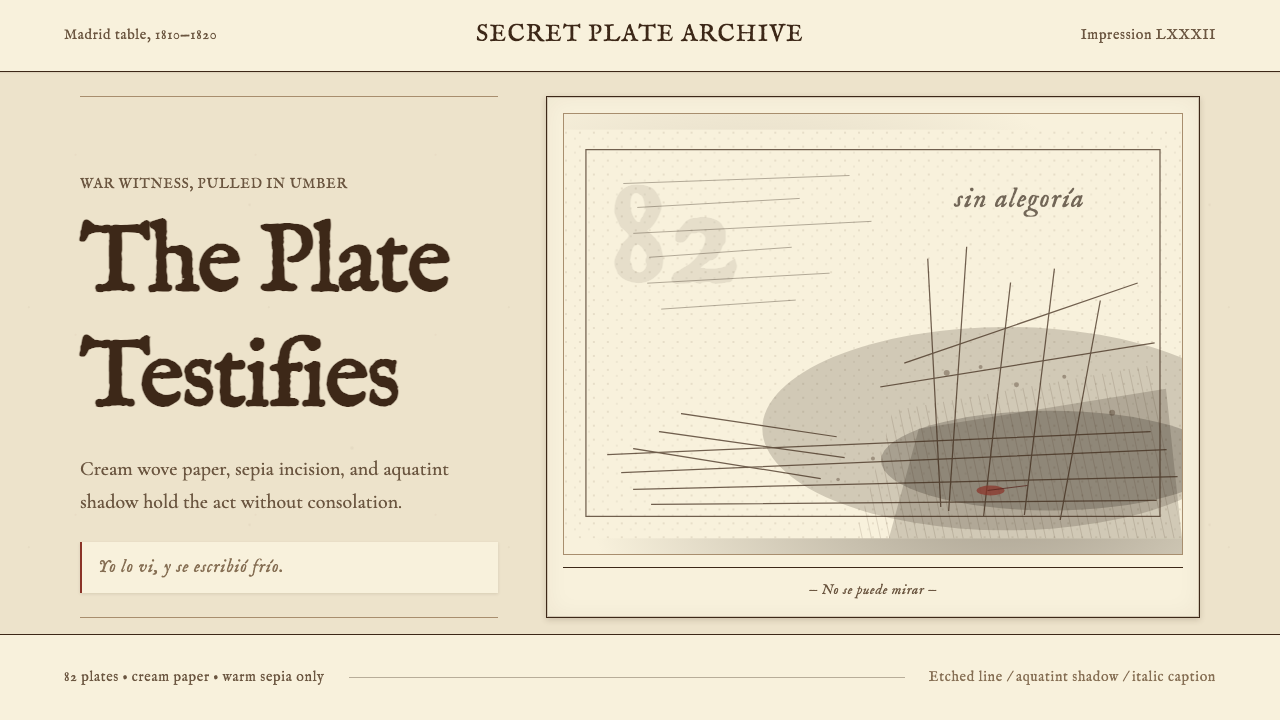 Goya — Disasters of WarWitness without ornament. Cream paper, umber line, aquatint shadow, italic ca…
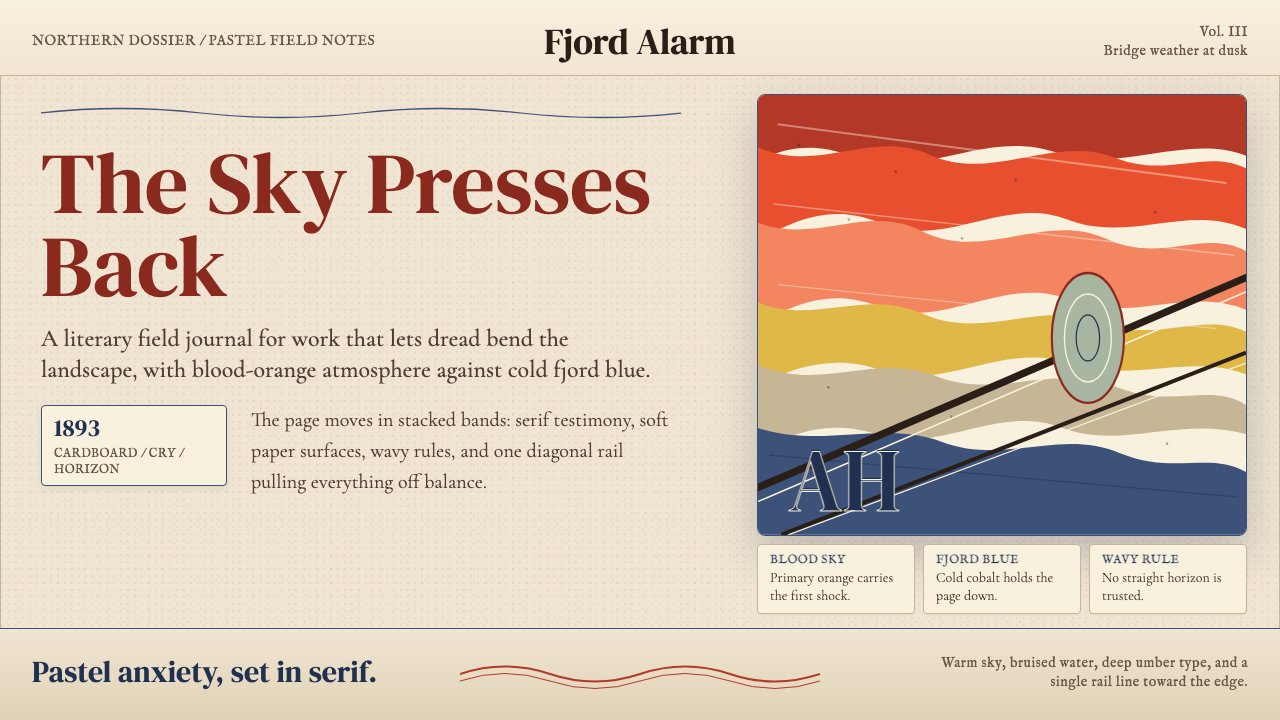 Munch — The ScreamAnxiety bends the page. Blood orange bands, cobalt fjord, and serif type tilt…
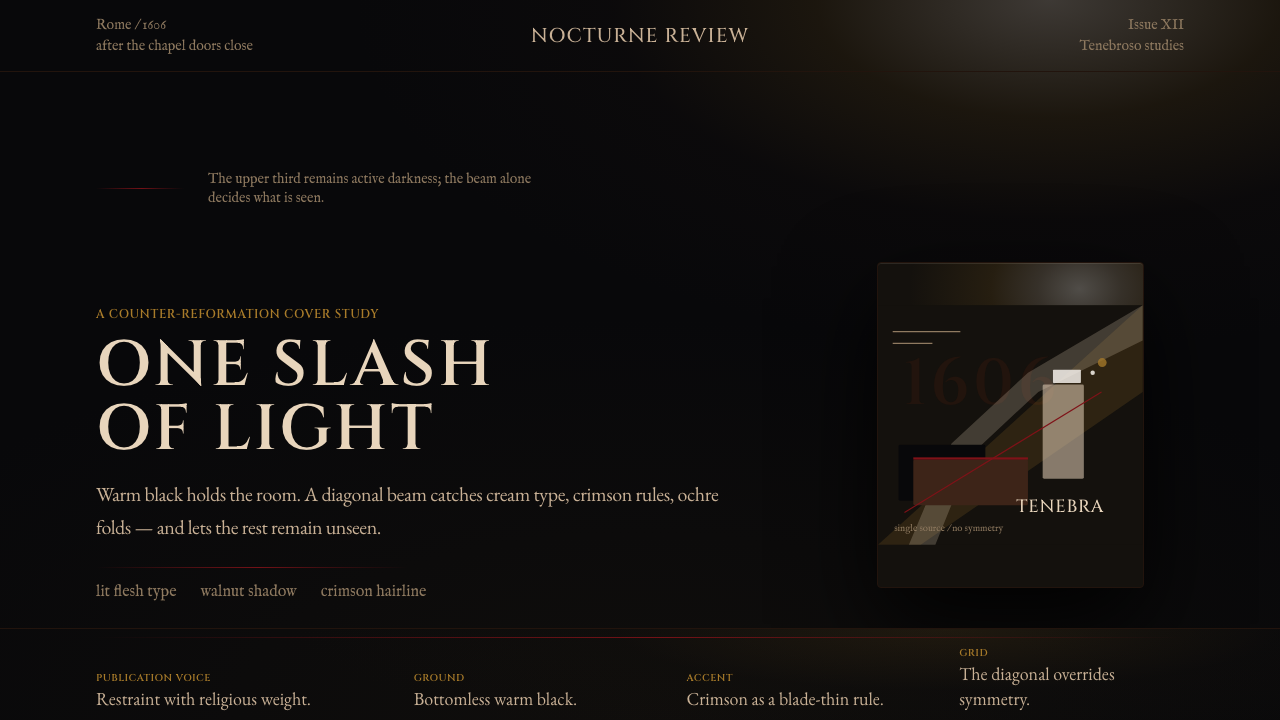 Caravaggio TenebrismDarkness acts first. Warm-black voids, Cinzel capitals, and one ochre raking…
 Frankenstein (1818)Knowledge glows before it kills. Acid green cuts through storm-slate and engr…
 Maya Blue PigmentDeep, never sky. Saturated turquoise mural fields, ochre cartouches, carved-s…
 Michelangelo Sistine Ceiling (1512)Paint becomes monumental. Coral, cerulean and ochre figures strain against a…