What is Munch — The Scream?
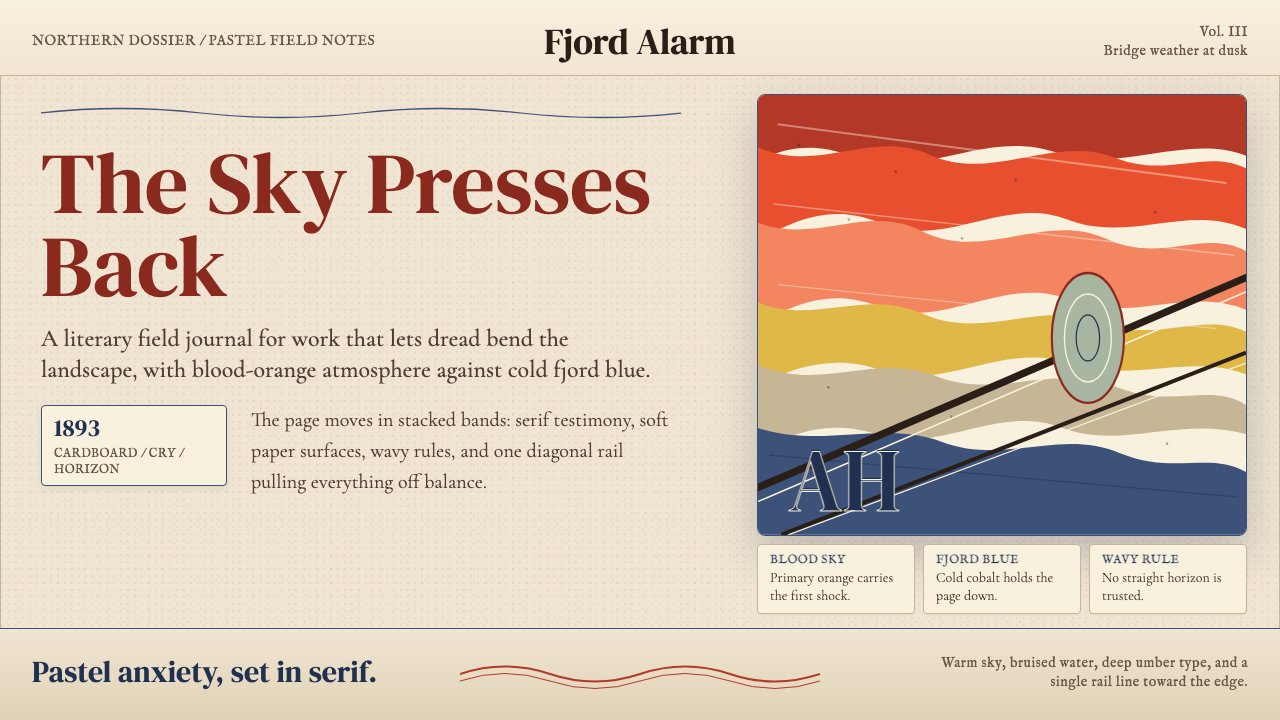
Anxiety bent the sky over a Norwegian fjord in 1893 — and the visual tremor has never stopped.
Munch — The Scream in brief
The Scream design system draws its entire visual logic from Edvard Munch's 1893 pastel-on-cardboard painting Skrik — a work in which landscape and psychology become inseparable. Sky, water, and air do not sit still; they undulate in shared dread with the agonized figure at the bridge railing. That instability is the aesthetic: warm blood-orange bands press down from above while cold bruise-blue water recedes into the distance, and the boundary between them is never a straight line.
Unlike design systems built around geometry or typographic clarity, this one is built around emotional atmosphere. The organizing principle is not the grid or the module but the wave — the horizontal undulation that runs through Munch's sky, through his water, through the figural contour itself. Fin-de-siècle serif letterforms reinforce the period: heavy, ink-drenched, slightly off-kilter, as though the type itself has been caught in the same vortex as the landscape. The palette is warm against cold, anxious against inert.
The result is a design language suited to content where emotional resonance matters more than functional neutrality — literary platforms, art archives, exhibition catalogues, psychological publications, and cultural editorial work that wants to feel inhabited rather than merely organized. It is expressive without being chaotic, and unsettling without being illegible.

Where does Munch — The Scream come from?
Edvard Munch painted the first version of Skrik in 1893, working in pastel and oil on cardboard in the studio he kept in Christiania, the city that would later be renamed Oslo. The painting's genesis is documented in his diary entry of January 22, 1892, in which he describes walking with friends along the Ekeberg road — a ridge path above the Oslofjord — when the sky turned, in his words, 'blood and tongues of fire.' His companions walked on; Munch stopped. He felt an 'infinite scream passing through nature.' The painting is not of a person screaming. It is of a person who has heard the scream that nature itself is producing.
Munch created four versions of the composition between 1893 and 1910 — two in paint and two in pastel — as well as a lithograph that gave the image its mass circulation. The undulating sky and the vertiginous diagonal of the bridge railing were consistent across all versions; what varied was the intensity of the color and the degree to which the figure was rendered as a specific person versus a universal psychic state. By the time of the 1895 lithograph, the figure had become essentially a skull-faced archetype, stripped of individual identity and readable as the modern subject confronting industrialization, urbanization, and the dissolution of meaning.
The painting emerged from a specific cultural moment: Norwegian proto-Expressionism in the 1880s and 1890s, shaped by the radical bohemian circle around the anarchist writer Hans Jæger in Christiania. Munch was part of this milieu, which advocated for the frank expression of inner life against bourgeois propriety. He also spent formative years in Berlin between 1892 and 1896, where he exhibited with the Berlin Secession and encountered the work of August Strindberg and the Polish writer Stanisław Przybyszewski. These Berlin years were intellectually decisive: the city's fin-de-siècle anxiety — nervous, modern, politically charged — reinforced and deepened the emotional register Munch had developed in Norway.
The movements surrounding Munch — Symbolism, proto-Expressionism, and the early Secession networks — all shared a conviction that visible reality was insufficient: that the task of the artist was to make internal states externally legible. In Munch's case, this meant bending the landscape itself to conform to feeling. The sky does not merely reflect the figure's anguish; it participates in it. The fjord does not recede; it recoils. The bridge railing does not vanish perspectivally; it pulls. This principle — that form should be distorted by emotion rather than constrained by representation — became the founding logic of German Expressionism, which flourished in the decade after Skrik was completed, and of much subsequent twentieth-century art that placed psychological truth above perceptual accuracy.
What defines the Munch — The Scream look?
Color Temperature Clash
The defining chromatic move is a collision between warm and cold: blood-orange and ochre bands in the upper sky press against deep cobalt and bruised teal in the water below. Neither field is allowed to rest — warm pushes forward while cold recedes, and the eye is kept in a constant state of mild spatial vertigo. This tension is not decorative; it is structural. The warm-cold boundary is where the emotional charge of the composition lives.
Undulating Horizontal Bands
Straight horizontal rules are replaced throughout by gently undulating bands that mirror the waves Munch painted across his sky and fjord. These rippling dividers are never agitated to the point of chaos; they maintain a low, persistent oscillation — more anxious than calm, but never unreadable. They function as section breaks, decorative rules, and background textures, always reminding the viewer that the ground beneath the content is not stable.
Vertiginous Diagonal
The bridge railing in Skrik plunges from the foreground toward an off-canvas vanishing point, pulling the eye in a direction that feels more like falling than reading. This diagonal is formalized in the design system as an organizing axis: page layouts tilt slightly off the orthogonal, type columns sit at a barely perceptible angle, and compositional weight is distributed along a falling rather than a horizontal line. The effect is kinetic — things feel as though they are in motion, arrested mid-slide.
Fin-de-Siècle Serif Type
Where Bauhaus reached for the geometric sans-serif, this system turns to the heavy, slightly dramatic serifs of late nineteenth-century Northern European book culture. The serifs carry historical weight — they evoke the printed page of the 1890s, the literary magazine, the exhibition catalogue. Set in deep umber rather than pure black, and used at pronounced hierarchical contrast between display and body sizes, they give text a material, ink-on-paper presence that reinforces the system's period atmosphere.
Atmospheric Depth Without Flatness
Unlike Bauhaus, which insists on flatness as a structural principle, this system allows a degree of atmospheric haze and tonal blending, particularly in background fields. The sky in Skrik is not a flat wash of color; it is a layered atmosphere. Background treatments in this system may blend from one tonal temperature to another in the manner of a painted sky rather than a digital gradient — soft, directional, and never posterized. The effect is depth without simulation of three-dimensional objects.
Deep Umber Ground
Where true black would read as graphic assertion, the system uses a rich, dark umber — the color of old oil paint, aged wood, or the shadows in Northern European oil paintings — for text, structural lines, and primary dark fields. This color is warm-dark rather than neutral-dark, and it harmonizes with the warm-orange sky tones while providing enough contrast for body text legibility. The umber ground gives the system a material, almost archival character that distinguishes it from purely digital aesthetic vocabularies.
Figure as Void
The central figure in Skrik is notable for what it lacks: individual features, specific identity, grounded weight. It is a hollow, skull-like face in a featureless dark cloak, defined more by its contour than its substance. This formal principle translates into the design system as a preference for silhouette over detail, for outline over fill, for implied presence over explicit rendering. Iconography in this system is contour-driven and deliberately incomplete — suggesting rather than depicting, outlining rather than filling.

Who shaped Munch — The Scream?
Munch (1863–1944) was a Norwegian painter and printmaker whose entire body of work can be read as an extended investigation of anxiety, mortality, and desire. Born in Loten and raised in Christiania, he lost his mother and a sister to tuberculosis in childhood, experiences that haunted his imagery throughout his career. He studied under the naturalist Christian Krohg and fell into the radical bohemian circle around Hans Jæger before developing the emotionally distorted landscape language that would define his mature work. Beyond Skrik, his Frieze of Life cycle — including The Sick Child, Melancholy, and Madonna — established him as the primary visual poet of the Northern European fin de siècle. His Berlin years (1892–1896) were crucial for bringing his work to an international audience and planting the seeds of what would become German Expressionism.
The Swedish playwright and writer August Strindberg (1849–1912) was one of Munch's closest intellectual companions during the Berlin years. They met through the circle at the Black Piglet tavern in Berlin, a gathering point for Scandinavian and central European avant-garde artists, writers, and musicians. Strindberg's theatrical work — particularly his development of expressionistic dream plays and his radical dissolution of realistic stage conventions — ran parallel to Munch's visual project: both were making inner psychological states the primary subject of their art, and both were willing to distort external reality to achieve that aim. Strindberg also attempted painting and photography during this period, and his visual experiments share with Munch's work a tendency toward the ominous and the psychologically charged.
Hans Jæger (1854–1910) was a Norwegian anarchist writer and the center of the Christiania Bohème — the radical intellectual circle to which the young Munch belonged in the late 1880s. Jæger's program, summarized in his nine commandments for the bohemian life, called for the frank public confession of inner experience, the abolition of conventional morality, and the right of the individual to live according to feeling rather than social convention. His novel Fra Kristiania-Bohêmen was prosecuted for obscenity in 1885. The Jæger circle gave Munch a philosophical framework for the confessional, autobiographically charged art he would develop through the 1890s: the idea that private anguish was legitimate public subject matter, and that the artist's duty was to record it without softening.
The Polish writer Stanisław Przybyszewski (1868–1927) was a central figure in the Black Piglet circle in Berlin, and wrote one of the earliest sustained critical analyses of Munch's work — the 1894 essay collection Das Werk des Edvard Munch. Przybyszewski argued that Munch was doing something unprecedented: making the naked soul of modern experience visible through paint. His writing helped frame Munch's reputation at a formative moment, positioning Skrik and the other paintings of the Frieze of Life cycle not as Scandinavian curiosities but as universal statements about the psychological condition of modern humanity. The language Przybyszewski used — nakedness, exposure, the soul stripped of convention — influenced how Munch's work was received across Europe.
How do you use Munch — The Scream today?
The Scream system works best when the content it frames is itself concerned with inner life, emotional complexity, or cultural seriousness — and when a degree of atmospheric unease is a feature rather than a liability. Applying it correctly requires committing to the system's emotional register rather than simply borrowing its surface palette. Warm-blood sky colors against cold-bruise water colors only work if the undulating horizontal logic runs through the whole layout; isolated on a neutral grid, they become costume rather than language.
For presentation slides, this system performs exceptionally well on covers and transitional pages where atmosphere matters more than data density. A cover built on this system anchors an off-diagonal title in heavy serif type against a sky-to-water color transition, with the bridge-railing diagonal implied by a compositional lean rather than drawn explicitly. Section opener slides use a single undulating band to divide a warm upper field from a cool lower field, with the section title floating just above the boundary — suspended, not grounded. Data slides require the most restraint: charts and graphs should be treated as objective islands in an atmospheric sea, using the umber dark for axis lines and the warm-orange family for positive values, the cobalt family for comparative or negative values.
For web interfaces, this system suits editorial products, long-form reading environments, dashboards for cultural institutions, and any platform where the user is expected to dwell rather than transact. The approach: use the deep umber as the primary text color against cream or pale warm ground, reserve warm-orange accents for navigation states and primary calls to action, and use undulating separator lines between major content sections. Pricing pages and tier differentiation work well here by assigning each tier a distinct temperature — warm for premium, cool for standard — rather than a numerical color code. Interactive cards should use a barely-perceptible warm-tinted drop, not a geometric hard shadow.
For editorial and marketing work, the system's strongest application is feature-length digital articles, exhibition microsites, literary event promotion, and cultural brand identity. A long-form article layout benefits from the system's atmospheric depth: wide margins in warm cream, running body text in umber serif, pull quotes lifted into a warm-orange band that undulates across the full column width, and section transitions marked by a slow fade from warm to cool across a full-bleed atmospheric strip. Marketing pages for cultural products should use full-width atmospheric transitions between sections — sky-temperature headers giving way to fjord-temperature detail sections — with the diagonal axis implied by compositional weight rather than drawn rule.
A common mistake when applying this system is treating the warm-orange palette as permission to use bright, highly saturated accent colors throughout. The warm-orange in Skrik is not cheerful; it is lurid, almost threatening — closer to the color of a bruise under artificial light than to a sunset. Applied at full saturation across large areas, it becomes aggressive. The correct application uses the warm-orange concentrated in narrow bands or small accent areas, with the broader composition held in the more restrained umber-cream-cobalt range. Similarly, the undulating band motif should be used sparingly — it is a structural signature, not a repeating pattern, and overuse dissolves the atmospheric tension that makes the system distinctive.

Munch — The Scream — FAQ
Is this style suitable for professional or corporate contexts, or only for artistic ones?
It suits a narrower band of professional contexts than styles like Bauhaus or Swiss International. It works best in fields where cultural authority, emotional depth, and period gravitas are genuine brand values — publishing houses, art institutions, literary platforms, mental health and psychology services, premium cultural journalism, and heritage brands. It is not well-suited to SaaS dashboards, financial services, consumer e-commerce, or any context where the primary user goal is efficiency rather than immersion. The test is simple: does the product want the user to feel something, or to do something quickly? If the former, this system may fit. If the latter, look elsewhere.
How does this system differ from other Expressionist-influenced styles?
Expressionism as a broad category encompasses several distinct visual temperaments. German Expressionism — the Die Brücke and Der Blaue Reiter movements — tends toward acidic, clashing complementaries, heavy woodcut-like contours, and an almost aggressive primitivism. The Scream system is more specifically Northern European fin-de-siècle: its palette is more atmospheric and less chromatic, its type is serifed and literary rather than hand-drawn and graphic, and its emotional register is closer to melancholic dread than to combative rage. The distinction matters in application: German Expressionist-derived styles read as confrontational; this one reads as elegiac.
Can this system work in a light, airy layout, or does it require a heavy, atmospheric treatment?
A lighter variant is possible but requires careful management. The system's characteristic tension depends on the interplay between warm and cold color temperatures; if both are diluted to pastels, the tension dissolves into something that reads more as a general Northern palette than as Skrik specifically. A successful light variant retains the warm-cool polarity but shifts the values upward — using a pale warm cream against a pale cool blue-grey, with the umber dark reserved for type and the undulating bands kept very low in contrast. The danger is that without sufficient tonal weight somewhere in the composition, the atmospheric depth collapses and the result looks like a generic soft editorial style rather than a Munch-derived one.
How should photography be used — or avoided — in this system?
Photography requires careful handling. Naturalistic, full-color documentary photography sits awkwardly against the system's atmospheric and historical register — a crisp modern photograph can puncture the period atmosphere entirely. The most coherent approach is to process photography through a warm-toned or desaturated treatment that brings it into the system's tonal family: high-contrast duotone using the umber and warm-cream range, or a heavily warmed-and-desaturated treatment that strips images of their contemporaneity. Silhouette photography — figures against atmospheric sky — is the most natural fit. Avoid product photography, bright lifestyle imagery, or any image whose color palette introduces clean modern neutrals that the system's warm-dark ground cannot absorb.
Does this system work for dark-mode layouts?
A dark variant is the more natural home for this system than it is for most historical styles, because Skrik itself has a dark ground — the fjord and the lower landscape are deeply shadowed. A dark-mode variant works by inverting the temperature logic rather than simply inverting the values: place a deep cobalt-dark or near-black umber ground behind the content, and use the warm-orange family as the luminous accent against it — the way the blood-sky reads against the dark water. Cream and pale warm tones serve as body text. The system's undulating bands, in this inversion, read as ribbons of warm light crossing a dark atmospheric field. What must be avoided is a flat black ground with neon-bright warm accents; the result loses all atmospheric depth and reads as generic dark-mode UI rather than Northern Expressionist atmosphere.
Related design styles
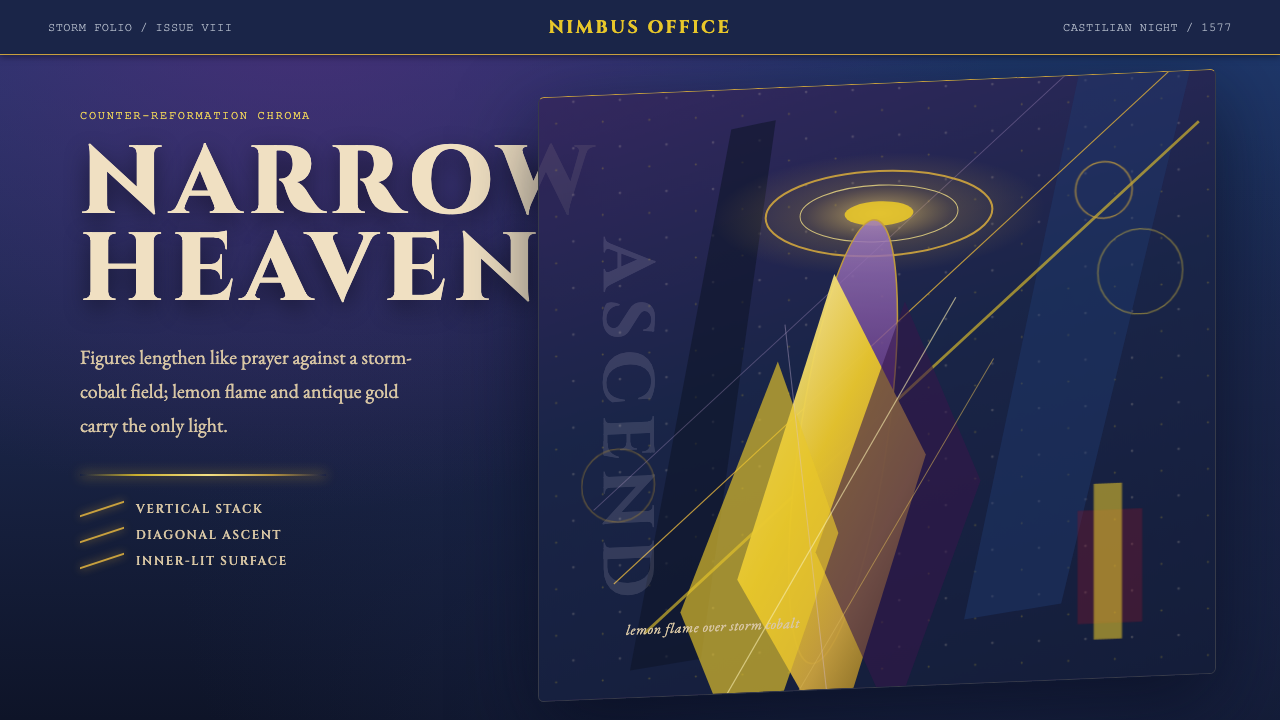 El Greco — Toledo MannerismMysticism strains upward. Storm cobalt, lemon flame, and gold halos pull the…
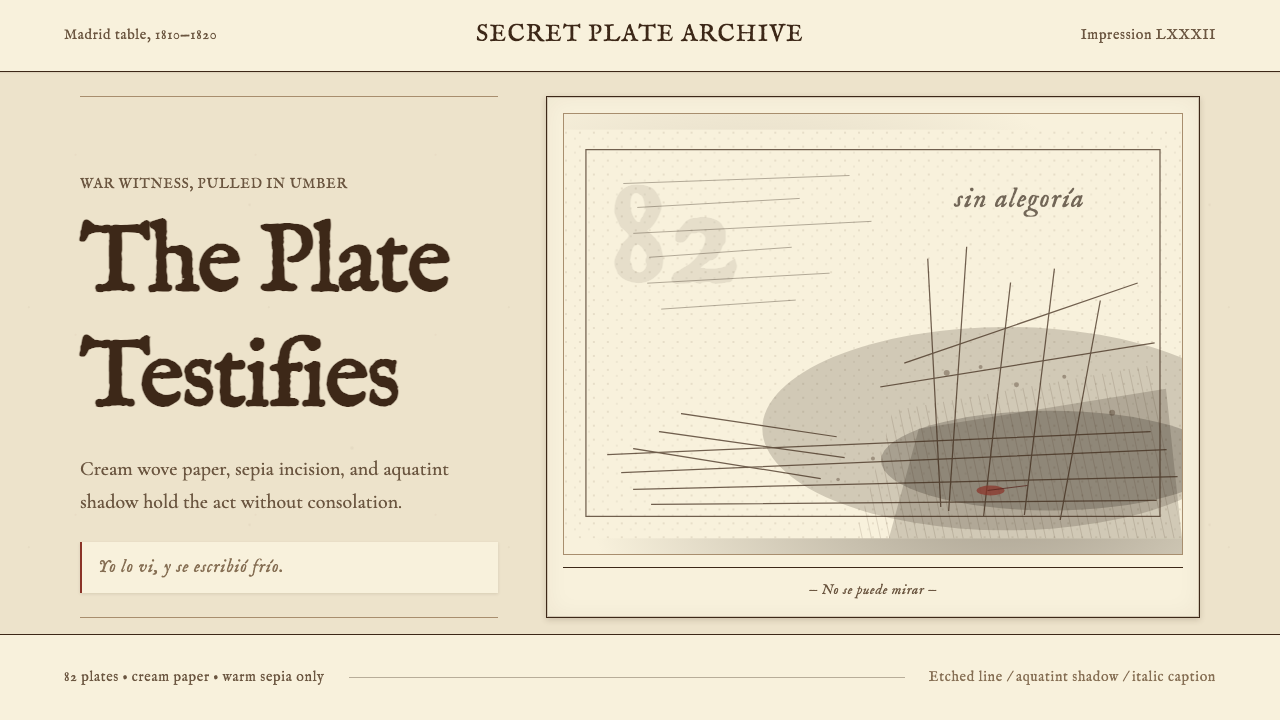 Goya — Disasters of WarWitness without ornament. Cream paper, umber line, aquatint shadow, italic ca…
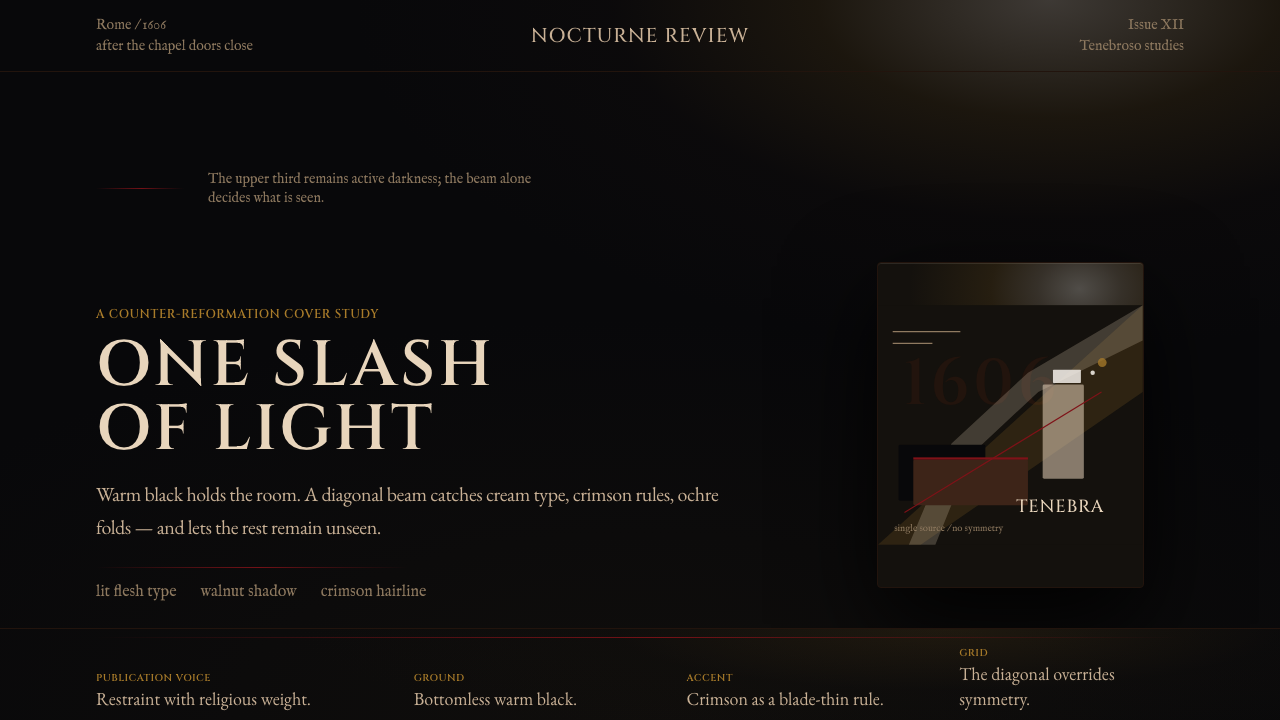 Caravaggio TenebrismDarkness acts first. Warm-black voids, Cinzel capitals, and one ochre raking…
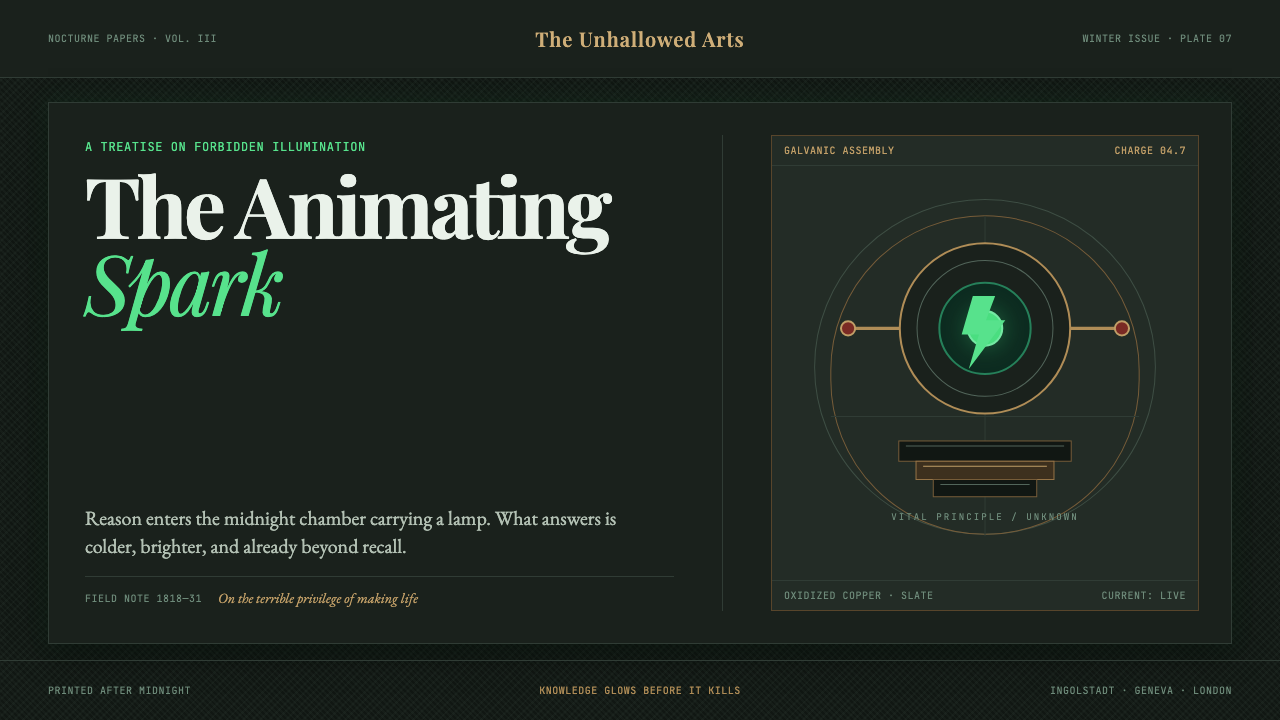 Frankenstein (1818)Knowledge glows before it kills. Acid green cuts through storm-slate and engr…
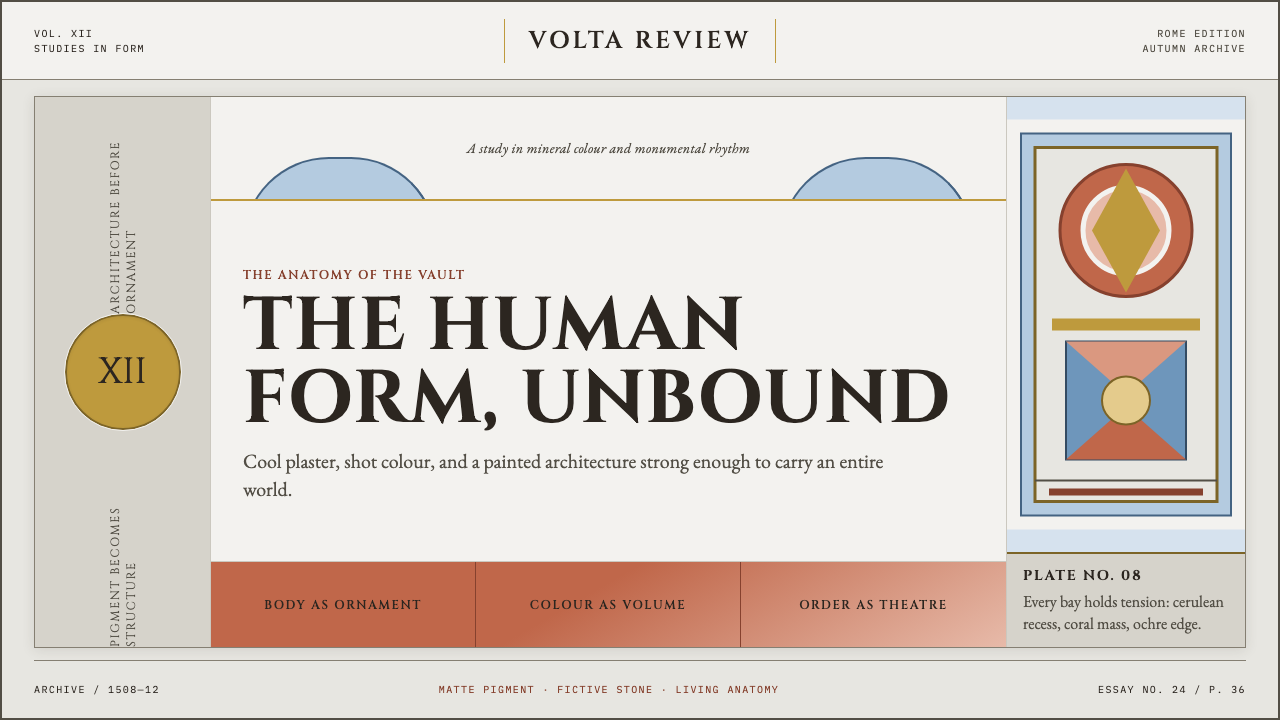 Michelangelo Sistine Ceiling (1512)Paint becomes monumental. Coral, cerulean and ochre figures strain against a…
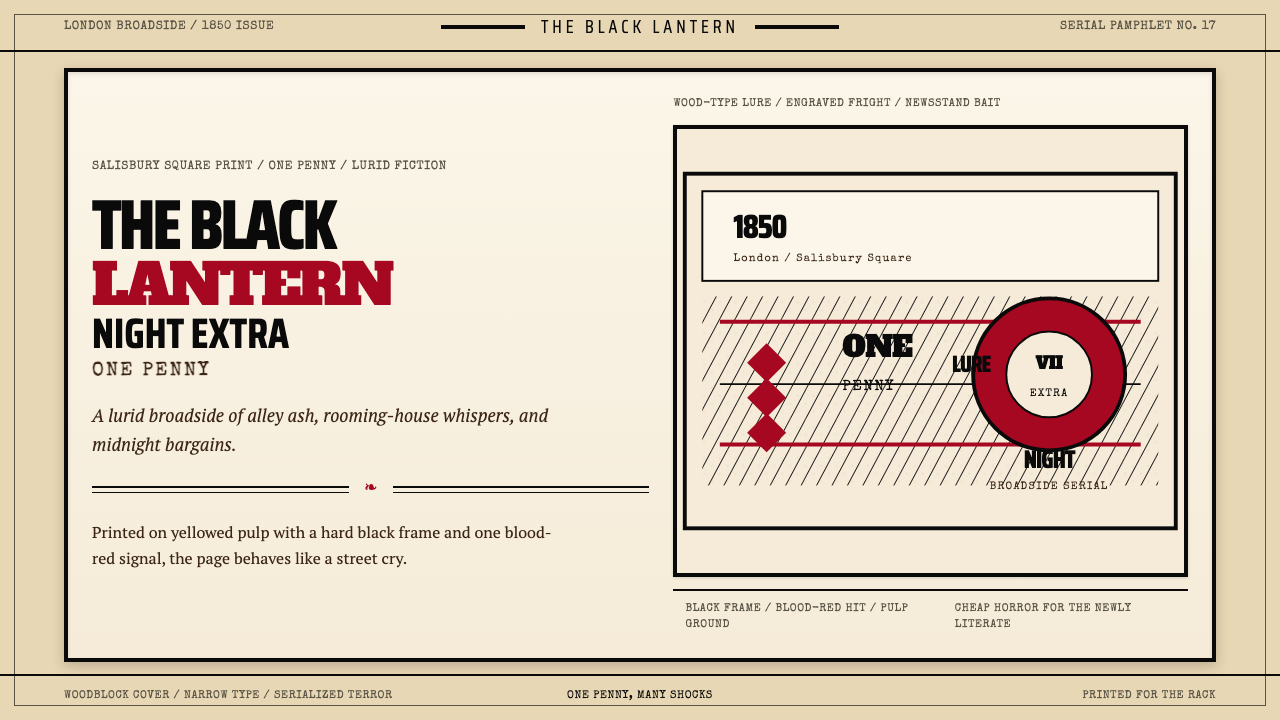 Penny Dreadful Victorian Headline (1850)Cheap terror in full cry. Condensed wood-type, black borders, and one blood-r…