What is Goya — Disasters of War?
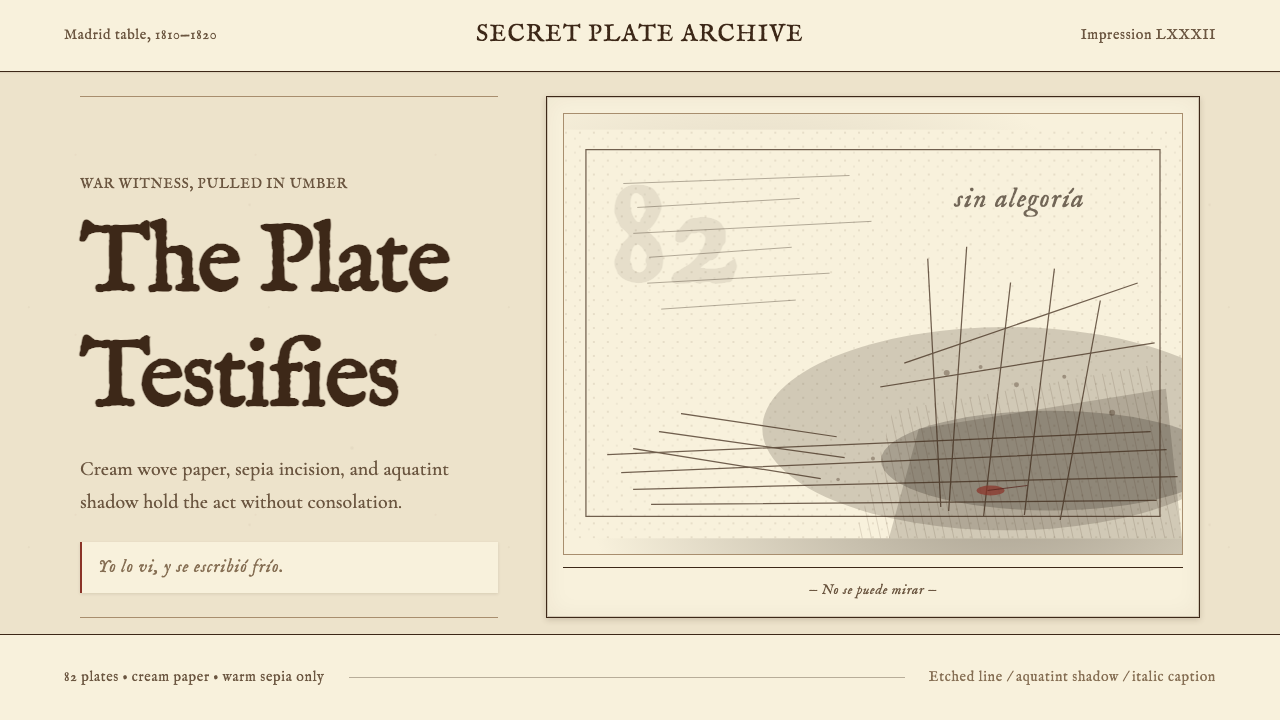
Goya's war etchings turned printmaking into journalism — raw, monastic, and so brutal that Spain dared not publish them for thirty-five years.
Goya — Disasters of War in brief
Goya — Disasters of War is a design system distilled from Francisco Goya's *Los Desastres de la Guerra*, a series of 82 etchings created in secret between 1810 and 1820 during Napoleon's invasion of Spain. The aesthetic is built on the vocabulary of intaglio printmaking: cream laid paper as the ground, warm umber-sepia for every line and edge, dense aquatint pools for shadow, and a short italic caption positioned beneath each image as the only text element. Nothing is gilded, symbolic, or allegorical. The visual language is that of witness.
What distinguishes this system from other historical print aesthetics is its relationship to restraint-as-statement. Goya stripped away the rhetoric of Neoclassical allegory and Romantic grandeur to produce images of devastating directness. The same principle governs the design system: a near-monochrome palette of warm darks and warm lights, the physical trace of the etching plate as a compositional frame, and captions that comment rather than explain. The result is authoritative without being decorative, grave without being cold.
The system is not historical cosplay. The plate-mark border, the sepia line work, the aquatint shadow, and the italic footnote are all translatable to screen and print contexts — they produce a coherent visual identity that reads as unflinching, credible, and editorially serious. It suits contexts where the audience is assumed to be adult, informed, and uninterested in reassurance.

Where does Goya — Disasters of War come from?
Francisco de Goya y Lucientes was already sixty-four years old and entirely deaf when Napoleon's forces crossed the Pyrenees and swept into Spain in 1808. He had spent decades as court painter to the Spanish Crown, producing tapestry cartoons, aristocratic portraits, and festive genre scenes. The Peninsular War shattered that world. Goya witnessed or received direct accounts of executions, mass graves, famine, and the systematic destruction of villages across Aragon — the region where he had been born. Between roughly 1810 and 1820 he worked in secret, etching and aquatinting a series of plates he never showed publicly and never titled. He may have called them simply *Fatal consequences of Spain's bloody war with Bonaparte, and other emphatic caprices* — the title *Disasters of War* was affixed posthumously.
The technique Goya used was itself a statement. Aquatint — a form of intaglio printing that produces tonal areas resembling ink wash — had been adopted by printmakers for its ability to reproduce the subtleties of drawing and watercolor. In Goya's hands it became something else entirely: the aquatint grounds are heavy and atmospheric, pooling like shadow or smoke, refusing to prettify the forms beneath them. The etchings are not polished reportage. They are raw, deliberately unfinished in places, with visible reworking and the physical evidence of the plate itself — its beveled edges leaving a mark on the paper — incorporated as part of the image's honesty.
The written captions are as important as the images. Goya wrote them in a clipped, often ambiguous Spanish that resists easy interpretation. *Yo lo vi* — I saw this. *Con razon o sin ella* — With reason or without. *Para eso habeis nacido* — This is what you were born for. The captions are not journalistic identification; they are moral provocations, addressed simultaneously to the viewer, to the perpetrators, to history, and to no one. This interplay between image and laconic text became a defining structural element of the design system that bears the series' name.
The plates passed into the possession of the Real Academia de Bellas Artes de San Fernando after Goya's death in Bordeaux in 1828. For thirty-five years they sat unpublished — the images were considered too inflammatory for the political climate of Restoration Spain. The first edition of 80 plates finally appeared in 1863. Subsequent scholarship, notably the catalogue work of Tomás Harris in the twentieth century and the exhibition and interpretive essays by Eleanor Sayre at the Boston Museum of Fine Arts, established the series as the foundational document of modern war reportage in visual art and one of the most consequential bodies of work in the history of printmaking.
What defines the Goya — Disasters of War look?
Palette
The color range is deliberately narrow and warm: cream or aged-ivory as the ground, a single warm umber-sepia for all lines and marks, and deep brown-black for the heaviest shadow areas. There is no cool black, no blue-gray, no neutral white. Every tone sits on the warm side of the spectrum, evoking the sulfurous chemistry of the etching process and the yellowed paper of aged prints. Accent color — if it appears at all — is a muted ochre or rust, never a saturated hue. The absence of color is itself information: this is a world stripped of spectacle.
Line and Mark
All linework reads as hand-drawn and slightly imperfect — a quality inherited directly from the etching needle. Lines are not mechanical; they carry the slight variation in weight that comes from the hand pressing into a resist-coated plate. Hatching and cross-hatching build tone where aquatint shadow does not reach. Outlines are not uniform contours; they are drawn as observed, thickening where form turns away from light and thinning where surfaces catch it. This humanized line quality is non-negotiable — any crisp, mechanical stroke reads immediately as a forgery of the system.
Aquatint Shadow
Shadow in this system is rendered as aquatint tone — a granular, slightly uneven atmospheric field rather than a crisp geometric shape or smooth gradient. Shadows pool and mass; they do not define edges cleanly. This distinguishes the system sharply from both hard-shadow Bauhaus work and soft-shadow contemporary UI. The shadow is environmental, almost airborne, suggesting the haze of gunpowder or the dimness of a scene lit by uncertain light. Where shadows are darkest they become nearly opaque, and this extreme tonal contrast — bright cream against near-black — is the system's primary compositional engine.
Plate-Mark Frame
Etched prints carry a characteristic plate mark: the impressed rectangular border left by the edge of the copper plate pressing into damp paper. In this design system, that plate mark is translated into a compositional device — a visible rectangular frame, slightly inset from the outer edge of the composition, that contains the image while simultaneously revealing itself as a made artifact. The border is not decorative; it is a reminder that what is seen has been mediated through a physical process. It signals handmade, particular, and unrepeatable — the opposite of the seamless digital surface.
Italic Caption
Each composition is accompanied by a short caption positioned beneath the image, set in a humanist italic that echoes the hand-lettered originals. The caption does not describe the image; it comments, questions, or accuses. This means the typographic register is fundamentally different from a label or headline — it is closer to a marginal note or a spoken aside. The italic is always small relative to the image, never centered, and set close to the lower edge of the plate mark. It is the only place body-weight type appears in the system. Everything else communicates through image, shadow, and the weight of line.
Monastic Restraint
The system contains no decorative element that cannot be traced to the original printmaking process. No ornamental borders, no color washes beyond the umber-sepia range, no geometric shapes added for visual interest, no photographic backgrounds. Every element present is necessary and accountable. This is not minimalism in the contemporary sense — contemporary minimalism often achieves visual interest through generous whitespace and refined proportion. Goya's system achieves its power through density and darkness, packing tone and line into a constrained field and withholding relief until the caption.
Witness Stance
The system's defining non-visual characteristic is its implied point of view: the design is constructed as if by someone who was present. There is no editorial smoothing, no compositional heroism, no color-coded moral judgment. Events are recorded in the order they were witnessed, without ranking or resolution. Applied to contemporary contexts, this means the system resists reassuring conclusions — charts do not trend optimistically upward, calls to action do not promise transformation. The visual register is that of testimony, which requires that the designer resist the impulse to comfort.

Who shaped Goya — Disasters of War?
Goya (1746–1828) created the Disasters series while serving as First Court Painter to the Spanish Crown — a position that gave him access to events and the social protection to observe them without immediate censorship. His earlier career in tapestry design and portraiture gave him technical mastery of tone and composition; the Peninsular War gave him the subject that would define his late work. Deaf since a serious illness in 1792, Goya developed a visual language uncoupled from the aural world, increasingly interior and uncompromising. The Disasters plates were made for no patron and with no expectation of publication — they represent the clearest instance in his career of art made under no obligation but to record.
Harris (1908–1964) was a British art dealer, intelligence officer, and Goya scholar whose 1964 catalogue raisonné of the complete prints remains the standard scholarly reference. Harris's cataloguing work established the chronology of the Disasters plates, identified the different printing states, and documented the provenance of surviving impressions. Before Harris, the series existed largely as legend and partial reproductions; his systematic account gave designers, historians, and educators a reliable corpus from which to work. His intelligence career during the Second World War — he ran the double-agent GARBO — gave him an unusual personal understanding of the gap between official narrative and witnessed reality that runs through the Disasters.
Sayre (1916–2001) was curator of prints and drawings at the Boston Museum of Fine Arts and organized the landmark 1974 exhibition *Goya and the Spirit of Enlightenment*, which brought the Disasters to international public attention as a unified artwork rather than a collection of historical illustrations. Her scholarly essays argued that the series should be read sequentially and as a moral argument, not merely as documentation. This interpretive shift — from archive to artwork, from record to statement — is foundational to the design system that takes the series' name. Sayre's insistence on the captions as integral to meaning, not secondary to the images, is directly reflected in the system's typographic hierarchy.
López was the secretary of the Real Academia de Bellas Artes de San Fernando who oversaw the first 1863 printing of the Disasters plates, nearly thirty-five years after Goya's death. Working from 80 of the 82 original plates — two had been lost — López's edition defined how the world would first encounter the series: the print quality, the caption placement, and the ordering of the images. The decisions made in 1863 established aesthetic conventions that subsequent editions, scholarly reproductions, and ultimately the design system all inherit. López is largely invisible in popular Goya literature, but the visual form in which the series is known is substantially his responsibility.
How do you use Goya — Disasters of War today?
Goya — Disasters of War is not a versatile all-purpose style. It is a specific instrument suited to specific work: editorial, analytical, documentary, and any context in which unvarnished credibility is more valuable than approachability. Understanding its strengths means understanding its refusals — it refuses decoration, refuses optimism-signaling, and refuses the visual conventions of reassurance. Applied correctly, it communicates that the designer trusts the audience to face difficult material without prettification.
For presentation slides, the system operates in a register quite different from conventional deck design. A cover built in this aesthetic uses the cream-ground plate-mark composition as its container, with the presentation title in a humanist italic at modest scale and an aquatint-style tonal image or texture occupying most of the field — no hero gradient, no large display typeface at maximum weight. Content slides use a sparse grid: one or two text blocks in a narrow measure with generous margin, a single visual element framed by the plate-mark convention, and a one-line italic caption below it. Data slides treat charts as engravings — rendered in the umber-sepia range with heavy axis lines and no color-coded highlights. The absence of color in the data serves as a discipline: information must organize itself through labeling and scale, not through hue.
For web interfaces and dashboards, the style is suited to serious analytical tools, investigative journalism platforms, research archives, and institutional documentation sites — contexts where the user arrives already motivated and where visual sobriety signals depth. Apply the cream-ground palette to the page background and umber tones to borders, rules, and typographic markers. Interactive elements are distinguished by line weight and position rather than by fill color changes; hover states deepen the umber rather than introducing a new hue. Data visualization in this system relies on density and contrast rather than color differentiation. For pricing or marketing pages, the style works when the product itself is framed as serious, evidence-based, or protective — research services, legal tools, medical information systems — and fails when the product needs to project warmth, accessibility, or playfulness.
For editorial and long-form content, the system's natural habitat is the serious magazine spread, the annual report for an organization comfortable with gravity, the monograph, or the exhibition catalogue. Column widths are narrow and the measure disciplined; the type set in a humanist face with minimal leading variation. Section breaks are marked by a bold umber horizontal rule rather than decorative ornaments or color bands. Pull quotes, if used, are set in the same italic register as the original captions — small, marginal, not large and centered. The plate-mark framing device applies to any contained visual: photographs, charts, and maps are all given the same inset rectangular border, bringing them visually into the printmaking register. The effect is that the entire layout reads as a considered artifact rather than a rendered surface.
The most common mistake when applying this system is misjudging its emotional register and using it where sympathy and warmth are required. The Goya aesthetic communicates witness, not comfort — it is credible and serious, but it does not invite the viewer in. A second common error is softening the palette toward beige-and-gray neutrality in an attempt to modernize it; this strips out the warmth that distinguishes the system from generic muted editorial design and produces something that reads as neither historical nor contemporary. A third mistake is using the plate-mark frame as pure decoration — placing it around content that does not justify the seriousness the frame implies. The frame is a truth-claim; use it only when the content can support that claim.

Goya — Disasters of War — FAQ
Is this style appropriate for consumer-facing products?
Rarely, and with significant caveats. The Goya Disasters aesthetic is built on emotional sobriety and the refusal of reassurance — qualities that serve investigative journalism, research tools, institutional memory, and documentary work, but that actively resist the warmth and invitation that most consumer products need. It can work for consumer-facing contexts where the brand identity is deliberately serious: certain financial products that want to signal integrity rather than growth-optimism, some medical information platforms, legal research tools. It does not work for e-commerce, social applications, lifestyle products, or anything that needs to communicate joy, ease, or welcome. When in doubt: if the product needs to make the user feel good about using it, this style will work against you.
How does this style handle color photography or full-color images?
Color photography is handled by desaturation or duotoning, not by exclusion. A full-color photograph placed into a Goya Disasters layout without treatment will read as a foreign element — its naturalistic color logic conflicts with the near-monochrome field. The correct approach is to render photographic images as warm-toned duotones, using the umber-sepia range as the print color, or to convert them to a high-contrast near-grayscale that is then tinted slightly warm. This treatment does not destroy the photographic information; it translates the image into the register of the system. Maps, diagrams, and data visualizations are treated similarly: any color they originally carried is replaced by the umber-sepia tonal range.
Can the plate-mark frame be omitted to simplify the layout?
It can, but doing so removes one of the system's core structural signals. The plate-mark frame is not a decorative border; it is a reminder that the image has been mediated — that someone chose to record this, pressed a plate into paper, and accepted the evidence of that physical act. Removing it does not break the system, but it does shift the register from printmaking toward generic editorial. If the plate-mark is retained for images and removed for text blocks, the contrast between framed visuals and unframed text can actually reinforce the system's distinction between witnessed image and interpretive word. The frame should never be reduced to a thin decorative rule; it needs to carry enough visual weight to read as a physical impression rather than a design choice.
What kind of typeface works within this system, described in qualitative terms?
The system calls for type that reads as hand-drawn in origin rather than mechanically constructed — humanist faces in the italic cut are the primary register. The ideal type for captions has slightly variable stroke width, a calligraphic axis, and letterforms that feel penned rather than plotted. For body text, a humanist roman with moderate contrast between thick and thin strokes works well: the variation in stroke weight echoes the variation in the etching line without imitating it directly. Geometric sans-serif faces are incompatible with this system — their mechanical regularity and uniform stroke weight read as a different technological moment entirely. Transitional or modern serifs with high contrast and sharp hairlines are also discordant; they belong to the printing conventions of a later century and introduce anachronistic precision.
Is the Goya Disasters style related to other dark or gothic editorial aesthetics?
There are superficial similarities but fundamental differences. Dark editorial aesthetics — the kind associated with luxury fashion, certain music publications, or high-end cultural journals — use blackness and high contrast for visual drama and sensory richness. They are designed to attract and hold attention, and they rely on sophisticated type treatments, high-contrast photography, and carefully controlled emptiness. The Goya Disasters aesthetic uses its darkness differently: the near-black of the aquatint shadow is atmospheric and slightly unstable, not sleek. The system does not seek drama; it seeks accuracy. The comparison to gothic or black-metal visual culture is even more distant — those aesthetics are interested in the sublime, the transgressive, and the theatrical. Goya's is interested in the actual. The closest contemporary analogs are investigative documentary design, photojournalism publication design, and the more austere end of institutional memorial design.
Related design styles
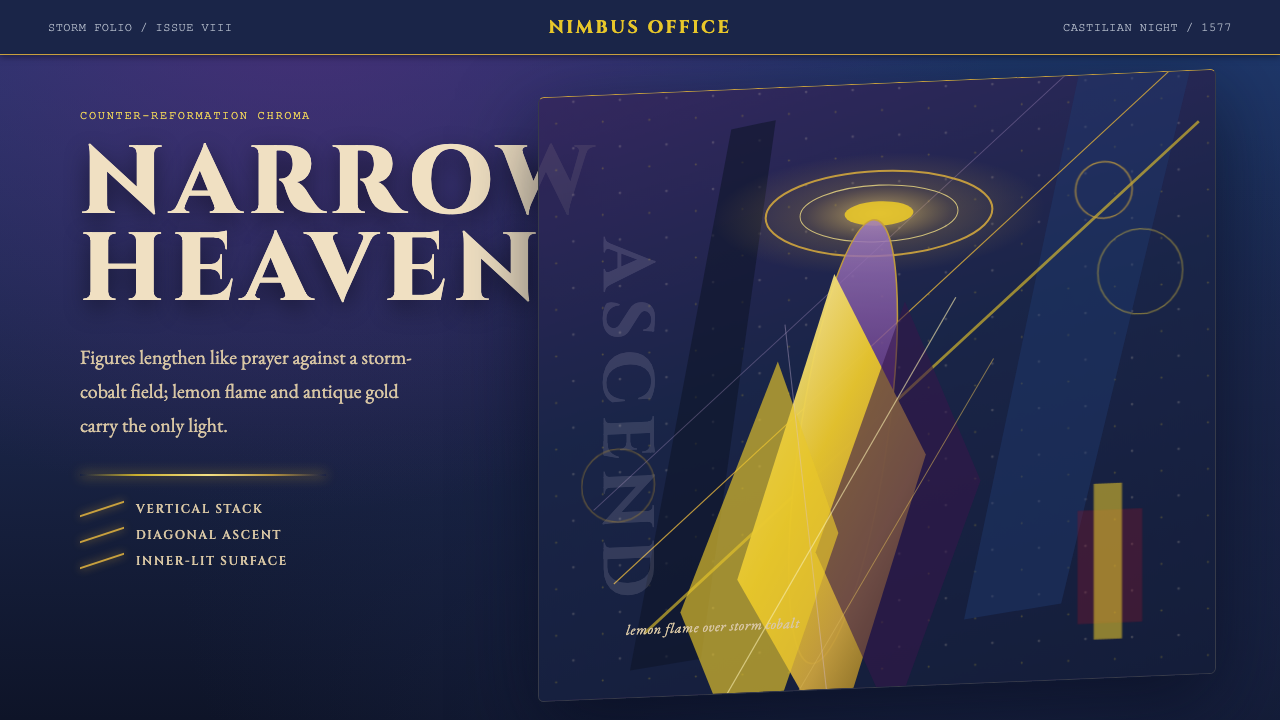 El Greco — Toledo MannerismMysticism strains upward. Storm cobalt, lemon flame, and gold halos pull the…
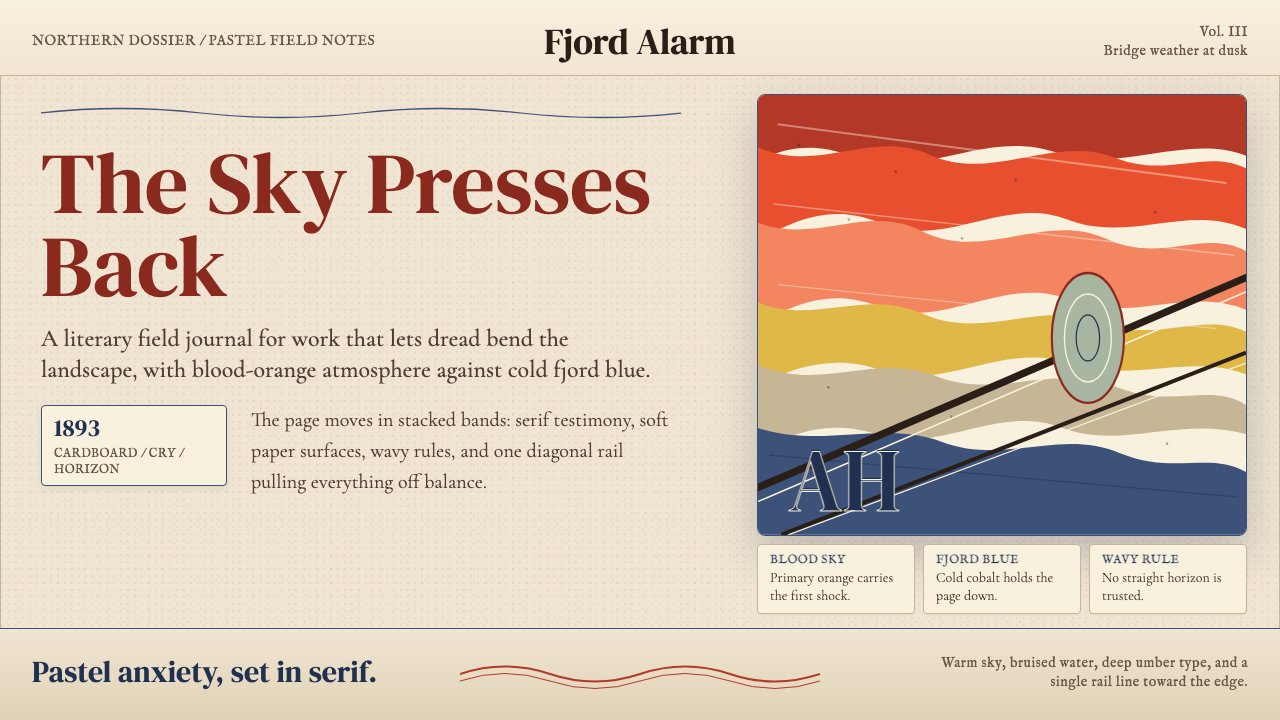 Munch — The ScreamAnxiety bends the page. Blood orange bands, cobalt fjord, and serif type tilt…
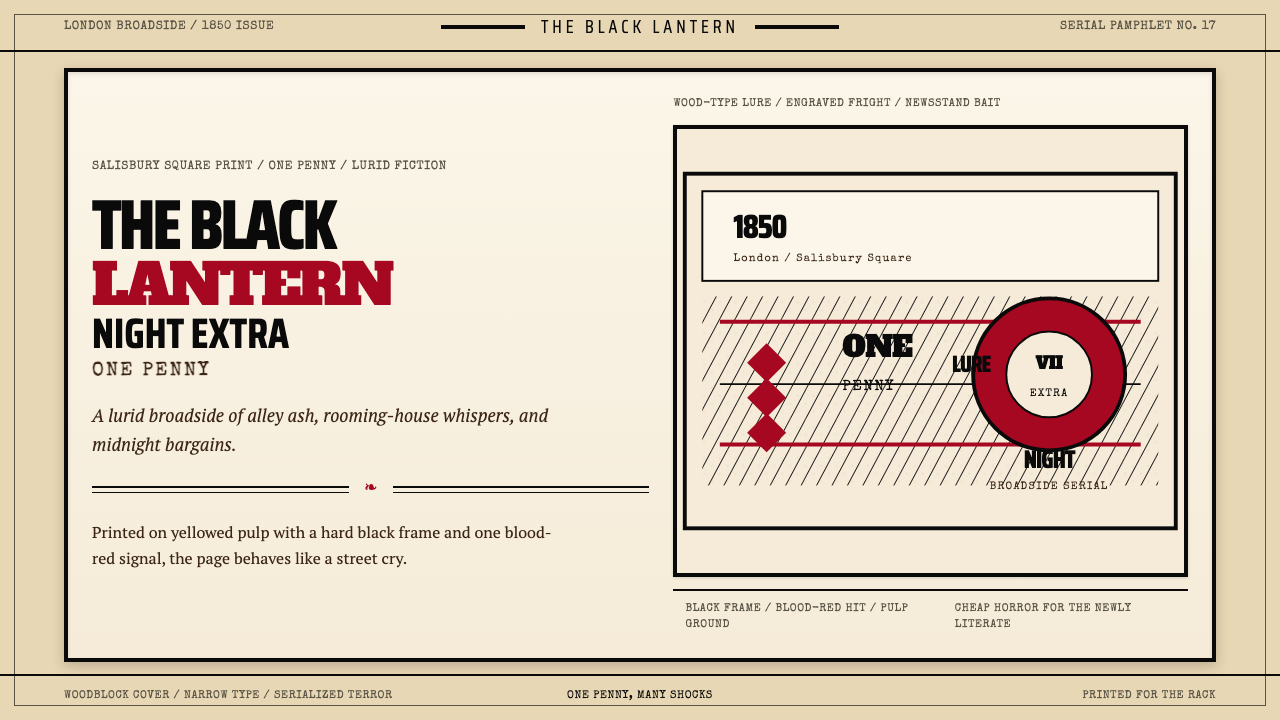 Penny Dreadful Victorian Headline (1850)Cheap terror in full cry. Condensed wood-type, black borders, and one blood-r…
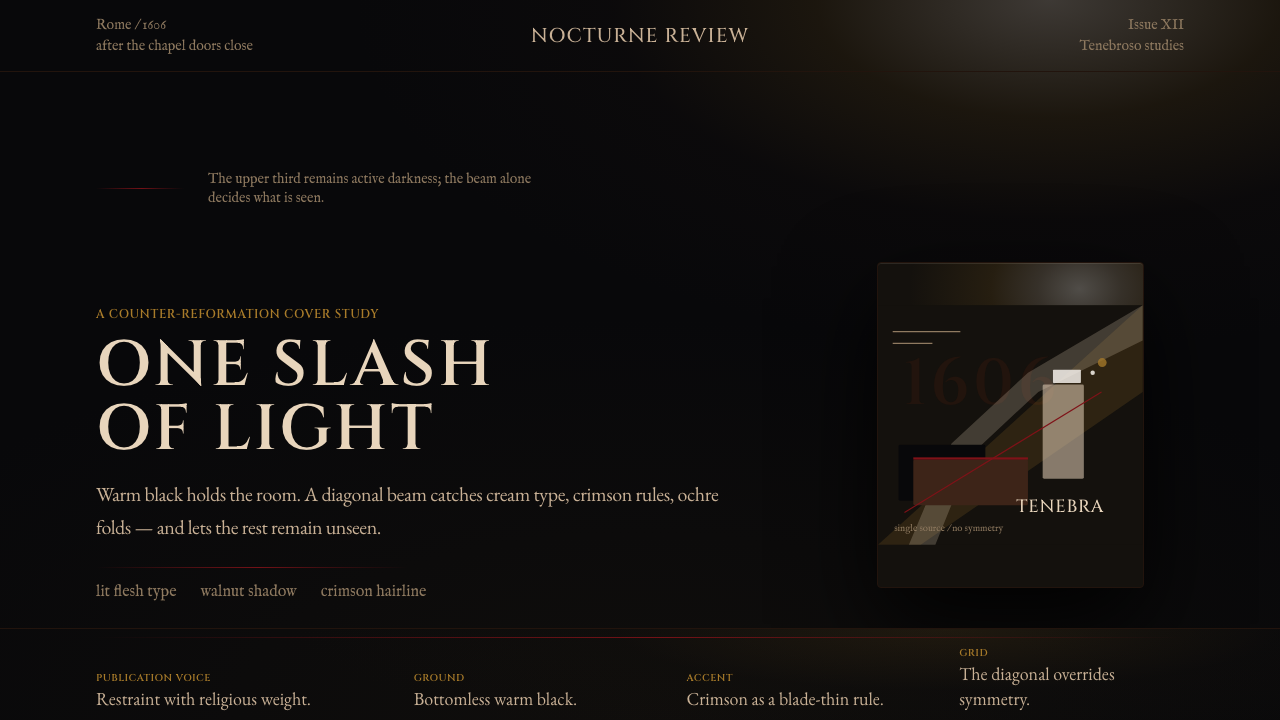 Caravaggio TenebrismDarkness acts first. Warm-black voids, Cinzel capitals, and one ochre raking…
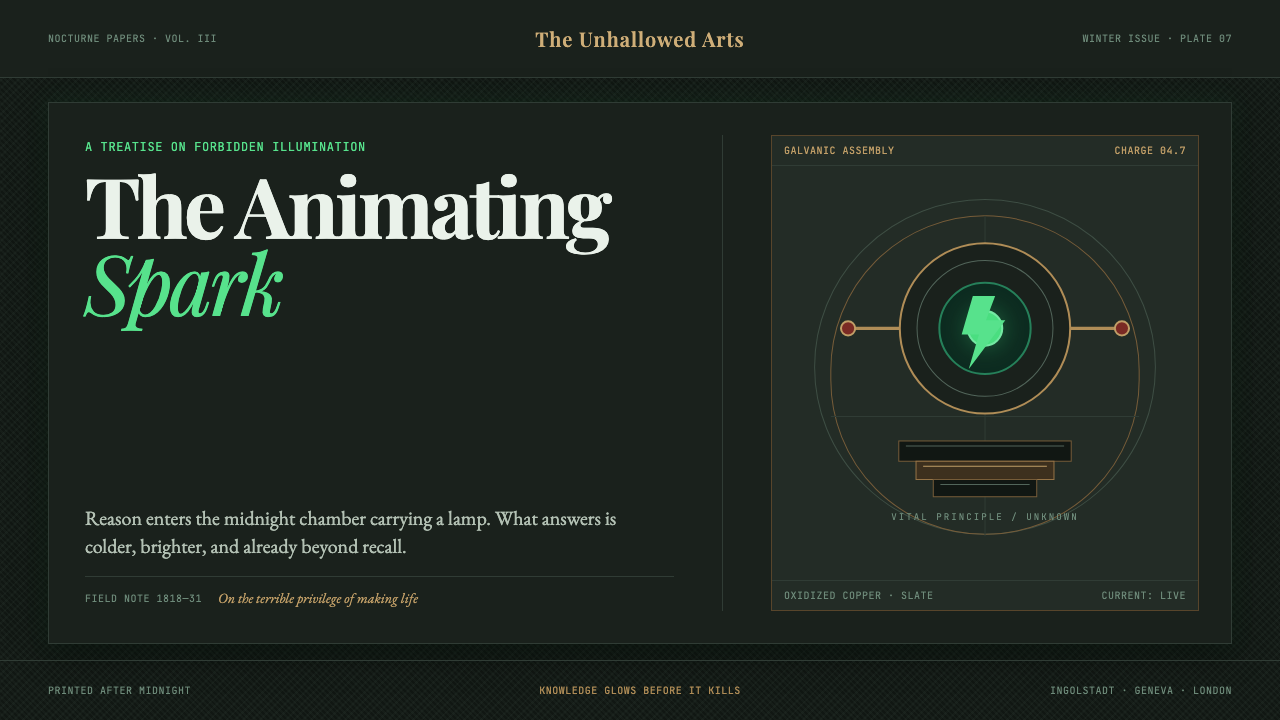 Frankenstein (1818)Knowledge glows before it kills. Acid green cuts through storm-slate and engr…
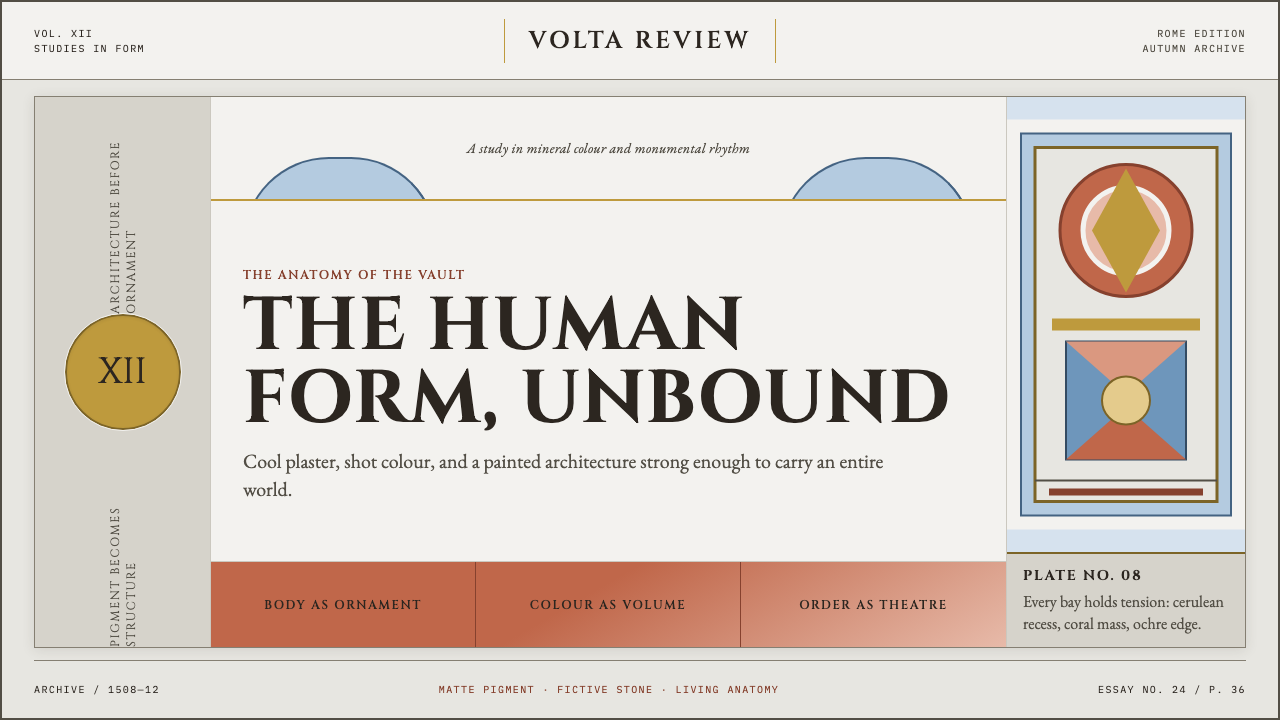 Michelangelo Sistine Ceiling (1512)Paint becomes monumental. Coral, cerulean and ochre figures strain against a…