What is Turner — Rain, Steam and Speed?
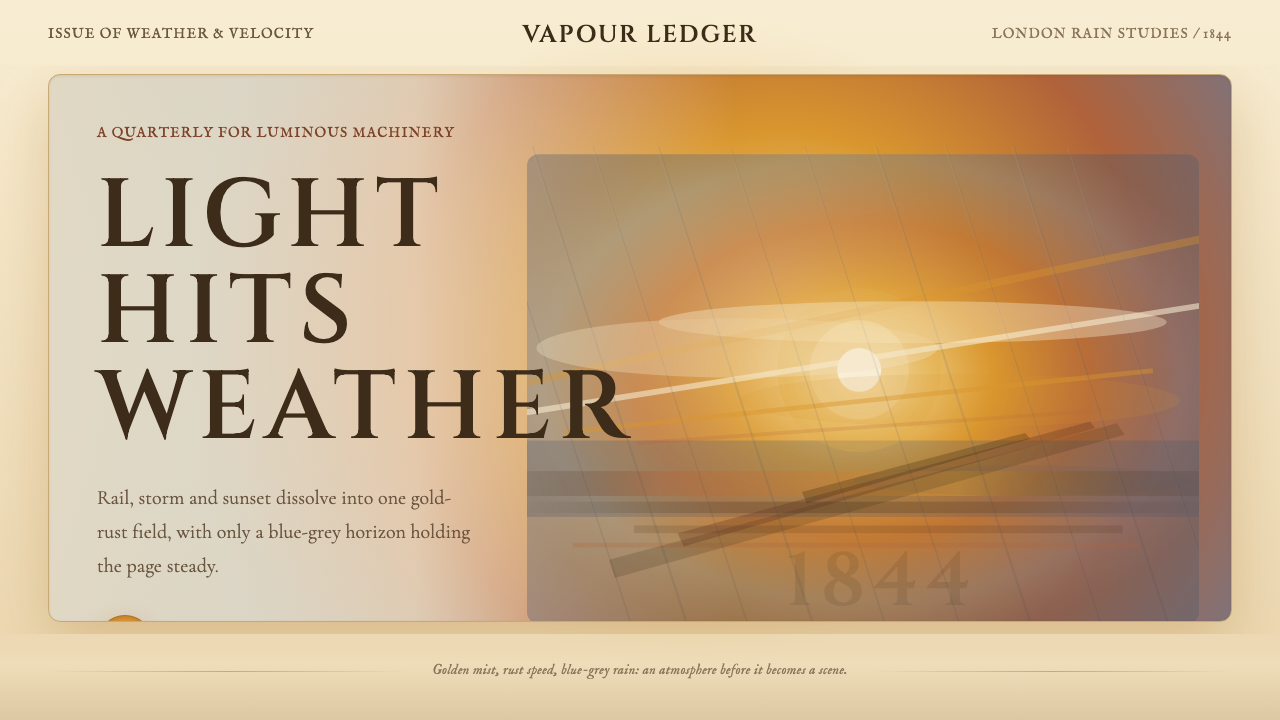
Turner dissolved the Industrial Age into luminous haze — edges, engines, and storms all melting into the same amber light.
Turner — Rain, Steam and Speed in brief
Turner's late atmospheric style — crystallized in Rain, Steam and Speed, exhibited at the Royal Academy in 1844 — is among the most radical visual ideas in the history of Western painting. Where earlier landscape art prized clear contours, local color, and legible detail, Turner's mature work does the opposite: it sacrifices definition to light. The painting depicts a locomotive crossing Maidenhead Railway Bridge on Brunel's Great Western Railway during a rainstorm, yet the train is barely visible — a dark smear inside a vortex of gold, rust, cream, and blue-grey vapor. The subject is not the train. The subject is atmospheric sensation.
Aesthetically, the system is built around dissolution. Edges are not drawn — they are absorbed into surrounding mist. Color is organized not by local identity but by the temperature and density of light: warm amber and saffron dominate the sun-struck center, bleeding outward into cooler blue-violet at the horizon. Horizontal smears of ochre and cream suggest the bridge without defining its masonry. The locomotive announces itself through darkness and forward thrust rather than through outline. Every visual element is held in suspension, as if the scene exists at the exact moment before it becomes something else.
This aesthetic sits at the intersection of British Romanticism, the Sublime landscape tradition, and what later critics would recognize as proto-Impressionism. It is not a style of clarity or structure — it is a style of atmosphere, imminence, and emotional intensity. Applied to contemporary design work, it conveys historical weight, literary mood, and a quality of drama that clean, geometric systems cannot produce.

Where does Turner — Rain, Steam and Speed come from?
Joseph Mallord William Turner was born in London in 1775, the son of a barber. He entered the Royal Academy Schools at fourteen and exhibited his first oil painting there at the age of sixteen. His early work was conventional topographical watercolor, carefully observed and precisely rendered. But over the decades that followed — traveling through Wales, Scotland, the Alps, Venice, and the coastal town of Margate — his style underwent a transformation that his contemporaries found alternately visionary and incomprehensible. By the 1820s, his canvases had begun to dissolve into light in ways that no precedent in British painting quite explained.
The intellectual and artistic context for Turner's late style comes from multiple directions. The tradition of the Sublime — formulated by Edmund Burke in 1757 and popularized in British landscape culture — held that experiences of overwhelming natural power (storms, mountainous vastness, oceanic depth) produced a particular species of elevated terror that was aesthetically valuable. Turner spent his career pursuing and depicting such experiences. His travels to Switzerland in the 1840s, after the opening of the Mont Cenis railway route, brought him face to face with both the grandeur of Alpine weather and the new industrial infrastructure cutting through it — a confrontation between geological time and mechanical speed that energized his final decade of work.
John Ruskin, the most influential art critic of the Victorian era, became Turner's most ardent champion. In the first volume of Modern Painters (1843), published just a year before Rain, Steam and Speed was exhibited, Ruskin argued that Turner's atmospheric truth-telling surpassed the literalism of Dutch and Flemish landscape painters. Ruskin saw in Turner's mists and luminosities an almost moral fidelity to natural experience — the claim that painting should capture how the world actually appears to a sensitive observer, not how it might be diagrammed by a surveyor. This defense gave Turner's dissolution of form intellectual legitimacy precisely when critics most questioned it.
Walter Fawkes, Turner's friend and patron at Farnley Hall in Yorkshire, was an important early supporter whose collection of Turner watercolors became one of the finest in England. Through Fawkes and other collectors including Sir George Beaumont (who eventually came around to Turner's vision after years of opposition), Turner had access to private patronage that insulated him from the swings of public taste. He was elected a full Royal Academician in 1802 at the age of twenty-six — the youngest painter to achieve that distinction at the time — and served as Professor of Perspective there from 1807, a position that gave him institutional authority to develop his ideas in public. By the time of Rain, Steam and Speed, Turner was seventy years old, working largely in isolation in Chelsea, and had fully arrived at the atmospheric style for which he is now remembered.
What defines the Turner — Rain, Steam and Speed look?
Atmospheric Dissolution
The defining gesture of Turner's late style is the deliberate dissolution of sharp edges into surrounding atmosphere. Forms are suggested rather than stated: a bridge, a locomotive, a distant tree line all emerge from the same luminous vapor that surrounds them. The eye is given just enough information to recognize the subject and no more. This is not imprecision but a different kind of precision — the precision of how light actually behaves when it strikes mist, steam, or wet air.
Warm-to-Cool Color Drama
Turner's palette in Rain, Steam and Speed is structured around a dialogue between warm and cool tones rather than around hue contrast. A glowing amber and saffron core — the sun disc burning through storm — radiates outward and cools progressively into blue-grey, blue-violet, and eventually deep shadow at the far edges. Rust and ochre smears occupy the transitional zone where warm light meets cool distance. The result is a color field that feels luminous from within rather than lit from a single external source.
Horizontal Velocity
The painting's composition is built around horizontal momentum. Broad, directional smears of paint run left to right across the canvas, paralleling the movement of the train and the sweeping of the storm. This horizontal energy compresses vertical information — the height of the bridge, the weight of the sky — into lateral motion. In design terms, this translates to a preference for wide, low-proportion formats, sweeping horizontal gradations of tone, and compositional elements that lead the eye steadily across the frame rather than anchoring it vertically.
Vortex Composition
Despite the dominant horizontality, Turner structures his late paintings around a vortex — a central luminous point from which color and energy spiral outward, or into which the surrounding atmosphere appears to be drawn. In Rain, Steam and Speed, the sun disc and the advancing train share this vortex function: they are the point of maximum intensity around which the rest of the composition swirls. This creates a composition that feels simultaneously expansive and centripetal, immersive rather than scenic.
Impasto and Surface Incident
Turner's late technique involved building up paint in thick, irregular layers — impasto strokes applied with brush, palette knife, and reportedly even his fingers and thumbnail — so that the painted surface itself carries physical incident. Lighter, thicker passages of paint reflect more light; thinner scumbled passages allow underlayers to show. The surface is never smooth or homogeneous. In contemporary design, this quality translates to textured overlays, paper or canvas grain, layered washes, and the deliberate avoidance of the frictionless flatness that digital tools produce by default.
Indeterminate Light Source
In Turner's late paintings, light does not emanate from a single, locatable source. The luminosity is atmospheric — suffused through vapor and mist so that the whole scene is lit from within. This is fundamentally different from the directional lighting of most academic painting, which creates a clear shadow side and a clear light side on every object. Turner's diffuse luminosity eliminates hard shadow almost entirely, replacing it with gradations of intensity and warmth. The effect is enveloping rather than dramatic in the theatrical sense — the viewer is inside the light, not observing it from outside.
Industrial Sublime
Rain, Steam and Speed is notable as one of the first major paintings to place industrial technology within the tradition of the Sublime. The locomotive is not celebrated as a feat of engineering — it is absorbed into the same overwhelming atmosphere that, in earlier Turner canvases, would have been occupied by an Alpine avalanche or a sea storm. The machine becomes sublime by being made small within weather. For contemporary design, this is the tension the style holds: monumental scale and historical weight on one side, the fragility and contingency of any particular moment on the other.

Who shaped Turner — Rain, Steam and Speed?
Turner (1775–1851) is the originating figure of this entire aesthetic. Born in Covent Garden, he entered the Royal Academy Schools at fourteen and spent six decades relentlessly expanding the expressive range of landscape painting. His late works — produced largely at his studio in Chelsea and during travels to Venice, Switzerland, and the Margate coast — moved steadily away from topographical accuracy toward pure atmospheric sensation. Rain, Steam and Speed was exhibited in 1844 when he was sixty-eight; he continued painting until near his death in 1851. He left the bulk of his estate and several hundred finished oil paintings to the British nation; the core collection is now held at Tate Britain in London.
Ruskin (1819–1900) was the defining critical voice of Victorian-era art and architecture, and Turner's most eloquent champion. His multi-volume Modern Painters — the first volume published in 1843, the year before Rain, Steam and Speed was shown — argued systematically that Turner's atmospheric truth surpassed the documentary literalism of earlier landscape traditions. Ruskin's concept of 'truth to nature' reframed Turner's dissolution of form not as incompetence or eccentricity but as a higher fidelity to visual experience. Without Ruskin's intervention, Turner's late work might have remained a critical curiosity rather than the foundational influence it became.
Fawkes (1769–1825) was a Yorkshire landowner, Whig politician, and Turner's closest friend and patron over more than two decades. His estate at Farnley Hall in Yorkshire became a second home to Turner, who visited almost annually between 1808 and 1824. Fawkes assembled one of the finest private collections of Turner watercolors in England, including studies of Alpine scenery, Rhine travels, and the Yorkshire landscape, and exhibited them publicly in his London house in 1819 — one of the earliest major public showings of Turner's work in an accessible, non-academy setting. The depth of Fawkes's personal and financial support gave Turner the freedom to experiment that his later atmospheric work required.
Brunel (1806–1859) was the engineer who designed the Great Western Railway and its Maidenhead Railway Bridge — the very bridge depicted in Rain, Steam and Speed. His design of the Maidenhead Bridge, completed in 1839, used the widest and flattest brick arches then built in the world, and critics had predicted at the time of construction that it would collapse. It did not; it still carries trains today. The bridge's combination of engineering audacity and subtle elegance made it an ideal subject for a painting about industrial speed, and the choice to paint Brunel's bridge rather than a more conventional viaduct aligns Turner's aesthetic with a particularly ambitious moment in British engineering.
How do you use Turner — Rain, Steam and Speed today?
Turner's atmospheric style is among the most distinctive and least copied of the canonical historical design vocabularies, which means it carries genuine distinctiveness when applied well. Its correct application is not about reproducing the look of a painting — it is about importing the specific tension the painting holds: warmth and power in the center, dissolution at the edges, horizontal momentum, and a pervading sense that the scene is lit from within rather than from above. Designers who understand this tension can apply it far beyond the obvious (amber backgrounds, misty overlays) into layout structure, typographic weight, and the ratio of defined to undefined space.
For presentation slides, this style excels in contexts that require historical gravitas and emotional atmosphere rather than data density. A cover slide built in Turner's register works best with a single dominant tonal field — amber, rust, or deep gold — into which type is set in a contrasting tone rather than a high-contrast color. The title may be partially obscured by a lighter overlay, as if emerging from mist, rather than sitting cleanly on a flat background. Content slides should avoid hard grid edges: let text columns breathe into surrounding space, use tinted or washed section dividers instead of ruled lines, and treat any data visualization as an atmospheric gradient field rather than a hard-edged chart.
For web UI and dashboards, Turner's palette and dissolution logic apply best to editorial and immersive contexts — long-form reading experiences, cultural or arts organization sites, heritage brand interfaces, or any product where the emotional quality of the user's experience matters as much as task efficiency. The approach: warm ground tones, typographic hierarchy established through weight and size rather than color contrast, generous open space that functions as the compositional equivalent of mist, and imagery treated with warm tonal overlays that reduce contrast and push photographs toward the amber-rust register of the painting itself.
For editorial and marketing design — book covers, event posters, cultural institution campaigns, premium brand materials — the style has direct applicability. A Turner-register poster uses a warm, luminous background with a centered or slightly off-center focal element that radiates outward into increasingly diffuse tone. Typography should feel weighted and substantial but sit in the atmosphere rather than dominating it; condensed letterforms in a warm near-white or cool blue-grey read well against amber grounds. The horizontal compositional emphasis suits wide-format work — billboard, panoramic social card, widescreen video title card — better than square or portrait formats.
The most common mistake when applying this style is conflating atmospheric dissolution with vagueness or incompleteness. Turner's paintings are not unfocused — they are precisely organized around a luminous core from which energy and color radiate outward in controlled gradations. The equivalent in design is not blurring everything or reducing contrast indiscriminately, but rather establishing a clear center of intensity and allowing surrounding elements to subordinate themselves to it. A second common mistake is using cool or neutral ground tones: the warmth of amber, gold, and rust is not a surface choice but the structural logic of the style, and substituting grey or blue grounds produces something that reads as fog rather than as Turner.

Turner — Rain, Steam and Speed — FAQ
Is this style appropriate for corporate or business design, or is it too painterly?
It depends heavily on the kind of corporate context. Turner's atmospheric style is well-suited to premium, heritage, or culturally positioned brands — financial institutions with long histories, arts and cultural organizations, publishing houses, architecture firms, hospitality groups operating in the upper-luxury register. It struggles in contexts that demand immediacy, data density, or rational clarity — SaaS dashboards, fast-moving consumer products, or any context where the user needs to extract information quickly. The style communicates depth and gravitas; it does not communicate speed or efficiency. Use it when those values align with the brand.
How do you handle readable typography in a style that is built around atmospheric diffusion?
The key is to reserve the atmospheric dissolution for backgrounds and supporting visual fields, not for the typographic layer. Turner's own paintings have a clear compositional hierarchy: the most defined elements in the painting — the train's dark silhouette, the forward-facing arch of the bridge — are also the most structurally important. Typography should function the same way: high contrast between text and its immediate ground, even if that ground is itself a diffuse tonal field. The most effective approach is to place text on a zone where the background tone is relatively uniform — the amber core, for instance — and allow the dissolution to happen in the margins and transitions. Text set in deep warm tones on a lighter field, or in near-white on a mid-amber field, reads cleanly while remaining inside the style's atmosphere.
How does this style relate to Impressionism, and why does that distinction matter for designers?
Turner predates the French Impressionists by a generation — Monet was born in 1840, four years before Rain, Steam and Speed was exhibited — and the relationship is one of anticipation rather than influence, though Monet reportedly visited London specifically to study Turner's work. The visual distinction matters for designers because Turner's atmospheric dissolution is organized around a dramatic, often singular light source and a clear compositional hierarchy, whereas Impressionism distributes attention more evenly across the picture surface and uses broken color strokes throughout. A Turner-derived design has a center of gravity; an Impressionist-derived design tends toward allover pattern. Knowing this helps designers avoid the common error of importing Impressionist visual logic (scattered, equal-weight color incidents) under the assumption that it reads as Turner.
Can this style work in dark mode, and if so, how?
A dark-mode Turner variant is possible but requires rethinking the light logic rather than simply inverting the original palette. The canonical Turner is a light-emitting style — the warmth radiates from a bright center outward. On a dark ground, the equivalent is a deep charcoal or near-black field with a luminous amber or deep gold center that glows rather than blazes. The warm tones should remain but be compressed toward the center, with the dark margins serving the function that mist serves in the original — a zone of dissolution rather than a hard edge. Avoid the temptation to use bright white or high-contrast blue as a counterpoint; instead, let cool dark tones do the work of recession. The result should feel like looking at a lantern through fog at night, not like a standard light-on-dark interface with amber accent colors applied.
What kinds of imagery work best alongside Turner's atmospheric palette, and what should be avoided?
Imagery that works best in this register shares three qualities: tonal unity, atmospheric subject matter, and a warm color temperature that can be harmonized with the amber-rust palette through overlay or tonal treatment. Landscape photography shot in golden-hour or overcast light, architectural photography emphasizing mass and surface rather than structural clarity, and any imagery with inherent mist, smoke, or water vapor integrate naturally. Avoid crisp, high-definition product photography, technical diagrams, and any image whose primary value is informational precision — these fight the atmospheric logic of the style. Portraiture can work if treated with a warm duotone overlay that subordinates skin tones to the amber register and reduces background detail to near-abstraction. The rule: if the image has a strong sense of a specific, well-lit, clearly defined moment in time, it will resist the style. If it has an ambient, enveloping quality, it will strengthen it.
Related design styles
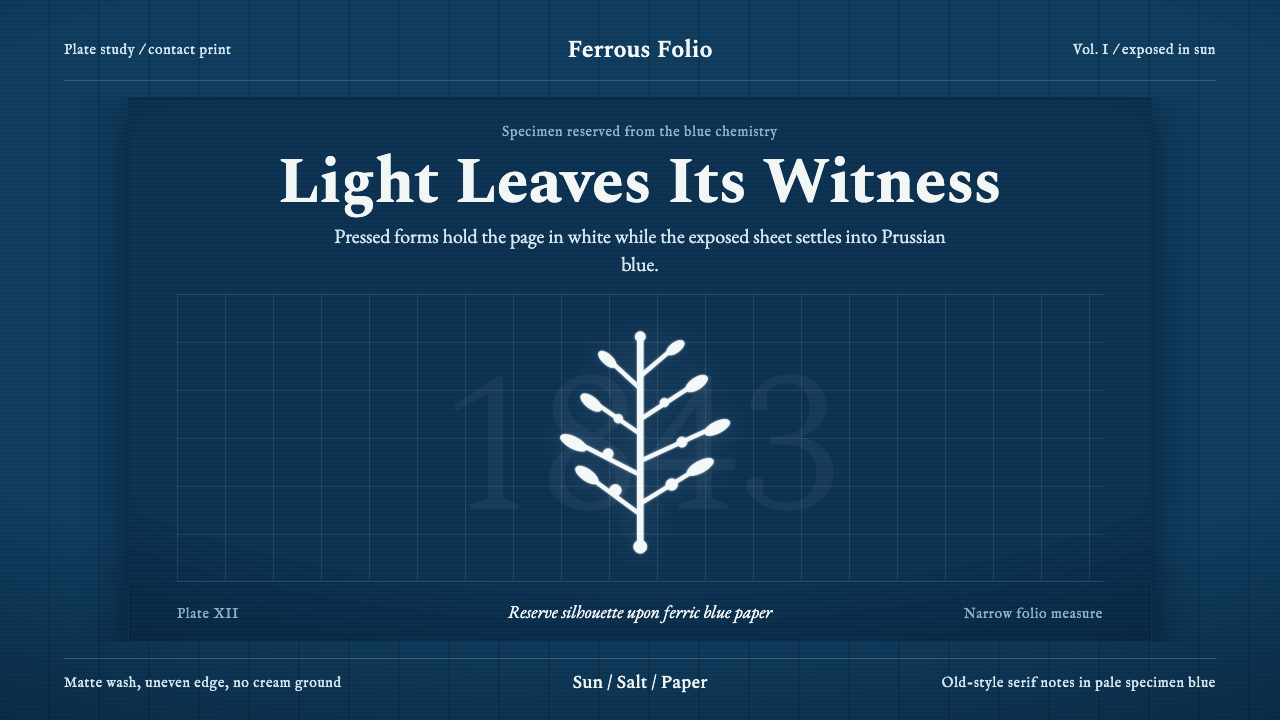 Anna Atkins CyanotypeScience turns spectral. Prussian blue ground, white reserves, Victorian serif…
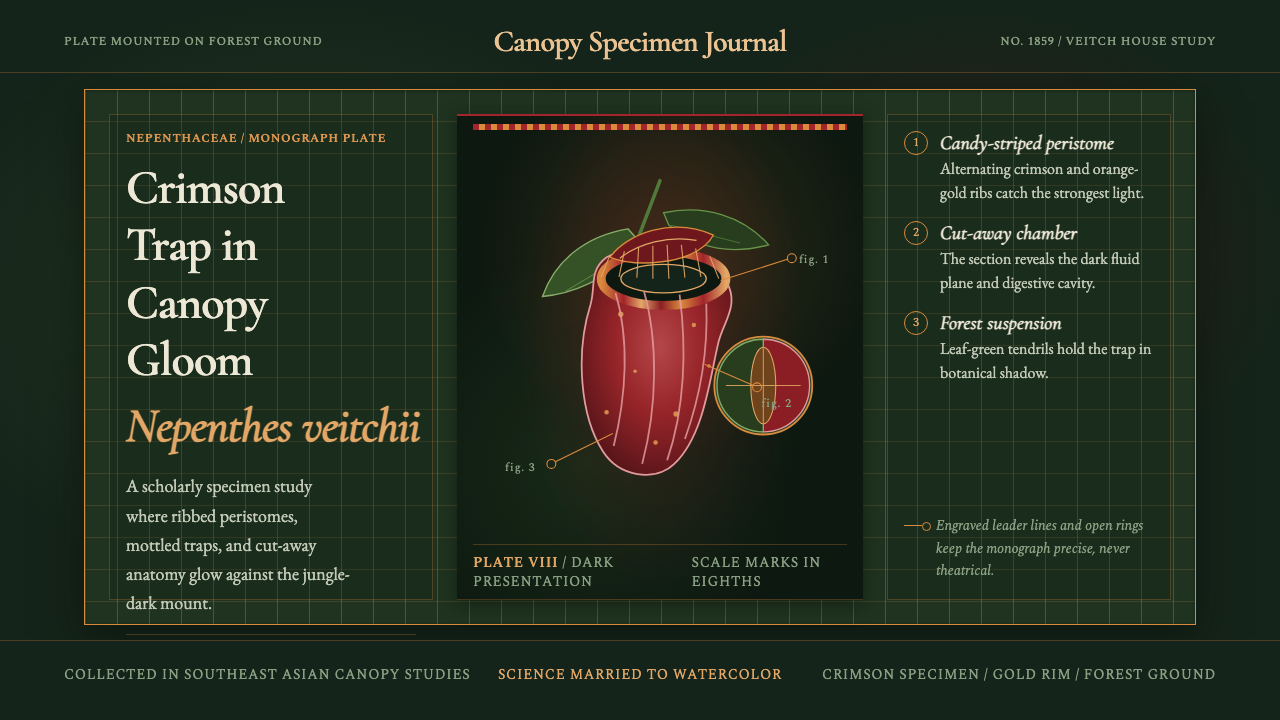 Carnivorous Pitcher PlantBotanical danger glows. Crimson traps and gold rims float on jungle-dark gree…
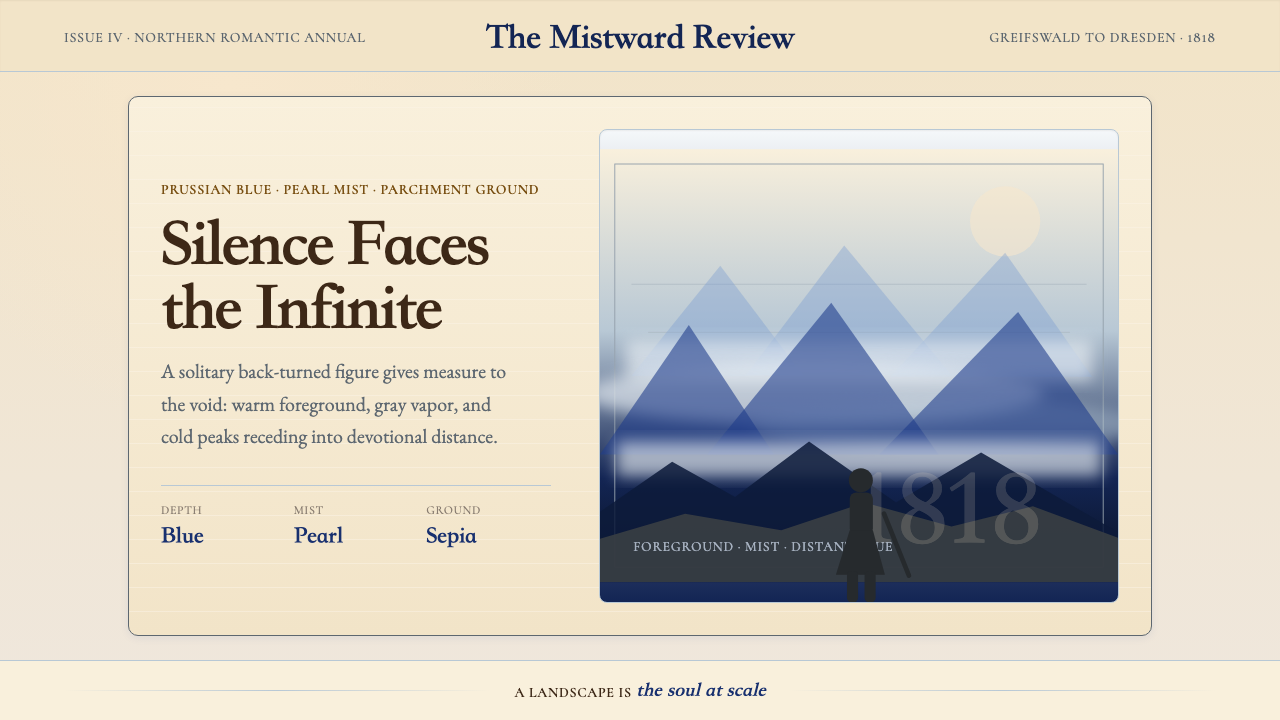 Caspar David FriedrichSilence becomes vast. Prussian blue depth, pearl mist, and parchment framing…
 Charcoal & Conté DrawingAtelier calm, in middle value. Gray-taupe tooth, smoky charcoal, and chalk-wh…
 Claude Monet ImpressionistLight becomes the subject. Buttercream, pastel dapples, and Cormorant serif s…
 Degas Ballet PastelsBackstage glamour is labor. Jade walls, rose footlights, cropped serifs on cr…