What is Degas Ballet Pastels?
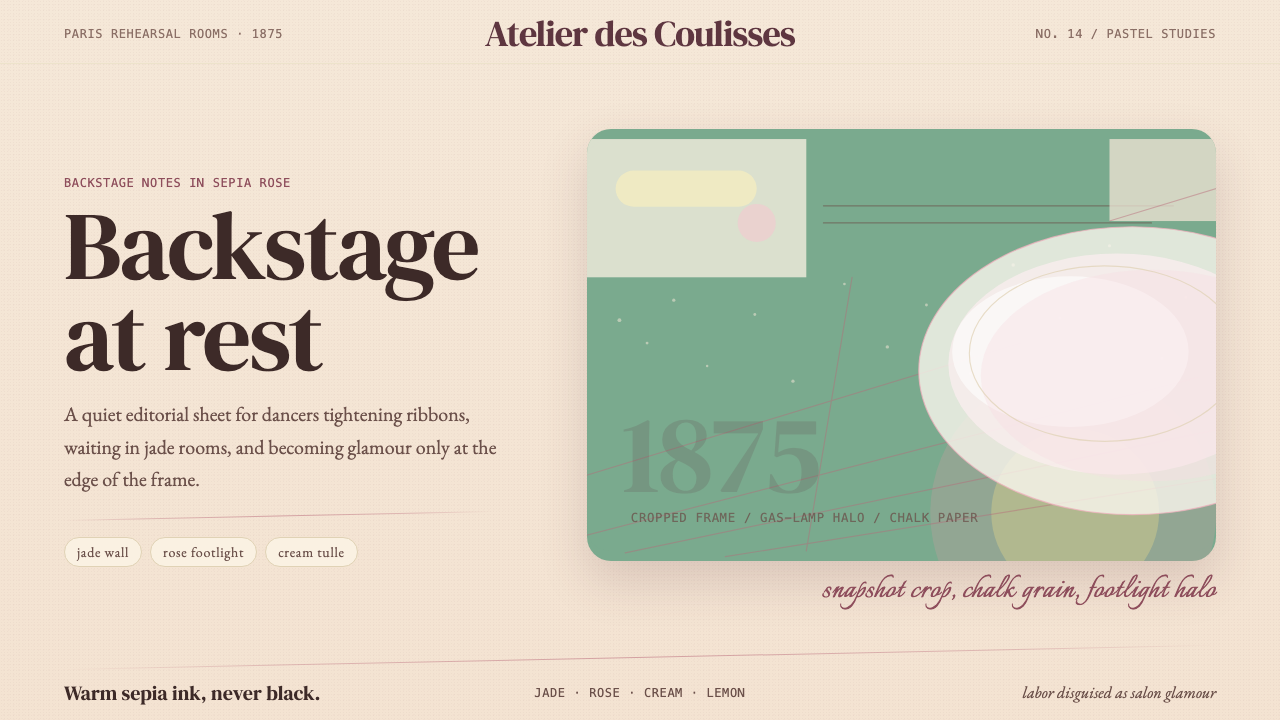
Edgar Degas spent twenty-five years backstage at the Palais Garnier painting what audiences never saw — and in doing so invented an aesthetic of warm cream, jade green, and footlight rose that makes glamour feel like labor and labor feel like beauty.
Degas Ballet Pastels in brief
Degas Ballet Pastels is a design system drawn from the visual world of Edgar Degas's ballet paintings and pastels, produced between roughly 1870 and 1895. Where most historical styles derive from public, monumental art, this one is deliberately backstage: warm cream paper grounds, walls in a muted jade green, highlights in the soft rose of gas-lamp footlights, and body text rendered in a warm sepia-brown rather than stark black. The atmosphere is one of waiting, preparation, and practiced effort — not performance.
The compositional logic is equally distinctive. Degas was a serious collector of Japanese woodblock prints, and from ukiyo-e he borrowed the cropped frame — subjects cut by the picture edge as though caught by an accidental glance, bodies half-entering or half-exiting the composition. This off-balance cropping is not carelessness; it is the system's primary way of generating intimacy and movement. Paired with Belle Époque serif letterforms that carry the weight of a Parisian salon programme, the result is something between a rehearsal-room document and a collector's print.
The texture throughout is pastel-stippled rather than smooth. Where a contemporary digital style might reach for glassy gradients or glossy fills, this system substitutes the granular bloom of chalk on laid paper — soft, slightly uneven, never harsh. Shadows are halos of diffused footlight rather than hard drops. The overall effect is warm, studious, and subtly imperfect: the aesthetic of something beautiful that knows how much effort went into it.

Where does Degas Ballet Pastels come from?
Edgar Degas first entered the rehearsal rooms and stage wings of the Paris Opéra in the late 1860s, granted access through his friendship with the bass singer Lorenzo Pagans and later through Henri Rouart, an industrialist and amateur artist who moved easily in operatic circles. Degas was already a trained classicist who had studied the Renaissance masters in Italy; what the Opéra gave him was not spectacle but structure — the architecture of practiced bodies, the geometry of repeated movement, the way artificial gas-lamp light fell differently from any natural source he had ever painted.
The ballet motif consumed him for the rest of his working life. He produced more than six hundred works depicting dancers — in oils, pastels, bronze sculpture, and monotype — across a span of roughly twenty-five years. The medium of pastel was central: it allowed rapid mark-making that could capture transient poses, and its chalky, powdery surface read in reproduction with a warmth that oil paint rarely achieved. By the 1880s Degas had developed a working method of layering pastel over monotype prints, building up dense, atmospheric grounds that glowed with an almost phosphorescent softness.
Two movements shaped what became, in retrospect, the system's visual DNA. French Impressionism supplied the commitment to observed light and the rejection of academic studio conventions — the sense that a painting should feel like a moment encountered rather than a scene arranged. Japonisme supplied the compositional audacity: Degas owned hundreds of ukiyo-e prints by Hiroshige, Utamaro, and Hokusai, and from them he absorbed the high viewpoint, the asymmetric cut, the willingness to let the frame amputate a figure at an arbitrary point. The resulting combination — Impressionist light values and Japanese compositional freedom — was entirely novel in European painting of the 1870s.
The specific palette that defines this system — cream grounds, jade walls, footlight rose, sepia ink — is drawn directly from the physical environment of the Palais Garnier and from the material conditions of pastel itself. The jade-green of rehearsal-room walls was a standard institutional color of Belle Époque Paris, used because it did not fatigue the eye under gaslight. The warm rose of footlight illumination was a quality of early gas-stage lighting before electric arc lamps replaced it in the 1880s and 1890s. The cream and sepia are the tones of the laid paper Degas preferred and the warm brown ink he used for compositional sketches. Every color in the system has a documentary source — it is an archaeology of a specific place at a specific moment in the history of artificial light.
What defines the Degas Ballet Pastels look?
Color Palette
The palette is built around four closely related warm and cool neutrals — cream, jade, footlight rose, and sepia — rather than the saturated contrast of primary-color systems. Cream serves as the dominant ground, occupying the largest surface areas. Jade green appears as structural color: walls, accents, supporting fields. Footlight rose is used sparingly, reserved for highlights, warm glows, and emotional focal points. Sepia-brown replaces black for text, giving all type a warmth that pure black would destroy. The effect is chromatic intimacy rather than chromatic drama.
Texture and Surface
All surfaces carry a pastel-stipple quality: slightly granular, chalky, and uneven in the way that chalk on laid paper is uneven. This texture is not decorative noise layered over clean shapes — it is the ground itself, present in backgrounds, in color fields, and in the soft halos that define the edges of lighter elements against darker ones. The system never uses glassy, gradient, or gloss-finish surfaces. The visual register is that of a collector's cabinet: beautiful and handled, not pristine and sealed.
Typography
Type in this system is drawn from the Belle Époque serif tradition — letterforms with the structured elegance of late nineteenth-century French printing, including gently bracketed serifs, high contrast between thick and thin strokes, and a slight calligraphic warmth. Headlines carry the weight of a theatre programme or a collectors's edition colophon. Body text is set in the warm sepia-brown of the system ink, never stark black. Caps-set labels and short display lines are treated with generous letter-spacing, recalling the typographic conventions of Belle Époque poster design.
Compositional Cropping
Layouts in this system deliberately avoid centered, closed, symmetrical compositions. The core principle — borrowed directly from Degas's ukiyo-e-influenced framing — is the cropped subject: primary visual elements are positioned so that they appear to extend beyond the frame, or to have arrived mid-gesture. A figure's shoulder, a column header, a chart axis may all be cut by the edge of the card or slide. This off-balance composition generates a sense of caught motion and documentary immediacy, as though the design is a detail from something larger rather than a self-contained artifact.
Light and Shadow
Shadow in this system is not a hard geometric offset but a soft bloom — the diffused glow of light that wraps around a form rather than cutting a clean silhouette behind it. This reflects the actual quality of gas-lamp footlight illumination, which was warmer, softer, and more enveloping than the directed spotlights of later electric theatre. Highlights are warm rather than white, tending toward cream or the palest rose. The overall lighting model is low-contrast and enveloping, emphasizing atmosphere over clarity — the opposite of Bauhaus's hard shadow logic.
Structural Color Use
Despite its warmth, the palette is used with structural discipline. Jade is not scattered as accent but assigned to specific functional zones: navigation backgrounds, sidebar fields, secondary card surfaces. Rose is not used for general decoration but appears only where an element carries emotional or hierarchical priority — a featured statistic, a section title, a call-to-action. Sepia anchors all text at every level. This assignment — ground color, structural color, accent color, ink color — is strict, and departing from it toward more general colorfulness immediately breaks the system's period coherence.
Ornament and Restraint
Unlike Bauhaus, this system does not prohibit all ornament. It permits the ornament that Degas's source world actually contained: fine ruled lines in the manner of nineteenth-century bookbinding, small bracket and swash details drawn from Belle Époque letterpress, and subtle texture patterns derived from the woven structure of ballet costumes and barre floors. What the system refuses is ornament that does not have this documentary anchor — generic decorative borders, arbitrary floral motifs, or contemporary graphic elements imported from unrelated visual traditions. The question is not whether ornament exists but whether it belongs.

Who shaped Degas Ballet Pastels?
Degas (1834–1917) trained as a classicist, copying Ingres and the Italian masters before developing the distinctive snapshot compositions and pastel technique that defined his mature style. He was not an Impressionist in the plein-air sense — he distrusted outdoor light and worked almost entirely from memory and studio observation — but he exhibited with the Impressionist group eight times from 1874 onward. His collection of more than a thousand Japanese woodblock prints directly shaped his compositional approach, and his systematic study of Eadweard Muybridge's motion photographs in the 1880s informed the documentary accuracy of his dancers' poses. The ballet works are the direct source material for every element of this design system.
Marie van Goethem (born 1865) was a petit rat — the lowest rank of the Paris Opéra Ballet's student corps — who posed for Degas over several years in the late 1870s and early 1880s. She is best known as the model for the wax sculpture The Little Dancer of Fourteen Years, exhibited at the Impressionist show of 1881 and now known primarily through bronze casts. Van Goethem represents the human center of the system's aesthetic: not the celebrated principal dancer but the anonymous, working student waiting in the wings — the figure the system's backstage intimacy is built around.
Mary Cassatt (1844–1926) was an American painter who worked in Paris within the Impressionist circle and shared with Degas both a passion for Japanese prints and an interest in domestic and interior subjects as legitimate painterly territory. Degas championed her work and the two maintained a long artistic friendship. Cassatt's own palette — warm cream grounds, soft rose, intimate interior light — runs closely parallel to the Degas ballet pastels and provides a secondary reference point for the system's color temperature and compositional intimacy. Her work demonstrates that the aesthetic is not unique to the ballet subject but is a coherent approach to interior warmth and observed light.
Henri Rouart (1833–1912) was an engineer, industrialist, and amateur painter who served as Degas's closest personal friend for over forty years and as his primary conduit into the social world of the Paris Opéra. Rouart's collection of Degas's works — assembled over decades of friendship — became one of the most important private holdings of Impressionist art in Paris. His role in the system's genealogy is less artistic than social: without Rouart's introductions and hospitality, Degas might never have gained the sustained backstage access that made the ballet pastels possible. He is a reminder that great aesthetic systems often depend on friendships and social networks as much as on formal artistic influences.
The Japonisme movement — the widespread European fascination with Japanese visual art following the opening of trade with Japan in the 1850s and 1860s — supplied the compositional vocabulary that most sharply distinguishes the Degas ballet aesthetic from its Impressionist contemporaries. The high viewpoint, the cropped frame, the willingness to interrupt a figure at the picture edge, the asymmetric placement of subject against ground: all of these were conventions of ukiyo-e woodblock print design that Degas, Cassatt, Whistler, and others absorbed and adapted. In terms of this design system, Japonisme is the source of the cropping principle — the single most unusual compositional feature — and the authority behind its apparent informality.
How do you use Degas Ballet Pastels today?
Degas Ballet Pastels is suited to contexts that need warmth, cultural depth, and a sense of practiced craft — not to contexts demanding sharp rational authority. Applied correctly, it transforms a designed artifact into something that feels curated and inhabited rather than manufactured and neutral. The style works best when the product it represents has a relationship with history, skill, or human effort: arts organizations, editorial publications, premium consumer goods, cultural institutions, and digital products in the adjacent spaces.
For presentation slides, the system offers a strong solution for both cover and content pages that need to feel distinguished without being loud. A cover slide works best with an off-center composition: the primary heading placed in a cream field with jade sidebar or footer element, and a subtle pastel-texture ground giving the surface its characteristic warmth. Content slides should avoid dense information packing — the aesthetic demands breathing room and generous white space. Data slides can carry simple charts and figures, but color coding should remain within the system palette: jade for primary data series, rose for highlight values, sepia for axis labels. Pie charts and donut charts work particularly well, as their circular form resonates with the choreographic imagery underlying the style.
For web interfaces, this system is well-suited to editorial dashboards, arts-organization portals, premium brand websites, and any interface where the user experience is meant to feel like browsing a carefully curated collection rather than operating a tool. The approach: a cream or very warm off-white background throughout, jade for navigation and sidebar surfaces, sepia for all body and label text, rose reserved for primary calls to action and notification states. Card components should have soft, glowing edges rather than hard drop shadows. Pricing pages benefit from the system's inherent tier-differentiation logic: jade backgrounds for standard tiers, rose accents for featured or premium tiers, cream for supporting information.
For editorial and marketing contexts, Degas Ballet Pastels supports a style of long-form storytelling that feels considered and unhurried. Article layouts work well with generous margins that carry pull-quotes in a slightly larger serif, section breaks marked by a fine horizontal rule in jade rather than a decorative ornament, and opening paragraphs set in a slightly elevated size to ease the reader in. Marketing pages are not well-served by the fast-scroll, high-contrast approach of contemporary conversion design — the style is better applied to above-the-fold feature sections and brand story sequences where depth and warmth matter more than immediacy. Social cards and event announcements in this style work well with an asymmetrically placed subject, a pale cream ground, and a single line of sepia type carrying the key information.
The most common mistake when applying this system is pushing the palette toward conventional prettiness — adding more pink, softening the jade toward mint, making the cream brighter and cooler. Each of these moves destroys the period specificity that gives the palette its authority. The jade must stay in the muted, institutional register of Belle Époque interiors, not drift toward contemporary sage or seafoam. The rose must retain its warm, slightly amber character — it is footlight glow, not blush or candy. The cream must be genuinely warm, reading closer to aged paper than to fresh white. A second common mistake is symmetric centering: centering the headline, centering the image, centering the supporting text. This produces a layout that is merely soft and pretty rather than Degas-inflected — the cropping logic and off-balance placement are what give the system its distinctive vitality and must be preserved.

Degas Ballet Pastels — FAQ
How does this style differ from general vintage or Art Nouveau aesthetics?
Vintage and Art Nouveau aesthetics share some surface similarities — warm colors, period typography, decorative texture — but they are compositionally and philosophically quite different from the Degas ballet system. Art Nouveau relies heavily on organic, flowing line work, botanical motifs, and symmetrical decorative programs. Vintage aesthetics tend toward saturated nostalgia and deliberate imperfection as surface treatment. The Degas system, by contrast, is built on documentary observation: its colors are historically specific, its cropping is derived from photographic and ukiyo-e logic, and its warmth comes from material accuracy rather than stylistic softening. The test is whether the design looks like it is performing a period — if so, it has drifted toward general vintage. Authentically applied, it should feel like an archival object that happens to be contemporary.
Can this style work for data-heavy or technical products?
It can, but with discipline. The system's warmth and atmospheric quality can make a data-heavy interface feel less overwhelming and more considered — useful in analytics tools, research platforms, or editorial dashboards where users spend extended time with complex information. The constraint is that the pastel-texture aesthetic and the cropping logic must not be allowed to compromise information legibility. In practice this means: keep the sepia-on-cream text contrast well above comfortable reading thresholds, use jade and rose only for categorical or hierarchical differentiation in charts (not as continuous data scales), and resist the temptation to give every chart element a pastel-softened treatment that reduces contrast. The style works for analytical depth but not for rapid-scan dashboards where every millisecond of comprehension matters.
Does the cropping principle apply to images only, or to layout elements as well?
It applies to both, and the most effective use of the system extends the cropping logic beyond photography into structural layout elements. A jade background panel that bleeds off one edge of a slide, a serif heading whose ascenders are partially clipped by the card boundary, a circular chart motif positioned so that roughly a quarter of it falls outside the visible area — all of these extend the Degas framing logic into the layout layer without requiring any figurative imagery at all. The principle is that the frame of the design should feel arbitrary rather than definitive: as if the composition extends beyond what is shown. This is very different from the self-contained, fully-resolved compositions that most design systems aim for, and it is the feature that most clearly marks the style's distinctiveness.
How does this system handle dark mode or dark-background layouts?
The system is fundamentally a light-ground system and a dark inversion is not recommended as a direct equivalent. The cream-and-jade palette depends on light reflectance to produce its warmth — on a dark background, the same hues flatten and lose their period character. A sympathetic dark variant, if required, should not simply invert the palette but instead reference the actual darkness of a Degas painting's shadows: a very deep, warm brown-black as background, jade as a mid-value structural tone, and rose and cream used sparingly as foreground accents only. Type should shift to a warm near-white rather than pure white. This approach preserves the atmospheric warmth of the source material on a dark ground without producing a generic dark-mode result.
Is the pastel texture appropriate for professional or corporate contexts?
The texture is appropriate in any professional context where the product's brand values include warmth, craftsmanship, cultural depth, or distinguished heritage — and inappropriate where the dominant values are precision, speed, technical authority, or corporate neutrality. A gallery, a fine-dining brand, a literary publisher, a premium financial advisory, or a performing-arts organization can all carry the pastel texture comfortably because the texture reinforces their values. A SaaS analytics platform, a logistics dashboard, or a legal compliance tool would find the texture at odds with what users expect and what the product needs to communicate. The texture is not more or less professional than any other design decision — it is specifically suited to some brand positionings and unsuited to others.
Related design styles
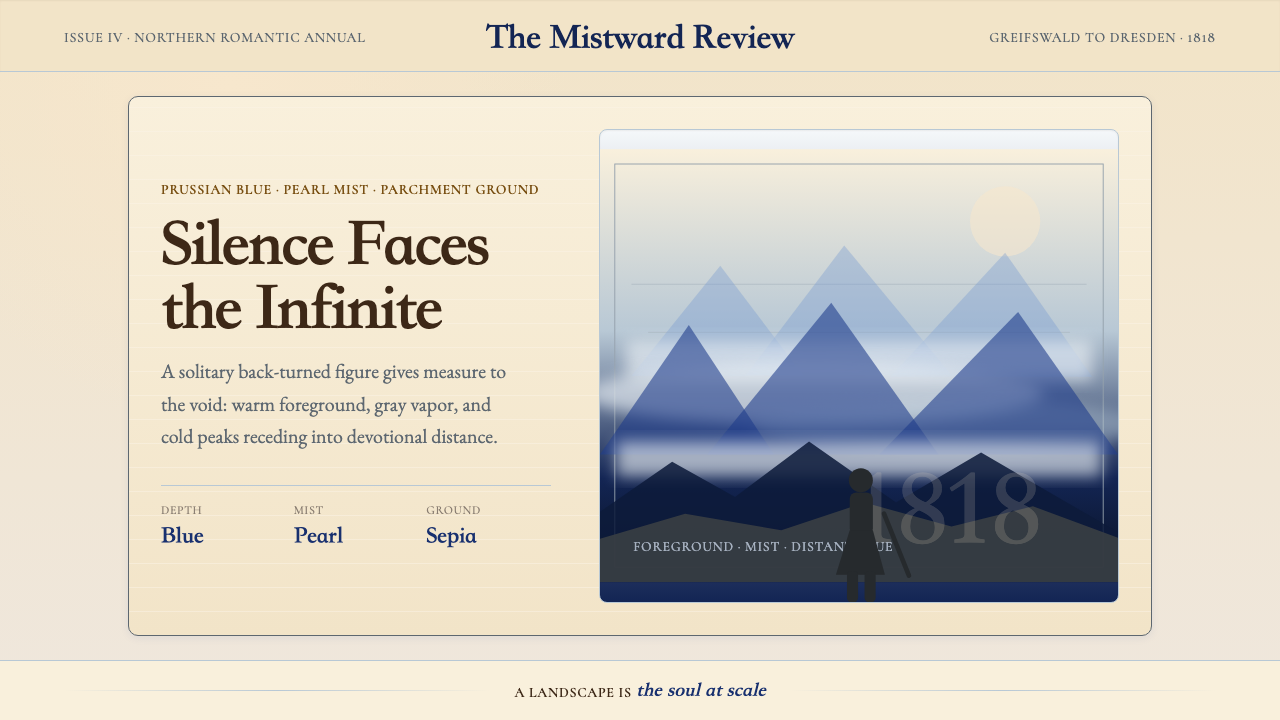 Caspar David FriedrichSilence becomes vast. Prussian blue depth, pearl mist, and parchment framing…
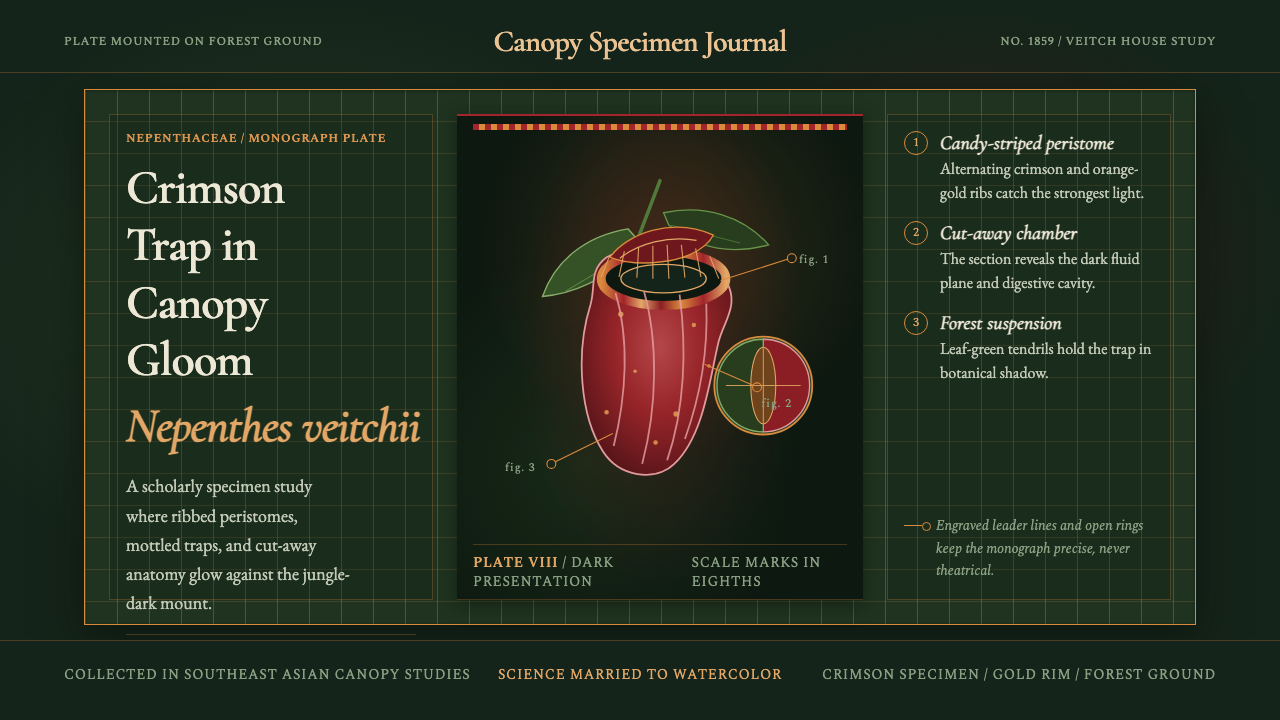 Carnivorous Pitcher PlantBotanical danger glows. Crimson traps and gold rims float on jungle-dark gree…
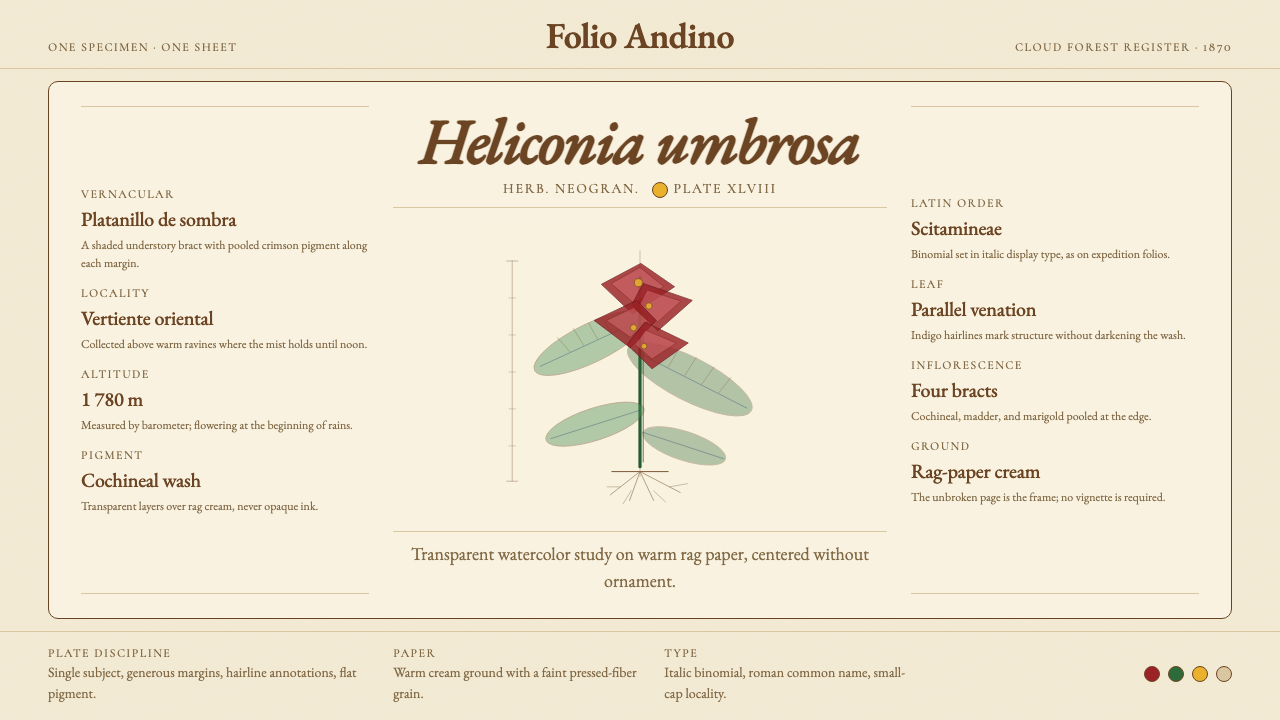 Colombian Botanical (Triana)Observation becomes ornament. Crimson watercolor specimen breathes on cream r…
 Millais — Ophelia / Wildflower Pre-RaphBotany, rendered with conviction. Cream gesso, emerald, and vermilion stay in…
 Hiroshige — Tokaido RoadA road print in motion. Prussian blue blocks, vermilion cartouches, diagonal…
 Tamil Grantha InscriptionSacred stone, quietly lit. Pale Grantha glyphs float on dark granite in a nar…